Menu
By Grace Carr, IWT Marine Advocacy Officer
First published online: 12 December 2025
2025’s Article 17 report results are as clear as day. Nature is declining in Ireland. The State needs to properly fund and support nature restoration.
Every 6 years countries in the EU have to report on the state of their protected habitats and species under the Habitats Directive. Ireland’s latest report, “The Status of EU Protected Habitats and Species in Ireland 2025” was released yesterday and the results paint a worrying picture for Irish nature.
Protected Habitats
The Article 17 report does not cover every species and habitat in Ireland, rather it focuses on the habitats and species listed for protection under the European Union Habitats Directive. Under the directive every member state is obliged to assess the status of these listed habitats and species and report their findings to the European Commission.
It’s more than disappointing to see the results of the 2025 Article 17 report on the status of Ireland’s protected habitats. Many habitats have declined since the last report in 2019. The report found that 90% of habitats are in unfavourable status, with half showing ongoing declines. This has increased from 85% in the last report. 51% of habitats show ongoing deteriorating trends.
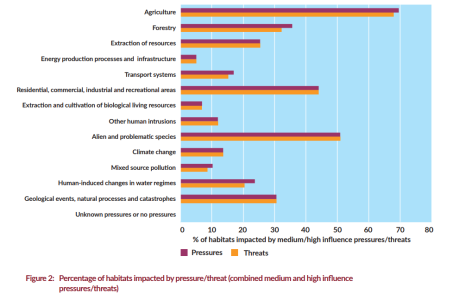
The most frequent pressure recorded in habitats relates to agriculture pressures. 69% of habitats are impacted by agricultural practices, the most common being ‘intensive grazing or overgrazing by livestock’ followed by ‘drainage for use as agricultural land’. Alien and problematic species are recorded as the second most frequent pressure at 51%.
This report will help inform the measures needed in Ireland’s National Restoration Plan to restore 30% of degraded habitats by 2030. Clearly it should also highlight to the Government the drastic need for dedicated funding for nature restoration. Minister for nature, heritage and biodiversity, Christopher O’Sullivan said “We must also redouble our commitment to nature: continuing investment, strengthening collaboration and improving delivery as we strive to stop the loss of biodiversity and move towards a future where it is protected and restored.”
These words are welcome but they will ring false unless the Government follows through on its responsibilities and finally commits to creating a Nature Restoration Fund that can be used to support landowners to take urgent action to reverse these pressures on our habitats. Farmers, communities, NGOs and experts have all been asking for dedicated funding for the National Restoration Plan since before the Nature Restoration Regulation came into force in 2024.
Protected Species
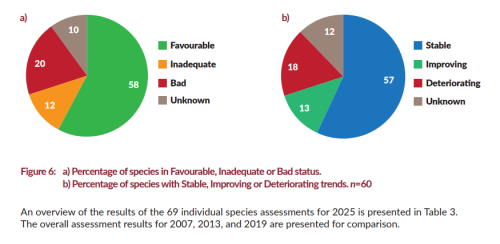
On a slightly more positive note, the report showed that 58% of the protected plant and animal species assessed (excluding birds which are assessed in a separate report not yet released) were in favorable status. However, with ongoing declines in habitats, is it just a matter of time before this number goes down too? It’s worth noting that many endangered and critically endangered fish species are not included in these reports as they are not listed in the Habitats Directive. So while some of these results are promising, it doesn’t give a full picture on the true state of species in Ireland.
Conclusion
Reports come and go as do governments but what is clear is the need for a system change in how we care for nature in Ireland. There are many challenges to effective nature restoration, however people on the ground from farmers to community groups, to NGOs and individuals want to do their bit to save nature. We need to support these groups across Ireland through a state led response, and a Nature Restoration Fund is an essential step.
Appendix 1: Comparisons between the status and trends of habitats from the 2019 and the 2025 reports.