Urgent: European Parliament vote tomorrow (25/11) on EU law which could open up vital nature protection law and allow for the killing and destruction of protected species and habitats.
First published online: 24 November 2026
MEPs are currently in Strasbourg to vote on the Regulation for Speeding up Environmental Assessments. This is an extremely problematic file which contains articles within it that would allow for the disturbance and killing of protected species (Article 8) and a non exhaustive list of ‘strategic’ sectors that would be fast tracked through the permitting system and allowed to cause increased harm to protected species and habitats (Article 14).
A new amendment (no.103) was tabled yesterday by the European Conservatives and Reformers (ECR) group to reopen the Birds and Habitats Directives (the EU’s primary legislation for protecting nature). This goes against the very basis of democracy as the European Commission’s own ‘stress test’ on the Birds and Habitats Directives is currently underway and no decision has been made on whether to reopen it. ECR, with support from the European People’s Party (EPP) are trying to undermine this entire process and push through their own agenda to open these laws and weaken the environmental protections within them.
Ireland has four Fine Gael MEPs that are part of the EPP group. We are calling for the public to send an email to all Irish MEPs asking them to defend Europe’s nature and not side with those trying to remove its legal protection. MEPs must not give in to this pressure. They must reject Amendment 103, refuse any further weakening of the agreed compromises and ultimately reject the Commission’s flawed proposal altogether. They must listen to the 1.25 million citizens who have called on them to protect, not weaken, our EU nature laws. Elected representatives must put the public interest ahead of political deals and defend the laws that safeguard Europe’s nature, health and people.
Here is an email tool you can use to speed up the process of contacting Irish MEPs.
‘We were in Brussels last week to lobby Irish MEPs ahead of this critical vote which will determine whether or not it will be legal to kill and destroy protected wildlife and habitats.
While many Irish MEPs stated that they would vote against the most harmful aspects of this law, it is clear that in the EU, many of those in high power positions, do not see ‘competitiveness’ being compatible with nature protection. They believe that we must reduce the few protections we currently have if we want to fast track infrastructure and industry. The Commission’s own 2024 Environmental Impact Assessment Implementation study, which was based on surveys from Member States, found that ‘the lack of expertise, staff, and/or resources were the most common reasons for delays’ not environmental impact assessments or current environmental protections.
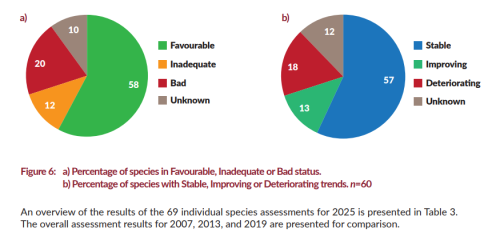
90% of protected habitats in Ireland are not in good condition and this is a trend across the EU. Competitiveness will not matter when devastating floods and fires are increasing, the soil will no longer grow food and every river and water body is polluted.’ – Grace Carr, Marine Advocacy Officer, Irish Wildlife Trust
The law was due to be voted on today, the 24th of November but has been postponed until tomorrow by request from the European People’s Party (EPP). This raises serious concerns that further attempts will be made to renegotiate and weaken an already problematic compromise, including its insufficient safeguards for protected species under Article 8.
By keeping its support for Amendment 103 on the table, the EPP is using political manoeuvring to roll back decades of nature protection, including reopening the EU’s cornerstone Birds and Habitats Directives before the Commission has even completed its assessment.
Media Contact: Grace Carr, Marine Advocacy Officer, grace@iwt.ie
Reflections from the UN Biodiversity Conference in Yerevan, Armenia
by: Oisín Ó Néill, IWT Nature Advocacy Officer
First Published 05th November 2026
The view flying into Dublin Airport Ireland – one of a treeless patchwork landscape of green fields, channelised rivers, and expanses of drained bogland – is a snapshot view of the huge task facing the Irish nation in the coming years when it comes to nature restoration. Ireland has suffered enormously from biodiversity loss and the Irish public have become accustomed to degraded landscapes: our ecosystems today are shadows of what once existed.
Biodiversity loss (or simply the extinction and disappearance of plants, animals and other living species) was on the agenda for two weeks at COP 17 in Yerevan Armenia where governments, scientists, Indigenous leaders and environmental organisations gathered to discuss what must be done to halt it.
There were moments of genuine inspiration, important conversations and examples of progress from around the world. However, there was also real frustration with the negotiations and the difficulties in translating global commitments into real action.
State of the Globe
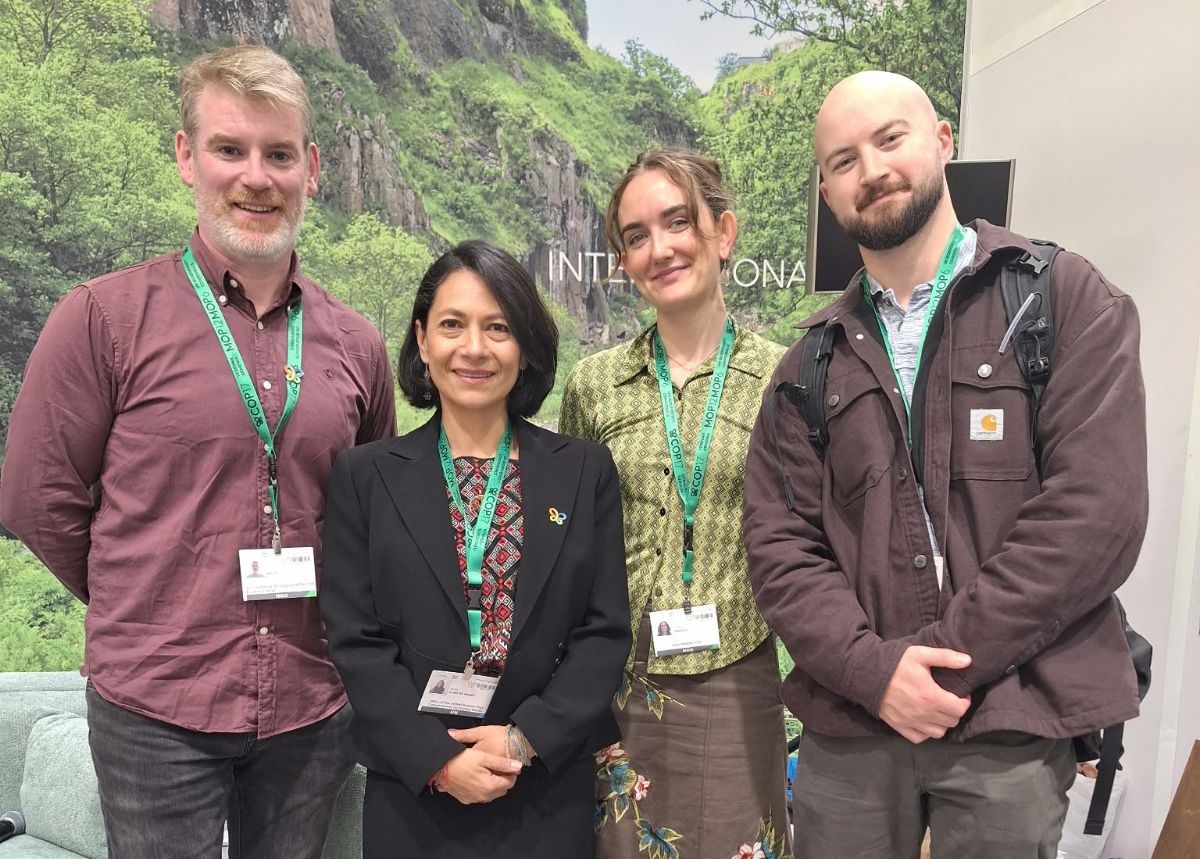
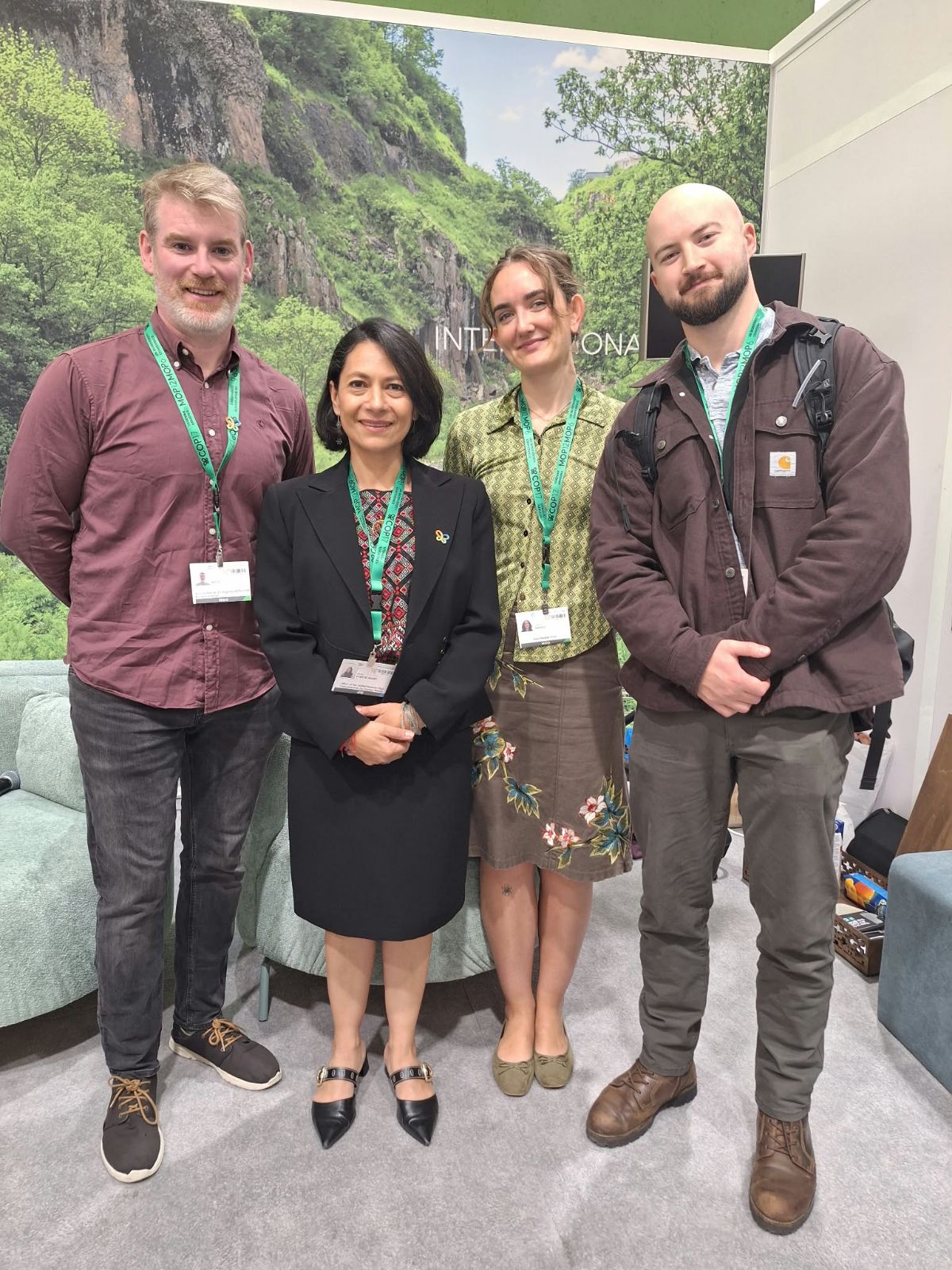
Oisín with Helena Wrenne of Streamscapes, Astrid Puentes Riaño United Nations Special Rapporteur on the human right to a healthy environment and Fintan Kelly of Irish Environmental Network
COP17 marked the halfway point between the adoption of the Kunming-Montreal Global Biodiversity Framework (GBF) and its 2030 targets. While some progress has been made on halting biodiversity loss, the world is not on track to meet the 2030 targets of halting and reversing biodiversity loss and protecting 30% of the world’s land and seas. Geopolitical tensions and competing national interests continued to influence negotiations showcasing the weakness of the UN consensus-based system – where the objections of individual countries can prevent meaningful progress. Russia backed up by Argentina, and Saudi Arabia were successful in watering down language on environmental ambition in the final agreement, while wealthier governments were divided on who would contribute more financial resources.
The question of biodiversity finance remains unresolved, with wealthier nations having fallen significantly short of their commitments to provide funding to support biodiversity protection in developing countries. Negotiations failed to deliver meaningful progress on closing the biodiversity finance gap. The Cali Fund, intended to generate funding for biodiversity conservation and Indigenous communities from commercial entities and private-sector industries who profit from the commercial use of genetic resources, remains largely empty, with decisions on how to mobilise further resources deferred to COP18 in Ecuador in 2028. Investigative reporting also highlighted attempts by pharmaceutical industry representatives to weaken the terms of the Cali Fund.
Despite commitments to reform environmentally harmful incentives, negotiations resulted in weakened language on implementation. The final text merely encouraged accelerated implementation of the relevant GBF target, while governments continue to spend an estimated $1.8 trillion annually on environmentally harmful subsidies including fossil fuel and agricultural subsidies.
Unlike COP16, where negotiations ran so far over time that talks had to resume months later in Rome, COP17 concluded with all major negotiation texts agreed. However, an earlier conclusion is not necessarily a sign of success or meaningful progress. Despite recognising the scale of the biodiversity crisis and the need to accelerate implementation, countries largely failed to translate these acknowledgements into concrete commitments on finance, harmful subsidies and the wider reforms needed to address biodiversity loss.
Positives
There were positives with over 50 countries showing how they have protected more than 30% of their ecosystems. Panama is one such example, having surpassed the target years ago. It also recognised the Rights of Nature through legislation in 2022. Environment Minister, Juan Carlos Navarro, called for a universal UN declaration on the Rights of Nature, these calls were echoed by Ecuadorian environmentalist Natalia Greene, who spoke about ‘eco-apartheid’ and the importance of recognising the Rights of Nature.
Throughout the conference, Indigenous representatives spoke powerfully about their relationship with the natural world, their role in protecting biodiversity and the increasing pressures they face. A positive development from the negotiations was progress towards establishing a permanent body within the Convention on Biological Diversity to provide Indigenous peoples with a dedicated advisory channel in decision-making processes, recognising their vital role in protecting biodiversity.
Countries ultimately adopted the Yerevan Pathway, intended to accelerate implementation of the Global Biodiversity Framework over the next four years. There were also new biodiversity funding announcements totalling nearly US$2 billion, alongside progress on the establishment of a permanent subsidiary body to strengthen the participation of Indigenous peoples and local communities in biodiversity decision-making.
These are developments but with just four years remaining to achieve the 2030 Global Biodiversity Framework targets, the outcomes of COP17 fall short of the urgency required. The global biodiversity finance gap remains substantial, and efforts to address environmentally harmful subsidies and transform the economic systems driving biodiversity loss remain inadequate.
We have another set of commitments, pathways and funding announcements. The question is whether the governments will deliver them.
Ireland’s missed opportunity
As an Irish delegate attending COP17, I was particularly conscious of how Ireland was represented on the international stage.
Ireland currently holds the Presidency of the Council of the European Union. It was therefore disappointing that Ireland did not have a national pavilion at COP17, as other countries did. There’s an Irish Pavilion planned for COP31 (The Climate COP) so its absence at the Biodiversity COP felt like a missed opportunity to showcase Ireland’s unique island biodiversity and our special relationship with natural heritage in front of a global audience. It could also have provided an opportunity to highlight the work of Irish environmental organisations, which had a strong presence at COP17, contributing to discussions and building relationships with international partners. The highlight being the Fair Seas panel discussion on marine protection, which took place in the Ocean Pavilion.
At the Nature Ministers’ press conference, Minister of State for Nature, Heritage and Biodiversity, Christopher O Sullivan, said that this COP cannot simply become another exercise in producing words. He also spoke about the need to retain commitments to remove environmentally harmful subsidies. It was encouraging to hear this from him. However, the real test of his political leadership is what happens at home.
Ireland is experiencing increasingly visible signs of ecological decline. From the pollution of Lough Neagh and recurring fish kills to wildfires, declining bird populations and the disappearance of wildlife from our increasingly silent fields, the evidence is all around us. Ireland continues to provide substantial support for activities and practices that place pressure on nature, particularly within the agricultural sector. We cannot call for the removal of harmful subsidies internationally while failing to confront the incentives and policies contributing to biodiversity loss at home.
The Irish Government has repeatedly spoken about the need for a Nature Restoration Fund. It must now demonstrate that commitment through adequate funding and delivery. Recent budgetary decisions have not provided the level of ambition required. The Irish Government must show real political leadership in halting biodiversity loss and fund its commitments. Let’s hope that by COP 2028 in Ecuador, we will be in a position to proudly showcase our nature restoration efforts.
Side Events: Forests, Invasive Species and Island Nations
Beyond the main negotiations, COP17 provided an opportunity to attend events and meet people working on nature conservation around the world. Among many interesting events was the launch of a new European Forum for Primary and Old-Growth Forests.
I heard familiar discussions about the need to protect existing woodlands, expand forest cover and recognition of the need to reform the mandates of state forestry agencies (something that is particularly relevant to the future direction of Coillte in Ireland). Disappointingly, Ireland has no primary or old-growth forests, even when applying the broader criteria established by the forum. We have no forests on our island where natural ecological processes remain undisturbed to the extent associated with primary forests.
However, we should be trying to change this. We need to move beyond measuring the success of forestry through the number of trees planted or hectares covered. The ecological integrity of our woodlands matters. A rethinking of our relationship with forestry is long overdue. We need to prioritise natural regeneration, rewilding and the protection of existing habitats. We need to recognise the role of natural processes, including predation, in maintaining healthy woodland ecosystems. Healthy forests are essential infrastructure, not simply timber resources.
I also had a fascinating conversation with Dheeraj Jayant, Executive Director of Biflores, based in Brava, Cabo Verde. We discussed the parallels between Ireland and Cabo Verde, when it comes to invasive alien species. Biflores takes a holistic approach to invasive species management, working with local communities to replace invasive species with agroforestry systems and examining the wider social and ecological causes of their spread. Their approach recognises that invasive species management can also create opportunities for community involvement and alternative livelihoods. We also discussed the role of global trade in biodiversity loss and ecological degradation. Ireland knows this problem well. Many of the invasive plants threatening our native habitats were introduced through the horticultural trade in exotic plants.
This conversation raised some interesting questions about how we approach invasive species in Ireland. Can we change public perceptions of invasive species management? Can the removal of invasive plants be connected with positive community and economic outcomes? There are many lessons we can learn from other island communities facing similar challenges to those we face in Ireland.
The final days of COP17 were dominated by familiar calls for greater resources, stronger implementation and more ambitious commitments. Every diluted commitment has consequences for the natural world. While governments negotiate over language and funding mechanisms, species continue to disappear and ecosystems continue to deteriorate.
The Global Biodiversity Framework was agreed four years ago. We now have just four years left to meet its 2030 targets. For Ireland, this means putting nature at the centre of government decision-making. It means adequately funding nature restoration, reforming environmentally harmful subsidies, protecting our remaining habitats and ensuring that public bodies lead by example. Nature conservation cannot be treated as a separate policy issue, but must underpin decisions on agriculture, forestry, planning, infrastructure and economic development.
Hope through action
“If the forest breathes, we all breathe.” – spoken by Maimuna Jawara, an Indigenous leader from the Manding Tribe in The Gambia, captures the essence of our relationship with nature which is that nature protection is not separate from our own wellbeing, but essential to it.
Despite the frustrations of COP17, I returned from Armenia with a tentative sense of hope. That hope came from the people and grassroots movements I met and the examples of progress from countries demonstrating what genuine political and community leadership can achieve. The Indigenous leaders at COP17 reminded me of the importance of becoming ambassadors for the natural world. We need more of that spirit here in Ireland. We need to become nature ambassadors in our own communities, standing up for our rivers, woodlands, bogs, coastlines and wildlife.
We cannot allow the shortcomings of international negotiations to undermine our determination to protect nature. If anything, they reinforce the importance of strong civil society movements and public pressure. The Irish Government must match its international commitments with meaningful action at home. But while governments continue to falter, we must not lose hope.
During my time in Armenia, I saw a painting by Ara Bekaryan in the National Gallery. In the mid-1950s, Bekaryan had moved away from his earlier propagandist works, instead focusing on paintings that celebrated the inseparable bond between humanity and nature. This shift formed part of the wider political and cultural ‘thaw’ taking place in the USSR during the 1960s.
Looking at his work, I think we need a similar thaw today: a shift in how we view our relationship with the natural world, away from one based on exploitation and control, towards one rooted in respect and coexistence.
This shift and this hope for change can be built through action. On 14 November The Irish Wildlife Trust alongside many colleagues and friends will be marching in Dublin for the climate rally, to demand the political leadership that nature urgently needs. Join us on the day and follow the Irish Wildlife Trust, subscribe to our updates and get involved in the work to protect and restore nature.
We cannot afford to be passive in the face of biodiversity loss. We can build hope through action.
Sinking ambition – new report from EU auditors shows Ireland’s failure to protect the marine environment
by Grace Carr, IWT Marine Advocacy Officer
First published online: 29 October 2026
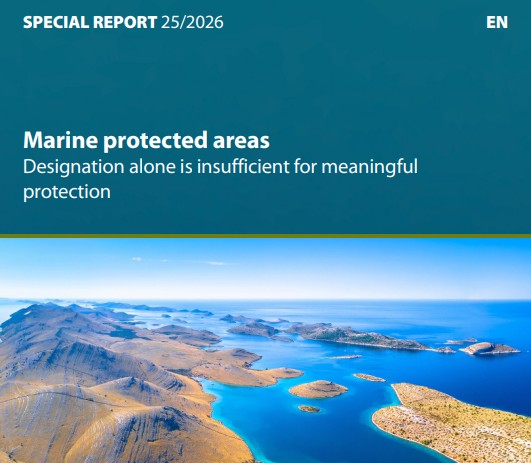
On Monday the 26th of November the European Court of Auditors (ECA) released a report that conducted an in depth analysis on how Marine Protected Areas are managed in the EU. The report looked closely at Ireland, Sweden and France and included analysis of progress in implementing EU legislation (Natura sites) and national MPAs and whether these areas are being effectively managed and protected (1). The Irish Wildlife Trust, Fair Seas and Birdwatch Ireland all gave evidence into this report in Summer 2025.
The EU biodiversity strategy for 2030 stipulates that all protected areas should be subject to effective management, define clear conservation objectives and measures, and monitor them appropriately. Unfortunately, we are not on track to meet the EU biodiversity targets for 2030.
The report found that most protected areas do not apply adaptive management practices which ‘prioritises continuous learning by integrating feedback from past performance into future strategic planning’. Member States are not taking into account the main pressures facing protected areas and adapting their management to learn from past mistakes. This makes sense in an Irish context since the number of protected habitats (on land and sea) in Ireland not in good condition increased from 85% in 2019 to 90% in 2025 (2). We are going backwards when it comes to protecting nature. The report highlighted that ‘the conservation outcomes of a marine protected area are significantly higher in well-managed, strictly protected environments than in lightly protected areas with weak or no management, where they are generally considered negligible.’
They selected 15 MPAs in each Member State to analyse. In Ireland, managing authorities could not provide information for 10 out of the 15 Irish sites. We believe that this highlights the lack of knowledge, management and ambition that is in place for Irish marine Natura sites. One part of the analysis involved a questionnaire given to managing authorities. The questionnaire covers key aspects of protected area management, including planning, implementation, monitoring, enforcement and stakeholder engagement. Questions included were, ‘are appropriate regulations/controls in place to manage land/sea use and activities (such as fishing, mining, tourism)? Is there a management plan or equivalent and is it being implemented? Are management activities regularly monitored, evaluated and adapted?’ This type of information should be readily available if the legal requirements of the Birds and Habitats Directives were being met. The report confirmed that there was not a single management plan for all 15 Irish sites they analysed.
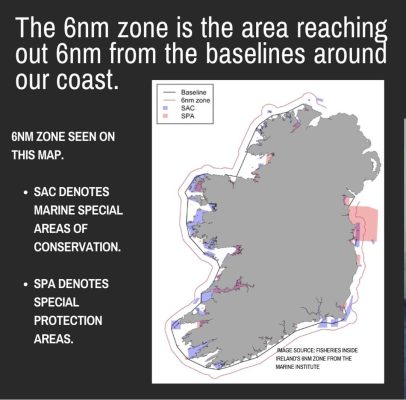
The report highlighted the public consultation in Ireland on the 6nm trawling ban as an example of stakeholder engagement. While we were happy for the opportunity to submit to this consultation to give our views, the Government needs to do more to ensure truly effective early and ongoing stakeholder engagement. In regards to managing protected areas around Ireland, currently there is no system in place for the in depth engagement that is needed and no plan for how to ensure the engagement continues into the future to contribute to adaptive management and to ensure the best results for nature and people.
References: 1 Marine Protected Areas: Designation alone is insufficient for meaningful protection
“In the elusive grace of the wolf, we find a reflection of our primordial fears. Few creatures lead our minds along such untrodden paths, showing us that there are multiple truths, multiple realities.” — The Wolf Within
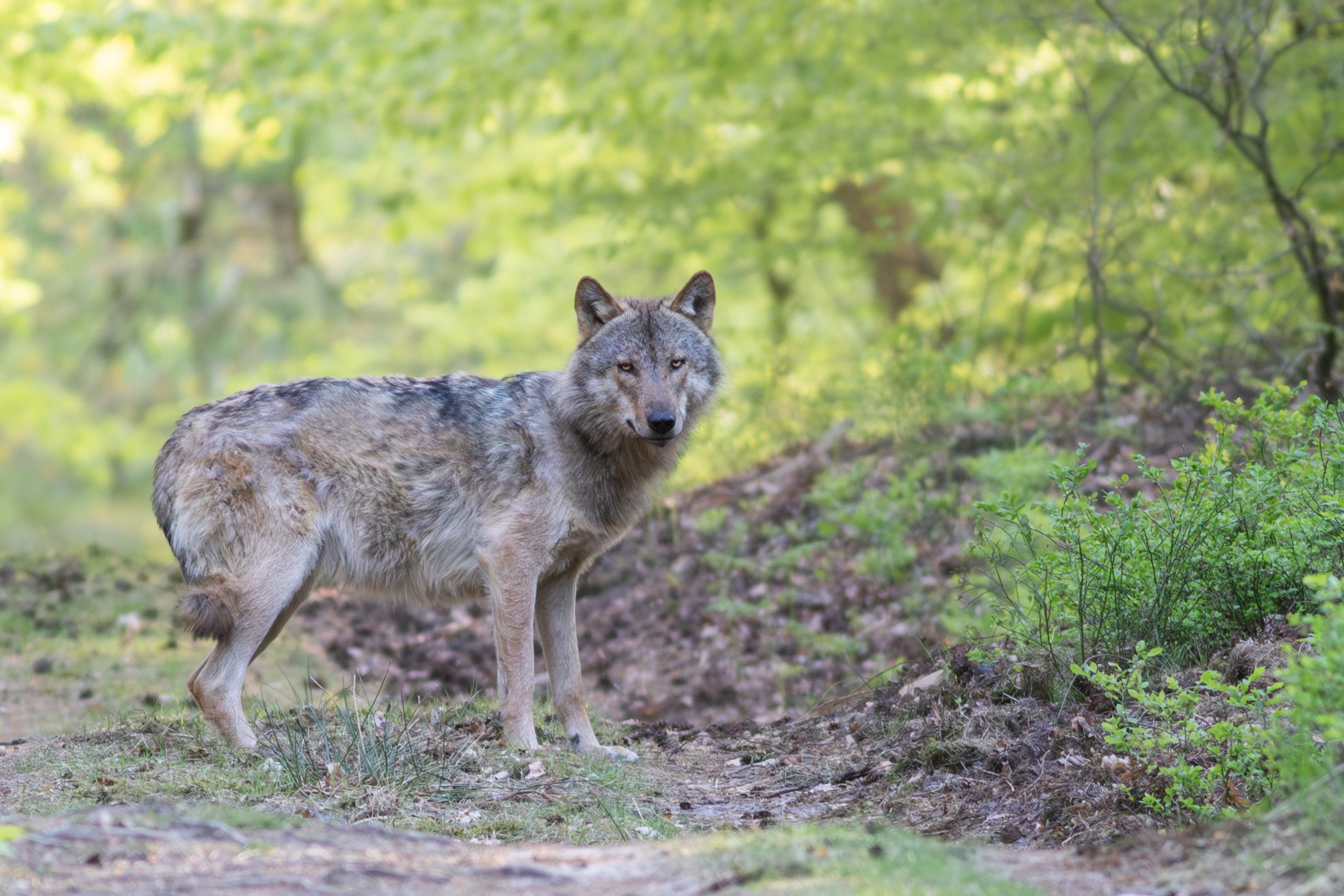
Wolf in Netherlands. Photo: Jefta Leeuwis.
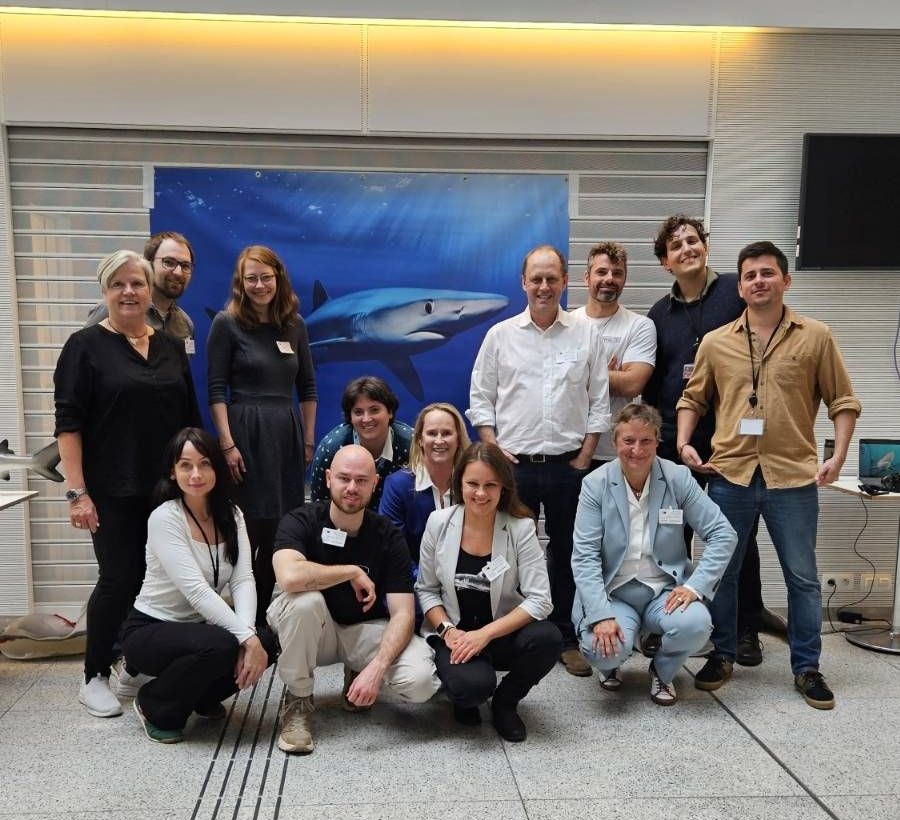
Last week I joined European colleagues in Strasbourg for the Council of Europe’s study session on Empowering Youth Participation through the Bern Convention on the Conservation of European Wildlife and Natural Habitats.Among many species discussed unsurprisingly one species dominated the discussions: the Eurasian Wolf (Canis lupus lupus). In 2024, in a politically and seemingly personally motivated campaign, the European Union voted to downgrade the Wolf’s protection under the Bern Convention. This led to a vote in the European Parliament last year, which resulted in the Wolf’s strictly protected status being downgraded at EU level, opening the door to the culling and hunting of this iconic species. This decision opened up a new and dangerous precedent for species protection in Europe. The Eurasian Brown Bear, the Lynx and the Cormorant are among the species now in the crosshairs, facing growing political pressure to weaken their protection.
This decision opened up a new and dangerous precedent for species protection in Europe. The Eurasian Brown Bear, the Lynx and the Cormorant are among the species now in the crosshairs, facing growing political pressure to weaken their protection.
The Convention on the Conservation of European Wildlife and Natural Habitats (the Bern Convention) was established in 1979 to protect European wildlife and habitats and promote cooperation between its contracting parties. The Bern Convention is an international treaty adopted under the Council of Europe. The Council of Europe is distinct from the European Union, therefore countries such as Azerbaijan, Armenia, and the United Kingdom are contracting parties to the Bern Convention. The European Union is itself a contracting party to the Bern Convention and the Bern Convention is primarily implemented and enforced in Ireland through EU law, mainly the Birds and Habitats Directives.
The Eurasian Wolf has been persecuted for centuries. The last Irish Wolf was shot in Carlow in 1786. The English Colonial Administration at the time had placed bounties on Wolves in their efforts to bring “wolf and woodkerne” to heel. Across Europe the Wolf suffered heavy persecution and struggled to escape the undeserved negative reputation attached to it. Its appearance as the villain in folk tales such as Little Red Riding Hood and The Three Little Pigs helped sear this negative image into the European psyche for generations.
In reality, the Wolf is a keystone species trying to survive in a human-dominated world, carrying out a vitally important role as an apex predator in its ecosystem. Without apex predators, ecosystems fall out of balance, herbivore numbers proliferate placing greater pressure on the herbaceous layer and stunting forest regeneration, while increases in mesopredators such as Crows, Foxes and Martens place greater pressure on ground-nesting birds. The web of life is interconnected, and once one piece is removed, the effects ripple through the rest, creating a domino effect across the ecosystem.
Wolf attacks on humans in Europe are extremely rare, with no conclusive fatal attacks recorded in Europe in the last 40 years. Wolves have co-existed with humans successfully in the past, and are now re-colonising parts of Europe, including very densely populated countries such as the Netherlands. However, conflict between Wolves and farmers does occur as humans often struggle to share landscapes with animals that do not fit our ideal of nature. In areas of Italy where Wolves are common, shepherds and livestock-guarding dogs are used to protect sheep, yet persecution remains a problem.
Since 2022 the Wolf has been subjected to a relentless political campaign to downgrade its protection status. This campaign stemmed from an unfortunate incident in Germany, when a Wolf killed a pony belonging to European Commission President Ursula von der Leyen. The incident triggered a major political push by von der Leyen and the European Commission to reconsider and ultimately weaken the legal protection afforded to Wolves across the European Union.
Following the decision under the Bern Convention, on 8 May 2025 the European Parliament approved the European Commission’s proposal to weaken the Wolf’s strict protection under the EU Habitats Directive (with 371 votes for, 162 against, and 37 abstentions). Irish MEPs from Fianna Fáil, Fine Gael, and Independent Ireland including Nina Carberry (FG) Regina Doherty (FG) Seán Kelly (FG) Maria Walsh (FG) Barry Andrews (FF) Barry Cowen (FF) Billy Kelleher (FF) Cynthia Ní Mhurchú (FF) Ciaran Mulooly (II) aligned themselves with the European Commission’s proposal to downgrade the species from strictly protected to protected. Irish politicians voted against the Wolf, delivering a decision that has weakened one of Europe’s most important legal protections for wildlife.
Irish politicians voted against the Wolf, delivering a decision that has weakened one of Europe’s most important legal protections for wildlife.
Europeans have a moral obligation to hand down stable, biodiverse, and ecologically viable ecosystems to future generations. This decision dealt a blow to that future and won’t easily be undone. Europeans are facing the inescapable reality of the biodiversity crisis. Nature is under immense pressure from efforts to weaken environmental protections, intense lobbying from environmentally damaging industries, and growing political conflict over the direction of the nature restoration movement. Collectively, we suffer from shifting baseline syndrome, as over time each generation accepts more diminished wildlife, and that degraded state becomes accepted as the norm. Downgrading protections normalises a lower standard of biodiversity, shrinking the ecological imagination and ambition of future generations, and running counter to the nature restoration movement.
Collectively, we suffer from shifting baseline syndrome, as over time each generation accepts more diminished wildlife, and that degraded state becomes accepted as the norm.
In Ireland, shifting baselines have contributed to a situation where Wolves do not even make it onto the nature restoration agenda. This is a mistake. Protection of Wolves should be the bare minimum, the return of Wolf populations across Europe, including to Ireland and the UK should be the aim. We must reverse the trend of shifting baselines and learn to imagine what genuinely restored ecosystems could look like. The extermination of the Wolf in 1786 marked the loss of Ireland’s last native apex predator and, with it, an important component of Irish ecosystems.
An ambitious approach to the Bern Convention and the Nature Restoration Law should therefore ask not only how we prevent species from disappearing, but how we restore the functioning ecosystems from which those species have been removed. We must not only rewild Europe; we must rewild our ambitions. We must imagine, and ultimately work towards, a Europe where wildlife, ecosystems, and the species that shape them can once again thrive.
The downgrading of the Wolf has created a dangerous precedent and attempts to weaken protections won’t stop at the Wolf. Calls are already mounting for further species to be downgraded, with the Eurasian Brown Bear (Ursus arctos arctos) and the Eurasian Lynx (Lynx lynx) being targeted. Again, Ireland will have a role to play. Despite having no Bears and most Irish people having never seen a Bear, Irish politicians will have vote on whether Bears deserve protection. When that time comes it’s important that we stand with our European nature allies in defending the protection of species across the continent. Sooner or later, downgrading decisions will affect species closer to home. There are already growing calls to downgrade the protection of the Cormorant (Phalacrocorax carbo). When we accept the weakening of protection for one species for political reasons, we normalise and create a precedent for a process in which legal protection becomes increasingly vulnerable to political pressure.
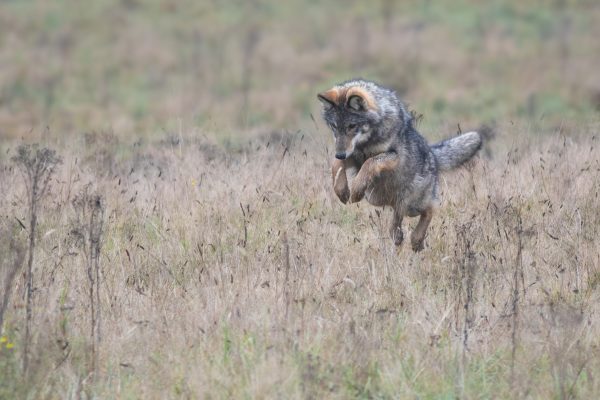
Wolves in Netherlands by Jefta Leeuwis
In an increasingly multipolar world, where international cooperation is under growing pressure, study sessions such as the one I attended in Strasbourg are vitally important. They bring together conservationists, campaigners, nature advocates, and communicators from across Europe to share experiences, build relationships, and think collectively about the challenges facing nature. At a time when protections are coming under increasing pressure, we need spaces where people can collaborate and plan how we can respond collectively. Pan-European cooperation on species protection needs to be built in advance, through relationships, shared knowledge and a sense of common responsibility for European nature.
Ireland should be an advocate for the protection of Wolves, Bears, and other species across our European community. Nature has no borders. Neither should our efforts to protect it. Across Europe, we must stand together to defend wildlife, restore our ecosystems, and move towards a future in which wild nature thrives.
IWT Statement on media misrepresentation of incident involving Blue Shark fishing
First published online: 13 August 2026
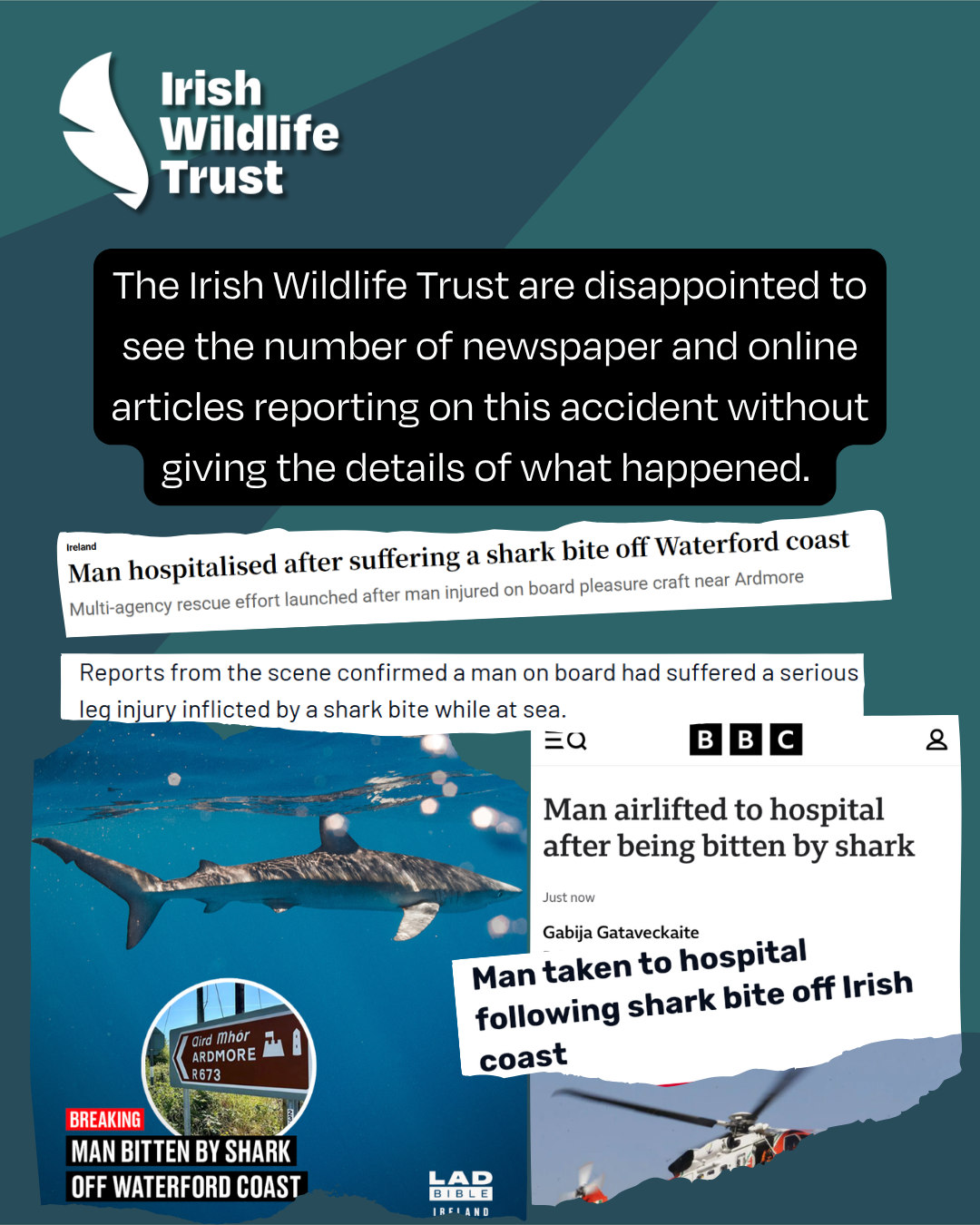
The IWT is disappointed to see the number of newspaper articles reporting on this accident without giving the details of what happened or any information about Ireland’s sensitive shark species.
Some of the headlines and articles on 12 August 2026 following the incident
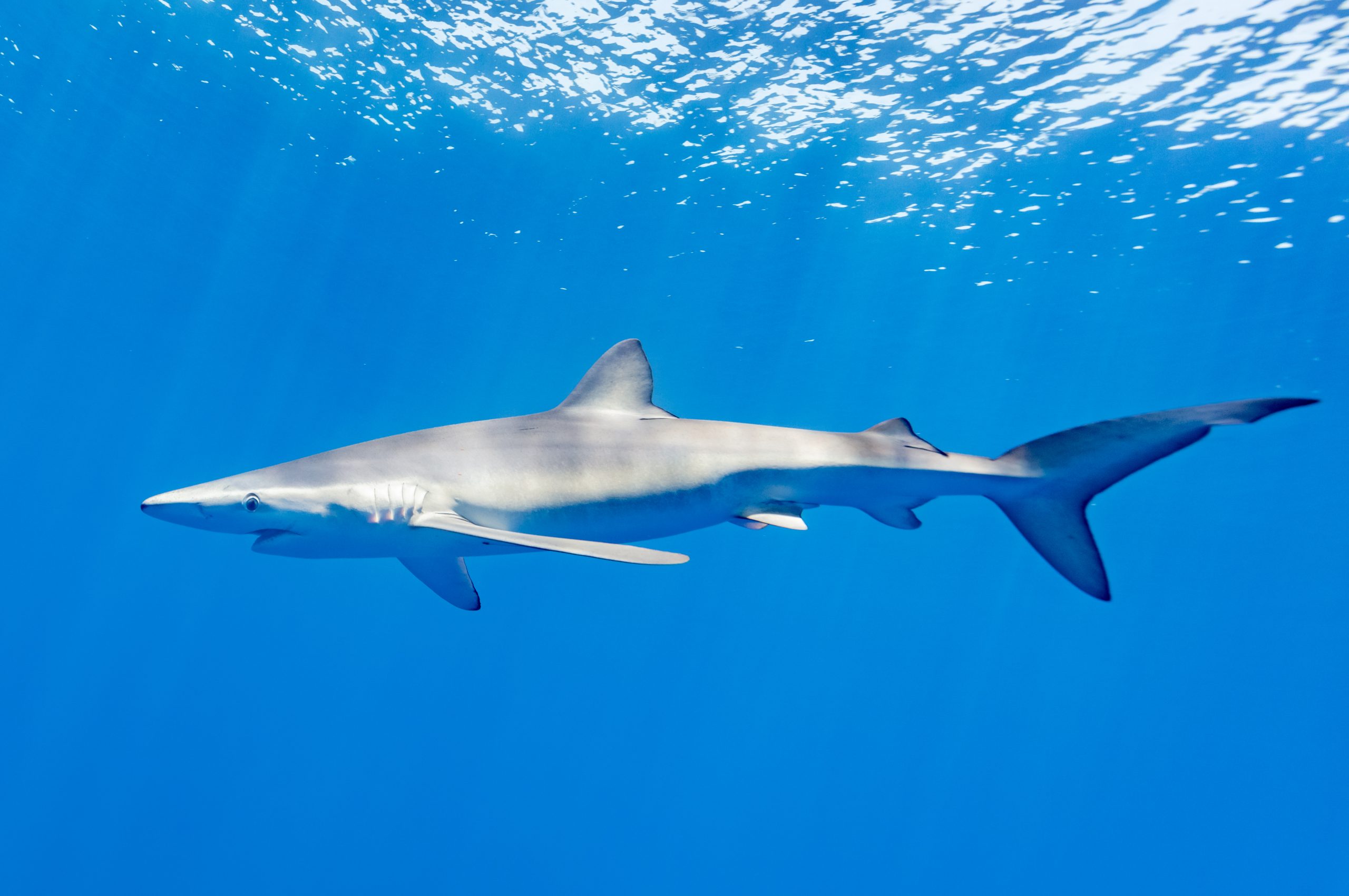
The boat involved had several anglers on board who were shark fishing for recreation. A 1.4m Blue shark was caught and brought on board. As the man was taking the hook out of the shark’s mouth, the shark bit his leg. Shark bites are a rare and unusual occurrence, but a perfectly natural response from an animal that has been captured and is in a stressful situation. We are very glad that the emergency services reacted quickly and the man is recovering well in hospital.
Unfortunately, many articles have sensationalised this incident. The writing has failed to accurately describe what happened and gives the impression that someone was attacked by a shark unprovoked. Sharks are wild animals and like any wild animal, the utmost care must be taken if you are planning to have any interactions with them. People should undergo the appropriate training and have the experience and knowledge needed if they plan to interact with any wild animal.
Globally sharks have gained a bad reputation for being ‘man eaters’ due to the media not accurately reporting on situations and writing for dramatic effect. This has resulted in the deliberate culling of sharks across the globe. Sharks are a vital part of many marine ecosystems but unfortunately pelagic shark populations around the world have declined by over 70% since 1970. Blue sharks are a migratory fish and they are common in Irish offshore waters. Although they are common, their populations have drastically declined due to being one of the species most frequently caught as bycatch by commercial fisheries. Bycatch is a term used when a species is caught accidentally by fishing boats targeting another species and blue sharks are regularly caught by boats targeting species of tuna. The global decline in shark numbers is due to many factors, including animals being caught as bycatch as well as being targeted for the fin and meat trade. Europe is one of the largest exporters of shark fins to the Asian market and there is currently ongoing campaigns such as stop finning EU to ban the import, export and transit of fins throughout the EU. Unfortunately many people don’t realise or care how devastating the decline of shark populations is for the entire health of the marine environment as for many people, sharks are just seen as ‘man eaters’. It is the responsibility of journalists to ensure that they report accurately on any incidents involving wildlife to prevent the negative consequences that could arise from this.
Cherry Laurel Assessed as High Risk Invasive: The Science is Clear. Ireland Must Now Ban Its Sale.
by Oisín Ó Néill, IWT Nature Advocacy Officer
First published online: 12 August 2026
A newly published risk assessment of Cherry Laurel (Prunus laurocerasus) has confirmed what ecologists, conservationists, and community groups on the ground have been warning about for years: Cherry Laurel is extremely invasive and is extremely damaging to Irish ecosystems. The assessment has conclusively found that this widely sold hedging plant poses an overall High risk to Ireland’s biodiversity, with High confidence.
In response, the Irish Wildlife Trust (IWT) and the Gaelic Woodland Project are calling on the Government to commit to a clear, published timeline for a nationwide ban on the sale of Cherry Laurel.
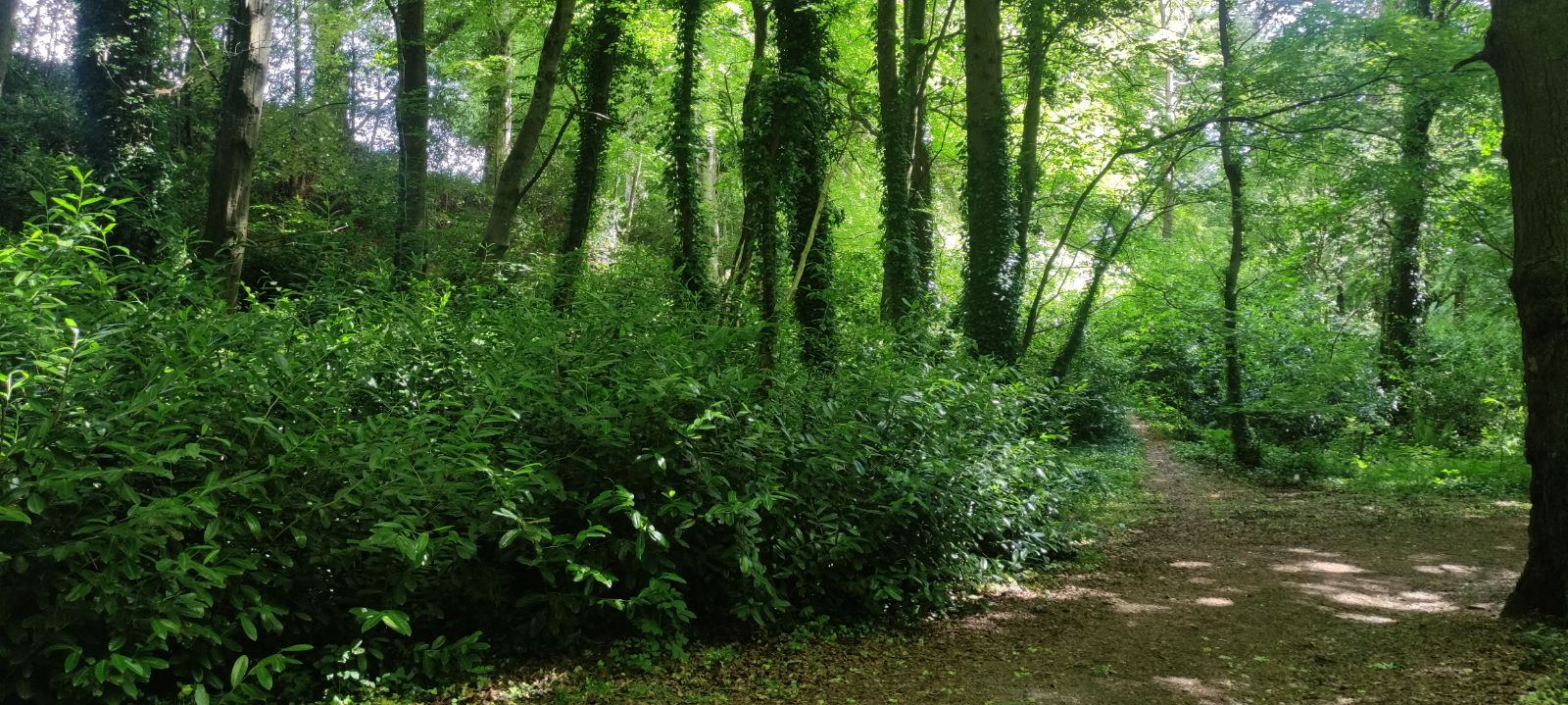
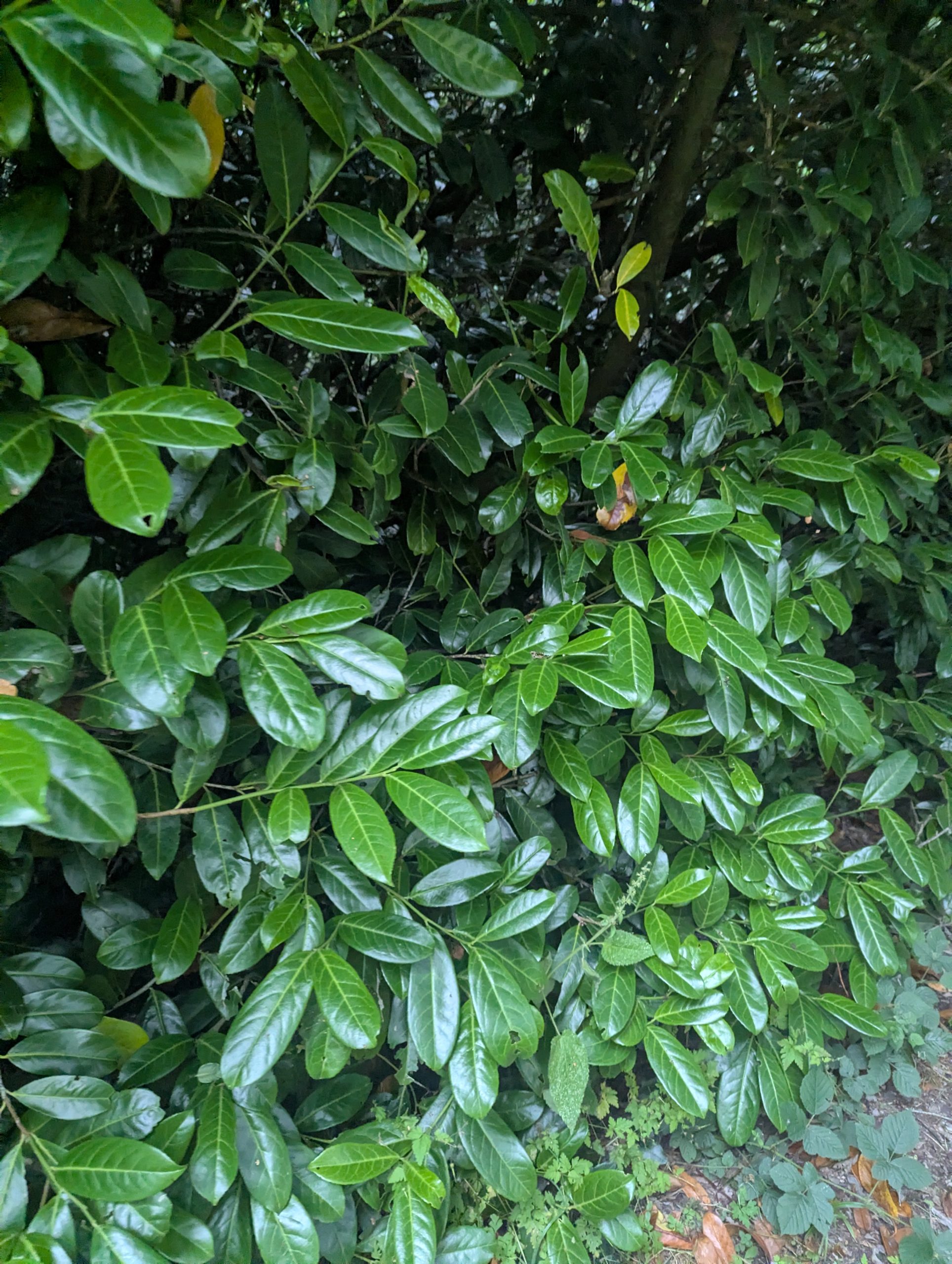
Cherry Laurel spreading in broadleaf woodland
Cherry Laurel is extremely invasive and causes serious harm to Ireland’s native woodlands, it fundamentally alters the conditions needed for a healthy ecosystem. Its dense evergreen canopy blocks light from reaching the forest floor, preventing native trees and woodland plants from regenerating. Over time, it can transform diverse woodland ecosystems into monoculture stands dominated by a single invasive species. Significant effort and public money has already been spent tackling and attempting to remove Cherry Laurel infestations from areas of high value nature including Glen of the Downs, Hazelwood and the Coole-Garryland Special Areas of Conservation.
About the assessment
The assessment was produced by the National Biodiversity Data Centre at the request of the National Parks and Wildlife Service (NPWS), and is now open for stakeholder and public consultation via invasives.ie.
It follows years of campaigning, political pressure, and evidence-gathering by small environmental organisations, ecologists, community groups, and volunteers who refused to let the issue be ignored. Ireland’s Citizens’ Assembly on Biodiversity Loss specifically named Cherry Laurel when it recommended that the State “act immediately to put a timeline on the phasing out of, and eventual ban of, the sale of invasive species.”
The Independent Advisory Committee on Nature Restoration has separately recommended that Cherry Laurel be added to Ireland’s List of Invasive Species of National Concern, and that Ireland seek its inclusion on the EU List of Invasive Alien Species.
What the risk assessment found
The findings are unequivocal. Every pathway by which Cherry Laurel spreads in Ireland — including nursery sales, contaminated soil, garden escape, and intentional planting for hedging — is rated likely to very likely.
Once established, Cherry Laurel spreads rapidly and can form dense stands that prevent native woodland regeneration and reduce the ability of ecosystems to recover naturally.
The assessment found:
Overall risk: High. Confidence: High.
Spread: Recorded in 63% of Ireland’s 10km grid squares, up from just 4% before 1970.
Impact: Rated major with high confidence. Cherry Laurel is a documented driver of biodiversity loss, damaging EU-protected Annex I habitats, impacting multiple Special Areas of Conservation, and threatening species including the Killarney Fern.
Control costs: Can exceed €10,000 per hectare over time — comparable to Rhododendron ponticum, one of Ireland’s most damaging and costly invasive species.
International precedent: Switzerland has already banned its sale for cultivation, while Belgium and Slovenia have placed it on watch and early-warning lists.
Existing measures are not working
Ireland already has phytosanitary regulations, green waste guidance, and prohibitions on planting non-native species in the wild. However, the assessment shows these measures have not been sufficient to prevent the spread of Cherry Laurel.
The continued and accelerating spread of this species demonstrates the limits of existing control attempts. Once invasive species become widely established, eradication becomes increasingly difficult and expensive. Prevention and early intervention are far more effective — yet currently Ireland is continuing to allow the commercial sale of a plant that has now been assessed as posing a High risk to biodiversity.
“Over six years facilitating volunteer removal efforts, we have met hundreds of people giving their weekends to tackling local Cherry Laurel infestations. This report from the NBDC confirms the national situation is actually worse than we thought. This has been an under-appreciated ecological crisis and a serious threat to our native woodlands. We hope the Minister will heed the warning of this report and honour the efforts of communities by prohibiting the sale of Cherry Laurel. Government action here would demonstrate a unified commitment to protecting our natural heritage.”
— Eoghan Connaughton, Ecologist and Founder, Gaelic Woodland Project
Gaelic Woodland Project at work removing invasive Cherry Laurel from woodland
Weighing the economic cost against the ecological one
The assessment recognises the economic dimension of Cherry Laurel. The species supports a cut foliage industry worth an estimated €7 million annually, with around 100 hectares under cultivation and close to 400 registered nurseries selling it for hedging.
However, that economic value must be weighed against the ecological cost. Ireland ranks among the bottom 10% of countries globally for Biodiversity Intactness, invasive species are among the greatest pressures on native biodiversity, and Ireland is legally obliged to restore degraded ecosystems under the EU Nature Restoration Regulation. These challenges exist within the wider context of a global biodiversity crisis, where the continued loss and degradation of ecosystems demands urgent action.
The protection of native habitats and species must come before short-term economic interests. Protecting our ecosystems and native species must take precedence over short-term economic gain. Every year, month, and week of delayed regulation allows Cherry Laurel to become more deeply entrenched, intensifies the damage to native habitats, and increases the cost of control. The Government must now commit to a full ban on the sale of Cherry Laurel.
Protecting our ecosystems and native species must take precedence over short-term economic gain. Every year, month, and week of delayed regulation allows Cherry Laurel to become more deeply entrenched, intensifies the damage to native habitats, and increases the cost of control. The Government must now commit to a full ban on the sale of Cherry Laurel.
A mandate that already exists
The call for action is not new. The Citizens’ Assembly on Biodiversity Loss has already recommended immediate State action on this issue. The Independent Advisory Committee on Nature Restoration recommended formal national listing and an EU-level proposal.
The risk assessment provides clear evidence that Cherry Laurel is a highly invasive species causing serious ecological damage and placing immense pressure on ecosystems across Ireland. In the midst of a biodiversity crisis, anything short of a full ban on the sale of Cherry Laurel would be irresponsible governance.
This risk assessment is also a testament to the persistence of the ecologists, community groups, and volunteers who continued to raise the alarm despite repeated delays. The science has now confirmed what many working on the ground have witnessed for years.
The evidence is overwhelming. The government must act on it.
Ask:
The Irish Wildlife Trust and the Gaelic Woodland Project are calling on the Government to:
Commit to a clear, published timeline for phasing out and banning the sale of Cherry Laurel nationally.
Formally list Cherry Laurel as a Species of National Concern.
Submit a proposal to the European Commission to add Cherry Laurel to the EU Alien Invasive Species List.
Have your say
The public and stakeholder comment period on the risk assessment is open now via invasives.ie.
Members of the public, environmental organisations, and industry stakeholders are encouraged to review the assessment and submit their views.
Press Release: Irish Wildlife Trust and Gaelic Woodland Project Call for Nationwide Cherry Laurel Sales Ban
12 August 2026
New Government-commissioned risk assessment finds invasive Cherry Laurel poses a High risk to Ireland’s biodiversity, with High confidence.
A newly published risk assessment of Cherry Laurel (Prunus laurocerasus) has found the invasive plant poses an overall High risk to Ireland’s biodiversity, with High confidence. In response, the Irish Wildlife Trust (IWT) and the Gaelic Woodland Project are calling on the Government to commit to a clear timeline for a nationwide ban on its sale.
The assessment, produced by the National Biodiversity Data Centre at the request of the National Parks and Wildlife Service (NPWS), is now open for stakeholder and public consultation. Every pathway by which Cherry Laurel spreads in Ireland — nursery sales, contaminated soil, garden escape, and intentional planting for hedging — is rated likely to very likely, and it is already causing significant ecological harm.
“This risk assessment gives us total clarity on Cherry Laurel, it is a highly invasive species that is spreading extremely quickly. It is suffocating our native woodlands, outcompeting native flora and putting immense pressure on fragile ecosystems across Ireland. Anything short of a full ban on the sale of Cherry Laurel is irresponsible governance in the midst of a biodiversity crisis.” — Oisín Ó Néill, Nature Advocacy Officer, Irish Wildlife Trust
Key findings
Overall risk: High. Confidence: High.
Spread: recorded in 63% of Ireland’s 10km grid squares, up from just 4% before 1970.
Impact: rated “major” with high confidence — damaging EU-protected Annex I habitats, pressuring Special Areas of Conservation, and threatening protected species including the Killarney Fern.
Control cost: exceeds €10,000 per hectare — comparable to Rhododendron ponticum.
International precedent: already banned for sale in Switzerland; watch-listed in Belgium and Slovenia.
Ireland already has some measures in place but the assessment shows these are not working. Cherry Laurel supports a cut foliage industry worth an estimated €7 million annually and close to 400 registered nurseries are selling it for hedging, but the IWT and Gaelic Woodland Project argue that economic value must be weighed against the damaging ecological cost, with Ireland already ranking among the bottom 10% of countries globally for Biodiversity Intactness and invasive species recognised as a significant driver of Biodiversity loss. Significant effort and public money has been spent tackling and attempting to remove Cherry Laurel infestations from areas of high value nature including Glen of the Downs, Hazelwood and the Coole-Garryland Special Areas of Conservation.
“Over six years facilitating volunteer removal efforts, we have met hundreds of people giving their weekends to tackling local Cherry Laurel infestations. This report from the NBDC confirms the national situation is actually worse than we thought. This has been an under-appreciated ecological crisis and a serious threat to our native woodlands. We hope the Minister will heed the warning of this report and honour the efforts of communities by prohibiting the sale of Cherry Laurel. Government action here would demonstrate a unified commitment to protecting our natural heritage.” — Eoghan Connaughton, Ecologist and Founder, Gaelic Woodland Project
The Ask. The IWT and GWP are calling on the Irish Government to:
Commit to a clear, published timeline for phasing out and banning the sale of Cherry Laurel nationally.
Formally list Cherry Laurel as a Species of National Concern, as recommended by the Independent Advisory Committee on Nature Restoration.
Submit a proposal to the European Commission to add Cherry Laurel to the EU Alien Invasive Species List.
Press Release: Over 600,000 call on EU to defend nature laws as wildfires sweep across Europe
10 August 2026
As the European Commission’s public consultation on the future of the Birds and Habitats Directives closes today, more than 600,000 people have signed a petition calling on the EU to defend its nature laws.
Devastating fires have swept across Ireland and the rest of the EU highlighting the urgency of protecting nature. The Irish Wildlife Trust, alongside several other Irish environmental NGOs, have submitted to the Birds and Habitats consultation urging the European Commission not to weaken environmental regulations [1]. Organisation across the EU including the #HandsOffNature campaign coalition (consisting of BirdLife Europe, ClientEarth, the European Environmental Bureau, and WWF EU) are also urging the European Commission to use its review of the EU’s nature laws to fully enforce and fund the existing legislation, rather than weaken it. [2]
“The Birds and Habitats Directives are two of the most important laws for protecting nature in Ireland and the rest of the EU. Weakening these laws would have hugely negative impacts on the natural environment which is already struggling. Most marine habitats in Ireland are considered to not be in good environmental condition and water quality is at an all time low. Wildfires are spreading due to a lack of biodiverse native woodland and the ongoing drainage of land. The last thing we should be doing right now is reducing the protections we have in place. The focus must be placed on fully implementing these laws and ensuring there is enough funding and resources to do that. If we don’t there will be a much higher price to pay going into a future of climate uncertainty.” Grace Carr, Marine Advocacy Officer
While the Commission stated that the ‘stress test’ of the EU’s nature laws, namely the Birds and Habitats Directives, aims to “reduce administrative burdens,” Environmental NGOs warn against framing environmental protections as ‘red tape’ to be cut. We do not want to move in the same direction as the United States where laws protecting people and nature have been weakened or removed to help boost private profits.
These laws were already assessed as “fit for purpose” in the European Commission’s 2016 ‘Fitness Check’. [3] They help protect the forests, wetlands, rivers, and habitats that provide clean water, healthy soils, and resilience against climate-related risks such as wildfires, floods, and droughts. As we have seen in recent wildfires in Ireland, healthy native woodland is not as vulnerable to wildfires as degraded, overgrazed habitats.
As the climate crisis shows, these are essential protections for people and nature – helping to maintain the healthy ecosystems that underpin Europe’s long-term resilience, safety, and prosperity.
European citizens are also clear that they want stronger action to protect nature. The latest Eurobarometer survey found that almost all Europeans consider it important to halt biodiversity loss, while 94% say that protecting nature is important for our long-term economic prosperity. [4]
In a separate petition led by the #HandsOffNature coalition, more than 600,000 people have called on EU decision-makers to defend the laws that protect Europe’s nature and wildlife. [5]. Environmental NGOs in Ireland, including the Irish Wildlife Trust have been supporting and promoting this petition.
[4] The full Eurobarometer survey is available here:Special Eurobarometer 571: Attitudes of Europeans towards biodiversity. Almost all Europeans (96%) believe halting biodiversity loss is important because we have a moral responsibility to protect nature, while 95% recognise that human health and well-being depend on healthy ecosystems.
[5] The European Commission will now assess the feedback received through the consultation as part of its ‘stress test’ of the Birds and Habitats Directives. The #HandsOffNature coalition is calling on the Commission to listen to the hundreds of thousands of citizens who have spoken out and use the process to strengthen implementation, enforcement and funding: https://iwt.ie/what-we-do/hands-off-nature/
Leading by Example? The State’s Role in Wildlife Persecution
First published: 05 August 2026
by Oisín Ó Néill, IWT Nature Advocacy Officer
Wildlife crime is a serious, persistent, and growing problem in Ireland. Many protected species are used for illegal sporting activities, birds of prey are poisoned, and protected habitats and species destroyed when they stand in the way of profit. Far too often, wildlife in Ireland is treated as expendable.
When we look at incidents of wildlife crime, fingers are often pointed at certain segments of Irish society, and much remains to be done to improve public attitudes towards the persecution of wildlife. While it is easy to point to individual wrongdoers, we must begin to ask what message the State itself sends about the value it places on wildlife. Governments play a role in shaping public attitudes. Laws communicate what society considers acceptable. When we have a State that permits and licences persecution of wildlife, we should not be surprised when parts of wider society follow suit.
Governments play a role in shaping public attitudes. Laws communicate what society considers acceptable. When we have a State that permits and licences persecution of wildlife, we should not be surprised when parts of wider society follow suit.
In 2022, the Irish Government convened the Citizens’ Assembly on Biodiversity Loss in response to growing awareness of the biodiversity crisis, both in Ireland and globally. That crisis has not gone away and if anything, it has become more critical, compounded by the increasing frequency of extreme weather events driven by climate change. Across Ireland, communities, conservation groups, and individuals are taking action to restore habitats, protect species, and rebuild connections with nature. This growing public desire to protect our natural heritage demonstrates that a different relationship with wildlife is possible.
The European Union has recognised that protecting what remains is no longer enough. It has acknowledged the need to actively restore nature through the Nature Restoration Regulation, which has been adopted in Ireland with a draft plan on what this will look like in progress.
Yet despite this growing recognition of the urgency of the biodiversity crisis, a contradiction persists in that the State tells the public that biodiversity is in crisis and that it values nature which must be restored and protected but at the same time it continues to permit activities that involve the persecution of wildlife. If Ireland is serious about restoring nature, this requires more than habitat targets and restoration plans. It requires a fundamental reassessment of the laws, policies, and cultural attitudes that determine how wildlife is treated.
The decision is extremely difficult to reconcile with the claim that the State is taking the biodiversity crisis seriously. The Irish Hare faces pressures from habitat loss, illegal poaching, and the spread of the fatal RHD2 virus, a disease linked to the movement and confinement of hares associated with coursing. It is a species that should be protected and celebrated, not captured and exploited for sport.
Approximately one-fifth to one-sixth of all submissions to the Citizens’ Assembly on Biodiversity Loss explicitly called for a ban on live hare coursing and those calls have not gone away, yet neither has the State’s willingness to permit the practice. Hare coursing was made illegal in the United Kingdom including Northern Ireland in 2004. Today, Ireland is one of just three countries in the European Union where hare coursing remains legal, alongside Portugal and Spain—two countries that also continue to permit the archaic practice of bullfighting.
The Government has acknowledged the biodiversity crisis and the need to restore nature, has adopted the Nature Restoration Regulation. Yet it continues to permit the capture and use of this protected wild species for sport.
It must therefore be assumed that, despite the biodiversity crisis and the Government’s stated commitment to nature restoration, it has concluded that subjecting protected wild hares to this activity is compatible with wildlife and nature restoration. That is a conclusion that many people will struggle to understand. It also raises broader questions about political leadership during a worsening biodiversity crisis. The Irish Hare is part of Ireland’s living heritage, part of our landscapes, folklore, and relationship with the countryside. Protecting nature requires recognising wildlife not merely for its ecological role, but for its intrinsic value and place within our shared society.
Illegal hare coursing continues in the murky underworld of wildlife crime in Ireland, involving the illegal capture and trafficking of wild hares for sport. While this activity is clearly separate to regulated legal hare coursing, both activities are rooted in the same underlying outlook: that it is acceptable to take wild hares from the countryside and use them for human recreation. This is the message that legal hare coursing sends. It tells the public that the capture and use of a protected wild species for sport remains acceptable under certain circumstances.
A disease-control model that accepts this level of wildlife persecution is impossible to justify. It is a blunt, outdated approach that has no place in an Ireland that has legal obligations to protect its native wildlife and has repeatedly committed to halting biodiversity loss.
In December 2025, the Government also voted to retain the sport of fox hunting. Fox hunting, a pastime introduced to Ireland during British rule, has since been banned in England, Scotland, and Wales, yet it continues to be legally practised here.
The Wildlife Act provides that foxes may only be hunted as a form of pest control and that no unnecessary suffering should be caused to the animal. As anyone who has been relentlessly chased down by a pack of howling dogs will tell you, this activity involves a lot of suffering. Because foxes are not a protected species, the National Parks and Wildlife Service has no licensing or regulatory role in relation to fox hunting.
If foxes can legally be pursued by packs of hounds as part of recognised sporting activities, is it surprising that some people come to regard foxes not as wildlife deserving protection but as vermin or sporting targets? The Journal’s Wild Not Free investigation uncovered an underground trade in which live foxes were captured, confined, and sold for around €100 to be used as bait in illegal hunting activities, with requests for fox cubs also appearing in private social media groups.
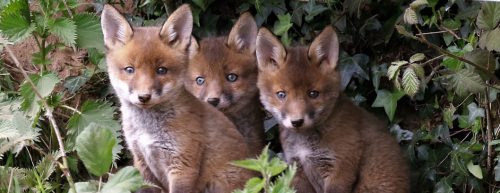
Fox cubs by Pat Quinlan
There is, of course, a clear legal distinction between licensed hunting and organised wildlife crime. But both exist within a society where the fox continues to be viewed as an animal whose persecution is acceptable under certain circumstances. If the State wishes the public to foster greater respect for wildlife, it must consider the message its own laws and policies send.
Wildlife Crime is rising in Ireland and the government should be concerned. A government cannot expect society to respect wildlife while simultaneously permitting its persecution, treating serious wildlife offences leniently, or defending practices that would be unacceptable if directed at many other animals. Leadership begins with example.
A government cannot expect society to respect wildlife while simultaneously permitting its persecution, treating serious wildlife offences leniently, or defending practices that would be unacceptable if directed at many other animals. Leadership begins with example.
Wildlife crime carries penalties of up to €100,000 in fines and prison sentences under the Wildlife Act. On paper, these offences are treated as serious crimes. In practice, however, the outcome is often very different. Even where wildlife crime reaches the courts, sanctions often fail to reflect the seriousness of the offence. If offenders can avoid criminal conviction through application of the Probation Act after making payments to charities directed by the court, to many this sends the message that wildlife crime is viewed as a lesser offence.
A recent case involving the destruction of House Martin nests once again resulted in the application of the Probation Act. Each case turns on its own facts and sentencing is rightly a matter for the courts. Nevertheless, the case reflects a wider pattern. In that case, an estate agent deliberately destroyed 57 house martin nests, resulting in the deaths of an estimated 205 amber-listed birds. The judge himself described the offence as “appalling” and accepted that it had been committed for profit. Yet despite the scale and seriousness of the offence, the matter concluded with the application of the Probation Act, with €10,000 directed to be paid to wildlife charities and no recorded criminal conviction.
A similar issue arose in the case of Dublin developer Con McCarthy, who was convicted under the Wildlife Act after burying an active badger sett under tonnes of clay and soil. The destruction of the sett likely resulted in the suffocation of a breeding family of badgers. However, following an appeal to the Circuit Court in March 2024, the conviction was overturned through the application of the Probation Act, with McCarthy instead directed to pay €15,000 to animal charities. The Irish Wildlife Trust rejected these funds, and stands firmly by its position that allowing offenders to avoid a criminal conviction through charitable payments risks weakening the deterrent effect of wildlife protection laws.
The criminal justice system does more than punish wrongdoing, it shares a society’s values. When offences against protected wildlife repeatedly end without a recorded conviction, the public is left to wonder whether these crimes are truly regarded as serious.
The government on one hand speaks about the biodiversity crisis and the urgent need to protect nature. Yet the laws relating to permitted activities to the sentencing outcomes relating to wildlife crime cases, send a very different message.
Wildlife crime does not occur in a cultural vacuum. Laws, institutions, and public policy all help shape the way society values, or fails to value, the natural world. They are products of a culture. And culture is shaped, in part, by the government and what the government is seen to deem acceptable. When the Government licenses the capture of wild hares for coursing, permits organised fox hunting, and repeatedly sees wildlife offences conclude without recorded convictions, it sends a message about the value of wildlife. Conservation is not only about restoring habitats and species, it is also about defining our relationship with nature. Ireland has shown before that it can change its relationship with our natural heritage. The growth of community conservation projects, habitat restoration initiatives, and public engagement with biodiversity shows that there is a strong desire for a future where wildlife is respected and protected. However, if our government continues to treat some forms of wildlife persecution as acceptable, it is hardly surprising that some segments of society will continue to do the same.
Salmon aquaculture in Ireland is polluting coastal waters, contributing to the collapse of wild salmon and driving overfishing for its feed – all despite organic labelling. Phasing out these open-net farms from our ocean is essential for healthy seas and rivers, wildlife, and coastal communities.
We are calling on the Irish government to follow in the lead of other governments around the world and ban the destructive and cruel practice of open-net fish farming in Ireland.
5 Reasons to sign:
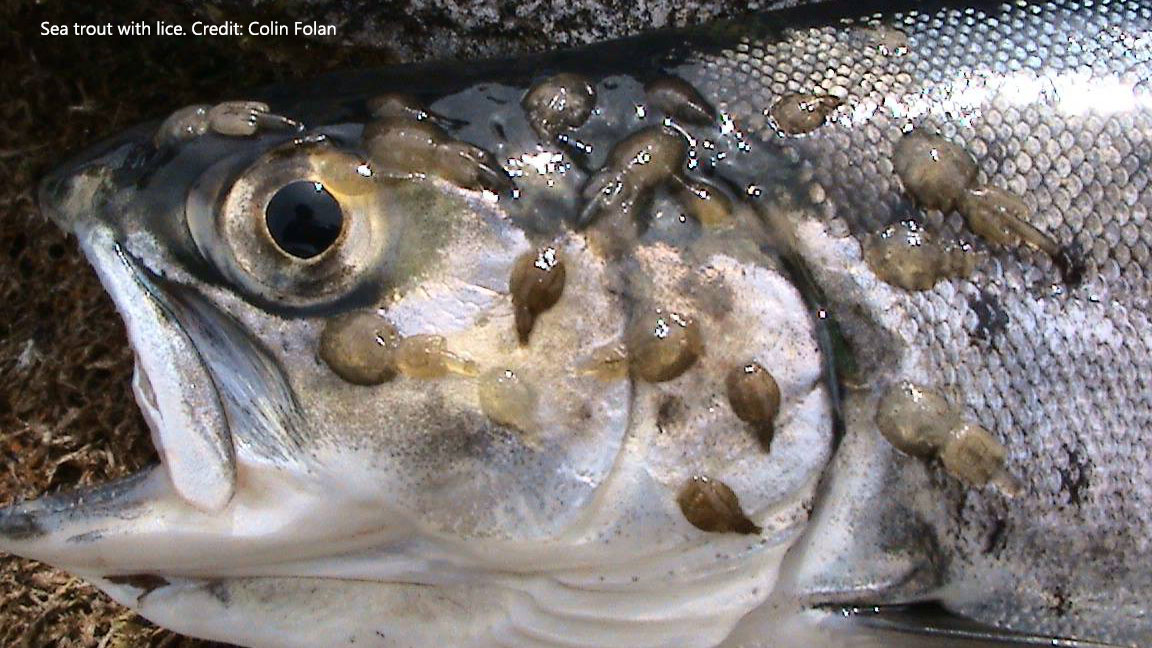
Protect wild salmon and trout Wild salmon returning to Irish rivers declined 90% between 1975 and 2022. Sea lice from open-net salmon farms are a major source of infection for wild salmon and sea trout, cutting wild salmon returns dramatically in some Irish rivers and pushing already struggling stocks closer to collapse. Open cages allow diseases and parasites to spread freely between farmed and wild fish.
Stop escapees threatening wild salmon When cages fail, farmed salmon escape into rivers and bays, where they can breed with wild fish, weaken their genetics and compete for food and spawning grounds. Inland Fisheries Ireland has called farmed escapees a “significant threat” to the future of wild salmon.
Ensure clean water Open-net farms discharge faeces, uneaten feed, pesticides and antibiotics straight into bays, loading them with pollution and damaging seafloor habitats under the cages.
Make “organic” have meaning Ireland’s farmed salmon is labelled 100% organic, yet organic standards still allow the use of pesticides, antibiotics and powerful disinfectants in open cages for them to be viable, with waste and residues entering the marine environment.
Keep salmon feed for wildlife Salmon in open-net farms are fed using wild-caught fish, including sprat, taking key food sources from seabirds, dolphins and whales and undermining marine food webs, for what amounts to much less food for people.
The Sustainable Water Network (SWAN) is an umbrella network of 25 of Ireland’s leading environmental NGOs, national and regional, working together to protect and enhance Ireland’s water environment.
You can learn more about why we need a ban on open-net fish farms and other recommendations that we have for aquaculture in Ireland in the Sustainable Water Network policy brief.
Last week the Government published A Living Land (Phase 2 of Ireland’s Land Use Review). The report contains a number of recommendations and ambitious modelled pathways for how Ireland could use its land over the coming decades. The Department has explicitly stated the report “is not an articulation of government policy or a new strategy in relation to land use, nor has it been adopted by the Government.” It’s important to bear in mind that the figures and scenarios it contains are therefore possible future pathways rather than Government commitments.
Nature must be at the heart of Land Use
The report’s main recommendation is the creation of a national land use governance framework through a Land Use Taskforce, co-chaired by the Department of Climate, Energy and the Environment and the Department of Agriculture, Food and the Marine, with senior representatives from Housing and other relevant departments and agencies. The Taskforce would be responsible for balancing food production with restoring nature, improving water quality, and climate adaptation and mitigation.
Those familiar with Ireland’s draft Nature Restoration Plan will rightly ask whether the EU Nature Restoration Regulation was fully considered during the preparation of this report. If a Land Use Taskforce is established, it should have shared responsibility for overseeing nature restoration. Policies on restoring nature need to be embedded within every future decision about how Ireland’s land is managed.
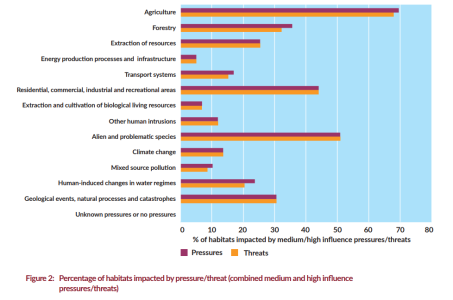
The report lays out the scale of Ireland’s biodiversity crisis. Around 85% of Ireland’s EU-protected habitats are in unfavourable condition. Agricultural land use is identified as the most prevalent pressure, affecting more than 70% of protected habitats, while forestry impacts around 35%. Despite the EU target to protect 30% of land for biodiversity, only 13% of Ireland’s land currently has protected status.
The report also calls for policies that “drive extensive peat soil rehabilitation and restoration to achieve long-term climate and biodiversity objectives”. Bord na Móna has rehabilitated approximately 24,500 hectares of peatlands yet only around one-quarter of Ireland’s peatlands are currently considered healthy enough to provide essential ecosystem services such as carbon storage, water filtration, and flood regulation. Unauthorised industrial-scale peat extraction has also been identified by the 2026 UN Special Rapporteur report as a significant driver of habitat loss and biodiversity decline. Ireland has also faced legal action before the European Court of Justice over failures to adequately protect peatland habitats under EU environmental law.
Forestry needs to be Nature Friendly
Afforestation is one of the report’s most ambitious sections. Ireland is currently planting only around 1,700-2,000 hectares of forest annually, well below the Government’s existing target of 8,000 hectares each year. Under the report’s “high ambition” pathway, planting would increase to 16,000 hectares annually until 2030 before rising to 25,000 hectares every year between 2031 and 2080. If achieved, this would result in approximately 2.3 million hectares of forestry by 2100, covering around 30% of Ireland’s land area.
To put that into perspective, planting 25,000 hectares annually would be roughly equivalent to repeating the total amount of afforestation achieved over the past nine years every single year.
Importantly, the report states that “productive conifer forests could deliver stronger climate mitigation out to 2050 compared with broadleaf forests but would deliver lower biodiversity benefits.” Ireland has historically lost much of its native woodland, and we continue to have one of the lowest levels of forest cover in Europe. The current forestry model dominated by non- native conifers places significant pressure on ecosystems and biodiversity. The coniferous forestry model has been identified as the leading pressure on Blue Dot catchments (Ireland’s most pristine waterways)-, sedimentation and acidification associated with plantation forestry can severely damage river systems. With Irish rivers already under serious pressure, and species such as Atlantic Salmon and Freshwater Pearl Mussels facing severe decline, any expansion of afforestation should prioritise native broadleaf woodland and diverse mixed-species forests, which provide significantly greater biodiversity benefits than commercial monoculture conifer plantations. Future forestry policy must also move away from continued reliance on large-scale commercial conifer plantations, given their well-documented impacts on biodiversity, water quality, and soil health.
Farming for Nature needs to be Incentivised and Rewarded
Several of the report’s modelled pathways also envisage a shift towards alternative land uses, including increased tillage, plant protein production, forestry, and bioenergy. Such changes could create more diverse landscapes and improve habitat connectivity, although they are likely to prove politically contentious as we can expect opposition centred on concerns about farm incomes, rural communities, and food security, despite the fact that around 90% of Ireland’s dairy production and approximately 90% of its beef production is exported. Reducing reliance on intensive livestock production would represent a positive shift for biodiversity, as intensive dairy farming remains one of the greatest pressures on Ireland’s rivers and freshwater ecosystems through nutrient pollution and agricultural runoff.
One possible pathway is described as “multifunctional land use based on extensive cattle systems”. It envisages lower stocking rates alongside payments to farmers for delivering ecosystem services. Significantly, it is also the only one of the five pathways that the report concludes would have a negative economic impact under current market conditions. At the same time, this pathway would deliver the greatest increase in High Nature Value farmland and ecosystem services. The report notes that these services “could become marketable in future, generating significant (diversified) income.” In other words, the biodiversity benefits are clear, but current markets and support schemes do not adequately reward them.
This reflects one of our key recommendations during the public consultation on Ireland’s draft Nature Restoration Plan: farmers must be properly incentivised and fairly rewarded for restoring nature on their land. Voluntary participation will only succeed if restoring habitats is economically viable. Existing agri-environment and eco-schemes remain underfunded and, as a result, are often underutilised. If Ireland is serious about delivering large-scale nature restoration on privately owned land, payments for ecosystem services and long-term financial support will need to become a central pillar of future land-use policy.
If Ireland is serious about delivering large-scale nature restoration on privately owned land, payments for ecosystem services and long-term financial support will need to become a central pillar of future land-use policy.
Water Quality and River Health needs to be urgently addressed
Water quality remains another major challenge. Around 46% of Ireland’s surface waters are in unfavourable ecological condition, while the Water Action Plan 2024 identifies agriculture as the most common and significant pressure, affecting more than 1,000 water bodies.
The report recognises that some of its more “efficient” pathways could reduce overall nutrient losses while maintaining agricultural output. However, it also warns that they could exacerbate localised water quality pressures through high stocking rates on dairy land. National averages may improve, but individual catchments could still face severe environmental pressures.
With yet another fish kill reported last week, it is more important than ever that the pressures facing our rivers, chief among them agricultural pollution, are addressed.
The State needs to lead by example on Public Land
Ultimately, around 80% of Ireland’s land is privately owned, and the report repeatedly identifies farmers and landowners as the “ultimate decision-makers”. Any large-scale transition towards nature-positive land use will therefore depend on incentives, agri-environment schemes, payments for ecosystem services, and long-term financial certainty, rather than regulation alone.
This was also one of the recurring themes during consultation on Ireland’s draft Nature Restoration Plan, where the State placed significant emphasis on voluntary participation while showing comparatively little ambition for restoring nature on publicly owned land.
Nature restoration anywhere is welcome. But one of the clearest messages from both the Nature Restoration Plan process and A Living Land remains unchanged: the State must lead by example. This was one of our key asks throughout the Nature Restoration Plan consultation. Public bodies, including Coillte and Bord na Móna, need refreshed mandates that prioritise nature restoration alongside sustainable production rather than commercial extraction. While private landowners require long-term financial certainty and stronger incentives to restore nature on their own land, the State should lead by example and demonstrate what ambitious restoration looks like on the land it already owns and manages.
Ambition to Action
A Living Land sets out ambitious possibilities for how Ireland could transform its landscapes over the coming decades. The real question is whether these possibilities can be converted into legislation, funding and binding policy. Given the report’s own disclaimer that none of its pathways have been adopted as Government policy, and the lack of ambition shown in Ireland’s draft Nature Restoration Plan, that remains very much an open question.
Nature & Society Need More Ambitious Nature Restoration
First published online: 10 July 2026
The National Restoration Plan represents a historic opportunity, as arguably the most significant piece of biodiversity legislation to bind Ireland in a generation. The destruction and degradation of the ecosystems around us threatens not just our beautiful wild species but our way of life. Ireland needs a National Restoration Plan that reflects the scale of that opportunity and the scale of the environmental crisis we face. At present, this draft doesn’t do that. We welcomed the opportunity to submit to the public consultation on Ireland’s draft National Restoration Plan, but we were disappointed by the contents and lack of ambition highlighted in the plan and we believe it risks falling short of what is legally required and ecologically necessary.
The section on marine life is hugely underdeveloped. No new measures to help with the restoration of marine ecosystems were highlighted and the measures that were listed are ones that are already occurring and have so far failed to effectively protect, let alone restore, marine ecosystems. Many of the schemes mentioned in the plan also end in a few years and there doesn’t appear to be any long term vision for the restoration of marine ecosystems, even though the legal requirements of the Nature Restoration Law are up to 2050.
While the land sections are more developed than the marine section, it still falls well short of what is needed to meet the ambitions of the Nature Restoration Regulation. Overall, the plan lacks the ambition required to restore nature at the scale of the biodiversity crisis. It fails to demonstrate how the State will lead restoration on public land, despite repeatedly stating that this will be the primary delivery mechanism. There is little detail on the long-term funding needed to restore habitats or to provide meaningful incentives for private landowners to participate. Finally, the plan lacks joined-up thinking across Government, with little integration between the National Restoration Plan and other key initiatives and delivery bodies, such as the proposed National Invasive Species Bureau, whose work will be essential if restoration efforts are to succeed.
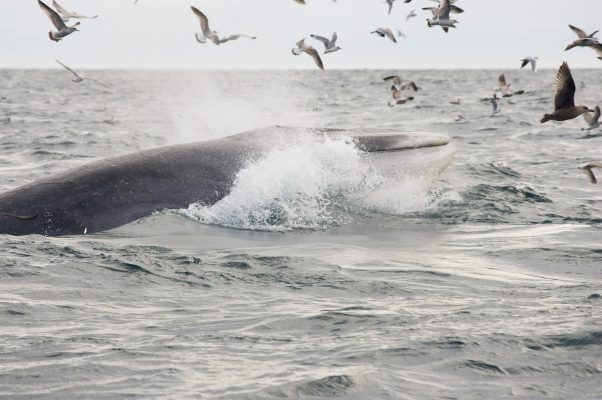
Fin Whale. Photo: Mike Brown
The main shortcomings of the marine section of the plan are as follows –
Inaccurate estimation of coverage of marine habitats and lack of ambition for re-establishing habitats
The National Parks and Wildlife Service (NPWS) have grossly underestimated the area coverage of habitats included within the law. Having these low numbers then allows them to set the areas needed for restoration at much lower coverage than what is actually needed. These numbers undermine the entire concept of the Nature Restoration Law and what it is trying to achieve.
Countries are required to re-establish habitats where they have been lost and bring them back to a Favourable Reference Area (FRA). The plan has not set any reestablishment target for marine habitats and has set FRAs as their current (grossly underestimated) coverage. FRA for terrestrial habitats has also been set incredibly low and does not take into account the Commission’s guidance or the legal requirements of the NRR which states that comprehensive evidence from historical datasets, ecological needs, and expert opinion should be taken into account.
No clear pathway on how fisheries will be managed in Irish waters.
The last Article 17 Habitats Directive report listed 12 out of 14 marine habitats to not be in good ecological condition. One of the main pressures listed was fishing. From engaging with fishing communities, we know that many are asking for better (or any) management plans to be put in place for different species. This doesn’t appear to be happening and fishing communities, as well as civil society, know that this will result in a collapse in these species populations.
Currently fisheries are not effectively managed in protected areas. The system that is in place is complicated and it is extremely difficult to get information on how activities are assessed and managed. The plan states that a risk assessment is undertaken of fisheries around protected areas, but the last evidence online of this happening is from 2015. We have asked for clarity on this situation and for the process to be made transparent and available for the public.
No plans for Joint Recommendations in Irish offshore waters
Since Irish offshore waters are shared waters, Joint Recommendations through the Common Fisheries Policy are the only way to manage fishing activity in protected offshore sites. The plan offered an opportunity for the Irish Government to start documenting how they intend to initiate them. They did not do this. They stated that they will wait until they have decided on the percentage coverage of soft sediments that need to be restored before adding any more information on Joint Recommendations. There is no set timeline for when this percentage must be decided and no targets for the restoration of these habitats for 2030, so in essence we feel that this is a way to delay the process.
There are targets in the Nature Restoration Regulation to have restoration measures in place on 30% of reef habitats in bad ecological condition by 2030 and Ireland’s offshore marine space has several cold water coral forests within it. In fact the two largest protected areas designated in Ireland’s offshore areas have reefs as their qualifying interests, and yet the NPWS and the Department of Agriculture, Food and the Marine did not even attempt to document the steps they plan to take to effectively protect these areas. Aside from this being a failure to achieve the legal targets of the Nature Restoration Regulation, it will also stop Ireland from reaching the globally agreed target of having 30% of its waters designated as protected areas by 2030.
The main shortcomings of the land sections of the plan are as follows –
Public Land Contradiction
Throughout the process of preparing for this draft Nature Restoration Plan the government has consistently stated that restoration efforts will be led on public land. Civil society and academics have all agreed that the State must lead by example on the land it already owns and this was the main recommendation of the Independent Advisory Committee on Nature Restoration. In the Irish context, it is the only realistic route to delivering restoration at the pace and scale the law requires. Coillte and Bord na Móna are named in the plan as key delivery partners for restoration. On the surface, that sounds like a sensible idea as between them and other public bodies, the State controls somewhere in the region of 8–11% of the country’s land area, land that could be restored at scale without the years of negotiation that restoration on private land inevitably requires.
The problem is that neither body has actually been given the mandate to do it.
Coillte still manages roughly 73% of its estate as commercial conifer plantation, much of it Sitka Spruce. This model of forestry has consistently been shown to drive biodiversity loss, with sedimentation and acidification impacting rivers and streams, alongside the replacement of native habitats with monocultures. It makes little sense to expect Coillte to lead nature restoration while continuing to operate under a commercial forestry model that actively damages nature. The draft plan itself uses language that commits the company to nothing more than the suggestion that it “can contribute towards” national restoration targets.
Beyond the rehabilitation work Bord na Móna is already legally obliged to undertake under its EPA licence, the plan contains no additional commitment to restoring its land. This is despite EPA assessments indicating that around 70,000 hectares of Bord na Móna land requires rehabilitation if Ireland is to meet its climate targets for agriculture and land use by 2050.
The plan places the State’s two largest landowners, both of whom are still operating under legal mandates centred on commercial extraction, in charge of delivering nature restoration on their land. Under their current economic models, nature restoration will be little more than a side effect of business as usual. That is not a sustainable restoration model.
Private land restoration depends on farmers and landowners voluntarily participating in schemes that have historically been underfunded and poorly subscribed. Payments through ACRES and the Eco-Scheme are welcome, but they remain nowhere near sufficient to drive land-use change at the scale required. The draft NRP fails to identify any credible funding pathway capable of closing that gap.
That leaves public land as the one lever the State can pull without waiting for anyone else’s consent. It is land the State already owns, already controls, and could restore at scale if the political will existed.
Invasive Species are an afterthought
An example of how disconnected this draft is from wider Government policy is its treatment of the issue of invasive alien species.
Invasive species are now recognised as the second greatest pressure on Irish biodiversity, behind agriculture pressures. Ireland’s most recent Article 17 reporting identifies them as a major driver of biodiversity decline across threatened habitats. They are also one of the few pressures capable of actively undoing restoration work after it has already been completed, wasting both time and public money.
The Government has separately announced plans to establish a new National Invasive Species Bureau. You would expect a restoration plan drafted alongside that announcement to embed the Bureau as the operational backbone of Ireland’s invasive species response with clear responsibility, a binding national strategy and landscape-scale delivery programmes. Instead, the Bureau is not mentioned once, highlighting the lack of joint up thinking between departments on the matter of nature restoration and reducing the pressures nature faces.
The plan also misses another crucial opportunity: setting measurable national targets for invasive species control. Without clear objectives, delivery becomes almost impossible to assess. Targets should be established for priority invasive plants such as Rhododendron and Himalayan Balsam, alongside landscape-scale management targets for deer populations. Deer, particularly Sika and expanding hybrid populations, are one of the greatest barriers to woodland regeneration and habitat recovery in Ireland, yet they barely feature in the draft. Restoration cannot succeed if browsing pressure continues unchecked. Deer management needs to sit alongside invasive plant control as a core component of restoration.
Without a properly resourced, legally binding invasive species strategy underpinning restoration, a significant share of the investment made through this plan risks being undone before restored habitats have had the opportunity to establish.
Agricultural Pollution – The Nitrates Derogation
The Nitrates Derogation is a licence to spread more organic nitrogen per hectare on land than is routinely permitted under the Nitrates Directive. Organic Nitrogen is livestock manure applied to the land each year, including by the animals themselves. Under the Nitrates Derogation, roughly 7,500 Irish dairy farms are permitted to spread livestock manure at rates of up to 250 kg of nitrogen per hectare, well above the standard 170 kg limit established under the EU Nitrates Directive.
The consequences are well documented. Agricultural nutrient pollution remains the single biggest reason Irish rivers, lakes, estuaries, and coastal waters fail to achieve good ecological status under the Water Framework Directive. Dairy intensification since the abolition of milk quotas has measurably worsened water quality in catchments containing Special Areas of Conservation and Special Protection Areas designated precisely for the freshwater habitats this plan is supposed to restore.
Elsewhere, the draft NRP acknowledges that Ireland needs to identify and phase out environmentally harmful subsidies, pointing to more than €634 million annually in public expenditure considered likely to damage biodiversity.
The Nitrates Derogation, one of the policies most responsible for the continued decline of Ireland’s freshwater ecosystems, is missing from the Nature Restoration Plan altogether. There is no acknowledgement of the Nitrates Derogation, no commitment to phasing it down, and no indication that Ireland would oppose its renewal when it next comes before the European Commission.
The draft NRP cannot claim to provide a roadmap for freshwater restoration while remaining silent on one of the main causes of freshwater pollution. Ignoring the derogation is one of the clearest examples of the plan’s lack of ambition and its unwillingness to confront the policies driving biodiversity loss.
Lack of Clarity or Ambition
Despite containing more detail than the marine chapter, the terrestrial section still falls well short of the ambition needed to deliver nature recovery at the scale required by the Nature Restoration Regulation. Much of the chapter repackages existing schemes, strategies, and policy commitments rather than setting out genuinely new restoration measures, with many actions focused on developing further plans instead of delivering measurable ecological outcomes.
Ultimately, however, the biggest unanswered question is funding. Throughout the document there are references to existing schemes, future funding opportunities, and mechanisms yet to be developed, but there is no credible explanation of how restoration at the scale required by the Nature Restoration Regulation will actually be paid for. The plan requires long-term, dedicated investment to achieve its commitments. More fundamentally still, the draft lacks ambition and there doesn’t appear to be the cross departmental work and coordination that is needed in order to address the main issues impacting biodiversity.
Conclusion
Ireland is in the midst of a biodiversity crisis. Around 90% of our protected habitats are in unfavourable condition. We rank among the bottom 10% of countries globally for biodiversity intactness. Nature is on its knees. So why then are the NPWS and the Government departments responsible for this continuing to show little to no ambition when it comes to trying to bring back nature?
This should have been the moment for a bold restoration plan that fundamentally changes how the State manages land and invests in nature. Instead, too much of the draft is characterised by cautious language, voluntary measures, and an unwillingness to confront the policies driving biodiversity loss in the first place.
Press Release: This Invasive Species Week, the IWT and Mary Reynolds are asking everyone to welcome native species into their gardens instead of planting invasives
Be Plant Wise. Let nature lead. Plant native.
25 June 2026
The National Biodiversity Data Centre (NBDC) coordinates Invasive Species Week. You can learn all about Ireland’s invasive species and events happening this week hereInvasive Species Week. As part of Invasive Species Week (22–28 June 2026), the Irish Wildlife Trust (IWT) is encouraging gardeners, landowners, community groups, and local authorities to take simple but powerful actions to help nature recover.
The message is straightforward:
Stop planting invasive species, including popular garden and hedging plants such as Cherry Laurel, Rhododendron, and Spanish Bluebell.
Be Plant Wise by choosing plants that support biodiversity and do not escape into the wild and harm biodiversity.
Let nature lead by allowing native plants already present in the soil to regenerate naturally.
If you are planting, choose native species and local provenance trees and hedging.
Welcome nature back into your garden and watch wildlife return.
Invasive species are recognised as the second greatest driver of biodiversity loss globally after habitat destruction. In Ireland, invasive plants continue to spread through our woodlands, wetlands, waterways, and countryside, displacing native species and altering entire ecosystems.
Many invasive plants were originally introduced for ornamental or hedging purposes. Today, introduced flowering plants outnumber native flowering plants recorded in the wild across Ireland. At the same time, more than half of Ireland’s native plant species have declined in range, abundance, or both.
Oisín O’Néill the IWT Nature Advocacy Officer explains:
“Plants are the foundation of our ecosystems. They provide food, shelter, and breeding habitat for countless species. By choosing native plants and avoiding invasive species, everyone can play a direct role in restoring biodiversity from the ground up.”
This week, the IWT is highlighting positive, practical actions that anyone can take, whether they have a large garden, a community space, a schoolyard, or even a small patch of lawn. To share this important message the IWT held a collaborative webinar with landscape designer, environmental activist and founder of We Are The Ark, Mary Reynolds. A link to this webinar can be found here.
For many years now Mary has been supporting communities and garden owners to welcome native plants into their garden and public space through the We Are The Ark programme. This work has recently featured through the TG4 programme Réabhlóid ar Chúl an Tí.
Mary added:
“We have ripped nature apart, patch by patch. We have a lot of work to do. Patch by patch is how we stitch it all back together. We are the needle and native plants are the thread.”
The IWT is encouraging people to think carefully about where their plants come from. Locally sourced, native trees and hedging plants are better adapted to local conditions and support stronger ecological connections with wildlife. Projects such as Seeds of Inspiration, led by the IWT Monaghan Branch in partnership with Monaghan County Council Biodiversity Office, are demonstrating how communities can collect, propagate, and share local provenance native trees for future generations. For more information on local tree propagation people can watch the Seeds of Inspiration documentary and short videos on the IWT’s YouTube channel.
This Invasive Species Week, the Irish Wildlife Trust is asking everyone to take a moment before planting and ask: Will this plant help nature, or harm it?
By being plant wise, embracing native species, and allowing nature to recover, every garden can become part of Ireland’s nature restoration movement providing a growing network of habitats for wildlife.
Learn more
The National Biodiversity Data Centre (NBDC) coordinates Invasive Species Week. You can learn about Ireland invasive species and other events happening this week hereInvasive Species Week.
Visit the Irish Wildlife Trust website for practical guidance on native planting, local provenance trees, and the Seeds of Inspiration project – https://iwt.ie/seeds_of_inspiration/
Réabhlóid ar Chúl an Tí, a TG4 series hosted by Mary Reynolds and Aedín Ní Thiarnaigh, seeks to change the way we view our gardens by turning gardeners into guardians.
For information on invasive species including identification guides and other resources, see https://invasives.ie/resources/
Oisín Ó Néill, Irish Wildlife Trust Nature Advocacy Officer, oisin@iwt.ie
About the Irish Wildlife Trust
The Irish Wildlife Trust was founded in 1979 as a charitable conservation body. We provide the public with information about wildlife, run education and training programs, carry out habitat and species surveys, campaign and lobby around biodiversity issues, restore natural habitats, consult with industry, agriculture, and Local Authorities to maintain our natural heritage, and contribute to national and international forums for the protection of biodiversity. The IWT is a nationwide organisation with a strong membership base and branches in Dublin, Kerry, Limerick, Waterford & Monaghan.
If you value our work, please consider supporting us by becoming a member
Why Ireland’s new Invasive Species Bureau must have teeth to be successful
By Oisín Ó Néill, IWT Nature Advocacy Officer
First published online: 18 June 2026
Over the June bank holiday, I travelled north from Dublin to spend a weekend in Donegal. I spent a misty afternoon hiking in the Bluestack Mountains (na Cruacha Gorma), a spectacular landscape of montane bogs and lakes. At one point I stumbled across and flushed a Snipe sitting on four stone-coloured eggs, moving a short distance away I watched as it eventually returned to its clutch. These glimpses of nature thriving tempered the sense of unease I had felt on the drive up from Dublin. After crossing the border from Fermanagh into Donegal, the road carried me through a landscape completely dominated and seemingly completely surrendered to the invasive plant Rhododendron ponticum.
Early June is when Rhododendron ponticum flowers, producing its bright pink blooms. The flowering made it easier to spot across the landscape as it stood out starkly against the light brown tones of the surrounding hills. As I scanned the horizon, I was completely shocked at the scale of this spread of Rhododendron. I drove through this ocean of pink for over twenty minutes before arriving in Donegal Town.
Rhododendron spread in Dublin Mountains. Photo: Aart Jonkers
In Cork I first heard the term “the green creep”, used to describe the spread of intensive cattle farming and the nitrogen-rich grasslands that accompany it into parts of West Cork that would not traditionally have supported such levels of cattle production. On seeing this spreading Rhododendron ocean, I immediately thought of a different phrase — “the pink creep”.
Isolated houses in this landscape are being encroached upon and surrounded by the advancing Rhododendron infestation. Sheep grazed amongst it, and in the far distance I could see young Rhododendron steadily making their way up mountainsides. As I hiked up to the summit of the Bluestacks, it was quite a foggy day with low visibility. On the descent the fog began to clear and I could see the Rhododendron invasion on all sides of the mountains, spreading out from a nearby nature reserve that appeared to have been surrendered to the alien invader years ago, and spilling from the grounds of Lough Eske Castle, an obvious contender for the local ground zero.
To me, it was like something from a plant-based horror film. Huge swathes of an entire county being swallowed by a monstrous pink plant with an endless appetite for conquest.
The effects of Rhododendron are well documented. Once established, it completely dominates a landscape. Bog, forest, and mountainside are all fair game. It forms dark, dense, impenetrable thickets, devoid of other plant life and entirely unpalatable to grazing animals. Once in place, it shades out everything beneath it, including life itself.
Native to parts of the Iberian Peninsula and the Black Sea region, genetic studies suggest Irish populations are largely derived from a hybrid mix of Iberian and Asian stock introduced through the horticultural trade, with this hybridisation likely contributing to the vigour and invasiveness that have made it such a successful coloniser. The first evidence of the plant becoming naturalised in Ireland dates from 1843, when it was documented in Derrycunnihy Wood, Killarney, Co. Kerry, almost certainly spreading from the gardens of Muckross House. On visiting the woods in August 1911 the International Phytogeographical Excursion noted that Rhododendron ponticum, while not native, “evidently feels quite at home here”. By the 2000s, Rhododendron was recognised as a major issue.
As I looked across the landscape in Donegal, I could not help thinking about the future. What will happen here? There were no visible signs here of any effort to fight back. Incredibly, the number of houses, hotels, and churches with mature flowering Rhododendron plants in their gardens make no secret of where these infestations originate. A single flower can produce as many as 7,000 seeds, while a large specimen can produce over one million seeds in a season, readily carried by the wind.
Rhododendron will not stop of its own accord. It is a greedy plant in the Irish landscape, one that happily dominates and casts out native plants, biodiversity and light. Left unchecked, we are looking at a future where vast swathes of land are surrendered to forests of Rhododendron. Hill farmers, lacking the time, energy or resources to fight its advance, will eventually be forced to forfeit their commonages to the advancing infestation. It is a bleak future, one that makes me shudder.
On the 19th of May 2026, the NPWS (National Parks and Wildlife Service) and the NBDC (National Biodiversity Data Centre) announced the establishment of an Invasive Species Bureau, a collaborative approach to tackling invasive species in Ireland. This is, of course, welcome news. However, the scale of the challenge facing this bureau is immense.
Minister of State for Housing, Local Government and Heritage, Christopher O’Sullivan stated:
“Left unchecked, invasive species are a major threat to nature and a threat to livelihoods. Our response to managing them must be based on early detection, public awareness, and collaboration – and backed by science.”
For landscapes like those I witnessed in Donegal, the response required goes far beyond public awareness and early detection. The infestation is already here and very visible.
What an Effective Bureau Must Look Like
The Bureau has the potential to be transformative — but only if it is built with the right powers and the right resources. A Bureau that functions primarily as a coordination and information body will not be sufficient. Ireland needs a Bureau with genuine operational reach. What is needed is an urgent landscape-scale management plan, with county-level targets set over five, ten, fifteen, and twenty years, dedicated funding streams and a locally based bureau officer overseeing the operation.
“What is needed is an urgent landscape-scale management plan, with county-level targets set over five, ten, fifteen, and twenty years, dedicated funding streams, and a locally based bureau officer overseeing the operation.”
Every county should have a dedicated bureau officer, with local management plans developed, infestations mapped, and funding ring-fenced through multi-year programmes. The Bureau should coordinate surveillance, oversee eradication projects, administer grant schemes for landowners and communities, and where necessary, enforce compliance. It should have the authority to issue remediation notices where invasive species are clearly spreading — from private gardens, hotel grounds, or otherwise. Under current legislation, the release and spread of listed invasive species is already prohibited. These obligations cannot remain merely theoretical.
Invasive species spread indiscriminately across Coillte forests, NPWS lands, private farms, and commonages. Coordinating these landowners and enabling joint action is essential if eradication efforts are to succeed — but coordination alone will not clear a single hectare. The Bureau needs teeth; the alternative is continued ecological decline.
Community-led projects such as Dúlra in Mayo and Galway, Killarney Mountain Meitheal, and the Gaelic Woodland Project along with similar groups in Donegal and Wicklow, show that people are willing to do this work. What they need is sustained support. Having spoken to groups carrying out invasive species removal across Ireland, what strikes me is how precarious many of these operations are. Some of the most effective groups — groups achieving real results on the ground — are relying on private funding simply to provide tools and basic equipment for volunteers. That is not a sustainable model for a national ecological crisis.
Rather than duplicating these local efforts, the Bureau should act as a coordinating and enabling body, providing multi-annual funding agreements, technical expertise, and strategic direction. Long-term funding allows organisations to retain skilled staff and plan landscape-scale projects — something that is simply not possible on short-term or ad hoc grants.
The Funding Gap
Between 2020 and 2024, approximately €2.7 million was spent on Rhododendron management in Killarney National Park alone, with close to 2,000 acres treated — yet there remains no cohesive national strategy for eradication. In 2022, the cost of eradication was estimated at €2,457 per hectare. Scale that across every affected county in Ireland and the figure runs to hundreds of millions.
The NPWS budget last year was approximately €100 million. While that represents significant public investment in nature, it must be seen in the context of what is needed. Invasive species alone — one pressure among many — require sustained, multi-decade intervention at landscape scale. There must be massive and sustained increases in funding if Ireland is to have any realistic chance of turning the tide. A Bureau established on the basis of existing Heritage Council and NPWS funding arrangements, without additional dedicated resourcing, will not be equal to this challenge.
Transparent accountability is also essential. The Bureau should publish annual county-by-county reports detailing infestations mapped, hectares treated, expenditure, and progress against targets. In the case of Rhododendron ponticum, annual maps should show areas cleared and areas of new spread. Without this, it will be impossible for the public, landowners or policymakers to know whether Ireland is winning or losing this battle.
Invasive Species and the Nature Restoration Plan
Invasive alien species now rank as the second most significant pressure on Ireland’s protected habitats, affecting 51% of Annex I habitat types according to the 2025 Article 17 report. Yet Ireland’s Nature Restoration Plan (NRP) so far contains no dedicated invasive species strategy, no binding eradication targets, and no coordinated governance structure to deliver landscape-scale management. This is a critical and legally significant omission.
The Nature Restoration Law requires Member States to actively restore degraded ecosystems across forests, peatlands, rivers, wetlands, grasslands, and marine habitats. Invasive species represent one of the most consistent barriers to that restoration. Attempts to restore native woodland will fail if Rhododendron or Cherry Laurel continue to suppress regeneration. River restoration projects can be undermined by invasive riparian plants. Peatland recovery can be compromised by invasive vegetation. Restoration measures will fail to achieve their objectives where invasive species continue to suppress native habitats and threaten protected species.
Ireland’s Independent Advisory Committee on the Nature Restoration Law was unambiguous on this point: restoring habitats while ignoring invasive species produces poor outcomes. Long-term restoration requires long-term invasive species management, not one-off interventions. And restoration funding must support invasive species control where it contributes to ecological recovery.
The Bureau’s forthcoming National Invasive Species Management Strategy must be fully synchronised with the Nature Restoration Plan. These cannot be treated as separate policy areas. The logic is straightforward: control leads to recovery, and recovery enables restoration. Without addressing invasive species, Ireland’s restoration ambitions will remain only ambitions.
A Call to Action
Ireland’s Nature Restoration Plan is currently open for public consultation. This is a critical opportunity to ensure that invasive species management is treated as the central restoration priority it needs to be. If you are concerned about the scale of the invasive species crisis — whether you have witnessed Rhododendron spreading across Donegal hillsides, seen Japanese Knotweed encroach on a riverbank, or watched Himalayan Balsam take over a wetland — now is the time to say so. Submissions calling for a dedicated invasive species strategy, binding eradication targets and adequate resourcing will send a clear signal to the Government that this issue cannot be left to the margins of the restoration plan. Make your voice heard.
Conclusion
The establishment of an Invasive Species Bureau is a welcome development. The question is no longer whether Ireland should have one — that debate is over. The question now is whether it will have the authority, resources, and operational reach to meet the scale of the challenge.
Minister O’Sullivan has said:
“One of my top priorities for the Bureau will be to develop an Invasive Species Management Strategy and support its implementation. This will provide us with solid data, co-ordinate key agencies and stakeholders, and unlock the power of citizen science so that we can spot these species early and stop them from spreading.”
That strategy must include measurable national targets, annual reporting requirements, and publicly accessible progress metrics. It should set out clearly how Rhododendron ponticum and other invasive species will be systematically reduced and ultimately eradicated across the island over the coming decades. There is no reason for a brand-new bureau to lack ambition.
Unless the State significantly expands its intervention — with dedicated funding, operational powers, and a long-term commitment — invasive species will continue to spread, damage native habitats, undermine restoration efforts, and alter Ireland’s landscapes beyond recognition. The Bureau is a promising start, though it is only one early step in a long journey ahead.
If you value our work, please consider supporting us by becoming a member
Further Reading:
Department of Housing, Local Government and Heritage (2026) Minister O’Sullivan announces new approach to tackling invasive species in Ireland. Published 19 May 2026. Available at:Department of Housing Press Release
Woodworth, P. (2019) ‘Rhododendron: An ecological disaster in Killarney National Park’, The Irish Times, 18 May 2019. Available at:The Irish Times Article
Ryan, R. (2022) ‘Rhododendron removal costs estimated at €2,457 a hectare’, Irish Examiner, 16 March 2022. Available at:Irish Examiner Article
Irish rivers remain at the mercy of the island’s largest source of water pollution and greenhouse gas emissions: the agricultural sector, particularly the intensive dairy industry. In 2023, agricultural interests lobbied aggressively in Europe to retain Ireland’s nitrates derogation — effectively a licence to continue polluting at levels beyond standard EU limits. The EU Nitrates Derogation allows Irish farmers to stock animals at higher densities — up to 250kg of livestock manure nitrogen per hectare, compared with the standard EU limit of 170kg/ha. Ireland now holds the ignominious distinction of being the only EU member state still operating under this exemption. The derogation weakens the intent of the EU Nitrates Directive, a vital measure designed to protect rivers, lakes and groundwater from pollution caused by excessive agricultural nutrients.
The Environmental Protection Agency (EPA) has repeatedly highlighted the deteriorating state of Irish water quality. Recent assessments show that around half of Ireland’s rivers and two-thirds of its estuaries are polluted. Agricultural nitrogen from slurry, manure and chemical fertilisers remains one of the principal causes of this decline. The Irish public overwhelmingly support clean, healthy waterways. Polling by Ireland Thinks at the time found strong public backing for protecting water quality, with most respondents opposed to Ireland seeking a further nitrates derogation. Yet the dairy industry got its way. In exchange, Ireland has received rivers choked by agricultural runoff, waterways rendered unsuitable for swimming or drinking, and landscapes increasingly dominated by nutrient pollution. The beneficiaries are export-driven dairy and beef industries that continue to sacrifice the ecological health of Irish rivers in pursuit of ever-higher yields.
In the 2026 Community Conversations on the Nature Restoration Law, clean water emerged as the primary concern, with communities calling for urgent action to restore Ireland’s rivers, lakes, and coasts. Yet despite these concerns, Irish river quality continues to decline. Many water bodies are in deteriorating ecological condition, with Lady’s Island Lake in Wexford and Lough Neagh among the most visible examples of ecosystems severely damaged by nutrient pollution and agricultural runoff. As for fish kills, what happened on the River Glyde is sadly not unusual. Excessive nitrate pollution drives eutrophication, a process in which nutrient enrichment fuels algal blooms and excessive plant growth. When these blooms die and decompose, oxygen levels collapse, often causing mass fish mortalities.
Five dead brown trout, three dead salmon. Photo: Inland Fisheries Ireland.
In 2025, the Munster Blackwater suffered a major ecological disaster, as many as 40,000 fish were killed in a single pollution event. While 66% of waters within the Blackwater catchment retain High or Good status, nitrate concentrations remain persistently elevated. Long-term nutrient enrichment had already weakened the river system. Whether the final trigger was wastewater, industrial discharge, accidental pollution, or environmental conditions such as warm temperatures and algal die-off, the result was catastrophic. No definitive source was ever identified and no prosecution followed.
A major report by Inland Fisheries Ireland examining fish kills between 1969 and 2022 paints a deeply troubling picture. Fish kills occurred in every county in Ireland during that period. Hotspots were concentrated in the east, south and north midlands, overlapping with areas of intensive agriculture and large urban centres. Most significantly, agriculture was identified as the single largest cause of fish kills, accounting for 23% of all recorded incidents. This was followed by eutrophication (13%), industrial pollution (12%), municipal sources (8%), mining (3%) and construction (2%).
What happened in Louth should be called what it is: ecocide. IFI stated: “The source of the pollution has been identified as an agricultural discharge, and has been stopped.” Prosecution must follow. But accountability for individual incidents is only part of the solution. The deeper problem is systemic. Ireland’s rivers continue to be degraded by a model of agricultural production that places short-term economic output above ecological health. Our rivers are not expendable. They are the lifeblood of our landscapes, ecosystems and communities. How much longer will this continue? How much longer will the Irish public — who consistently express support for clean water and healthy rivers — be forced to watch as powerful agricultural lobby groups travel to Brussels seeking exemptions from environmental protections?
The River Glyde fish kill is not an isolated tragedy. It is another warning.
References
An Taisce (n.d.) EU Nitrate Derogation Decision: A Bad Day for Irish Waterways. Available at:An Taisce
Press Release: River Glyde Fish Kill Exposes Ongoing Failure to Protect Ireland’s Waterways
Irish Wildlife Trust calls for prosecution and urgent action to address agricultural pollution
5 June 2026
The Irish Wildlife Trust has expressed outrage following confirmation of a devastating fish kill in the River Glyde, Co. Louth, where more than 20,000 fish have died, including Minnows, Sticklebacks, Salmon, Eels, Brown Trout, Roach, and Pike. Inland Fisheries Ireland (IFI) has confirmed that the source of the pollution was an agricultural discharge.
Commenting on the incident, Oisín Ó Néill, Nature Advocacy Officer with the Irish Wildlife Trust, said:
“What happened on the River Glyde is an environmental catastrophe and an absolute disgrace. More than 20,000 fish have been killed and a river ecosystem has been devastated. The source has been identified as an agricultural discharge. Those responsible must be held fully accountable and prosecution must follow.”
For anyone concerned with the health of Ireland’s rivers, fisheries, and natural environment, the scale of this incident is appalling. Unfortunately, it is not surprising.
Ireland’s rivers remain under intense pressure from agricultural pollution, particularly nutrient runoff associated with intensive livestock farming. Despite repeated warnings from the Environmental Protection Agency (EPA) about declining water quality, Ireland continues to operate under the EU Nitrates Derogation, allowing significantly higher livestock stocking rates than the standard EU limit.
The consequences are increasingly evident. EPA assessments show that around half of Ireland’s rivers and two-thirds of its estuaries are polluted, with agricultural nitrogen among the principal causes. Communities across Ireland have repeatedly identified clean water as a top environmental priority, yet river quality continues to deteriorate.
The River Glyde disaster is not an isolated incident. A major IFI report on fish kills between 1969 and 2022 found that agriculture was the single largest cause, accounting for 23% of all recorded fish kills nationwide.
What happened on the River Glyde is symptomatic of a wider, systemic failure to protect Ireland’s waterways.
Ó Néill added “This incident is the predictable consequence of a system that continues to place the economic interests of intensive agricultural production ahead of the health of our rivers. Ireland holds the shameful distinction of being the only country in the European Union still operating under a nitrates derogation, permitting higher levels of agricultural pollution than are allowed elsewhere in the EU. The Irish public overwhelmingly support clean water and healthy rivers. Yet they are forced to watch powerful agricultural lobby groups travel to Brussels to demand exemptions from regulations designed to protect our environment. The price is being paid by Ireland’s rivers with worsening water quality, repeated fish kills, and freshwater ecosystems pushed closer to ecological collapse. Unless Ireland takes decisive action to tackle agricultural pollution and restore freshwater ecosystems, incidents like this will continue to happen.”
ENDS
Media Contact: Oisín Ó Néill, IWT Nature Advocacy Officer, oisin@iwt.ie
Image: Deceased salmon recovered from River Glyde by IFI (Inland Fisheries Ireland) staff
If you value our work, please consider supporting us by becoming a member
Three actions you can take to save marine life this May
First published: 08 May 2026
The Irish Wildlife Trust is a proud founding partner in the Fair Seas campaign. Our aim is to see Ireland become a world leader in marine protection, giving our species, habitats and coastal communities the opportunity to thrive. Key to this is the creation of a network of ecologically coherent Marine Protected Areas (MPAs). For decades, successive governments committed to having a representative network of MPAs. Unfortunately, we are still waiting. Ireland’s marine wildlife and ecosystems are under increasing pressure. Enough is enough. This May, we are asking you to support the call to protect our seas. Here are three key actions you can take to take action for marine life:
One: On 21 May at 11am, we will hold a Rally For Ireland’s Seas outside Leinster House. This is a chance for our community to come together in person and take action. We’re demanding the urgent publication of long-promised MPA legislation, and real progress on the effective designation and management of protected areas at sea. Come along and make some noise!
Two:Fair Seas launched an online tool that will allow you to write directly to Taoiseach Mícheál Martin and relevant ministers to tell them enough is enough. The seas around Ireland, and the communities that rely on them, can wait no longer. New MPA legislation must be prioritised and progressed urgently.
Three: Join the gathering at the Fair Seas World Ocean Week Conference. Leading scientists, community leaders and advocates will showcase best practice and strong case studies of successful ocean management. Our Marine Advocacy Officer, Grace Carr, is among the speakers. Places are filling up but there are still a few spots available.
If you value our work, please consider supporting us by becoming a member
IWT welcomes Commission action against Ireland over failure to designate protected areas at seas
IWT Press Release
06 May 2026
The European Commission has sent a letter of formal notice to Ireland over its failure to designate protected areas at sea. Ireland has two months to provide a satisfactory response before the Commission decides whether to issue a reasoned opinion.
Grace Carr, Marine Advocacy Officer says,‘Irish peoplehave been fighting for better protections in Ireland’s marine area for decades. Our current MPA network is not sufficient in size and the areas we do have designated are not being effectively managed and so the vast majority is not in good condition. Aside from Ireland’s failure to comply with EU Nature laws, we are also still waiting for national MPA legislation to help us meet the global targets set for marine conservation and finally turn the tide for our struggling seas. We have highlighted these shortcomings with the European Commission on a number of occasions and we are happy to see the Commission taking actions to hold the Government accountable. We are already decades behind in conserving nature, there is no more time to delay.’
Previous cases against Ireland over its failure to protect nature
This isn’t a new issue. The European Commission initiated infringement proceedings to Ireland in 2015 over its failure to designate Special Areas of Conservation under the EU Habitats Directive. The results of this case were finalised in 2023 and Ireland was found guilty of failing to put in place site specific conservation objectives and management measures for protected areas. Without setting these objectives for an area and putting in place measures to reach these objectives, the area is effectively a ‘paper park’. This lack of management and Ireland’s failure to protect nature was confirmed when the latest Article 17 report was released in December 2025. 90% of Ireland’s ‘protected’ habitats were found to be in bad or inadequate condition. It’s more than frustrating that we are in 2026 and Ireland is still failing to protect nature and failing to even designate areas at sea for protection.
Contents of new proceedings against Ireland
This new letter from the Commission highlights that Ireland has failed to propose new marine Sites of Community Importance (SCI) and Special Protection Areas (SPA) in coastal and offshore areas. The Commission had agreed with Member States that an ecologically coherent network of marine protected areas should be in place by 2012. It also states that new SCIs for reefs, sandbanks, bottlenose dolphins and harbour porpoise need to be established. Reefs were classified as being in bad ecological conditions in the latest Article 17 report and sandbanks were classified as being in favourable condition (however, the roll out of offshore renewable energy around Ireland’s coasts is likely to cause significant pressures to this habitat type). SCIs are not fully established protected areas, they are the first step towards designating an area as a Special Area of Conservation (SAC), so this highlights how far behind Ireland is.
The letter also highlights Ireland’s failure to designate SPAs for eight bird species listed in Annex I of the Birds Directive and eleven migratory birds which are regularly found in Ireland.
Over the past decade, monitoring has improved in Ireland’s marine areas, but the delay in taking action with the data available is unacceptable. Ireland is pushing forward with offshore renewable energy and this is something that cannot occur without first designating areas which should be protected for vulnerable marine species and habitats. This is something that Irish citizens, scientistsand industry have been calling for for years and yet the Government continues to drag its heels. National marine protected area legislation is still being prepared and a first draft of the Bill has yet to be released. This new Bill must ensure that an inclusive approach to designating and managing Ireland’s marine space is taken so that we can finally achieve an ecologically coherent network of MPAs that protects and restores marine ecosystems and those who depend on them.
Grace Carr questions, ‘With infringement proceedings happening again so many years after deadlines have passed for designating protecting areas, it makes you question what the Government’s priorities are and if they have any intention of ever effectively protecting the land and sea that protects us.’
ENDS
Media Contact: Grace Carr, IWT Marine Advocacy Officer, grace@iwt.ie
If you value our work, please consider supporting us by becoming a member
Irish Wildlife Trust calls for urgent action over misleading Sitka spruce forestry materials in schools
IWT Press Release
21 April 2026
The Irish Wildlife Trust is calling for immediate action from the Department of Education and Youth to address and revise misleading messaging presented to primary school children by the Society of Irish Foresters, Seefa, and the Irish Timber Council on the ecological benefits of Sitka spruce forestry. In the context of the global biodiversity crisis the Irish Wildlife Trust urges the Department to provide schoolchildren with educational materials which offer a more balanced understanding of Ireland’s biodiversity, native ecosystems and the pressures they face.
The organisations are distributing a booklet titled “Sitka Spruce, The Amazing Timber Tree” in both printed and narrated digital form to primary schools across Ireland. The IWT says the material presents a one-sided and commercially aligned narrative that fails to acknowledge the well-documented ecological impacts associated with Sitka spruce monoculture forestry.
In the context of the global biodiversity crisis, the IWT warns that children are being exposed to material that normalises industrial forestry systems as environmental best practice, without adequate reference to native ecosystems, biodiversity loss, or ecological trade-offs.
One of the distributors of the booklet, the Society of Irish Foresters, has described Sitka spruce as “the most important commercial, environmental and social tree species in Ireland.” The IWT says this is not an objective statement, but a promotional framing of a non-native plantation species that omits significant ecological context.
Ecological concerns raised
The IWT highlights that Sitka spruce plantations are structurally uniform, single-species systems that support significantly lower biodiversity than native woodland ecosystems. The expansion of such plantations has contributed to ecological simplification, including reduced habitat diversity, impacts on water quality in sensitive catchments, and displacement of potential native woodland restoration.
The IWT notes that clearfell forestry practices associated with commercial Sitka spruce plantations can increase soil exposure and habitat disruption, and that drainage and harvesting in peatland and upland areas can contribute to sediment loss and water quality pressures affecting sensitive aquatic ecosystems.
Oisín Ó Néill, Nature Advocacy Officer with the Irish Wildlife Trust, said the material risks normalising an environmentally damaging model of land use at a time of accelerating ecological decline:
“In the context of the global biodiversity crisis, it is deeply concerning that children are being presented with promotional narratives about extractive industrial forestry from an industry that continues to cause serious harm to Ireland’s ecosystems. Ireland’s ecosystems are under severe pressure, and education materials must reflect ecological reality. This booklet is one-sided industry messaging presented as environmental fact.”
“As anyone familiar with woodlands in Ireland will tell you, a Sitka Spruce forest is not a healthy forest ecosystem, and should not be represented as such in educational materials.“
The IWT argues that Ireland remains one of the most ecologically degraded landscapes in Europe in terms of native woodland cover and biodiversity loss, and that education materials should reflect the ecological costs of our current forestry model.
Call
The Irish Wildlife Trust is calling for immediate action from the Department of Education and Youth to address and revise misleading messaging presented to primary school children by the Society of Irish Foresters, Seefa, and the Irish Timber Council on the ecological benefits of Sitka spruce forestry. In the context of the global biodiversity crisis the Irish Wildlife Trust urges the Department to provide schoolchildren with educational materials which offer a more balanced understanding of Ireland’s biodiversity, native ecosystems and the pressures they face.
The organisation is also calling for greater safeguards to ensure that commercially aligned messaging is not presented to children as environmental education.
END
Media Contact
Oisín Ó Néill, Irish Wildlife Trust Nature Advocacy Officer, oisin@iwt.ie
If you value our work, please consider supporting us by becoming a member
Call to action: Prohibit destructive tangle nets to protect endangered Irish species
Published online 13/2/2026
Grace Carr
Call to action – Write to the Minister asking him to prohibit the use of tangle nets to prevent the extinction of critically endangered shark and ray species
Thousands of endangered and critically endangered species are being caught and killed in Ireland’s inshore areas from a fishing method known as tangle netting. We are calling on the Minister to ban this destructive practice and support a transition to a lower impact fishing method. Tangle nets are deployed on the seabed in certain areas along the west coast and south coast and left for up to a week and a half targeting crayfish (also known as crawfish). There are no restrictions to the amount of nets allowed and so thousands of kilometres are being used.
This fishing method is extremely indiscriminate and the nets end up catching anything that crosses their path. The Marine Institute released a report showing the shocking numbers of non-target species caught in a 4 year period. Most of the data on catch and bycatch in the report were obtained in the area from Kerry Head south to the Blasket Islands. Smaller amounts of data were collected further south close to Castletown Berehaven. The report also makes it clear that these numbers are severely underestimating the true extent of the damage.
The estimated numbers of species caught in tangle nets from the sampling area was –
– 1161 protected grey seals were caught.
– 81 critically endangered angel sharks. The report specifically states that this level of bycatch ‘increases the risk of extinction for this species.’
-1712 critically endangered flapper skate
– 500 endangered tope shark
– 80 endangered stingrays
– 8000 endangered spurdog
There were thousands of other individuals caught as bycatch including crabs, lobsters and other commercially valuable fish. Low numbers of endangered undulate ray, risso dolphin and common dolphin were also caught. It is reported that approximately 33% of the crayfish caught in Tralee were below the minimum landing size and 62% of those caught were below the minimum landing size in Dingle.
Legal Obligations
Habitats Directive
The Government has a legal obligation to protect certain species such as grey seals and dolphins under the Habitats Directive and this fishing method is in clear violation of those obligations.
Marine Strategy Framework Directive
Ireland has failed to achieve Good Environmental Status for 84.5% of the 142 fish species assessed through the Marine Strategy Framework Directive. Allowing a fishery with such high levels of bycatch to continue is not aligned with improving this number. Descriptor 1 of the MSFD looks at biological diversity and criteria 1 addresses bycatch. ‘It states, ‘the mortality rate per species from incidental by-catch is below levels which threaten the species, such that its longterm viability is ensured.’
OSPAR
Ireland is a contracting party of the OSPAR convention and should implement the recommendations made through this convention for protecting declining species. The list of declining species under OSPAR includes the critically endangered angel shark and flapper skate. Each contracting party should ‘take relevant conservation measures in key areas where significant numbers of these species would still occur’
Nature Restoration Law
Under the EU Nature Restoration Law, Member States must put in place measures to restore the habitats of different marine species, including angel sharks.
Common Fisheries Policy
States that Member States shall adopt conservation measures. Types of conservation measures may include, ‘modifications or additional devices to reduce the incidental capture of endangered, threatened and protected species, as well as to reduce other unwanted catches; limitations or prohibitions on the use of certain fishing gears, and on fishing activities, in certain areas or periods; requirements for fishing vessels to cease operating in a defined area for a defined minimum period in order to protect temporary aggregations of endangered species & specific measures to minimise the negative impact of fishing activities on marine biodiversity and marine ecosystems, including measures to avoid and reduce, as far as possible, unwanted catches.’
We at the Irish Wildlife Trust, have been engaging with fishing communities and believe it’s important for all stakeholders to work together to come up with solutions to protect the marine environment and help preserve sustainable livelihoods. In the case of tangle netting, there is no time to lose in banning this practice. The evidence is clear that this fishing method is not sustainable and that it poses a significant risk to the survival of critically endangered species. On a national scale the economic returns of this method could be easily compensated by the state and that should be a priority. There are also sustainable alternatives for fishing crayfish such as pots and therefore there is no reasonable argument to allow for tangle netting to continue.
Photo credit: LuisMiguelEstevez, Shutterstock
How you can help
It is vitally important that the Department for Agriculture Fisheries and the Marine and Minister Martin Heydon introduce bylaws to prohibit the use of these nets. Sending emails to your local TDs as well as to Minister Heydon and Minister Dooley highlighting your concern, will show political leaders that this is an issue that needs addressing urgently. Below is a suggested template you can use and adjust to send to Minister Heydon and Minister Dooley
Minister Heydon – martin.heydon@oireachtas.ie
Minister Dooley – timmy.dooley@oireachtas.ie
Minister ……
I am writing to ask that you introduce bylaws to prohibit the use of tangle nets in Irish coastal waters. The Marine Institute released a report showing the shocking numbers of non-target species caught in a 4 year period in the tangle net fishery along the south west coast. The report also makes it clear that these numbers are severely underestimating the true extent of the damage.
An estimated –
– 1161 protected grey seals were caught.
– 81 critically endangered angel sharks. The report specifically states that this level of bycatch ‘increases the risk of extinction for this species.’
-1712 critically endangered flapper skate
– 500 endangered tope shark
– 80 endangered stingrays
– 8000 endangered spurdog
There were thousands of other individuals caught as bycatch including crabs, lobsters and other commercially valuable fish. Low numbers of endangered undulate ray, risso dolphin and common dolphin were also caught. It is reported that approximately 33% of the crayfish caught in Tralee were below the minimum landing size and 62% were below the minimum landing size in Dingle.
There are alternatives for catching crayfish and prohibiting the use of these nets does not mean the end of this fishery. A transition to a more environmentally friendly fishing method needs to be supported. The Irish Government has legal obligations to protect species under the EU Birds and Habitats Directive and under international agreements such as OSPAR, contracting parties should put in measures to protect threatened or declining species. The issue of tangle netting needs to be addressed as soon as possible.
On Tuesday 13 January we attended the Joint Oireachtas Committee on Fisheries and Maritime Affairs. An Oireachtas committee is a group of TDs and Senators from all political parties that have responsibility to scrutinise and advise on particular matters. This Committee meeting was an opportunity for the members to ask expert stakeholders questions on marine protected areas. It’s important for us to attend these meetings as it gives us an opportunity to engage with representatives and highlight our key asks in a public forum. Some of the main points that we wanted to highlight was the need for all stakeholders to be involved early in the process and that we would like the draft legislation published as soon as possible with time factored in for pre-legislative scrutiny. We were joined with colleagues from Fair Seas, Sustainable Water Network, the Irish Environmental Network (representing Coalition 2030) and Birdwatch Ireland. Also in attendance were members from the Department of Climate, Communications and the Environment who are drafting the Marine Protected Area bill and representatives from the Seafood Ireland Alliance (SIA) which included the Irish South West Fish Producer Organisation and Irish South East Fish Producer Organisation.
Stakeholder engagement
Representatives gave their opening statement and it was clear that there were many shared goals and concerns across all the witnesses. Fair Seas have consistently called for early and ongoing stakeholder engagement which is fair and inclusive and this was echoed by Seafood Ireland Alliance. It was encouraging to hear that the Department ‘fully supports the principle of co-creation for marine protected areas. If we take a step back from the legislation, which I can speak to in a minute, we want this to work really well. The only way it can work well is by including everybody in the development, design, creation and management of marine protected areas. That is really clear. It is a fundamental principle underpinning how we are approaching this. Inclusivity is really important.’
The Department stated that there will be processes in the Designated Maritime Area Plan (DMAP) framework to allow for this although it may have to be strengthened for the MPA process. We would agree with this and the need for better engagement when designating MPAs through DMAPs. The Seafood Ireland Alliance said that development of the current Natura network and the DMAP process was not done in a fully transparent manner. They want to ensure that they are fully involved in the design and establishment of MPAs which they fully support if they are done in the right manner. We also must ensure that all scientific data is taken into account as well as traditional knowledge from fishing and coastal communities.
Management
Issues around the current management of Natura sites came up several times. The Department stated that this is the responsibility of NPWS and could not go into great detail. Representatives from the environmental sector made it clear that there has been a consistent lack of funding provided by the government to effectively manage and monitor existing protected areas on land and sea. We highlighted that a lot of mistrust has been bred in the process of designating and managing areas. People are being caught under layers of bureaucracy and yet are seeing none of the benefits that well managed MPAs should provide. Going forward we need to make sure we do things differently and ensure we have co-design and co-management of areas involving all stakeholders.
Funding
Funding to ensure the proper management of protected areas has not been provided by the Government. While NPWS funding increased, this was nowhere near enough of an increase to cover the responsibilities they have. A systemic change in how we protect our environment is needed going forward. We highlighted the upcoming nature restoration law requirements and this possible source of funding and how most of the conversation around the NRL has been focussed on the land based aspects of the law. We need to remember that funding must be made available for marine restoration activities as well as payments for those working at sea who could be affected or assist in managing an area.
Delays
It was nearly three years to the day that the Irish Wildlife Trust, Fair Seas and Birdwatch Ireland sat before the Joint Oireachtas Committee in 2023 to discuss the General Scheme of the MPA bill. At that point we were scrutinising the draft which had been released. Now we are in a different position and still waiting for the draft of the new amendment legislation. Fair Seas acknowledged that work has been done in the background since then in regards to the MPA Life project but publicly in regards to the legislation we are no further ahead. Minister of state Timmy Dooley has said that we should expect the General Scheme of this bill to be ready mid 2026. This legislation has been delayed long enough and we feel that this timeline is not acceptable. Our marine environment is deteriorating and the latest Article 17 report for the Habitats Directive painted a stark picture. Out of 14 marine and coastal habitats only two are in favourable condition, down from 3 in 2019. In 2019, 3 marine and coastal habitats were in bad condition and this has more than doubled to 7 in bad condition. The rest are still in inadequate condition. While there is no time to lose and the legislation must be completed as soon as possible, this must not come at the expense of pre-legislative scrutiny and in depth engagement with stakeholders. Pre-legislative scrutiny will allow us and other stakeholders to work constructively with the Department and ensure we get the best possible outcome for this complex piece of legislation.
Outcome
A positive outcome from the meeting was that the committee agreed to write to the Minister to urge him to ensure the legislation is published quickly, to ensure that stakeholder dialogue is central to it, and to present us with a clear timeline for delivery. Our marine life and marine communities cannot wait any longer. We need to start the process of getting our MPA legislation enacted as soon as possible and for that we need the General Scheme published.
The Irish Wildlife Trust (IWT) is a non-governmental organisation and charity founded in 1979. Our vision is an Ireland where wild nature thrives, and society enjoys the benefits of coexisting with diverse, functioning ecosystems. Our mission is to protect and restore biodiversity in Ireland by motivating and supporting people to take action for nature. We achieve this through assertive advocacy, inspirational rewilding, and building empowered communities for nature. We have a small dedicated staff team and a network of volunteer run branches who engage IWT members at a county level. https://iwt.ie/about-us/
Nature Advocacy Officer Role
IWT Advocacy for Nature pillar: Our society and economy are supported by and reside within the natural world, however nature is often forgotten or overlooked in policy making and the legislative process. At the IWT, we act as a voice for nature, demanding action on the existential threats of biodiversity loss, pollution and climate breakdown. We advocate for ambitious legislation, policy change and implementation to protect and restore nature.
The Nature Advocacy Officer will be a key member of our team helping us to deliver on our Advocacy For Nature pillar of work. They will work alongside our Marine Advocacy Officer and will report directly to the IWT Chief Executive Officer. They will drive advocacy on legislation and policy affecting our woodland, freshwater, peatland and farmland ecosystems. This will include the implementation of the Wildlife Act, Nature Restoration Regulation, Habitats and Birds Directives and Water Framework Directive. The Nature Advocacy Officer will advocate for policies that recognise our fundamental connection with and reliance on the natural world and the need to shift from a system geared towards un-checked extraction and exponential economic growth to a system that recognises ecological connectedness and values nature and people’s wellbeing.
Duties
The IWT Nature Advocacy Officer will report directly to the IWT Chief Executive Officer. Duties will include:
Nature advocacy campaign delivery.
Researching and writing IWT submissions to key public consultations.
Representing IWT in meetings with relevant politicians and public servants.
Writing online articles and press releases communicating IWT policy positions.
Researching and writing IWT policy positions and papers.
Communicating IWT policy positions to the public and the media.
Coordination & collaboration with existing and new IWT advocacy networks e.g the Irish Environmental Pillar, Sustainable Water Network, European Environmental Bureau.
Skills, Experience & Attributes
Essential:
A passion for wildlife protection, nature advocacy and the IWT mission and vision.
Strong interpersonal skills. The role requires effective collaboration with IWT and network colleagues.
Experience working as part of a busy team.
Demonstrable knowledge of and interest in Ireland’s ecosystems and species.
Knowledge of Irish and EU nature / environmental legislation and policy.
An understanding of the stakeholders involved in nature restoration and land use in Ireland.
Demonstrable organisational, time management and workload prioritisation skills.
An ability to communicate effectively, both written and verbally.
A relevant third level qualification e.g. natural science, environment, policy, law.
Desirable:
Experience in nature or environmental campaigning.
Experience in media engagement.
Experience in political lobbying.
Experience in policy and public consultation submission writing.
Experience working for an environmental or advocacy organisation.
Experience in event organisation.
Knowledge of the Irish legislative process.
Conditions of Employment & Hybrid Working
The successful candidate is required to be resident in Ireland and eligible to work in Ireland.
This role allows for hybrid working in so far as is practicable. The post-holder will be expected to attend in-person internal meetings at our office on a minimum of two days a month as well as attendance of external advocacy events and meetings in Dublin and around Ireland as required.
The IWT office is located in the bustling neighbourhood of Smithfield in Dublin City. It is five minutes walk from the LUAS Green and Red line and close to Heuston train station.
The role requires occasional travel within Ireland and occasional weekend or evening work. All necessary expenses for work related travel and subsistence are reimbursed by IWT.
IWT offers employee training opportunities, company pension contributions, and the bike to work scheme.
The IWT is an equal opportunities employer. We are committed to building an inclusive and supportive environment for all employees.
A complete list of all terms and conditions and IWT internal policies will be made available to all staff members. For queries about this position or terms of employment email jobs@iwt.ie
How to apply
Please email your CV and a Cover Letter in pdf format to jobs@iwt.ie
Please put “Nature Advocacy Officer” in the email subject line.
Your cover letter should be a maximum of two pages in length. In your letter please outline your motivation for this position and why you feel you have the skills and experience to deliver on the responsibilities and duties of this role.
Applications for this position must be received by18:00 on 26th January 2026.
2025 has been a difficult year for environmental issues. Pressures are appearing from all sides and there have been many disappointing blows to contend with. Those in power nationally and internationally don’t seem to have safeguarding the environment on their agendas and deregulation in favor of economic growth and business as usual are popular topics. That being said, there have been some wins this year and it’s important to remember that now, more than ever, we must continue to push and use our collective power as a community to fight for what is right for people and planet. Read on for an overview of some key moments this year for the environment.
The new Programme for Government (PfG) was released in January and we were disappointed to see the majority of our key asks not included within it. There was no mention of a mandate reform for Coilte and Bord na Mona to manage forestry and protected bogs for nature. There was also no mention of a review of the outdated ‘Arterial Drainage Act 1945’, a key law which, as it stands, would prevent Ireland from meeting its targets within the Nature Restoration Regulation (NRR). Increasing marine protected area coverage was mentioned but there was no mention of the legislation which was included in the last PfG.
In June the UN Ocean Conference (UNOC) took place in Nice and the EU Ocean Pact was officially launched. The European Ocean Pact’s aims were to bring together the European Union’s policies and actions related to the ocean and create a unified and coordinated plan for managing the ocean. However many experts and NGOs were disappointed by its vague wording.The pact acknowledges the importance of ocean conservation but for it to be successful it must lead to the immediate implementation of the existing marine protection laws we have in place.There are no legally binding requirements in the pact but it does state that an EU Ocean Act, which will be legally binding, will be released in 2027. During UNOC there were announcements from some EU member states on planned conservation actions. Portugal took another step forward in the conservation of its marine natural heritage by declaring that the Gorringe seamount will see its conservation status reinforced, with an expansion of the total protected area and the designation of a portion as a fully protected area. In February the Danish government stated it would ban bottom trawling in over 17% of its waters and it reaffirmed this at UNOC as well as its commitment to having 8% of its waters designated as strictly protected by 2028. Not every country showed ambition in protecting and restoring its waters. The French president announced that trawling would be banned in 4% of French waters…in areas where zero trawling already occurs. This was a blatant attempt at green washing while all eyes were on France during the conference.
There was some good news in July with the announcement of the6nm trawling ban around Irish coasts. From the 1st of October 2026, trawling by vessels over 18m in the 6 nautical mile zone around Ireland’s coasts will be prohibited. From the 1st of October 2025, vessels over 18m fishing for sprat in the 6nm zone will require authorisation to do so and there will be a limited total allowable catch (TAC) of 2,000 tonnes of sprat for these vessels. This is a much needed measure to help protect the inshore fishing sector and have positive benefits for the marine environment. The Irish Wildlife Trust have advocated on this topic for many years, running campaigns to raise awareness and mobilize the public to take action and submit to consultations, so it was a relief to see action being taken. Just 12 days after the new quota came into force, the Sea Fisheries Protection Authority (SFPA) informed Fisheries Minister Timmy Dooley that licensed vessels had landed the allocated 2,000 tonne quota, and he closed the fishery to vessels over 18m. It’s important to continue monitoring the situation to ensure no sprat are being landed by the larger vessels as they continue to fish within the 6nm.
In August Global talks to develop a landmark treaty to end plastic pollution failed. The UN Plastics Treaty was envisioned as a historic, legally binding agreement, akin to the Paris Climate Agreement, but for plastic pollution. Its purpose was to address the entire lifecycle of plastic—from production by fossil fuels to disposal and pollution. The failure of these high level negotiations highlights how difficult it is to reach a consensus on the global stage. It’s therefore more important than ever for countries to show ambition and lead the charge in environmental protection nationally.
The same month, an ecological disaster occurred at the river Blackwater in county Cork when around 50,000 fish were reported dead on its shores. Fish species included protected species such as salmon, eels and lampreys. It’s believed this devastating fish kill occurred due to poisoning. Inland FIsheries Ireland continue to state that they cannot find out who the polluter is and so there has been no repercussions. This event not only caused the death of 10s of thousands of fish, it also had impacts on the entire river ecosystem and the species that rely on it. While this is the largest incident of this nature to happen in Ireland, it is by no means an isolated case. Read SWAN’s report to learn more about the broken system that allows this to continue happening.
Some good news from October was the successful release of four Norwegian White Tailed eagles in Killarney National Park. This year marks the end of an 18 year reintroduction programme to bring this beautiful bird species back to the island. White tailed eagles were once native to Ireland but unfortunately had not been seen for more than a century when the reintroduction programme started. The project was done in collaboration with Norway and the Irish population is now considered strong enough to reproduce and continue to grow without further help from Norwegian partners.
Some good news in November as the state announced that it purchased 100 acres of forestry land at Glen of the Downs. The Glen of the Downs is a national nature reserve which is hemmed in by monocultures. If the land which has been purchased is restored it could result in the expansion of this important woodland ecosystem. This was one of the only national good news for nature stories in Ireland this year and we hope to see the state build on this ambition going forward.
COP30 took place in Brazil during November. This global climate conference had a disappointing conclusion. The final text which was agreed had no reference to fossil fuels. No mention of oil, gas or coal, the biggest causes of climate change. Within the final text there were voluntary initiatives to speed up national climate action. Brazil intends to move forward with roadmaps for phasing out fossil fuels and ending deforestation. These roadmaps and future discussions will take place outside of the official UN COP talks. Again, these results have shown the importance of countries driving forward change nationally if we are to reach our goals at a global level.
In November, the Government announced movement towards the MPA Bill. It was officially announced that the legislation will go ahead as an amendment to the MMarine Area Planning Act instead of standalone legislation. The General Scheme (which highlights the main points to be contained within the Bill) will now be drafted and once that’s approved then the legislation can be written. No definitive timeline was given which is worrying as this legislation has been delayed time and time again, despite it being listed as a government priority. Fair Seas and partners will continue to advocate for the timely delivery of ambitious legislation which will effectively protect our marine environment.
Earlier this month the latest Habitats Directive Article 17 report was published for Ireland. This report is due every 6 years and looks at protected habitats and species designated under EU law. 90% of protected habitats were found to be in unfavorable condition with 51% of these showing ongoing deteriorating trends. This has increased since 2019 when 85% of protected habitats were in unfavorable condition. It highlights the systemic issues in Ireland’s governance and protection of nature. The draft national restoration plan will be completed early in 2026 which is supposed to document the measures which will be put in place to restore 30% of degraded habitats by 2030. This plan will have to contain incredibly ambitious actions if we are to reach this legally binding target. There has not been any announcement on how the NRP will be funded, despite repeated calls for ringfenced funding by NGOs, nature conservation experts, farmers and the wider community. It is clear what needs to be done, but the government continues to drag its heels.
Another blow this month was the approval for another three years of the nitrates derogation just two weeks after the European Court of Justice ruling that Ireland is failing to implement essential water protection legislation. From 2026, Ireland will be the only EU country still benefiting from a derogation. The derogation is only supposed to be applied if it doesn’t affect water quality, but it appears the evidence showing the downhill trend for Ireland’s water quality has been ignored. Prolonging this derogation will ultimately result in negative consequences for farmers here in Ireland as well as devastating consequences for the environment as we fail to move towards sustainable nature friendly farming. At the same time the EU has announced its plan to revise the Water Framework Directive. A law that’s main goal is to protect EU water. It has been included in the environmental omnibus which is a group of laws which will be opened for ‘simplification’ next year. The EU claims that this will reduce administrative burden and streamline legislation but so far it seems that it will also result in the dismantling of laws which have been built over many years to help protect and restore the environment.
It’s a worrying time for the world we live in. Pressures are appearing from all angles and those in power don’t seem to have much ambition when it comes to safeguarding our future by protecting the environment which protects us. It’s important now more than ever to continue standing up for nature and to continue using our voice and the power we have as a collective to push for greater environmental protections. Each new report which contains bad news for the natural world is another tool we can use to push back against lacklustre measures for the protection and restoration of habitats and species. Nearly 200,000 people signed a petition stating that they do not want to see EU environmental legislation weakened. Going into 2026, we must remember promising news like this and continue putting pressure on those in power to restore the natural world. Now is not the time to give up.
2025’s Article 17 report results are as clear as day. Nature is declining in Ireland. The State needs to properly fund and support nature restoration.
Every 6 years countries in the EU have to report on the state of their protected habitats and species under the Habitats Directive. Ireland’s latest report, “The Status of EU Protected Habitats and Species in Ireland 2025” was released yesterday and the results paint a worrying picture for Irish nature.
Protected Habitats
The Article 17 report does not cover every species and habitat in Ireland, rather it focuses on the habitats and species listed for protection under the European Union Habitats Directive. Under the directive every member state is obliged to assess the status of these listed habitats and species and report their findings to the European Commission.
It’s more than disappointing to see the results of the 2025 Article 17 report on the status of Ireland’s protected habitats. Many habitats have declined since the last report in 2019. The report found that 90% of habitats are in unfavourable status, with half showing ongoing declines. This has increased from 85% in the last report. 51% of habitats show ongoing deteriorating trends.
The most frequent pressure recorded in habitats relates to agriculture pressures. 69% of habitats are impacted by agricultural practices, the most common being ‘intensive grazing or overgrazing by livestock’ followed by ‘drainage for use as agricultural land’. Alien and problematic species are recorded as the second most frequent pressure at 51%.
This report will help inform the measures needed in Ireland’s National Restoration Plan to restore 30% of degraded habitats by 2030. Clearly it should also highlight to the Government the drastic need for dedicated funding for nature restoration.Minister for nature, heritage and biodiversity, Christopher O’Sullivan said “We must also redouble our commitment to nature: continuing investment, strengthening collaboration and improving delivery as we strive to stop the loss of biodiversity and move towards a future where it is protected and restored.”
These words are welcome but they will ring false unless the Government follows through on its responsibilities and finally commits to creating a Nature Restoration Fund that can be used to support landowners to take urgent action to reverse these pressures on our habitats. Farmers, communities, NGOs and experts have all been asking for dedicated funding for the National Restoration Plan since before the Nature Restoration Regulation came into force in 2024.
Protected Species
On a slightly more positive note, the report showed that 58% of the protected plant and animal species assessed (excluding birds which are assessed in a separate report not yet released) were in favorable status. However, with ongoing declines in habitats, is it just a matter of time before this number goes down too? It’s worth noting that many endangered and critically endangered fish species are not included in these reports as they are not listed in the Habitats Directive. So while some of these results are promising, it doesn’t give a full picture on the true state of species in Ireland.
Conclusion
Reports come and go as do governments but what is clear is the need for a system change in how we care for nature in Ireland. There are many challenges to effective nature restoration, however people on the ground from farmers to community groups, to NGOs and individuals want to do their bit to save nature. We need to support these groups across Ireland through a state led response, and a Nature Restoration Fund is an essential step.
Appendix 1: Comparisons between the status and trends of habitats from the 2019 and the 2025 reports.
By Charlotte Salter-Townshend, IWT Communications & Network Officer
First published online: 04 December 2025
Red Fox (Vulpes vulpes). Image credit: Andrew Kelly
Background and Timeline
Fox hunting emerged as a topic during the presidential election debates. Most people were aghast at the description of this brutality as a “rural pursuit”. Ireland is now an outlier on this issue as it has been banned in the UK for twenty years.
This month, People Before Profit-Solidarity TD Ruth Coppinger isseeking to amend the Animal Health and Welfare Act (2013), which currently contains an exemption that allows fox hunting. The amendment to the Act would make fox hunting an illegal and unlawful activity. The bill would also ban trail hunting and the snaring and trapping of foxes.
Coppinger first introduced the Bill on 27 May 2025. Independent Ireland and Sinn Féin opposed this initial step. Fortunately, the Bill passed its First Stage vote the next day, and a Second Stage debate – a final vote – is now scheduled for Wednesday 17 December.
Last month, Ireland Thinks carried out an opinion poll across a sampling of 1,000 people. It found 72% believe foxhunting as a sport should be banned in Ireland, with 17% against the Bill and 11% unsure. This public support for the Bill is not reflected in the Dáil. At the time of writing, Fine Gael, Fianna Fáil and Sinn Féin TDs are set to vote against the Bill.
Although communications from individual Sinn Féin, Fine Gael and Fianna Fáil TDs have expressed some diverging views, at the moment it looks like the party whip will ensure members toe the party line when it reaches the next stage. TDs who would be in favour of the Bill to Ban Fox Hunting have to follow their party leadership and vote against it or risk being ejected from their party. Hence the campaigners in favour of the Bill are calling for a free vote on the Bill on 17 December.
Take Action for Foxes
One action you can take is to email your local TDs and show your support for the Bill. If the parties and TDs opposing the Bill feel enough public pressure, they may relax the whip. Below you will find a sample template that you can use to email TDs. You can find a list of contact details for all TDs on this website. You can also follow the Rural Ireland Against Fox Hunting campaign on Instagram and lend your support there.
Young foxes. Image credit: Mike Brown
Does fox hunting still happen in Ireland?
Fox hunting happens regularly in Ireland during the hunting season, which runs from November to April, with 42 registered packs often meeting two or three times a week. Hunts often start around 11.00am and follow a specific route through areas where foxes have been previously identified.
Established in 1845, the Irish Masters of Foxhounds Association (IMFHA) “represents the interests of foxhunting packs in Ireland.” Each Hunt Club has its own constitution and rules. Hunt Club committees have the power to appoint a Master or Joint-Masters. The function of a Master or Joint-Masters is to organise and run the Hunt and to part-finance the activities of the Hunt Club.
The IMFHA Code of Conduct focuses on care of foxhounds and horses, neat appearance, and not obstructing passage of motorists. “Accidental trespass cannot always be avoided but the wishes for all landowners, no matter how small, must be respected. Every effort must be made to prevent hounds and followers from hunting a fox into a “built-up” area or straying onto places where they are not welcome. Animal rights activists can be extremely irritating and may even break the law. Hunt followers must resist the temptation to retaliate in kind no matter what the provocation.”
“The dogs are sent into an area to scent out a fox and force it to break cover. With the fox in the open, the chase begins and can continue for an hour or more. This part of the hunt provides the “field” (i.e. the riders) with the excitement they crave as they hurdle fences, ditches and walls in pursuit of the fox. The fox will go anywhere to escape the hounds. He will try to go to earth down a fox-hole, drain or badger sett, but these escapes are likely to have been blocked the night before by hunt supporters. The fox will run among sheep and other livestock, the hounds following in pursuit, resulting in the livestock being scattered and put under stress. If he cannot escape, the fox is chased to exhaustion at which point he will be caught and savaged to death by the hounds. Foxhounds are bred for stamina, not speed, otherwise the fox would be caught too soon and spoil the hunters’ fun. Often a fox will succeed in finding an unblocked refuge. The hunt has several options; they can leave the fox if they are confident of finding others, they can dig him out with shovels, or they can send for the terrierman, who will either send down a terrier to bolt the fox, allowing the chase to continue, or they will dig the fox out later when the “field” has gone.”
Research on the effect of fox hunting
The pro-hunting lobby’s key argument is that foxes reduce livestock and have a negative impact on the livelihood of farmers. They also point to how fox control benefits ground-nesting birds. But habitat restoration should be the focus, not containment of natural predators. As with livestock, there are other measures, e.g. fencing, as used by RSPB NI and Breeding Waders EIP.
The Hunt is an ineffectual form of control of fox numbers. While there is a lack of research on this topic in Ireland, a case-study on the foxes and foxhunting on farms in the UK (Baker and McDonald, 2000) discredits the “pest-control” argument, with “…hunting being more likely to occur on farms reporting fewer foxes, less livestock farming and fewer fox pest problems. It is likely that these farms presented fewer incompatibilities with, or physical access problems for, the Hunt. Most farmers, even on farms where foxes were considered a pest, tolerated, rather than encouraged, hunting on their land. Evidence from hunting farmers suggests that hunting is considered primarily as recreation, and secondarily as a method of controlling foxes.”
Reasons to effect a Ban on Fox Hunting
It is a cruel blood-sport. The purpose of fox hunting is to chase the fox to exhaustion for an hour or more before the animal is torn to pieces by the hounds. Harrowing evidence that foxes and hares killed by dogs suffer painful deaths formed evidence during the debate leading to the banning of fox hunting in the UK.
Fox hunting with dogs was introduced to Ireland from the UK, where it has since been banned. It was banned in England and Wales in February 2005 following the passing of the Hunting Act 2004. A separate ban had already been implemented in Scotland in 2002.
Illegal hunting is still taking place in the UK, so some argue it will keep happening. However, the continuation in the UK is mostly down to loopholes: trail hunting is allowed (a controversial activity where hounds follow a man-made scent trail, typically made from fox urine, instead of a live fox). The Bill being proposed here in Ireland avoids this pitfall as it also bans trail hunting.
Foxes play an important part in our ecology as both omnivores and scavengers. As a predator, they help control numbers of rabbits and rodents. They also disperse seeds and remove carrion.
They are social and live in family units. They communicate with a range of sounds, including a high-pitched bark from males and a high-pitched scream from vixens during the mating season. They have whiskers not just on their face, but also on their legs to help them navigate in the dark. They are nocturnal but can also be active during the day and enjoy sunbathing.
The intellect and patience of the fox are recurring themes in Irish folklore. They are also said to be able to foresee events including the weather and the bark of a fox is said to be a sure sign of rain.
Previously it was believed that foxes were introduced by Neolithic people for their fur, but a recent genomic study shows that they naturally colonised Ireland in the early post-glacial period. They are a prime example of a highly-adaptable species responding to a rapidly changing environment. For thousands of years we have lived alongside these charismatic canines. If you would like to find out more about foxes visiting your garden, check out this blog post.
Sample Email to TDs
Re. The Animal Health and Welfare (Ban on Fox Hunting) Bill 2025
Dear Deputy,
I am asking you for your view on fox hunting and whether you will support the Bill to ban fox hunting, expected to be moved at second stage on 17 December by Deputy Ruth Coppinger.
Fox hunting emerged as an important issue during the presidential election debates. Most people were aghast at the description of this brutality as a rural pursuit. Ireland is now an outlier on this issue.
I call on all parties to remove the whip on this issue and allow a free vote. This will allow TDs to search their conscience and reflect on how best to represent their constituents. Polls show 77% want fox hunting banned, including a majority in rural and urban areas.
A fox getting chased by a pack of dogs and horses and torn limb from limb is not a rural pursuit or method of control on farms.
Irish Wildlife Trust welcomes good news for the Glen
The Irish Wildlife Trust has welcomed the news that the National Parks and Wildlife Service have purchased 100 acres of forestry land beside the Glen of the Downs nature reserve.
IWT Chief Executive, Kieran Flood commented, “It is very encouraging to learn of public funds being used to purchase land for nature restoration. We hope to see the NPWS resourcing an ambitious native woodland restoration project at this site, to help Ireland meet its nature restoration goals and to expand the precious old oak woodland habitat of the Glen of the Downs.”
The Glen of the Downs is a national nature reserve protecting rare native oak woodland; however, it is cut in half by the N11 dual carriageway and is hemmed in by monocultures. The restoration of this forestry site could potentially allow this important woodland and its wildlife to expand its range making it more resilient and increasing Ireland’s native woodland cover.
Kieran Flood added “At the Irish Wildlife Trust, we have been campaigning for this NPWS purchase as we want to see the state playing a lead role in protecting nature in Ireland for the benefit of all. Nature restoration protects our natural heritage, restores ecosystems and their wildlife and helps fight climate change. It’s a win for wildlife, people and the planet.”
The European laws that have been safeguarding our forests, rivers, wildlife and clean air are being quietly dismantled – under the false promise of “simplification”. But what’s really being simplified is the path for those who want to profit from nature at everyone’s expense.
The European Commission quietly launched a so-called ‘Call for Evidence’ on this matter, inviting companies, organisations and citizens to have their say on whether or not EU environmental laws should be weakened.
We have just a few days toraise our voices . Tell the European Commission: Hands off Nature.
A simple easy to use email tool has been created so that you can respond to this call for evidence. All you need to do is fill in your name, email, country and you can write a message on how important nature and the laws that are in place to protect it are. If you’re not sure what to write you can use the generated text that’s supplied. Every voice counts at this stage and we must let decision makers know that we don’t want environmental laws weakened under the false pretence of ‘simplification’.
The Irish Wildlife Trust welcomes the announcement of large vessel trawling restrictions in Ireland’s 6nm zone
IWT Press Release
22rd July 2025
The Irish Wildlife Trust welcomes the announcement made today on the long overdue 6 nautical mile (nm) trawling ban. It has been announced that from the 1st of October 2026, trawling by vessels over 18m in the 6 nautical mile zone around Ireland’s coasts will be prohibited. From the 1st of October 2025, vessels over 18m fishing for sprat in the 6nm zone will require authorisation to do so and there will be a limited total allowable catch (TAC) of 2,000 tonnes of sprat for vessels over 18m in length.
Grace Carr, Marine Advocacy Officer for The Irish Wildlife Trust said,
‘It is vital that there are effective resources available to record catches of sprat. Unfortunately, current monitoring of landings falls below what is needed to ensure sustainable fisheries and if the Government is serious about listening to the public and putting in effective measures around the sprat fishery, they need to have more people on the ground monitoring the situation. We are happy to see that there is movement in the right direction on this issue and hope that this ban will not be overturned again. Aside from the ban, there needs to be effective management plans put in place for inshore fisheries, including sprat, to ensure a thriving marine environment and a sustainable livelihood for fishing communities.’
Map of 6nm zone
The Irish Wildlife Trust believes that there needs to be further clarity on how these measures will be implemented, specifically the total allowable catch limit proposed for larger boats from October this year. Greater monitoring of landings needs to occur as sprat could potentially be landed and declared as other species, such as anchovy. Observers from the Sea Fisheries Protection Authority (SFPA) should be there physically to record what is being landed. This will require greater resources to be given to the SFPA to achieve this, as without sufficient monitoring, there will be no way of ensuring that the 2,000 tonne limit is adhered to. ICES (International Council for the Exploration of the Sea) have said that no more than 2,000 tonnes of sprat should be taken from Irish waters, but for many years over 14,000 tonnes has been taken (aside from 2022 when just under 8,000 tonnes was taken when the previous ban was in place). Having a TAC of 2,000 tonnes for vessels over 18m means that Ireland will still be exceeding the recommended 2,000 limit as vessels under 18m will also be fishing for sprat.
The Irish Wildlife Trust have advocated on this issue for many years and submitted to the last public consultation at the beginning of 2024 when they called for the option of implementing a ban on vessels over 18m trawling within the baselines and 6 nautical miles around the Irish coast.
Grace Carr of IWT added that “there was huge engagement from the public on this issue during the 2024 consultation and we would like to thank everyone who has taken the time to support this conservation measure over the last few years.”
The EU Ocean Pact was proposed by the European Commission and aims to bring coherence across any EU policies which are linked to the ocean. Some of the goals of the pact are to achieve healthy, resilient and thriving oceans and coastal communities and to promote a successful and sustainable blue economy.
At the end of January, the Commission launched a ‘Call for Evidence’ to allow EU citizens to have their opinions heard on what should be included and focussed on within the pact. While this pact is not legally binding, the EU Commissioner for Fisheries and Oceans, Costas Kadis, has stated that this does not mean that a series of legislation to enforce the pact cannot be formed.
The consultation period ended on the 17th February and on the 21st of February the first Fisheries and Ocean Dialogue was launched. This meeting was attended by Ministers holding the EU Council Presidency, Chair of the PECH (fisheries) Committee, Vice Chair from the European Parliaments SEARICA intergroup, as well as a diverse range of representatives from advisory councils, industry, NGOs and research institutes. They discussed issues around biodiversity, management, sustainable growth and how to support the resilience of coastal communities and cities in various EU sea basins.These Dialogues will continue and marks a significant step in shaping the EU Ocean Pact.
We submitted to the call for evidence as we believe it is important to ensure that NGOs have their issues addressed when it comes to shaping EU documents. We want to give a voice to nature and make sure that new policies are as ambitious as possible when it comes to nature protection and restoration. We are part of the Marine Protected Area group with Seas at Risk who are an environmental NGO based in Brussels. Seas at Risk (along with other NGOs working in the marine environment) released the Blue Manifesto when the new Parliament was elected at the end of 2024. Many of the points made within this document highlight what needs to be done to ensure healthy oceans and a sustainable blue economy.
Transparency
We asked for the Pact to be transparent and contain a clear roadmap of actions to be taken to reach the goals within it. This is to help ensure that enforcement and monitoring can be achieved. Unfortunately, the EU Marine Action Plan which was announced in 2022 and also didn’t have legal standing, seems to have lost traction across Member States (although some are doing better then others in regards to banning destructive bottom trawling etc). We don’t want a similar situation to occur with the Oceans Pact.
Just Transition for Sustainable Fisheries
Sustainability and ecological limits must take priority over economic growth for the underpinning framework for the Ocean Pact. A just transition away from destructive activities needs to be enabled, with communities affected provided with support to ensure this is a viable option. To do this an EU Ocean Fund needs to be established. Without ensuring sustainable fisheries are enacted, the viability of any blue economy will be precarious.
Coherence across Policies
It is necessary to create a framework to ensure coherence between the legally binding targets on ocean related EU Regulations. Alignment between policies such as the Marine Strategy Framework Directive and the Marine Spatial Planning Directive is crucial to ensure the sustainable use of the marine environment. With many industries evolving in the marine environment, climate change impacts proliferating and biodiversity declining, we must ensure sustainable marine spatial planning with an ecosystems approach is implemented. The use of an holistic approach has been mentioned so far in discussions around the Oceans Pact and we welcome that.
We asked for new legally binding legislations to effectively protect 30% of EU waters along with having 10% strictly protected. While there is a Commission document giving a definition of ‘Strict Protection’, this has not been legally defined and needs to be rectified to ensure Member States are able to comply. There also needs to be full implementation of ambitious National Restoration Plans under the EU Nature Restoration Law. This must include 30% of degraded marine habitats having measures in place to be restored by 2030.
The Common Fisheries Policy (CFP) has the means of ensuring sustainable fisheries but unfortunately, it has not been implemented effectively. Article 17 of the CFP states that precedence should be given when allocating quotes to boats using more sustainable and climate friendly fishing methods. This has not been undertaken and so does not incentivise fisheries to move away from harmful practices which destroy the ecosystem and deplete fish stocks with huge quantities of bycatch. Reopening the CFP will be a timely and resource heavy process and the marine environment does not have time to waste. Ensuring effective implementation of the current policy is enough to protect fish stocks and the wider ecosystem services that are provided.
What next?
We will continue advocating for the marine environment through our advocating and lobbying activities at national and EU level. The points we mentioned in our submission are points that ourselves and many other NGOs try to ensure are addressed across different legislative groups. There may be future consultations on the Oceans Pact which we will submit to and throughout the year there will be many opportunities, such as the UN Oceans Conference in July to advocate for healthy resilient oceans, fisheries and livelihoods.
Overall, 2024 has been a disappointing year for nature conservation. We haven’t seen the ambitious change that is needed to tackle both the biodiversity and climate crisis. New political climates at EU level have brought new challenges and we lost many nature positive politicians at a national level. Aside from this, there have been a few major wins over the year and now more than ever it’s important that we don’t get disheartened and that we continue to advocate for the protection and restoration of nature.
Biodiversity Action Plan
In January the 4th Biodiversity Action Plan was released. The foundation of the plan rests on a ‘whole of Government’ approach which is vital if we are to tackle biodiversity loss. The plan also has statutory footing for the first time which means state bodies can be legally held to account to implement the actions. However, many actions undertaken by other policies and legislation that are the root cause for declining biodiversity are not addressed in the plan and in that way, the plan contradicts itself. Structural changes within Coillte and Bord na Mona were not mentioned in the plan even though a review of the remits of these two bodies was within the programme for Government.
Hen Harrier Threat Response Plan
After a decade of work and a public consultation earlier this year, the new Hen Harrier Threat Response Plan was released in September. Civil society condemned the plan stating that it was vague as well as lacking in detail and ambition. The population of the Hen Harrier has plummeted to only 86-100 breeding pairs in the Republic of Ireland, a decrease in 30% since 2015. One of the main threats to the Hen Harrier is the loss of habitat in our uplands due to forestry, intensive agriculture and wind energy development. While this was acknowledged in the plan, no concrete actions to remedy this were mentioned. Coillte, the largest land owner, could drastically improve the Hen Harriers chances of survival by reducing reforestation and restoring peatlands. These actions would not only assist in the recovery of this iconic species but also ensure Ireland will hit its obligations under other legislation and policies such as the Climate Action Plan, National Land Use Review and The Nature Restoration Law.
The Nature Restoration Law
A major good news story to happen in 2024 was the historic passing of the EU Nature Restoration Law (NRL). This law aims to restore 20% of EU land and sea by 2030 and have all degraded habitats restored by 2050. Farmers in Ireland were concerned over the implications of this law and worried that they would not be compensated for any restoration undertaken on their land. NGO’s in Ireland and across Europe supported farmers’ calls to ensure that there would be sufficient funding ring fenced for restoration.The law went through years of negotiations as well as many misinformation campaigns spearheaded by right leaning groups in the EU and was nearly derailed before a final Council vote. Ireland played a vital role throughout this process and in the final weeks, Minister Ryan penned a letter to the EU Council calling for their support of the law. We’d like to take this opportunity again to thank everyone who took the time to sign the RestoreNature campaign calling on our representatives to enact this crucial piece of legislation. Ireland had the third highest number of signatures per capita in the EU and this show of public support is one of the reasons this law made it through.
EU weakens the environmental protection of the wolf
The EU agreed to weaken the conservation status of the wolf under the Bern convention. Conservationists were dismayed at this development as there is no scientific evidence to support this measure and the latest IUCN assessment shows that 6 out of 9 wolf populations in Europe are vulnerable or near threatened. After wolves nearly went extinct in Europe, reducing their protection now will considerably undermine their fragile recovery. Backtracking on the wolves protected status also goes against EU law such as the Habitats Directive which states that Member States must ensure the restoration and conservation of endangered species. The Commission’s in depth analysis failed to show evidence that a cull of these animals would prevent attacks on species kept as livestock and so downgrading the wolves status will not solve challenges in rural areas and risks setting a dangerous precedent that scientific evidence can be ignored for political gain.
Trawling in Ireland and the EU
In April this year a public consultation was held on the ban of trawling within the 6 nautical mile zone around Ireland’s coast. This ban was first put in place back in 2018 but has been called off over the years due to flaws in the designation process and not flaws in the actual policy. Over 5000 responses were submitted to the consultation and we are now at the end of the year with no information or timeline in place as to when this ban will be reinstated. All the while large trawlers have been allowed to ravage inshore bays, emptying them of vital forage fish which are one of the bases of marine food webs.
Unfortunately the rest of the EU backtracked on ambitions for marine conservation this year as well. Last year the European Commission released its Marine Action Plan and goals within that included a transition to more sustainable low impact fishing methods. The European Parliament rebuked the Commission’s plan early this year, stating that a more balanced approach is needed and that the phasing out of destructive fishing oversimplifies the issue.
Some good news is that the UK is doing better on this issue, banning bottom trawling in 13 MPAs this year and bringing their total marine area protected from bottom trawling to 12%. Court cases have also been launched in France, Spain and Germany against their Governments stating that they are violating national and EU conservation law by allowing bottom trawling to continue in protected areas. Greece announced they will ban bottom trawling in their national parks by 2026 and all MPA’s by 2030 and Sweden went one step further and announced that they plan to ban bottom trawling in their territorial waters.
Europe stalls vital Deforestation Regulation
A proposal by the European Commission to stall the implementation of the European Union Deforestation Regulation by one year was approved. This law aims to reduce the EU’s contribution to global deforestation by prohibiting products which were produced on deforested land from entering the EU market. The centre right group, European People’s Party, in the European Parliament tried to get the regulation reopened with the aim of weakening the text but this proposal was rejected earlier in December. The delay shows a disregard for the democratic processes which were undertaken last year, as well as the investment some responsible businesses already undertook to comply with the regulations.
LIFE funding for Marine Protected Areas (MPAs)
This year, Minister Noonan announced a 25 million investment in MPA’s in Ireland. 15 million of this is coming from the EU LIFE project and the Irish Government is matching this with 10 million. Minister Noonan said, “The new Marine Protected Areas LIFE project launched today involves a €25m investment which will be used to research and develop a comprehensive network of Marine Protected Areas in line with international best practices.”
Initiatives stemming from LIFE project need to have ambitious and effective legislation to back them up and while this money is a welcome development, we are still waiting on the national Marine Protected Area Bill. Securing the MPA Bill was in the previous Programme for Government and unfortunately this was not fulfilled.
‘Seas off Wexford’ Special Protection Area
Ireland’s largest Special Protection Area (SPA) was designated this year off the South coast of Ireland. This SPA, covering more than 305,000 hectares, was designated to protect the wide range of bird species which can be found there. Unfortunately, there was no stakeholder engagement in the run up to this designation. While this is not a legal requirement under the EU Birds Directive, Fair Seas are calling for better community engagement when it comes to protecting Ireland’s seas. Seeing the Government designate more areas for protection is always welcomed, however, for these areas to be effective there must be transparent and ambitious stakeholder engagement before designation and through the management and enforcement process.
Páirc Náisiúnta na Mara – Ireland’s first national marine park
Ireland’s largest National Park covering over 70,000 acres of land and sea was designated in April this year. It’s encouraging to see the Government using money to acquire land for nature but it will be vitally important that the park is managed effectively and enough resources are dedicated to ensure environmental protection. Killarney National Park is facing ecological threats from overgrazing as well as invasive plant species spreading through the park. One could argue that some of the money that was spent purchasing new land could have been put to better use through allocating more resources to protecting the biodiversity in existing National Parks and protected areas. The Government has released a public consultation on the Park to help shape the development and management of the area and it would be worthwhile for people to get involved and ensure that the protection and restoration of biodiversity is top priority.
EU and National Elections
While the results of the EU parliamentary election were not as bad for the environment as civil society originally feared they would be, we lost many strong Green MEPs and the far right gained some traction. The main pushback on the Green Deal agenda is coming from the far right and the centre right party EPP so this is a worrying development. Things are not as positive as they were in 2019 when the Parliament declared a climate emergency and asked the Commission to adapt all proposals to adhere with the 1.5°C limit for global warming. However, the EU will face global scrutiny if it severely backtracks on its promises to restore biodiversity and mitigate against climate change. Unfortunately, we saw a loss of the ‘progressive’ majority (who in general supported environmental legislation) which we had in the last Parliament. EPP was the biggest winner out of all the groups and remains the group with the most seats in the Parliament. Far right groups gained more seats, but not as many as was initially predicted while the far right group Identity and Democracy ended up splitting into two separate groups, Patriots for Europe and Europe of Sovereign Nations. There was a rise in the numbers of non-attached members and these MEPs will have a range of priorities and beliefs, therefore it will be important to analyse each one of these to identify allies for the environment.
Ursula Von Der Leyen was re-elected as the leader of the European Commission and released her Political Guidelines for the coming mandate in July. In this statement, the Green Deal is mentioned early on, ‘A stronger Europe that delivers social fairness and supports people. A stronger Europe that implements what it agrees in a fair way. And that sticks to the targets of the European Green Deal with pragmatism, technology-neutrality and innovation.’ This was a relief for many environmental organisations to see, however the first priority within the guidelines remains sustainable prosperity and competitiveness.
Budget 2025 was announced before the national election with some welcome funds for upgrading water infrastructure as well as the electricity grid. However, some key opportunities were missed to create a sustainable taxation system, such as a plan to remove harmful subsidies. Money must also be ring fenced within the Climate and Nature fund to ensure nature restoration is adequately funded.
In the national General election, Fianna Fail and Fine Gael received the most votes and this election saw the loss of every Green TD bar one. It is yet to be seen who will join Fianna Fail and Fine Gael in a coalition Government and whether there will be any champions for nature in the next Government. Ahead of this, plenty of advocacy is taking place behind the scenes to ensure important environmental issues are included within the next Programme for Government.
Ireland’s first Designated Maritime Area Plan (DMAP)
Ireland’s first Designated Maritime Area Plan (DMAP) for Offshore Renewable Energy (ORE) went through public consultation and was passed through both houses of the Oireachtas in October. An environmental constraints analysis was undertaken and these issues were considered ahead of technical constraints which was a good step in the right direction. However, some areas overlap with spawning grounds of certain fish species and the impacts of this will have to be closely monitored and any negative impacts mitigated promptly.
While we think that the DMAP process was, in general, better than other plans, unfortunately this process hasn’t been repeated in other parts of the country. Several ORE planning applications have been going through on the east coast of Ireland which have failed to go through similar environmental constraints analysis. This is extremely worrying as placing ORE in areas that will damage biodiversity will have a negative impact on the climate crisis.
Annual Climate Change Advisory Council Report
The Climate Change Advisory Council (CCAC) published the 5th part of their Annual Review of agriculture and land use, land use change and forestry (LULUCF). The report states that sectors will need to implement the measures within the Climate Action Plan if they are to reach their emission reduction targets by 2030. The review made several recommendations including calling for an ambitious National Restoration Plan (through the Nature Restoration Law), funding for biodiversity, incentives for farmers, nature based solutions and an integrated land use strategy which takes into account climate, biodiversity and water targets.
Convention on Biological Diversity COP16
The 16th Conference of Parties (COP16 ) took place in Colombia this year. The Irish Wildlife Trust along with the Irish Environmental Network attended and it was promising to see a large presence of Irish civil servants and Ministers in attendance. The aim of this COP was to put in place concrete actions to fund the ambitious targets agreed upon at the last Biodiversity COP (reaching 30% protected areas on land and sea by 2030). Unfortunately, countries failed to agree on financing and monitoring mechanisms for these actions. Thankfully countries are due to resume crucial talks in Rome in February 2025. Some positive results to come from COP16 included an agreement for a permanent body to be created for Indigenous peoples to ensure their effective consultation during UN negotiations. Another win was that companies that gain financial benefit from using natural resources (in products like drugs and cosmetics) must pay a percentage of their revenue to countries to protect nature.
Environmental Protection Agency (EPA) State of the Environment Report 2024
The 8th State of the Environment Report was released this year by the EPA and a chapter dedicated to nature highlights the alarming rate of biodiversity decline. 85% of protected habitats in Ireland are considered to be in unfavourable status and more than 50% of native plant species are declining. The main drivers of the decline are human activities.
The report looked at several topics including air, environmental noise, climate change, soil, the marine environment and agriculture. For agriculture, it states that there are many programmes in place and positive actions are being undertaken at a farm scale but there is no clear evidence that the actions being taken will achieve the level of environmental outcomes that are needed. Our food systems are currently not meeting our sustainability targets and a shared vision (including clear actions and adequate supports to achieve them) for 2050 for land use is urgently required.
In the marine chapter, it states that there have been many changes in marine policy resulting in a need for greater coherence and coordination to avoid further damage to the marine environment. Some key pressures such as fishing at unsustainable levels and coastal nutrient enrichment need to be addressed to ensure the health and productivity of the marine environment. The lack of a vital national marine protected area bill was also highlighted, stating that this is an essential component of the marine spatial planning approach.
Marine Protected Areas
Fair Seas and partners continued working hard all year to get the Marine Protected Area (MPA) Bill over the line. Unfortunately, despite the Bill being promised in early 2023, this still hasn’t happened.
Fair Seas have worked closely with a number of stakeholders throughout the year, including the wind industry and have held events across the country highlighting the views of different groups. Public support has been strong, with nearly 2000 people sending emails to the relevant Minister’s using the Fair Seas contact your minister tool and over 70,000 people signing the petition asking the Government to enact the legislation without delay. We have held events in the Dáil as well as a rally for Ireland’s seas at the front gates of Leinster house.The Irish Wildlife Trust and other partners of Fair Seas will continue working on this vital piece of legislation in 2025 so keep an eye out for news in our newsletter and social media.
We’d like to thank all our members and followers for their support in 2024. While the year had many ups and downs, we will continue working hard as a community to ensure our natural environment gets the protection it deserves.
We use cookies to ensure that we give you the best experience on our website. If you continue to use this site we will assume that you are happy with it.