Menu
By Oisín Ó Néill, IWT Nature Advocacy Officer
First published online: 18 June 2026
Over the June bank holiday, I travelled north from Dublin to spend a weekend in Donegal. I spent a misty afternoon hiking in the Bluestack Mountains (na Cruacha Gorma), a spectacular landscape of montane bogs and lakes. At one point I stumbled across and flushed a Snipe sitting on four stone-coloured eggs, moving a short distance away I watched as it eventually returned to its clutch. These glimpses of nature thriving tempered the sense of unease I had felt on the drive up from Dublin. After crossing the border from Fermanagh into Donegal, the road carried me through a landscape completely dominated and seemingly completely surrendered to the invasive plant Rhododendron ponticum.
Early June is when Rhododendron ponticum flowers, producing its bright pink blooms. The flowering made it easier to spot across the landscape as it stood out starkly against the light brown tones of the surrounding hills. As I scanned the horizon, I was completely shocked at the scale of this spread of Rhododendron. I drove through this ocean of pink for over twenty minutes before arriving in Donegal Town.
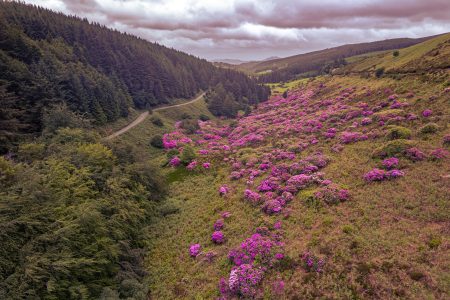
Rhododendron spread in Dublin Mountains. Photo: Aart Jonkers
In Cork I first heard the term “the green creep”, used to describe the spread of intensive cattle farming and the nitrogen-rich grasslands that accompany it into parts of West Cork that would not traditionally have supported such levels of cattle production. On seeing this spreading Rhododendron ocean, I immediately thought of a different phrase — “the pink creep”.
Isolated houses in this landscape are being encroached upon and surrounded by the advancing Rhododendron infestation. Sheep grazed amongst it, and in the far distance I could see young Rhododendron steadily making their way up mountainsides. As I hiked up to the summit of the Bluestacks, it was quite a foggy day with low visibility. On the descent the fog began to clear and I could see the Rhododendron invasion on all sides of the mountains, spreading out from a nearby nature reserve that appeared to have been surrendered to the alien invader years ago, and spilling from the grounds of Lough Eske Castle, an obvious contender for the local ground zero.
To me, it was like something from a plant-based horror film. Huge swathes of an entire county being swallowed by a monstrous pink plant with an endless appetite for conquest.
The effects of Rhododendron are well documented. Once established, it completely dominates a landscape. Bog, forest, and mountainside are all fair game. It forms dark, dense, impenetrable thickets, devoid of other plant life and entirely unpalatable to grazing animals. Once in place, it shades out everything beneath it, including life itself.
Native to parts of the Iberian Peninsula and the Black Sea region, genetic studies suggest Irish populations are largely derived from a hybrid mix of Iberian and Asian stock introduced through the horticultural trade, with this hybridisation likely contributing to the vigour and invasiveness that have made it such a successful coloniser. The first evidence of the plant becoming naturalised in Ireland dates from 1843, when it was documented in Derrycunnihy Wood, Killarney, Co. Kerry, almost certainly spreading from the gardens of Muckross House. On visiting the woods in August 1911 the International Phytogeographical Excursion noted that Rhododendron ponticum, while not native, “evidently feels quite at home here”. By the 2000s, Rhododendron was recognised as a major issue.
As I looked across the landscape in Donegal, I could not help thinking about the future. What will happen here? There were no visible signs here of any effort to fight back. Incredibly, the number of houses, hotels, and churches with mature flowering Rhododendron plants in their gardens make no secret of where these infestations originate. A single flower can produce as many as 7,000 seeds, while a large specimen can produce over one million seeds in a season, readily carried by the wind.
Rhododendron will not stop of its own accord. It is a greedy plant in the Irish landscape, one that happily dominates and casts out native plants, biodiversity and light. Left unchecked, we are looking at a future where vast swathes of land are surrendered to forests of Rhododendron. Hill farmers, lacking the time, energy or resources to fight its advance, will eventually be forced to forfeit their commonages to the advancing infestation. It is a bleak future, one that makes me shudder.
On the 19th of May 2026, the NPWS (National Parks and Wildlife Service) and the NBDC (National Biodiversity Data Centre) announced the establishment of an Invasive Species Bureau, a collaborative approach to tackling invasive species in Ireland. This is, of course, welcome news. However, the scale of the challenge facing this bureau is immense.
Minister of State for Housing, Local Government and Heritage, Christopher O’Sullivan stated:
“Left unchecked, invasive species are a major threat to nature and a threat to livelihoods. Our response to managing them must be based on early detection, public awareness, and collaboration – and backed by science.”
For landscapes like those I witnessed in Donegal, the response required goes far beyond public awareness and early detection. The infestation is already here and very visible.
What an Effective Bureau Must Look Like
The Bureau has the potential to be transformative — but only if it is built with the right powers and the right resources. A Bureau that functions primarily as a coordination and information body will not be sufficient. Ireland needs a Bureau with genuine operational reach. What is needed is an urgent landscape-scale management plan, with county-level targets set over five, ten, fifteen, and twenty years, dedicated funding streams and a locally based bureau officer overseeing the operation.
Every county should have a dedicated bureau officer, with local management plans developed, infestations mapped, and funding ring-fenced through multi-year programmes. The Bureau should coordinate surveillance, oversee eradication projects, administer grant schemes for landowners and communities, and where necessary, enforce compliance. It should have the authority to issue remediation notices where invasive species are clearly spreading — from private gardens, hotel grounds, or otherwise. Under current legislation, the release and spread of listed invasive species is already prohibited. These obligations cannot remain merely theoretical.
Invasive species spread indiscriminately across Coillte forests, NPWS lands, private farms, and commonages. Coordinating these landowners and enabling joint action is essential if eradication efforts are to succeed — but coordination alone will not clear a single hectare. The Bureau needs teeth; the alternative is continued ecological decline.
Community-led projects such as Dúlra in Mayo and Galway, Killarney Mountain Meitheal, and the Gaelic Woodland Project along with similar groups in Donegal and Wicklow, show that people are willing to do this work. What they need is sustained support. Having spoken to groups carrying out invasive species removal across Ireland, what strikes me is how precarious many of these operations are. Some of the most effective groups — groups achieving real results on the ground — are relying on private funding simply to provide tools and basic equipment for volunteers. That is not a sustainable model for a national ecological crisis.
Rather than duplicating these local efforts, the Bureau should act as a coordinating and enabling body, providing multi-annual funding agreements, technical expertise, and strategic direction. Long-term funding allows organisations to retain skilled staff and plan landscape-scale projects — something that is simply not possible on short-term or ad hoc grants.
The Funding Gap
Between 2020 and 2024, approximately €2.7 million was spent on Rhododendron management in Killarney National Park alone, with close to 2,000 acres treated — yet there remains no cohesive national strategy for eradication. In 2022, the cost of eradication was estimated at €2,457 per hectare. Scale that across every affected county in Ireland and the figure runs to hundreds of millions.
The NPWS budget last year was approximately €100 million. While that represents significant public investment in nature, it must be seen in the context of what is needed. Invasive species alone — one pressure among many — require sustained, multi-decade intervention at landscape scale. There must be massive and sustained increases in funding if Ireland is to have any realistic chance of turning the tide. A Bureau established on the basis of existing Heritage Council and NPWS funding arrangements, without additional dedicated resourcing, will not be equal to this challenge.
Transparent accountability is also essential. The Bureau should publish annual county-by-county reports detailing infestations mapped, hectares treated, expenditure, and progress against targets. In the case of Rhododendron ponticum, annual maps should show areas cleared and areas of new spread. Without this, it will be impossible for the public, landowners or policymakers to know whether Ireland is winning or losing this battle.
Invasive Species and the Nature Restoration Plan
Invasive alien species now rank as the second most significant pressure on Ireland’s protected habitats, affecting 51% of Annex I habitat types according to the 2025 Article 17 report. Yet Ireland’s Nature Restoration Plan (NRP) so far contains no dedicated invasive species strategy, no binding eradication targets, and no coordinated governance structure to deliver landscape-scale management. This is a critical and legally significant omission.
The Nature Restoration Law requires Member States to actively restore degraded ecosystems across forests, peatlands, rivers, wetlands, grasslands, and marine habitats. Invasive species represent one of the most consistent barriers to that restoration. Attempts to restore native woodland will fail if Rhododendron or Cherry Laurel continue to suppress regeneration. River restoration projects can be undermined by invasive riparian plants. Peatland recovery can be compromised by invasive vegetation. Restoration measures will fail to achieve their objectives where invasive species continue to suppress native habitats and threaten protected species.
Ireland’s Independent Advisory Committee on the Nature Restoration Law was unambiguous on this point: restoring habitats while ignoring invasive species produces poor outcomes. Long-term restoration requires long-term invasive species management, not one-off interventions. And restoration funding must support invasive species control where it contributes to ecological recovery.
The Bureau’s forthcoming National Invasive Species Management Strategy must be fully synchronised with the Nature Restoration Plan. These cannot be treated as separate policy areas. The logic is straightforward: control leads to recovery, and recovery enables restoration. Without addressing invasive species, Ireland’s restoration ambitions will remain only ambitions.
A Call to Action
Ireland’s Nature Restoration Plan is currently open for public consultation. This is a critical opportunity to ensure that invasive species management is treated as the central restoration priority it needs to be. If you are concerned about the scale of the invasive species crisis — whether you have witnessed Rhododendron spreading across Donegal hillsides, seen Japanese Knotweed encroach on a riverbank, or watched Himalayan Balsam take over a wetland — now is the time to say so. Submissions calling for a dedicated invasive species strategy, binding eradication targets and adequate resourcing will send a clear signal to the Government that this issue cannot be left to the margins of the restoration plan. Make your voice heard.
Conclusion
The establishment of an Invasive Species Bureau is a welcome development. The question is no longer whether Ireland should have one — that debate is over. The question now is whether it will have the authority, resources, and operational reach to meet the scale of the challenge.
Minister O’Sullivan has said:
“One of my top priorities for the Bureau will be to develop an Invasive Species Management Strategy and support its implementation. This will provide us with solid data, co-ordinate key agencies and stakeholders, and unlock the power of citizen science so that we can spot these species early and stop them from spreading.”
That strategy must include measurable national targets, annual reporting requirements, and publicly accessible progress metrics. It should set out clearly how Rhododendron ponticum and other invasive species will be systematically reduced and ultimately eradicated across the island over the coming decades. There is no reason for a brand-new bureau to lack ambition.
Unless the State significantly expands its intervention — with dedicated funding, operational powers, and a long-term commitment — invasive species will continue to spread, damage native habitats, undermine restoration efforts, and alter Ireland’s landscapes beyond recognition. The Bureau is a promising start, though it is only one early step in a long journey ahead.
If you value our work, please consider supporting us by becoming a member
Further Reading: