
Menu
by: Oisín Ó Néill, IWT Nature Advocacy Officer
First Published 05th November 2026
The view flying into Dublin Airport Ireland – one of a treeless patchwork landscape of green fields, channelised rivers, and expanses of drained bogland – is a snapshot view of the huge task facing the Irish nation in the coming years when it comes to nature restoration. Ireland has suffered enormously from biodiversity loss and the Irish public have become accustomed to degraded landscapes: our ecosystems today are shadows of what once existed.
Biodiversity loss (or simply the extinction and disappearance of plants, animals and other living species) was on the agenda for two weeks at COP 17 in Yerevan Armenia where governments, scientists, Indigenous leaders and environmental organisations gathered to discuss what must be done to halt it.
There were moments of genuine inspiration, important conversations and examples of progress from around the world. However, there was also real frustration with the negotiations and the difficulties in translating global commitments into real action.
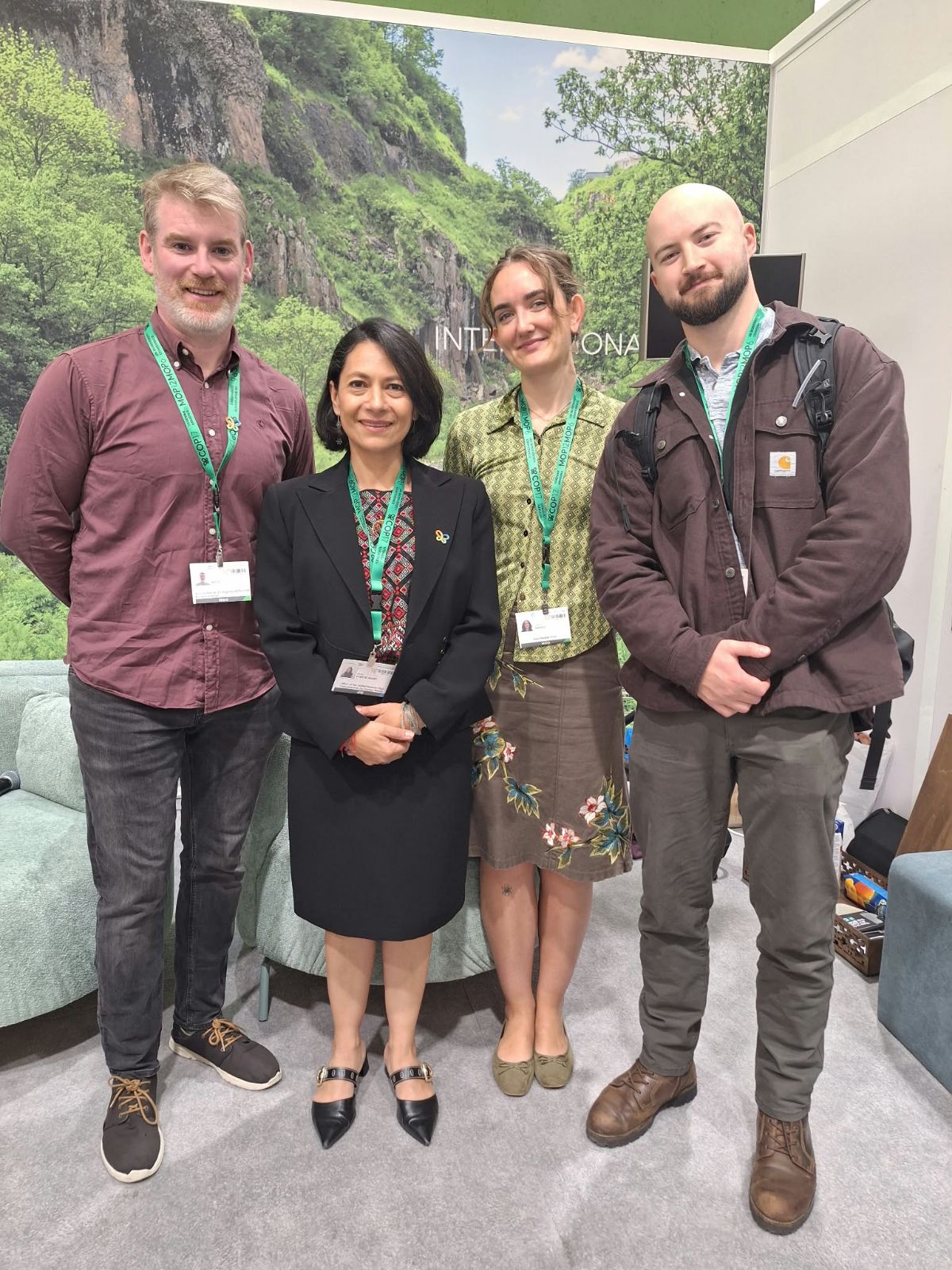
Oisín with Helena Wrenne of Streamscapes, Astrid Puentes Riaño United Nations Special Rapporteur on the human right to a healthy environment and Fintan Kelly of Irish Environmental Network
COP17 marked the halfway point between the adoption of the Kunming-Montreal Global Biodiversity Framework (GBF) and its 2030 targets. While some progress has been made on halting biodiversity loss, the world is not on track to meet the 2030 targets of halting and reversing biodiversity loss and protecting 30% of the world’s land and seas. Geopolitical tensions and competing national interests continued to influence negotiations showcasing the weakness of the UN consensus-based system – where the objections of individual countries can prevent meaningful progress. Russia backed up by Argentina, and Saudi Arabia were successful in watering down language on environmental ambition in the final agreement, while wealthier governments were divided on who would contribute more financial resources.
The question of biodiversity finance remains unresolved, with wealthier nations having fallen significantly short of their commitments to provide funding to support biodiversity protection in developing countries. Negotiations failed to deliver meaningful progress on closing the biodiversity finance gap. The Cali Fund, intended to generate funding for biodiversity conservation and Indigenous communities from commercial entities and private-sector industries who profit from the commercial use of genetic resources, remains largely empty, with decisions on how to mobilise further resources deferred to COP18 in Ecuador in 2028. Investigative reporting also highlighted attempts by pharmaceutical industry representatives to weaken the terms of the Cali Fund.
Despite commitments to reform environmentally harmful incentives, negotiations resulted in weakened language on implementation. The final text merely encouraged accelerated implementation of the relevant GBF target, while governments continue to spend an estimated $1.8 trillion annually on environmentally harmful subsidies including fossil fuel and agricultural subsidies.
Unlike COP16, where negotiations ran so far over time that talks had to resume months later in Rome, COP17 concluded with all major negotiation texts agreed. However, an earlier conclusion is not necessarily a sign of success or meaningful progress. Despite recognising the scale of the biodiversity crisis and the need to accelerate implementation, countries largely failed to translate these acknowledgements into concrete commitments on finance, harmful subsidies and the wider reforms needed to address biodiversity loss.
There were positives with over 50 countries showing how they have protected more than 30% of their ecosystems. Panama is one such example, having surpassed the target years ago. It also recognised the Rights of Nature through legislation in 2022. Environment Minister, Juan Carlos Navarro, called for a universal UN declaration on the Rights of Nature, these calls were echoed by Ecuadorian environmentalist Natalia Greene, who spoke about ‘eco-apartheid’ and the importance of recognising the Rights of Nature.
Throughout the conference, Indigenous representatives spoke powerfully about their relationship with the natural world, their role in protecting biodiversity and the increasing pressures they face. A positive development from the negotiations was progress towards establishing a permanent body within the Convention on Biological Diversity to provide Indigenous peoples with a dedicated advisory channel in decision-making processes, recognising their vital role in protecting biodiversity.
Countries ultimately adopted the Yerevan Pathway, intended to accelerate implementation of the Global Biodiversity Framework over the next four years. There were also new biodiversity funding announcements totalling nearly US$2 billion, alongside progress on the establishment of a permanent subsidiary body to strengthen the participation of Indigenous peoples and local communities in biodiversity decision-making.
These are developments but with just four years remaining to achieve the 2030 Global Biodiversity Framework targets, the outcomes of COP17 fall short of the urgency required. The global biodiversity finance gap remains substantial, and efforts to address environmentally harmful subsidies and transform the economic systems driving biodiversity loss remain inadequate.
We have another set of commitments, pathways and funding announcements. The question is whether the governments will deliver them.
As an Irish delegate attending COP17, I was particularly conscious of how Ireland was represented on the international stage.
Ireland currently holds the Presidency of the Council of the European Union. It was therefore disappointing that Ireland did not have a national pavilion at COP17, as other countries did. There’s an Irish Pavilion planned for COP31 (The Climate COP) so its absence at the Biodiversity COP felt like a missed opportunity to showcase Ireland’s unique island biodiversity and our special relationship with natural heritage in front of a global audience. It could also have provided an opportunity to highlight the work of Irish environmental organisations, which had a strong presence at COP17, contributing to discussions and building relationships with international partners. The highlight being the Fair Seas panel discussion on marine protection, which took place in the Ocean Pavilion.
At the Nature Ministers’ press conference, Minister of State for Nature, Heritage and Biodiversity, Christopher O Sullivan, said that this COP cannot simply become another exercise in producing words. He also spoke about the need to retain commitments to remove environmentally harmful subsidies. It was encouraging to hear this from him. However, the real test of his political leadership is what happens at home.
Ireland is experiencing increasingly visible signs of ecological decline. From the pollution of Lough Neagh and recurring fish kills to wildfires, declining bird populations and the disappearance of wildlife from our increasingly silent fields, the evidence is all around us. Ireland continues to provide substantial support for activities and practices that place pressure on nature, particularly within the agricultural sector. We cannot call for the removal of harmful subsidies internationally while failing to confront the incentives and policies contributing to biodiversity loss at home.
The Irish Government has repeatedly spoken about the need for a Nature Restoration Fund. It must now demonstrate that commitment through adequate funding and delivery. Recent budgetary decisions have not provided the level of ambition required. The Irish Government must show real political leadership in halting biodiversity loss and fund its commitments. Let’s hope that by COP 2028 in Ecuador, we will be in a position to proudly showcase our nature restoration efforts.
Beyond the main negotiations, COP17 provided an opportunity to attend events and meet people working on nature conservation around the world. Among many interesting events was the launch of a new European Forum for Primary and Old-Growth Forests.
I heard familiar discussions about the need to protect existing woodlands, expand forest cover and recognition of the need to reform the mandates of state forestry agencies (something that is particularly relevant to the future direction of Coillte in Ireland). Disappointingly, Ireland has no primary or old-growth forests, even when applying the broader criteria established by the forum. We have no forests on our island where natural ecological processes remain undisturbed to the extent associated with primary forests.
However, we should be trying to change this. We need to move beyond measuring the success of forestry through the number of trees planted or hectares covered. The ecological integrity of our woodlands matters. A rethinking of our relationship with forestry is long overdue. We need to prioritise natural regeneration, rewilding and the protection of existing habitats. We need to recognise the role of natural processes, including predation, in maintaining healthy woodland ecosystems. Healthy forests are essential infrastructure, not simply timber resources.
I also had a fascinating conversation with Dheeraj Jayant, Executive Director of Biflores, based in Brava, Cabo Verde. We discussed the parallels between Ireland and Cabo Verde, when it comes to invasive alien species. Biflores takes a holistic approach to invasive species management, working with local communities to replace invasive species with agroforestry systems and examining the wider social and ecological causes of their spread. Their approach recognises that invasive species management can also create opportunities for community involvement and alternative livelihoods. We also discussed the role of global trade in biodiversity loss and ecological degradation. Ireland knows this problem well. Many of the invasive plants threatening our native habitats were introduced through the horticultural trade in exotic plants.
This conversation raised some interesting questions about how we approach invasive species in Ireland. Can we change public perceptions of invasive species management? Can the removal of invasive plants be connected with positive community and economic outcomes? There are many lessons we can learn from other island communities facing similar challenges to those we face in Ireland.
To read more about Biflores follow the link here: https://biflores.org/
The final days of COP17 were dominated by familiar calls for greater resources, stronger implementation and more ambitious commitments. Every diluted commitment has consequences for the natural world. While governments negotiate over language and funding mechanisms, species continue to disappear and ecosystems continue to deteriorate.
The Global Biodiversity Framework was agreed four years ago. We now have just four years left to meet its 2030 targets. For Ireland, this means putting nature at the centre of government decision-making. It means adequately funding nature restoration, reforming environmentally harmful subsidies, protecting our remaining habitats and ensuring that public bodies lead by example. Nature conservation cannot be treated as a separate policy issue, but must underpin decisions on agriculture, forestry, planning, infrastructure and economic development.
“If the forest breathes, we all breathe.” – spoken by Maimuna Jawara, an Indigenous leader from the Manding Tribe in The Gambia, captures the essence of our relationship with nature which is that nature protection is not separate from our own wellbeing, but essential to it.
Despite the frustrations of COP17, I returned from Armenia with a tentative sense of hope. That hope came from the people and grassroots movements I met and the examples of progress from countries demonstrating what genuine political and community leadership can achieve. The Indigenous leaders at COP17 reminded me of the importance of becoming ambassadors for the natural world. We need more of that spirit here in Ireland. We need to become nature ambassadors in our own communities, standing up for our rivers, woodlands, bogs, coastlines and wildlife.
We cannot allow the shortcomings of international negotiations to undermine our determination to protect nature. If anything, they reinforce the importance of strong civil society movements and public pressure. The Irish Government must match its international commitments with meaningful action at home. But while governments continue to falter, we must not lose hope.
During my time in Armenia, I saw a painting by Ara Bekaryan in the National Gallery. In the mid-1950s, Bekaryan had moved away from his earlier propagandist works, instead focusing on paintings that celebrated the inseparable bond between humanity and nature. This shift formed part of the wider political and cultural ‘thaw’ taking place in the USSR during the 1960s.
Looking at his work, I think we need a similar thaw today: a shift in how we view our relationship with the natural world, away from one based on exploitation and control, towards one rooted in respect and coexistence.
This shift and this hope for change can be built through action. On 14 November The Irish Wildlife Trust alongside many colleagues and friends will be marching in Dublin for the climate rally, to demand the political leadership that nature urgently needs. Join us on the day and follow the Irish Wildlife Trust, subscribe to our updates and get involved in the work to protect and restore nature.
We cannot afford to be passive in the face of biodiversity loss. We can build hope through action.
***