
Menu
Published online 13/2/2026
Grace Carr
Call to action – Write to the Minister asking him to prohibit the use of tangle nets to prevent the extinction of critically endangered shark and ray species
Thousands of endangered and critically endangered species are being caught and killed in Ireland’s inshore areas from a fishing method known as tangle netting. We are calling on the Minister to ban this destructive practice and support a transition to a lower impact fishing method. Tangle nets are deployed on the seabed in certain areas along the west coast and south coast and left for up to a week and a half targeting crayfish (also known as crawfish). There are no restrictions to the amount of nets allowed and so thousands of kilometres are being used.
This fishing method is extremely indiscriminate and the nets end up catching anything that crosses their path. The Marine Institute released a report showing the shocking numbers of non-target species caught in a 4 year period. Most of the data on catch and bycatch in the report were obtained in the area from Kerry Head south to the Blasket Islands. Smaller amounts of data were collected further south close to Castletown Berehaven. The report also makes it clear that these numbers are severely underestimating the true extent of the damage.
The estimated numbers of species caught in tangle nets from the sampling area was –
– 1161 protected grey seals were caught.
– 81 critically endangered angel sharks. The report specifically states that this level of bycatch ‘increases the risk of extinction for this species.’
-1712 critically endangered flapper skate
– 500 endangered tope shark
– 80 endangered stingrays
– 8000 endangered spurdog
There were thousands of other individuals caught as bycatch including crabs, lobsters and other commercially valuable fish. Low numbers of endangered undulate ray, risso dolphin and common dolphin were also caught. It is reported that approximately 33% of the crayfish caught in Tralee were below the minimum landing size and 62% of those caught were below the minimum landing size in Dingle.
Habitats Directive
The Government has a legal obligation to protect certain species such as grey seals and dolphins under the Habitats Directive and this fishing method is in clear violation of those obligations.
Marine Strategy Framework Directive
Ireland has failed to achieve Good Environmental Status for 84.5% of the 142 fish species assessed through the Marine Strategy Framework Directive. Allowing a fishery with such high levels of bycatch to continue is not aligned with improving this number. Descriptor 1 of the MSFD looks at biological diversity and criteria 1 addresses bycatch. ‘It states, ‘the mortality rate per species from incidental by-catch is below levels which threaten the species, such that its longterm viability is ensured.’
OSPAR
Ireland is a contracting party of the OSPAR convention and should implement the recommendations made through this convention for protecting declining species. The list of declining species under OSPAR includes the critically endangered angel shark and flapper skate. Each contracting party should ‘take relevant conservation measures in key areas where significant numbers of these species would still occur’
Nature Restoration Law
Under the EU Nature Restoration Law, Member States must put in place measures to restore the habitats of different marine species, including angel sharks.
Common Fisheries Policy
States that Member States shall adopt conservation measures. Types of conservation measures may include, ‘modifications or additional devices to reduce the incidental capture of endangered, threatened and protected species, as well as to reduce other unwanted catches; limitations or prohibitions on the use of certain fishing gears, and on fishing activities, in certain areas or periods; requirements for fishing vessels to cease operating in a defined area for a defined minimum period in order to protect temporary aggregations of endangered species & specific measures to minimise the negative impact of fishing activities on marine biodiversity and marine ecosystems, including measures to avoid and reduce, as far as possible, unwanted catches.’
We at the Irish Wildlife Trust, have been engaging with fishing communities and believe it’s important for all stakeholders to work together to come up with solutions to protect the marine environment and help preserve sustainable livelihoods. In the case of tangle netting, there is no time to lose in banning this practice. The evidence is clear that this fishing method is not sustainable and that it poses a significant risk to the survival of critically endangered species. On a national scale the economic returns of this method could be easily compensated by the state and that should be a priority. There are also sustainable alternatives for fishing crayfish such as pots and therefore there is no reasonable argument to allow for tangle netting to continue.
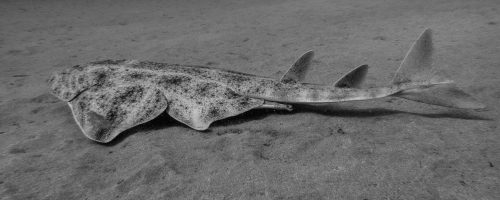
Photo credit: LuisMiguelEstevez, Shutterstock
It is vitally important that the Department for Agriculture Fisheries and the Marine and Minister Martin Heydon introduce bylaws to prohibit the use of these nets. Sending emails to your local TDs as well as to Minister Heydon and Minister Dooley highlighting your concern, will show political leaders that this is an issue that needs addressing urgently. Below is a suggested template you can use and adjust to send to Minister Heydon and Minister Dooley
Minister Heydon – martin.heydon@oireachtas.ie
Minister Dooley – timmy.dooley@oireachtas.ie
Minister ……
I am writing to ask that you introduce bylaws to prohibit the use of tangle nets in Irish coastal waters. The Marine Institute released a report showing the shocking numbers of non-target species caught in a 4 year period in the tangle net fishery along the south west coast. The report also makes it clear that these numbers are severely underestimating the true extent of the damage.
An estimated –
– 1161 protected grey seals were caught.
– 81 critically endangered angel sharks. The report specifically states that this level of bycatch ‘increases the risk of extinction for this species.’
-1712 critically endangered flapper skate
– 500 endangered tope shark
– 80 endangered stingrays
– 8000 endangered spurdog
There were thousands of other individuals caught as bycatch including crabs, lobsters and other commercially valuable fish. Low numbers of endangered undulate ray, risso dolphin and common dolphin were also caught. It is reported that approximately 33% of the crayfish caught in Tralee were below the minimum landing size and 62% were below the minimum landing size in Dingle.
There are alternatives for catching crayfish and prohibiting the use of these nets does not mean the end of this fishery. A transition to a more environmentally friendly fishing method needs to be supported. The Irish Government has legal obligations to protect species under the EU Birds and Habitats Directive and under international agreements such as OSPAR, contracting parties should put in measures to protect threatened or declining species. The issue of tangle netting needs to be addressed as soon as possible.
Go raibh maith agat,
Link to report –