Menu
First published: 05 August 2026
by Charlotte Salter-Townshend, IWT Communications & Network Officer
The theme for National Heritage Week this year was “Heritage at Risk”. At a time of accelerating environmental change, social transformation, and technological shift, the theme invites us to reflect on what is putting our heritage at risk — and how we can respond with care, creativity, and collective responsibility.
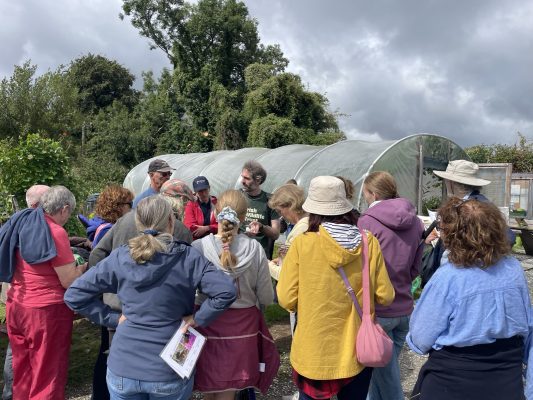
People for Bees workshop at Kenmare Community Gardens
On a Sunday afternoon, the IWT Limerick Branch set out from Ringmoylan Pier at the Shannon Estuary to explore the specialised plants of the salt marsh and river bank. Two experts, Tom Harrington, Emeritus Lecturer in plant science, ecology, and genetics University of Limerick, and Olly Lynch, Vice-County Recorder for the Botanical Society of Britain & Ireland, led the excursion.
Over in Kerry, IWT CEO Kieran Flood led a People for Bees workshop at the Kenmare Community Garden. The event was run with the support of Kenmare Tidy Towns and Kenmare Community Care. Attendees learned about the life cycles of Ireland’s wild bees, how to identify some common species, and what you can do to help protect them. More than half of Ireland’s bee species have undergone substantial declines in their numbers since 1980 and many are threatened with extinction. This is a prime example of Ireland’s heritage at risk but it is not too late to take action to save Ireland’s bees. The latest phase of the All-Ireland Pollinator Plan aims to create ‘pockets for nature every 200 metres’ across the island of Ireland. We are a proud partner in the Buzzing Communities category, where we work to help communities take action. Our People for Bees workshops focus on actions people can take to help protect and restore our wild bee populations.
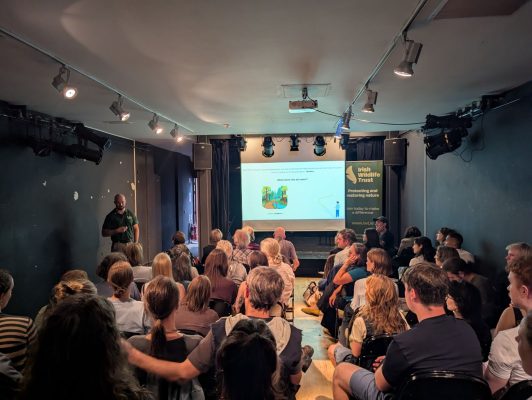
Natural Heritage in Ireland: Reverence, Ruin, Restoration, and Rights with IWT Nature Advocacy Officer Oisín Ó Néill at the Pearse Centre
Our lecture for Heritage Week was delivered by IWT Nature Advocacy Officer, Oisín Ó Néill, at the Pearse Centre in Dublin. In an expansive talk traversing history, culture, language, and ecology, he explored Ireland’s changing relationship with the natural world, from a time when nature was revered, feared, and culturally protected through myth, folklore, and tradition, to an era where it became increasingly managed, exploited, and separated from human identity. Tracing the emergence of conservation through the development of the Irish State, he explored the tensions between economic expansion and the protection of nature, before looking at today’s shift from conservation to restoration, repairing ecosystems, restoring habitats, and rebuilding our relationship with the natural world. The talk concluded by exploring the emerging concept of Rights of Nature, a legal and cultural approach that recognises nature’s inherent value and right to exist, flourish and regenerate, reflecting an older understanding that humans are part of, rather than separate from, the living world.
IWT Communications & Network Officer Charlotte Salter-Townshend joined the Dublin 8 Green Bridge Forum and Inchicore Environmental Group for a Heritage Week nature walk in Lansdowne Valley Park. Dublin 8 Green Bridge Forum is a community-led voluntary group focusing on blue & green spaces, under the umbrella of the Inchicore Environmental Group. They do regular clean-ups and meet ups in the area. Lansdowne Valley Park is full of wild corners thanks to the maintenance and stewardship of Dave Moore of Dublin City Council. Tracing the banks of the River Camac, we took a closer look at plants and insects that indicate the heritage of the area, such as Mugwort ( Artemisia vulgaris) and gall wasps, and discussed why spaces like this linear park are so important for urban biodiversity. We also touched upon local history and heritage of the river, exploring the myriad ways in which it connects people and nature in the city.
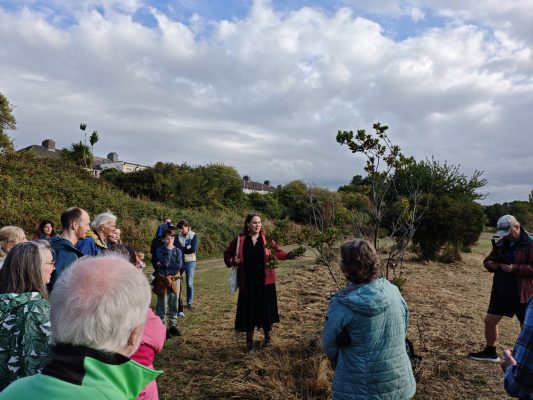
Down the Crooked Glen: A walk along the River Camac at Lansdowne Valley Park, Inchicore.
Finally, as dusk descended, IWT Dublin Branch and Kieran Flood led a very popular Bat Walk at St Anne’s Park in Raheny. Using bat detectors, we heard and identified calls of species including Common Pipistrelle and Leisler’s Bat and discussed their vital role in our ecosystem. Despite their tiny size, one little bat can eat up to 3,000 midges and small bugs in a single night!
Thanks to the Heritage Council for their generous funding through the Heritage Organisation Support Fund and to our collaborators and hosts this Heritage Week. We look forward to continuing to forge these connections between local communities and between culture and nature.
If you value our work, please consider supporting us by becoming a member or join our mailing list to receive regular updates from the Irish Wildlife Trust.
