Menu
First published online: 10 July 2026
The National Restoration Plan represents a historic opportunity, as arguably the most significant piece of biodiversity legislation to bind Ireland in a generation. The destruction and degradation of the ecosystems around us threatens not just our beautiful wild species but our way of life. Ireland needs a National Restoration Plan that reflects the scale of that opportunity and the scale of the environmental crisis we face. At present, this draft doesn’t do that. We welcomed the opportunity to submit to the public consultation on Ireland’s draft National Restoration Plan, but we were disappointed by the contents and lack of ambition highlighted in the plan and we believe it risks falling short of what is legally required and ecologically necessary.
The section on marine life is hugely underdeveloped. No new measures to help with the restoration of marine ecosystems were highlighted and the measures that were listed are ones that are already occurring and have so far failed to effectively protect, let alone restore, marine ecosystems. Many of the schemes mentioned in the plan also end in a few years and there doesn’t appear to be any long term vision for the restoration of marine ecosystems, even though the legal requirements of the Nature Restoration Law are up to 2050.
While the land sections are more developed than the marine section, it still falls well short of what is needed to meet the ambitions of the Nature Restoration Regulation. Overall, the plan lacks the ambition required to restore nature at the scale of the biodiversity crisis. It fails to demonstrate how the State will lead restoration on public land, despite repeatedly stating that this will be the primary delivery mechanism. There is little detail on the long-term funding needed to restore habitats or to provide meaningful incentives for private landowners to participate. Finally, the plan lacks joined-up thinking across Government, with little integration between the National Restoration Plan and other key initiatives and delivery bodies, such as the proposed National Invasive Species Bureau, whose work will be essential if restoration efforts are to succeed.
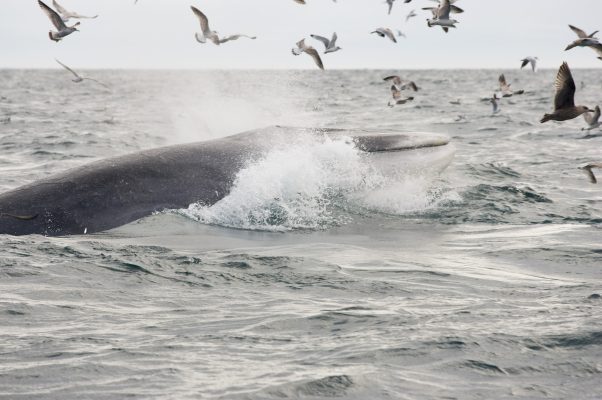
Fin Whale. Photo: Mike Brown
The main shortcomings of the marine section of the plan are as follows –
The National Parks and Wildlife Service (NPWS) have grossly underestimated the area coverage of habitats included within the law. Having these low numbers then allows them to set the areas needed for restoration at much lower coverage than what is actually needed. These numbers undermine the entire concept of the Nature Restoration Law and what it is trying to achieve.
Countries are required to re-establish habitats where they have been lost and bring them back to a Favourable Reference Area (FRA). The plan has not set any reestablishment target for marine habitats and has set FRAs as their current (grossly underestimated) coverage. FRA for terrestrial habitats has also been set incredibly low and does not take into account the Commission’s guidance or the legal requirements of the NRR which states that comprehensive evidence from historical datasets, ecological needs, and expert opinion should be taken into account.
The last Article 17 Habitats Directive report listed 12 out of 14 marine habitats to not be in good ecological condition. One of the main pressures listed was fishing. From engaging with fishing communities, we know that many are asking for better (or any) management plans to be put in place for different species. This doesn’t appear to be happening and fishing communities, as well as civil society, know that this will result in a collapse in these species populations.
Currently fisheries are not effectively managed in protected areas. The system that is in place is complicated and it is extremely difficult to get information on how activities are assessed and managed. The plan states that a risk assessment is undertaken of fisheries around protected areas, but the last evidence online of this happening is from 2015. We have asked for clarity on this situation and for the process to be made transparent and available for the public.
Since Irish offshore waters are shared waters, Joint Recommendations through the Common Fisheries Policy are the only way to manage fishing activity in protected offshore sites. The plan offered an opportunity for the Irish Government to start documenting how they intend to initiate them. They did not do this. They stated that they will wait until they have decided on the percentage coverage of soft sediments that need to be restored before adding any more information on Joint Recommendations. There is no set timeline for when this percentage must be decided and no targets for the restoration of these habitats for 2030, so in essence we feel that this is a way to delay the process.
There are targets in the Nature Restoration Regulation to have restoration measures in place on 30% of reef habitats in bad ecological condition by 2030 and Ireland’s offshore marine space has several cold water coral forests within it. In fact the two largest protected areas designated in Ireland’s offshore areas have reefs as their qualifying interests, and yet the NPWS and the Department of Agriculture, Food and the Marine did not even attempt to document the steps they plan to take to effectively protect these areas. Aside from this being a failure to achieve the legal targets of the Nature Restoration Regulation, it will also stop Ireland from reaching the globally agreed target of having 30% of its waters designated as protected areas by 2030.
The main shortcomings of the land sections of the plan are as follows –
Throughout the process of preparing for this draft Nature Restoration Plan the government has consistently stated that restoration efforts will be led on public land. Civil society and academics have all agreed that the State must lead by example on the land it already owns and this was the main recommendation of the Independent Advisory Committee on Nature Restoration. In the Irish context, it is the only realistic route to delivering restoration at the pace and scale the law requires. Coillte and Bord na Móna are named in the plan as key delivery partners for restoration. On the surface, that sounds like a sensible idea as between them and other public bodies, the State controls somewhere in the region of 8–11% of the country’s land area, land that could be restored at scale without the years of negotiation that restoration on private land inevitably requires.
The problem is that neither body has actually been given the mandate to do it.
Coillte still manages roughly 73% of its estate as commercial conifer plantation, much of it Sitka Spruce. This model of forestry has consistently been shown to drive biodiversity loss, with sedimentation and acidification impacting rivers and streams, alongside the replacement of native habitats with monocultures. It makes little sense to expect Coillte to lead nature restoration while continuing to operate under a commercial forestry model that actively damages nature. The draft plan itself uses language that commits the company to nothing more than the suggestion that it “can contribute towards” national restoration targets.
Beyond the rehabilitation work Bord na Móna is already legally obliged to undertake under its EPA licence, the plan contains no additional commitment to restoring its land. This is despite EPA assessments indicating that around 70,000 hectares of Bord na Móna land requires rehabilitation if Ireland is to meet its climate targets for agriculture and land use by 2050.
The plan places the State’s two largest landowners, both of whom are still operating under legal mandates centred on commercial extraction, in charge of delivering nature restoration on their land. Under their current economic models, nature restoration will be little more than a side effect of business as usual. That is not a sustainable restoration model.
Private land restoration depends on farmers and landowners voluntarily participating in schemes that have historically been underfunded and poorly subscribed. Payments through ACRES and the Eco-Scheme are welcome, but they remain nowhere near sufficient to drive land-use change at the scale required. The draft NRP fails to identify any credible funding pathway capable of closing that gap.
That leaves public land as the one lever the State can pull without waiting for anyone else’s consent. It is land the State already owns, already controls, and could restore at scale if the political will existed.
An example of how disconnected this draft is from wider Government policy is its treatment of the issue of invasive alien species.
Invasive species are now recognised as the second greatest pressure on Irish biodiversity, behind agriculture pressures. Ireland’s most recent Article 17 reporting identifies them as a major driver of biodiversity decline across threatened habitats. They are also one of the few pressures capable of actively undoing restoration work after it has already been completed, wasting both time and public money.
The Government has separately announced plans to establish a new National Invasive Species Bureau. You would expect a restoration plan drafted alongside that announcement to embed the Bureau as the operational backbone of Ireland’s invasive species response with clear responsibility, a binding national strategy and landscape-scale delivery programmes. Instead, the Bureau is not mentioned once, highlighting the lack of joint up thinking between departments on the matter of nature restoration and reducing the pressures nature faces.
The plan also misses another crucial opportunity: setting measurable national targets for invasive species control. Without clear objectives, delivery becomes almost impossible to assess. Targets should be established for priority invasive plants such as Rhododendron and Himalayan Balsam, alongside landscape-scale management targets for deer populations. Deer, particularly Sika and expanding hybrid populations, are one of the greatest barriers to woodland regeneration and habitat recovery in Ireland, yet they barely feature in the draft. Restoration cannot succeed if browsing pressure continues unchecked. Deer management needs to sit alongside invasive plant control as a core component of restoration.
Without a properly resourced, legally binding invasive species strategy underpinning restoration, a significant share of the investment made through this plan risks being undone before restored habitats have had the opportunity to establish.
The Nitrates Derogation is a licence to spread more organic nitrogen per hectare on land than is routinely permitted under the Nitrates Directive. Organic Nitrogen is livestock manure applied to the land each year, including by the animals themselves. Under the Nitrates Derogation, roughly 7,500 Irish dairy farms are permitted to spread livestock manure at rates of up to 250 kg of nitrogen per hectare, well above the standard 170 kg limit established under the EU Nitrates Directive.
The consequences are well documented. Agricultural nutrient pollution remains the single biggest reason Irish rivers, lakes, estuaries, and coastal waters fail to achieve good ecological status under the Water Framework Directive. Dairy intensification since the abolition of milk quotas has measurably worsened water quality in catchments containing Special Areas of Conservation and Special Protection Areas designated precisely for the freshwater habitats this plan is supposed to restore.
Elsewhere, the draft NRP acknowledges that Ireland needs to identify and phase out environmentally harmful subsidies, pointing to more than €634 million annually in public expenditure considered likely to damage biodiversity.
The Nitrates Derogation, one of the policies most responsible for the continued decline of Ireland’s freshwater ecosystems, is missing from the Nature Restoration Plan altogether. There is no acknowledgement of the Nitrates Derogation, no commitment to phasing it down, and no indication that Ireland would oppose its renewal when it next comes before the European Commission.
The draft NRP cannot claim to provide a roadmap for freshwater restoration while remaining silent on one of the main causes of freshwater pollution. Ignoring the derogation is one of the clearest examples of the plan’s lack of ambition and its unwillingness to confront the policies driving biodiversity loss.
Despite containing more detail than the marine chapter, the terrestrial section still falls well short of the ambition needed to deliver nature recovery at the scale required by the Nature Restoration Regulation. Much of the chapter repackages existing schemes, strategies, and policy commitments rather than setting out genuinely new restoration measures, with many actions focused on developing further plans instead of delivering measurable ecological outcomes.
Ultimately, however, the biggest unanswered question is funding. Throughout the document there are references to existing schemes, future funding opportunities, and mechanisms yet to be developed, but there is no credible explanation of how restoration at the scale required by the Nature Restoration Regulation will actually be paid for. The plan requires long-term, dedicated investment to achieve its commitments. More fundamentally still, the draft lacks ambition and there doesn’t appear to be the cross departmental work and coordination that is needed in order to address the main issues impacting biodiversity.
Conclusion
Ireland is in the midst of a biodiversity crisis. Around 90% of our protected habitats are in unfavourable condition. We rank among the bottom 10% of countries globally for biodiversity intactness. Nature is on its knees. So why then are the NPWS and the Government departments responsible for this continuing to show little to no ambition when it comes to trying to bring back nature?
This should have been the moment for a bold restoration plan that fundamentally changes how the State manages land and invests in nature. Instead, too much of the draft is characterised by cautious language, voluntary measures, and an unwillingness to confront the policies driving biodiversity loss in the first place.
If you value our work, please consider supporting us by becoming a member or join our mailing list to receive regular updates from the Irish Wildlife Trust.