
Menu
First published online 05/06/2026
Oisín Ó Néill, Nature Advocacy Officer
Irish Wildlife Trust calls for prosecution and urgent action to address agricultural pollution
On 4 June 2026, news broke of a devastating fish kill in the River Glyde, Co. Louth. More than 20,000 fish have been confirmed dead so far, including Minnows, Sticklebacks, Salmon, Eels, Brown trout, Roach, and Pike. Inland Fisheries Ireland (IFI) announced that it was pursuing a definitive line of enquiry and subsequently reported that the source of the pollution had been identified as an agricultural discharge. For anyone concerned with the health of Ireland’s rivers, fisheries, and wider natural environment, this is absolutely appalling news.
Appalling, yes. Shocking? Not at all.
Irish rivers remain at the mercy of the island’s largest source of water pollution and greenhouse gas emissions: the agricultural sector, particularly the intensive dairy industry. In 2023, agricultural interests lobbied aggressively in Europe to retain Ireland’s nitrates derogation — effectively a licence to continue polluting at levels beyond standard EU limits. The EU Nitrates Derogation allows Irish farmers to stock animals at higher densities — up to 250kg of livestock manure nitrogen per hectare, compared with the standard EU limit of 170kg/ha. Ireland now holds the ignominious distinction of being the only EU member state still operating under this exemption. The derogation weakens the intent of the EU Nitrates Directive, a vital measure designed to protect rivers, lakes and groundwater from pollution caused by excessive agricultural nutrients.
The Environmental Protection Agency (EPA) has repeatedly highlighted the deteriorating state of Irish water quality. Recent assessments show that around half of Ireland’s rivers and two-thirds of its estuaries are polluted. Agricultural nitrogen from slurry, manure and chemical fertilisers remains one of the principal causes of this decline. The Irish public overwhelmingly support clean, healthy waterways. Polling by Ireland Thinks at the time found strong public backing for protecting water quality, with most respondents opposed to Ireland seeking a further nitrates derogation. Yet the dairy industry got its way. In exchange, Ireland has received rivers choked by agricultural runoff, waterways rendered unsuitable for swimming or drinking, and landscapes increasingly dominated by nutrient pollution. The beneficiaries are export-driven dairy and beef industries that continue to sacrifice the ecological health of Irish rivers in pursuit of ever-higher yields.
In the 2026 Community Conversations on the Nature Restoration Law, clean water emerged as the primary concern, with communities calling for urgent action to restore Ireland’s rivers, lakes, and coasts. Yet despite these concerns, Irish river quality continues to decline. Many water bodies are in deteriorating ecological condition, with Lady’s Island Lake in Wexford and Lough Neagh among the most visible examples of ecosystems severely damaged by nutrient pollution and agricultural runoff. As for fish kills, what happened on the River Glyde is sadly not unusual. Excessive nitrate pollution drives eutrophication, a process in which nutrient enrichment fuels algal blooms and excessive plant growth. When these blooms die and decompose, oxygen levels collapse, often causing mass fish mortalities.
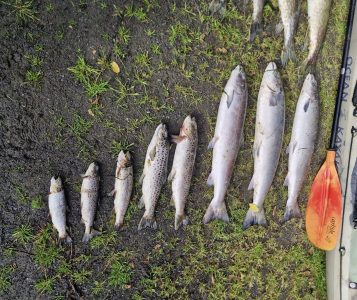
Five dead brown trout, three dead salmon. Photo: Inland Fisheries Ireland.
In 2025, the Munster Blackwater suffered a major ecological disaster, as many as 40,000 fish were killed in a single pollution event. While 66% of waters within the Blackwater catchment retain High or Good status, nitrate concentrations remain persistently elevated. Long-term nutrient enrichment had already weakened the river system. Whether the final trigger was wastewater, industrial discharge, accidental pollution, or environmental conditions such as warm temperatures and algal die-off, the result was catastrophic. No definitive source was ever identified and no prosecution followed.
A major report by Inland Fisheries Ireland examining fish kills between 1969 and 2022 paints a deeply troubling picture. Fish kills occurred in every county in Ireland during that period. Hotspots were concentrated in the east, south and north midlands, overlapping with areas of intensive agriculture and large urban centres. Most significantly, agriculture was identified as the single largest cause of fish kills, accounting for 23% of all recorded incidents. This was followed by eutrophication (13%), industrial pollution (12%), municipal sources (8%), mining (3%) and construction (2%).
What happened in Louth should be called what it is: ecocide. IFI stated: “The source of the pollution has been identified as an agricultural discharge, and has been stopped.” Prosecution must follow. But accountability for individual incidents is only part of the solution. The deeper problem is systemic. Ireland’s rivers continue to be degraded by a model of agricultural production that places short-term economic output above ecological health. Our rivers are not expendable. They are the lifeblood of our landscapes, ecosystems and communities. How much longer will this continue? How much longer will the Irish public — who consistently express support for clean water and healthy rivers — be forced to watch as powerful agricultural lobby groups travel to Brussels seeking exemptions from environmental protections?
The River Glyde fish kill is not an isolated tragedy. It is another warning.
References
Image: Deceased salmon recovered from River Glyde by IFI (Inland Fisheries Ireland) staff
If you value our work, please consider supporting us by becoming a member