Menu
by Charlotte Salter-Townshend, IWT Communications & Network Officer
First published online: 25 June 2026
Invasive Species Week is coordinated by the National Biodiversity Data Centre (NBDC). As part of Invasive Species Week (22–28 June 2026), the Irish Wildlife Trust (IWT) is encouraging gardeners, landowners, community groups, and local authorities to take simple but powerful actions to help nature recover.
The message is straightforward:
We are highlighting positive, practical actions that anyone can take, whether they have a large garden, a community space, a schoolyard, or even a small patch of lawn. To share this important message, we held a collaborative webinar with landscape designer, environmental activist, and founder of We Are The Ark, Mary Reynolds. Watch the webinar here.
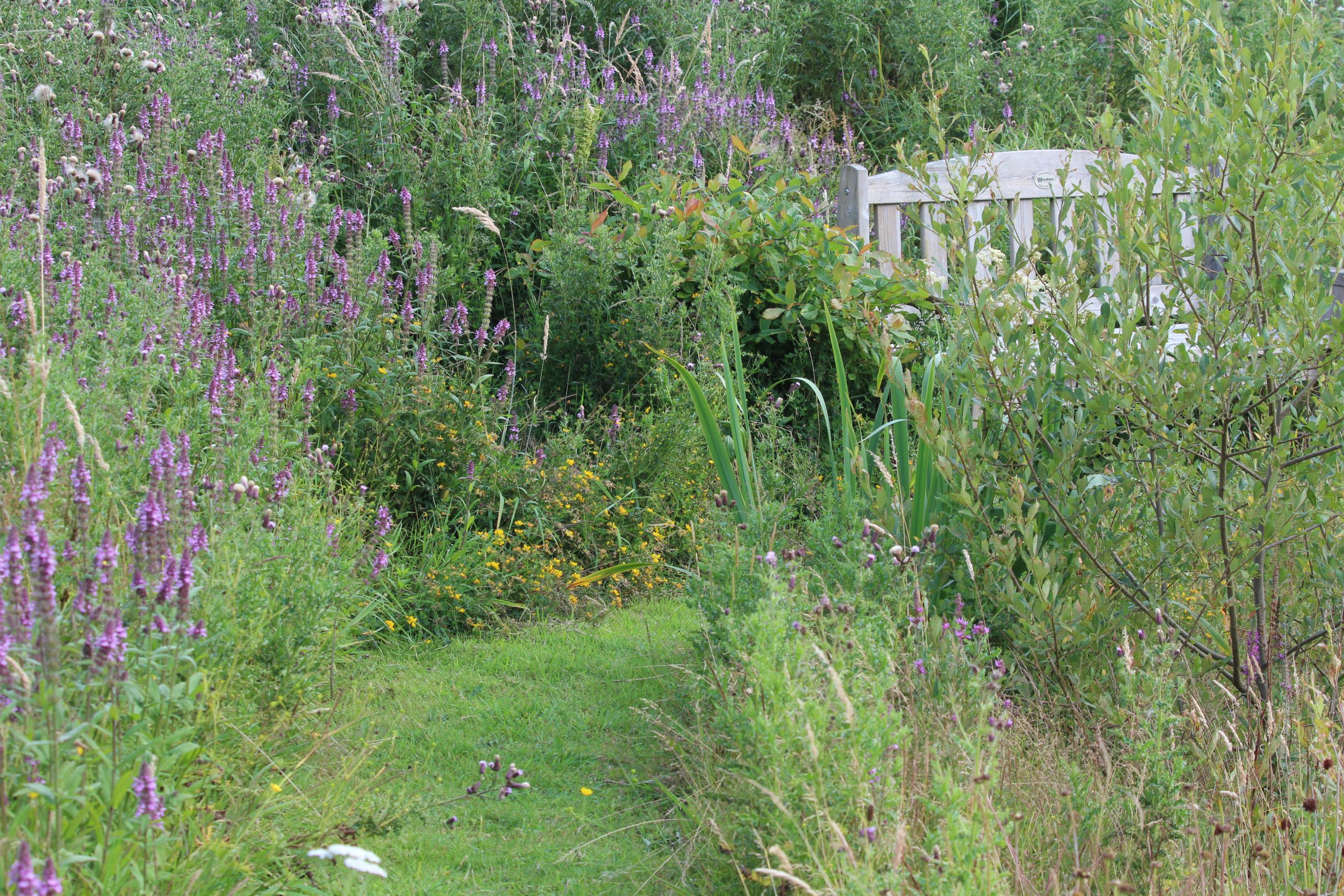
Wild perennial borders with mown path. Photo: Claire Leadbitter
Invasive plants – what’s the damage?
Invasive plant and animal species are the second greatest driver of nature loss both worldwide and in Ireland, after habitat destruction (United Nations Environment Programme, 2023). An invasive species is a plant, animal, or pathogen that is brought into a new environment and which spreads quickly, causing harm to local nature, economy, or human health. They are found in our freshwater, the marine environment, and on land.
Not only do invasive species outcompete native species and displace plant and animal communities, they alter the very function of ecosystems and ecosystem services, with socio-economic ramifications and impacts on human well-being.
Most invasive plant species were first introduced for ornamental or hedging purposes. Now introduced plants outnumber native ones in the wild across Ireland. Of the almost 1,939 flowering plant species recorded in the wild in Ireland, there are more introduced species (987) than there are native species (952) (BSBI Plant Atlas 2020 press release).
What are the effects of this imbalance? The Botanical Society of Britain and Ireland (BSBI) Plant Atlas 2020 found that more than half of Irish native plant species have declined in range and abundance or both. By contrast, 80% of the species introduced into Ireland since 1500 have increased. Some of these are well-known invasive species such as Cherry Laurel (Prunus laurocerasus) and Japanese Knotweed (Reynoutria japonica).
Actions
Plants are both food and habitat for most of our land-based animals. By focusing on native plants and stopping the spread of invasives, we can rebuild habitats and biodiversity from the ground up, with cascade effects on the rest of our wildlife.
Key actions include allowing native plants to naturally regenerate and planting local provenance hedgerows and trees instead of introduced species. Below we share examples from our community and partners, including the IWT Monaghan Branch and Mary Reynolds (activist and founder of We Are The Ark), which can be readily replicated in your local area.
Be Plant Wise
Being plant wise means choosing the right plants for your garden (never purchasing or planting invasive species), keeping your plants in your garden (don’t allow them to disperse into the wild), and disposing of your unwanted plants responsibly (compost with care). See the NBDC Be Plant Wise page for details.
For up-to-date information on invasive plants, be sure to check the latest edition of Ireland’s Regulated Invasive Plant Species (2025) and bear in mind that some species that are highly invasive are not yet regulated. Three new species were added in this latest publication – Black Wattle (Acacia mearnsii), German Ivy (Delairea odorata), and Paper Mulberry (Broussonetia papyrifera) – but Cherry Laurel surprisingly was not. Information on the problem of Cherry Laurel by the Gaelic Woodland Project is available here.
This for that
Looking for native substitutes for typical garden plants? Réabhlóid ar Chúl an Tí, a TG4 series hosted by Mary Reynolds and Aedín Ní Thiarnaigh, seeks to change the way we view our gardens by turning gardeners into guardians. The hosts visit a selection of Ireland’s suburban neighbourhoods, community centres, and schools and instigate change by adding in curated pockets of thriving, native plants in order to attract wildlife back into these spaces.
A reformed internationally recognised landscape gardener, Mary Reynolds has first-hand experience of the forces that push for sales of non-native plants when our own wildlife is under immense pressures on several fronts, including the spread of invasive plants.
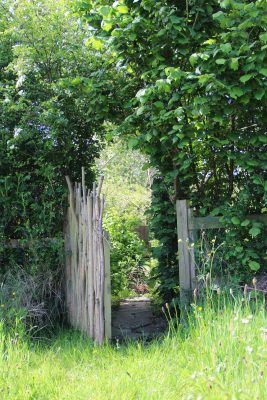
Photo: Claire Leadbitter’s Irish forest garden
Mary advocates for a grassroots movement to restore our wild habitats.
She said:
On Reabhlóid ar Cúl an TÍ, Mary gives examples of how native plants transform sterile, lifeless lawns and schoolyards into thriving mini-ecosystems. She replaces non-native species with native ones (either from letting nature take the reins or helping along with local provenance seeds). Follow the series on social media for advice on replacing “this for that”.
If you like the feathery leaflets and white flowers of the False Acacia (Robinia pseudoacacia) tree (a popular garden plant from North America), why not try planting the native Rowan (Sorbus aucuparia) instead? It produced beautiful clusters of white flowers which are followed by the iconic red berries in autumn and winter. These berries feed a multitude of birds and mammals including Song and Mistle Thrushes, Blackbirds, and winter visitors like the striking Waxwing. Additionally, if you plant Rowan among your fruit trees it will help keep them free from disease thanks to the fungal community associated with its roots!
Seeds of Inspiration
When planting native species, it is important to source the seed from as close to your locale as possible. Hard lessons have been learnt (we hope) from the importation of plants from overseas. Fireblight, which infects trees and shrubs in the rose family, including Hawthorn (Crataegus monogyna), was introduced to Ireland via imported hedgerow plants. The Ash Dieback disease was introduced to Ireland when Ash trees (Fraxinus excelsior) were imported from the Netherlands. Hawthorn and Ash are both foundational keystone native trees and are present throughout the land. Ash Dieback and Fireblight are just two examples of needless and devastating introductions that will affect us for many years to come (just like the Dutch Elm Disease). But there is hope. Plants have a remarkable capacity to adapt thanks to their very high genetic diversity – for example, the Scot’s Pine (Pinus sylvestris) is eight times the size of the human genome. A small number of Ash have natural resistance to the dieback (Metheringham et al, 2025). This is why we need to protect young Ash trees, any of which may hold resistance in their genetic code.
Well-established, local provenance seed stock has adapted over generations to fit local micro-climates and microbiomes. Hence, plants sourced locally tend to thrive and form better connections with wildlife. When purchasing native trees, always ask if they have been grown locally. Or even better, try propagating your own trees.
Recently, the IWT Monaghan Branch and Monaghan County Council Biodiversity Office launched the Seeds of Inspiration project, sharing the practical expertise of John McKeon, a Castleblayney man who has spent 25 years growing, preserving, and championing Ireland’s native trees. Seeds of Inspiration encompasses several resources available on the IWT website and YouTube. A feature-length film captures John McKeon’s extraordinary work and dedication to preserving trees of Monaghan provenance. This is complemented by a series of short video guides teaching people how to easily propagate and grow individual native tree species from seeds or cuttings. An accompanying book is also available for free download in both English and as Gaeilge.
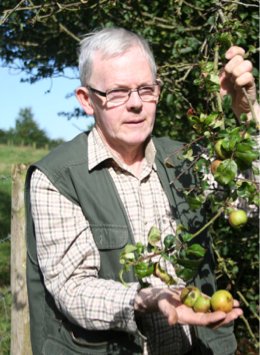
John McKeon, Seeds of Inspiration
John was an agriculture adviser for most of his career and in his own words he was responsible for advice causing a lot of environmental damage (such as removal of hedgerows to enlarge fields). Since retirement, he has taught himself to save seeds from wild trees around him in Co Monaghan and grow native trees. His life-long experience growing his own fruit and vegetables informed his technique and with some trial and error and a gardener’s patience, he has succeeded in developing remarkably high levels of success in propagating 20 native tree species. This includes classic hedgerow plants like Hawthorn (Crataegus monogyna) and Blackthorn (Prunus spinosa) as well as wonderful rarities such as Purging Buckthorn (Rhamnus cathartica) and Wild Privet (Ligustrum vulgare).
John has been quietly and steadfastly carrying out his work sourcing seeds in woodlands and country laneways, and propagating trees in his own and several borrowed gardens. It turns out a small patch of lawn can be converted into a tree nursery with dozens of saplings. What John has achieved is nothing short of remarkable. He has shown how we can turn around the consumerist mindset to work as a community and share our natural resources. The IWT Monaghan Branch together with the Monaghan County Council Biodiversity Office (with funding from the NPWS) have captured not only John’s practical advice but also a story to inspire us all. His methods of collecting local provenance seeds and saplings could be replicated across the whole island of Ireland. John’s call to action is to create a “land army” of gardeners growing native trees. If you love gardening and nature, what’s stopping you?
A closer look – Why are some plants invasive?
Specific insects, fungi, and herbivores have evolved to feed upon or infect plants within their native range. These are complex, long-established, balanced systems that keep populations in check. When plants are introduced to a new region, these natural controls are left behind, allowing them to grow without interference. Some native Irish plants are invasive elsewhere, e.g. Common Gorse (Ulex europaeus) in New Zealand, Chile, and even as far as the sub-Antarctic Falkland Islands (Islas Malvinas).
Some invasives, most notably Rhododendron ponticum, release toxins into the soil to inhibit the growth and germination of surrounding plants, clearing huge swathes of land for themselves. These toxins suppress competing plants by inhibiting seed germination and preventing the development of crucial mycorrhizal fungi on the roots of other plants (essentially starving them).
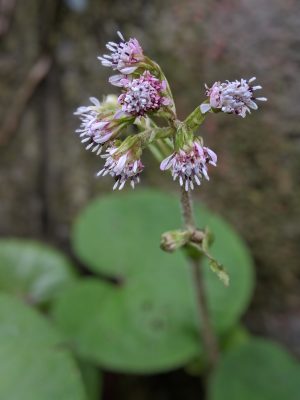
Winter Heliotrope (Petasites pyrenaicus), a highly invasive plant which spreads clonally in Ireland.
Invasive plants often produce massive quantities of seeds that are easily spread by the wind, birds, or human activity. A single mature Giant Rhubarb (Gunnera tinctoria) is hugely prolific, producing between 80,000 and 250,000 seeds annually, which are spread by birds. It also spreads rapidly through aggressive root systems (rhizomes), making them incredibly difficult to eradicate. Even tiny broken-off fragments of the rhizomes can sprout and reproduce. Seeds and plant fragments frequently fall into streams and rivers and are carried downstream to establish new colonies. Himalayan Balsam (Impatiens glandulifera) is another example of an invasive plant that spreads downstream along our waterways.
Some invasive plants are clonal and do not reproduce seed in Ireland. For example, all Winter Heliotropes (Petasites pyrenaicus) recorded in Ireland (and UK) are male. It spreads aggressively through a deep network of rhizomes, allowing it to return every year and form dense mats that outcompete other native flora. It is also a frost-tolerant early bloomer, soaking up sun and nutrients before other plants emerge later in spring. Ireland’s mild, wet climate is perfect for many invasive plant species. Our lack of freezing winters and consistent moisture allow these plants to thrive year-round, giving them a competitive edge over native flora that have evolved for distinct seasonal dormancy.
Ongoing research and monitoring of introduced plants in the wild is essential, as both environmental factors and plants themselves are constantly shifting. Climate change and the degradation of native habitats gives highly adaptable and resourceful species the chance to suddenly gain a foothold and become invasive species.
Resources
If you value our work, please consider supporting us by becoming a member or join our mailing list to receive regular updates from the Irish Wildlife Trust.