Author: Fabiola Vieira

  • Species of the week: Marmalade Hoverfly

    Species of the week: Marmalade Hoverfly

    Marmalade Hoverfly
    Episyrphus balteatus
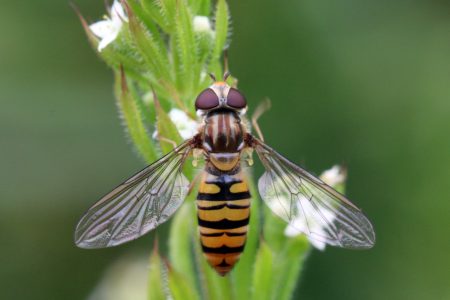
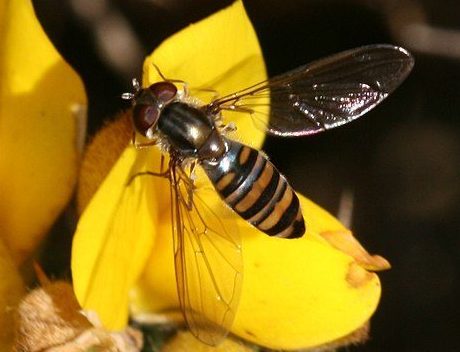
    Charles J Sharp creator QS:P170,Q54800218, Marmalade hoverfly (Episyrphus balteatus) female, CC BY-SA 3.0

    E. balteatus is a relatively small hoverfly (9–12 mm) of the Syrphidae family. The upper side of the abdomen is patterned with orange and black bands. Two further identification characters are the presence of secondary black bands on the third and fourth dorsal plates and faint greyish longitudinal stripes on the thorax. Some specimens also show white bands on the abdomen, whilst other forms are quite dark.

    As in most other hoverflies, males can be easily identified by their holoptic eyes, i.e., left and right compound eyes touching at the top of their heads.

    Adult Marmalade Flies feed on pollen and nectar. It is among the very few species of flies capable of crushing pollen grains and feeding on them.

    The larva is terrestrial and feeds on aphids.

    The Marmalade fly can be seen from January to December in a wide range of habitats. Adult flies hibernate during the winter, but emerge on mild days to forage. Numbers peak in August and can be boosted by an influx of migrants. They often form dense migratory swarms.

    Featured image by S. Rae from Scotland, UK (https://commons.wikimedia.org/wiki/File:Episyrphus_balteatus_(female)_-_Marmalade_Hoverfly_-_Flickr_-_S._Rae.jpg), “Episyrphus balteatus (female) – Marmalade Hoverfly – Flickr – S. Rae”, https://creativecommons.org/licenses/by/2.0/legalcode
  • Species of the week: Oak Moss

    Species of the week: Oak Moss

    Oak Moss
    Evernia prunastri

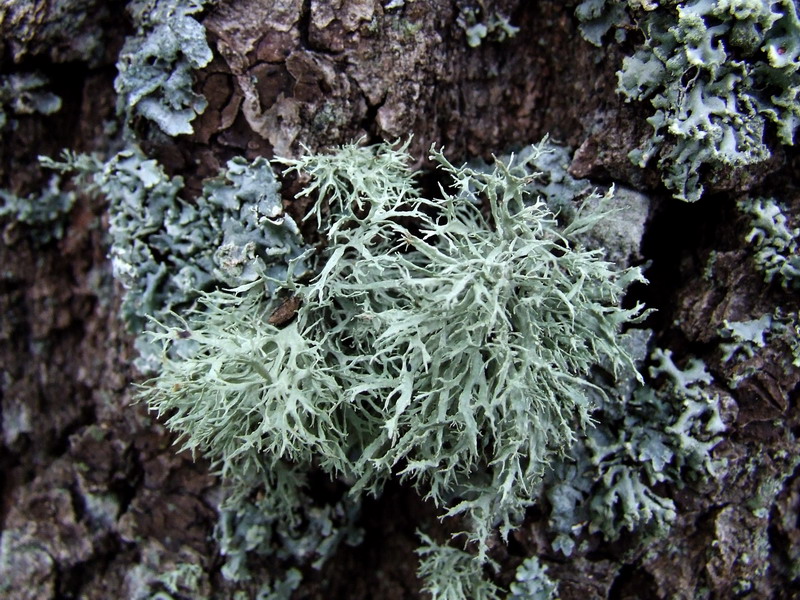
    Evernia prunastri is a species of lichen, it has no official English name but is known as Oak Moss. Lichens that are attached only at the base are called fruticose and E. prunastri is the commonest in this group.

    It has a strap-shaped body, with fork-like branches hanging down from the basal attachment. The upper surface of the branches is grey-green but the undersides are white. Oak moss grows primarily on the trunk and branches of oak trees, but is also found on the bark of other deciduous trees and conifers such as fir and pine.

    It is commercially harvested in south-central Europe and exported to France where its fragrant compounds are extracted and used as perfume fixatives and form the base notes of many fragrances. The lichen has a distinct odour, described as woody, sharp and slightly sweet. Oak moss growing on pines has a turpentine odour that is valued in certain perfume compositions.

    Oak moss had many uses in the past. It was once ground-up with rose petals to make a hair powder to whiten wigs and kill off head lice!

    Featured image by Tomas Čekanavičius (https://commons.wikimedia.org/wiki/File:Evernia_prunastri1.jpg), “Evernia prunastri1”, https://creativecommons.org/licenses/by-sa/3.0/legalcode

  • Species of the week: Spindle

    Species of the week: Spindle

    Spindle tree

    Euonymus europaeus
    Feoras

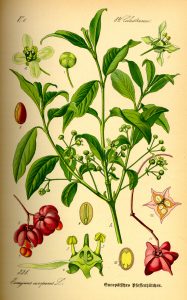
    Original book source: Prof. Dr. Otto Wilhelm Thomé Flora von Deutschland, Österreich und der Schweiz 1885, Gera, Germany, Illustration Euonymus europaea0, marked as public domain, more details on Wikimedia Commons

    Spindle is found throughout Ireland in woodland, scrub and hedgerows on limestone. It is often planted in gardens and parks. A deciduous shrub or small tree which grows 3–6 m tall, rarely 10 m, with a stem up to 20 cm in diameter.

    The leaves are opposite, lanceolate to elliptical, 3-8 cm long and 1-3 cm broad, with a finely serrated edge. Leaves are dark green in summer. Autumn colour ranges from yellow-green to reddish-purple, depending on environmental conditions.

    The hermaphrodite flowers are produced in late spring and are insect-pollinated. They are rather inconspicuous, small, yellowish green, with 4 well separated petals and 4 sepals. They grow in small, branched clusters in leaf axils on square-sided twigs on much-branched, upright stems.

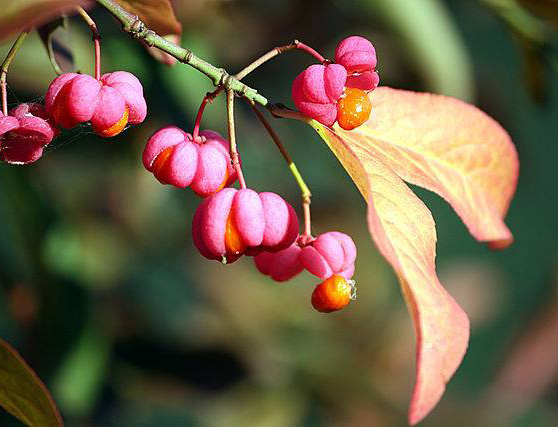
    The capsular fruit ripens in autumn, and is coral pink in colour and approximately 1-1.5 cm wide. It is four-lobed, with fleshy, orange, succulent covering over the seeds. When ripe, September to November, the four lobes split open to reveal the bright orange seeds. The fruit is poisonous.

    Spindle wood is very hard, and can be cut to a sharp point; it was used in the past for making wool spindles.


    Featured image by Hedwig Storch (https://commons.wikimedia.org/wiki/File:Gewöhnlicher_Spindelstrauch_(Euonymus_europaeus)_IMG_7940.JPG), “Gewöhnlicher Spindelstrauch (Euonymus europaeus) IMG 7940”, https://creativecommons.org/licenses/by-sa/3.0/legalcode

  • Species of the week: Raft Spider

    Species of the week: Raft Spider

    Raft Spider

    Dolomedes fimbriatus


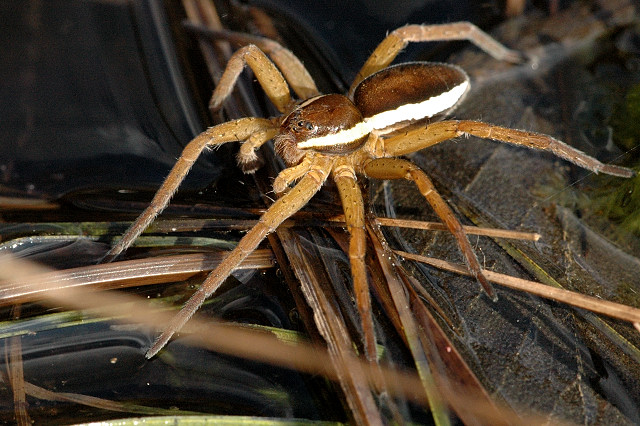
    Ireland’s largest spider, the Raft Spider, lives within our bogs and fens. The female (remember female spiders are larger than male spiders) spider’s body measures up to 22 millimetres long and leg span up to about 70 millimetres.

    Tragopogon (https://commons.wikimedia.org/wiki/File:Dolomedes_fimbriatus_Teuffen.JPG), “Dolomedes fimbriatus Teuffen”, https://creativecommons.org/licenses/by-sa/3.0/legalcode

    We associate spiders with dry land but the Raft spider is semi-aquatic. When alarmed it can dive under water and remain submerged for several minutes, hidden from the predator.

    Their European name, fishing spider, is more suitable as like other Dolomedes they do not build webs to feed but hunt. A raft spider often waits motionless on the water’s edge or on floating vegetation with two feet in the water. When it feels ripples from the prey, it runs across the water to attack. Air bubbles get trapped on the spider’s hairy body and legs. These help it to float on water. Raft spiders are big enough to catch small fish e.g. stickleback, water insects, snails, tadpoles and even small frogs and then race back to land to eat.

    Between May and August is the best time to spot this amazing spider. Chunky, heavyset spider is dark brown in colour (sometimes greenish) with a conspicuous cream/white strip along each side. Air trapped under its body hair makes the spider appear silver under water.
    In Ireland it is believed it takes raft spider two years to mature. Courtship must be a frightening experience for the male spider. He cautiously glides across the water. Should he inadvertently trigger the female’s instinctive predatory response he could become her next meal. Up close both spiders bob their bodies up and down in a dance. Mating itself only lasts a few seconds before the male makes a quick exit.

    Then, the female spider spins an egg sack, laying several hundred eggs. For about 3 weeks she carries the egg sack about on her back. She dips it frequently into the water to keep the eggs moist. Just before the eggs hatch she spins a nursery web close to the water edge and will protect her spiderlings for about ten days before they disperse to colonize in damp vegetation nearby.

    The female spider dies shortly after her spiderlings leave in Autumn. The male spider dies much earlier in the year. Spiderlings hibernate through the winter months and emerge the following Spring.

    Featured image by James Lindsey at Ecology of Commanster (https://commons.wikimedia.org/wiki/File:Dolomedes.fimbriatus2.-.lindsey.jpg), “Dolomedes.fimbriatus2.-.lindsey”, https://creativecommons.org/licenses/by-sa/3.0/legalcode

  • Species of the week: Pedunculate Oak

    Species of the week: Pedunculate Oak

    Pedunculate Oak

    Quercus robur
    Dair ghallda

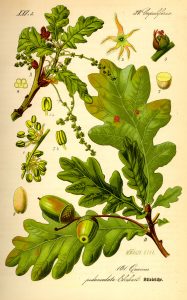
    Prof. Dr. Otto Wilhelm Thomé Flora von Deutschland, Österreich und der Schweiz 1885, Gera, Germany, Illustration Quercus robur0, marked as public domain, more details on Wikimedia Commons

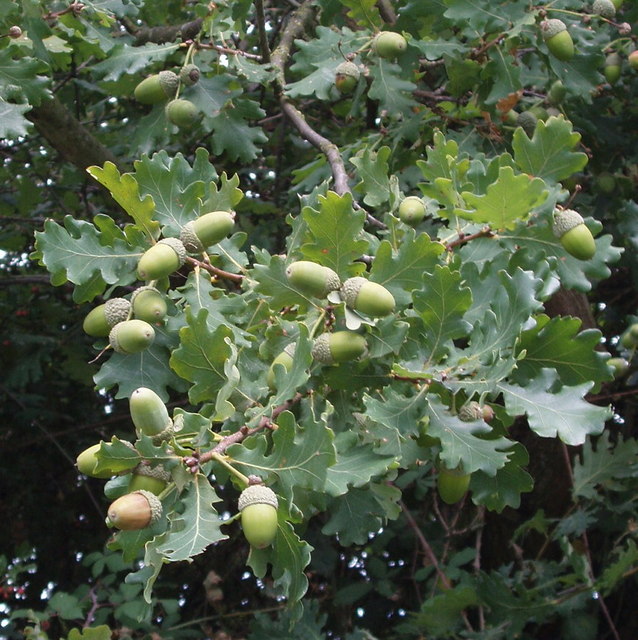
    Pedunculate Oak is the less common of the two native Irish oak species. You can distinguish it from Sessile oak by looking at its acorns – pedunculate oak produces acorns on stalks.

    The oak is one of our largest and longest lived trees – specimens typically live for up to 500 years, the oldest know Pedunculate Oak in Europe grows in Lithuania and is 1500 years old! They grow very quickly at first, but after reaching 100-200 years of age their growth rate slows down.

    Native oak woods are important habitat for hundreds of invertebrates as well as many birds and mammals. The acorns are very rich in starch and tannins and are a great food source for all kinds of wildlife. Jays and squirrels are extremely important in dispersing acorns away from the parent tree – they bury them for later consumption and many of these acorns later germinate.

    Featured image by David Hawgood (https://commons.wikimedia.org/wiki/File:Acorns_and_oak_leaves,_near_Thame_-_geograph.org.uk_-_228229.jpg), “Acorns and oak leaves, near Thame – geograph.org.uk – 228229”, https://creativecommons.org/licenses/by-sa/2.0/legalcode

  • Species of the week: Common Green Grasshopper

    Species of the week: Common Green Grasshopper

    Common Green Grasshopper

    Omocestus viridulus
    Dreoilín teaspaigh

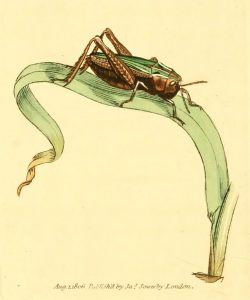
    The British miscellany
    London: Printed by R. Taylor & Co., and sold by the author, J. Sowerby by White, Johnson, Symonds, and all other booksellers,1806.
    http://biodiversitylibrary.org/item/91785

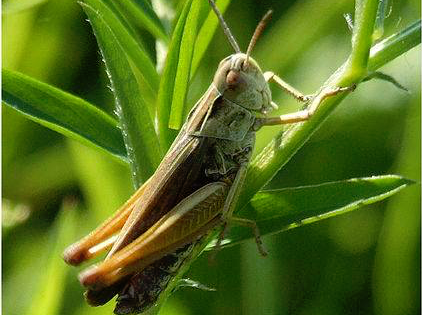
    The common green grasshopper is a grasshopper of the Acrididae family. It is found in moderately wet regions of Europe and is distributed widely across Britain. Its range extends as far as Siberia and Mongolia. In Ireland it tends to be found in areas with long grass, such as farmland, grassland, heathland and upland.

    The common green grasshopper is usually green all over, but some may have brown colouration on their sides. The eyes are either brown or yellow. The typical body length of the insect is 17 – 20 mm.

    The life cycle of the common green grasshopper begins with the females laying their eggs in the top layer of soil, or near the root of grass stalks. The young (nymphs) emerge in April. Nymphs resemble their parents but have immature wings. After about a month of moulting their exoskeleton several times, the nymphs mature into adults with functional wings. The insects are usually seen between April and October.

    The common green grasshopper can be identified by its song. The grasshopper’s characteristic loud, long song, which resembles “ticking”, lasts 20 seconds or more. During mating season, males may also make a “churring” noise, which is made by the grasshopper rubbing its legs against its wings. This is to attract and find a mate. Females which are ready to mate may also “sing” in response.
    Common green grasshoppers are a food source for many animals, including bats, birds and amphibians.

    Featured image by G.-U. Tolkiehn (https://commons.wikimedia.org/wiki/File:Omocestus_viridulus_m_080723-30.jpg), “Omocestus viridulus m 080723-30”, https://creativecommons.org/licenses/by-sa/3.0/legalcode

  • Species of the week: Fairy Flax

    Species of the week: Fairy Flax

    Fairy Flax

    Linum catharticum
    Lus na mban sí

    Carl Axel Magnus Lindman creator QS:P170,Q719778, 220 Linum catharticum, marked as public domain, more details on Wikimedia Commons

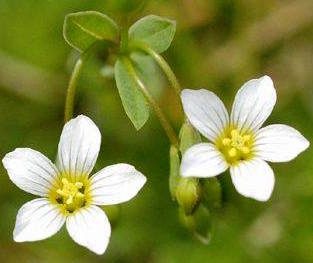
    Fairy Flax is an annual or biennial herb found in seashore meadows, dry fields, or rocky outcrops or limestone pavement. The 5 petals of the plant are small (4mm), white with light veins and a yellow centre. It flowers from May to September. The flowers droop noticeably when in bloom. The leaves of the Fairy Flax are narrow and oblong and are in opposite pairs that are held upwards close towards the stem.

    Fairy Flax can be found across Eurasia from Iceland and Scandinavia to Morocco and has been introduced to North America and New Zealand.

    Fairy flax is also known as the “Purging Flax” as it was used as a laxative in the past and as a cure for rheumatism. Fairy Flax contains the toxin Linamarin.

    In Irish the name means the “Fairies Herb”, although “Bean sí” is also the female spirt that calls the death of a family member.

    In English fairy tales, fairy flax was spun by fairies to make their clothes. Flax is an important resource used in the making of clothes and the linseed has been used for fodder for cattle and also to make poultice for treating boils and respiratory issues.

    Featured image by Zoë Devlin