Bad news for bogs as designated areas set to lose protections
4th July 2023
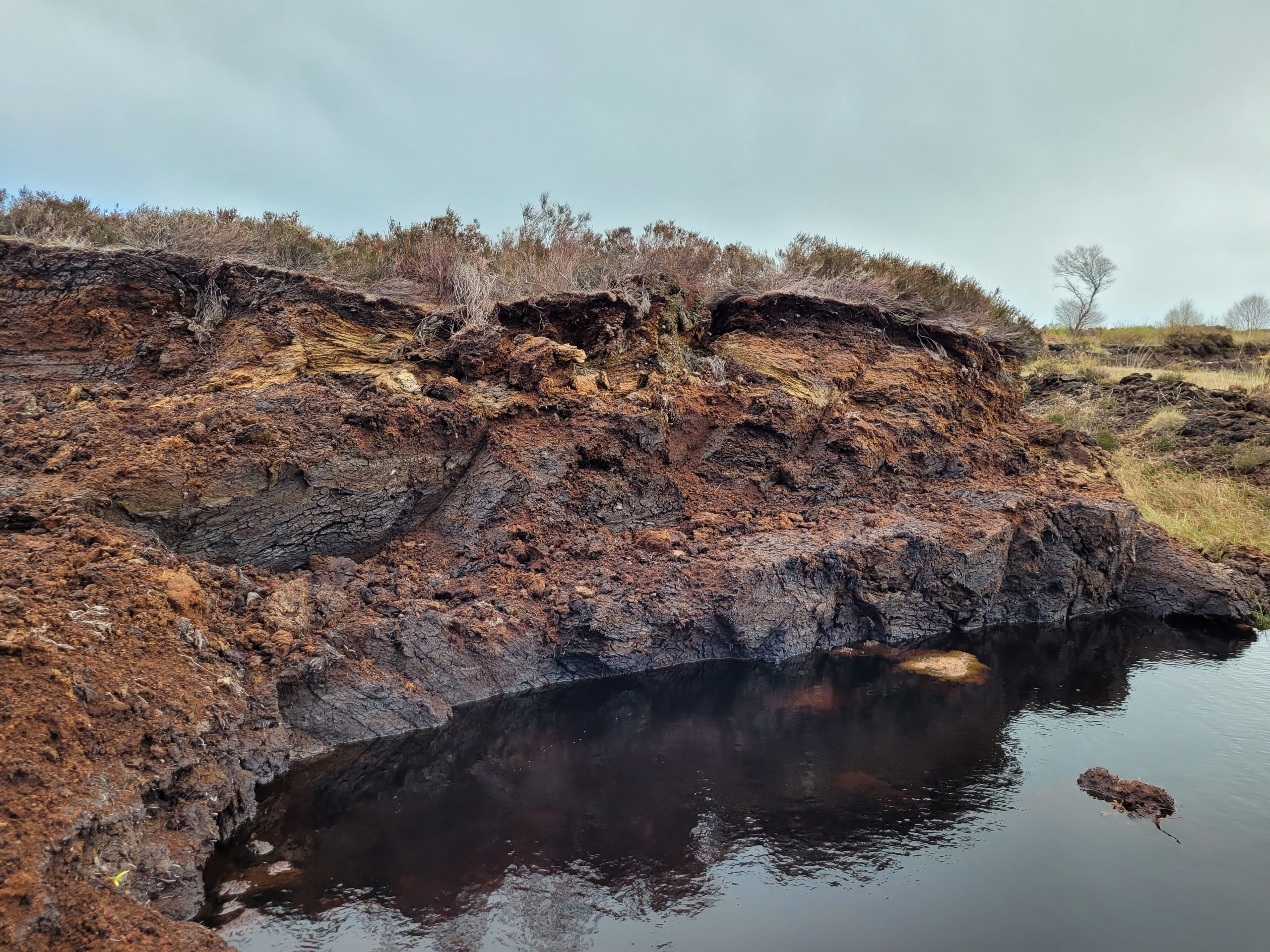
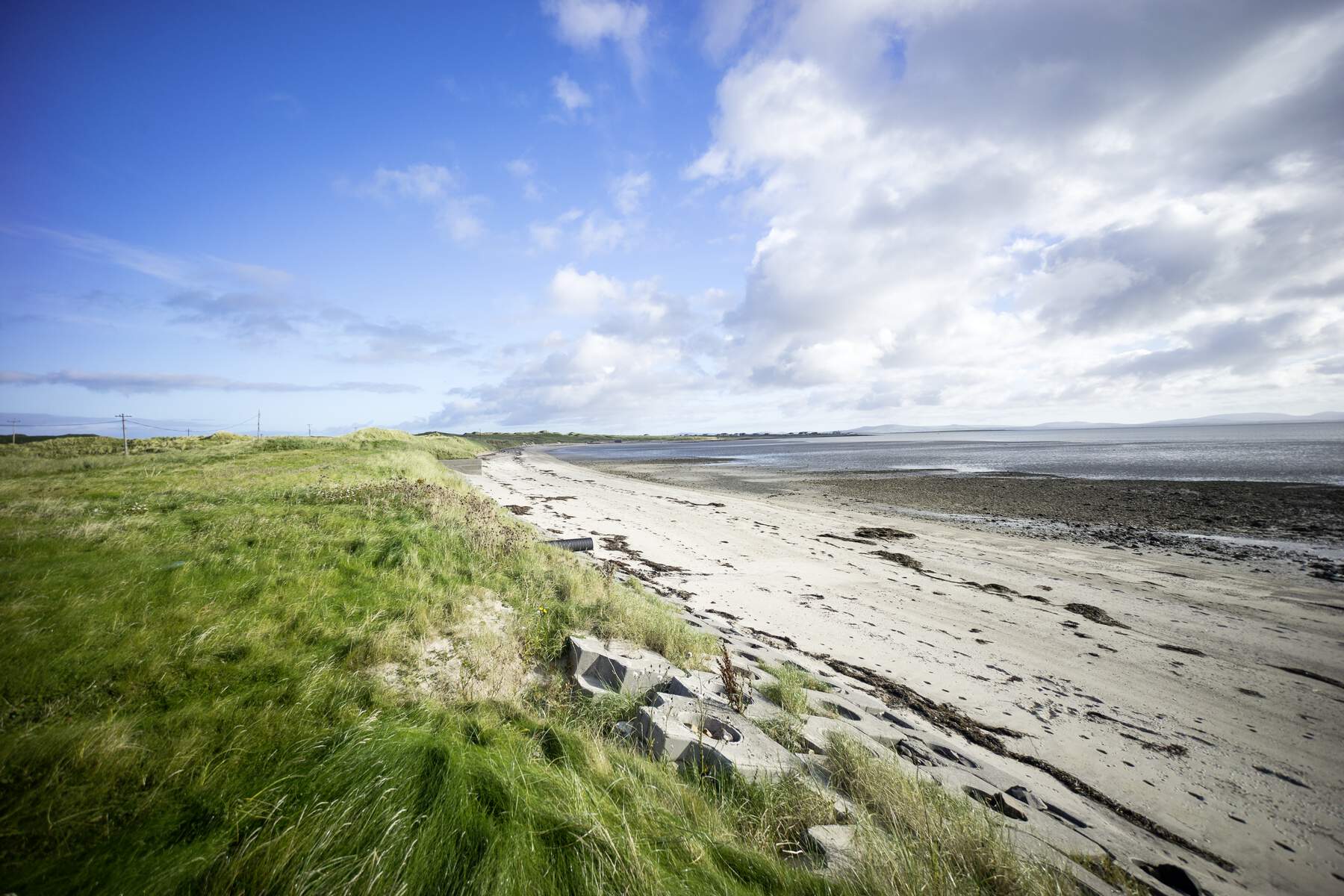
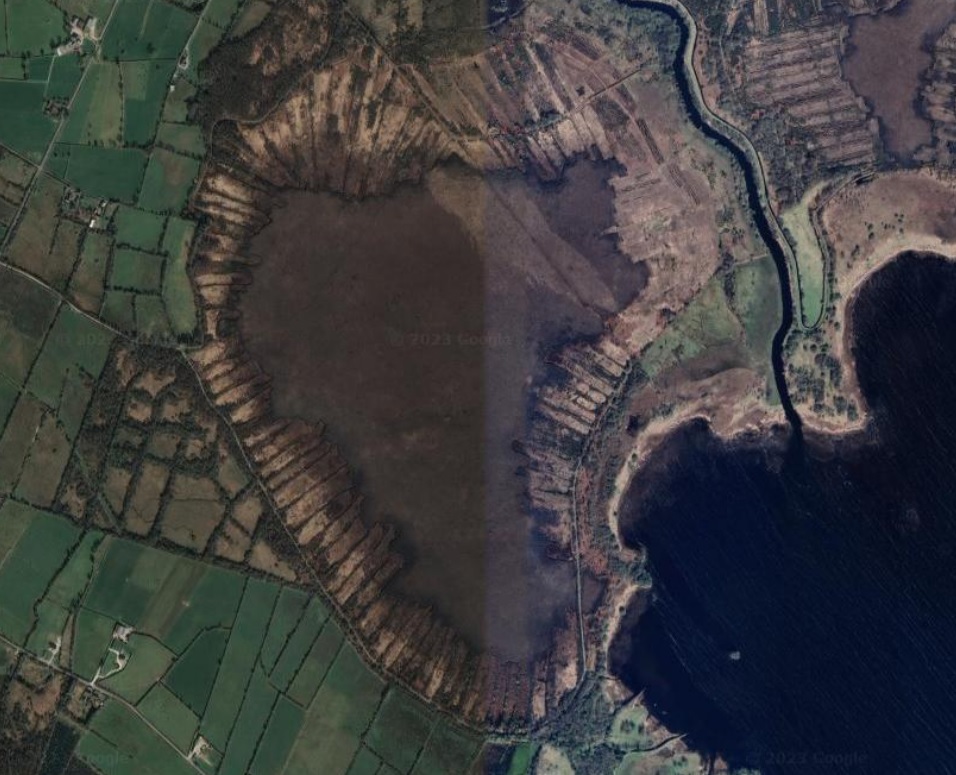
The Irish Wildlife Trust (IWT) is appalled that the Wildlife (Amendment) Bill 2016 is set to be passed by the Oireachtas (it is scheduled to be presented to the Dáil tomorrow evening, July 5th). The Bill, if enacted, will allow for the removal of legal protections from up to 46 sites which are currently protected as Natural Heritage Areas (NHA) for their raised bog habitats[i].
The removal of these protections will legalise the mechanical extraction of turf and so the permanent destruction of the bog habitats.
While the decision was made in light of wider measures under the National Peatlands Strategy over a decade ago in order to attain ‘favourable status’ for raised bogs[ii], among the world’s rarest habitats’, the demands of the climate and biodiversity emergency now demand a rethink.
Indeed, the Climate Action Plan (pg235), published only last year, committed to restoring and rewetting NHAs – how can the Government now be moving to remove protections when this is exactly the opposite of what needs to be done?
IWT campaign officer Pádraic Fogarty says “At Montreal last year governments from around the world committed to protecting 30% of land and sea by 2030 as part of a deal to protect and restore nature. Ireland supported this deal and even joined a ‘High Ambition Coalition’ furthering the aim. Yet what we see at home is the exact opposite. When we know we need to protect all of our peatlands for the climate, biodiversity and water benefits they bring, it’s impossible to understand how the Government feels that promoting more peat mining is the right thing to be doing.”
The Wildlife (Amendment) Bill is not all bad. The Bill will provide a legal footing for the National Biodiversity Action Plan, an essential step in implementing the measures they contain. The IWT warmly welcomes this change but it is lamentable that it comes with a weakening of protections on the ground for bogs, and sends yet another signal that this Government is not serious about making the changes that are needed to address the climate and biodiversity emergency.
The Government recently celebrated three years in office, how is it doing in meeting nature objectives? I wrote a blog after its first anniversary in 2021 and the same terms and conditions apply to the one you are about to read. A year is not a lot of time to judge a government’s performance. After three years we should expect some clear signs of achievement, while the two years left to run provide only a small window for new initiatives. The headings I am using below are the same as for my 2021 blog to allow for some consistency in my praise and criticisms and these are in the same order as they appear in the Programme for Government (PfG).
“Progress the establishment of a Citizens’ Assembly on Biodiversity”
The Citizens’ Assembly on Biodiversity Loss published its final report in April with 159 recommendations. It’s a thorough piece of work and we were happy that it supported many of the policy positions long-promoted by the IWT and others in the environmental NGO community. This week it was decided that the report will go to the Joint Oireachtas Committee on the Environment and Climate Action chaired by Brian Leddin. This committee published its own report on biodiversity only last November and there is a lot of commonality between the two. Clearly, we have enough reports and what we now need is a programme of prioritisation and implementation. For greater legitimacy however we do hope that other committees will get involved in this work, particularly the Committee on Agriculture, Food and the Marine.
“Review the remit, status and funding of the NPWS”
I think we can report good progress in this vitally important task. We had always said that without a functioning nature conservation agency to spearhead implementation of laws and regulations then nothing else would fall into place. We are happy that Minister of State Malcom Noonan has secured additional funding and a progress report for year one of the three-year plan maintains that things are broadly on track. The NPWS is now a statutory agency with former-assistant secretary at the Department of Housing Niall Ó Donnchú now director general of the NPWS.
Structural changes of this scale (changes to IT systems, recruitment etc.) are never easy but if done properly will provide resilience. While this is clearly progress, I can’t understand for the life of me why the communications and presentation of the NPWS and its work remains so dreadful. I had hoped that the agency would be given a new name, logo and identity but instead we have the same exhausted looking website, still no social media presence of note and no presence on mainstream media, e.g. a person doing interviews with radio and press. When you add the fact that actual conservation activities on the ground have yet to appear even in high profile places like Killarney National Park, it is easy for people to conclude that nothing is happening at all. This is an unforgivable own goal given that there are good stories to be told and easy things which could be done.
“Seek reforms to the CAP [Common Agricultural Policy] to reward farmers for sequestering carbon, restoring biodiversity, improving water and air quality, producing clean energy, and developing schemes that support results-based outcomes.”
The new CAP came into being in 2023. It will deliver nearly €10 billion to Irish farmers over its lifetime (to 2027) however, only 15% of this will be directed to results-based measures that incentivise tailored schemes rather than the general ‘bird box’ approach that has dominated so far. The Environmental Pillar dismissed Ireland’s CAP Strategic Plan as “failing the environment”. If we had measures in place to reward farmers for sequestering carbon would we have seen the outrage over the Nature Restoration Law? Unlikely.
Meanwhile, ammonia and greenhouse gas emissions from the sector both increased in 2021 while nutrient loadings in the south and east, mostly from dairy farming, are also leading to deterioration of water quality. At the end of the day, there are no effective controls on pollution from agriculture.
On the plus side, the hated rules around ‘eligibility’, which perversely incentivised farmers to remove scrub and wetlands, are gone. A farmer may now have 50% of a land parcel in ‘beneficial features’ (e.g. scrub and wetlands) with no penalty while, very significantly, 100% of land can be eligible if helping to meet a climate, biodiversity or water quality aim. This message may not have quite seeped through to those trying to manage land for nature but it has enormous potential to deliver results.
Agriculture remains the boil that needs lancing. A major problem is the continued greenwashing by Bord Bia or Minister Agriculture for Charlie McConalogue who continue to assert that Ireland’s food system is ‘sustainable’ or that farmers are “farming with nature”. This mixed messaging is a major block to getting on with the transformation that’s needed in agriculture.
“The government will undertake a national land use review”
Phase 1 of the Land Use Review was published in March. It makes for interesting reading but how it will be applied remains to be seen. A hint at where it might be going was revealed in a report commissioned by the Environmental Protection Agency looking at how land use needs to change to meet net-zero emissions targets by 2050. Its conclusions, that forest area needs to double, livestock numbers need to come down by 30% in addition to a 30% emissions reduction in the herd that remains and rewetting nearly all our peatlands, were treated with accusations of “ethnic cleansing” from TD Michael Fitzmaurice.
“Publish a successor forestry programme to deliver an ambitious afforestation plan”
A lot of work has gone into forestry by Minister Pippa Hackett and the ‘Project Woodland’ forum (IWT was a member). An exhaustive review of the regulations confirmed that environmental regulations must be followed and will not be weakened. Minister Hackett also approved a substantial €1.3 billion for the next Forestry Programme. These are both positives.
However, the longed-for transformation of forestry into a nature-friendly model did not appear, much to my dismay. While the Forest Strategy has not yet been approved by the European Commission (perhaps because of their concerns over planting industrial monocultures on peatlands or the loss of valuable sites for ground-nesting birds) the most recent draft envisages only marginal increases in native woodland or even continuous-cover forestry, with the bulk going to yet more blocks of monocultures destined to be clear-felled. Given the past and even recent statements from Ministers Hackett and her colleague, Minister for the Environment Eamon Ryan, about ‘the right trees in the right place’, the failure to deliver more than slogans for forestry is a major disappointment and a black mark on this government’s record to-date.
“Extend the badger vaccination programme nationwide and end badger culling as soon as possible”
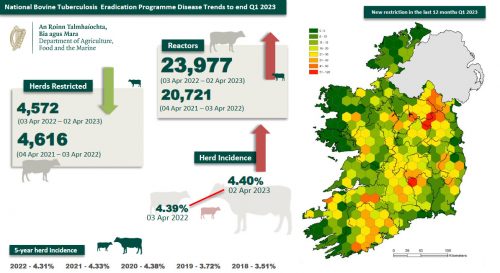
In 2020, the year the government took office, 4,723 badgers were snared and shot by the Department of Agriculture. In 2021 the figure was 5,868. So, the opposite of ending culling. Meanwhile, TB rates in cattle are increasing, something that the Department itself has said is associated with dairy expansion. This is another serious fail (not only for badgers) on the Government’s side.
TB rates in cattle going up
“We are fully committed to the environmental objectives of the Common Fisheries Policy” (CFP)
The matter of overfishing has now gone to the European Court of Justice, which is due to issue a ruling on the legality of exceeding scientific advice this autumn. It is expected to uphold the finding of the Irish High Court that setting quotas beyond scientific advice is illegal. Rather than being committed to environmental objectives of the CFP, the Irish government tried to defend overfishing in the High Court. If we do, finally, break out of the pattern of ignoring scientific advice, it will be no thanks to the Government.
In another fail, the High Court over-ruled the Government’s restrictions on trawling in inshore waters, meaning that five years of effort to protect this vulnerable zone have been wasted. We are no nearer ensuring “that inshore waters continue to be protected for smaller fishing vessels and recreational fishers and that pair trawling will be prohibited inside the six-mile limit”, as promised in the PfG.
In better news, there does seem to be greater assertiveness and capability on behalf of the Sea Fisheries Protection Authority to enforce fishing regulations while new rules that will mandate tracking all boats and CCTV on high risk boats were recently passed, with Government support, by the EU.
“We will realise our outstanding target of 10% under the Marine Strategy Framework Directive as soon as is practical and aim for 30% of marine protected areas [MPAs] by 2030.”
MPA coverage has increased to over 8% from a pitifully low 2% last year and are set to increase further, perhaps to the promised 10% threshold by the end of the year. Good news.
However, designations do not bring protection and actual management measures for the MPAs we have are still woefully poor. New legislation to drastically expand the MPA network to at least 30% by 2030 has been drafted and we are waiting to see an update in advance of Dáil amendments. The initial draft was quite poor but will hopefully be improved following a good report from the Oireachtas committee that looked at it.
An emerging issue we are seeing however is a reluctance to create ‘strictly protected areas’ (effectively no-fishing zones). The Irish government (Minister McConalogue again) is resisting a ban on bottom trawling in MPAs while even Malcolm Noonan’s department is resisting setting restrictions on bottom trawling in an effort to protect a fairly modest 10% of seabed.
I write this blog just after the European Court of Justice issued a final ruling against Ireland for failure to implement the Habitats Directive. Malcolm Noonan responded by saying that Ireland was “making good progress” in addressing the ruling and while that might be true within his particular (corner of a) department, it can’t be said for the wider land and sea use sectors that are driving the biodiversity crisis – especially agriculture and fishing but also forestry and peat extraction.
The government did, finally, come out strongly in favour of the EU’s Nature Restoration Law including, to his credit, Minister McConalogue. The idea of a dedicated Nature Restoration Fund to finance measures and deliver money to farmers and fishers will be a litmus test for how deep that support runs. This would certainly help to tip the dominant narrative that nature restoration is an attack on farming and ‘rural Ireland’. But without transformation of the key sectors the Government will fail to reach its environmental objectives. And there’s no sign of that happening.
European Court of Justice issues damning indictment of Ireland’s failure to protect nature
29th June 2023
The European Court of Justice today issued a damning finding against Ireland for its failure to implement the Habitats Directive. This ruling comes as no surprise to anyone following the deterioration of our natural environment and has consequences which are as devastating as they are far-reaching, going well beyond any threat of fines that may or may not transpire.
The result of this failure to implement the Habitats Directive, along with the many other directives and policies on nature protection, is plain for all to see. Irish people live in a landscape of extinction with near-empty seas, degraded lands and polluted waterways. It is not a dystopia because it is here and now.
The Irish Wildlife Trust acknowledges the efforts under the current government in addressing the structural failings behind our biodiversity crisis. However, how we use our land and sea is not changing to any substantial degree and without this we will continue to fail.
The IWT’s campaign officer, Pádraic Fogarty says, “Despite some positive initiatives we are not seeing the changes where it matters. We have whole sectors whose ecological footprints are out of control, particularly agriculture but also forestry, fishing and peat extraction. We have the solutions to address these issues in a way that is fair to people but the influence of these sectors has captured public policy to a degree that the public interest is set aside. The resistance shown by many politicians to the Nature Restoration Law is a demonstration of just how far this capture of public policy has developed. That must be addressed if we are to get a handle on this crisis.”
Irish MEPs must support a strong Nature Restoration Law at the European Parliament meeting in July
27th June 2023
Today, MEPs in the European Parliament committee for Environment, Public Health and Food Safety (ENVI) concluded their voting on the Nature Restoration Law (NRL). The final vote was tied 44-44 which means the report was not adopted.
The ENVI committee began voting on the NRL on the 15th June and it was voted then that the law would not be rejected. This was a positive result as members of the EPP group (of which Fine Gael is a part of) had been engaged in a campaign spreading misinformation about the law and the fact that it was not outright rejected shows that this campaign did not work. Any member of the EPP group which spoke out against the official EPP stance and showed support for the NRL were swiftly substituted out of the committee so that they would not be able to vote.
Since the law was not rejected, MEPs then began voting on the proposed amendments with EPP and other conservative MEPs doing their best to weaken the law as much as possible. Members of the EPP even voted against there being a specific nature restoration fund available for farmers to make the just transition to more sustainable ways of farming. This resulted in a watered down version of the law and this was what members voted on today resulting in the tie and the report not being formally adopted.
The law will now go to plenary in July where MEPs across the entire EU parliament will have the chance to vote on it. This crucial vote will give MEPs the chance to show they want a strong and ambitious NRL, that they care about the climate and biodiversity crisis and that they want to restore nature to help ensure food security, protect jobs and protect the habitats and species we rely on.
“This piece of legislation is the most important piece of legislation for nature since the Birds and Habitats Directive 30 years ago. Over 80% of EU habitats are in bad ecological status so this shows that what we have been doing so far hasn’t been enough. We desperately need this law to tackle the mass extinction we find ourselves in. All Irish members of the EU parliament must now do what is right by their citizens and nature and make sure we get the strongest version of this law through in plenary” – Grace Carr, Marine Advocacy Officer, Irish Wildlife Trust
Irish Wildlife Trust welcomes Irish Government support for Nature Restoration
20th June 2023
The Irish Wildlife Trust (IWT) warmly welcomes the strong endorsement by the EU Council of Ministers today in Luxembourg for the Nature Restoration Law. This throws a lifeline to the initiative which has been subject to a negative campaign led by the European People’s Party (EEP, of which Fine Gael is a member) and which has been characterised by scare tactics and misinformation.
We particularly want to acknowledge the strong support for the Nature Restoration Law demonstrated today by the Irish Government, represented in Luxembourg by Minister Eamon Ryan and Minister of State Malcolm Noonan. Ministers’ willingness to move the law forward sends a strong signal to the European Parliament, where political games have stalled negotiations.
The Nature Restoration Law will be voted again in the Parliament’s ENVI committee next week where another rejection amendment will be tabled. However, while the passing of such an amendment will be bad news, it will not be a fatal blow to the law, which will pass to a plenary of the European Parliament, expected in the middle of July. A risk remains nevertheless, that the law will be watered down to the point of meaninglessness.
The recent debate on this law has exposed deep divisions within Ireland’s large centre-right parties, Fianna Fáil and Fine Gael, which seem to have no coherent policy on the biodiversity crisis. Fine Gael MEPs, as well as Billy Kelleher of Fianna Fáil, have floundered in recent weeks in asserting that they are in favour of nature restoration while simultaneously engaging in efforts to kill off the new law entirely.
The IWT’s Campaigns Officer Pádraic Fogarty says “Today is a good day for the Nature Restoration Law however much still rests in the hands of MEPs in the coming weeks. While there seems to be deep divisions within the EPP on their wrecking ball approach to the legislation their fundamental philosophy hasn’t changed. Too many politicians, at home and in Brussels, continue to deny the terrible reality of our biodiversity and climate crisis.”
The south west-coast of Ireland has been identified by Fair Seas as an area which warrants designation as a Marine Protected Area (MPA). The Irish government has committed to protecting 30% of our territorial waters in MPAs by 2030 and legislation to allow for this is expected within months. While this ‘30×30’ target is important, the process of deciding where MPAs are located is critical, as will be the post-designation management.
The south-west of Ireland was chosen by Fair Seas for its important populations of whales, particularly fin, Minke and humpbacks, seabirds, sharks and commercially important fish (herring and whiting). Whales in particular have made what appears to be a stunning comeback to this coastline in recent years, for reasons that remain unclear.
Last week I boarded the Irish Whale and Dolphin Group’s research vessel Celtic Mist as part of their programme of scientific surveys for 2023. This programme will highlight a number of the ‘areas of interest’ which we hope will form part of Ireland’s MPA network.
The thought of spending a full week on board a boat like this was a dream come true for me. While my ideas of sailing the ocean blue come more from my imagination than experience, I was eager to sign up to get a tase for the real thing. In the end, we were blessed with (mostly) fair weather, calm seas and good conditions for sighting whales. The Celtic Mist is a comfortable and stylish craft. It was good enough for former scoundrel-taoiseach Charlie Haughey who had a taste for the finer things in life (as well as being a great fan of our natural heritage). Dizzying nausea during the first day at sea was eased later in the week with ‘sturgeon’ tablets and calmer conditions. The onboard fare included freshly baked bread, pressed coffee and home-cooked dinners. The trip itself could hardly have been better.
In recent years I have been a regular visitor to this part of the Cork coast, where a number of small boats operate whale-watching tours. I’ve never been disappointed. I’ve seen lunge-feeding fin whales, bait balls of small fish devoured by whirlwinds of gannets and shearwaters, blue-fin tuna, ocean sunfish and curious Minke whales swimming under our boat. And dolphins, lots and lots of common dolphins that revel in surfing the bow waves.
But our scientific mission was going to be different. Rather than making a beeline for the whales we were following predefined routes through the sea, known as ‘transects’. While whale-watching boats will tell you what species were where on a given day, a series of transects will give you better information about the numbers and types of whales over a given area. It will give you a sense of which areas are being used by whales and which aren’t. Transects are also repeatable, so changes over time can be more accurately assessed.
Whale watching goes to where the action is and increasingly these boats are accompanied by amateur photographers and video makers. Stunning images of feeding, lunging and breaching whales quickly make their way online which, in turn, can give an impression that our seas are teaming with whale activity.
Frequently however, it’s the same whale that is being tracked day after day. Do we have a false impression of just how many whales are in our waters?
A part of the problem is that we don’t know what a ‘healthy’ sea looks like. Industrial whaling only ended in the 1980s while it hasn’t ended at all in Iceland and Norway. While some populations are believed be recovering, other are still struggling. During the height of the whaling industry, whales were targeted all along their migration routes, from the Azores in the mid-Atlantic, to Spain, Ireland, Scotland, Norway and even the high Arctic. Today, the North Atlantic right whale is extinct completely from this side of the ocean. The famous ‘shifting baseline syndrome’ can blind us to the abundance that was once found off our coasts.
I may have fallen victim to this myself. I fully expected that we would encounter Minke whales and fin whales on our voyage, and perhaps even the humpback whale that was hanging around this area only a few weeks ago. I was therefore surprised and disappointed that after five days at sea with near-optimal sighting conditions, we didn’t spot a single whale.
We did spot lots of boats. Near the mouth of Cork harbour there was everything from mega-cruise liners to fossil fuel and cargo tankers to small pleasure craft. And fishing boats.
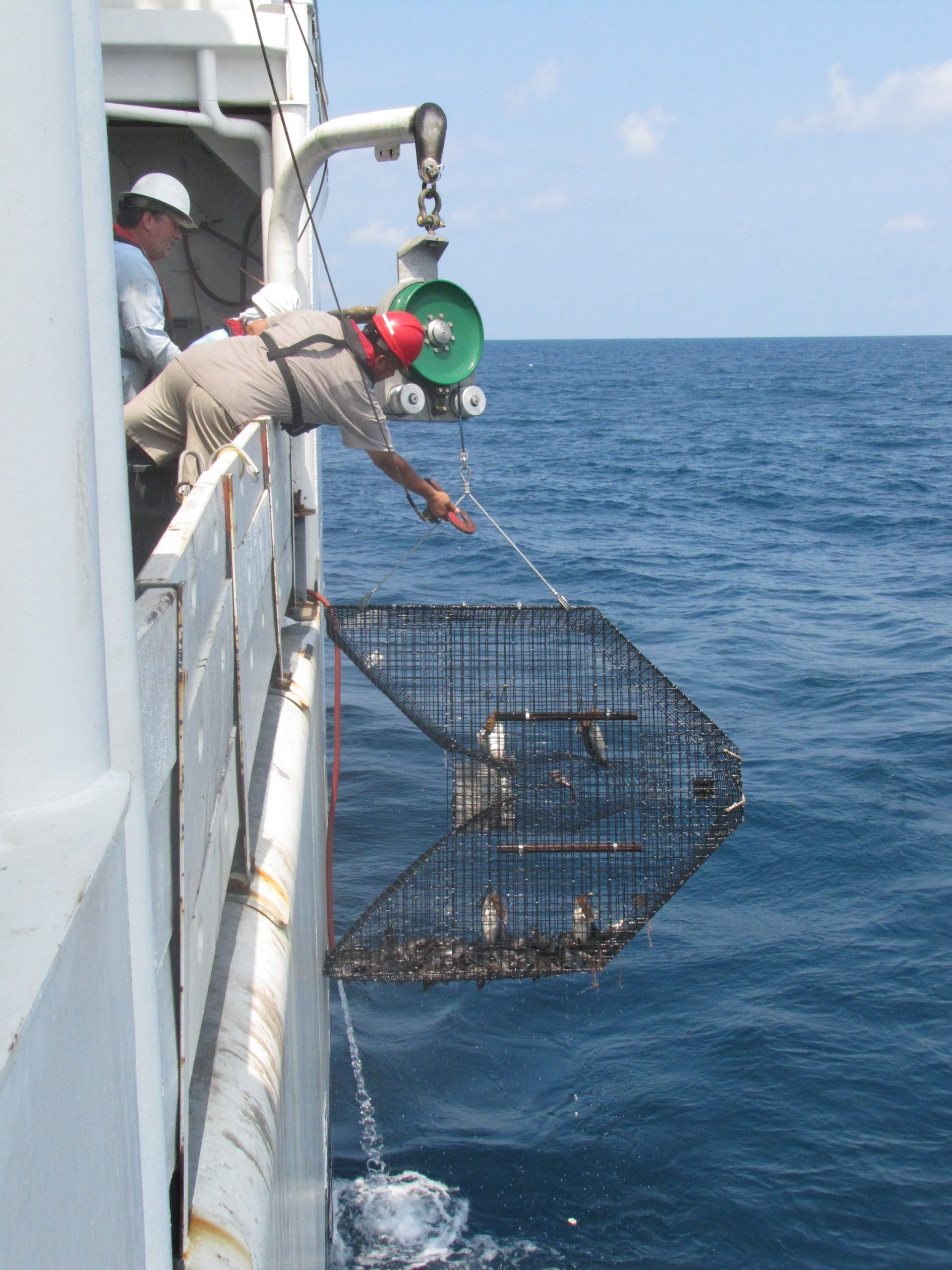
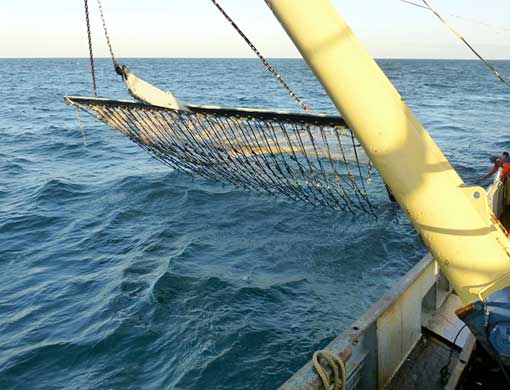
It is not that there are lots of boats out fishing at any given time, the industry has more or less collapsed in this area compared to the 1980s, but it is a constant and unrelenting presence. Strings of pots, some up to a kilometre in length, are rarely out of view. For bigger boats, scraping the bottom of the sea with otter trawls is still standard practice and data from the Marine Institute shows that between all the different forms of fishing there is nowhere in this area that isn’t trawled or potted or sieved or scraped clean.
A 2018 move by the government to limit trawling by larger boats, and to reduce to zero the pair trawling of small sprats (whale food) came to nothing after a court challenge. It’s a wonder there’s anything left for whales and birds at all.
A properly managed MPA would bring some order to this chaos. It would firstly exclude all industrial fishing activity, i.e. large boats of any kind (over 12m) and all harmful gear, particularly those hauling nets indiscriminately over the sea floor. The potting and any smaller net fishing, as well as recreational angling, would be carefully regulated and monitored within limits set by science. It may introduce speed and sound limits for cargo vessels, restrictions on anchoring for pleasure boats over sensitive features (reefs or seagrass beds) and regulations for whale-watching boats so that disturbance to whales is avoided.
Such a system would be a vast improvement on what we currently have. However, our MPA network needs to go further. We need areas that are not fished at all. These areas are variably called ‘highly’ or ‘strictly’ protected areas, or ‘no take zones’. They are areas where all disturbance is minimised, including from recreational activities and other commercial pursuits such as undersea cables and renewable energy installations.
At last week’s ocean conference, organised by Fair Seas, we heard that these highly protected areas give ocean life the best chance of recovery. We heard that there is no evidence that these areas have negative impacts on fisheries while a number of studies have shown that they are beneficial. Yet, there is huge reluctance to embrace this idea. We are even finding reluctance to understand that such destructive fishing methods like bottom trawling need to be excluded from all MPAs.
We need to banish this timidity. The North Atlantic is warming at a pace that is alarming even the scientists. Fishing has emptied our seas and hollowed out the economies that once depended on it.
Yet we see that politicians and government departments feel unable to stand up to a dying industry that has wreaked so much destruction. It has to stop. It was encouraging to hear at our conference from Kieran Healy, director of the National Inshore Fisheries Association, that MPAs could be the “saviour” of their sector. There is much to gain, for people and for whales.
My sincere thanks to the Irish Whale and Dolphin Group, the crew of the Celtic Mist and Fair Seas for welcoming me onboard.
MEPs have voted to keep the Nature Restoration Law alive and fought off attempts to quash it by the European People’s Party (Fine Geal’s European group)
15th June 2023
A key vote in Strasbourg has kept hopes alive for the livelihoods of millions of workers and the wellbeing of the planet. Voting today on the draft Nature Restoration Law, Members of the European Parliament (MEPs) in the Environment, Public Health and Food Safety (ENVI) committee voted down, with a rare tied vote, an attempt by conservative, far right and some liberal MEPs to reject the law.
Led primarily by the European People’s Party (EPP of which Fine Gael are a part of) and its chair, German MEP Manfred Weber, conservatives launched a misinformation crusade against the law and new environmental rules in general. The populist arguments they have been using have been widely criticised by experts from across a broad spectrum, including businesses, scientists, civil society organisations and the public. The evidence shows that nature restoration is vital if the EU is to protect the livelihoods of fishers and farmers, create sustainable tourism and coastal economies, preserve food systems, and fight climate change.
There were two Irish MEPs voting in the ENVI committee, Grace O’Sullivan (Green Party) and Mick Wallace (Independents for Change), both of whom supported nature by voting not to reject the law. They, along with 42 other MEP’s took the first steps towards restoring nature in Europe. MEPs then started the arduous process of voting on the over-200 pages of amendments to the law, but scheduling in Strasbourg means that multiple amendments plus the final vote on the law as a whole have been postponed until 27 June in Brussels. So far many compromise amendments that were negotiated were not supported and so the law has been weakened. The majority of votes were tied 44-44, so every vote will count to get a strong Nature Restoration Law over the line.
Grace Carr, Marine Advocacy Officer at the Irish Wildlife Trust, said:
“Even though some of the amendments which may be adopted could weaken the Nature Restoration Law, the fact that the EPP (and other conservative parties) did not succeed in killing the NRL outright is a win. It is positive to see that progressive MEPs voted to protect the law and the fight is still on to restore nature. It is crucial now for these MEPs to speak up and continue voting for a strong NRL when the vote continues at the end of the month.”
Five years after the initial proposal to reform the EU Fisheries Control Regulation, the EU Council and Parliament have finally come to an agreement in trilogue negotiations on the European Commissions proposal. The EU Fisheries Control Regulation helps to ensure that the rules of the Common Fisheries Policy (CFP) are followed by all those fishing in EU waters and these new reforms modernise the way fishing activities are monitored. The goal of the CFP is to ensure that the EU maintains healthy fish stocks and that fisheries are ecologically and economically sustainable.
Existing measures in the Fisheries Control Regulation include the monitoring and registration of catches, controls on access to waters (such as fishing licences) and rules on fishing gears and fishing effort (including engine size and quotas). 70% of the existing measures will be updated which will improve accuracy in monitoring and help reduce overfishing. Some of the main changes include the following.
Vessels will be required to have a new electronic logbook system for greater accuracy in reporting and more transparency in the traceability of fisheries products (people should be able to trace fish which they are buying to a particular vessel number and each trip will have its own ID.)
There will also be CCTV on vessels of 18m or more that are at a risk of non-compliance so that the landing obligation is adhered to.
All vessels will now be required to have tracking systems onboard to show their location in real time however some small scale vessels can apply to be exempt from this until 2030 if they have justifiable reasons.
A new reporting system will also be in place for recreational fisheries and those caught selling a catch which is worth more than 50 euro will face charges.
New rules on sanctions were also decided. The value of the products seized will determine the minimum fine. If there are repeated infringements then the fine will be at least twice the value of the products. This is to overcome the differences between member states when issuing fines to vessels caught engaging in illegal activity.
Unfortunately, there are some worrying developments with the measures. The Margin of Tolerance (MoT) is the difference which is allowed between the estimated report of the catch and the actual weight of the catch at port. This is to allow for genuine mistakes to occur and the MoT has been 10% per species up until now. This has now been increased to 20% for small scale fishers due to it being more difficult to estimate a smaller catch and 20% for any species on board that does not exceed 100 kg.
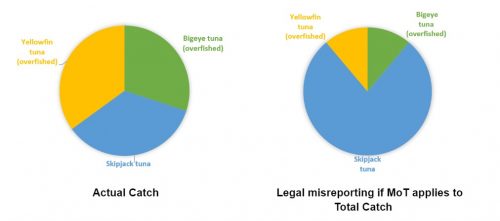
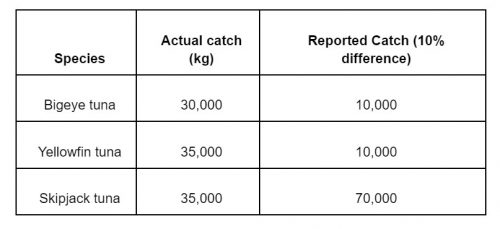
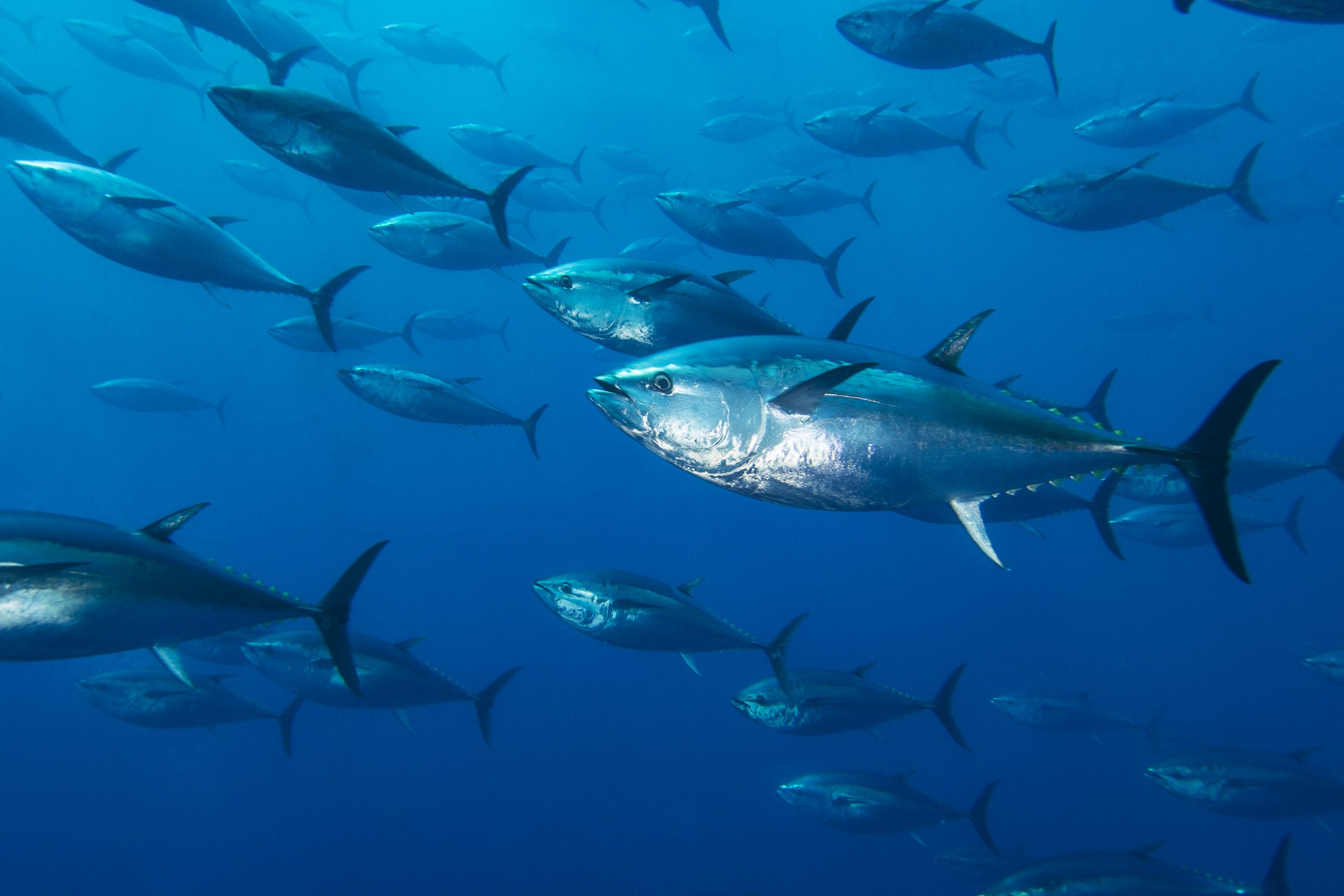
However, the most worrying development is a change to the MoT for small pelagic, industrial fisheries and tropical tuna species. There are three species of tropical tuna fished in EU waters including skipjack, yellowfin and bigeye tuna. Yellow and bigeye tuna are recorded as being overfished and/or subject to overfishing according to a 2022 stock assessment of the Indian Ocean. The new changes mean that the MoT will be for the entire quantity of the catch landed and not per species. There have been rules put in place along with the increase of the MoT. Vessels must land at specific ports which will be subject to higher investigations of the catch. However, the EU does not have a great track record of inspections which can be seen by an open infringement case on this matter.
This change to the MoT will allow for dramatic underreporting of the overfished species of yellowfin tuna and bigeye tuna alongside overreporting of skipjack tuna. The MoT was changed to show the total catch instead of per species in the Baltic Sea and this was the reason for a decline in ecological health of this area. An example below shows how a vessel could hypothetically legally misreport their catches.
While we welcome the majority of these changes to the control regulations, there is a very considerable worry that this change to the tropical tuna fleet will have devastating consequences.
Biodiversity week came to a close last week with dozens of events around the country celebrating our natural heritage. It’s hard to know if the irony was lost on some politicians that instead of spending time reflecting on our connection with nature they joined the most concerted attack on efforts to address the biodiversity crisis we have seen in a generation.
Fine Gael MEP Colm Markey and his Sinn Féin colleague Chris MacManus formed a strange alliance on the EU agriculture (AGRI) committee in choosing to vote down the EU’s proposed Nature Restoration Law (NRL) in its entirety rather than proposing any amendments that might have alleviated farmers’ concerns.
Fianna Fáíl’s (FF) Billy Kelleher, also an MEP but without a vote on the AGRI committee, was also all over the media describing the proposals to reduce emissions from drained peatlands as “extreme”. At home his FF colleague Barry Cowen condemned the NRL as “cultural imperialism”.
All of these political parties voted for the Climate Act in 2021 that mandated the reduction in emissions of 51% by the end of this decade. Yet, taoiseach Leo Varadkar said that elements of the proposed law “went too far”.
Each of these politicians squirmed in their insistence that they want to see nature restoration while also pressing the nuclear destruct button.
The NRL is under serious threat, but it has not been killed off. Despite the negative vote in the AGRI committee, followed a day later by a similar motion in the fishing (PECH) committee, these votes are not binding. The file belongs to the environmental committee (ENVI) and the outright rejection by the other committees in fact makes their job easier. Since there were no amendments, there is little to negotiate.
The ENVI committee itself votes on June 15th and a rejection here would indeed kill off the proposal. Ireland’s two full members of this committee, the Green Party’s Grace O’Sullivan and independent Mick Wallace, are both strong supporters of the law. The aforementioned Billy Kelleher and Fine Gael’s Deirdre Clune are substitutes… can either be persuaded to vote in favour if they are called on to vote?
While a negative vote in ENVI will bring a hard stop to the process a positive one means the proposal will then go to a full session of the European Parliament, scheduled to be held in July. Here again a negative vote would be fatal, an approval would be much more positive, meaning the Parliament would then enter ‘triologue’ with the Commission and the Council (representing member state governments).
In such an event, a final regulation could be approved by the end of this year.
In the Dáil over the past two weeks Green Party TDs launched a stout defence of the NRL while the minister in charge of the National Parks and Wildlife Service, Malcolm Noonan, said that even if it was rejected Ireland should press on with its own restoration plan.
Minister for the Environment Eamon Ryan is believed to be looking for Ireland’s impressive budget surplus to be used for a dedicated nature restoration fund, outside of the Common Agriculture Policy, that would put money on the table for farmers.
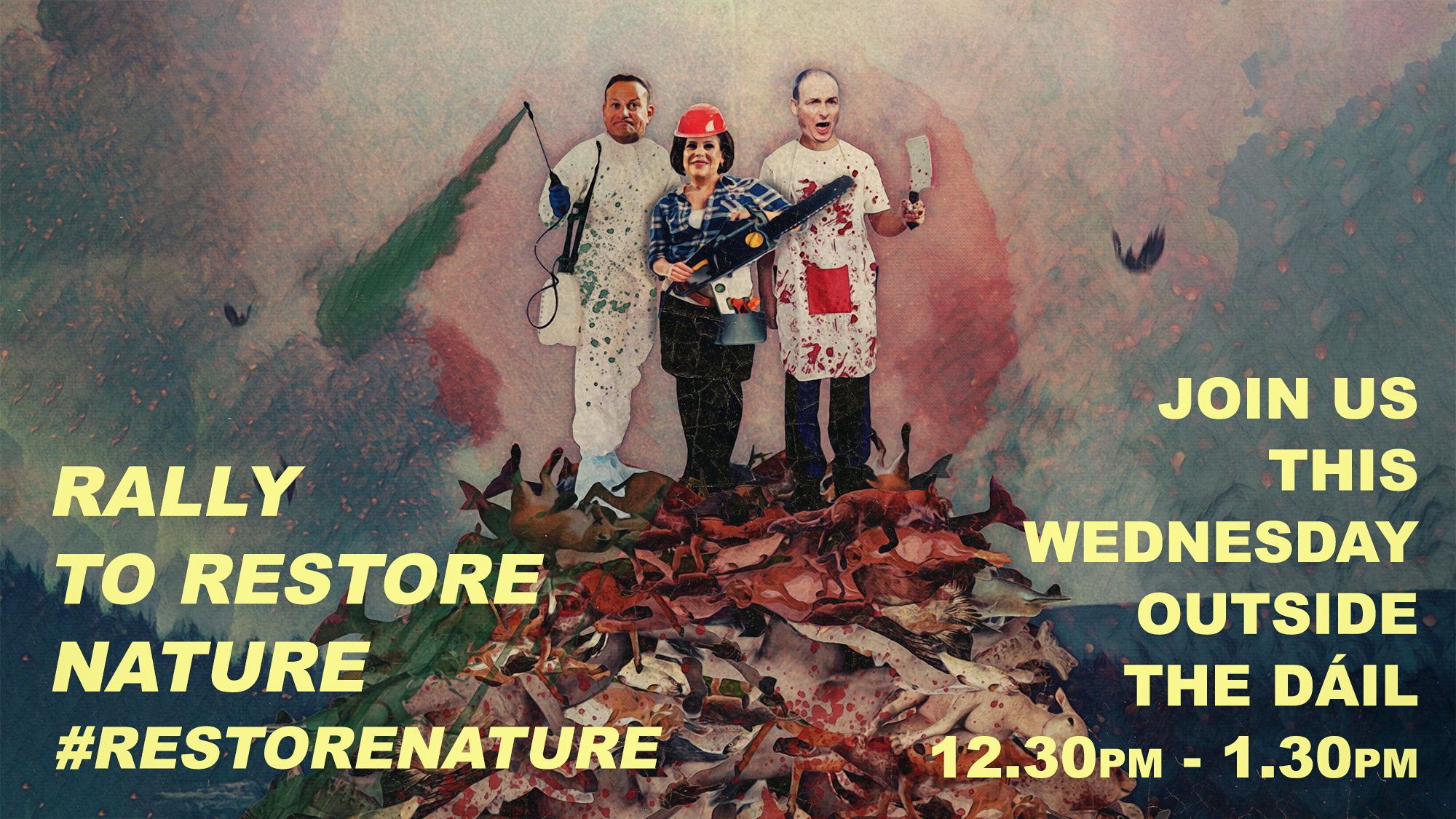
The IWT at the Dáil protesting for nature restoration
This week highlighted the inconsistencies within the three large political parties on climate and nature action. Tánaiste Micheál Martin is outwardly receptive to action, recently visiting Cavan to announce a big land purchase by the State for reaching biodiversity goals. But where is the leadership when so many in his own party are vocally scaremongering and spreading misinformation about the Nature Restoration Law?
Agriculture minister, Charlie McConalogue, made soothing noises this week, stating that “I now expect our MEPs to work hard to bring the European Parliament position much closer to that of the Council”. Let’s hope he’s right, as government support will mean little if the whole thing is thrown out by the parliament.
Sinn Fein’s climate spokesperson, Darren O’Rourke, told the Dáil that the NRL “has the potential to be an important tool” in addressing the biodiversity emergency, and insisting that his party was in favour of “urgent action”. But these words are unconvincing while Mary Lou McDonald has so little to say herself on the subject and when the party’s only MEP is siding with the right wing in rejecting the law.
Varadkar and Fine Gael are at least consistent in opposing any meaningful efforts to address climate and biodiversity collapse. Should we be surprised that the Taoiseach has joined a campaign of misinformation that seeks to steal votes from the far right in next year’s local and European elections?
This lack of leadership leaves a vacuum that is filled with the hysteria, the scaremongering and even blatant lies about what the NRL is, and clearly isn’t about. “The rhetoric on rewetting from Fine Gael, Fianna Fáil and the rural Independents does not seem to be matched by the facts” said Harry McGee in the Irish Times while Daniel Murrey, writing in the Business Post, noted how “facts are increasingly taking a back seat to feverish rhetoric”.
Were the NRL to be defeated, the consequences would travel far beyond the EU’s borders. It would threaten the entire ‘Green New Deal’ that has been a signature of Ursula von der Leyen’s Commission. The EU likes to see itself as a leader on climate and biodiversity. Its rules can have global reach, e.g. in the fight against deforestation, a carbon border tax, pesticides, single use plastics and more. The threat to the Nature Restoration Law is international news and its fall would undermine efforts to curb tropical deforestation, climate action and ocean protection.
People like Colm Markey, Chris MacManus and Billy Kelleher, with an eye on re-election in 2024, may not care much for these things but their political masters at home should. A weaker EU plays into the hands of its enemies from China and Russia to the American Far Right.
The leaders of the three big parties would prefer not to be talking about nature and climate. But room on the fence is getting tighter and the only way they’ll get off it entirely is through public pressure. This is why the coming weeks are critical not only for nature but our broader approach to the climate and biodiversity crisis. Time is running out.
Irish political leaders must support Nature Restoration in the European Parliament
May 25th 2023
The Irish Wildlife Trust is calling on all political leaders in Ireland to ensure that their MEPs support the Nature Restoration Law in the European Parliament
This week the European Parliament’s Committee on Fisheries (PECH) and Agriculture and Rural Development (AGRI), both rejected the Nature Restoration Law (NRL). The vote to reject the NRL without amendments was supported by MEPs from the government and main opposition party in Ireland.
This rejection of the NRL by these committees poses a direct threat to the objectives of the European Green Deal, which aims to steer the EU towards a just transition to sustainable and equitable practices. It also goes against several of the recommendations of the Citizens’ Assembly on Biodiversity.
The NRL has the potential to be the EU’s most significant legislation for tackling the biodiversity and climate crisis. For EU decision makers this represents a pivotal moment to leave a positive legacy and securing support from each Member State is crucial. The landmark NRL will only pass if decision makers show a level of political will to match the level of urgency imposed by the environmental crises we are facing. Due to poor communication by the Government, there has been a lot of misinformation spread on the NRL, stating that it will undermine food security and stop all economic development. This is simply not true and member’s of the AGRI and PECH committees rejecting the NRL is a short-sighted decision which will threaten farmer’s livelihoods and food security in the long run.
The PECH committee rejecting the law also disregards all scientific evidence showing that the health of the marine environment is in severe decline and the effects this will have on small scale fishermen and women along with coastal communities.
NGO’s, including the Irish Wildlife Trust are now urging Members of the European Parliament (MEPs) in the lead committee on this file – the Committee on Environment, Public Health and Food Safety (ENVI) – to listen to the science and uphold the NRL in their vote on June 15th.
Irish MEPs must listen to what the Irish people are calling for in the Citizens’ Assembly last month for:
‘The State [to] renew and stand by its commitment to implement the objectives and targets of the EU 2030 Biodiversity Strategy and play a leading and supportive role in the adoption and implementation of a new EU Nature Restoration Regulation.’
Member’s of conservative and liberal groups in the European Parliament including the European People’s Party, the European Conservative and Reformists (ECR) and Renew Europe, along with the far right, have voted against restoring 20% of the land and ocean and this shows a blatant disregard for people and to nature.
Grace Carr, Marine Advocacy Officer at The Irish Wildlife Trust, said “The results this week are very disappointing for nature restoration. The recommendations in the Citizen’s Assembly also clearly call for greater restoration targets on land and sea. With the new Irish Marine Protected Area legislation in the process of becoming a bill, we hope that Irish TD’s will show more support for marine conservation and restoration then the MEPs in Brussels”.
It is time for the leader’s of Irish political parties to stand up for the Irish people and request their MEPs support a strong Nature Restoration Law.
Irish Wildlife Trust calls on the Government to send the Citizens’ Assembly report to an Oireachtas committee to fast-track action for nature
24th May 2023
The Irish Wildlife Trust (IWT) is today calling on the Government to ensure the recommendations of the Citizens’ Assembly on Biodiversity Loss are fast-tracked for action. A cross-party Oireachtas committee would be best placed to set about the process of prioritisation of the 159 actions contained in the final report which was published last month.
The IWT have issued this call in advance of statements to the Dáil on the Citizens’ Assembly to be delivered by TDs tomorrow afternoon (Thursday, May 25th).
IWT campaigns officer Pádraic Fogarty says “we have analysed the issue of biodiversity collapse now from every conceivable angle, it’s imperative that we move from making recommendations to implementation. This means politicians taking charge of the Citizens’ Assembly report and setting an agenda for making the changes that have to happen, and fast.”
Principle among these will be the headline finding that the State has “comprehensively failed” to implement its own laws and policies in relation to biodiversity. The Assembly has recommended that there be an “independent review of implementation and enforcement of biodiversity related legislation, directives and policies” and that “all governmental departments must explicitly acknowledge the State’s declaration of a Biodiversity Emergency and take immediate and targeted action”. This must be backed by adequate and sustained financial and technical support that will empower communities, farmers, fishers and local authorities to undertake the necessary actions on the ground.
A key measure for the government will be to legislate so that the National Biodiversity Action Plan is put on a statutory footing. This is the principal vehicle for delivery of actions and it must be put on a par with the Climate Action Plan, with defined reporting and accountability mechanisms.
The Citizens’ Assembly also highlights how the State must “play a leading and supportive role in the adoption and implementation of a new EU Nature Restoration Regulation”.
We have known for many years what we need to do and how to do it, but the will to actually do it has been missing, that needs to change immediately.
The European Nature Restoration Law (NRL) is the first continent-wide comprehensive law to restore Europe’s degraded ecosystems on land and sea. The climate and biodiversity crisis are two sides of the same coin and we must tackle them simultaneously. Having healthy ecosystems will not only help to mitigate climate change it will also offer natural solutions to disasters such as flooding. We are now reaching a crucial stage in the NRL process, with votes happening soon from the PECH committee (on fisheries) and ENVI committee (environmental ). We will then have a plenary vote on the law which will take into account the votes and amendments from the committees involved.
There has been a lot of discussion in Ireland about the land-based targets and push back from different groups on the peat rewetting goals. There has not been as much coverage on the fisheries and marine side of the NRL, although the situation with the PECH committee is not looking very positive from a conservation outlook. Click here and scroll down to files uploaded in January to view the full PECH amendment documents.
Some of the amendments which the PECH committee have proposed significantly weaken the restoration and conservation targets originally proposed for the NRL. They suggest that the 20% restoration target for land and the 20% target for sea be scrapped and that a new 20% target be set for land and sea jointly. They also want to delay marine restoration deadlines until 2035 instead of 2030. The time to act is now and delaying goals will only ensure greater destruction of marine ecosystems.
It has also been stated that there is already enough legislation in place and there is no need for the NRL. They want to change the law to a directive so that it is not binding and member states can decide how, and whether, they want to hit the targets. This is especially worrying as Ireland’s track record of voluntarily protecting its land and sea is dismal to say the least. Ireland currently only has 8.3% of its maritime area designated as marine protected areas and these areas are not truly protected, with little to no management measures in place. The EU is currently takingIreland to the High Court over its consistent failure at setting and hitting conservation targets.
There is a non-deterioration principle within the NRL. This means that once an area is restored, it needs to be kept in this favourable condition. Restoration of severely degraded habitats can take a lot of time and money, and it would make sense for member states to then keep that area like that instead of wasting people’s money and effort. However, one of the amendments from the PECH committee calls for the non-deterioration principle to be watered down or removed completely. The reason they have given is that a member state cannot be held accountable if climate change negatively impacts a restored area. If restoration of an area is done right and the correct management plans are put in place to ensure the area is kept in good environmental condition, then keeping it like that should not be an issue.
One good agreement coming from the PECH committee is that better implementation of the Common Fisheries Policy should be obtained. If ocean restoration is to succeed then correct management of fisheries is vital or restoration impacts will be minimal.
If the PECH committee rejects the NRL in full this would be a disaster, not only for nature but for fishing communities and coastal businesses. It will also send a negative message to the world on what the EU’s political stance is towards ocean restoration.
Take action today and sign up to the RestoreNature campaign!
This campaign will send a common letter to decision makers (which you can read before it is sent) stating that you want a strong nature restoration law. All you have to do is fill in your name and email and we will do the rest.
Dublin’s wonderful Natural History Museum has a lot to say about our sea fish. The Victorian cabinets that line the walls of the hall on the ground floor speak to not only the great diversity of marine life that once abounded around our coasts but also the great size of fish in the past. The mackerel are a metre in length, plaice are the size of a dinner plate, turbot the size of a dinner table, common skate (no longer common) bigger than a car bonnet.
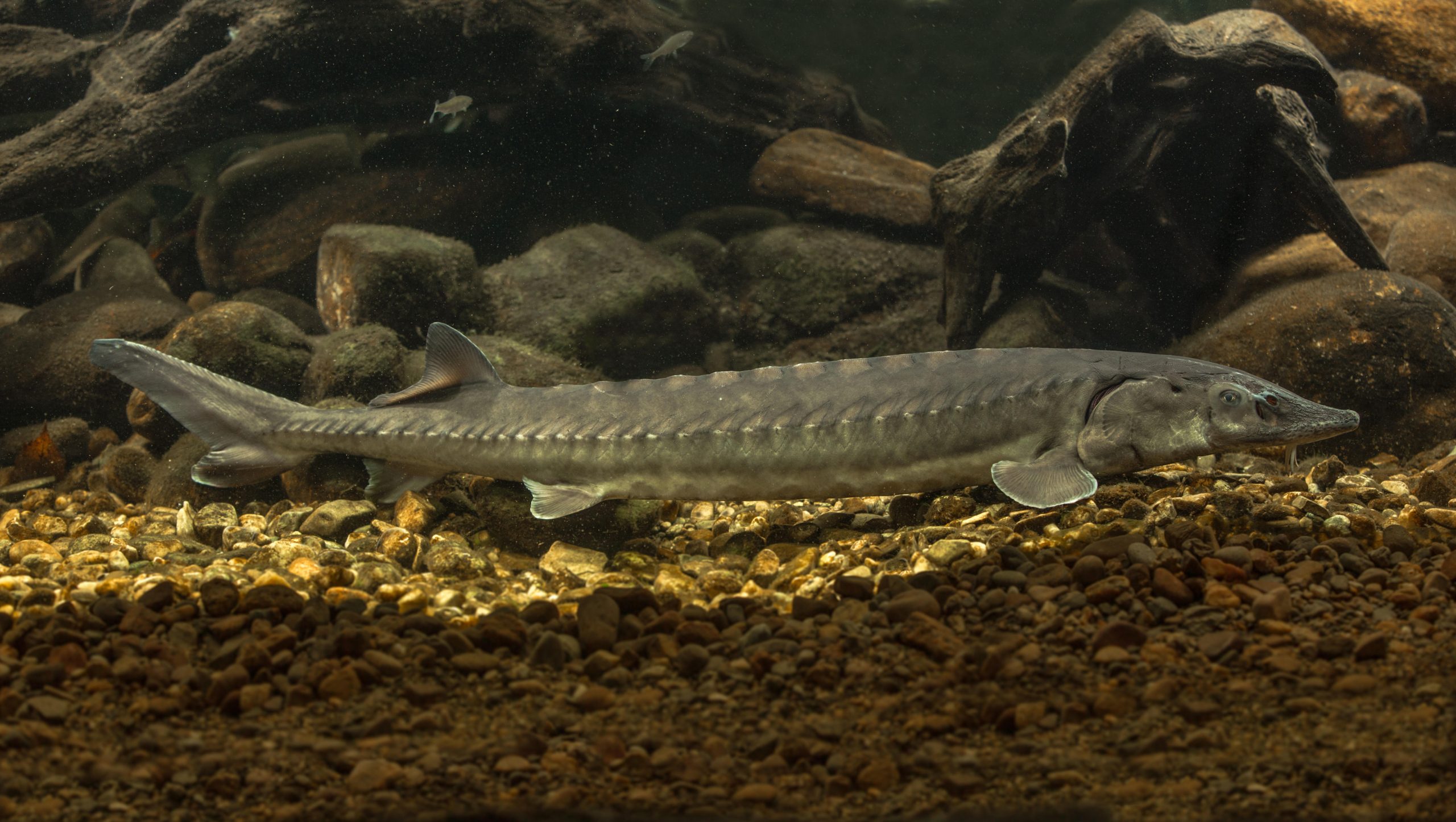
But one in particular has always caught my eye: the sturgeon. It’s a whopper, around two metres in length. The museum card says it’s an Atlantic sturgeon Acipenser oxyrinchus and was “taken from the Poolbeg Salmon Fishery, River Liffey, Poolbeg, Dublin in June 1890”.
Dublin’s salmon fishery is long gone, indeed virtually all the fisheries of the Irish Sea are gone but more gone than most is the sturgeon. Research from Declan Quigley, who has analysed records since the 1600s, has found that while sturgeon were never very common they were regularly found around our coast. More than that, he has found evidence that they may have been spawning in our rivers, including the Rivers Lee and Suir.
Sturgeon are ‘anadromous’, meaning that, like the Atlantic salmon, they spawn in freshwaters but then migrate to the sea where they spend most of their lives snuffling about on the sea floor, feeding on crabs and small fish.
The sturgeon can grow to three meters but there are likely very few left of this size in Western Europe. At around the same time that the last sturgeon of the 20th century was recorded in Ireland (from the coast of Dublin in 1987), they were disappearing from across their former range. Today, all 27 species of sturgeon are threatened with extinction; over-fished, over-exploited, their sea habitats dredged and trawled, their spawning habitats polluted and/or inaccessible due to dams and weirs.
The last river in Western Europe with spawning sturgeon was the Garonne in France, these are European sturgeon A. sturio, which was believed to be the same species as the one in the Dublin museum, until DNA tests in 2016 which showed that is was in fact the Atlantic species. On the Garonne, as well as the Elbe and the Rhine, reintroduction efforts have been under way, prompted by a Europe-wide action plan published in 2007 under the Bern Convention on migratory species.
This plan urged all signatory nations to join the effort in restoring sturgeons to their former habitats was bolstered in 2018 with the publication of a Pan-European Action Plan for Sturgeons. Ireland, a signatory to the Bern Convention, has not indicated whether it intends to participate in these initiatives. This is perhaps, because the sturgeon has not been officially recognised as extinct from our waters, a ‘red list’ assessment from 2011 excluded it from its analysis, saying it was a “rarely recorded vagrant”, although this doesn’t tally with what is known about the fish.
In 2021, Melissa Vanderheyden from what was then the Galway-Mayo Institute of Technology (now the Atlantic Technology University) studied a number of big rivers in Ireland (the Shannon, Boyne, Suir, Barrow and Munster Blackwater) to see if suitable spawning habitat is available for sturgeon today.
She found that “in all of the analysed rivers, medium to highly suitable spawning and rearing habitat is found, which according to a subsequent population viability analysis would be sufficient to sustain a viable population of European sturgeon”. She also found that were barriers to migration removed along the lower stretches of these rivers, even more suitable habitat would become available.
As it happens, the removal of barriers on rivers is a requirement under a number of policy stipulations including the Water Framework Directive, the EU Biodiversity Strategy and the (hopefully soon to be enacted) Nature Restoration Law. The latter will also require restoration measures for a number of marine species, including the sturgeon. The creation of Marine Protected Areas around the Irish coast, something which will be provided for under legislation which is due to be enacted later this year, will also help the sturgeon by creating zones free of bottom trawling.
The Irish Wildlife Trust and the Blue Marine Foundation in the UK have just released a report which looks at sturgeon reintroduction to Ireland. We asked marine lawyer, Dr Sarah Ryan Enright, for an analysis of the legal status of the sturgeon and she confirmed that Ireland is obliged under the Habitats Directive, to examine the feasibility of reintroducing a range of species, including the sturgeon, as it is listed by the EU as in need of special protection. Her report noted that Ireland has no legally enforceable obligation to undertake such a reintroduction but has signed up to a range of international conventions to that effect.
We have seen that reintroducing species can be successful but there is no commitment to examine all the species that we’ve lost over the centuries or coordinated approach to reintroducing them.
This is badly needed. The sturgeon could, feasibly, swim into our waters following reintroductions in France, Holland and Germany. The UK Sturgeon Alliance last month released a report urging their government to act. But this could take decades. Sturgeon need all the help they can get right now. They would serve as an ‘umbrella species’ that would spearhead the restoration of our seas and waterways as part of a wider European effort.
Currently, the only place to see an Irish sturgeon is in a museum. There’s no reason that needs to remain the case.
You can read the full report ‘Restoring the Sturgeon to Irish Waters’, as well as the legal review, on our website.
If you want to learn more, I’ll be talking at the Patagonia store on Wicklow St. in Dublin on Thursday evening (May 25th) at 7:30pm, it’s free and there’s no need to book.
Ireland and UK conservation groups unite to call on the Government to reintroduce the sturgeon – Ireland’s lost ‘dinosaur fish’
19th May 2023
The Irish Wildlife Trust (IWT) and the Blue Marine Foundation in the UK have jointly published a report, ‘Restoring the Sturgeon to Irish Waters’ urging the Government to examine the feasibility of reintroducing this long-lost and enigmatic fish.
Sturgeon, sometimes called ‘dinosaur fish’ as they have been swimming in rivers and seas since the Jurassic Period, can grow to over two metres and were once frequent in the waters around our coast.
Before Irish independence they were designated a ‘royal fish’ and any sturgeon caught was automatically the property of the Crown.
A legal review commissioned for this study found that under the Habitats Directive Ireland is obliged to examine the feasibility of reintroducing sturgeon while existing data show that suitable habitat exists for them, particularly in the Rivers Shannon and Suir.
These migratory fish spawn in freshwater but spend most of their lives at sea. Sturgeon can therefore be an ‘umbrella species’, i.e. measures to restore their habitat will benefit a range of other species in the aquatic and marine environments.
The publication of our report coincides with the recent release of the UK Sturgeon Conservation Strategy and Action Plan 2023-2033, which in turn complements pan-European efforts to restore the critically endangered sturgeon throughout its former range. Ireland must be part of this wider effort.
IWT campaign officer, Pádraic Fogarty says “we need to see a more concerted effort to reintroduce species to Ireland that have been driven to extinction. We believe the sturgeon should be a priority as many of the measures to restore its habitat, such as improving the status of rivers and the creation of marine protected areas, are already government commitments. It’s also a magnificent animal that deserves to be brought back to Ireland in its own right”.
Adrian Gahan of Blue Marine Foundation says “Sturgeon once moved freely through the seas and rivers of Britain, Ireland and continental Europe. It is great to see conservation groups from across Europe come together to restore these ancient animals. Nature does not recognise national borders so nor should our conservation efforts. Blue Marine Foundation is delighted to partner with The Irish Wildlife Trust on this important study. ”
Birdwatch Ireland in collaboration with the IWT has created a petition calling on the Minister for agriculture, food and the marine, Charlie Mc Conalogue to block a new dangerous proposal which could have devastating effects on fish stocks and incentivise overfishing and underreporting. It has been proposed that the 10% Margin of Tolerance (MoT) should be increased, which allows discrepancy for fishing vessels when reporting their catch. The sustainability of EU fisheries can only happen if scientists and decision makers know what has been caught accurately.
In February the European Commission released four documents on how to improve EU fisheries (1). Many of these documents reference the Control Regulation, the draft of which was published in February 2020. There are many aspects to the Control Regulation aimed at improving the sustainability of EU fisheries.
All fishing vessels must complete an electronic logbook containing information on all catches. Landings and transshipment declarations should be recorded.
To help with the traceability of seafood, operations at all stages of production, processing and distribution should be recorded electronically and linked with a unique fishing trip number of a particular vessel.
To help assist with the landing obligation, CCTV should be continuously-recording on a minimum % of vessels.
These are just a few of the proposals and there are many aspects to this regulation, which, if they were taken on board and made mandatory, would be a huge step in the right direction for proper implementation of the Common Fisheries Policy and restoration and conservation targets of the marine environment.
However, there are some aspects to the Control Regulation which would cause ecological destruction. A proposal on increasing the Margin of Tolerance (MoT) was suggested which would backtrack on current fisheries control regulations in place to support the accuracy of catch reporting. The current MoT allows for a 10% discrepancy in reported catches per species. This means vessels can misreport up to 10% of the weight per species which was caught and this is to allow for genuine mistakes to occur without fines and prosecutions coming down on the vessel and its crew. However, previously the EU parliament proposed to increase this margin to 20% for some small pelagic and mixed fisheries and 25% for tuna species which would have had devastating effects. It has also been proposed by member states that the MoT percentage should account for the entire catch and not on a per species basis. This would allow for the huge underreporting of overfished species and overreporting of fish species that are in favourable conservation condition. This has happened before as the MoT was weakened in the Baltic Sea and this contributed to fish populations collapsing and ‘incentivised’ hidden overfishing (2). The European Commission has even stated ‘this relaxation played a major role in facilitating misreporting of the species…and therefore contributing to the very bad state of the stocks in the (Baltic) region’.
If Member States do not show support to keep the MoT at 10% per species then there is a very real risk that the Commission could withdraw the entire proposal. This would mean that the positive amendments which would help transform EU fisheries and reduce the overfishing which is destroying the oceans ecosystems would also be taken off the table.
This is a huge opportunity for the EU to make positive change and if it is taken away due to member states’ silence over the proposed increase to the MoT it would be a devastating shame. The Common Fisheries Policy, which is supposed to keep fisheries sustainable and prevent overfishing, needs to be properly implemented to ensure the EU meets its international ocean and biodiversity protection and restoration commitments. Seas at Risk states in a joint NGO paper on the Nature Restoration Law that proper restoration of the ocean cannot happen without the CFP actually being put to work. The collapse of fish stocks has knock on effects to the entire marine ecosystem.
Birdwatch Ireland in collaboration with the IWT has created a petition calling on the Minister for agriculture, food and the marine, Charlie Mc Conalogue to block this proposal before the May 30th meeting. Please sign now and share wide so the Irish Minister knows that the Irish people do not want an increase to the MoT. This is a vital time for ocean restoration and we must ensure this dangerous proposal is blocked.
2050 is only 27 years away. It’s at the same point in the future as 1996 is in the past, when Hotmail launched on the internet, Mission Impossible, Twister and Independence Day were in cinemas and the ‘Macarena’ was driving people on to, and away from, the dance floor.
2050 is also the year when we are supposed to be reaching ‘net zero’ emissions of greenhouse gases in order to stay within 1.5 degrees Celsius of warming and so, maintain a habitable world for millions of people. That is not the course we are on however.
At current rates of emissions we could break through the 1.5 degree threshold by the end of this decade and hit 2 degrees by 2050. This would see extreme flooding, heat and water stress to many parts of the world, precipitating migration, conflict and misery on a scale this generation has only read about in history books.
On current trajectories, and based on a ‘business as usual’ approach, a number of birds will be extinct from Ireland by 2050 as breeding species including the curlew, hen harrier, dunlin, redshank and twite. A few dying freshwater pearl mussels in a mountain river or two may be all that’s left of Ireland’s longest-living animal. Overfishing will have extracted the last of the fish shoals from our coasts so the few whales that visit us today will be long gone for want of food.
We like to say that nature has great capacity for recovery but this is only up to a point. You can lean back on your chair and return to your original position when you let go, but there is a point where instead of landing back on your feet you end up on your arse. In nature this is called ‘hysteresis’ – a point where there is no recovery, even when a pressure has been removed. A warming climate with more frequent and longer droughts may mean that treasured ecosystems cannot recover, such as the moist Atlantic rainforests of the west, or our peat bogs which could turn from greenhouse gas absorbers to emitters, even when every effort has been made to rewet them. A combination of warming, more acidic and polluted seas could mean that even if we stop fishing, the fish will not come back. In other words, a point where restoration and recovery are no longer possible.
In 2050, all going well, I will be celebrating my 77th birthday. My daughter, Maia, 16 today, will be only 43, younger than I am now. She may have children of her own, who knows. She can’t vote (even if she wanted to) and has had no say in the decisions that have led us to the brink of calamity. I’m sure her future self will have some choice words for my generation in 2050 as we enjoy our retirement, just like I feel a certain resentment for those in power in the 1980s and 1990s who made such disastrous decisions in the full knowledge that we were heading for climate and biodiversity meltdown.
We often hear platitudes towards the generation coming behind us, saying that their voices need to be heard and, thanks to the publication last week of the Children’s and Young People’s Assembly on Biodiversity Loss, we know exactly what they are saying.
This process, the first in the world of its kind, was held in parallel to the Citizens’ Assembly (which produced its report in April, and which was for over-18s only) and heard from 35 citizens between the ages of 7 and 17. This is a heavy topic for children; our past, present, and potential future have paid them – never mind the natural world – scant regard.
The report, written by the young people themselves says that “it is so important that children and young people in Ireland can have their say on biodiversity loss because we are the ones who are going to have to live with whatever happens”. The report shows off their creativity, their art, stories of the friendships they made and the fun they had in exploring their love of nature and in coming up with their recommendations. It has no hint of blame or anger. We learn from it that children have rights under the UN Convention on the Rights of the Child and that “biodiversity loss is a children’s rights issue”.
Through their work, they have created a vision for Ireland “where we are connected to and care for the rights of nature (and each other) so that biodiversity is restored and protected and we live and grow up in healthy, clean and fair environments”. “We must treat the Earth like a member of the family or a friend” and “future generations must live in a world where there isn’t a biodiversity crisis and where children don’t have to take action because of the incapability of past generations”.
They have produced 58 recommendations around the teaching of biodiversity and climate, governance (“every decision being made must consider biodiversity and the rights of nature”), a switch to renewable energy and public transport, and reducing waste and pollution. They want more nature reserves, reintroductions of native species including wolves, green jobs and reforestation of our denuded island. They want an end to overexploitation, including an end to overfishing and a halving of the national cow herd. Above all they want to be listened to and they want action on their recommendations.
There are no children or young people in the Dáil, the chambers of County Councils or the boards of companies. Yet everyone in those institutions is making decisions that directly impact them, for good or for ill. Ireland in 2050 doesn’t have to be a struggling, depleted place where we are forced to adapt to a new, frequently hostile nature. But if it is to be different we must listen to the articulate, empathic young people who have laid it out for us in no uncertain terms. We have to start acting now.
In the greater scheme of things, owning a dog is probably seen as at the insignificant end of the biodiversity crisis wedge. Owners of harmless-looking lapdogs or lumbering retrievers do not typically see their beloved pets as destroyers of ecosystems. I’m not a dog owner myself but I’m as fond of the mutts as anyone, even when, as once happened, a friend’s dog lunged into the long grass along our walking trail to snap at a lizard, which subsequently lost its tail.
I’ve been with friends in nature reserves where they have let their dog off the leash and have been confidently assured that their dog would quickly come to heel when called. No one likes to challenge their friends or to make a stand on an issue like this but the problems of dogs and their owners came into troubling relief recently when hill farmer Pat Dunne felt forced to close access to walkers along the popular ‘ZigZags’ trail in Glenmalure Co. Wicklow after being physically assaulted. Pat has allowed access through his land on condition that dogs are not allowed, even on a lead they can bother the sheep. With no enforcement, this has routinely been ignored (I even met a couple on this route once that had lost their dog after it bounded off after something in the bracken) so who’d blame Pat for having enough?
Dogs are increasingly recognised as a problem or, perhaps as a dog-owner would be quick to point out, the problem is irresponsible dog ownership. But not all problems are associated with their behaviour.
One recent study from Belgium estimated that the volume of dog foul in some areas, measured in the deposition of nitrogen and phosphorous, can reach levels that would be illegal on a farm. Where this is occurring in nature reserves, it may be affecting the local ecology through excessive artificial fertilisation, reducing the biodiversity of plants in particular. Many dog owners see no harm in this and while most are no doubt responsible and bring poo bags, these are then sometimes hung on branches. Nothing is done about nitrogen-rich urine.
And these effects are seen when dogs are kept on leads. When they’re off the lead we see a whole different level of negative impacts. One 2020 study found that insecticidal flea treatments, which include substances which have been banned on farmland, are washing into rivers. In the UK it is estimated that 80% of dogs are receiving flea treatments and this study found that 99% of samples from 20 rivers contained levels of finopril, with concentrations of one breakdown product on average 38 times the safety limit. Author of the 2021 book ‘Silent Earth’ and entomologist Prof. Dave Goulson told the Guardian newspaper that “the problem is these chemicals are so potent… one flea treatment of a medium-sized dog with imidacloprid contains enough pesticide to kill 60 million bees”. These poisons can enter the environment by washing dogs at home but allowing dogs to jump into rivers and lakes is also a source.
And then there’s the disturbance. Many popular places for people to walk, with or without their dogs, also happen to be nature reserves (partly as a result of very restricted access to the Irish countryside). People see little harm in letting their dog off the leash in the local forest or coastal beach to get a bit of exercise, but where’s there’s one dog, there’s typically another one not far behind. For birds in particular, whether they’re trying to nest in the spring and summer, or fatten up over the winter in preparation for migration, this continual harassment can be devasting for whole populations.
In Dublin, the country’s most populous region, Sandymount Strand and the area around Bull Island at low tide are filled with people, dogs, horses, you name it. Dublin Bay, Malahide Estuary and Baldoyle Bay are all ‘Special Protection Areas’ for coastal birds but studies which are now a decade old found that disturbance by dogs in each of these areas was ‘high’ or ‘moderate’, and in some cases more or less ‘continual’ (along with other unregulated activities like jet-skiing and digging for bait or shellfish).
You might well wonder how these places retain any ornithological interest at all in the face of this pressure. But the fact that you might see impressive numbers of birds while out and about in these areas is masking serious declines of wintering waterbirds in Ireland. A 2018 study by BirdWatch Ireland recorded a decline of 138,160 birds (15%) between the four winters from 2011-2016 compared to the previous 2006-2011 period. This is a very short interval to see such a dramatic fall off in numbers. Some species of duck, such as shoveler, pochard and common scoter saw declines of over 30%. The study found climate change to be an important driver but noted that “this should not mask the many local pressures faced by wintering waterbirds”, which include recreational disturbance.
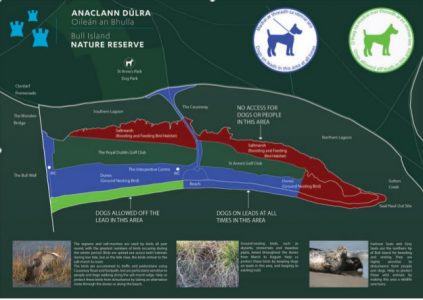
Zoning of Bull Island
And it’s not just birds. Bull Island, north of Dublin Bay, is believed to have lost its population of Irish hare due to harassment by dogs.
A response has been long in coming. Dublin’s Bull Island enjoys every kind of protection that exists, from National Nature Reserve to UNESCO Biosphere Reserve but like all the other ‘protected’ areas, these designations have brought little noticeable change to site management. Disturbance from dogs was identified as an issue in a Management Plan for the island in 2009, indeed by-laws prohibiting dogs off-leash are in place since 1994, but have never been enforced. The rusty signs can still be seen.
An updated ‘Action Plan’ was published in 2020 and which proposed a zoning of the island to keep people and dogs away from the salt-marsh (vital feeding grounds for the birds) and the north of the island (where seals can haul out and would give birth if they were given a bit of peace). Walkers on the dunes will be required to keep dogs on a leash at all times. Last month, a press statement from Dublin City Council said this would come into being at the end of April. But it also said that this would be based upon a ‘voluntary code’. In other words, there will be no enforcement of these rules.
Why are rules for the protection of wildlife not enforceable in the way that parking violations or littering are? All of our important wildlife sites need information boards, wardens and a programme of education to explain to people why they are important and worth protecting (not to mention actual management measures, something Ireland is being taken to Court for by the EU). But it is senseless to think that without rules that can be backed up with fines there will be any lasting impact.
So maybe the problem isn’t dogs, it’s not even irresponsible dog-owners, it is the reluctance of the State (which includes local authorities and the National Parks and Wildlife Service) to take responsibility, something described in the recent report of the Citizens’ Assembly as a ‘fundamental disappointment’.
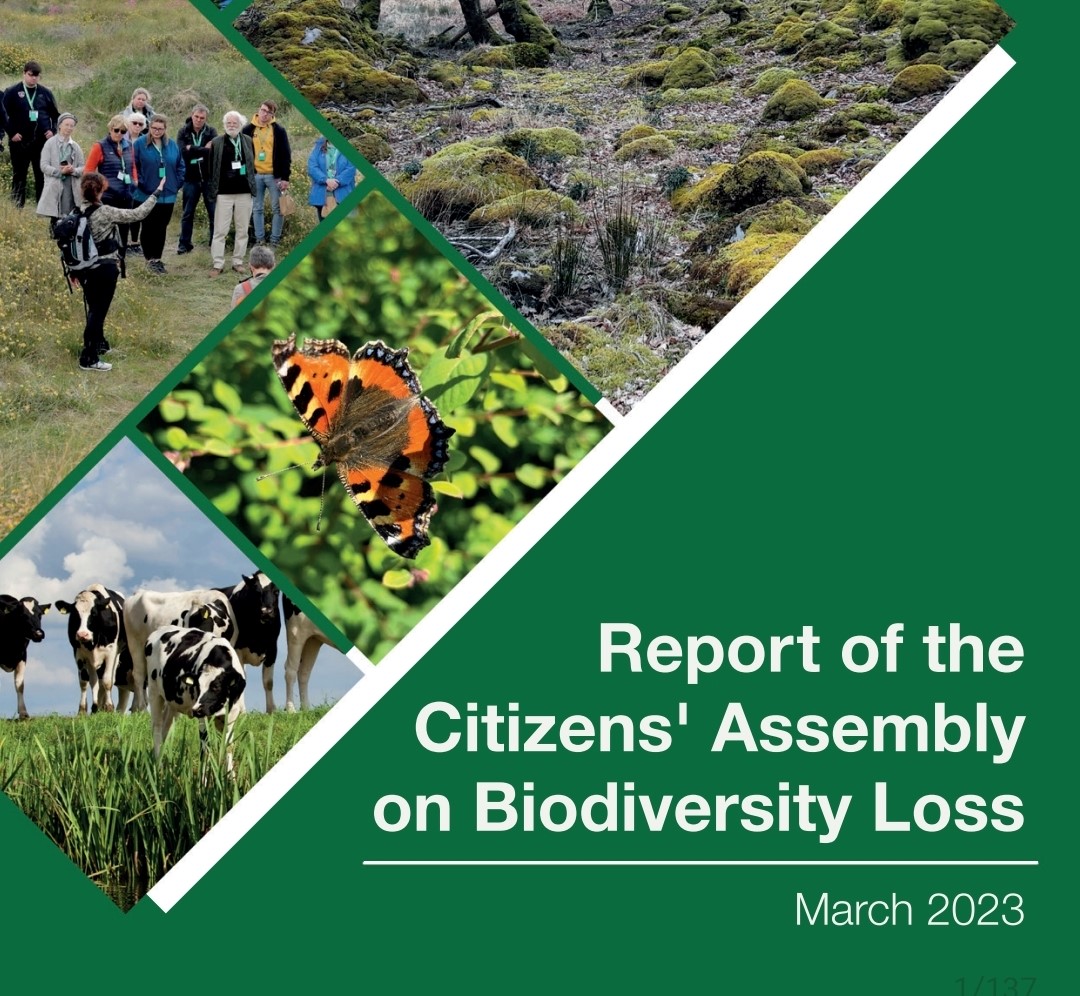
This week’s publication of the Citizens’ Assembly report on Biodiversity Loss is a vindicating moment for environmental NGOs. Over the past year, 100 randomly selected citizens were given the task of making comprehensive recommendations on how we can reverse biodiversity loss, even though many of those at the first gathering may only have had the vaguest idea of what this was. Even the chair, Aoibhinn Ní Shúilleabháin admitted that she was reluctant to take on the role as she knew too little about it.
It has been fascinating to watch the work of the Assembly, guided by the (all voluntary) expert group, as they followed an arc of realisation on the state of nature in Ireland via the litany of State failures to act on its own laws and policies. Ní Shúilleabháin described this as a “fundamental disappointment”.
Many of the subsequent recommendations are changes that NGOs have long been calling for while the report itself acknowledges the “critical role” our sector plays in the biodiversity crisis. One recommendation, for the State to increase its support for NGOs and community groups, was supported by 95% of the citizens. Given the attacks that NGOs have come under in recent years from politicians and sectoral lobbyists, this is a welcome endorsement for our work.
The Citizens’ Assembly report complements the publication last November of a similar report from the Oireachtas Committee on the Environment and Climate Action on the same topic, and which came up with broadly similar recommendations.
Every avenue for further analysis or report writing has now be thoroughly exhausted. Actually doing the things that need to be done continues to be the hard part and indeed much of the Assembly’s report has not been suggestions for radical transformation but reminding the government of the many things it has already said it would do.
So what hope is there that meaningful action will come out of this exercise? Five years ago, April 2018 to be precise, saw the publication of the Citizens’ Assembly report on Climate Change, and this may give us a clue.
This was tasked with “making Ireland a leader” in tackling climate change and revealed broad support for strong action to reduce greenhouse gas emissions. Yet, reading these recommendations today shows that implementation has been mixed and many would feel that there is a way to go before we could consider Ireland a leader in this field.
Specifically, those recommendations in relation to land use, including incentivising diversification away from meat and dairy and imposing a tax on emissions from agriculture have made little headway. Indeed, such are the sensitivities around land use that sectoral ceilings for this sector have not even been published by the government.
The Assembly’s report on Biodiversity Loss similarly recommends levies on agricultural exports and retailers, to be ring-fenced for investment in biodiversity, something that is perfectly compatible with the principle that the polluter should pay. But Fine Gael’s Simon Coveney, chief architect of the agricultural expansion that has resulted in so much pollution and biodiversity loss over the last decade has already said he would be opposed to such a move. A suggestion that people “must be encouraged to consume a plant-based diet” will likely fall on deaf ears.
The low-hanging fruit are the recommendations to do things that the government has already agreed to, such as protecting 30% of the ocean in Marine Protected Areas by 2030 (in fact, the report is rather weak on the marine, with no mention of aquaculture or overfishing) or adequately funding Irish Water to upgrade wastewater treatment infrastrucutre.
One thing the government could do straight way is the suggestion to review all government departments and their role in implementing environmental law, and to identify why laws are being broken and who is responsible. A recommendation for there to be a senior minister with responsibility for biodiversity will likely not happen until the next election.
Legislative change will be needed to reform the Arterial Drainage Act and the Forestry Act and to review the functions of the Office of Public Works, Coillte and Bord na Móna. This requires strong political commitment, even the gap between saying that a law needs to change and actually changing it can be dragged out for years. But it can also happen quickly if the will is there.
As for the prospect of a referendum to change the Constitution to provide a right to a healthy environment as well as rights for nature, this is something that is not likely during the lifetime of this government.
In the very short term, the government could instruct Coillte to stop replanting conifer monocultures, especially on peatlands. Plans for a wind farm on the Shannon Wilderness Park should be scrapped. Fines for environmental crimes should be increased while crimes committed by State agencies can no longer be tolerated. Ending bottom trawling in existing marine protected areas would not be that hard (given how small they are) while the government, particularly Minister for Agriculture, Food and the Marine, Charlie McConalogue must stop his equivocation around the EU’s Nature Restoration Law. Instead, he should be actively looking for new sources of funding so that it would be seen as a significant investment in rural Ireland as well as ‘merely’ restoring biodiversity.
The report of the Citizens’ Assembly has given us something we haven’t had before: a strong mandate to prioritise biodiversity as an issue of national importance. The members of the Assembly have done themselves proud in their commitment to a complex issue and for the bravery in their recommendations. But there is no magic wand to make all of these things happen.
I believe this report accurately reflects the desire of Irish people to address biodiversity loss, but this on its own won’t be enough. We all need to engage more with the climate and biodiversity crisis in a way that makes it a personal issue and not only a national, or global one. That means supporting the politicians who will champion the recommendations of the Citizens’ Assembly.
We can all play our part, but the report this week couldn’t be clearer – we can’t address biodiversity loss until the State steps up.
Citizens’ Assembly report on Biodiversity Loss a damning indictment of the State’s failure to protect nature
05th April 2023
The Irish Wildlife Trust (IWT) welcomes the publication today (April 5th 2023) of the final report and recommendations of the Citizens’ Assembly on Biodiversity Loss. It confirms that the State has abjectly failed to protect nature, including breaking laws and ignoring its own policies.
This can’t be just another report and the government must move rapidly to implement its recommendations. We don’t need any more committees or speeches and the Citizens’ Assembly report largely confirms what was already known. The actions needed to reverse biodiversity loss have been widely articulated and supported by evidence for at least three decades. The missing ingredient has been the government’s determined avoidance of taking the necessary remedial actions. There has been a fundamental absence of leadership in dealing with this crisis.
We whole-heartedly agree with the Citizens’ Assembly that the State has “fundamentally failed” in its duties and that must change without delay.
The Government must signal its support for this report by vocally backing the EU’s proposed Nature Restoration Law, which will set legally binding targets to restore nature across a range of species and habitats, including farmland, cities and the marine environment. Government ministers have so far been equivocal, or even openly negative, about this law, which will be fundamental in meeting climate and biodiversity targets by 2030 and beyond.
The IWT particularly welcomes the recommendation by the Citizens’ Assembly to change the Constitution to provide rights to nature and to people to a healthy environment. We also welcome the support for NGOs, like the IWT, for our role in raising awareness of biodiversity and holding the State to account for its failings.
In particularly we also welcome the following key recommendations:
That a new National Biodiversity Action Plan be a statutory plan aligned with the Climate Action Plan.
Change of the remit of Coillte and Bord naMona to bring them in line with the imperatives of the climate and biodiversity emergency.
The review of Ireland’s food policy, shifting to plant-based diet and ensuring farm subsidies are ‘results-based’.
Implementation of nature-based solutions for flood management and reviewing the Arterial Drainage Act 1945 which is “no longer fit for purpose”.
The creation of ‘no fishing zones’ as part of measures to protect the marine environment.
Income transition support for those affected by new marine conservation and restoration policies.
Review of the legislation around the protection of hedgerows.
Banning the sale of cherry laurel and other alien invasive species.
Greater transparency in planning and greater access to information and inclusion in the decision-making as it relates to planning.
The IWT wants to thank the chair of the Citizens’ Assembly, Aoibhinn Ní Shúilleabháin as well as the expert group and the participating citizens themselves for giving generously of their time.
Irish Wildlife Trust receives Lord Mayor’s Award in recognition of their work
31st March 2023
Lord Mayor of Dublin Caroline Conroy presenting award to Irish Wildlife Trust. Photo credit Fennell Photography
The Irish Wildlife Trust is honoured to have received a Lord Mayor’s Award in recognition of our work to help make Dublin a better place to live.
Lord Mayor of Dublin Caroline Conroy presented three individuals and three organisations with a Lord Mayor’s Award at the reception in the Round Room at the Mansion House in Dublin last night (3oth March). Since 1989, this annual award ceremony is an opportunity for the Lord Mayor to highlight and acknowledge, in a special way, achievements of both individuals and groups. We are delighted to be amongst fantastic recipients of this year’s Lord Mayor’s Awards; Sandra Dillon, Sail Training Ireland, Gerard Prendergast, An Taisce and Barry Keoghan.
The IWT Coordinator Kieran Flood says “We are delighted to receive the Lord Mayor’s Award and honoured that the Lord Mayor is taking this opportunity to recognise the positive impact the work of the Irish Wildlife Trust has on the citizens of Dublin. Nature is the cornerstone of life on earth, providing the food we eat, clear air to breath and water to drink. This award gives us hope to continue the work we do to engage people with the protection and restoration of nature in towns, cities and villages across Ireland.”
Speaking about the Awards Lord Mayor Caroline Conroy said, “The Lord Mayor’s Awards ceremony is one of the highlights of my term of office. I have chosen to honour individuals and groups from many different walks of life. They have helped make Dublin a better place through their tireless efforts in the fields of inclusion, health and well-being, the arts, heritage and biodiversity, conservation, and community and family support. I congratulate all the recipients and thank them on behalf of the people of Dublin for their contribution to this great city.”
The Irish Wildlife Trust gives a voice to nature, highlighting the most serious threats to nature in Ireland today and the solutions to the biodiversity crisis. We engage the public through nature events, our award winning magazine ‘Irish Wildlife’, our webinar series, social media platforms, and through radio and TV appearances. We combine this public engagement with directly advocating for change at a Government level through addressing Oireachtas committees, meeting Ministers, and submitting responses to public consultations.
We have a long tradition of engagement in Dublin city and many a Dubliner has joined us at events such as our annual visit to Phoenix Park for the deer rut, our trip to Bull Island to see the amazing orchids or our walks along the banks of Dublin’s Dodder and Liffey to explore our river wildlife. To find out more about how you can engage with nature in Dublin and beyond join our newsletter here or become a members today https://iwt.ie/support-us/become-a-member/
Northern Ireland miles ahead of Republic in protecting inshore waters
by Grace Carr March 30th 2023
New fisheries management measures were enacted this year in Northern Ireland which will prohibit bottom trawling in nine inshore Marine Protected Areas (MPAs). There will also be measures put in place in these MPAs for static gear such as pot fishing. This is in stark contrast to the overturned ban on boats over 18m trawling inshore waters in the Republic.
The Northern Ireland Marine Task Force (NIMTF) along with other stakeholders including members of the fishing industry, have formed a new coalition called ‘Co-Fish: NI Fisheries and Conservation Partnership’. They will work on ensuring that these management measures will deliver benefits for the marine environment through restoration and conservation while ensuring livelihoods of the fishing industry are also protected. A press release on the new welcomed measures can be viewed here. They also plan to ensure communication between government departments and stakeholders so their MPA network can be improved and managed as effectively as possible. Ensuring engagement from stakeholders such as the fishing community is essential in achieving and managing a strong effective network of MPAs. This is something many eNGOSs including the Irish Wildlife Trust and Fair Seas have called for in the new Irish MPA bill.
The nine areas where bottom trawling is banned will include Marine Conservation Zones, Special Areas of Conservation (SAC) and Special Protection Areas (SPA). Unfortunately things aren’t looking so optimistic in the waters around the rest of the island of Ireland. The Republic of Ireland is currently being taken to the EU Court of Justice over its failure to implement site specific management plans to protect their SACs. For some sites the deadline for enacting management measures expired well over a decade ago..
Another devastating blow for marine ecosystems in the Republic is the overturn of the bottom trawling ban within six nautical miles of the coast by vessels over 18 metres. Two Munster based fishermen appealed this ban which came into effect in January 2020. It was overturned in October 2020 although an appeal was lodged by Minister Charlie McConalogue and the ban was reinstated in 2021. After more legal action was taken, it has now been overturned again on a technicality that Ireland had failed to notify the UK and EU of these conservation and management measures as they would affect non-Irish vessels.
The Irish South and West Fish Producers Organisation (IS&WFPO) welcomes the lift of the trawling ban and has also called for no policy directives to be set until greater scientific evidence on the status of the fish stocks within the six nautical mile zone is gathered. The Marine Strategy Framework Directive (MSFD) has 11 indicators which must achieve Good Environmental Status (GES). Two of the indicators are: Commercial Fish and Shellfish, and Sea-floor Integrity which Ireland has failed to fully achieve GES for. 22% of commercial fish stocks have failed to achieve GES and 60% are unknown. In the face of these unknowns the precautionary principle needs to be applied and measures should be taken to protect and prevent further damage to marine ecosystems. With the overturn of the trawling ban, this doesn’t appear to be Ireland’s plan.
We are delighted to see these measures put in place in MPAs in the North of Ireland and hope that the Irish government will see that this is the level of management needed to restore and protect biodiversity in Irish waters.
See here Irish Wildlife Trusts recent press release and call for urgent action on the issue.
Irish Wildlife Trust celebrates rewilding at special event in Longford this weekend
21st March 2023
The Irish Wildlife Trust (IWT) will hold a special event entitled ‘Rewilling for People and Nature’ this Saturday March 25th at the Corlea Trackway Centre in Co. Longford to discuss rewilding and the enormous potential this has for addressing the climate and biodiversity emergency.
The IWT has chosen the Corlea Trackway Centre as it is an important hub for celebrating the cultural importance of Ireland’s peatland heritage. It is also within the area of the ‘Shannon Wilderness Park’ which is a landscape-scale nature restoration project originally envisaged by local people as an after use for the bogs once turf-cutting ended. The event hopes to promote the original vision of the Shannon Wilderness Park for the area of the worked out bogs and Lough Ree which could be one of the greatest landscape restoration projects in Europe. It would be the largest area of land dedicated to nature recovery in Ireland with immense amenity value for local people as well as provide material benefits in addressing the biodiversity and climate crises.
The event on Saturday will include talks from IWT Campaign Officer Pádraic Fogarty on the benefits of rewilding, Sue Moles, local ranger with the National Parks and Wildlife Service on the existing and potential wildlife of the area and Alan McDonnell of Trees for Life and the Affric Highlandsrewilding project in Scotland.
The IWT believes that rewilding is among the quickest, cheapest and most effective approaches to both the climate and biodiversity crises and should be embraced on a landscape scale. We want to make sure that rewilding works for people as well as nature and we look forward to hearing from the community in this part of Longford on Saturday.
Irish Wildlife Trust calls for urgent action to ban trawling and dredging in inshore waters
The Irish Wildlife Trust (IWT) has written to Minister for Agriculture, Food and the Marine, Charlie McConalogue, and Minister for Biodiversity and Land Use, Pippa Hackett, urging them to act swiftly to protect inshore waters and to ban all trawling within six nautical miles of the coast.
The call comes after a ruling from the Court of Appeals that has again overturned a ban on trawling by vessels over 18 metres in length which was originally brought into force in January 2020. Five years after then-minister Michael Creed launched a public consultation on the measures, which were widely supported by inshore fishermen, anglers and environmental groups, we are back at square one. Trawling, including pair trawling for small fish such as sprat, is recognised as unacceptably destructive and has wide-ranging impacts on marine ecosystems.
The original ban only applied to trawling with vessels over 18m however we believe that new measures must go much further given the rapidly deteriorating state of marine biodiversity. This means banning the use of all mobile/towed gears in these waters. This would include bottom and mid-water trawling as well as dredging the seafloor. Such a ban is urgently needed to allow for the recovery of marine life and is provided for in a number of EU directives and regulations which, in Ireland, are mostly unimplemented.
Protecting inshore waters is recognised as vital not only for the protection of biodiversity but also for fishing communities that depend upon them. Trawling and dredging not only destroys marine life, but are fishing methods that release vast amounts of carbon from the sea floor and are generally associated with high volumes of ‘bycatch’, i.e. unwanted catches that are subsequently dumped (despite this being illegal).
Along with the designations of Marine Protected Areas and the proper management of fishing activities elsewhere, a trawling and dredging ban would help to restore marine biodiversity and livelihoods that depend on it.
IWT Campaign Officer Pádraic Fogarty says “It’s incredibly disappointing that five year’s work has produced no changes to the destructive practices that are happening in our seas. At some point we need to get real about putting restrictions on what’s allowed as well as complying with the numerous regulations and directives that we have signed up to over the last three decades. If something good can come from this debacle it would mean finally banning trawling and dredging from inshore waters.”
Emo Court in County Laois is a splendid example of neo-classical architecture completed in the mid-1800s and set within mature trees and manicured gardens. It was also, until recently, home to a nationally important roost for brown long-eared bats.
Emo Court is one of dozens of State properties which are managed and maintained by the Office of Public Works (OPW).
The OPW is also the chief public body with responsibility for flood risk management and, in what is these days an obviously conflicting role, the river drainage programme for the maintenance of agricultural lands under the Arterial Drainage Act.
The former has attracted much attention among environmentalists and indeed the Irish Wildlife Trust has not only campaigned for reform of the ADA but has highlighted works that we believe were in breach of nature protection laws, e.g. on the River Newport in Co. Tipperary.
In the winter of 2019, the OPW set about repairs and maintenance works at Emo Court which included the basement which was home to the brown-long eared bats.
All of Ireland’s bat species are protected under the Wildlife Act and any works which may disturb them can only proceed under licence from the National Parks and Wildlife Service (NPWS).
Indeed, bats are not just protected they are ‘strictly protected’ due to their listing on Annex IV of the EU’s Habitats Directive. A document published by the NPWS in 2021 states that ‘strict protection’ means “that the carrying out of any work which has the potential to capture or kill any specimen of a Strictly Protected species, or to disturb these species, or to take or destroy eggs of such a species, and for which a derogation licence has not been granted, may constitute an offence under Regulation 51 of the Regulations”.
The works which were underway in November 2019 by the OPW were carried out in the absence of such a licence. When this was pointed out they set about applying for one but this left the NPWS in a bind.
According to emails released to Sinn Féin Senator Lynn Boylan under the Freedom of Information Act, in the days before Christmas 2019, a senior NPWS ecologist told his colleagues that “based on the ecological report we have received, it appears that a significant impact to the bat population on site cannot be ruled out. On that basis the Minister cannot issue a derogation licence for the proposed works at Emo Court”.
Indeed, a site inspection by the local NPWS conservation ranger in November 2019 found that “there was evidence of recent works in the basement area, (hard wall filler stuffed into former crevices). Overall there has been quite a lot of works above the basement, which may have had the effect of disturbing the site. […] If there was a lot of bats in the basement – they’re not there now”.
On the day before Christmas Eve 2019 a letter was dispatched to OPW HQ in Trim, Co. Meath, from the NPWS to instruct that “no further works are done as we have concerns about possible detrimental effects to bats at the site from works already carried out to date and proposed in the future”.
However, a follow up visit from the ranger in January 2020 observed “direct evidence” of works taking place in the basement as well as a “person operating an industrial hoover on the first floor – the noise of which was causing a significant disturbance to the bats”. The ranger noted the fact that a letter had been sent from the NPWS before Christmas but, he added “the evidence […] suggests that the Office of Public Works were ignoring this letter”.
These details are contained in a report prepared by the ranger for line management in the NPWS and which was released to Senator Boylan only in September 2022, and after appeal to the Office of the Information Commissioner. It concluded that “breaches of the EU (Birds & Natural Habitats) Regulations 2011 had occurred” and went on to recommend “that the Office of Public Works is prosecuted” under the aforementioned Regulations “for disturbing the breeding and resting place of bats in Emo Court House without a bat derogation licence”. The report drafts a summons and provides a statement of evidence. But no case was ever taken against the OPW.
Lynn Boylan has been dogged in her pursuit of this issue. The failure to act against the OPW is significant given that in March 2021 Minister of State with responsibility for the NPWS, Malcolm Noonan, said that he welcomed NPWS’s “’zero tolerance’ approach to offences under the Wildlife Act” which he (rightly) described as “serious offences”. He promised the establishment of a ‘wildlife crime unit’, such as operates in the UK, however that idea has been ditched (that’s another story).
How can the State maintain authority in prosecuting wildlife crimes when it would appear that these laws only apply to private individuals, while a blind eye is turned to crimes committed by State bodies?
The law around the protection of bats is enforced through the courts. As any developer will tell you, applications for planning permission are scrutinised for potential impacts to bats and applications are frequently accompanied by detailed reports based on ecologists’ surveys and promises of mitigation measures. Last August, a large housing development in Killarney was refused permission due to the potential for impacts to occur bats.
When confronted in the Seanad last March by Senator Boylan, Minister Noonan referred to his department’s “very strong relationship” with the OPW and that it was his “strong view that this ongoing good working relationship provides the best and most efficient means of protecting wildlife and our built heritage sites in the care of the OPW”. He refused to condemn the illegal works.
As for the bats themselves, the conservation ranger pointed out that Emo Court had been of ‘national importance’. The roost, which is used for both summer breeding and winter hibernation, has been monitored by Bat Conservation Ireland and had 74 bats in 2018. Minister Noonan informed the Seanad that “Bat Conservation Ireland undertook three surveys at Emo Court in 2021 and the surveying records indicate a stable population of bats in line with levels recorded in the 2012-20 period”.
However, this is a different picture to one that was revealed in survey data that the IWT received last month under a Freedom of Information request. This showed that on the 29th of March 2022, three long-eared bats were observed roosting in the basement of Emo Court. In May 2022, 16 bats were noted in various locations. Another check on June 7th revealed a single bat in the hallway of the basement along with two dead bats while no bats at all were recorded the following week, June 14th. On June 20th another survey, again no bats; on June 28th there was one, the next day: two. Two surveys in July identified no bats.
Brown long-eared bat by Maurice Flynn
A follow up survey in November 2022 noted that a “single unidentified bat was observed roosting on the ceiling in the round cellar room where there was also extensive droppings on the floor. This was the only bat observed within the entire basement at the time of the survey”.
A specially designed ‘roost room’ was a condition under an NPWS licence for works in 2020 and was constructed that summer. However, the 2022 surveys found no evidence that it was being used. While these surveys noted that “bats were still using the basement of Emo Court” in the summer of 2022, the numbers indicate that it is no longer of ‘national importance’.
The special status of the OPW, it would appear, will ensure that no sanction will ensue for this criminal damage. So much for Minister Noonan’s ‘zero tolerance’ approach to wildlife crime.
In February 2021 the IWT wrote to Minister Noonan to ask that a full investigation be carried out about the works at Emo Court. We have yet to receive a response.
New measures for the Marine Strategy Framework Directive are welcome and needed if we are to achieve Good Environmental Status in all descriptors. It is therefore disappointing to see that some new measures are vague, non-committal and are inadequate for reaching Good Environmental Status.
The IWT welcomes many of the new measures in the updated Programme of Measures (PoM) for the Marine Strategy Framework Directive (MSFD). The MSFD is an EU directive that aims to achieve Good Environmental Status (GES) in 11 different marine indicators. The plan was to achieve this goal by 2020 for EU waters, but that target was not met and so a new Programme of Measures must be undertaken to hit these goals. There were 12 new measures added to the PoM, 4 measures which existed but were not mentioned in the last report and 28 measures modified. Ireland failed to achieve full GES for 6 of the 11 descriptors in the MSFD.
Biological diversity
Commercial fish and shellfish (D3)
Foodwebs (D4)
Sea-floor integrity (D6)
Marine litter (D10)
Energy including underwater noise (D11)
The IWT highlighted in the last public consultation that new Marine Protected Area (MPA) legislation was of utmost importance, and this has made good progress since then. We also stated that site specific action plans were needed for current Natura 2000 sites and a legal review was taken of the current 15% disturbance threshold policy for activities within Special Areas of Conservation’s (SAC’s). This 15% threshold is applied in all risk assessments/appropriate assessments and is usually used to justify the continuance of a damaging activity as long as the activity disturbs less then 15% of the habitat. This has directly led to the deterioration of protected habitats (e.g. Roaringwater Bay).
The Common Fishery Policy (CFP) must also be implemented fully, and a transition to low impact fishing practices must begin while remote electronic monitoring devices should be on all vessels to record catches of target and non-target species. While we are happy to say some of these have been addressed, the full PoM falls short of what is required.
One of the measures in place since 2015 but not mentioned as it did not make the deadline for the report, is the support of the CFP by continuing to conduct research to ensure sustainable fisheries in Irish waters.
M228 states: Support Common Fisheries Policy in Ireland through Scientific Evidence and Advice. On an ongoing basis, continue to conduct research and produce scientific evidence and advice, both on a national basis and through work with ICES, in support of the CFP and related regulations to ensure sustainable fisheries in Irish waters and throughout the EU.
This obligation has not been fulfilled as it shows that only 18% of commercial fish stocks have achieved Good Environmental Status (GES), 22% have failed to achieve GES and for the remaining 60%, it is unknown what their environmental status is.
The national CFP Review Group reported in July 2022 and acknowledged that an ecosystem based approach is needed, taking into account socio-economic and conservation objectives while fishing at the maximum sustainable yield. It needs to be remembered that while taking into account socio-economic factors is extremely important, a more sustainable approach to fishing is the main objective. The measure in the PoM needs to be more specific and tackle the issue of phasing out indiscriminate and destructive fishing practices as well as having remote electronic monitoring systems onboard vessels so that catches and bycatch can be recorded correctly. This is essential to monitoring and enforcement so we can create appropriate conservation actions.
M229 states: Interactions Between Aquaculture & Fishing Activities and Natura 2000 Sites. Continue to investigate and manage the interactions between aquaculture and fishing activities and Natura 2000 sites and their qualifying interests (i.e. listed species/habitats); incorporating the development and use of scientific advisory products as they relate to appropriate licensing and management actions for such sites.
Managing Natura 2000 sites is something Ireland has consistently failed to do and while this measure has been in place since 2015, much more needs to be done. Assessing and updating the current 15% disturbance threshold policy in Natura 2000 sites should be specifically mentioned. This threshold is the reason many damaging activities still occur within sites, causing site deterioration and preventing conservation objectives being met. The proper implementation of the CFP policy is also a major factor in this.
For these PoMs to make a difference in GES of the indicators, full adherence to current EU and national directives and legislation is needed. Ireland has consistently failed to do this and we hope that with new MPA legislation coming into law this year, that a whole site, ecosystem-based approach is taken with the precautionary principle applied. Protected areas also need to undergo regular evaluation and have consistent management practices in place to ensure success. Only then can we hope for greater progress towards GES in many of the indicators.
State failing to stop destruction of “protected” bogs
The Irish Wildlife Trust (IWT) is calling for greater law enforcement after new data, released after appeal to the Office of the Information Commissioner, revealed that illegal turf-cutting remains a significant problem in Special Areas of Conservation (SAC) designated for raised bogs.
The records from the Department of Housing, Local Government and Heritage show that 330 turf plots were cut in 2022, an increase from 290 in 2021. Despite a ban on turf-cutting in SACs coming into force in 2011, last year saw this continued destruction in 15 such areas. Mining of peat accelerated in some bogs compared to 2021 such as Barroughter in Galway, Corliskea/Trien/Cloonfelliv Bog in Galway/Roscommon and Mouds Bog in Kildare.
The issue of illegal turf-cutting was highlighted by the IWT in 2020 and 2021.
In 2022 the European Commission announced that it was renewing an infringement action against Ireland for failure to protect peatland SACs, however the Commission itself has been slow to act in this area. Meanwhile irreparable damage continues to occur on the last of our ‘protected’ raised bogs.
The IWT is calling on Minister of State Malcolm Noonan, to stop being an onlooker in this destruction and to enforce the law. If people were walking out of the National Museum with priceless exhibits we’d expect them to be stopped, yet there is a general sense of impunity when it comes to destruction of our natural heritage because the State is refusing to intervene.
Raised bogs are globally unique habitats that are endangered with extinction. When fully functioning they are powerhouses of carbon storage and sequestration, water purification and regulation and are habitats to specially adapted species. However, our bogs are in dire condition and while some important restoration work is underway, not far from these sites the exact opposite is happening under the watchful eye of the State.
Nearly four years since the Dáil declared a climate and biodiversity emergency, it is time we saw some action before these bogs cease to be of conservation value.
Hill burning season a symptom of political apathy in the face of our biodiversity emergency
02nd March 2023
The depressing predictability of the fires which have engulfed West Cork and Kerry in recent days is a symptom of chronic apathy by government departments in the face of growing frustration in hill areas.
Despite the annual condemnations the issue is quickly forgotten once it fades from the headlines, until the following year when the flames are once again licking up the sides of hills and smoke pouring into people’s houses. No amount of loss of wildlife, stress to local people, pollution to air and water or greenhouse gas emissions seems to be sufficient to warrant a meaningful reaction from those in positions of authority.
It is part of a wider pattern of deadening inaction that has seen the Irish government once again in the dock of the European Court of Justice for failing to implement the Habitats Directive. The uplands, more widely, are vitally important areas from an environmental, social and cultural perspective, yet, perhaps because they don’t produce large quantities of products for exports, they have been disregarded from a policy perspective.
Nothing tells us more about the lack of care for our natural environment than the state of Killarney National Park, which was subject to an enormous fire in 2021. It had already been degraded due to overgrazing by deer and sheep and infestations of rhododendron. Yet, despite the incalculable biodiversity value of the Killarney woodlands, and the urgent need to protect and restore biodiversity, we still see no meaningful response to its dilapidation. In short, nothing is being done.
The National Park is entirely in public ownership and the disaster of 2021 should have been the spur to action that was already needed to see control of the pressures, particularly the reduction of grazing pressure and expansion of the native woodland, which would ultimately provide fire resilience.
Solutions are available
Once again, the Irish Wildlife Trust is calling on the Minister for Agriculture, Food and Marine, Charlie McConalogue, and Minister for State at the department of Housing, Local Government and Heritage, Malcom Noonan, to implement an emergency response which should include an immediate ban on all burning, education and awareness raising for landowners and the wider public, increased penalties for law breaking, ecosystem restoration and transitioning to sustainable farming techniques.
Until we see this level of response we can expect more fires into 2024 and beyond.
Ireland’s tattered ecosystems are so far down the path of collapse that most people have got used to the idea that our island is not the place for wild nature that can simply be allowed to look after itself. I am used to hearing that what we have is a ‘managed landscape’, although mismanaged might be closer to the truth.
Yet, contrary to this belief, Ireland has not broken free of the rules of nature and restoring fully-functioning, self-regulating, natural ecosystems (bogs, forests, rivers, coastal and ocean ecosystems) is an essential task for the coming century.
Ecosystems don’t work without the species that hold them together and you might think that even if our bogs and forests are in bad shape we would at least have an idea of what plants and animals should be present and in what numbers.
Sadly no. We are, in the words of Aldo Leopold, “playing a game of chess with nature” but can only “dimly see the board, the men, or the rules”.
Indeed, we know that many of the pieces are missing, but we don’t even fully know which ones they might be.
Traditional ecology has elevated the concept of the ‘native species’, broadly considered to be a plant or animal that was present before the arrival of humans.
Notwithstanding that certain alien invasive species have resulted in drastic, negative changes to local ecologies, this notion has not served us well in Ireland.
Red deer, badgers, hedgehogs, frogs, natterjack toads and, most recently, the strawberry trees of the south-west, are all increasingly believed to have been introduced by people.
Does this render them unworthy of conservation?
The list of animals that we are certain were here before the arrival of humans (remembering that there is debate even about when this was) is thin.
Among them is the Eurasian lynx, although there is scant evidence for its presence – a single femur from a Waterford cave that has been dated to nearly 9,000 years ago. For many, this is too little evidence from too long ago; a single bone tells us precious little about the lynx population that might have existed while the changes that have taken place to our landscape in the intervening millennia have been so extensive as to render any talk of reintroduction moot.
This last point seems to have been endorsed by a recent study led by Colin Guilfoyle at the Atlantic Technological University that found that (on purely ecological grounds) the chances of survival of lynx in Ireland after 100 years was low due to poor availability of habitat and poor connectivity between those areas of habitat that were otherwise suitable. This conclusion shouldn’t come as a surprise but, rather than ruling out the feasibility of bringing back the lynx, it instead shows what we need to do for such an undertaking to be successful.
What of the paucity of evidence for the historic presence of lynx? Current guidelines from the International Union for the Conservation of Nature (IUCN) on translocations (a term that is used to include any movement of species from one place to another) says that the method is an “effective conservation tool”, including for reintroductions within the species’ “indigenous range”. The idea of the ‘indigenous range’ is based upon historic records but, as we’ve just seen, this is a particularly fuzzy concept in Ireland – records can be ambiguous, incomplete or even misleading.
The natural range of a species has, in any case, never been something that is fixed but rather is a fluid space – species move around all the time, expanding and contracting their ranges, not only due to human pressures but also following disease outbreaks, climate shifts or even tectonic movements which have created islands or joined previously isolated continents. The idea that species have, or had, a fixed, and knowable ‘indigenous’ range is increasingly recognised as a shaky concept.
How does this help us in the task of rebuilding natural ecosystems? We need to acknowledge that historic records are insightful and important, but we should also recognise that their usefulness in facing the challenges of the future has its limits.
Present-day ecologists have no choice but to fill in the gaps, not in an arbitrary way, but using the ecological knowledge that exists about how ecosystems work.
So, for instance, we know that top predators play an essential role in regulating ecosystems and we know that lynx do this job in many European countries which share – broadly speaking – Ireland’s climate and biodiversity communities. In this light, the fact that the historical record for lynx in Ireland is poor becomes substantially less relevant.
The IUCN guidelines allow for introductions of species and “assisted colonisation” outside of the indigenous range, something which can include “the intentional movement and release of an organism outside its indigenous range to perform a specific ecological function”, something which could apply to any of the missing top predators in Ireland, or other species such as beaver, which is helping to restoring river systems across Europe although for which there is no evidence that it was ever present in Ireland.
This approach is not a willy-nilly invitation to release any and all species to Ireland. The IUCN is clear that any translocation must be subject to rigorous risk assessment and warns of the added risk of doing this outside the known range of the species. But equally, we have to stop using the historic record as the one and only arbiter of whether a species should or shouldn’t be introduced.
And it’s not just large, flamboyant species, the IUCN has detailed over 400 translocation projects since 2008 from around the world, many are plants, insects or fish. They are helping to repair damaged ecosystems, restore resilience and abundance in the face of climate stress and reconnecting people with nature. They are also overwhelmingly successful. It’s a task we need to be getting on with in Ireland.
A new Irish quota for the IUCN listed vulnerable spurdog (Squalus acanthias) for 1,874 tonnes was announced for 2023. Minister McConalogue stated that “When we reopen the fishery, measures will be put in place to require that larger spurdog are avoided to allow them to breed and reproduce.” This will be difficult to enact due to the fact spurdogs aggregate in shoals and fishing methods to target this species will be indiscriminate. How will it be possible to ensure that fully mature, sexually reproductive individuals will not be caught in the crossfire?
The spurdog (listed as Endangered in the 2016 Irish Red List for Cartilaginous Fish) gets its name due to having spines at the base of its dorsal fins. It is a slender, streamlined shark which can live for up to 75 years. They are typically small with females reaching up to 122cm and males reaching 95cm. They are predominately found in coastal waters but can also be found in deep waters and are widely distributed from as far north as Iceland down to North-west Africa. It takes 10-15 years for them to reach sexual maturity and spurdogs give birth to live young. They have one of the longest gestation periods in the animal kingdom and carry their young for somewhere between 18 and 22 months. They typically have one litter every two years and the larger the female, the greater the number of pups (between 10 and 21 young). Like most other shark and ray species, the spurdog is slow growing, long lived and late to sexually mature. These are some of the reasons they are vulnerable to the pressures of fishing activity.
Mark Conlin
While according to ICES there has been an increase in spurdog numbers since the fishery was closed in 2011, this success story could easily be reversed with the reopening of the fishery. Spurdogs are a common victim of bycatch in many fisheries due to their shoaling nature, and bycatch from gill net and trawl fisheries usually results in the death of the animal. Careful consideration into the fishing methods allowed for the target of this species should be looked into to avoid entire shoals of mature individuals being killed.
In the EU they have been listed as a prohibited species which results in the species falling through a loophole in the Common Fisheries Policy Landing Obligation. This means that bycatch of spurdog does not have to be landed and reported and could be discarded at sea. This resulted in fishing pressure that was not reduced for this species and insufficient data on population numbers. We believe that because of this and the shoaling nature of these animals, the reopening of this fishery is premature and could be disastrous for this species. More data are needed to determine the status of this species before allowing commercial fishing to begin.
The joke in 2008, in the forestorm of the economic meltdown that resulted in such pain for Ireland went like this: what’s the difference between Iceland and Ireland? One letter and six months. It wasn’t funny then either. Today it could be reframed: what’s the difference between Ireland and Holland? Three or four letters, and maybe a year and a half. It’s not any funnier.
The summer of 2022 saw unprecedented, and in some cases violent, protests by farmers in Holland. The reason was the imposition by the Dutch government of new rules to control the loss of nitrogen. Who’d have thought, that with so much attention on the climate changing influence of carbon compounds (carbon dioxide and methane principally) that the first sign of unrest among European farmers would, in fact, be triggered by a lesser appreciated, but equally insidious, element?
Nitrogen, as nitrous oxide, too is a greenhouse gas, but it’s more than that. As ammonia, as well as through its interplay with ozone, nitrogen is a direct threat to human health. This comes from car exhausts but also spreading and storage of cattle excrement, more commonly known as slurry.
Nitrogen is a key growth-limiting nutrient which is scarce in nature, being most abundant in air as N2, though this was, until relatively recently, inert and beyond the reach of farmers except through the use of soil microbes that are intimately associated with leguminous plants such as clovers and beans, or trees like alder.
The Haber-Bosch process changed all of that and today the disruption to the nitrogen cycle, along with its sister nutrient, phosphorous, is among the planetary boundaries that humanity have already transgressed, on a par with carbon or the loss of biodiversity. Nutrient pollution from nitrogen and phosphorus have fouled waterways including rivers and lakes. The excessive bacterial activity sucks the oxygen out of the water, a phenomenon that can lead to marine dead zones or areas with low oxygen. Nearly two thirds of Ireland’s estuaries are now polluted, a situation that has deteriorated in the last decade.
The result is a drastic decline in the diversity and abundance of species that have evolved with clean water, such as salmon and freshwater pearl mussels and an excessive amount of those species that thrive on low oxygen and high nutrients, algal slime mostly. It increases costs of water treatment for human consumption as well as our enjoyment of our rivers, lakes and beaches.
None of this is new. In 1991, the EU introduced the Nitrates Directive to control the loss of nutrients to water bodies. Along with the Water Framework Directive, which was introduced in 2000, it should have seen ‘good status’ of water bodies by 2015 or, with some exceptions, by 2027 at the very latest.
Today, the European Commission (EC) says that the loss of nitrogen costs €70 billion per annum while 81% of that loss to aquatic systems and 87% of toxic ammonia loss to air is a result of livestock farming. Ireland, naturally, applied for a derogation from the Nitrates Directive, and this has so far been granted by the EC, albeit with conditions. But these have failed.
Ireland’s water quality has deteriorated even as the standard of wastewater treatment from urban centres has improved, and this can be pinned on dairy expansion.
The deterioration of water bodies in the south and east, such as the Rivers Boyne, Slaney, Nore, Barrow and the Munster Blackwater is so extreme that it is now visible to the naked eye. Mats of green gunk drift downstream like corpses after a battle. Beaches in West Cork are piled high with putrid berms of rotting algae. Our waters have been poisoned and yet, the derogation persists.
Visible pollution from algal growth means things are really bad
As well as the protests, the issue has attracted the venom of the Far Right, with commentators seizing on the government move and lauding the farmers for their defence of “our freedom” and the “theft in the name of climate change”. Even funny guy Russel Brand has fallen for it, describing it as “connected to the land grab of Bill Gates”, notions that meld with the “Great Reset” and “Great Replacement” conspiracy theories.
Well-paid dairy farmers are unlikely conscripts to the Far Right cause, whether in Ireland or Holland; they can hardly claim to be part of those ‘left behind’. Still, we’d surely agree that no one wants to see a similar level of drastic action in Ireland and genuine disruption to people’s lives. But is it too late? Are we already locked on this trajectory?
Last year, the Irish government submitted its new Nitrates Action Programme and it was agreed by the EC, albeit it too – like in Holland – is to be reviewed after two years, in 2023. The government says it is tightening the rules including increased inspections of farms and expansion of the ASSAP programme, whereby farmers volunteer to be visited by inspectors and are given advice on how to reduce pollution. This has been derided as grossly inadequate, with only 20 advisors who are only active in a handful of ‘priority areas’.
The use of ‘lower emission slurry spreading’, where the slurry is dribbled onto the soil rather than broadcast sprayed to the heavens, is mandatory on derogation farms, as are proper facilities for storage of slurry during times when grass is not growing. Farmers don’t like this ‘calendar farming’ but then it is also estimated that 40% of dairy farms don’t have adequate slurry storage.
The draft of the River Basin Management Plan (RBMP), which is supposed to achieve good status for our water bodies under the Water Framework Directive, says that a “major behavioural change programme around slurry storage” is needed, and greater compliance with existing rules would certainly be welcome. But there is something much more concerning that can only lead an observer to believe that we are headed, inexorably, for a Dutch-style resolution.
In fact, the RBMP hints at this when it notes that there is a need to “reduce N [nitrogen] losses by up to 50% to water”. Fifty percent. How can we halve the nutrient loss when cutting cow numbers remains a taboo?
After the Nitrates Action Programme was agreed, environmental watchdog An Taisce brought legal action against the state for what it believes is “the inadequacy of the proposed protective measures for water”. Never flavour of the month in sections of rural Ireland, this action has brought new levels of opprobrium upon the NGO. At the Irish Farmers’ Association AGM last month, their president Tim Cullinane, ever grasping, went for the Far Right tropes, bellowing that “when the Greens get their way with more regulations their extremist wing, An Taisce, heads to the courts to try and finish us off. They seem obsessed with shutting down farming…”.
I spoke to Elaine McGoff, natural environment officer for An Taisce, for this blog and she told me she is worried about an outcome in Ireland like what has been seen in Holland. She said there’s “no control” over the loading of nitrogen onto the land here. “The low emission slurry spreading is good for reducing ammonia losses but does nothing for water, in fact it could make things worse”.
Introducing setbacks from rivers, another measure that is frequently promoted, is good for many reasons, including biodiversity and preventing the loss of sediment and phosphorous. But “it doesn’t work for nitrogen” Elaine tells me, because the nutrient simply washes through free-draining soil. She says that “there is no evidence that the measures in the Nitrates Action Programme will deliver the levels of nitrogen reduction needed”.
She points to research by Teagasc showing that over 60% of the nitrogen is delivered through cows urinating in the field. This statistic surprised me. Our image of outdoor grazing cows is the selling point for Irish dairy but, it seems, is a significant pollution problem. “What happens when farmers do all that they’ve been asked to do by the department? But we still don’t see improvements in water quality?” asks Elaine.
When the crunch happens, the department of Agriculture and farmer organisations will, no doubt, move from anger to pleading. They will say that farmers need time to adjust and that livelihoods are at stake. But remember, the Nitrates Directive is already 32 years old. It is not time that’s needed, its honesty.
And maybe it’s too late even for that. The IFA and the other farmer representatives will round on An Taisce for inflicting damage to the lucrative dairy industry, but they might look closer to home in explaining to their members why, or how, they thought they could evade the law indefinitely.
We use cookies to ensure that we give you the best experience on our website. If you continue to use this site we will assume that you are happy with it.