Press Release: Irish Wildlife Trust welcomes Coillte forest initiative which is potentially very significant for nature
20th June 2019
The Irish Wildlife Trust (IWT) strongly welcomes Coillte’s announcement that a new division of the company is to be devoted to biodiversity and non-commercial objectives.
This is a very significant step towards creating large areas of woodland which are permanently devoted to wildlife and recreation – something which Ireland is solely lacking. Currently only about 1% of our land is covered in native woodland, one of the lowest in the world. Coillte manages a significant estate including plantations dating to the 1950s and 60s, many of which were inappropriately located in environmentally sensitive areas, and which subsequently failed to be profitable. The IWT hopes that in time all of these plantations will be converted to wildlife-rich habitat which can help to restore species populations and water quality. We are particularly pleased that plantations in the Dublin Mountains are to be among the first locations for this conversion. If done correctly, this promises to transform the amenity and wildlife potential of these areas and will be a stunning addition to the city.
IWT campaign officer Pádraic Fogarty says: “This is a great announcement. We really need big public landowners like Coillte and Bord na Mona to play their part in addressing our biodiversity and climate emergency by transforming their operations towards land restoration and habitat creation. In time we’d like to see large areas of their estate solely devoted to nature conservation while areas for commercial production need to be managed under more nature-friendly methods such as ‘continuous cover forestry’. We also need to see an urgent reversal of the government’s forestry drive on private land which is resulting in social and environmental degradation. New forests should be focussed entirely on native species with a non-commercial objective – particularly across uplands and river corridors. This will bring maximum benefit to wildlife, water, carbon storage and local people.”
The IWT is keen to see action on the ground. We are also calling on Coillte to ensure that their plans are transparent and actively involve local people so that we can foster a new sense of ownership for this new generation of woodlands.
PRESS RELEASE: Nature largely missing from the government Climate Action Plan
18 June 2019
The Irish Wildlife Trust welcomes the publication of the government’s Climate Action Plan but is disappointed that nature – and addressing the biodiversity/extinction crisis in particular – is largely ignored.
We welcome the commitment to better manage hedgerows and soils in agricultural environments as these can have associated benefits for wildlife. However, the plan largely lacks ambition in this area. There is no mention for the potential for ‘high nature value’ farming (as practiced for instance in the Burren) to deliver climate and biodiversity benefits in tandem with stabilising farm incomes. There is no indication that the government is willing to rethink agricultural expansion plans which are as odds with environment goals.
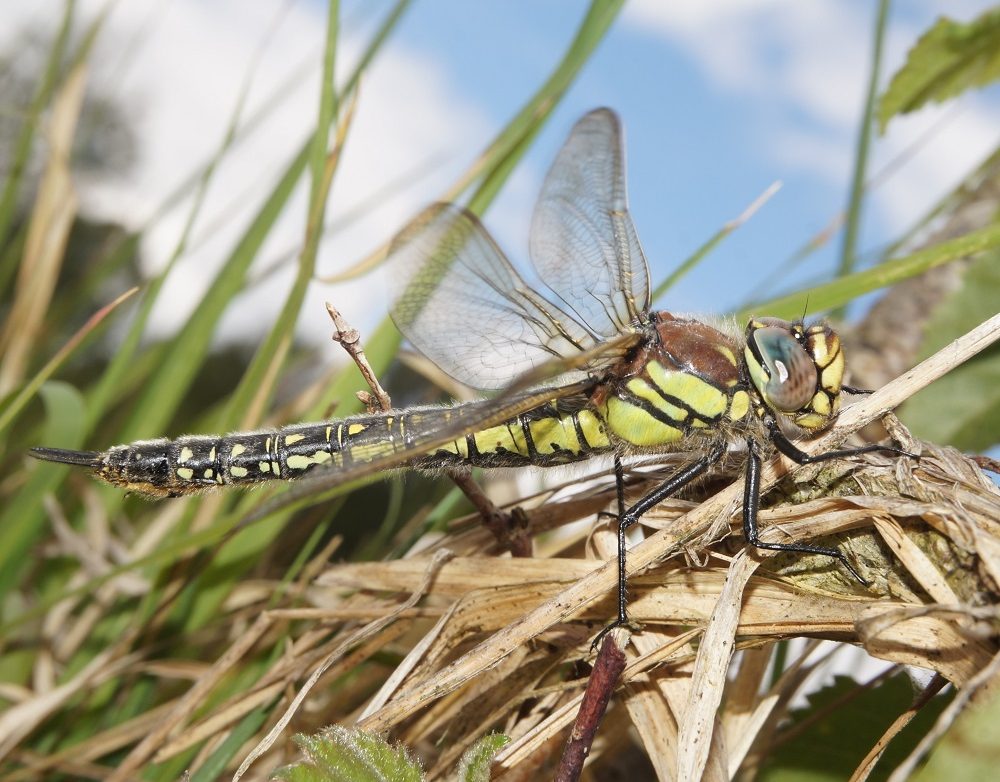
Dragonfly on Irish peatlands. Photo Credit: Kieran Flood
The plan is particularly weak in its sections on forestry and peatlands and is totally lacking the vision which is needed in these areas. There is clearly a strong emphasis on retaining commercial supremacy in these land uses and this mindset will necessarily diminish the biodiversity and climate (as well as local community) potential of these areas. It is especially concerning that the recommendations from the Joint Oireachtas Committee on Climate Action Report with regard to the emphasis needed on native and broadleaved woodlands and continuous cover forestry is not replicated in the government’s plan. The Joint Oireachtas report highlighted “the urgent need for the restoration, rehabilitation and rewetting of all peatlands” whereas the government plan is far weaker – merely calling for “assessing the optimum post-production after uses”. Nor is there any mention of the need to end peat extraction.
It is also notable that despite being an island nation, the ocean is all but absent from the report. This is a bizarre omission considering how the oceans have absorbed 90% of excess heat to-date [i] and are likely to inundate many of our cities within the next 100 years. Protecting our seas is among the most important areas of climate action but this is not acknowledged.
Nature is our greatest ally in the fight against climate change. So-called ‘nature-based-solutions’ may go up to one third of the way in meeting our Paris Climate Agreement commitments as well enhancing water quality, reducing extinction rates, creating sustainable jobs in rural areas and enhancing our health and well-being [ii]. Restoring natural habitats can also help to mitigate the negative effects of climate collapse, such as extreme weather events.
IWT Campaign Officer Pádraic Fogarty says, “the government is still failing to join the dots on our climate and biodiversity crises or the broader issues linked to the UN’s Sustainable Development Goals. In doing so, they are failing to grasp the full scale of the opportunity which restoring nature brings. Although we have yet to hear Leo Varadkar use the word ‘biodiversity’ since becoming Taoiseach, the Dáil last month declared a climate and biodiversity emergency. There is no sense yet that he realises the scale of the emergency we face.”
We need to protect the seas as if our lives depend upon it
Photo Credit: Regina Classen
For a small island nation our connection to the ocean can sometimes feel tenuous. Yet – unbeknownst to most of us perhaps – the oxygen in every other breath comes from the sea. To be more specific, 50% of the oxygen produced in our atmosphere is generated by tiny floating plants called phytoplankton. If the rainforests of the world are the planet’s green lung, the oceans are its blue lung. Yet our lungs are collapsing. The US space agency NASA warned in 2015 of a ‘significant decline’ in phytoplankton populations in the northern hemisphere and one study from 2010 suggested this was as high as a 40% fall since the 1950s. This worrying trend is likely to have far reaching consequences and, on its own, should be jolting us into action. Yet here in Ireland action feels a long way off. Although there have been improvements in the levels of overfishing in the last decade, we are still a long way from meeting the EU’s legally binding target for ending all overfishing by 2020. We are still destroying marine life on a vast scale from destructive bottom trawling and unsupervised supertrawlers with nets the size of football pitches. The EU aims to get independent observers on a mere 1% of fishing trips and in Ireland we don’t even meet this inadequate level of coverage. Entire fishing communities around our coast have disappeared in the last 40 years, with the riches of the sea increasingly concentrated in the hands of fewer, bigger boats.
The government’s Our Ocean Wealth summit takes place again this year to promote greater economic exploitation of our seas. While no doubt there will be lots of beautiful images of dolphins and references to our amazing marine wildlife, once again there will no Irish speaker or panel discussion on the issues affecting ocean health: over-exploitation, pollution and climate change chief among them. The recent UN report decrying the decline in global ecosystem health highlighted how 66% of the oceans are experiencing these “increasing cumulative impacts”. In Ireland, as part of international obligations, we committed to protecting 10% of our marine area by 2020 but we have yet to see any moves to pass the necessary legislation to designate these Marine Protected Areas (MPAs). Within existing conservation laws we manage to ‘protect’ a paltry 2% and these areas overwhelmingly have no real protection, lacking basic management strategies and excluding local participation.
Last month the government became the first in the world to declare a climate and biodiversity emergency. This has yet to be followed with any actions but if it were real, what would emergency actions to save our ocean look like? We would start by creating a large, fully protected network of MPAs which would include vast areas of the Atlantic where no extractive industries are allowed. In the shallow coastal areas, low-impact fishing using traditional techniques would be carefully managed by the communities themselves to restore livelihoods and marine life. We would give fish and marine invertebrates the same protections as wildlife on land so that our most threatened species of sharks and rays can recover in number. We would start to phase out all bottom trawling and move to a system of fishing that is fully documented, with rigorous supervision of factory boats. We would stop pumping untreated or under-treated effluent into the sea and regulate the most damaging forms of plastic pollution such as fishing gear, wet wipes and microbeads. We would immediately ban any more exploration of oil and gas, something that would not only help reduce our emissions of greenhouse gases but would also end the practice of seismic blasting which is deafening to whales. These actions are available to us, in many cases there is already legislation or initiatives there to be deployed. This World Oceans Day lets reconnect with the sea and fight to protect it like our life depends on it – because it does.
Pádraic Fogarty is Campaign Officer with the Irish Wildlife Trust and author of ‘Whittled Away – Ireland’s Vanishing Nature’
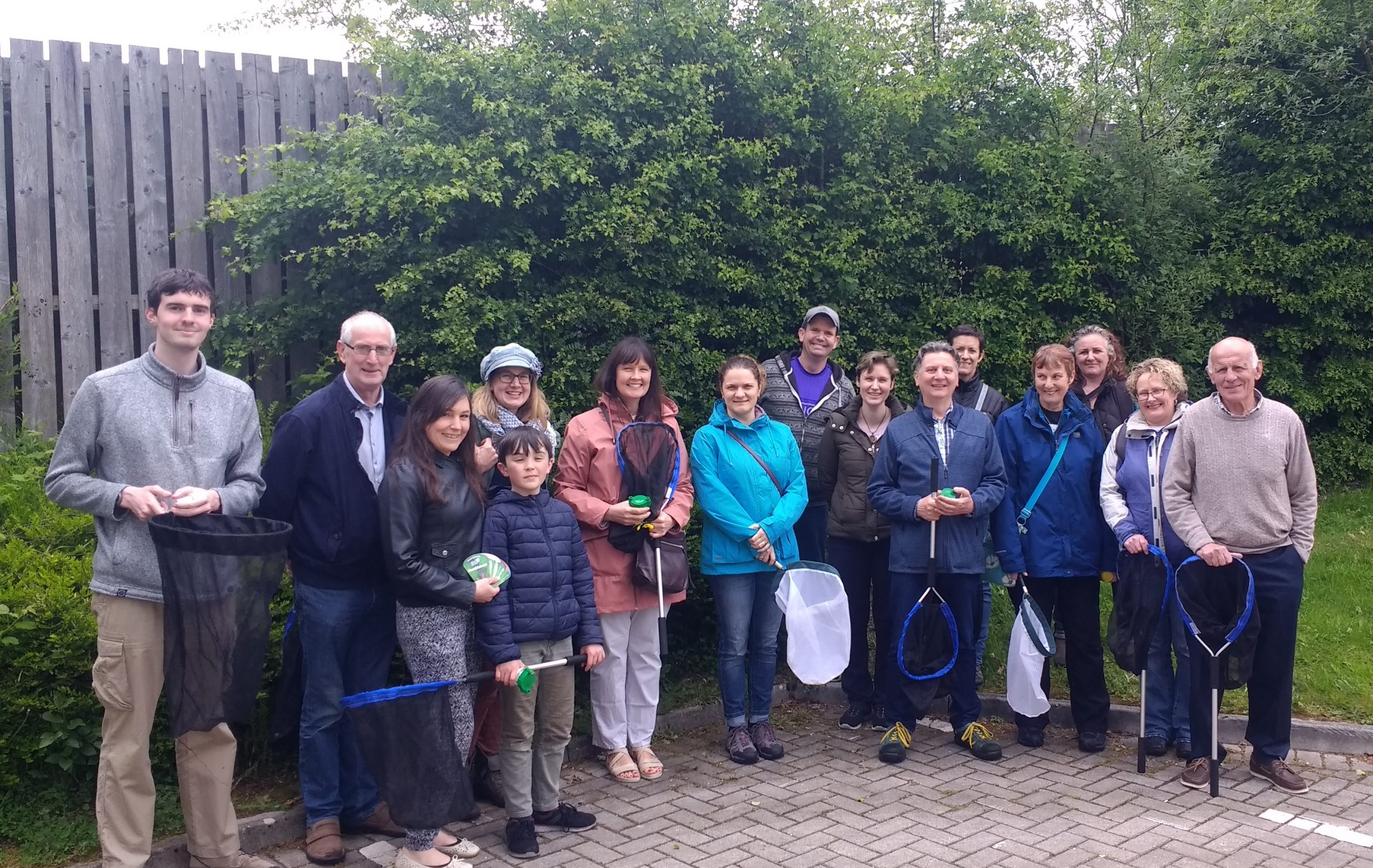
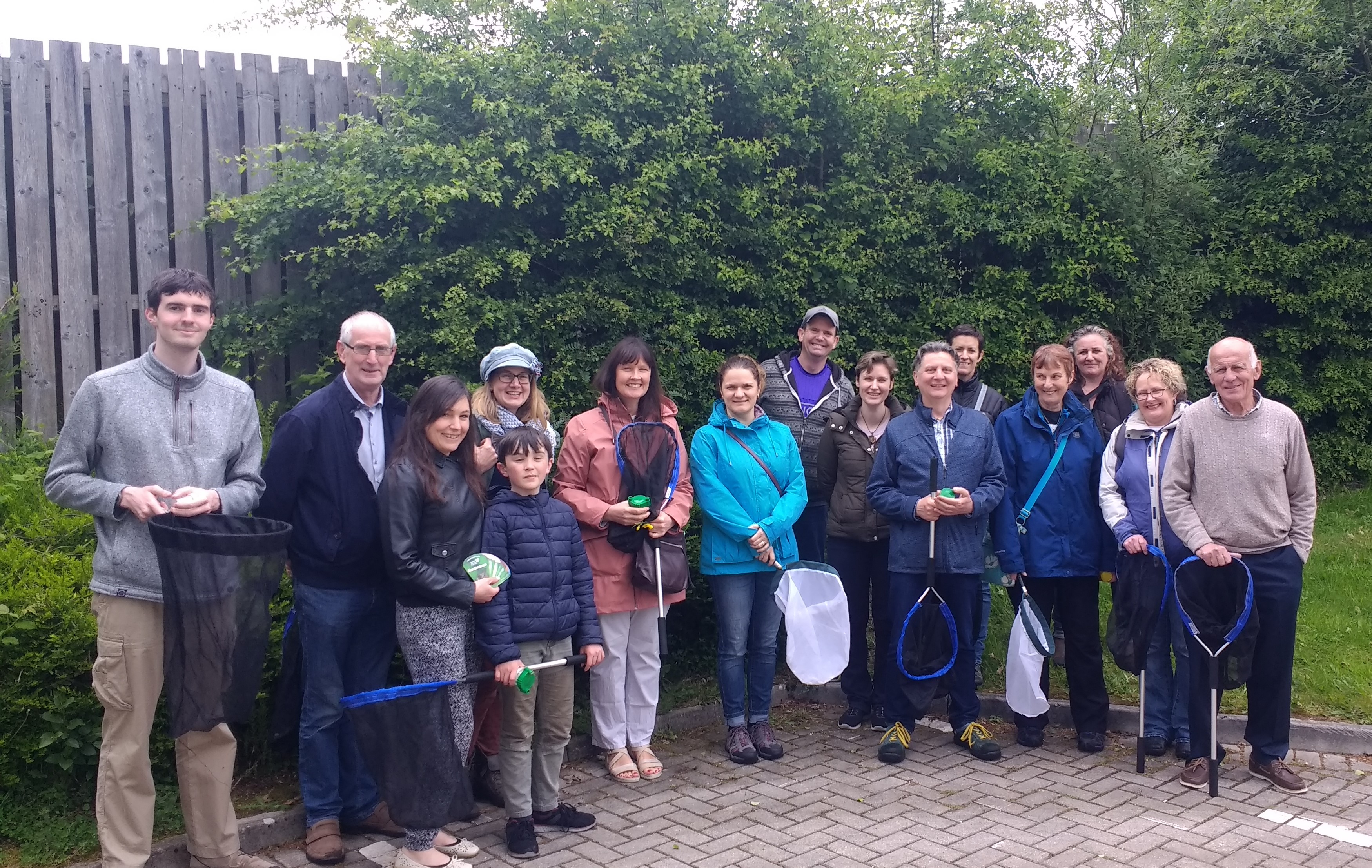
The IWT People for Bees programme had a great opening weekend to National Biodiversity Week, with a double bill of bee monitoring workshops. We were in St Enda’s park in Rathfarnham Co Dublin on Saturday and in Letterkenny Institute of Technology on Sunday. Both bee monitoring events were free of charge and open to all, thanks to funding from the Irish Environmental Network and Donegal County Council.
At the workshop participants learned about Ireland’s bees and how to identify and monitor them. We were delighted to find selection of bumblebees in the grounds of St Enda’s Park and Letterkenny IT campus.
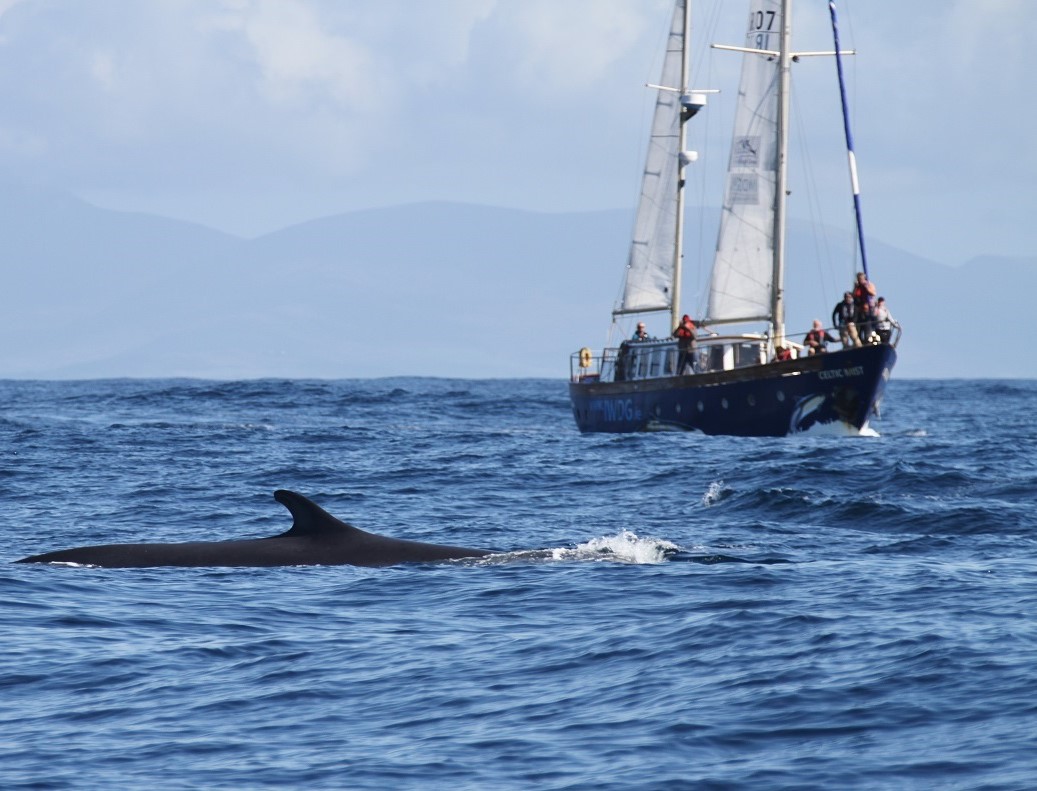
A group of Ireland’s environmental NGOs are teaming up this spring for a rather unique education project lead by the Irish Whale and Dolphin Group. The exciting Floating Classroom initiative is combining ocean exploration with an educational schools programme which aims to raise awareness of Ireland’s marine biodiversity. Taking to the seas in the IWDG’s research vessel Celtic Mist, the team of marine biologists and ocean literacy experts will be making their way down Ireland’s south east coast from Arklow to Cork, calling in to coastal communities provide engaging workshops to schools along the way.
After an extensive refit during the winter in Grand Canal Docks, Dublin, the 56 foot ketch yacht will also be open to the public when docked at local marinas and harbours, giving the public an opportunity to see the workings of a dedicated whale and dolphin research vessel and how researchers live and work at sea.
Apart from raising awareness for Ireland’s rich marine wildlife, the team will be emphasizing the importance of taking care of our seas and oceans. With challenges such as plastics pollution, climate change and biodiversity loss now frequently in the news, there is a pressing need for communities to work together to tackle environmental issues.
While pupils will be introduced to the wealth of marine and coastal wildlife on their doorstep, each school will be asked to come up with three ways in which they feel they can make a difference for their local blue environment.
The team of biologists will also be proposing ways in which the public can get involved, including citizen science projects that encourage people to report their sightings of whales, dolphins, seabirds and even shark eggs! Schools will be encouraged to get involved in other community-based initiatives too, such as beach cleans being run by organisations in their area.
Environmental NGOs involved in the Floating Classroom include the Irish Whale and Dolphin Group, Marine Dimensions, the Irish Wildlife Trust and the Irish Ocean Literacy Network. Funding for the Floating Classroom has been kindly received by the Irish Environmental Network through their Capacity Building Grant.
For more information contact:
Simon Berrow (Irish Whale and Dolphin Group) at simon.berrow@iwdg.ie Phone: 086 854 5450 or
Kieran Flood (Irish Wildlife Trust) at kieran.flood@iwt.ie Phone: 089 490 5716 or
Discover your nature this National Biodiversity Week
For the Irish Wildlife Trust, NationalBiodiversityWeek is one of the most important and enjoyable weeks of the year. It is an opportunity for people across the country to get out and experience the biodiversity we still have in Ireland. There is a huge amount to discover and a huge amount to protect. We hope everyone will take the opportunity to join one of the many event being run this week and have fun discovering our nationalbiodiversity.
Check out our event page for a listing of the free biodiversity event we are running over the coming week. From Saturday 18th May will be running woodland walks, marine protection talks and evening bat talks. Follow the link below for event details.
PRESS RELEASE: Irish Wildlife Trust accuses the Office of Public Works in acting unlawfully in destroying large sections of the River Newport in Limerick
The Irish Wildlife Trust (IWT) has accused the Office of Public Works (OPW) in acting unlawfully when clearing a 3km stretch of river habitat along the River Newport in Co. Limerick last year. The Newport is part of the Lower River Shannon Special Area of Conservation and is designated of European importance for river forests as well as its populations of Atlantic Salmon, Otter and Lamprey. Under the Habitats Directive (article 6.3) works can only be undertaken when a ‘screening for Appropriate Assessment’ has concluded that significant effects to the SAC are not likely to occur. Where this assessment finds that such effects cannot be ruled out, the competent authority is obliged to carry out a ‘full Appropriate Assessment’ which must impose mitigation measures (e.g. avoiding pollution or restricting works to certain seasons) so that the overall integrity of the SAC is not affected. The OPW is not exempt from these provisions.
The use of heavy machinery inside a protected SAC area, under any circumstances, is highly likely to trigger a full Appropriate Assessment. In this case, a screening report – released to the IWT only after a request under Access to Information on the Environment legislation – showed that the area of works contained alien invasive species (Himalayan Balsam, Japanese Knotweed and Giant Hogweed), high-value wet Willow woodland and Otter habitat. It stated: “Apart from some young trees, no large trees will be fully removed, with generally only a small portion of such trees being impacted upon” and that “In no instances will the rootballs of trees be removed”. The report also stated that “Apart from very minor localised sediment run-off and occasional partial removal of aquatic vegetation, there will be no impact on the watercourses”. This assessment should have triggered a full Appropriate Assessment given that it identified that significant effects to the SAC were likely to occur in the absence of mitigation measures.
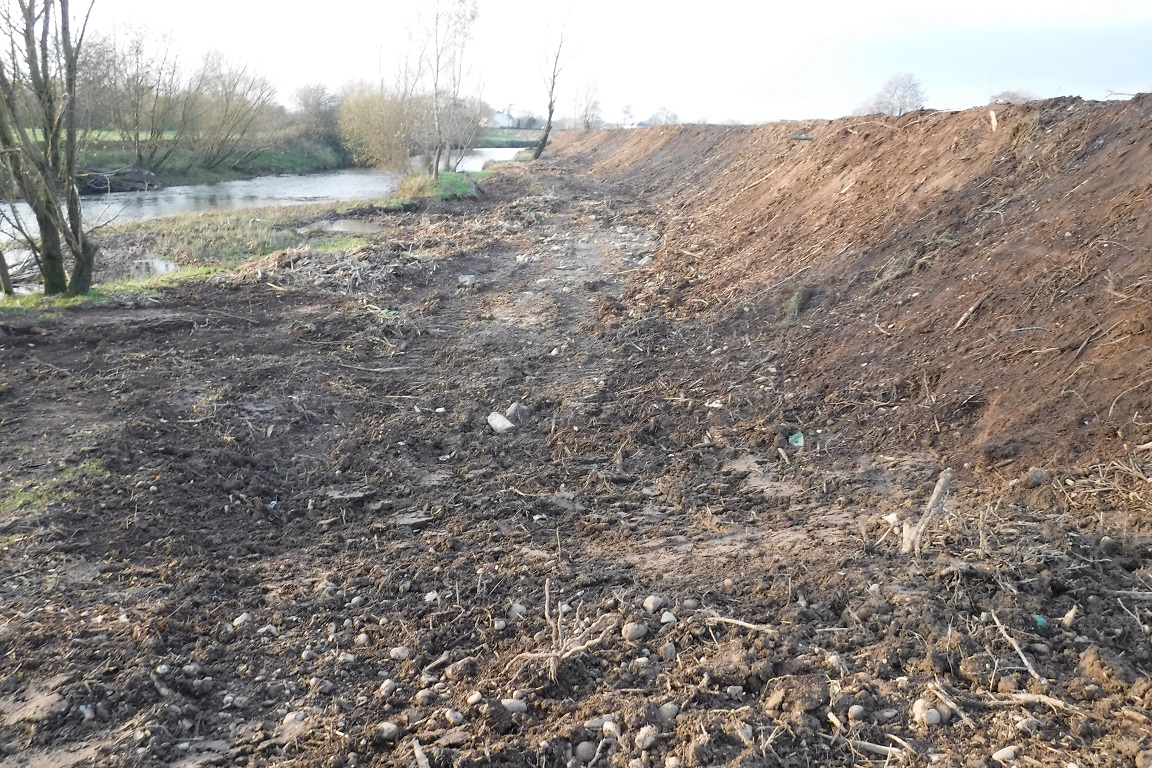
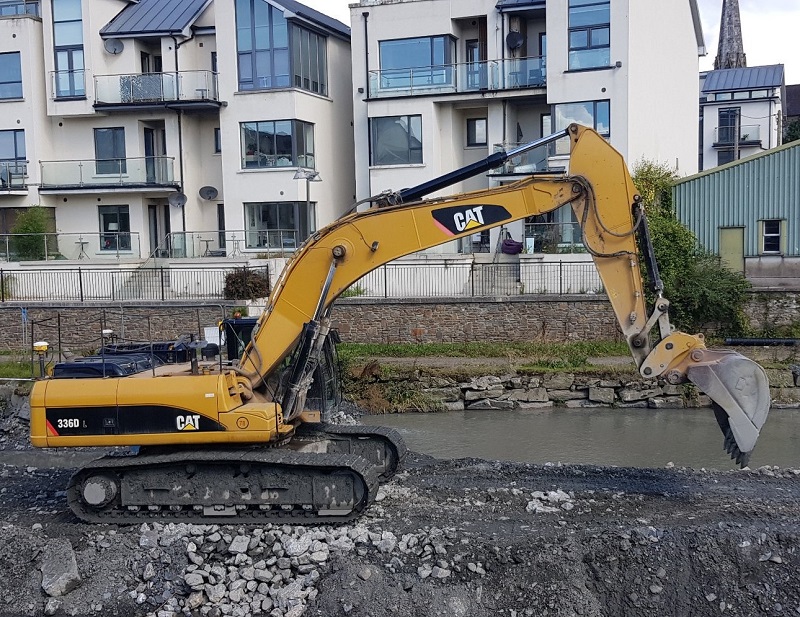
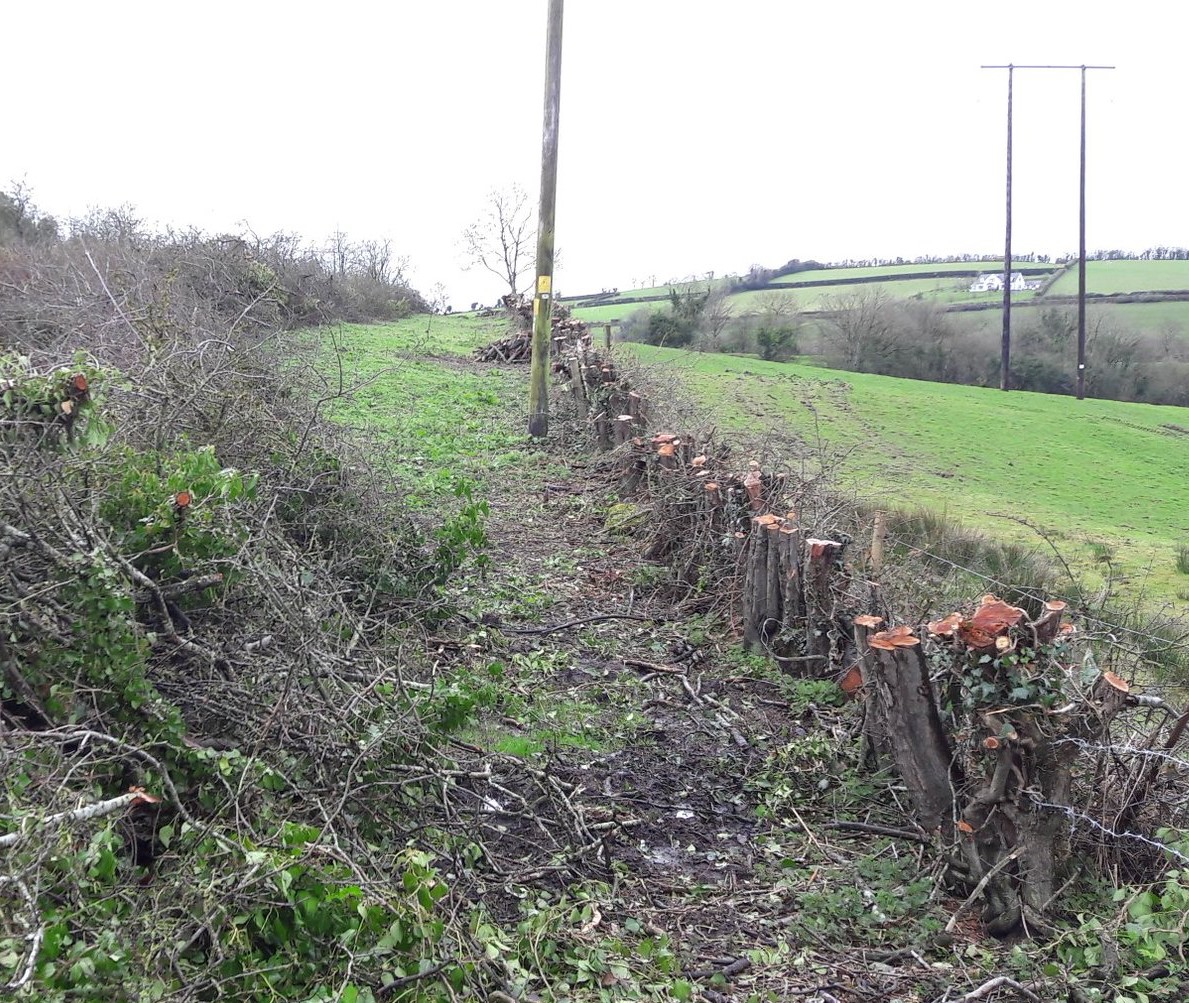
Last December (2018) the IWT visited the Newport River after reports that large sections of the river bank had been removed as part of ‘flood relief’ works carried out by the OPW (see photos). It was clear from this survey that works had greatly exceeded what had been set out in the OPW’s assessment report. Contrary to their report, entire stretches of the riverbank had been stripped down to bare soil, leaving the river extremely vulnerable to sediment pollution and erosion. There was no evidence of any mitigation measures having been employed either to avoid this pollution or to prevent the spread of alien invasive species. The Appropriate Assessment Screening Report was therefore largely inaccurate, reached the wrong conclusion and no Appropriate Assessment determination had been carried out by the OPW for these works. The works were therefore entirely unlawful.
This episode is symptomatic of the unsupervised nature of the OPW. Specifically,
Legally binding procedures are not followed;
Damage is done to important conservation areas with no consequences for the OPW;
‘Flood relief’ works are undertaken with no analysis of the flood benefits – in this case the works were undertaken upstream of Limerick City and increased the flood risk to houses in the path of the river.
The National Parks and Wildlife Service (which has responsibility for the conservation of SACs) were informed of the mistakes which occurred but had no role in supervising the works and could issue no sanction to the OPW. The OPW therefore, operates outside of any system of oversight or due process and this is resulting in the systematic destruction of our river systems.
IWT Campaigns Officer, Pádraic Fogarty, says: “The OPW is not above the law but yet it seems to think that it can operate with impunity. The damage it has done to our rivers is incalculable, this instance at the Newport in Limerick is not untypical of the distain they show for our natural heritage.”
The IWT would like to see an overhaul of the Arterial Drainage Act which mandates the OPW to undertake on-going ‘flood relief’ works. Specifically, we are calling for:
· greater transparency in their work programme (the public should know the nature and timing of their works and all environmental assessments should be readily available – not only through requests under Access to Information on the Environment rules).
· A requirement that the OPW should demonstrate the flood benefits of any works (especially so-called ‘routine maintenance’) and highlight the potential risks to areas downstream.
· Proper oversight of the OPW so that they are not the authority approving their own works.
· A legally-binging requirement that the OPW consider alternatives to heavy engineering works when addressing flood alleviation – i.e. natural flood solutions including restoration of floodplains, natural woodlands etc.
Editors Notes: The Irish Wildlife Trust was founded in 1979 as a charitable conservation body. We provide the public with information about wildlife, run education and training programs like SAC Watch and the Badger Schools Programme, carry out habitat and species surveys like the IWT National Newt Survey, campaign and lobby around biodiversity issues, restore natural habitats, consult with industry, agriculture and Local Authorities to maintain our natural heritage and contribute to national and international forums for the protection of biodiversity. The IWT is a nationwide organisation with a strong membership base, staff and Board of Directors, with branches in Dublin, Galway, Kerry, Laois/Offaly, Waterford.
Dáil Calls for biodiversity loss in Ireland to be examined by the Citizen’s Assembly
BirdWatch Ireland, The Irish Wildlife Trust and An Taisce warmly welcome the amendment passed in Dáil Éireann tonight for the issue of biodiversity loss to be examined by the Citizen’s Assembly. This move recognises the ecological crisis we are in. We call on the government to initiate the process to start the discussions at the Citizen’s Assembly immediately as we have no time to lose.
Fianna Fáil’s amendment declaring a climate and a biodiversity emergency strengthened a Fine Gael motion ‘noting’ the report on Climate Action of the Joint Oireachtas Committee on Climate Action. The accepted amendment also called ‘for the Citizen’s Assembly to examine how the State can improve its response to the issue of biodiversity loss’ putting the reality of declines in wildlife species and habitats in Ireland centre stage.
Two thirds of Ireland’s 202 wild bird species are of conservation concern with several bird species threatened with extinction such as the Curlew and Hen Harrier. One third of Ireland’s wild bees are threatened with extinction. Ninety one percent of globally important habitats here are in unfavourable ecological condition. Waterbirds have declined by forty percent in less than twenty years.
Biodiversity loss and climate change must be tackled together. Habitat restoration can help with climate change mitigation and adaptation as well as help restore populations of threatened wildlife.
Oonagh Duggan, Assistant Head of Policy and Advocacy said “It is high time for biodiversity loss in Ireland to be centre stage. Nature has been undergoing death by a thousand cuts and we must call a halt to the loss now.”
She said, “We call on the Government to initiate this process as soon as possible. We have no time to lose”.
IWT Campaigns Officer Pádraic Fogarty says “there can be no more hiding from the collapse of nature in Ireland. Presenting this issue to the Citizens’ Assembly is an important first step towards addressing our extinction crisis“. END
PRESS RELEASE: IWT is calling on the government to declare a climate and biodiversity emergency following the publication of the latest UN report
06 May 2019
The Irish Wildlife Trust is calling on the government to declare a climate and biodiversity emergency following the publication of the latest UN report to warn of catastrophic consequences for humanity in the face of global mass extinction. Biodiversity loss has impacted Ireland worse than most countries with 120 species documented as having gone extinct here since the arrival of people. An average of one third of all species assessed by scientists are categorised as threatened with extinction or ‘near threatened’. Whole ecosystems have practically vanished including our forests and raised bogs. Our seas have been emptied due to overfishing and bottom trawling. Nature has all but vanished from our hills, rivers and farmland due to pesticide use, wild fires, land drainage, pollution, plantations of conifers, reseeding and artificial fertilisation of soil and neglect of our ancient hedgerow network. In effect, natural ecosystems across Ireland have collapsed.
What would we do in a state of emergency?
• Properly fund and administer a new independent nature conservation agency for Ireland.
• Implementation of all nature laws as well as a commitment to hold a referendum on the rights to a healthy environment in our constitution.
• Abandon agricultural intensification targets in favour of a new model based on low-carbon regenerative farming.
• End the practice of bottom trawling in Irish waters, create large and effective marine protected areas and end all overfishing by the (already legally binding) 2020 target.
• End the practice of plantation forestry and move to creating large areas of native woodland which are primarily devoted to nature as well as converting commercially-oriented plantations to ‘continuous cover forestry’.
• Mandate Bord na Mona to rehabilitate and rewild all of the bogs in their holding while the state must implement all elements of the (already agreed) Peatlands Strategy.
• Mandate the OPW to restore our river system through dam removal and floodplain regeneration.
Nature provides us with the best carbon capture and storage technology yet known. Restoring forests, peatlands, farm soils and our seas can bring enormous benefits to people as well as helping to deal with the extinction and climate crises.
PRESS RELEASE: Radical transformation of our uplands required to overcome threat of wild fires
23 April 2019
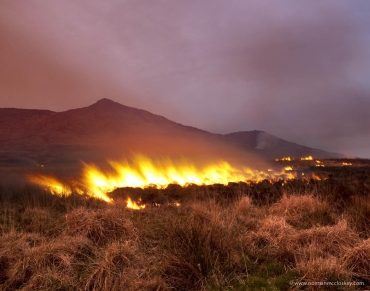
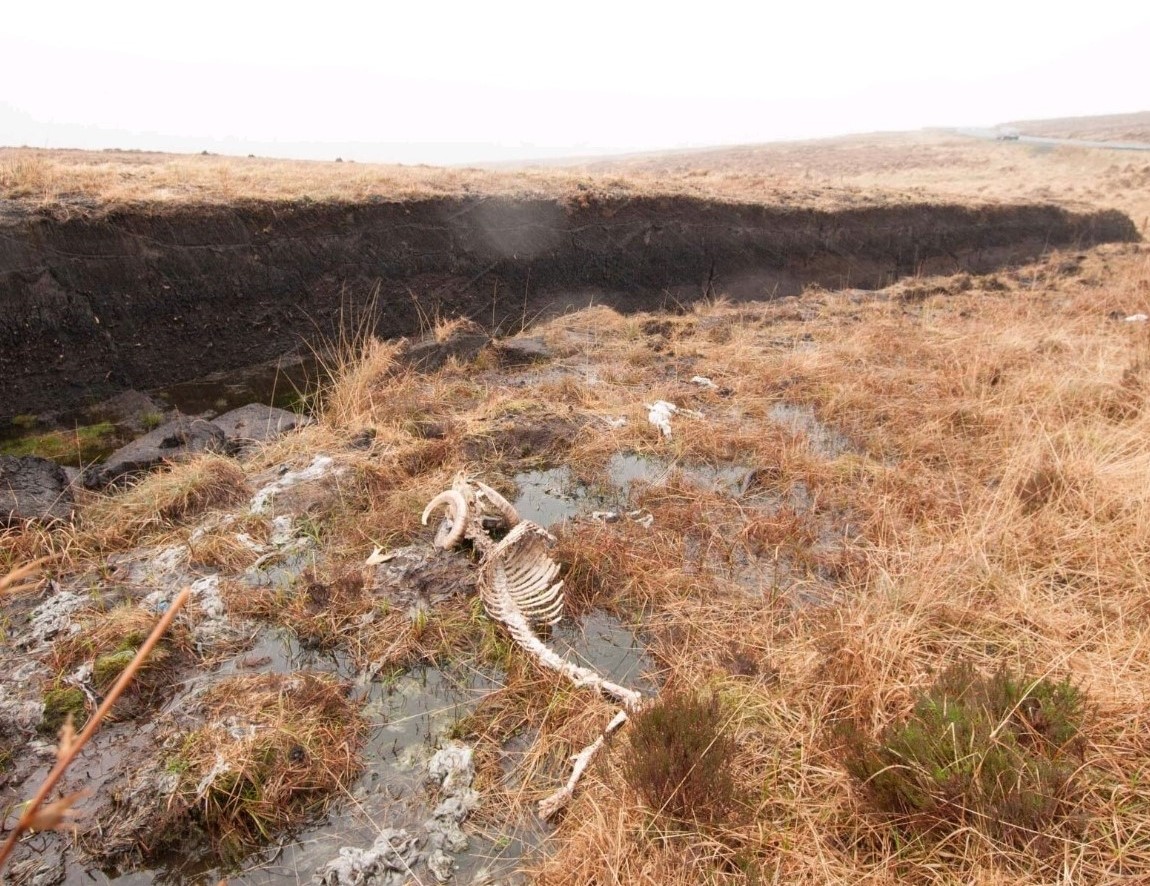
The Irish Wildlife Trust (IWT) is calling for a radical transformation in how we manage our upland landscapes after another weekend of wild fires devastated habitats across Ireland. Last year the Department of Agriculture, Food and the Marine confirmed that farmers with burned land would not be eligible for the single farm payment. While we have had reports that this has led to a reduction in fires in certain areas, clearly the message is not getting through to all, or other factors are at play. Whether the latest spate of fires was caused by farmers clearing land, acts of carelessness or wanton vandalism it is now apparent that only a transformation of how we manage these mountain and peatland areas will get on top of the problem. Habitats and wildlife populations in these areas have already been devasted through years of annual wildfires, along with inappropriate plantation forestry and land drainage. This means the vegetation that does exist dries out quickly, leaving it especially vulnerable to out of control fires.
A new vision is urgently required. These landscapes should be wildlife rich, carbon sinks, naturally holding water and places of high scenic and amenity value. Instead they are carbon sources, lead to flooding and pollution and have few resources for wildlife. In order to turn things around the IWT suggests that farmers and landowners in these areas be given greater options for their land, including:
Re-establishment of permanent, native woodlands;
Payments for not farming;
Incentives to move away from sheep and towards cattle;
Large-scale restoration of peatland habitats, including drain-blocking and rewetting;
We also need to see greater public awareness of the threat fires poses to public and environmental health as well as the penalties to be incurred from breaking the law.
IWT Campaign Officer Pádraic Fogarty says “years of neglect and poor management have left our hills largely barren and part of the problem in the fight against climate change and species extinction. They should be part of the solution, but only a radical change of vision can turn things around.”
Last week new research was published which provides the science behind growing calls for a Global Deal for Nature, as a companion agreement to the Paris Climate Accord. This calls for increasing protected areas to 30% of the land (in Ireland the figure currently stands at around 12%) and an additional 20% as ‘climate stabilisation areas’, particularly through peatland and forest restoration [1]. The UN has also announced that 2020 will see the start of a Decade of Ecosystem Restoration as an “unparalleled opportunity for job creation, food security and addressing climate change”[2]. We hope that local communities and state authorities can see the opportunities in these initiatives as well as the increasing urgency of the climate and extinction crises
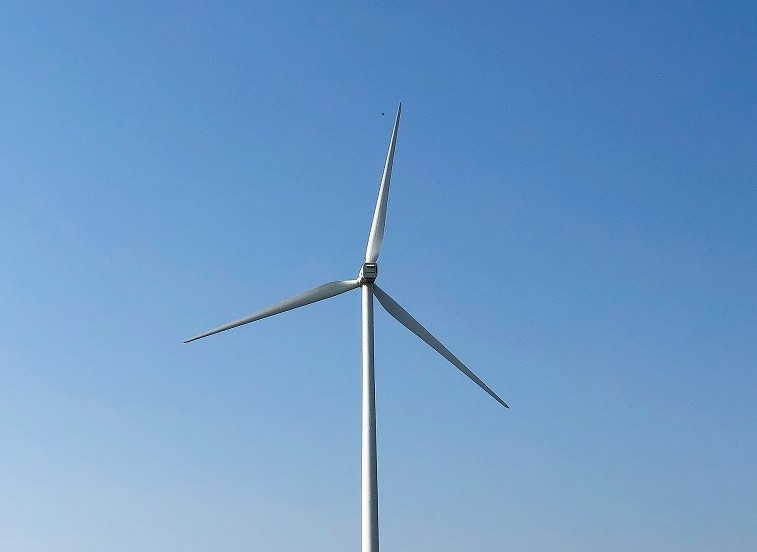
PRESS RELEASE: Irish Wildlife Trust objects to Bord na Móna’s plans for a 24-turbine wind farm within the Shannon Wilderness Park
28th March 2019
The Irish Wildlife Trust (IWT) has submitted an objection to An Bord Pleanala against Bord na Móna’s proposed Derryadd 24-turbine wind farm in the heart of the proposed Shannon Wilderness Park in Co. Longford. The IWT is not opposed to wind energy generation, which is necessary to meet greenhouse gas reduction targets, but we are increasingly concerned that turbines are being inappropriately located, especially on peatland habitats. In particular, the presence of turbines can be at odds with biodiversity protection, the restoration of which is equally as important as addressing climate change.
In this case it is proposed to install 24-turbines across the proposed Shannon Wilderness Park, a community initiative with the backing of Longford County Council. This plan envisages the creation of a new, restored peatland landscape that has the potential to be a haven for wildlife and a unique tourist/amenity attraction. For many ecologists this was the perfect site for the reintroduction of long-extinct Irish birds such as crane and bittern, while it was hoped that white-tailed sea eagles (breeding in some western counties) would colonise the shores of Lough Ree. A bank of turbines however is totally incompatible with these goals and would effectively negate any sense of unique identity which would be essential for the success of the Wilderness Park. Large, migratory birds are the most at risk from collision with turbines according to BirdLife International [i] and this project would effectively rule out any reintroduction of these charismatic species.
In addition to the foregone ecological opportunity that will result were this development to proceed, the Environmental Impact Assessment Report (EIAR) indicates that no less than nine red-listed wintering bird species, six species listed on Annex I of the Birds Directive, and seven red-listed breeding species are potentially impacted by this project. These include some of our most threatened breeding birds such as Curlew, Golden Plover and Lapwing. Whooper Swans, of which Ireland has an internationally important proportion of the world population in winter, were ‘regularly’ recorded from the site according to the EIAR. Clearly this site is important throughout the year for a wide range of birds and, given the habitats are recovering from historic exploitation, it shows the potential value of the lands were the Shannon Wilderness Park project to be implemented in full.
IWT Campaigns Officer, Pádraic Fogarty says “we’re very disappointed that the hard work and hopes of local communities for the Shannon Wilderness Park are being swept aside by Bord na Móna in their pursuit of this wind energy project. There’s a huge opportunity in creating a distinct and unique identity for this part of Longford, something people would travel from far and wide to experience. Bord na Móna should be working with local people and ecologists in trying to deliver this, rather than working against them to impose an unwanted wind farm. We hope An Bord Pleanala can refuse permission.” END
PRESS RELEASE: IWT welcomes news that burning of uplands will not be extended into March this year
28 February 2019
The IWT has welcomed the announcement from Minister for Culture, Heritage and the Gaeltacht, Josepha Madigan, that burning of uplands will not be permitted into March of this year.
IWT campaigns officer Pádraic Fogarty says: “This is a welcome reprieve for our wildlife and we welcome the minister’s timely condemnation of wild fires which have engulfed many parts of the country in recent days.”
The IWT believes that burning of uplands and land on peat soil should never be permitted. We urge government departments, especially those of Minister Madigan and Minister for Agriculture Michael Creed, to develop a new plan for upland and hill areas which would allow both people and nature to thrive.
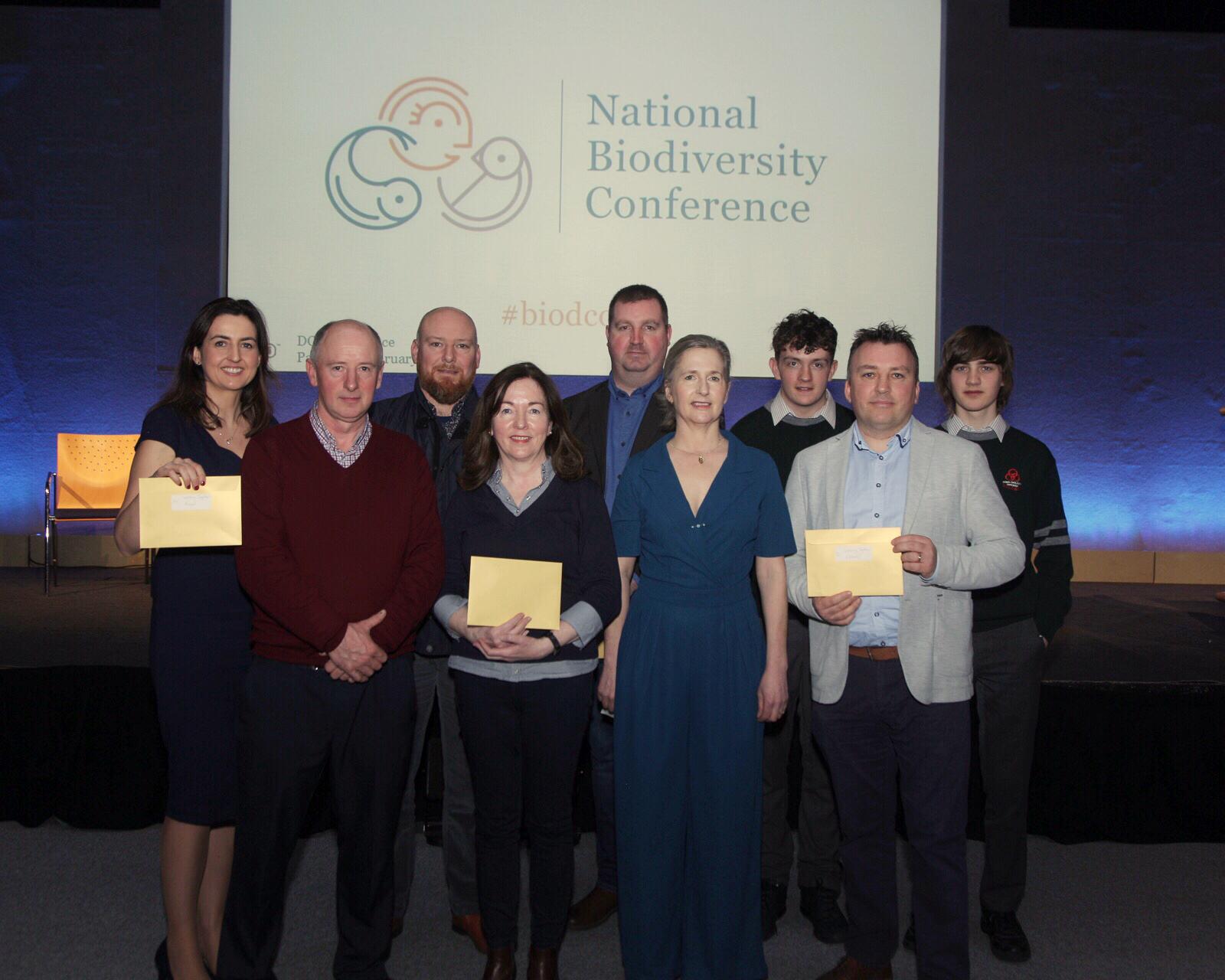
The Irish Wildlife Trust is delighted to announce the winners of the Together for Biodiversity Awards. The awards were presented to the category winners at the National Biodiversity Conference by Minister for Culture, Heritage and the Gaeltacht Josepha Madigan.
The Awards are an opportunity to celebrate the work being carried out by individuals, communities, schools, farmers and businesses across Ireland to protect our biodiversity. All 18 of our awards finalist are in attendance at the conference to engage with delegates and showcase their fantastic work. Projects included work on habitat and species protection, biodiversity advocacy, and innovative business ideas.
The Winners are;
Category A: People Together for Biodiversity Award Large Project
Baile Slachtmhar Bhéal an Mhuirthead, It’s all about the Bee’s and the Sea’s
Category B: People Together for Biodiversity Award Large Project
Moore Community Council CE Scheme, Ballydangan Bog Red Grouse Project
Category C: Local Biodiversity Champion Award
Tommy Earley, Sharing the biodiversity on his farm in Roscommon
Category D: Learning Together for Biodiversity Award
St. Colman’s Community College, Midleton, Co. Cork
Biodiversity in our School and the Wider Community
Category E: Farming Together for Biodiversity Award
Oliver and Pat Nagle, The Burren Programme
Category F: Working Together for Biodiversity Award
Gas Networks Ireland
Gas Networks Ireland Biodiversity Enhancement Programme
You can find information on all our candidates projects on our website here https://iwt.ie/biodiversity-awards/
A big thank you to the awards sponsors Dublin Port Company and the National Biodiversity Conference organisers National Parks and Wildlife Service, Irish Forum on Natural Capital and Department of Culture, Heritage and the Gaeltacht.
What a let down. After being invited to an Oireachtas hearing to “discuss preserving biodiversity and ecosystems of peatlands” I had thought that here was an chance to talk openly with law-makers about the threats and opportunities facing our bedragled bogs. Even the press release from the ‘Joint Committee on Culture, Heritage and the Gaeltacht’ was upbeat: “Peatlands are a critical feature of the Irish landscape, a traditional source for industry and energy, and a fragile home for many rare plants and animals,” said Committee Chairman Aengus Ó Snodaigh TD. “The Committee looks forward to discussing with ecology and land management officials how best to preserve and protect these habitats for irreplaceable flora and fauna.” There are 10 members of the committee, including TDs and Senators, and its worthwhile giving them all a name check:
Michael Collins (Independent)
Danny Healy-Rae (Independent)
Martin Heydon (Fine Gael)
Niamh Smyth (Fianna Fáil)
Éamon Ó Cuív (Fianna Fáil)
Aengus Ó Snodaigh – Chair (Sinn Féin)
Maura Hopkins (Fine Gael)
Marie-Louise O’Donnell (Independent)
Fintan Warfield (Sinn Féin)
Aodhán Ó Ríordáin (Labour Party)
The job of the committee is to ‘shadow’ (the word on the website) the Department of Culture, Heritage and the Gaeltacht headed by Minister Josepha Madigan. Along with representatives from the NPWS, Bord na Mona and the Irish Peatlands Conservaton Council we all received a letter two weeks previously inviting us to attend and to make a 10 minute presentation.
The first disappointment was the turn out. Of the ten parliamentarians listed above only five turned up, the committee chair himself was a no-show. So much for him ‘looking forward’ to discussing our ‘critical peatlands’. Of the five who were there three made no speaking contribution throughout the two and half hours. Deputy Healy-Rae’s contribution was focussed on job opportunities for Bord na Mona staff (important yes, but off topic). He asked no questions or made no statement which had any relevance to peatland biodiversity. The next disappointment came when we were told we only really had five minutes to make our ten minute presentation and at least two of us were interrupted mid-stream to be told to get on with it. It was hard to escape the feeling that there was little real interest in what we had to say. Also present was Deputy Michael Fitzmaurice, well known climate denier and chairman of the Turf-cutters and Contractors Association – and no fan of peatland biodiversity. Deputy Eamon O’Cuiv, who has served in government and is well versed in conservation policy also spoke at length. And I mean at length.
Irish peatlands face major problems (see the link to our presentation at the end of this blog). I had expected the NPWS to be challenged on why so many of the promises in the National Peatlands Strategy were not being fulfilled. If our peatlands are so critical (as the chairman of the committee proclaimed) why didn’t he bother to turn up? Why is the Fine Gael government so quick to de-designate previously protected areas or furtively remove the need for planning permission for industrial peat extraction but stubbornly reluctant to implement conservation promises? As we struggle to address climate change and other environmental challenges where is the vision for restoring peatlands to all their glory? Who exactly is holding Minister Madigan to account? In the end there was no discussion on ‘how best to preserve and protect these habitats for irreplaceable flora and fauna’. The state agencies should have been grilled but sailed through unchallenged. Far from ‘shadowing’ the Minister and her department, this committee, it seemed to me, is in the dark. As our bogs take their last gasps, few in the Oireachtas, it would appear, is prepared to fight to save what’s left. What a disappointment.
A copy of our statement to the Committee is available for download here
PRESS RELEASE: Proposed burning regulations are no solution to solving issues in our uplands
01 February 2019
The Irish Wildlife Trust (IWT) has made a submission to the proposed guidelines on the implementation of Section 7(1) of the Heritage Act 2018 which will allow controlled burning of vegetation during an extended season, including March.
The IWT was against any changes to the burning periods and campaigned with other interest groups against the passing of the Heritage Act – which in our view is a very regressive step at a time when we should be strengthening, not weakening, protections for nature.
The proposed guidelines have left us with no confidence that burning can be carried out in manner which protects habitats or which is compliant with conservation law. For example, the guidelines say that blanket bog should not be burned while wet heath should only be burned where the will be ‘no damage to the moss layer’. The guidelines do not say how these habitats are to be distinguished. Furthermore, identification of habitats even by trained ecologists is fraught with subjectivity and uncertainty given that historic damage has changed the vegetation while the habitats can occur in subtle patchworks or mosaics across any given landscape. How fire is to stay out of one habitat and be confined to another is anyone’s guess. How gets to decide whether the ground is suitable for burning or not? The guidelines for burning itself are complex and will require a lot of training and expertise by practitioners. It is unclear as to who is going to pay for the training, the habitat identification or the environmental assessments (where burning is to be done in protected areas). Nor does there seem to be any system of oversight or transparency to ensure compliance with various legal constraints. In short, we believe that the guidelines will not be possible to implement.
IWT campaign officer Pádraic Fogarty says: “these guidelines will do nothing for upland farmers in Ireland or the protection of the environment upon which they depend. Instead of wasting our time with regulations which are for appearances only, the government agencies should be working towards an upland management plan which would provide options for farmers which help to restore livelihoods and nature. Native woodland, hardy breeds of cattle and apiculture have all been suggested as ways in which farm incomes can diversify in a nature-friendly manner.”
Press Release: People urged to join Dáil protest against forestry policy
The Irish Wildlife Trust (IWT) is supporting the ‘Save Leitrim’ campaign which is organising a protest at the Dáil this Wednesday at 11am. We are urging people concerned with current forestry policy to turn up and send a clear signal to politicians that the continued drive to expand conifer plantations across Ireland is having major negative consequences on communities and the environment.
IWT campaign officer Pádraic Fogarty says “our native woodlands have all but vanished while already over 10% of our land is carpeted with lifeless plantations of non-native conifers. These are a major driver of extinction in Ireland and have been identified by the EPA as one of the principle sources of water pollution. The method of felling, referred to as ‘clear felling’ results in massive pollution run-off and leaves a devastated landscape in its wake.”
Edwina Guckian, from the Save Leitrim campaign, says: “Irish Government forestry policy has now reached a point where it is incentivising the replacement of people in communities with large swathes of non-native mono-culture conifers. This is having a very serious and negative impact on people, their lives, their mental health, businesses, communities, biodiversity and our environment. We need the right trees, in the right places used and managed in the right way.”
A forestry policy that is sympathetic to local communities and biodiversity is possible. It should be based on native tree species and ‘continuous cover forestry’ which protect water and wildlife, store carbon, alleviate flooding and provide sustainable economic opportunity for people.
PRESS RELEASE: IWT welcomes decision by Minister Creed to restrict trawling in coastal waters
The Irish Wildlife Trust (IWT) wishes to commend Minister for Agriculture, Food and the Marine, Michael Creed, for his decision today banning vessels over 18m in length from trawling within 6 nautical miles of the coast. This is a very significant step towards conservation of the marine environment and arises from a public consultation period early this year which saw over 900 submissions. The prohibition will ultimately safeguard the sea floor in these areas and bring an end to the practice of ‘pair trawling’ which has wrought so much damage in recent years. While the IWT would have liked to see the measures go further (particularly with regard to dredging the sea floor for scallops and seed mussels – damaging activities which will continue to be permitted), we acknowledge the importance of this move.
IWT Campaigns Officer, Pádraic Fogarty says “We’d like to thank all the people who made submissions to the Minister to bring this decision about. It will hopefully mark the point where sea life starts to rebound from decades of overfishing. While much more needs to be done this is an important milestone.”
The IWT emphasises that good management of marine resources is the key to healthy ecosystems and local economies. We still require better supervision of the industrial fishing fleet and Marine Protected Areas, among other measures, to relieve the pressure our seas are under.
CONTACT: Padraic Fogarty – IWT’s Campaigns Officer – Email: irishwildlife@iwt.ie for further details
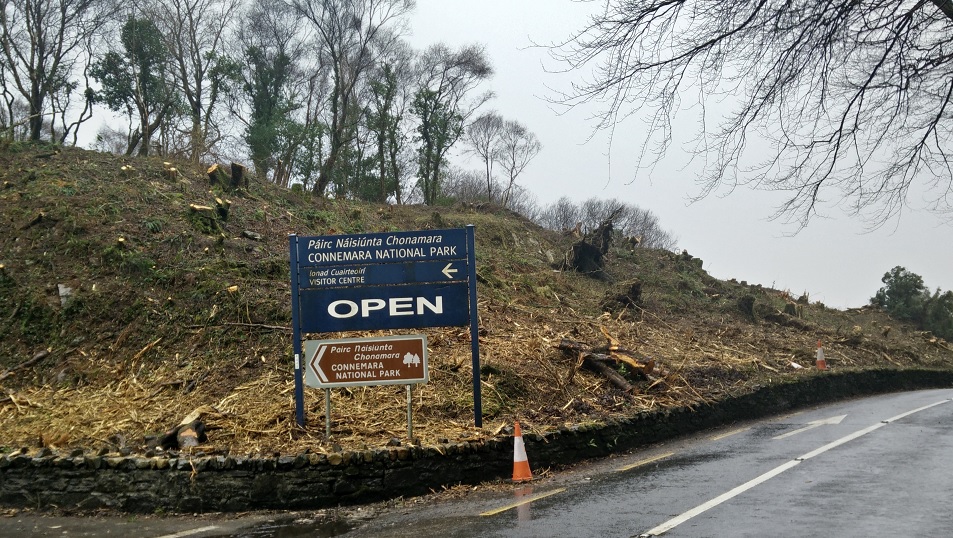
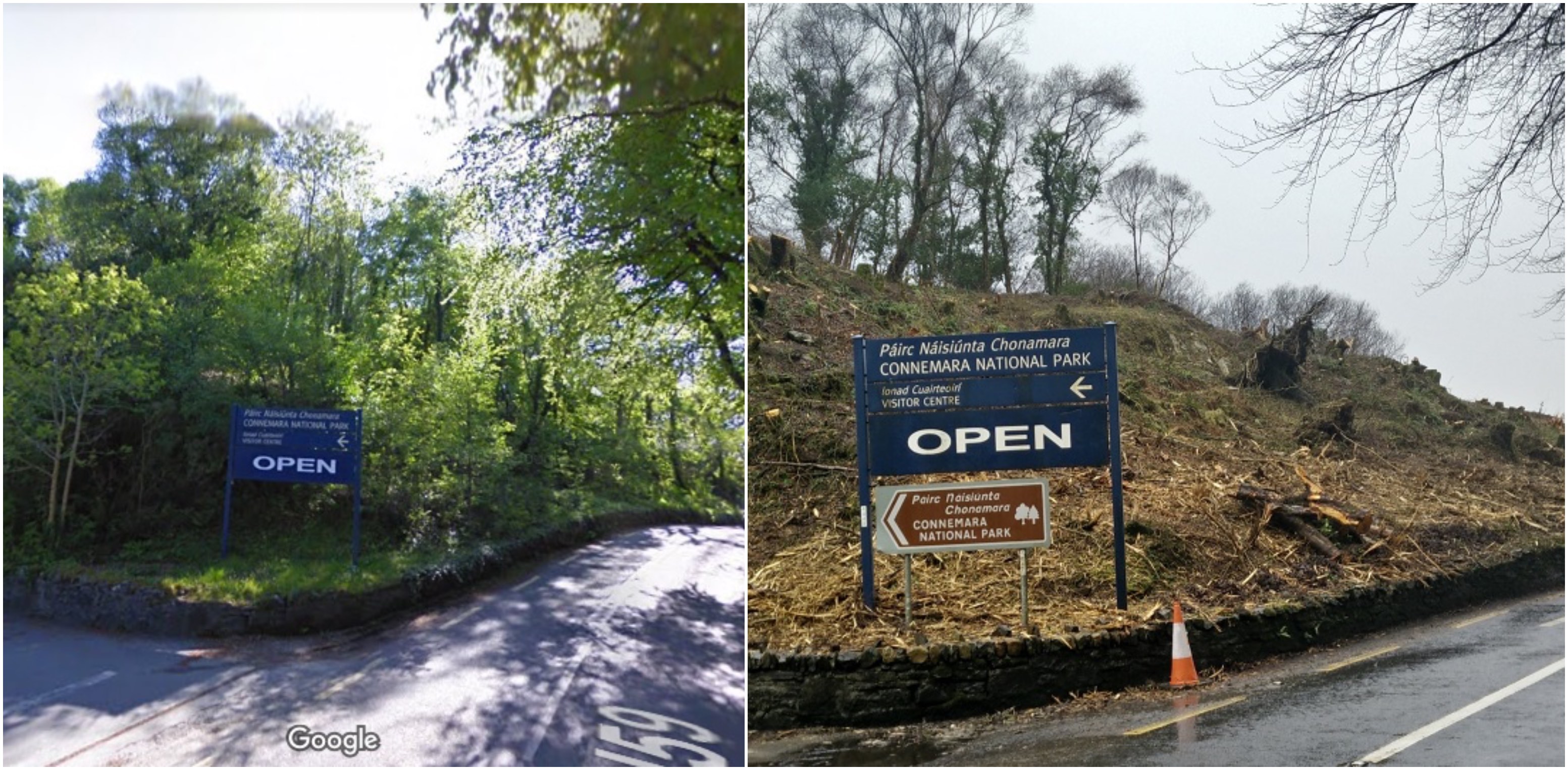
IWT complains to Minister Madigan over destruction of woodland in Connemara National Park
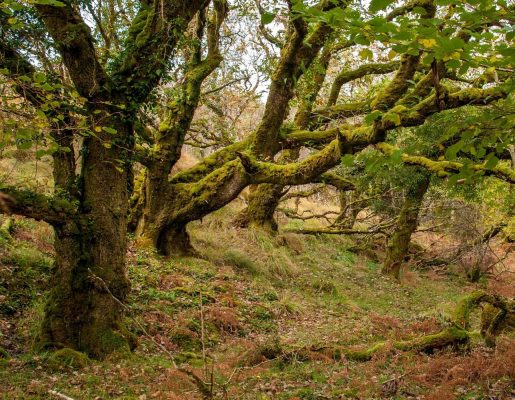
The Irish Wildlife Trust (IWT) has formally complained to Minister for Arts, Heritage and the Gaeltacht, Josepha Madigan, over the recent destruction of a broad-leaved woodland in Connemara National Park in Galway. The removal of the woodland, which was evaluated by independent ecologists as of ‘high biodiversity value in a local context’, was facilitated by the National Parks and Wildlife Service (NPWS) in a land transfer to Galway County Council with no public consultation process. The IWT believes that this sets a shocking precedent as it now seems that sections of National Parks can be hived off with virtually no due process. While an ecological impact report was prepared in advance of the road project, this was only after the NPWS had agreed to relinquish the land. The woodland, which contained Oak, Hazel, Ash, Beech, Willow, Birch and Alder, along with Bluebells and Ferns on the woodland floor and suitable roosts for bats, was cleared earlier this month. Native woodland is vanishingly rare in Ireland (only around 1% of our land area) and broad-leaved woodland of any kind – and especially in a National Park – is of significant value. The IWT understands that no compensatory land was sought by the NPWS from Galway County Council and so the public is now left with a smaller (and biologically poorer) National Park. The manner in which a section of a National Park can be given away highlights the poor levels of protection for these areas (National Parks have no legal status despite a decades-long commitment to introduce legislation).
IWT Campaigns Officer, Pádraic Fogarty says: “It’s really shocking to think that the NPWS, who are supposed to be the guardians of our natural heritage, can so easily sacrifice chunks of one of our country’s natural treasures. We’re disappointed, but not particularly surprised, that the Fine Gael government has signed off on this, given their poor regard for the environment. However, this incident also highlights the need for reform of the NPWS so that the Irish people can regain confidence that our natural heritage is being protected and defended – something which evidently is not happening at present”. END
CONTACT: Padraic Fogarty – IWT’s Campaigns Officer – Email: irishwildlife@iwt.ie for further details
PRESS RELEASE: Irish Wildlife Trust calls on the Oireachtas Committee on Climate Action to ensure that nature is central to its recommendations.
The Irish Wildlife Trust (IWT) has made a written submission to the Committee on Climate Action, calling on its members to recognise the important role that nature conservation can play in mitigating climate impacts and reducing greenhouse gas emissions. Ireland (and the world) is also experiencing a parallel, but overlapping, extinction crisis which also threatens our way of life and there is an enormous opportunity to address both crises at once.
There are two important ways in which better protection for nature can help us in our climate challenge. Firstly, healthy ecosystems can help mitigate Climate Change impacts. This is because healthy rivers, soil, forests and seas lessen the impacts of extreme weather. The European Commission has said that: ”Natura 2000 sites are key in this role, when properly implemented”[1], referring to the network of protected sites under the EU’s Birds and Habitats Directives. In Ireland there are currently over 600 such areas covering more than 13% of the land. However, to-date the directives have been poorly implemented, with very few management plans for protected areas and most habitats and species being in poor condition. If we are to address the extinction crisis and realise the potential for climate resilience, there is an urgent need to invest adequately in an independent nature authority as well as other conservation initiatives.
The other important role nature can play in climate action is in directly helping to achieve reductions in greenhouse gas emissions. A study by the Nature Conservancy in 2017 found that ‘nature-based solutions’ – such as rewetting bogs, expanding natural forests and better managing farmland so that soil absorbs carbon – can provide up to 37% of the emissions reductions needed to meet global targets under the Paris Climate Agreement. According to the authors “we’re unlikely to see a better carbon capture and storage technology than that which nature provides—we just need to actively give it the best chance to do its job”[2]. A study in the UK found a figure of 33% for land use in that country stating: “If reforestation occurred across the whole of the UK, increasing the total forest cover to 18% and if all bogs, grasslands, arable and horticultural lands were managed in the best way possible, then these could account for one third of the required cuts by 2050”[3]. No comparable figures are available for Ireland but given the levels of emissions from worked over peatlands and agriculture a similar scale can surely be expected. In Ireland, forestry has been seen as part of the solution to emissions reductions however our model has been based on the expansion of non-native monocultures, which are a driver of biodiversity loss and water pollution while providing few benefits for amenity or recreation. In addition, recent studies have found that mixed forests are better at drawing carbon out of the atmosphere while native woodlands can provide multiple benefits from wildlife habitat to amenity, water purification and flood alleviation[4]. Even better protection for the marine environment can help, with authors of a recent study saying: “marine reserves protected from fishing and other human exploitation can reduce the damage from acidification, rising sea levels, storm intensification, and other effects of climate change”[5].
IWT Campaigns Officer, Pádraic Fogarty says: “It’s a huge concern that the collapse of natural ecosystems is being forgotten in the climate debate. This would be a travesty, as restoring nature is likely to be the easiest, cheapest and most effective form of climate action available. We also believe it is likely to be among the most popular. Who doesn’t want to live in a county full of nature, with clean rivers, enchanting forests and healthy seas?”
Restoring nature must be central to climate action
By Padraic Fogarty, IWT Campaigns Officer
Two reports in the past two months focussed the world’s attention – if only briefly – on the dire state of our planet. The first, from the UN’s Intergovernmental Panel on Climate Change (IPCC) laid out in stark terms how there is only about 12 years remaining where meaningful action can be taken to curb the worst effects of climate collapse. The other, from the Worldwide Fund for Nature and the Zoological Society of London (WWF/ZSL), revealed how the population of the world’s vertebrates (animals with backbones such as mammals, birds and fish) have plummeted by 60% since the 1970s. Although the climate crisis remains largely ignored by Ireland’s business and political classes, it is positively lavished with attention when compared to our extinction crisis – something which rarely, and only sporadically hits the headlines. This is important for two reasons. Firstly, extinction is not something which has only affected far-away places but rather has impacted Ireland even more dramatically than most countries. Not only have we lost our bogs and forests, but our rivers are dammed, drained and polluted, our seas are trawled lifeless, and our farmland is increasingly sterilised. It’s revealing how, unlike the climate debate, there are no ‘extinction denialists’ or lobbyists trying to tell us this isn’t happening – it’s simply accepted with a shrug. Secondly, nature is an indispensable ally in meeting our climate goals. So, rather than viewing two separate ecological challenges, it is essential that they are seen as intimately interlinked and this is something that can work to our benefit. I would go so far as to say that restoring nature is the cheapest, easiest and most effective tool at our disposal for not only reducing emissions of greenhouse gases but helping to adapt to extreme weather events, building resilience in food production, and providing a lifeline to rural communities.
Although the extent of our extinction crisis is well documented, government departments have been woefully negligent in undermining conservation efforts (just look at the dilapidation of our national parks). For those looking for hope, the new Minister for the Communications, Climate Action and the Environment, Richard Bruton, took to Twitter on November 7th to say “I want to make Ireland a leader in responding to climate change, not a follower. That will require a significant step change across govt. I will lead on the development of an all of govt plan which will set out the actions which must be taken in every government dept and body.” He later told the Irish Times that meeting the challenge will require a “revolution in how we live”. These were welcome words to those of us used to the evasive language and denialism that has characterised the Fine Gael administration. Indeed, the normally buzzing social media accounts of government ministers fell silent on the release of the WWF/ZSL report, with even our minister in charge of nature conservation, Josepha Madigan, having nothing to say on the topic. This has to change if we are to turn things around in the short space of time left available to us.
A study published in 2017 by the Nature Conservancy in the US put a figure on just how useful nature will be in preventing climate collapse – fully 37% of the needed reductions in greenhouse gases can come from nature-based solutions such as restoring wetlands, re-establishing forests and farming in a way that absorbs carbon and methane rather than releasing them. Committing to the rewilding of the Midlands bogs, a once-unique ecosystem which has been lost due to turf-extraction, could transform the degraded landscape, providing a range of new job opportunities as well as being the biggest ‘no brainer’ in terms of locking up carbon permanently (currently the bare peat soil spews out CO2 at a ferocious rate even before it is burned). We’re still dredging and draining rivers, even blaming the few remaining trees along the River Shannon for flooding, when reconnecting rivers with their natural floodplains will reduce flood risk in towns and provide greater resilience in the face of wetter winters. We’re pumping hundreds of millions of taxpayers’ euros into a failing forestry model based on conifer plantations which are clear-felled after 50 years – pumping out cheap wood products and pollution while sterilising the landscape of people and wildlife. New research has shown that real forests – with a natural mix of species – store more carbon than monocultures, while at the same time purifying water, slowing the flow of water off land and providing valuable amenity benefits to local people. Across the continent ‘continuous cover forestry’ produces timber in a way that is sympathetic to the natural woodland ecosystem, something which jars with our pesticide-dependant, soil-destroying and forbidding landscapes of alien trees. Meanwhile on farmland, better management of hedgerows and restoring soil health would suck up carbon, while fewer livestock would not only cut methane emissions but eliminate the greatest source of pollution in our rivers and lakes. All of these initiatives require the revolution in thinking which Minister Bruton alluded to. They have the added benefit of restoring the glories of nature while providing sustainable futures for communities.
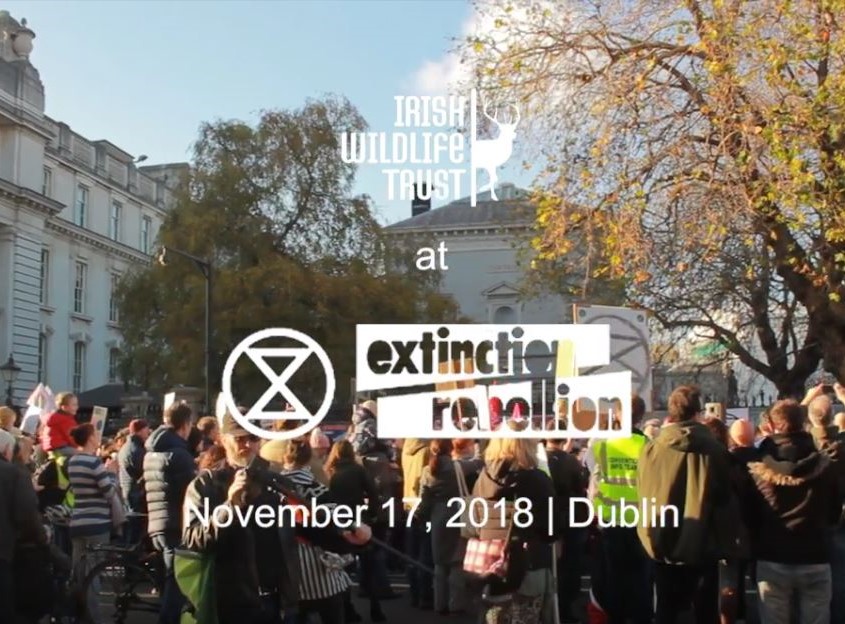
Press Release: Public urged to attend Extinction rally tomorrow(November 17th)
The Irish Wildlife Trust (IWT) is urging people to attend events around Ireland to protest the lack of action in the face of planetary ecological collapse. Events will be held in Dublin, Cork, Galway and Belfast at 2pm in what is planned to be a family-friendly but vocal expression of outrage and dismay at the lack of political action to prevent a mass extinction of life on Earth. Last month a shocking report from the World Wildlife Fund and the Zoological Society of London showed how 60% of the world’s large animals have disappeared since the 1970s. Meanwhile the UN’s Intergovernmental Panel on Climate Change have told us that there may only 12 years remaining where meaningful action can be taken to avert dangerous climate breakdown.
IWT Campaigns Officer, Pádraic Fogarty, says: “The world around us is dying. It’s vital for Irish people to know that the extinction crisis is not something that’s far away but is right here on our doorstep. Our seas and rivers are being emptied of fish, we have lost our bogs and forests and even our farmland has become a nature-free zone. We can’t address this crisis without political action at the highest level and our current government has failed spectacularly in this task. Extinction has already seen a loss of heritage and livelihood in Ireland and there are huge opportunities for us all were we to bring nature back.”
Protests will take place at 2pm in Dublin (Dead Zoo, Merion Square), Galway (Salthill Prom), Cork (City Hall) and Belfast (City Hall).
CONTACT: Padraic Fogarty – IWT’s Campaigns Officer – irishwildlife@iwt.ie for further details
Irish Wildlife Trust & Dublin Port launch new Biodiversity Awards with Minister for Culture, Heritage & the Gaeltacht, Josepha Madigan, T.D.
Calling on community groups, farmers, schools and individuals to enter now
25th October 2018. The Irish Wildlife Trust and Dublin Port Company today launched the Together for Biodiversity Awards with the Minister for Culture, Heritage & the Gaeltacht, Josepha Madigan, T.D.
The awards are being run by the Irish Wildlife Trust, as part of the National Biodiversity Conference (www.biodiversityconference.ie), and supported by Dublin Port Company. This is the first Irish awards programme of its kind dedicated solely to recognising and funding biodiversity champions in our society.
PRESS RELEASE: Irish Wildlife Trust calls for moratorium on pair-trawling to save the marine environment
23rd October 2018
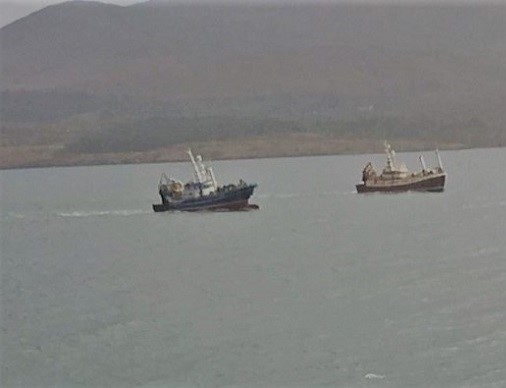
Pair trawling in Irish Coastal Waters
The Irish Wildlife Trust (IWT) has written to Minister for Agriculture, Food and the Marine Michael Creed asking him to impose a moratorium on pair-trawling to protect the marine environment, particularly in the south-west. Pair-trawling is the practice of two boats hauling one fine-meshed net. It is typically carried out in shallow bays and estuaries where sprat (a small shoaling fish) gather in great numbers at this time of year. Unregulated pair-trawling sieves the water of all life, not only resulting in the collapse of the sprat population, but also impacting on the entire marine food web including whales, dolphins and larger fish.
Earlier this year Minister Creed held a public consultation on trawling within the 6 nautical miles zone. The IWT understands that his department received an enormous 1,000 responses – an unprecedented figure for a consultation of this nature. While it is no doubt that it will take time to consider these submissions, the IWT feels that urgent measures are required to prevent the total collapse of marine ecosystems.
IWT Campaign Officer Pádraic Fogarty says, “it’s absolutely crazy that this level of unregulated fishing is allowed to continue as it has. It should have been banned years ago but now we really are on the threshold of collapsing the marine food chain in these areas. The Minister did the consultation and there was enormous interest – he now needs to get on with the task before it’s too late”.
END
CONTACT: Padraic Fogarty – IWT Campaigns Officer – irishwildlife@iwt.ie for further details
Environmental Groups enraged as Minister Madigan uses conservation plan to push for damaging forestry in protected sites.
17th October 2018
Environmental Groups call on Minister Josepha Madigan and the Department of Culture, Heritage and the Gaeltacht to retract new proposals to allow forestry in European protected sites. The Minister’s proposals are part of a Threat Response Plan being developed by the National Parks & Wildlife Service to save the endangered Hen Harrier from regional extinction and further severe population decline.
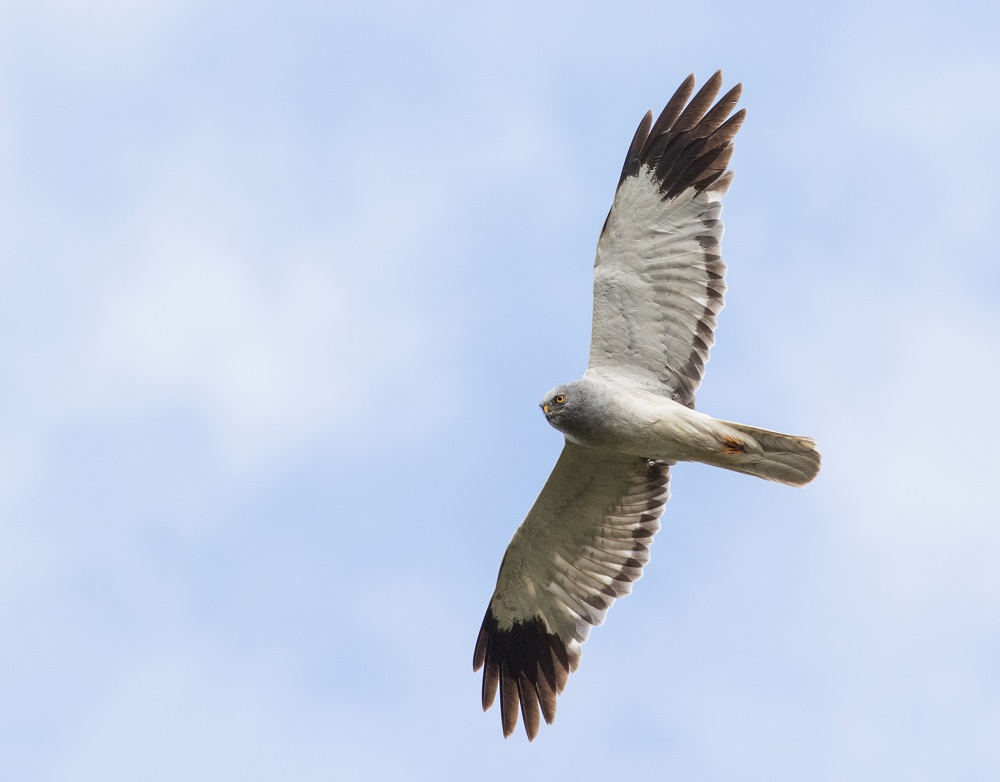
Six Special Protection Areas (SPAs) have been designated for the protection of Hen Harrier in Ireland. Large scale commercial conifer forestry is the main threat to the Hen Harrier which replaces the upland bog and marginal farmland on which this rare ground nesting bird depends. The Forest Service no longer approves new conifer plantations in SPAs due to these known negative impacts. Over 52% of the land in Hen Harrier SPAs has been lost to forestry. There are now more Hen Harrier outside of these protected areas than inside.
Despite Environmental Groups demanding that forestry is removed from SPAs as a key critical measure of the Government’s Hen Harrier Threat Response Plan, the National Parks & Wildlife Service has blatantly ignored scientific evidence, expert advice and European case law and proposed planting of Hen Harrier habitat in SPAs in a conservation document that aims to avoid, reduce and reverse impacts of forestry on Hen Harrier.
Pádraic Fogarty, Campaign Officer for the Irish Wildlife Trust (IWT) said:
“the National Parks & Wildlife Service has presented a draft Hen Harrier Threat Response Plan that is not a conservation plan, but a blueprint for the continued destruction of our protected sites and the extinction of the Hen Harrier.”
The National Parks & Wildlife Service and the Department for Agriculture, Food and the Marine are sending a clear message that the loss of rural farming communities and natural heritage are affordable in the pursuit of forest profits for the few. The move to approve forestry in protected sites is a purposeful assault on marginal and hill farmers and the conservation value and ecosystem services provided by high nature value farmland – entirely contrary to the future direction of results-based farming and the spirit of rural socio-economic stability and integrated sustainable upland land use. There is a need for accountability within the Minister’s Department.
Elaine McGoff, Natural Environment Officer for An Taisce said:
“It is extremely disappointing to see a draft document with no apparent conservation objectives set, no targets defined, no deliverables, and no explanation or way of measuring how proposed actions will yield any immediate, short or long term positive effects for the Hen Harrier”
The conservation of the Hen Harrier is worth over €100,000,000 to rural farming communities through agri-environment schemes as part of the Green Vision for Irish Agriculture in the current Rural Development Programme. Despite the huge investment in farming for conservation, lucrative tax payer funded forest premiums and grants are considerably higher and longer lasting than Basic Farm Payments. The low farm viability in upland areas and a looming farm succession crisis facing rural communities has driven a reluctant demand for forestry over farming in certain areas. This is despite the lack of any evident benefits of forestry to local communities over the last 30 to 40 years.
Dr. Allan Mee of the Irish Raptor Study Group said:
“The proposal to further expand forestry in Hen Harrier SPAs is not legal as the proposal is in direct contravention of European Union Environmental Law, is incompatible with sustainable upland farming, and the worst possible scenario for a conservation plan aiming to save the Hen Harrier”.
Environmental Groups An Taisce, Irish Wildlife Trust and the Irish Raptor Study Group now publicly call on Minister Madigan to retract these proposals and revise the plan to deliver positive long term gains for farmers and the Hen Harrier as a matter of urgency.
ENDS
Contacts:
Elaine McGoff, Natural Environment Officer, on behalf of An Taisce
The Irish Raptor Study Group (IRSG) is a voluntary non-profit organisation that carries out survey, monitoring and research on Birds of Prey and Owls (Raptors) in the Republic of Ireland.
The Irish Wildlife Trust was founded in 1979 as a charitable conservation body. We provide the public with information about wildlife, run education and training programs, carry out habitat and species surveys, campaign and lobby around biodiversity issues, restore natural habitats, consult with industry, agriculture and Local Authorities to maintain our natural heritage and contribute to national and international forums for the protection of biodiversity.
An Taisce is a charity that works to preserve and protect Ireland’s natural and built heritage. We are an independent charitable voice for the environment and for heritage issues. An Taisce are not a government body, semi-state or agency. Founded in 1948, An Taisce are one of Ireland’s oldest and largest environmental organisations. An Taisce is a member of the International National Trusts Organisation (INTO) and the European Environmental Bureau (EEB), Europe’s largest federation of environmental organisations. We are also the Irish member of the Foundation for Environmental Education (FEE), a global organisation of over 70 nations which is recognised as a world leader in education for sustainable development and environmental education.
In June 2013, the then Minister for Arts Heritage and the Gaeltacht Heather Humphreys began the development of a Threat Response Plan to save the declining Hen Harrier.
Under Regulation 39 of the European Communities (Birds and Natural Habitats) Regulations 2011 provision is made to develop and implement appropriate threat response plans. The purpose of such a plan would be to cease, avoid, reduce or prevent threats, pressures or hazards that may be having an adverse effect on the conservation status of a species of bird referred to in Article 1 of the Birds Directive and/or causing the deterioration of the habitats of species for which a European Site has been classified pursuant to the Birds Directive.
Open Birds Case: Irish Government did not meet the required standard regarding the level of protection being achieved in SPAs or in areas that should be designated as SPAs, as set out in Article 4 of the Birds Directive or Article 6 of the Habitats Directive, in particular by failing to take all reasonable measures, including targeted action to prevent their deterioration required protective measures outside SPAs have not been put in place Hen Harrier Special Protection Areas are meant to provide the conservation requirements of the species.
To inform land use policy, the Government has spent over €5 million of tax payers money on forest sector led research in an attempt to establish links between commercial forestry and impacts on Hen Harrier. This research shows strong scientific evidence that conifer forestry negatively impacts Hen Harrier and is a driver of population decline.
Both the extent and demography of the forest estate (habitat loss/temporary availability/predation) in upland areas are the mechanisms driving Hen Harrier decline. The number of breeding Hen Harrier in Ireland has predictably continued to be lost from previous strongholds. Environmental Groups are demanding forestry is removed from SPAs as a key critical measure of the Government’s Hen Harrier Threat Response Plan. Forest removal and restoration to upland habitat is essential if the Government have any remote hope of halting the population decline, localised extinctions and maintaining a viable, stable breeding population in the Natura 2000 network long term.
Loss of bog and rough grassland to forestry results in significant negative long-term effects on the breeding Hen Harrier population in Ireland. Hen Harrier can use early growth stages of forest, however scientific studies have shown birds nesting in forestry are more susceptible to predation and are therefore less successful, driving population decline.
A forest sector led tax payer funded research project undertaken by University College Cork showed that where the proportion of 2nd rotation pre-thicket forest within 1km of Hen Harrier nests increases above 10% land cover, nest survival decreases below a sustainable level. The Government have not provided any data on what proportion of 2nd rotation pre-thicket forest exists within the Hen Harrier SPAs either at present or into the future.
An open complaint to the European Commission led to a Forest Service imposed ban on any further planting in Hen Harrier SPAs in 2009. The Forest Service have categorised all lands in Natura 2000 sites as not considered suitable for certain types of forest development.
The Ministers Department have 20 years of breeding Hen Harrier data and also a highly accurate habitat map of the Hen Harrier SPA network on which to justify the urgency and scale of remedial actions.
Research to date, including an Oireachtas Report and the Governments own objective technical review documents on the Hen Harrier and forestry all clearly present scientific evidence of proven negative adverse effects of forestry on Hen Harrier at the national population level. Due to these known negative effects, the Forest Service, in 2009, imposed a ban on further afforestation in Special Protected Areas designated for the Hen Harrier in response to an active and still open complaint to the European Commission specifically on this issue.
Links to information:
Core Requirements for the Recovery and Conservation of the Hen Harrier in Ireland. Position Statement of the Committee of the Irish Raptor Study Group. (August 2016).
Joint Committee on Agriculture, Food and the Marine No. AFM 007 (October 2015): Designation of lands as Special Protection Areas for the conservation of breeding Hen Harriers.
Ruddock, M., Mee, A., Lusby, J., Nagle, A., O’Neill, S. & O’Toole, L. (2016). The 2015 National Survey of Breeding Hen Harrier in Ireland. Irish Wildlife Manuals, No. 93. National Parks and Wildlife Service, Department of the Arts, Heritage and the Gaeltacht, Ireland.
Moran, P. & Wilson-Parr, R. (2015) Hen Harrier Special Protection Area (SPA) Habitat Mapping Project 2014. Irish Wildlife Manuals, No. 83. National Parks and Wildlife Service, Department of Arts, Heritage and the Gaeltacht, Ireland.
PRESS RELEASE: Irish Wildlife Trust budget submission highlights chronic underfunding for conservation in the face of worsening extinction crisis
The Irish Wildlife Trust (IWT) has written to Minister for Finance Paschal Donoghue calling for greater public spending on conservation in Budget ‘18. In particular we are calling for a substantial increase in funding for the National Parks and Wildlife Service (NPWS) so that our worsening extinction crisis can be adequately addressed.
A report published early in 2018 from University College Dublin found that direct spending on biodiversity, over the six-year period from 2010-2015, amounted to €1.49 billion, or €250 million per annum [1]. While this sounds like a substantial sum, it represents a meagre 0.31% of national spending. However, this seemingly substantial expenditure is abjectly failing to make a dent in addressing the extinction crisis. The UCD/NPWS report goes on to note that 96% of the €1.49 billion total went on subsidies (80%), operational costs (10%) and staff (6%), leaving the remainder for actual work on the ground. Environmental non-governmental organisations, like the IWT, “are struggling with budgets that are barely sufficient to cover yearly administrative, personnel and management costs” while even the NPWS (the national body charged with protecting nature in Ireland) “is itself responsible for just 9% of total expenditure and has endured significant budget cuts in recent years”.
The report states:
“continuous year-on-year reduction in budgets have left [the NPWS and the Heritage Council] in a critical state. Interviews with public servants in both organisations, along with annual reports, reveal that that the capacity of these organisations has been reduced to maintain core infrastructure and critical programmes and priority staff, with many staff in temporary positions or positions left vacant. In some instances, programmes have had to be shut down”… “To meet national targets to halt decline in biodiversity trends and deliver positive gains, core funding for conservation through dedicated government budgetary allocations for conservation needs to be increased”.
It notes how despite the fact that our area of ocean greatly exceeds that of our territorial land, just 1.3% of the budget is linked to conservation of marine biodiversity.
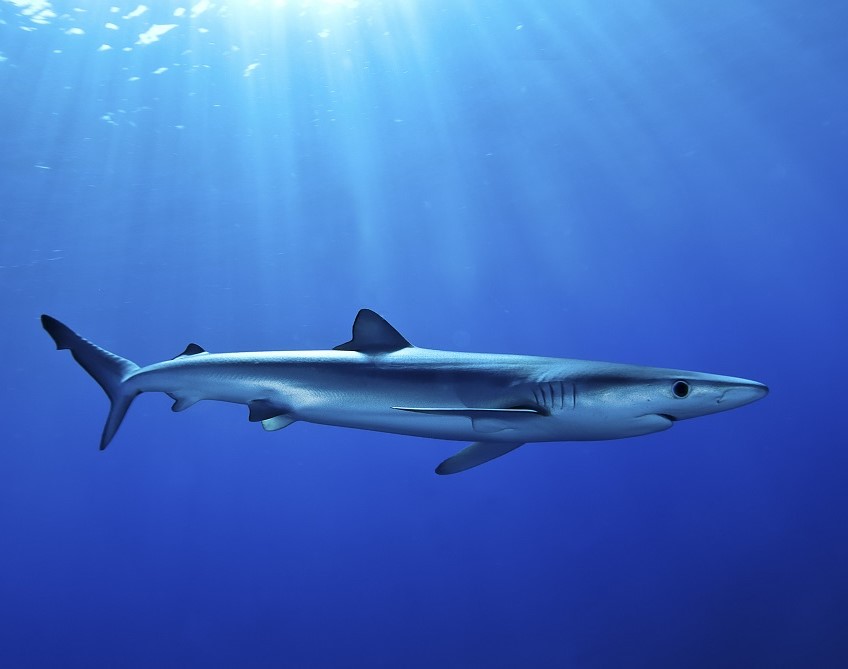
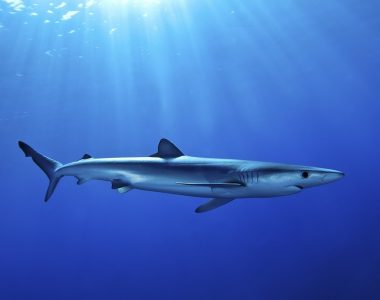
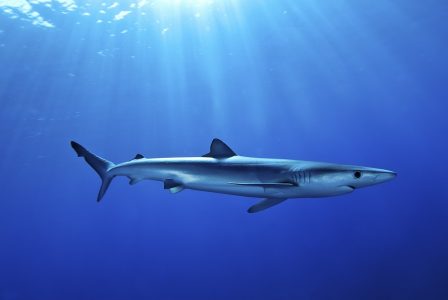
Blue shark (Prionace glauca) in the Azores, Portugal, Atlantic, Europe
The report highlights that biodiversity expenditure amounts to only 0.13% of GDP while the International Union for the Conservation of Nature has called on OECD countries to contribute at least 0.3%. The most recent figures available indicate that the NPWS was in receipt of just over €17 million in 2016. For comparison purposes, and perhaps reflecting the priority given to our natural heritage over other interests, the Greyhound Racing Bord received €16 million of public money in 2017 while Horse Racing Ireland got its hands on a massive €64 million. Indeed the funding to NPWS is dwarfed by the nearly €41 million given to An Bord Bia, the agency which markets Irish food and drink throughout the world as ‘green’ and ‘sustainable’. We simply cannot blame lack of resources for failing to address our extinction crisis.
Meanwhile the grim unfolding of ecological loss and extinction continues in Ireland unabated. The IWT is calling therefore for an urgent doubling of contributions to the NPWS and an independent review of the future funding needed to develop a robust organisation which can lead the reversal of our extinction crisis. We call on the government to chart a path to meeting the IUCN target of 0.3% of GDP.
IWT Campaigns Officer, Pádraic Fogarty says: “We utterly depend upon nature for a stable climate, clean water, healthy food and liveable surroundings. There are huge benefits to people from a healthy natural environment which are simply being ignored. We may be the last generation to have the means to reverse the extinction and climate crises – we simply can’t afford to screw it up.”
1 A National Biodiversity Expenditure Review for Ireland. 2018. R. Morrisson & C. Bullock. University
College Dublin – Planning and Environmental Unit
2 National Biodiversity Action Plan 2017-2021. 2017. Department of Culture, Heritage and the
Gaeltacht.
For further detail contact IWT Campaigns Officer Padraic Fogarty on irishwildlife@iwt.ie
PRESS RELEASE – The River Bandon Flood Scheme; is so much destruction necessary?
17th September 2018
The Irish Wildlife Trust (IWT) is calling on the Office of Public Works to adopt more nature-friendly means for alleviating flooding following the destruction of a section of the River Bandon in Co. Cork over the past 18 months. Local environmentalists have referred to the scheme as ‘butchery’ as it is set to permanently see the loss of what had been one of Ireland’s best-preserved river systems. According to the development’s Environmental Impact Statement the dredging of 3.6km will result in the loss of aquatic habitats of ‘European importance’ including ‘exceptional’ habitat for fish and otter and the destruction of 10% of a ‘nationally important’ Natural Heritage Area. The transformation of river from one with naturally diverse vegetation and physical features to one which is uniform and lined with walls of rock armour has seen the permanent loss of a precious natural amenity.
The IWT accepts that flooding is a serious problem and one which requires urgent attention. Indeed, climate change is likely to bring more flooding to Irish towns and cities as weather events become more intense and sea levels rise. The question which must be asked is: do we need to obliterate entire river systems to solve this problem? Are there other ways which can safeguard homes and businesses without so much environmental destruction? The answer is ‘yes’.
Natural flood management is defined by the UK government as “when natural processes are used to reduce the risk of flooding and coastal erosion. Examples include: restoring bends in rivers, changing the way land is managed so soil can absorb more water and creating saltmarshes on the coast to absorb wave energy[1].” They have listed 60 case studies across Britain, concluding that “It works. It can reduce flood risk, by slowing, storing and filtering water.” We have no such case studies in Ireland.
In the catchment of the Bandon River intensive agricultural practices (requiring on-going land drainage), unsustainable forestry activities (which reduce soil storage capacity by the use of non-native trees and the practice of clear-felling), peatland degradation and inappropriate development have all contributed to flooding. Conversely, less intensive farming, native woodland creation and peatland restoration can help to alleviate flooding. However, the planning documentation for the Bandon flood scheme shows that these were not considered as alternative approaches.
The OPW manages 11,500km of river channels which it is responsible for maintaining in a permanently ‘dredged’ condition under legislation dating from the 1940s (when the prime consideration was expansion of farmland rather than saving property). The Arterial Drainage Act now requires urgent review given the enormous changes to our environment which have occurred, and the greater acceptance that a more nature-friendly approach is needed.
IWT Campaign Officer Pádraic Fogarty says: “nobody blames the people of Bandon for wanting to rid their town of floods. But we can’t go on digging up rivers while simultaneously destroying all the landscapes around them. The OPW must crawl out of their 1940s mindset and realise that concrete and heavy machinery are not the solution to everything.”
Better protection for sharks needed as Spanish boat detained on suspicion of illegally shark finning in Irish waters
D1GKXD Blue shark (Prionace glauca) in the Azores, Portugal, Atlantic, Europe
The Irish Wildlife Trust (IWT) has written to Ministers Michael Creed (Agriculture, Food and the Marine) and Josepha Madigan (Culture, Heritage and the Gaeltacht) appealing for them to strengthen protections for sharks and other threatened marine species in Irish waters. Earlier this year, the IWT published a report (‘Protecting Our Ocean Wealth’) listing 48 species in need of full legal protection under the Wildlife Act. Currently no marine fish or invertebrate enjoys legal protection in Irish waters despite many species being in danger of extinction.
Since the report’s publication the IWT has met with a number of state agencies and has been encouraged by the response. In particular we welcome clarification (in a written communication) that Inland Fisheries Ireland does not “condone or promote” fishing for sharks and rays from kayaks – something the IWT would like to see prohibited entirely. We also welcome confirmation that guidelines for anglers targeting these sensitive species are being reviewed and are to be published shortly. According to a 2016 report from the National Parks and Wildlife Service, a massive 62% of all shark and ray species in Irish waters are threatened with extinction or ‘near threatened’[1]. This weekend it was revealed that a Spanish fishing vessel was detained by the Irish navy for allegedly finning sharks at sea, a practice that has been banned in EU waters since 2013. It was also reported that an angler in Cork was injured by a blue shark as he was removing a hook from its mouth.
IWT Campaigns Officer Pádraic Fogarty says: “Sharks and rays are top predators and so are crucial to the health of our seas – yet they are being hammered by poor management of our marine waters. We urgently need to see legal status in place which would pave the way for marine protected areas and the restoration of ocean biodiversity. We urge Ministers Creed and Madigan to take action to avoid the complete extinction of threatened species on their watch”.
PRESS RELEASE: Latest Fine Gael marketing campaign cannot mask their appalling environmental record
Fine Gael yesterday (20/8/18) launched their latest marketing initiative entitled ‘Green Week’ stating “This week, Fine Gael is going green. We are raising awareness about how you can be greener, what supports are available to you and why we need your help to tackle climate change.”
The Irish Wildlife Trust (IWT) wishes to remind the public of Fine Gael’s atrocious environmental record and feels that a week of social media spin is no substitute for actual environmental policies.
· Since coming to power in 2011 Fine Gael has presided over significant agricultural expansion plans including FoodHarvest 2020 and FoodWise 2025. This has resulted in ballooning greenhouse gas emissions, water pollution and habitat loss. It is driving species to extinction including the curlew, golden eagle and the freshwater pearl mussel. Last year the EPA highlighted a precipitous decline in the number of ‘pristine’ water sites – from over 500 in the 1980s to just 21 today.
· Investment in the National Parks and Wildlife Service was slashed during the recession and remains poorly organised and underfunded. Its current funding is on a par (€17 million) with the levels of taxpayer funding given to the Greyhound Racing Board. In contrast, An Bord Bia, which is behind the ‘Origin Green’ marketing initiative received €40.7 million in 2017.
· The Heritage Bill, passed into law only last month, allows for hedge-cutting and upland burning at a time when already struggling wildlife is at its most vulnerable. This went against all scientific and public opinion.
· Despite a legal commitment to create a network of Marine Protected Areas by 2020 no progress has been made to-date. The angel shark is likely to have disappeared from Irish waters during this government’s tenure as no action has been taken to save this critically endangered species.
· Despite a legal commitment to end all overfishing by 2020 the number of overfished populations increased in 2017 to 23%. Only 39% of scientifically assessed fish populations are considered to be fished within sustainable limits. Meanwhile supertrawlers hoover marine life from the sea unsupervised.
· Forestry policy remains fixated on monocultures of non-native conifers which devour landscapes, pollute water and eradicate habitats – even in areas which are of high landscape value or are protected for nature. Even the modest targets for native woodland creation are not being met.
· In 2013 a report to the European Commission indicated that a miserable 9% of our most important habitats are reaching ‘favourable’ status. An update to this report is due to be published shortly and there is no indication that this figure is likely to change substantially. The area of midlands raised bog remaining is now less than 1% of its original extent.
· Whole groups of species are threatened with extinction including 30% of bees and over half of our sharks and rays.
IWT Campaign Officer, Pádraic Fogarty, says: “Fine Gael are the party of ecological ruin and no amount of gloss can disguise the damage they have wrought on nature during their time in office. Since coming to office it has actively pursued policies which undermine the integrity of our natural environment – reducing budgets for conservation organisations, introducing laws to weaken nature protection, and knowingly following policies which are at odds with legal environmental safeguards. It is disgraceful that they think they can use their PR machine to weasel their way out of this shameful record.” END
CONTACT: Padraic Fogarty – IWT’s Campaigns Officer – irishwildife@iwt.ie for further details
PRESS RELEASE: Passing of the Heritage Bill highlights unhealthy relationship between government and lobbyists
The Irish Wildlife Trust (IWT) is disappointed at the passing into law of the poorly named Heritage Bill and we would like to pay tribute to all who campaigned to have it scrapped – including members of the public and politicians in both houses of the Oireachtas. We would also acknowledge that without the intervention of Fianna Fáil, to limit the cutting of hedgerows in August to those on roadsides only, this law would have been much worse. However, there is nothing good for nature in this legislation.
The process has highlighted the unhealthy relationship between Fine Gael and the Irish Farmers’ Association and the lack of regard in the government for the protection of nature. It has shown that Fine Gael are willing to disregard due process and scientific advice to deliver promises to their favoured interest groups. It shows that we cannot expect our Minister for Heritage to defend our heritage.
Although this is a say day for Irish wildlife, we have taken heart from the large numbers of people who are willing to fight for our heritage and the preservation of our precious countryside. This is a fight that does not end today. END.
CONTACT: Padraic Fogarty – IWT’s Campaigns Officer – irishwildlife@iwt.ie for further details
We use cookies to ensure that we give you the best experience on our website. If you continue to use this site we will assume that you are happy with it.