IWT welcomes acknowledgement of the biodiversity crisis and role of healthy ecosystems, including oceans, in the latest draft COP 26 text
The Irish Wildlife Trust (IWT) welcomes the prominence of nature in the latest draft of the COP text which appeared in Glasgow today (November 12th). The draft acknowledges in its preamble the “interlinked global crises of climate change and biodiversity loss, and the critical role of protecting, conserving and restoring nature and ecosystems in delivering benefits for climate adaptation and mitigation, while ensuring social and environmental safeguards”.
The extinction crisis and the potential for global ecosystem collapse cannot be separated from the climate emergency and requires a global, national and local response which acknowledges the intrinsic value of nature and biodiversity. For the first time, the draft text also places emphasis on the role of the ocean in a stable earth system and calls for a strengthening of “ocean-based action” that can help to mitigate and adapt to the climate crisis.
The IWT, which has been attending COP26, has noted the repeated theme that nature and climate are inseparable: while nature itself is at tremendous risk from rising temperatures, achieving the reductions in greenhouse gases needed to stay within 1.5 degrees of warming cannot be achieved without the protection and restoration of biodiversity.
IWT Campaign Officer, Pádraic Fogarty, says “It’s very welcome that finally we are seeing that the fate of humanity and that of the non-human world cannot be separated from each other. We simply cannot stabilise living conditions for people while continuing to destroy the natural systems upon which we depend. These include oceans, peatlands, forests and rivers and Ireland has an urgent task ahead to address the degradation of these ecosystems in our territorial area.”
The IWT is urging the government to support the global aim of protecting at least 30% of Ireland’s land area by 2030, to bring forth legislation for the creation and management of marine protected areas without delay, to stop the loss of protected peatlands and to increase ambition in restoring degraded peatlands, and to ensure that forthcoming agriculture and forestry plans are grounded in ecosystem restoration. The IWT also calls for immediate and rapid decarbonisation of our economy upon principles of climate justice as fundamental elements of achieving a safe living space for all of life on earth.
The COP is entering into its final days. Despite being labelled as a ‘now or never’ moment, the task of meaningfully addressing the climate and biodiversity emergency will remain with us after the delegates head home. No matter what the outcome it is important that momentum is maintained in the days and years ahead to minimise the negative impacts to the greatest degree possible.
The IWT came to Glasgow with the aim of flying the flag for nature, in the expectation that biodiversity would struggle to get a look in. However, I have been pleasantly surprised at just how prominent nature has been in the pavilion area (this is separate from the negotiation area and is the bit my badge allows me to take part in). One delegate I bumped into, who had attended previous COPs (this is my first), assured me this is a major uplift compared even to COP25 in Madrid in 2019.
There is a lot about nature-based solutions (NbS), financing for nature, saving the rain forests, ocean declarations and an entire pavilion dedicated to peatlands (and with impressive contributions so far from Irish-based scientists and ecologists).
The overarching, if unofficial, goal of COP26 is to keep alive the ambition of capping global temperature increase to 1.5 degrees. This is not achievable without nature – that is, the atmospheric reductions in greenhouse gas concentrations cannot be achieved through ending fossil fuel use alone. Many believe these removals can be achieved through technologies, such as carbon capture and storage, however these are not developed at any scale. NbS also have the potential to address other environmental and social issues. The role of nature, not only in taking carbon out of the air, but in helping us adapt to climate change is also recognised in the draft text of the COP agreement which appeared on Tuesday evening (November 9th). This agreement also refers to the role of the ocean, heretofore ignored in the text of climate agreements. This is all immensely positive.
There is, of course, a ‘but’. The level of greenwashing to which we have been subjected over the past decade has left an inevitable pall of scepticism over any and all announcements that appear to be doing good. For example, the declaration during the first week of COP from an alliance of over 100 countries that deforestation would end by 2030 was dismissed by some eNGOs (the promise had, after all, been made before).
Closer to home, the affiliation of WWF to An Bord Bia’s ‘Origin Green’ marketing programme has long been a source of frustration to Irish NGOs. In Glasgow, the IWT and An Taisce had the opportunity to express these concerns to a number of WWF staff which are here, including a meeting with a high level member of their delegation. WWF officially promotes the transition to a plant-based diet, along with a reduction in food waste and a food systems approach to feeding the world within planetary boundaries. Their on-going support for Ireland’s expansionist and intensive model of meat and dairy production is clearly at odds with this. In a brief meeting earlier today with their lead scientist on global food policy, I said as much. He assured me that WWF does not want to be associated with more greenwashing yet finding anyone in that organisation who can be held accountable for their Origin Green endorsement is a seemingly impossible task.
Another form of greenwashing, and just as insidious, is the rush for nature -based investments. One talk I attended earlier in the week on the topic, and which featured a representative from Microsoft, was keen to emphasise how investors are eager, very eager, to invest their money in restoring nature. But this enthusiasm is based upon a valuation of nature for its carbon storage capacity only. Companies like Microsoft are keen to portray themselves as ‘carbon neutral’, not by drastically cutting their emissions, but by offsetting said emissions through the purchase of carbon credits. This means ‘buying carbon’ from forests and wetlands, frequently in poor countries. Whether these investments actually result in carbon storage and sequestration, or how long the ecosystems will cooperate (fires and droughts have a habit of spewing the carbon back into the atmosphere), who knows?
The market in carbon credits is entirely unregulated and is based on ‘voluntary’ commitments. Even so, if a landowner or community were to sell its carbon to a private investor, can these still be counted by countries in their national accounts? The mechanism for carbon trading is one of the things under discussion at Glasgow but it is fraught with difficulty. When regulations do come, will the companies that have already made investments be entitled to compensation for any potential losses?
One thing is sure: even though the attention on nature here at Glasgow is welcome, the realisation that there is a biodiversity crisis, simultaneous but intimately interlinked with the climate crisis, is some way off. Valuing nature just for its carbon is a dangerous and risky path. We need to value nature for its intrinsic properties as well as those which benefit humanity. While finance, wherever is comes from, is welcome, I find it very hard to see a potential profit stream from protecting and restoring ecosystems. If I am right, what is in it for the private sector? I see no substation for public money being used for this task, based on taxing the wealth of individuals and corporations. But this is not something I have heard under discussion here at the COP.
The Irish Wildlife Trust is attending the COP26 climate summit in Glasgow. As a first-timer I have been overwhelmed by the enormity of the event. There’s the excitement at witnessing something of such global significance but a disorientation that is only lifting on day 4. World leaders and famous faces not infrequently whizz past, there’s an air of intense activity, but finding our own role in all of this, as a small NGO, has been daunting.
It is physically demanding. Daily Covid testing, queues over an hour long (thank goodness so far the weather has been kind), more queues for dreadful food, nowhere to sit and, perhaps most frustratingly, no single portal to find out what is happening across the dozens of venues and pavilions. I remind myself that these are small inconveniences when contrasted with what is at stake in these meetings. But it seems that optimism and goodwill are in just as short supply as chairs and a decent cup of coffee.
Perhaps it is best looked at as a tale of two events.
On the inside, the well-dressed delegates mill around between media interviews and panel discussions at slickly laid out pavilions. These are predominantly run by national governments, including many of the biggest polluting nations such as Saudi Arabia, Australia, Brazil (despite its leader, Jair Bolsonaro, staying away from Glasgow) and Norway (part of a Nordic pavilion). China is conspicuously absent. There are few NGOs. WWF is here but are indistinguishable from the US government.
Some of the discussions are excellent, many of the leading figures in their field are here, but they’re all very polite. I’ve seen nothing yet on moving to plant-based diets, abandoning GDP as the defining measure of success or the scale of rewilding needed to restore shattered ecosystems. From the inside, you would scarcely believe that humanity is on the precipice of disaster. Yesterday, I attended an EU sponsored event on carbon in coastal ecosystems and the speaker from Kenya told us that in “our best climate future”, i.e. staying within 1.5 degrees of warming, 70% of coral reefs around the world will die. At 2 degrees, nearly all of them will be dead. This factoid is not new, but it’s astonishing how it simply washed over those in attendance. Where is the outrage? The shock and the horror? Where are those responsible being held to account?
Outside, at least this anger is felt. That is, if you can see the demonstrations behind the walls of high-vis police jackets. A relatively small march by indigenous peoples yesterday, a colourful and benignly noisy affair, was accompanied by dozens and dozens of police. These people are fighting for their right to an existence, the threat to their homes and communities seems inversely proportional to any perceived threat they pose to public order on the streets of Glasgow.
The interaction between the reality on the outside and the sanitised halls of the Scottish Events Centre would seem to be minimal. Those with greater experience of COPs than me tell me Covid-19 has been used as an excuse to keep civil society out of negotiating rooms to an extent never before seen. The air is pessimistic. Even the good announcements, such as that earlier in the week on ending deforestation, are greeted with cynicism. All the promises have already been made, and subsequently broken.
This is not to be overly downbeat. The level of expectation, egged on by ‘now or never’ media headlines, was always too great to meet the reality of the outcome. It’s still early days, as the conference draws to a close next week, it is likely that some breakthrough will occur. The media attention has been phenomenal and outside, the protest marches are growing, and growing. The big one will happen in cities around the world this Saturday. I’ll take the march over the conference events, even though Saturday is the day dedicated to nature. It is on the outside, in the end, where the change will happen.
Irish Wildlife Trust welcomes announcement at COP26 to end deforestation – Ireland must move to address its own deforestation problem
The Irish Wildlife Trust, which is attending the COP26 climate summit in Glasgow, welcomes yesterday’s announcement by the UK hosts that over 100 countries have signed a pledge to end deforestation by 2030. This announcement comes with new funding commitments which will hopefully see the pledge implemented on the ground. The preservation of the world’s forests is essential for the stabilisation of global ecosystems including not only for climate but also water, biodiversity and livelihoods.
The IWT also welcomes the announcement by four Latin American countries of an enormous new Marine Protected Area (MPA) covering half a million square kilometres and stretching from Panama and Costa Rica to the coasts of Colombia and Ecuador’s Galapagos islands.
These announcements emphasis the intertwined and inseparable nature of the climate and biodiversity crises. They also show that nature-based solutions are available, implementable, cost-effective and deliver real results.
The announcements shine a spotlight on Ireland as among the most deforested countries on earth while lacking any meaningful network of MPAs. IWT campaign officer, Pádraic Fogarty, who is in Glasgow, says “It is very encouraging to see the focus on forests and the ocean at COP26, two ecosystems that are critical for the functioning of life on earth as we know it. This puts our own record under the microscope and we call on the government to increase the level of urgency in protecting our own ocean as well as setting about the task of restoring our native forests.”
As the government heads to the COP26 Climate Summit in Glasgow, new information shows that unlawful turf-cutting remains widespread on Special Areas of Conservation
Data from the Department of Housing, Local Government and Heritage, and acquired by the Irish Wildlife Trust (IWT) under Freedom of Information rules, show that mechanical turf-cutting continues to be a widespread issue on Special Areas of Conservation (SACs) in Ireland despite the practice being unlawful since 2011.
Under the EU’s Habitats Directive, 57 sites have been designated as SACs specifically for their raised bog habitat. This is one of the rarest habitats in the world; in Ireland the extent of ‘active’ raised bog (i.e. where wet peat was still growing) was mostly recently calculated at a lamentable 0.6% of its original extent.
However, this figure is now likely to be significantly smaller. The details sent to the IWT (and available upon request) show that of the 57 SACs, turf-cutting was monitored by the National Parks and Wildlife Service (NPWS) at around one third of the sites (18 SACs) in 2021.
At total of 282 plots were cut across all SACs in 2021, nearly the same as the 286 which were cut in 2020.
These included Mouds Bog SAC in Co. Kildare, Barroughter Bog SAC and Ardgraigue Bag SAC in Co. Galway, Cloonchambers Bog SAC and Callow Bog SAC in Co. Roscommon, Clooneen Bog SAC in Co. Longford and others have been cut every year since 2012 (as far back as the requested figures went).
It had previously been confirmed to the IWT by the Department that in accordance with the Wildlife (Amendment) Act 2000 and the European Communities (Birds and Natural Habitats) Regulations 2011, turf cutting may not take place on raised bog SACs unless with the prior consent of the minister”. Our FOI request showed that no such prior consents were granted in 2021.
Peatlands in Ireland are not only unique habitats for rare species but play an important role in storing carbon and in regulating flood water run-off. They are a significant part of our heritage and are frequently important amenity sites. However, when peatlands are damaged through drainage, turf-cutting, animal grazing or forestry, these processes go into reverse. It is particularly distressing therefore so see that even in the small number of ‘protected areas’ peatlands continue to be destroyed under the noses of the authorities.
IWT campaigns officer Pádraic Fogarty says “As the government heads to Scotland for the COP people need to know that we are still losing our most biodiversity and carbon rich habitats to illegal activity in areas where peat extraction was supposed to have been ended a decade ago. Despite the great speeches we’re likely to hear, the destruction of nature is on-going and shows little sign of abating. Last year we highlighted this issue with Minister Malcolm Noonan, the minister in charge of the NPWS, as well as the European Commission however neither body seems inclined to take any action.”
The Burren winterage festival just finished up with its annual cattle drive. Now in its 20th year it is a reminder of an ancient tradition of transhumance – the movement of cattle from the lowlands to upland winter grazing pastures. It is this practice that lies at the heart of the ecological diversity of the Burren grasslands, as the same pastures are left to grow during the summer, thereby promoting the range of plants and insects that make them of European significance.
These days, the future of the grasslands and farmers who drive the cattle in this part of Clare seem secure. For nearly two decades, the farmers have been paid a top up on their income for maintaining the biodiversity and the human heritage of the region (stone walls etc.). Individual fields are scored by ecologists and the better the score, the greater the payment, hence this is known as a ‘results-based’ scheme (as opposed to the more common form of agri-environment scheme which pays farmers for actions whether or not they result in any measurable benefit).
The success of the Burren was born from rancour, and in particular the vision for a tourist development that was not shared by all in the community. At the time, the European Union’s Habitats Directive was being rolled out and ‘special areas of conservation’ (SACs) were being designated to protect the flower-rich grasslands. The combination of the SACs, the ultimate failure of the development to get planning permission and some enterprising local people, notably Brendan Dunford and the Burren Beo group, led to the birth of the results-based scheme and the popularity of the annual winterage festival.
The formula is now being trialled across Ireland in some dozens of ‘European Innovation Partnerships’ (EIPs) that use a combination of EU and national funding to support the ‘locally led’ schemes. ‘Locally led’ because the applications are made by local collectives, the farmers or landowners are not told what they have to do (participation is voluntary) and the solutions to any given environmental issue comes from the people involved. National support is bolstered by ecological expertise, thus the three legs to the stool that are essential for positive conservation outcomes.
Among the events of this year’s festival was a day-long presentation of some of the EIPs which are currently underway. These include promoting Hen Harrier breeding success, better management of upland commonages, increasing biodiversity on dairy farms and promoting agro-ecological farming techniques to restore soil health and move away from artificial chemical inputs. The atmosphere of the day was positive and the farmers – who were centre-stage – clearly felt empowered and recognised by the work they were doing. Dunford captured the mood when he suggested that farmers could potentially be ‘first responders’ to the climate and biodiversity emergency.
I have visited some of these EIPs and a recurring theme which I still find shocking is how farmland was designated for nature conservation with little communication with the farmers themselves. Yes they were informed, but they were not allowed appeal any designation unless on scientific grounds. This meant that they had to demonstrate that their land was not ‘dry heath’, ‘orchid-rich grassland’, ‘cladium fens’ or one of the hundred or so ecological assemblages which were pronounced by European scientists to be of ‘community importance’.
To farmers, designation has been a bitter pill that only meant a list of things that could not be done. Many will say that no one ever came to walk their land with them, to tell them why it was special, something the EIPs are only now addressing. Certainly, most see designation as a burden that has devalued their land.
While conversations are happening now that should have happened twenty years ago, the intervening decades have left a residue of resentment that will be hard to shift. Especially so given that the EIPs are small in scale relative not only to the area of farmland in Ireland but also to the scale of the task of addressing the biodiversity crisis.
Although it is a difficult area to confront, there is an odour of colonialism about nature conservation in Ireland. This is most obvious in the history of designation of sites for nature conservation, starting with the displacement of native peoples for the creation of national parks across the Americas, Africa and Asia. While the EU’s Habitats Directive was never intended to physically displace people or traditional land practices, the way it has been implemented: the drawing of lines on maps by distant bureaucrats, the lists of prohibitions, the marginalisation and/or exclusion of local people from decision making, has all the hallmarks of colonialism.
When people who have experienced this dispossession hear of plans for rewilding, more designation of land to meet global targets or the idea of ‘carbon farming’ (and the coupled idea of payments for carbon credits that they may or may not own themselves), it is small wonder that there is suspicion and pushback.
Recently, at an event in the Blackstairs Mountains in Co. Carlow, I was among a group who heard from farmers about their frustration of working inside an upland SAC and not being allowed to do controlled burning. This is something that can only be done outside the bird nesting season (September to February when weather conditions rarely allow) and with various departmental permissions (all kinds of burning should be done away with but that’s another blog post). Meanwhile they see land that is literally beside them under Coillte plantation forestry where clear-felling is permitted at any time of the year. To them, this is an inherent unfairness. Why are government agencies exempt from rules that are strictly enforced when it comes to farm practices?
The EIPs show us one way that we can decolonise conservation. We can centre local people, put them in the driving seat while providing them with the scientific and administrative support so that public money actually delivers the public goods that we should expect. But we also need to see the state take the lead. If Ireland really is to take the biodiversity and climate crisis seriously, we will need many more EIPs but we also need to see state bodies, like Coillte and the OPW, taking drastic action to address their negative ecological impacts.
Irish Wildlife Trust welcomes restoration of funding to the National Parks and Wildlife Service but much more needs to be done
The Irish Wildlife Trust (IWT) welcomes the announcement in yesterday’s budget that funding for the National Parks and Wildlife Service (NPWS) has been restored to 2008 levels. This is not only a reflection of the extent of defunding under previous governments but also the increased priority placed on biodiversity by the current administration.
However, much more needs to be done if we are to get a handle on addressing the biodiversity crisis in Ireland.
World governments are currently meeting (virtually) for the 15th Conference of Parties (COP) on the Convention on Biological Diversity (CBD). This will conclude in May 2022 with an in-person meeting in the Chinese city of Kunming by agreeing a new ‘global framework’ for biodiversity. The deal will be an essential complement to the Paris Climate Agreement and is expected to endorse a goal to protect 30% of land and sea for nature by 2030. Sadly, Minister Malcolm Noonan’s address to the COP earlier today (13/10/21) gave us no clue as to the government’s plan to meet these commitments, or what his broader vision for nature in Ireland is.
Nearly a year and a half into this government, we still have no idea what the plan is to address the biodiversity crisis. Ireland has already signed up to protect 30% of the sea by 2030 although practically no progress towards this has been made. We do not know whether the government supports the idea of protecting 30% of land. While the EU has said it wants 10% of land and sea ‘strictly protected’ (i.e. with no commercial extractive activities), Ireland has made no comment on this target. Certain habitats found in Ireland, such as old woodlands, blanket bogs, marine reefs and seagrass meadows require urgent and strict protection.
In May 2018 the Dáil committed to holding a citizens’ assembly on biodiversity loss however still no date for this has been set.
The Programme for Government committed to an independent review of the NPWS, and while this was carried out earlier this year, it has yet to be published. What’s the delay?
Under the CBD, Ireland must produce periodic Biodiversity Action Plans. Our most recent plan expires at the end of this year and no work has been done with stakeholders on a successor. Are we to have no plan at all in 2022?
IWT campaign officer Pádraic Fogarty says, “We acknowledge that Minister Noonan inherited a much-debilitated NPWS and we thank him for his work in restoring some of its capabilities. However, the ship is still taking on water. We need a clearer vision of how we are going to halt the loss of biodiversity as a matter of urgency while bending the curve towards restoration of ecosystems in the medium to long term. We call on him to set out his plans as a matter of priority.”
It’s nearly 30 years since world leaders met in Rio de Janeiro, Brazil for the Earth Summit. I recently bought a copy of TIME on eBay which anticipated the event with the cover headline ‘Coming Together to Save the Earth’.
“What kind of planet will our children inherit? Will they have room to roam, air to breath and food to eat? Will they ever see an eagle flying free or enjoy the solitude of a pristine mountain lake?… Will the countries represented at Rio show the courage and vision and leadership necessary to protect our planet for future generations? The answer is not certain, but there is some hope.”
What hope remains after three decades that has seen greenhouse gas emissions, deforestation, pollution and overexploitation all rise exponentially to the point that we face the real possibility of tipping our civilisation over the edge?
In the end, Rio produced more than just speeches, it defined the architecture through which governments have tried (let’s be charitable) to address the two main environmental concerns of our time: climate and biodiversity. It resulted in the United Nations Framework Convention on Climate Change (which went on to spawn the Kyoto Protocol and the Paris Agreement) and the Convention on Biological Diversity (which was signed up to by all nations except the US). The signatories to these accords are referred as the ‘parties’ and their biannual meetings are the ‘conference of the parties’ or COPs.
Momentum is now building towards COP26 which will take place in Glasgow from November 1st to 12th and is officially being hosted by the UK and Italy. If you haven’t already heard of it this is likely to change as an enormous level of media attention is planned. Even RTÉ have said their SixOne and Morning Ireland shows will come live from Glasgow on the day it opens and have assigned George Lee as a lead reporter for the event. The expectations for the summit are centred on financing and whether we can still hold on to the goal of maintaining the rise in global temperatures to 1.5˚C.
But why should we expect anything from this summit? So many promises have been made before and which were quickly forgotten. If past form is anything to go by, expect too that media attention will quickly evaporate once the delegates have gone home. One thing we can be sure of is that there will be plenty of lofty speeches but ignore the ones that say anything like ‘this is the last chance for action’. Just like every day that passes when nothing is done makes matters worse, there is no point at which action ceases to be useful. This summit is likely to be a failure, like all the ones before it, but the show will roll on. If we fail to meet the 1.5˚C target (and many already think this is impossible), the fight will be on to stay within 2˚C. If that is missed, we need to stay within 2.5˚C, and so on.
But there is another COP that you almost certainly have heard nothing about: that’s the COP15 on biodiversity. After Covid-related delays, this is now due to take place in Kunming, China at the end of April 2022 but also consists of an online event taking place this week (October 11th). I will be amazed if this is acknowledged anywhere in Irish media but then again, the ‘declaration’ which is expected to be signed off this week, is one of the blandest documents I’ve read in a while, with no concrete proposals at all. The real work, it would seem, is being left to the April meeting.
The deal being referred to as the ‘post 2020 Global Biodiversity Framework’ which will see yet another ‘commitment’ to ending biodiversity loss, this time by 2030, with full restoration of ecosystems by 2050. There is at least acknowledgement that since this was last attempted (at COP10 in Japan in 2010), not a single target of the text that was then agreed has been fully met. Nevertheless, the EU is working with China to ensure that a meaningful deal will be done. Our own minister, Malcolm Noonan, who has, unlike his predecessors, been seen turning up to biodiversity-related summits of late, may even engage with the meetings this week.
Last week, EU Environment Commissioner Virginijus Sinkevičius was in Dublin where he met a delegation of NGOs, including the IWT. We put it to him that the European Union cannot turn up to events like COP15 thinking it is a leader, with its ‘Green New Deal’, when we are failing to enforce so many key environmental regulations at home. Overfishing goes on, Marine Protected Areas are just ‘paper parks’, old-growth forests continue to be felled etc. We’re all wondering when the talking is going to be matched by action.
The EU will go to China next year supporting the goal of protecting 30% of land and sea by 2030 (the so-called 30×30 target), something which is already within its Biodiversity Strategy. But then we also see that a key target, that 10% of land and sea should be ‘strictly protected’, has been watered down in the most recent communication to include areas that could be ‘grazed or mowed’, evidently something that is totally contrary to the idea of ‘strict protection’ for a natural ecosystem. The omens for anything meaningful to emerge from this process are not good.
Will anything of substance emerge from the COPs? The answer must surely be ‘no’, but with the crisis only worsening, the chances of something happening at some point can only increase.
The TIME article, which was written ahead of the Rio summit itself, concluded that “if the world’s environmental problems did not get solved in two years of preparatory negotiations [before the summit], they can hardly be solved in 10 days dominated by banquets, receptions and photo opportunities”. Rio, ultimately, cannot be seen as a success but it has left us a legacy through which we could still solve the issues at hand, were the desire there to do so.
So, as we look ahead to the COPs, maybe it’s best to temper expectations and knuckle down, knowing that there’s an awful lot more work to be done.
Rewilding got a little closer to home this week with the announcement that the Affric Highlands in Scotland are to be added to the Rewilding Europe network. It becomes one of only nine landscape-scale projects (the organisation has many more smaller initiatives which include the Dunsany Estate in Meath) across the continent which include the Central Apennines in Italy and the Southern Carpathians in Romania (earlier this year we held a webinar with the manager of the Oder Delta project which straddles the border with Germany and Poland).
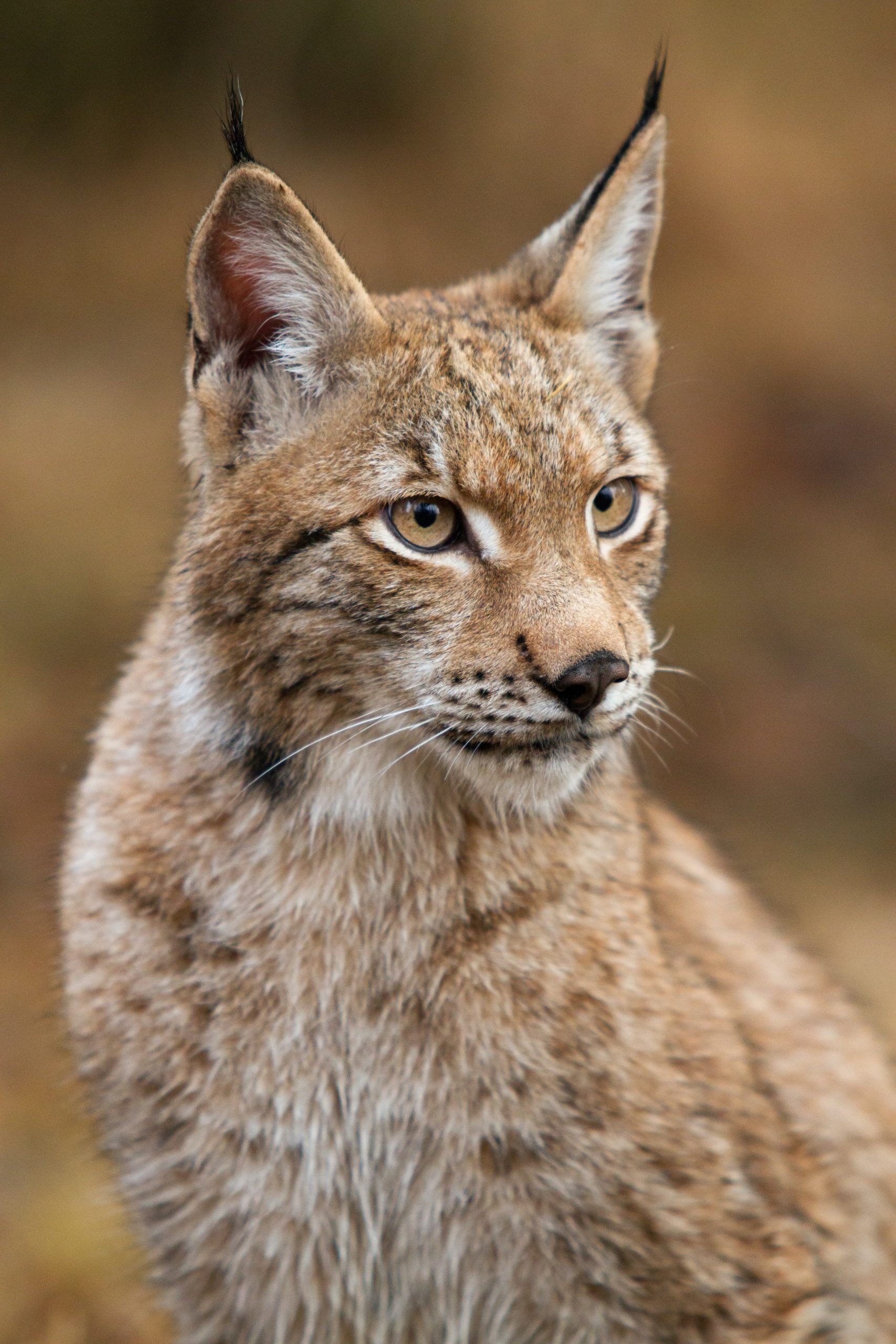
The Affric Highlands project builds upon the work of the Trees for Life project and its founder, Alan Watson Featherstone. It started rewilding the Glen Affric area over 25 years ago, mostly through the reduction of grazing pressure to allow the natural regeneration of the native forest. I visited (too briefly) in 2018 and it is stunning what has been achieved. The new collaboration with Rewilding Europe will see greater connectivity, more native woodland, restoration of bogs and the recovery of endangered species such as Wild Cat and Capercaille. It may even provide a site for the reintroduction of Lynx to Britain (incidentally, all of these species are native to Ireland but now extinct). It will be a fascinating project to watch and I can’t wait to visit again.
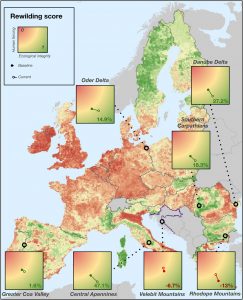
Rewilding Europe projects work at scale and are founded in partnerships with local organisations and landowners. The Affric Highlands project is the fruit of three years of consultations in the area and the approach is based on a long-term commitment. Apart from their beautiful communications material, the early monitoring work suggests that rewilding is working in its primary goal of restoring naturally functioning ecosystems. A study published last month showed that at seven Rewilding Europe sites, measures of ecological integrity were improving and that “overall progress along the rewilding scale” was seen at five of the sites. These improvements have occurred in less than a decade and point to the immense potential of rewilding to achieve long-term ecological aims.
The research comes on the heels of the recent adoption by the IUCN of a motion to establish “with urgency” a working group to develop guidance and principles for successful rewilding. It notes that rewilding is a “cost-effective approach to enhancing biodiversity, connectivity, ecological resilience and ecosystem service delivery” while stressing the need for “careful assessment of the relative risks and rewards to ecosystems and local communities affected by land-use changes”.
The lines show movement towards greater ecological integrity (green) (from Segar et al., 2021)
The Rewilding Europe network is just one initiative and there are many more projects where rewilding is happening in a directed, or more or less accidental way, across the continent and even here in Ireland. Randal Plunkett’s Dunsany project has received widespread media attention both here and abroad. Arguably the rewetting of Bord naMona’s worked out peat mines is rewilding through the restoration of hydrology in order to kickstart natural processes, particularly the prevention of carbon losses (and, maybe, carbon sequestration). But it’s sold as predominantly a climate action project that might have benefits for biodiversity. The nesting of a pair of Cranes on a former peat mine this summer, the first in over 300 years, on a bog that wasn’t even part of the rewetting programme, shows how nature will respond quickly and spectacularly to even passive rewilding. Imagine what would happen if we were to actually get behind rewilding at an official and policy level? Many ecologists in Ireland are currently afraid of even using the word, despite the desperate need for restoration of natural ecosystems and the growing body of evidence to show that rewilding works. How long can this go on?
So, I’m thrilled and excited for the new Affric Highlands project, but I’m frankly also envious and frustrated that we are so behind the curve in Ireland. The rewetting of peat mines, the recent release of more White-tailed Eagles and the Coillte Nature projects to convert plantations to native woodlands in Dublin, Sligo and Galway show that we can do these things, but we really need to be scaling up and we must shed the reticence to talk about the need for natural ecosystems (as opposed to enhancing nature on farmland, even if that is also needed).
So where should we start? Here are three places where I think should be working towards official recognition as Rewilding Ireland sites:
The Shannon Wilderness Park. Much of the work has already been done with local groups and Longford County Council already behind the project. The recent refusal by An Bord Pleanála of a large wind farm provides an opportunity to inject some new life into the original project. Investments are being made in walking and cycling infrastructure and Bord naMóna’s Peatlands Climate Action Scheme. But the biodiversity potential is, so far, a secondary consideration. A proper rewilding project encompassing the entire Shannon wetlands from Lough Allen in the north to Lough Ree in the south, could see all manner of benefits for endangered species, water quality, climate and people.
Wild Nephin. Despite the justified criticism of this project since its inception in 2013, the area still has enormous potential. But it needs a reboot. Local public participation needs to be prioritised, the politicians (including ex-taoiseach Enda Kenny) who were so keen to support the launch need get behind a new vision that lives up to the promises that were made. I think we can also be going a lot further. Blanket bog restoration, Coillte Nature plantation conversions, raptor reintroductions and high nature value farming programmes could stretch from the Céide Fields on the Atlantic coast of Mayo to the 12 Bens in Connemara. It could even be the location for an Irish lynx reintroduction.
Atlantic megafauna. The Programme for Government commits to creating Ireland’s first marine national park. This should be off the south-west coast which has seen a stunning uptick in big whale activity in recent decades. It would be Europe’s first ocean rewilding project while helping to meet targets for Marine Protected Areas and throwing a lifeline to beleaguered fishermen.
Ultimately we need to be thinking a lot bigger, eventually joining up these rewilding projects with others in every county and every parish. Who will be first the get the ball rolling?
The International Union for the Conservation of Nature (IUCN) is a global organisation that has worked for the protection of biodiversity since its founding in 1948. It is probably best known for producing ‘red lists’ of species which are endangered with extinction. Its latest assessment, published last week to coincide with its Congress found that 28% of the 138,000 species it looked at are headed for oblivion. The Congress brings together over 4,000 scientists, government representatives and NGOs from nearly every country and for the first time, the Irish Wildlife Trust was in attendance.
That there was a meeting at all has been a great achievement of the organisers and the host city, Marseille in France, and the first of the big, environmentally-focussed gatherings to be held in the aftermath of Covid-19 (the others being the COP26 climate summit in Glasgow in November, the COP15 for biodiversity in China in October and May, and the United Nation’s Oceans Conference in Portugal some time in 2022). It has been a tremendous challenge to organise and one that has no doubt excluded many from the Global South who have been unable to travel. Many activities were hybrid in nature, including much of the voting for organisational and policy changes. Nevertheless, voting on policy motions which had been thus far undecided was, after some debate, restricted to those in the room.
It is clear that there is still a huge appetite for face-to-face meetings like this as much of the energy and inspiration comes from meeting others in the field, socially as well as well during the various working sessions. But other than that, is there any point to them?
Actor Harrison Ford, who gave a short pep talk during the opening event, captured the sense of exasperation felt by many both inside and outside the Congress halls. “Well here we are… again” he sighed, clearly cheesed off that so little seems to change. The sessions I attended all week echoed that.
Many of the attendees are veterans of these meetings, they’ve been doing the rounds for decades, getting greyer and older as their cries for action go ignored. Sometimes this spilled into anger, particularly on panels with indigenous representatives or young people. Over 330 environmental defenders were killed in 2020, mostly in Latin America where resource grabs are destroying ecosystems and trampling human rights. Like the scientists, these people too feel ignored while their friends are murdered and their land stolen. Youth activists too feel that their future is being stolen. But the fact that they are still turning up tells me these people are not giving up any time soon. The delegates who are here in their thousands are evidently set to man the barricades in defence of truth and justice. Despite the many bland speeches, this must surely give the rest of us resolve to keep up the fight.
And apart from the speeches serious work is done. The IUCN represents the scientific consensus when it comes to protecting the natural world and debates that are thrashed out here are likely to find their way into policies in other global fora, for instance the forthcoming COPs. World leaders look to the IUCN for how to respond to the extinction crisis. In answer to the question: what do we need to do? It is the IUCN that has the answer. These originate in ‘motions’ that are debated and voted upon at the Congress.
This year, many motions were approved in advance (see here for the full list) due to the Pandemic, and only the most contentious were left to the event itself. The most talked about of these was a motion to protect half of the Earth for nature; in the end the agreement was to protected at least 30% of land and sea and “to recognise the evolving science, the majority of which supports that protecting, conserving and restoring at least half or more of the planet is likely necessary to reverse biodiversity loss, address climate change and as a foundation for sustainably managing the whole planet.” Other motions which were approved and which are of direct relevance to us in Ireland included one to provide noise-free Marine Protected Areas (MPA), imposing a moratorium on deep sea mining, protecting marine mammals from the depredations of industrial fishing and urging European countries to ‘strictly protect’ and restore their old native forests. These positions now represent the best science in the field and should (if they haven’t already) find their way into EU and Irish policies. Whether it does or not is a different matter.
At a more global level a last minute motion was approved to protect 80% of the Amazon by 2025 has indirect but consequential impacts on us through trade arrangements. In particular, it’s very hard to see how the Mercosur deal with South American counties, including Brazil, could go ahead.
So, what about Ireland? The Irish government has a poor record of engaging with the IUCN and were not present in Marseille. There seemed to be few other countries who were not present and, when I met one delegate from another EU country, he did agree that it was “pretty embarrassing” that we had no government representative. Once again, the National Parks and Wildlife Service presence is noted by the empty chair, the silence on the airwaves and the astoundingly mute response to the biodiversity crisis to-date. This position is no longer tenable.
The French government brought out the big guns for this meeting and emphasised the need to carry the momentum forward to the COPs in Scotland and China. The IWT plans to be there, let’s hope the Irish government shows up too!
Irish Wildlife Trust calls on the Government to back key biodiversity protection measures at the IUCN Congress
The Irish Wildlife Trust (IWT) is calling upon the Minister of State for Heritage & Electoral Reform, Malcolm Noonan, on behalf of the Irish government, to use his voting power at the IUCN Congress (currently underway in Marseille, France) to support key measures for the protection of biodiversity which are being debated. These include:
· Fully integrating the issues of climate change and biodiversity collapse through a commitment to strictly protect carbon-rich ecosystems (e.g. peatlands, old forests, sea grass beds or ocean sediments) and the restoration of natural ecosystems;
· Defining the term ‘industrial fishing’ and ensuring that industrial fishing is excluded from Marine Protected Areas (MPAs) along with all harmful infrastructure developments;
· Supporting a moratorium on deep seabed mining;
· Supporting a call for effectively protecting half of the earth’s surface based upon the evidence of what is needed for thriving people and nature;
· Reinforcing protections for marine mammals particularly through the use of MPAs and a “drastic reduction” in unwanted by-catch in fisheries;
· Protection of native, old forests in Europe through urgent mapping and restoration
The IWT is disappointed that a representative of the Irish government is not present in Marseille to take part in these discussions in person. IWT Campaign Officer, Pádraic Fogarty, who is in Marseille for the Congress, says: “There’s an enormous sense of urgency at this event among the scientists and NGOs in the face of the collapse of ecosystems and also a sense of frustration that so little is being done. Many of the issues being discussed are directly relevant to Ireland and it’s embarrassing that the government did not see fit to send a representative. The biodiversity crisis must get equal billing to the climate crisis, the message here is crystal clear that we cannot address one without tackling the other.”
The IUCN Congress happens once every four years (this one was delayed due to Covid-19) and it is gathering of governments, NGOs and scientists. The discussions in Marseille provide crucial support to intergovernmental gatherings in the coming months, particularly the COP26 Climate summit in Glasgow in November and the COP15 Biodiversity summit in Kunming in China in October and March of next year.
Hardly a week goes by without articles appearing in the farming press about the dire state of the forestry industry in Ireland. These articles are repetitive (typically reprints of industry press releases) and bemoan the difficultly in getting licences for routine operations. These rarely, if ever, mention that forestry has been a rogue industry in terms of compliance with environmental law (see here for more background).
These stories also tend to defend the status quo, suggesting that some kind of ‘return to normal’ is needed when in reality a total transformation of the sector is required. While environmental NGOs have long-held views on what such a transformation looks like, this summer a new EU Forestry Strategy for 2030 has spelled it out. It comes at an interesting time for Ireland, as Minister Pippa Hackett’s ‘Project Woodland’ lumbers on. Any new Irish strategy will presumably have to be consistent with that of the EU and, even if it isn’t, it has validated what many in the eNGO sector and beyond have been saying for some time, particularly in relation to monoculture plantations and clear-fell harvesting.
out with the old…
So what are the main objectives of the EU Strategy? First and foremost it acknowledges that future forests must be multi-functional and climate resilient. It says that “we will need larger, healthier and more diverse forests than we have today, notably for carbon storage and sequestration, reduction of the effects of air pollution on human health and halting loss of habitats and species” adding that this is “a precondition [my emphasis] for forests to be able to provide livelihoods and deliver on their socio-economic functions for decades to come”. Indeed a recent study on the state of forests in Europe noted that the “condition of European forests is deteriorating” with disturbance impacts from droughts, fires, and pests increasing (despite the forest area also increasing in recent decades).
A key target is “protecting, restoring and enlarging EU’s forests to combat climate change, reverse biodiversity loss and ensure resilient and multifunctional forest ecosystems”. It states that “In light of climate change and biodiversity loss there is an urgent need for adaptive forest restoration and ecosystem-based management approaches that strengthen the resilience of EU forests” adding that “very few forests will either not be strongly affected by climate change, or will not require immediate management action to reduce their vulnerability to climate change”.
There is a strong emphasis on protecting primary and old-growth forests stating that all such forests “will have to be strictly protected” in line with the EU Biodiversity Strategy (which aims to ‘strictly protect’ 10% of EU land area by 2030). It says there is an “an immediate need to map the primary and old-growth forests and establish their protection regime”, something of particular relevance in Ireland where many patches of old native woodland are not identified or covered by conservation legislation (and even when they are they are falling to bits). The EU believes that “Member States should urgently engage in completing the mapping and monitoring of these forests, and ensuring no deterioration until they start to apply the protection regime” and proposes a common definition for primary and old growth forests by the end of 2021.
Ireland is an outlier by European standards not only by the low level of overall tree-cover, but by the dominance here of non-native, single-species stands. We should use this exercise in identifying existing old, native woodlands as a basis for expanding and joining them up so that we are restoring the national forest ecosystem. This is a separate task to addressing issues in commercial forestry (though it can be complementary) and new land use planning should identify areas for ecosystem recovery with little or no commercial extraction.
But what about rebuilding the commercial forestry sector? While the industry paints a sob story in its effort to ‘return to normal’, it’s not so downbeat in its communications with investors. One brochure proclaims that it is a sector that is “growing fast” and that “the supply of wood from Irish forests will double by 2035” as trees planted in the 1980s come to felling age. As these crops are removed the question then becomes, what should replace them?
The EU Strategy says that “all forests should be increasingly managed so that they are sufficiently biodiverse” adding that:
There are significant opportunities for win-win measures, which simultaneously improve forest productivity, timber production, biodiversity, carbon sink function, healthy soil properties and climate resilience. A greater diversity of forest ecosystems and species, and the use of well adapted genetic resources and ecosystem-based approaches to forest management can enhance long‐ term adaptability and forests’ capacity to recover and self-organise.
In addition, certain management practices that support biodiversity and resilience, are essential in this context, such as the creation or maintenance at stand and landscape level of genetically and functionally diverse, mixed‐ species forests, especially with more broadleaves and deciduous trees and with species with different biotic and abiotic sensitivities and recovery mechanisms following disturbances, instead of monocultural plantations. Also, management practices like uneven-aged and continuous-cover forestry, sufficient quantities of deadwood, regulation of wildlife densities and the establishment of protected habitat patches or set aside areas in production forests help ensure long-term environmental and socio-economic viability of forests.
The strategy is unequivocal that clear-felling “should be used only in duly justified cases” and that “carrying out logging during bird-nesting period must comply with the Birds Directive”. The document also promised a crackdown on non-compliance by EU Member States that are disregarding environmental laws.
…in with the old
Forestry in Ireland has an acute problem with licencing because it has been operating outside these laws. That is being addressed by Minister Hackett and her team in the Department of Agriculture, Food and the Marine. The medium term (up to 2035) however will see healthy returns for the industry judging by their own projections. Now is therefore the perfect time to radically transform new planting and the long-term future of Ireland’s forests. Tree nurseries will adapt quickly no doubt, even if natural regeneration plays a dominant role in forest expansion. Sawmills will need to retire assets that are designed for only a narrow range of products but they have 15 years in which to do so. A new commercial forestry model must be based upon diversity, protecting soil, water and biodiversity and leaving behind the blocks of monocultures and clear-felling that have caused so much harm. This has been said by many for years but the newly minted EU Forestry Policy paints it in big letters.
Last week I spent some time walking in Norway. Outdoor activity in the country is a national obsession and starts at an early age with their utebarnehage (outdoor kindergardens). Here, children spend much of their week in the forest regardless of the weather. Babies in cots are brought inside for their naps only if the temperature dips below -10˚C. Den Norske Turistforening (DNT) is an organisation founded in 1868 and works for a ‘genuine, active, inclusive, and nature-friendly friluftsliv (literally ‘fresh air life’). It maintains around 20,000km of off-road, marked trails (for both walking and skiing) across the whole country and has over 300,000 members out of a population of c.4 million. The network includes 1,200 hytter; or cabins, which range from full-service accommodation with meals, to very basic shelters with only a woodstove fire.
Norwegians enjoy the allemannsretten, or right-to-roam, so that walking and camping are permitted anywhere on uncultivated (more or less unenclosed) land. This right comes with respect for landowners, others, plants and animals and is something that is continuously emphasised. I walked for about 100km in the Sør Trøndelag region (between Trondheim and the border with Sweden) camping by lakes and forests near the cabins along the way. I crossed one public road in that time, while much of the hiking was through native forests, bog and mountainous terrain above the treeline.
According to Environment Norway about 11.5% of the country is ‘wilderness-like’, a figure that has seen a “dramatic reduction” during the 20th Century. At the turn of the 19th Century, it is estimated that half of Norway was at least 5km from a road or major infrastructure. Still, along my route I encountered little evidence of human intrusion: no commercial forestry, a handful of farms and no ‘one off’ houses, though there are private hytter tucked into the forest and some major hydroelectrical installations which can be seen in the landscape as large reservoirs and power cables.
Farm animals were few. I did have to shoo off a small flock of sheep one night who were showing too much interest in my tent, while reindeer are a common sight across the open uplands. Although these animals seem to have minimal impact on the vegetation, they affect the ecology in indirect ways. Large predators are not permitted and despite the vast expanses of suitable habitat the area I walked through has no resident bears, wolves, lynx or wolverine. Wolves are critically endangered in Norway and according to WWF there are only between 109-114, roughly a quarter of which are shot annually. The Norwegian government has established a ‘wolf zone’ in the south-east, where wolves are allowed to exist, covering 5% of the country’s area. If a wolf strays outside this zone, permission to shoot it is quickly granted according to WWF. Despite the licenced shooting, illegal killing is also an issue. WWF says that half the wolf mortality in Scandinavia is from illegal activity. Even with all the shooting, the issue of wolves is toxically polarising in Norway and this shows no sign of abating. The situation is little better for the other predators, which are all threatened with extinction and which are confined to isolated corners of the country.
Nevertheless, the uplands were alive with birdlife on my trek (at least that was my impression when compared to walking in uplands in Ireland!) with golden eagle, golden plover, redshank, sandpipers, pipets and other species I didn’t recognise. Without large flocks of free-roaming sheep (or many deer for that matter) the vegetation is well developed. In fact, the upland forests are among the most beautiful I know, with twisty birches interspersed with juniper bushes, rowan, heather and other flora. Lower down in the valleys there are stands of Norwegian Spruce and my route took me through some old-growth forest (ancient woodland) in the Skarvan and Roltdalen National Park.
Interestingly, the extent of this old forest in Norway is little better than in Ireland, at about 2% (to qualify for ‘old-growth’ or ‘ancient’ it should have been continuously wooded since at least 1600). Like nearly everywhere in Europe, the original forests were felled for timber. Today, Norway is 38% forested, a phenomenal turn-around in the space of a century. According to figures from the UN 83% of this ‘new’ forest has naturally regenerated while the remainder has been planted. The story of Norway’s re-forestation is oft-told in rewilding circles in Ireland and Britain as a way of demonstrating that our own treeless hills need not stay that way. It is also a repost to those who insist that trees don’t grow in these places because it is too wet/windy/rocky/exposed etc.
Much of Norway’s forest is commercially exploited and on my travels I have seen areas of clear-felling and plots of monoculture (though the much-maligned Sitka Spruce is not permitted). Areas of forest that are just for nature are confined to those areas where it is not commercially profitable to exploit them. Forests are home to 60% of the recorded species in Norway and extensive ‘red lists’ are made of everything including fungi and lichens. This is much more expansive than the red lists we have in Ireland. 30% of Norway’s habitat types are threatened while 2,355 species are assessed as threatened with extinction. This is a reflection of human intrusion into previously ‘wilderness-like’ areas, the relatively young age of its forests (very old forests are more structurally and species diverse) as well as climate change.
Norway also has plenty of bog and I saw a lot of this on my walk. It’s also possible to see where trees are growing, and not growing, on bogs. Scots pine, in particular, is a common sight on bogs, presumably where the peat is shallower. It creates a very mixed landscape, with patches of woodland, open wetlands and hillsides and scattered trees. Flowers like harebell and yellow-rattle, synonymous in Ireland with pastures grazed by animals, grow in open woodland rides and the edges of bogs. It makes me think that we (ecologists) need to be more open-minded about where we think certain species will thrive.
Norway shows us some of the immense opportunities, as well as some of the challenges, that Ireland faces if we are to address the climate and biodiversity crisis. Re-establishing woodland cover to about 30-40% by 2120 is possible but only if we prioritise natural regeneration, i.e. if we can give nature some time and space. On bogs, we should be restoring hydrology but otherwise we should not be too hung up on the appearance of native trees. We could also aspire to the wonderful connection Norwegians enjoy with nature, not only the ease of access to the countryside but also the quality of the nature in these places. But Norway still struggles with predators while the tension between commercial exploitation and allowing natural processes to dominate is very much a live issue. In that regard, Norway is no further on than any European country, but for all that, I’m already planning my next long distance hike here!
I first left the country in 1986, at the age of 12. It was a much-anticipated family sun holiday to Mallorca. Until then every holiday had been to the caravan in Wexford. This was perfectly normal at the time, leaving the country was expensive. But my generation was quick to catch up. I longed to see the world and during these wanderless early years, I stuck pins on a map of the world on my bedroom wall of all the places I wanted to visit. There were a lot of pins.
The 1990s heralded an unprecedented explosion of air travel. No previous generation in the history of humanity has had such access to the world, something made possible only with cheap air travel. J1 visas to the US, gap years in Australia and round-the-world back-packing trips were all standard fare by end of the 20th century. I managed to take quite a few pins off the map as the years ticked by. And, until recently, I never gave a thought to the carbon dioxide this was pumping into the air.
While aviation contributes a relatively small portion of global greenhouse gases (1.9% according to www.theworldindata.org) for those who fly, it occupies a whopping portion of their personal carbon footprint. While the precise emissions depend upon the type of plane, where you sit on the plane (first class vs economy) and the distance you travel, the average is somewhere around 80g of CO2 per km. A return Dublin to New York flight in an economy seat is estimated to release around 1.6 tonnes of CO2, that works out at about 10% of the total annual emissions for an average Irish person. Maybe that doesn’t seem so much but Ireland’s per capita emissions were the third highest in the EU in 2017. To boot, emissions from international flights are not counted under the Paris Agreement.
Meanwhile it is estimated that 80% of the world’s population has never set foot on an airplane! Essentially, flying, particularly the unnecessary sort (think stag weekends in Prague) is eating into the ever-shrinking global carbon budget if we are to stay within 1.5 degrees of warming. And it is the wealthy that are doing all of the eating. The more we fly, the less available emissions there are for others to adapt to a rapidly warming climate.
I have been part of this problem and in the years before the pandemic I had paid to ‘offset’ my emissions from flying. But I did this with an uneasy feeling that I was merely buying indulgences and, as time has passed, the offsetting of emissions has lost credibility (even petrol stations in Ireland these days are claiming to be ‘carbon neutral’).
Like most people, I have not left Ireland since the start of the pandemic, but with in-laws in Scandinavia, it wasn’t going to be long before an overdue trip to relatives came on the cards. A return flight from Dublin to Stockholm in the middle of August will cost about €350 and flying time is about two and a half hours. Airlines don’t pay tax on their fuel so the tickets are artificially cheap. Booking is easy, most airlines now have apps so that you can book, pay and check in from your phone.
Taking a train meanwhile, is an altogether different proposition. There are no longer ferries linking England with Scandinavia, which would be the most direct route, so you must go through mainland Europe. There is nowhere to buy a single sail-rail ticket between the two cities and the best estimate is three days of travel. With no overnight trains the cost must also factor in hotel stays along the way. So who in their right mind would take the overland route instead of flying?
I have travelled across Europe by train before, so I know that it’s possible. You can get to Japan by train and boat from Ireland quite easily if you have the inclination and weeks and weeks to spare. India and South-East Asia are more challenging but possible. Africa is doable for the really intrepid but America is virtually off the cards (unless you’re Greta Thunberg or sail on the Queen Mary II).
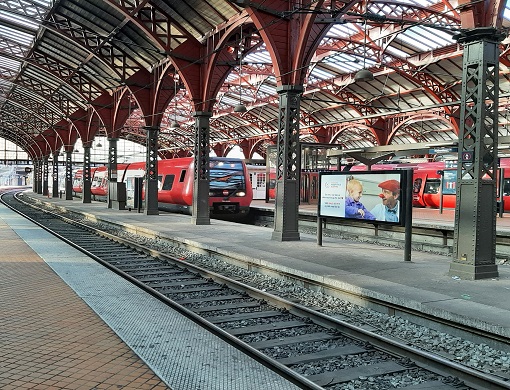
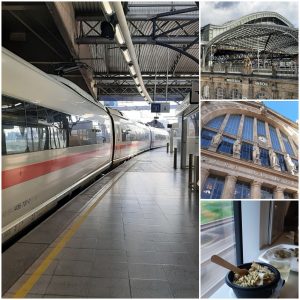
I feel confident enough to navigate the various cities and train stations and am determined enough to overcome the logistical challenges. So, I left Dublin on Tuesday evening bound for Holyhead. The next morning, I set off for London (via Chester and Crewe), taking the Eurostar to Paris and then Brussels (normally there would be a direct connection to Brussels but the schedule seems to be curtailed by Covid). An early start the next morning took me to Cologne, then onwards to Hamburg (a cancelled train due to the recent storms in Germany didn’t inconvenience too much due to the frequency of intercity trains in that part of the world). An S-bahn across Hamburg took me to Altona station where I picked up the mainline to Copenhagen, getting off near Odense for a bus connection due to line repairs, arriving in that city late on Thursday. An early start again on Friday for the short hop between Copenhagen and Malmö was 20 minutes delayed, necessitating a breathless dash for the onward connection to Stockholm. I arrived at my destination, the picturesque island of Dalarö in the Stockholm archipelago, on Friday afternoon.
So, nearly bang on, a three-day trip: one boat, 13 trains, one bus and five countries. The overland distance is nearly 3,000km, nearly twice that of flying. www.carbonfootprint.com calculates that a one-way flight would have emitted 0.23 metric tonnes of CO2 while taking the train emitted 0.01 tonne – a massive difference. I’m hoping these figures are correct as it proves that surface travel will significantly lower your carbon footprint (and that I’m not completely wasting my time).
To overcome the ticketing problem, I bought an interrail pass which allows me seven days travel in one month and cost €340. This does not cover the total price as many trains, particularly the fast ones, command a supplement. So, adding the cost of a hotel room in Holyhead, Brussels and Copenhagen, the whole trip (including getting home) is over twice the price of an airfare. The interrail ‘rail planner’ app allows you to plan connections fairly easily as well as making reservations where these are required (and they mostly are).
Despite some minor hiccups everything ran on time and with half-decent wi-fi and power points it was possible to work throughout (take note IWT bosses!). Trains are clean and comfortable and you get to watch the landscapes roll by (although admittedly across northern Europe these do not change very much). Food, where is it served, is mostly terrible. The number of connections, and navigating unfamiliar stations along with the sometimes tight switchover times, is not for the faint-hearted and the whole trip would be a nightmare with small children.
Still, I arrived on time and unfrazzeled. The European train network is world class, rivalled only by Japan’s. But it is not set up for the kind of cross-continental journey I am doing. There are simply too many trains and booking is too hard. But I will be doing it again! I can hope that a resumed ferry from the UK to Norway or Denmark would make things faster and simpler. Or perhaps an overnight train from Brussels to Copenhagen would take a chunk off the journey time. There’s lots that could be done to encourage more of this type of travel. Until then it will be another dozen trains and a boat to get me home!
The sea has given us everything. The earliest people lived by, and off, the sea, as have generations that followed. The sea brought us our history, from the Viking and Norman invasions to the Martello towers that were built as look-outs for a Napoleonic invasion. The sea took our hopeful and destitute during times of famine and today we look to the sea for a redemption of sorts, as the source of greenhouse gas-free energy that will help ward off climate collapse. In a way that has only relatively recently been appreciated by science, we know that every other breath we take comes from oxygen generated by marine plants while the sea has absorbed much of the heat and the carbon dioxide generated by human industrial activity. During the pandemic more of us have turned to the sea for calm and solace. But let’s face it, it has been all take.
The sea is in a dire state and is, quite literally, rising against us. It’s time to start giving something back and, like much of nature, what it craves most is time and space.
On July 30th the period of public consultation on the creation of Marine Protected Areas (MPAs) for Ireland will close. The Irish Wildlife Trust has been campaigning for the creation of MPAs for over a decade. When it signed up to the EU’s Marine Strategy Framework Directive in 2008 the government agreed to establish a ‘coherent network of MPAs’ by 2020. At a conference held by the Sustainable Water Network (SWAN – an alliance of environmental groups) in 2017, then-minister for the Marine, Simon Coveney, promised us we’d have legislation for this purpose by the end of that year.
Needless to say, Coveney didn’t make good on his word, while the new government’s programme commits to achieving 30% coverage by 2030. We have to-date designated a shade over 2% of our waters in Special Areas of Conservation (for habitats and species which are not birds) and Special Protection Areas (for birds) but these MPAs are not managed so they are not useful in protecting biodiversity.
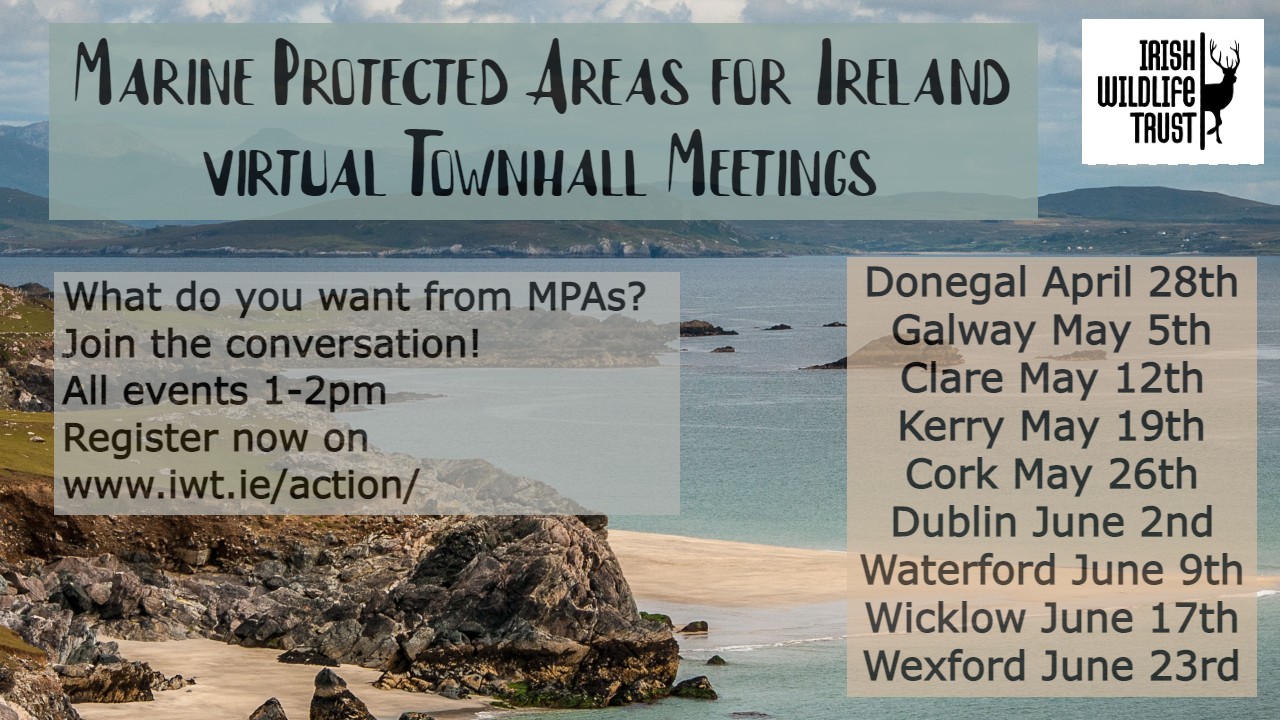
My colleague, Regina Classen, and I have spent the last months trying to raise the profile of this consultation period through social media videos and webinars. We held a series of virtual townhall meetings in coastal counties from Donegal to Dublin. We heard from local politicians, scientists, community groups and interested citizens and I was impressed with the breath and depth of interest in the sea. In June we heard from National Geographic’s Enric Sala, who gave us a global perspective on the need to protect the ocean while last week we heard from activists in Ireland and Britain on themes ranging from ‘blue carbon’ (how coastal ecosystems store carbon) to the experiences in Lyme Bay in England, where local fishers have been working with the Blue Marine Foundation to protect biodiversity and enhance their livelihoods.
Our friends in the Irish branch of Extinction Rebellion held a colourful protest in Dublin calling for MPAs, which we attended, while they have also been raising ‘poo flags’ on beaches where human wastewater is being pumped to the sea with little or no treatment.
There are a number of things I took away from the many conversations I have had since April. Firstly, there is a strong – and growing – interest among Irish people in the sea. I’d even go so far as to say there is love for the sea. Perhaps this has been underappreciated in the past but as people realise the pressures it is under the love is turning to concern and even anger. In our Donegal and Kerry events we heard from locals how aquaculture developments are threatening their local coasts. They might have assumed that because many of these areas fall within existing MPAs that they would be somehow protected. There has been shock to discover that this is not the case and that the state tends to be on the side of the developers in privatising the public spaces that they love.
Which brings me to my second point. There’s a lot we could be doing right away in protecting the sea. Even though only about 2.1% of our seas are within existing MPAs, these are home to vitally important species and habitats. We would like to see EU funding through the LIFE programme (the same fund that developed the highly-successful Burren farming for nature project and which brought the Iberian Lynx back from the brink of extinction) for our marine MPAs. This would start the vitally important work of engaging with local interests and setting up structures for the management and monitoring of these areas. A dedicated LIFE project for the marine would give us a head start when new legislation for MPAs is eventually passed.
I was impressed with the contribution of marine scientists to our events and there is already an impressive body of knowledge ranging from fisheries and social science, to seabed mapping and carbon sequestration. But there is much we don’t know. Our internationally important seabird populations are poorly monitored while marine fish and invertebrates (with the exception of sharks and their cousins) have not even been assessed for their conservation status. We have not mapped our carbon rich habitats from seagrass beds to kelp forests while the carbon being released from muddy sediments on prawn trawling grounds is not quantified. Greater investment in science will be essential in protecting the sea and in planning developments in the marine environment, particularly when it comes to off-shore energy installations.
Protection must mean protection. While Ireland has lagged behind the designation of MPAs there are precious few examples in European waters where MPAs are actually delivering. The science is clear that the most effective way of protecting an MPA is to stop all kind of extractive activities. Basically, just leaving the sea alone will result in a restoration of marine life in most cases. This is complicated where there are many small-scale fishers who may not have alternative fishing grounds, or it may push fishing effort into areas outside these ‘no take zones’, leading to conflict and ecological degradation in these areas.
We want these fishers to feel like they are included, not excluded, from the process. But at a minimum we have to demand that MPAs exclude industrial fishing. This means no big boats in MPAs and no dredging or trawling. An MPA that allows industrial fishing is simply a waste of everybody’s time and will deliver nothing for anyone.
Finally, there is the urgency. To-date the government has shown no sense of urgency in dealing with any of the pressures affecting our seas, not only MPAs but in ending overfishing or reducing pollution. The bigger picture is that we have a very limited time window to address the climate and biodiversity crisis – less than a decade say scientists. If we don’t act in that time we risk triggering irreversible tipping points and/or increasing warming effects that will be truly catastrophic for life on earth. Yes, we have to do things carefully, but we also have to do things. We have to start showing our love for the sea and to give something back.
And until the end of July you have the chance to give something. We need you to take 10 minutes to send an email to marine.env@housing.gov.ie telling them why we need MPAs. It doesn’t need to be long or technical and personalised messages will carry more weight. But if you want inspiration please visit our website where we have a template email and some suggested points you might want to make. But above all, please do it.
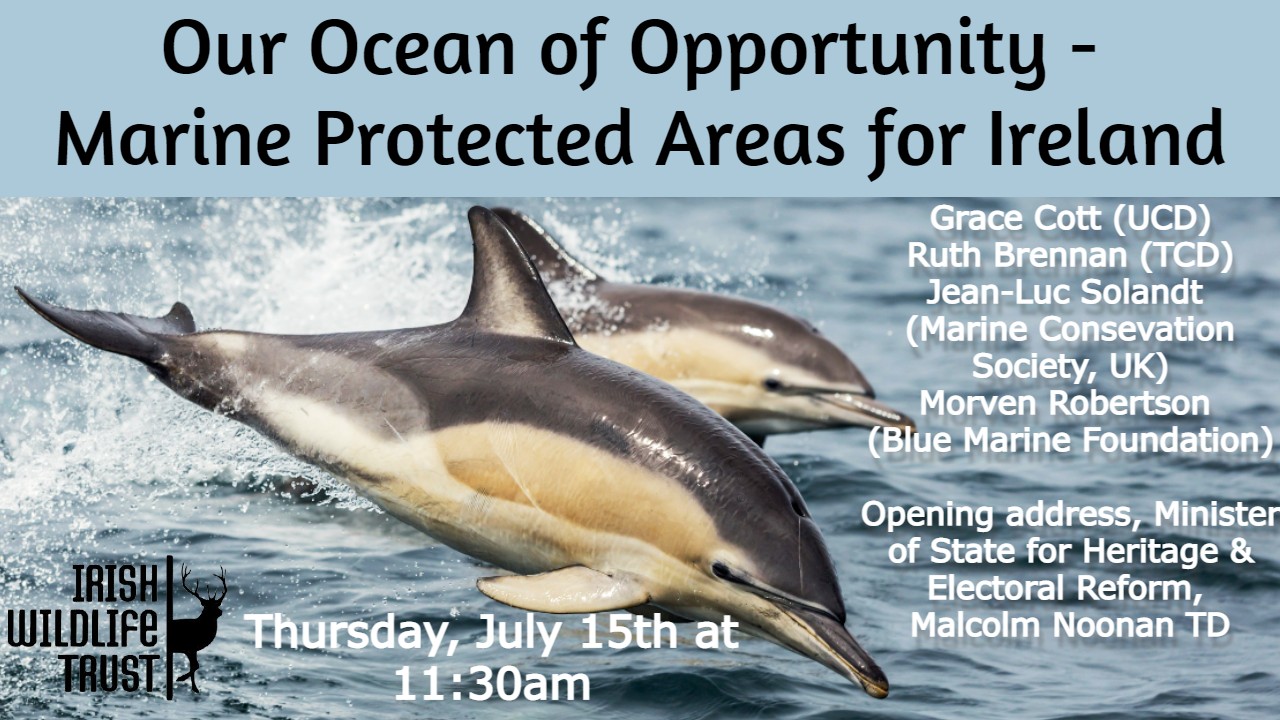
This is a free webinar on the Zoom platform. All are welcome.
[divider style=’full’]
Programme
11.30 Opening address by Minister of State for Heritage and Electoral Reform Malcolm Noonan TD
11.40 Panel discussion chaired by Pádraic Fogarty (Irish Wildlife Trust) with
Grace Cott, Assistant Professor at University College Dublin. Grace is a coastal wetland ecologist with a special focus on coastal blue carbon.
Ruth Brennan, Trinity College Dublin, PI of CO-SUSTAIN Collaborative Sustainable Innovation: co-designing governance approaches for a sustainable and innovative small-scale fishing industry in the Irish islands.
Jean-Luc Solandt, Principle Specialist in Marine Protected Areas, Marine Conservation Society UK. Jean-Luc provides technical and policy advice on all matters to do with UK and overseas Marine Protected Areas.
Morven Robertson, Senior Projects Manager, Blue Marine Foundation. Morven manages some of BLUE’s UK projects including the Solent Oyster Restoration Project.
12.45 Close
For more information on Marine Protected Areas in Ireland CLICK HERE
For information on how to participate in the public consultation on Expanding Ireland’s Marine Protected Area Network, CLICK HERE
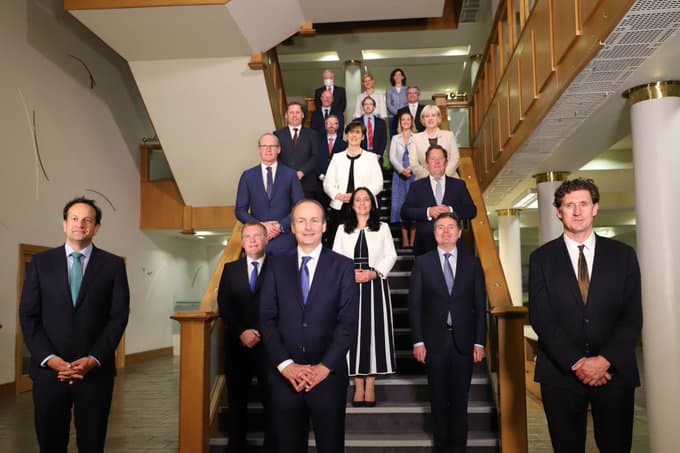
The government recently celebrated a year in office. The IWT supported the Programme for Government (PfG) on the basis that – if implemented – it would set us on a course to addressing the biodiversity emergency. Green Party leader and minister for Transport Eamon Ryan, has said that it is the greenest PfG in Europe and few could suggest that it isn’t the most nature-friendly PfG we’ve ever seen (granted, it’s a low bar). How has the year gone? Are we, as we hoped, on our way to addressing the biodiversity emergency? Before giving my assessment, it’s important that a couple of caveats are laid down.
Firstly, the IWT supported the PfG, that is, the document that was presented in black and white. We are an apolitical organisation and so it was not a decision to support any political party, though clearly having backed the PfG we supported Green Party members in approving it (there was very little debate within Fine Gael or Fianna Fáil around this in comparison). As such, this analysis looks at the government’s implementation of the PfG and it is not a critique of the Green Party or their role within the government. The Green Party obviously pushed for many of the policies that we supported but it cannot be their responsibility entirely to get everything over the line.
Secondly, the government inherited a mess in terms of environmental action. While the previous administration slow pedalled implementation of climate commitments, it actively undermined efforts to address biodiversity issues (e.g. the Heritage Bill or defunding the National Parks and Wildlife Service, NPWS). Building new structures and institutions takes time and the foundations are only now being put in place.
Also, there many facets to environmental action, not least promoting active travel, decarbonising energy networks, the circular economy, retrofitting buildings etc. These are important, but I don’t intend to go into these areas so my focus here is on what the PfG has delivered so far for nature.
The Climate Bill, expected to be passed by the Dáil very shortly, is no doubt the most significant achievement for the government and it has benefited from cross-party support as well as enhancement by parliamentarians of all stripes at what is termed ‘pre-legislative scrutiny’. This process has proved to be invaluable and has greatly improved the bill from its first draft. From a biodiversity point of view, there are provisions to fund nature-based solutions while setting carbon budgets which will apply to agriculture, pollution from which urgently needs to be addressed (more on this later). Although not directly related to biodiversity, the new Act will set us up to finally face up to our climate obligations and will have knock-on impacts for land use more broadly.
Here are the principle nature-related promises in order of appearance in the PfG:
“Progress the establishment of a Citizens’ Assembly on Biodiversity”
There has been no progress on this head. Climate Case Ireland recently wrote an open letter to the government calling for the Citizens’ Assembly to be prioritised and for the Constitution to be amended to include the right to a healthy environment.
“Review the remit, status and funding of the NPWS”
Earlier this year the Department of Housing, Local Government and Heritage, under Minister Malcolm Noonan, carried out this review which included a period of public consultation. I hear there were around 3,500 submissions which is a very healthy number for an exercise like this. The review has been completed as far as I know, and it was due to be published in June. This hasn’t happened for reasons which are unclear. Reforming the dysfunctional NPWS is probably the most important thing that needs to be done to address the biodiversity crisis (imagine dealing with Covid-19 without NPHET). If we don’t get this right, we’ll be on the back foot for another decade.
“Seek reforms to the CAP [Common Agricultural Policy] to reward farmers for sequestering carbon, restoring biodiversity, improving water and air quality, producing clean energy, and developing schemes that support results-based outcomes.”
The CAP negotiations concluded only in the last week. Minister for Agriculture, Charlie McConalogue, was particularly unimpressive in his public statements in the run up the final deal, not once (that I heard of) acknowledging the climate and biodiversity crisis. Repeated use of the phrase ‘maximum flexibility’ can be read as keeping as much of the money for doing as little as possible and so that is a concern in the run-up to Ireland developmening its own CAP plan. BirdLife, a Brussels-based eNGO, described the new CAP as a “giant step towards killing nature” so the omens are not good.
There has been some progress towards a new results-based programme for Irish farmers to replace the Green Low-carbon Agri-environment Scheme (GLAS) with the Results Based Environment Agri Pilot Programme (REAP). The scheme was over-subscribed which shows that farmers are keen to do their part. A separate results-based initiate was launched for farmers with peat soils and that is positive. A new soil survey has been launched which is very welcome but a proposed national hedgerow surveys and a “baseline biodiversity survey of every farm” have not progressed.
Farming is obviously the hot potato when it comes to land use in Ireland and there is huge resistance to change. Having said that, what ‘change’ means for farmers has not been explained so the fear is understandable. The government needs to do a better job of mapping out what the future holds for farmers.
Changes to eligibility rules (which encourage the removal of wildlife habitat on farms) are also referred to in the PfG and my sense is that we will see this change once Ireland finalises its CAP plan. How far this will go we don’t know but one suggestion is that it will apply to only 30% of a farm area. It needs to be a lot higher and, in some circumstances, 100%, although likely this would mean moving out of CAP and into another scheme such as forestry or peatland restoration.
The new agri-food policy to 2030 has yet to be signed off by the government but it is evidently not compatible with meeting climate and biodiversity targets. It envisages yet more growth in output when we need to be doing the opposite.
So, so far, the government seems to be set on pulling in opposing directions when it comes to farming. The row over An Taisce and the cheese factory in Kilkenny shows clearly that Fianna Fáil and Fine Gael have no interest or ideas when it comes to how farming is to adapt to the coming changes.
“The government will undertake a national land use review”
Where should we rewild, where should we promote forestry, high nature value farming or peatland restoration? Up to now these goals have been in competition with one another and increasingly the need for land use planning is seen as a way to resolve these potential conflicts. A new mapping exercise from the Environmental Protection Agency and the Ordnance Survey Ireland will provide a level of detail that we have never before seen, something that will be invaluable. However, although Eamon Ryan has referred to this goal on a number of occasions, there has been no obvious progress on a plan itself. We don’t know what it will look like, how it will work or how it might influence policy.
“Publish a successor forestry programme to deliver an ambitious afforestation plan”
The forestry sector is in an acute crisis largely because it has not been in compliance with environmental law. There are no short-cuts to addressing the immediate issues of licencing and it may take another few years to sort this out fully. Minister Pippa Hackett has established ‘Project Woodland’ (IWT has a seat on this) and it has brought the various parties together. There has been a lot of taking but the outcome is far from clear. There have been no obvious changes to the cycle of monoculture planting and clear-felling for those operations that can get through the licencing system and communities will live with these decisions for another four or five decades. A successor forestry programme is probably a year off and it remains unclear how radical a change a new regime will bring. Nevertheless, my sense is that a radically transformed forestry sector is on the cards.
The PfG says that state forestry company Coillte’s remit should “support the delivery of climate change commitments and the protection of biodiversity”. There is so far no indication that this is being addressed. Coillte Nature is being expanded to include legacy plantations in the west of Ireland, which is great, but if the potential scale of this is to be achieved the government needs to step in.
“Extend the badger vaccination programme nationwide and end badger culling as soon as possible”
Badger vaccination is being rolled out, albeit slowly, and the numbers of badgers being killed is coming down but remains around 5,000 per annum. I represent the IWT on the TB Forum and there’s no indication that pressure is coming from the government to accelerate this to the point where culling will end any time soon.
“We are fully committed to the environmental objectives of the Common Fisheries Policy”
Somebody please tell Charlie McConalogue. The fishing industry is in a tailspin due to Brexit and allegations of illegal fishing resulting in changes to rules on how fish can be landed. There’s a lot of money swishing around and talk of using this to tie up boats. However, there is no talk that this should be done to help end overfishing and stop dumping unwanted marine life, as stipulated in the CFP. If anything the level of overfishing is getting worse and there is no indication that the government is planning anything but business as usual.
“We will realise our outstanding target of 10% under the Marine Strategy Framework Directive as soon as is practical and aim for 30% of marine protected areas [MPAs] by 2030.”
There has been a lot of talk about MPAs in recent weeks, but so far that’s all it has been. While a new planning framework for development in the maritime area has been rushed though, there is no such urgency in protecting our precious marine biodiversity. An expert report on MPAs (initiated under the last government) was not published until early this year, and an exceptionally long (five months!) public consultation will conclude only at the end of July. Who knows when we’ll see the outcome of this consultation while new legislation to define an MPA in law is at best a year away. Existing MPAs remain woefully mismanaged while we don’t even have criteria for deciding where MPAs should go. In the marine area in general, there has been no meaningful action from the government since its formation.
Like I say, a year is not a long time to deal with the issues left by the previous government. It is also fair to say that a lot has changed in the past 12 months and we have to hope that this momentum will be maintained. Based on the work that has been done it is not unreasonable to believe that by the summer of 2022 we will have a new nature conservation agency, a Climate Act with legally binding emissions reductions targets for agriculture, a CAP plan that rewards nature-friendly farming and rewildling, and an ambitious forestry programme that is close to nature. All this still requires a leap of faith. Meanwhile, the lack of urgency in protecting the marine environment is a big worry; at this rate it could be years before we see any meaningful action. And that’s the thing. We don’t have forever. This week Greta Thunberg eviscerated political leaders for acting on the climate and ecological crises – not real action of course; performance action. I’m looking forward to the real action phase of this government programme.
Science denial has a long and inglorious history. In 1615 Galileo Galilei was condemned to house arrest for defending Copernicus’ theory that the earth travelled around the sun and not vice versa. In the 1960s, Rachel Carson, an aquatic biologist working for the US Bureau of Fisheries, came under ferocious attack from the chemical industry following the publication of ‘Silent Spring’ in 1962 and her evidence of the harm of chemical sprays.
Denial of the realities of climate change followed in this vein with a range of tactics employed by the fossil fuel industry and other interest groups, employing the full spectrum of obfuscation from outright conspiracy theories (it was invented by the Chinese) to doubt, delay and distraction. Anything to avoid confronting reality head on and taking action.
Few of these voices now employ outright denial, knowing that even the media have more-or-less stopped using false balance to present the ‘alternative facts’ but the other tactics are alive and well among what US author and scientist Michael Mann refers to as the ‘climate inactivists’. But what we haven’t seen much of, until recently, is denial of the extinction crisis. But this is likely to change as biodiversity receives more attention. In fact, it is already emerging in Ireland and seems to be following an identical trajectory to previous efforts to deny the science.
Addressing biodiversity loss at first may not seem to be a direct threat to big business interests, being diffuse and multi-faceted, unlike climate action which directly threatens oil companies and animal agriculture. Until recently, extinction and ecosystem collapse had been largely ignored in the media (not that it gets that much notice now, but still… it’s better than it was) and so is less understood. One farmer I spoke to recently said that the sector was suffering what he described as ‘whiplash’ with what seemed to him like the sudden focus on biodiversity.
Extinction denial went largely unnoticed until May 2019 when the UN’s Intergovernmental Science-Policy Platform for Biodiversity and Ecosystem Services (IPBES) hit the headlines warning that up to a million species could be at risk of extinction. Right wing news outlets (what else) in the UK and the US at the time sought to undermine the findings and had a go at the authors. In 2020, a paper in the scientific journal Nature Ecology and Evolution warned that extinction denial was on the rise and urged scientists to confront the phenomenon with the “cold hard scientific facts”.
This week, IPBES teamed up with the Intergovernmental Panel on Climate Change (IPCC) to emphasise that “biodiversity loss and climate change are both driven by human economic activities and mutually reinforce each other. Neither will be successfully resolved unless both are tackled together”. Restoring biodiversity directly threatens a number of sectoral interests – notably in agriculture and fishing but also forestry and peat mining. And so, as the challenge falls into sharper focus we can expect to see more extinction denial in Ireland.
It’s always going to be hard to get people to accept we have a problem in a particular area when doing so implicitly requires a response that challenges the status quo. But I had not encountered outright denial that we have a biodiversity problem until last summer and an article in the Irish Independent farming supplement by dairy farmer Peter Hynes. In it he said that “biodiversity seems to be the buzz word in agriculture for 2020” and found himself “looking at the farm over the last few months questioning myself whether we lack biodiversity or not”. He looked around and saw mature trees, hedgerows and stone walls buzzing with insects. He has fenced off his stream to protect it from cattle and enjoys watching kestrels which sometimes fly over his farm. “In closing” he concluded, “I would ask does the picture painted of our farm depict a biodiversity crisis? I don’t think so”. No need to read any of the scientific literature or reports on the issue, no need to talk to an ecologist – just look around, and if what you see pleases you, then then all those facts and data simply fall away.
Later that year Conor Skehan (a planning lecturer who has demonstrated a reluctance to acknowledge climate science) wrote for the Sunday Independent warning of the dangers of the EU’s Biodiversity Strategy, bemoaning that “many of [its] targets are based on abstract idealism that is blinkered to the realities of economics or agriculture”. He questioned the point of taking action on biodiversity noting that “calls for greater protection of nature overlook the fact that, despite continued population growth, the world has already achieved the idealistic Aichi Biodiversity Targets that were set back in 2010”. In fact, not a single once of these targets had been met.
Two swallows does not a summer make. But then there is the continued denial from other quarters, such as the fishing industry, which routinely challenges the veracity of the science. In September last year, in an article about a mooted cull of seals, head of the Irish South and West Fish Producers Organisation, Patrick Murphy, challenged the Irish Wildlife Trust view (supported by science) that our seas are overfished. “If they [IWT] are saying that the fish stocks are decimated? [sic] How is it that the seal population is growing, what are they eating? It doesn’t add up”.
Then, on Tuesday just past, the Irish Independent farming supplement ran a story by agricultural consultant Mike Brady that went all out. He wanted to address a number of ‘misconceptions’, including that global heating was not a greenhouse gas problem but that human population growth was the issue, and that that methane (a greenhouse gas with a warming effect 86 times that of carbon dioxide) has a “cooling effect”. There’s no such thing as intensive agriculture in Ireland, he revealed, nor is there factory farming (there are nearly 1.7 million pigs[1] and up to 80 million chickens[2] in Ireland, the vast majority of which are held indoors).
Meanwhile “indices of biodiversity (water and air quality) in Ireland are excellent” and “our water and air quality are among the cleanest on the planet”. In fact, “if there was an Olympics for dairy, Irish farmers would be top of the medal table, whatever metric you choose — physical, financial or environmental.”
So there’s no issue. All those people working at the Environmental Protection Agency or the National Parks and Wildlife Service, never mind the hysteria from the NGOs… we’re all just making it up because…? Well, Mike doesn’t tell us why we’d all be devoting our careers to the study of mythology and folklore.
It’s not just that Brady based an entire article addressing ‘misconceptions’ by simply pulling his own facts from thin air. It’s incredible that the editor of one of our national newspapers read this and made a decision to knowingly publish such misinformation.
As the realisation of the scale of our climate and biodiversity challenge dawns, the resistance to change will increase and, sadly, we can expect more of this denialist rubbish. While some will find it soothing to be assured that no such challenge exists, the facts have an annoying habit of not caring how we feel.
This week saw two important publications that bring the urgent need for rewilding closer to being accepted at a policy level. While rewilding has gained widespread popular support, policy-makers and even many ecologists have remained sceptical. Part of this has been the lack of a widely accepted definition, accompanied by its morphing into a catch-all term that encompasses everything from reintroducing lost species to planting ‘wild flower’ meadows on public open space. Woolly terms make for poor policy while spreading the term too thinly denies it the scientific basis that is needed if it’s going to make a real difference.
These issues are recognised within the community of ecologists who are keen to see rewilding progress and who are part of a working group within the International Union for the Conservation of Nature (IUCN). They have published a paper on ‘rewilding principles’ which says that rewilding is:
…the process of rebuilding, following major human disturbance, a natural ecosystem by restoring natural processes and the complete or near complete food-web at all trophic levels as a self sustaining and resilient ecosystem using biota that would have been present had the disturbance not occurred. This will involve a paradigm shift in the relationship between humans and nature. The ultimate goal of rewilding is the restoration of functioning native ecosystems complete with fully occupied trophic levels that are nature-led across a range of landscape scales. Rewilded ecosystems should – where possible – be self-sustaining requiring no or minimum-intervention management (i.e. natura naturans or “nature doing what nature does”), recognising that ecosystems are dynamic and not static.”
This week, the group published a two-page ‘issues brief’ which highlights that:
Rewilded ecosystems can help mitigate climate change by increasing carbon removal from the atmosphere and protect against climate change impacts by reducing soil erosion and flood risk, for example. Rewilded ecosystems can also create socio-economic opportunities for local communities, reduce the effects of and costs associated with environmental hazards (such as flooding), and improve human health and wellbeing by improving access to nature.
The brief is careful to also point out the risks associated with rewilding, in particular how misuse of the concept “risks alienating communities, harming existing biodiversity and undermining confidence in a technique with enormous conservation potential.” Rewilding shouldn’t be seen as unique in this regard; traditional conservation, after all, has alienated local people in Ireland, particularly in rural areas, and (arguably) has done more harm to biodiversity than no conservation at all. It should go without saying that any land use initiative requires local participation and buy-in if it is to succeed in the long term (think not only nature conservation but how wind farms and commercial forestry have also led to alienation of local people in many circumstances).
The IUCN is the premier global organisation for nature conservation and is a first-stop shop for governments and international bodies looking for advice and policy support in this field. The rewilding working group is to present its recent publications to the next IUCN World Congress which meets in France in September. The adoption of rewilding at this level means it can no longer be ignored or dismissed.
I still get the feeling that many in the ecological community here feel that rewilding is not for us. It is either that the word itself is divisive or contentious or that Ireland has somehow broken free of the laws of nature and that the rules of ecology no longer apply. There is a dominant narrative that the best we should aim for are commercial land/sea uses, particularly farming, fishing and forestry, that are nature-friendly – but that allowing nature the time and space to develop on its own terms is neither desirable nor acceptable. It is why the IUCN working group call for a paradigm shift:
…rewilding means transformative change, providing optimism, purpose and motivation for engagement alongside a greater awareness of global ecosystems that are essential for life on the planet. This should lead to a paradigm shift in advocacy and activism for change in political will and help shift ecological baselines towards recovering fully functioning trophic ecosystems, such that society no longer accepts degraded ecosystems and over-exploitation of nature as the baseline for each successive future generation. This change in paradigm will also help to create new sustainable economic opportunities, delivering the best outcomes for nature and people.
That we need fully-functioning ecosystems and maximum recovery of both the abundance and diversity of life has yet to be widely acknowledged in Ireland. It was powerfully underlined this week during the IWT webinar with National Geographic’s Enric Sala where he laid out the science that we need to be setting aside nearly half of the world’s oceans where no fishing or extractive activities of any kind occur. This kind of scale and ambition would, he pointed out, not only protect biodiversity but would also protect ocean carbon and secure marine food supplies.
Atlantic rainforest in Co. Galway
It is the need and urgency of these measures which is currently lacking in the still flaccid debate on nature and the biodiversity emergency in Ireland. We have yet to appreciate the full scale of the challenge and the little time we have to act before we pass irreversible tipping points. Sala told the IWT event that “whatever is not protected by 2030 we have lost”.
This was stressed in the other significant publication of the week, this time from the United Nation’s Environment Programme (UNEP). It launched the decade on ecosystem restoration which demands that 1 billion hectares of degraded land (and a similar area of ocean and coastal zone) be restored by 2030. The report leaves us in no doubt that these targets are not just ‘nice to have’ they are essential if we are to stay within 2 degrees of increased global heating while achieving food security for a still-increasing world population.
Restoration does not necessarily mean only rewilding; the UN report details a number of ways this can be achieved which also includes regenerative agriculture and more established ecological restoration techniques. Rewilding should never be seen as the be-all and end-all, but it’s potential to restore naturally functioning ecosystems is too great to be ignored.
In Ireland, rewilding is already underway on some of the worked-out bogs of the Midlands – but God forbid anyone in official circles would refer to it as such. There also seems to be progress on the much-despised ‘eligibility rules’ that currently penalise farmers for having unmanaged scrub or wetlands. News is that a farmer will be allowed to rewild up to 30% of any land parcel without penalty. But why only 30%? What are we afraid of? We could be rewilding whole landscapes including bogs, native forests and river systems, alongside regenerative and high nature value farming producing healthy food. At sea meanwhile, there is currently nowhere in Irish waters that are off limits to fishing. This has to change.
Time is not on our side, we must embrace rewilding as the cheapest, easiest and most effective way of simultaneously addressing the climate and biodiversity emergency.
While dairy is the most profitable sector in farming in Ireland, it increasingly faces environmental questions. What are the options?
by Oliver Moore
There has been strong growth in the dairy sector in Ireland because it is, by a distance, the most profitable sector in Irish farming. Even when overall farm incomes are stable or down, dairy incomes are up. According to the latest information available dairy incomes are about €66,000 per annum – about €1,100 per hectare. At the other end of the spectrum cattle rearing earns €285 per ha and as an average income of €9,000.
Dairy farms make economic sense – but with caveats.
Dairy farms are certainly profitable but they are also heavily in debt. The 2019 National Farm Survey showed two-thirds of Irish dairy farmers in debt on average to the tune of over €110,000, with levels increasing over the past five years. Being heavily invested in a particular path (path dependency) makes change both more difficult and less attractive – even if a strong environmental case emerges to do so.
Many dairy farms avail of a derogation from the EU’s Nitrates Directive (something which has been in place since 1991 and aims to protect water quality from pollution by agricultural sources). This comes with important limits.
For example, new derogations demand Low Emission Slurry Spreading (LESS) techniques such as trailing shoe must be used, which is more efficient, so there’s less emissions into the air and water. Derogations also involve improved training and clover incorporation.
While these rules are in place for the Nitrates derogation, there have been ongoing issues with compliance. A study some years back (2013) found almost half of those who were inspected failed. Over 1,600 of the 7,000 farmers were fined for breaches in 2017.
The contribution of the growth in dairy to overall/absolute greenhouse gas (GHG) emissions is obvious – it increases them. The impact on water and air quality is also more intense, as has been unpacked in detail in the Environmental Pillar SWAN and Stop Climate Chaos joint document Towards a New Agricultural and Food Policy for Ireland.
While there are aggressive policies to finding new export markets to match growth plans, there is also a huge problem with finding a market for the male calves born on dairy farms. There are plans afoot to trial flying them to veal farms in the Netherlands (now delayed due to Covid-19). Ireland also carries out long distance (outside-of-the-EU) live exports, which are increasingly exceptional by EU standards and at variance with the animal welfare direction of travel other EU member states and the UK are taking.
While there are plans for agriculture to supposedly reduce methane emissions by just 10% by 2030, concurrently there is a plan to increase the number of dairy cows by almost 200,000 by 2027. This puts enormous pressure on other farming sectors, on the rest of society and on the environment (both various pollutants and climate).
So what to do – is organic dairy an option?
Ostensibly, Ireland is well suited to organic dairy. We already have a long outdoor grazing season for example. Organic dairy rules are in many ways what the rules in general should be – higher welfare standards such as a little more space and comfort for the animals in indoor housing; more space outside too via a lower stocking rate; no mineral fertilizers, more judicious use of medication, no herbicide when reseeding fields. All of this simply means less pressure on the animal and the environment.
However while there are c. 18,000 conventional dairy farmers, there are fewer than 100 certified organic dairy farmers. Why is this?
Organic dairy farms are, after all, profitable. They “compare favourably” to conventional farms according to Teagasc and on “a return per litre basis, some of the most profitable dairy farmers in the country are farming organically”.
To summarise, according to Teagasc: “When comparing organic dairy farms to conventional systems, profit per cow and per litre is often much higher on organic farms, but on a per hectare basis, is average or lower.” (Yes that’s the farm of Peter Young from the Farmers Journal at the link, and yes he’s an organic dairy farmer!)
c. European Commission
The main savings are in the costs of mineral fertilizer (none) and vet bills (much smaller).
The question is – should conventional farms be allowed the stocking rate they have for dairy? This is a crucial question because this is where both the environmental pressures and the profits come from.
The EU has compared six different EU countries on various metrics, including yield, and profitability). It’s interesting that when countries like the Netherlands try to be stricter with the environmental regulations, you can see the comparable impact on milk yield (see figure 1) and income per dairy work unit (see figure 2). Organic compares very favorably on these metrics.
Fig 1 – Yield comparison between organic and conventional systemsFig 2 – Income comparison between organic and conventional systems
So farm compared to farm, yes, organic makes sense as a profitable business. But if you compare a maximum stocked dairy farm, one with a Nitrates derogation, to anything in organic, it is probably difficult to find an organic farm doing as well financially. Unless that is, like Peter Young above, you are also making your own cheese and get an extra organic premium that way. A number of organic dairy farmers have come together to do this via the Little Milk Company. The per kg price for this cheese is good, and they own the company.
So if you are also willing to do something like that – which of course can suit the family members, as some may be more interested in food business and marketing than milking cows – you can do even better again in organic dairy.
Also the per ha CAP payments are better and some grants are specific to organic.
Issues for conversion to organic
However, there are issues with conversion. For one thing, those expensive cow sheds you have borrowed heavily for – they aren’t allowed in organic operations as they are laid out in conventional farms. Farmers need to change them to be compliant with the organic rules regarding slatted flooring and possibly other variables too (depending on the structure of the shed – remember, organic cows get more space and comfort indoors). So borrowing now for conventional dairy sheds mitigates against conversion to organic in the future. It’s more likely a suckler conventional farmer will convert to organic diary.
Also more generally, the whole organic sector needs across the board support, not just new farmers entering into the scheme. It needs better support in training, third level and research and development (R&D), far more advisors, better processing options, better market support at home and abroad. It needs 7.5% of the Department of Agriculture’s budget, because that’s their own target for organic production. We are currently hovering around 2%. This issue is underscored by the disappointing take up of the newly launched Organic Farming Scheme – the aim was 4-500 new entrants, whereas only c.300 have come in.
In fact the Irish Farmers’ Association (IFA) are now also pointing to the issue of a lack of state support and a lack of farmer confidence in the scheme. Farmers have joined the new REAP scheme (Results-based Environment-Agri Pilot) instead, Nigel Renaghan of the IFA claims, as it’s better funded.
It should be added that there is simply no extra market for this REAP produce – which means there is little incentive for the Department to keep offering it when times are tough. Whereas in organic, there is a growing market at home and abroad. The organic food market is growing faster than the conventional market, so it really is baffling that An Bord Bia chooses to invest so little into developing the organic market. French and German markets are now worth more than €20 billion annually, and there is a gap in Ireland (unlike many EU member states) between supply and demand which favours increasing supply. (For more see FIBL statistics here)
Organic dairy can be done – see France
France is probably the most interesting to compare to Ireland for organic growth, including in dairy. Like Ireland, France is strongly agri-focused and 20 years ago, like Ireland, it was an organic laggard. Growth has been phenomenal in recent years, and this includes in dairy (see also here). Especially comparable are places like Normandy and Brittany – these are strong diary regions in France, with very strong growth in organics. 13% of the milk produced in Normandy is now organic, and both supports and supportive infrastructure are strong. But it takes political and institutional will.
Organic dairy and biodiversity
There is vanishingly little R&D into organic in Ireland in general, less so when it comes to environmental assessments. Eileen Power and Jane Stout conducted research into organic dairy in Ireland from a biodiversity perspective some years back. Organic dairy farms performed better both in terms of insects themselves and farmer attitudes to and knowledge of biodiversity.
“Organic farming was found to provide increased floral resources that attract more pollinating insects and pollination success was higher on farms under organic management” they found. More research by the pair (along with Daniel Kelly) also on Irish organic and conventional dairy farms found “organic management increases plant richness in field centres, but that landscape complexity exerts strong influences in both organic and conventional field edges.”
Other approaches
For other approaches such as regenerative and micro dairy, there are similar cases to be made. Interestingly, both often go together – regenerative approaches and micro dairying. (Indeed Mimi below is all three – micro, regen and organic!) Regenerative brings down costs, micro dairying brings up the price per litre.
See these videos form John McHugh and Mimi Crawford as examples:
Conclusion
As long as we allow a nitrates derogation, avoid taking serious action on absolute GHG emissions and other pollutants, build new processing plants for export, encourage borrowing to rise, and stress the EU rules on live export, conventional dairy will of course compare favourably to organic or other related approaches in purely economic terms. But with political and institutional will, organic dairy – already very viable – could grow in Ireland and help take the pressure off the environment, while being viable for farmers.
Oliver Moore is editor-in-chief and communications director with ARC2020. ARC2020 focused on policy research and communications on agri-food and rural issues in Europe, at both EU institutional and member state level. For more on organics in Ireland from Oliver see this article from Oliver, which includes lots on its interesting history. More also here on sustainability and organics in Ireland. Oliver also works with the Cultivate NGO in Cloughjordan’s ecovillage, where he lives. There, he is a Director of the community-owned farm. He is a member of the Irish Food Writers Guild and lecturers in the Centre for Cooperative studies in UCC, on the MSc in Cooperatives, Agri-Food and Sustainable Development.
Irish Wildlife Trust condemns Taoiseach’s interference in An Taisce case
The Irish Wildlife Trust (IWT) is horrified at the intervention this week by the Taoiseach, Micheál Martin, in the case being taken by An Taisce against a proposed cheese factory in Co. Kilkenny. The ungainly remarks have unleashed a cascade of bullying and abuse directed at the environmental NGO which is unacceptable. A thriving democracy depends upon a lively civil society, independent NGOs and access to the courts. Time and again these checks on the government’s freedom to act have proven invaluable to the common good. We want to express our solidarity with An Taisce in this attack on their integrity.
The IWT also wishes to acknowledge the fears and concerns of farmers as we finally begin to face up to our biodiversity and climate challenge. Farmers have responded to government policy over the last decade and it is these policies, which are at odds with meeting biodiversity and climate aims, which are at the heart of the current conflict in our view.
Specifically, it is the drive to expand and intensify production which has led us down this cul de sac. And yet, the draft agri-food Strategy 2030 envisages even more growth in production despite the flashing red lights coming from scientists in the Environmental Protection Agency and the National Parks and Wildlife Service. Pursuing this path will lead to greater societal conflicts and further environmental degradation, with taxpayers, communities and future generations left to pick up the tab.
The IWT believes that solutions are available. These include a radical transformation of food production to allow for agro-ecological techniques such as organic, high nature value, regenerative, agro-foresty and rewilding – all proven to restore nature and livelihoods.
However, those farmers that have pursued these techniques have done so despite the government’s best efforts, not because of them. A failure by the state to face up to our environmental obligations has led us to this point and only the state can lead us out of the mess we find ourselves in.
It is rather depressing to see just how little the debate on agriculture and eco-action has progressed in recent years. The voices of the farming community, typically the leaders of farming organisations, the farming media and a cohort of rural politicians are sticking with their arguments on carbon leakage (if we don’t do the polluting someone else will) and how our efficiency is world-beating, so why change it? This week saw already entrenched positions harden further.
On Tuesday, the Joint Oireachtas Committee on agriculture met to discuss the issue of the ‘Climate Action Plan and its implications for agriculture’ and had invited An Taisce to present their ideas and answer questions. The all-male parliamentarians who spoke spent the two hours giving the NGO a drubbing on such issues such as to why they make so many objections to planning applications (Sen Paul Daly, Fianna Fáil) and whether the An Taisce rep, Ian Lumley, had ever visited a dairy farm (TD Paul Kehoe, Fine Gael… and yes he had). Senator Kehoe suggested An Taisce “would close down rural Ireland if you had your way”. TD Matt Carthy of Sinn Fein laboured a question on whether there are countries with higher standards of food production elsewhere. Fine Gael Senator Tim Lombard, whose party has been in government for the past decade, talked at length about the lack of investment in wastewater treatment from towns and villages which he said was the “sins of sins” and was “the biggest frustration I see in rural Ireland” (as oppossed to intensive agriculture). Independent TD Micheal Collins chose to use his time to question how An Taisce was spending its money and even tried to suggest that staff costs at the organisations were too high. Mr Lumley clarified that he worked for the organisation in a voluntary capacity. Brian Leddin of the Green Party was notable in expressing praise for An Taisce for their work in standing up for our heritage over the past half century. In all, there was little discussion on the substantive issue of the day.
The naked hostility towards An Taisce has sharpened in recent months with their court case against the granting of permission for a Glanbia cheese plant in Co. Kilkenny. But this gladiatorial display of chest thumping can be seen alongside the headline in the Farming Independent this week which proclaimed that “Cutting national herd would lead to rise in global GHG emissions – top US scientist”. Professor Frank Mitloehner from the University of California, Davis styles himself as a ‘GHG guru’, is not a climate scientist and runs a research centre which is partly funded by the US meat industry. It’s small wonder he’s the darling of big-ag here in Ireland and readers of the farming press are being water cannoned with this messaging.
Or what about former agriculture minister Micheal Creed’s (FG) statement to the Dáil on Thursday that “there is a great deal of prejudice, propaganda, misinformation and ideology [surrounding the climate debate]. There are also many instances of big business trying to shape, inform and influence the direction of this debate”, adding then that “if we were to sacrifice the national herd on the altar of climate change, the reality is that on a global scale, and this is a global challenge, there would be no net gain because we are one of the most efficient producers of food globally”. He concluded by saying that “Irish agriculture needs to embrace wholeheartedly the challenges of climate change” but clearly that is also not what he’s saying.
The issue of carbon leakage would be an issue had all the other countries of the world not signed up to the Paris Climate Agreement in 2015. Every country has its pet industries that it wants to hang on to and no country wants to take painful measures that may be to the advantage of others. But water quality and biodiversity are not global issues in the way that climate breakdown is. If Irish farming was not polluting the waterways of the south and east of the country, it is not the case that someone else would. No one else is going to drive our curlews to extinction. We also know that our efficiency in producing food is not relevant when we have absolute targets for protecting nature, water and air quality.
However, these arguments are not sinking in. The fact that the debate is not moving on is a source of great frustration for many people who are not directly involved but who are nevertheless concerned about the general trajectory of environmental indicators while also worried about the social impact of meeting these targets.
If we are to cut our herd of cattle by 51% to meet greenhouse gas emission targets is the idea that all farmers will do this equally? This would put many out of business, especially those in the diary sector who might have borrowed heavily on foot of industry growth projections, and egged-on by the Department of Agriculture. Are some farmers expected to destock entirely to allow others to maintain their numbers? If this is so, then is the land that is vacated to be taken over by forestry funds, wind farms and data centres? And will dairy then be left as the only show in town for farmers, maintaining the current levels of water and air pollution for people who live in the south and east of Ireland? These are the questions that people are asking.
It is of great concern that a new narrative is not emerging which provides the answers. We should all be worried about this. Climate and biodiversity action must come without the blunt force trauma to communities including, but not only, farmers, and which is currently a cause of fear and anxiety. To do this will require a level of interdisciplinary collaboration which we are not currently seeing. In other words, we need to join the dots. In its absence the vacuum is being filled with misinformation, greenwashing and fear mongering.
We know we can produce food without using imported or artificial inputs (pesticides, nitrogen, animal feed etc.) using agro-ecological principles (organic/regenerative). But if farmers go down this road, something which will require not only long-term commitment from the farmer but training and assistance from state bodies, will the income be there for them? This is the overriding question for farmers.
A webinar held by the Irish Farmers Journal this week, on the topic of farm incomes under a new Common Agricultural Policy, challenged Minister Pippa Hackett on this issue. The host asked had the Department of Agriculture done any modelling of farmer incomes under a scenario where we greatly increase organic production. It appears they haven’t. There are many farmers who have already taken the plunge in this direction, but they have done this despite the best efforts of the Department, Teagasc and An Bord Bia.
Once again, we find ourselves at the crux of the issue: targets that the government have signed up to protect the common good are not aligned with government policy to grow an industry that benefits relatively few. It’s hard to see how the debate will move on until this changes.
Irish Wildlife Trust calls for full investigation into fire at Killarney National Park and emergency measures to stop the cycle of infernos
The Irish Wildlife Trust (IWT) is calling for a full investigation into the causes and consequences of the fire which has destroyed swathes of Killarney National Park over the weekend. We are also calling on Ministers Darragh O’Brien and Malcolm Noonan (Dept. of Housing, Local Government & Heritage) and Ministers Charlie McConalogue and Pippa Hackett (Dept. of Agriculture, Food and the Marine) to initiate an emergency response to the spate of out-of-control fires which are devastating wildlife habitat, poisoning air and water and releasing greenhouse gases. The fire at Killarney National Park was only one of a number of fires on upland areas in recent days and are part of an annual ritual which has been going on for over a decade.
The IWT feels that the law surrounding these illegal fires must be enforced and a cultural shift is needed to discourage the burning of land for agricultural purposes. Politicians and farming organisations must show leadership in this regard.
An investigation into the fire in Killarney National Park should identify the areas burnt and the associated greenhouse gases and other pollutants which were emitted. Preliminary evidence suggests that areas with woodland cover were less affected by the flames, which were concentrated on areas of degraded open moor and heath. Killarney National Park has no active management plan while problems associated with over-grazing by deer and sheep, as well as infestation by rhododendron are well documented. These issues have contributed to the fires to which the park is subjected annually.
As part of the emergency response we are calling on the ministers at the two departments to:
· Immediately suspend the ‘eligibility’ rule which penalises farmers for having land not in grazable condition for farm animals.
· Calculate the greenhouse gas emissions from these fires and add them to our national inventory.
· Expedite management measures for all upland Natura 2000 sites (Special Areas of Conservation and Special Protection Areas) as no such plans exist. These must focus on rewetting peatlands, ceasing damaging activities such as turf-cutting and sheep grazing, and afforestation with native species where appropriate. Healthy wetlands and woodlands are fire resistant as well as providing ancillary benefits to water, carbon storage and wildlife.
· Expand ‘Coillte Nature’ to include legacy conifer plantations on upland peatland to restore natural habitats.
· A prohibition of all burning of peatlands and the promotion of programmes for rewilding and/or ‘high nature value’ schemes to benefit farmers and landowners.
IWT Campaigns Officer Pádraic Fogarty says “it’s nearly two years since the Dáil declared a climate and biodiversity emergency yet we are still waiting on emergency measures which would break the annual cycle of infernos that has wreaked havoc on our natural environment. We know what those measures are but we have so far lacked the political will and leadership from farm organisations to see these through.”
In 2015 Ireland published its last agri-food strategy. ‘FoodWise 2025: A vision for growth’ was unabashed in its ambition. “It represents the shared voice of an industry striving to create a business and regulatory environment in which the extensive growth opportunities of the next 10 years can be fully capitalised on.” And growth is what the industry delivered. The value of exports grew by 64% between 2010 and 2019 from €8.9 billion to €14.6 billion. But the value of exports was not the only thing to grow in that time.
Agriculture’s greenhouse gas emissions, which had been falling from 2003 to 2011 also started to grow, boosted by the lifting of milk quotas in 2015, to a peak in 2018 (followed by a slight dip in 2019). Water pollution, which had been showing signs of improvement, also started to deteriorate, with a noticeable increase in pollution from agriculture in the south and east – coinciding with those areas where dairy farming is concentrated.
We have also seen continued growth in the rate of biodiversity loss. Just this week, BirdWatch Ireland published a grim summation of the state of our birdlife. Over 60% of all bird species are now on their ‘red’ or ‘amber’ list, the vast majority of which are associated with areas of intense ‘agri-food’ production, not only on land but also at sea. FoodWise 2025 was keen to state that “environmental protection and economic competitiveness are equal and complementary” but this was never realistic and the data backs that up. So, while the industry leaders have been cracking open the champagne, the agri-food sector has left a legacy of pollution and extinction while exacerbating inequalities among farmers, most of whom rely entirely on subsidies for an income.
Last week, the government published its successor to FoodWise 2025. It doesn’t have a name yet, I expect it will be FoodSmart or FoodMiracle 2030 or something which combines buzzwords into meaningless neologisms in the way only marketing people can. But here’s my suggestion: GoneOff, because while this plan may be fresh from the oven it’s already past its sell by date.
You may at first think this harsh. The strategy does recognise that environmental indicators are going in the wrong direction. It claims that Irish agriculture will be ‘climate-neutral’ by 2050 and that we’ll also be a “world leader in Sustainable Food Systems over the next decade”. But it quickly becomes apparent that a willingness to face facts is largely absent. This is demonstrated most clearly by the intention to ‘strengthen’ the discredited Origin Green programme when this really needs to be scrapped entirely.
While the strategy states that “Ireland has built a strong reputation for sustainable food by having the world’s only national food and drink sustainability programme – Origin Green”, only this week the Environmental Protection Agency (EPA) tweeted that “Ireland’s reputation as a food producer with a low environmental footprint is at risk of being irreversibly damaged”. Only one of these statements is rooted in reality.
The plan has a strong bias towards techno-optimism. The forthcoming Climate Action Act demands a reduction in greenhouse gas emissions of 51% by 2030. Agriculture is about a third of our total emissions, and of agri-emissions, over half is methane from ruminant livestock. Yet the Agri Food Strategy only calls for a 10% reduction in methane by 2030. “Technology will play a key role in underpinning this ambition” we’re told, when it should be as plain as day that the only way of doing this is to reduce the number of farm animals. Who are they fooling?
However, this emphasis on technological innovation has its limits. The plan goes out of its way to criticise the development of plant-based meat and dairy alternatives, sneering that “products should only be treated as meat and dairy alternatives in terms of sensory experience, but not as true replacements in terms of nutrition”. The plan doesn’t say whether we should apply this attitude to the burgeoning milk powder industry which is sold to fitness enthusiasts or mothers who might otherwise be breastfeeding their babies.
The strategy fails when it comes to one of its more important goals: policy coherence. This is important. The recent report by the National Biodiversity Forum (on which I represented the Irish Environmental Network) highlighted that one of the main failings of Ireland’s National Biodiversity Action Plan was that other plans, notably in the agri-food realm, were in direct opposition to it.
This is acknowledged in the draft agri-food strategy when it says “there is a need for policy coherence between food, climate and environment; food and health; and between domestic and foreign/development cooperation policy”. But it then completely fails in this task. There isn’t a single mention of the Birds and Habitats Directives, the most important legislation we have to protect biodiversity and one which is failing utterly to deliver. The Biodiversity Action Plan also fails to get a mention.
The Water Framework Directive, which demands ‘good status’ of all water bodies by 2015 (!) does get a mention and there is a commitment to reduce diffuse losses of nitrogen to water courses. But how this can be done while maintaining the same number of dairy cows is not explained. Ireland has a legal obligation to restore ‘favourable conservation status’ to the critically endangered freshwater pearl mussel, not only in mountain rivers in the north and west, but in the channels of rivers in the south and south-east, where dairying is concentrated. This policy challenge is not recognised.
This tone of denialism reaches its highest pitch under Goal 5: Enhance the Environmental Sustainability of the Seafood Sector. Despite having committed to ending overfishing by 2020 (another policy aim that is weirdly absent) only about one third of commercially exploited fish populations in Irish waters are fished within sustainable limits. Only this week an exasperated European Commission found that Ireland could not be trusted to report on its fish landings after it was found that weighing scales and holding tanks had been tampered with. Ireland is set to lose up to 42,000 tonnes of quota as a result. Human rights abuses are ‘endemic’ in the industry according to one report after two Egyptian fishermen were rescued from a trawler without work permits. The agri-food strategy suggests there might, just might, be a need for “a greater focus on sustainability”.
We know what needs to be done. At sea we need to wind down industrial fishing and end bottom trawling, manage all small-scale fishing and aquaculture while creating fully protected Marine Protected Areas, including some no take zones.
On land the number of animals needs to be reduced. This includes a drastic reduction of livestock on all peatlands (not just agricultural peatlands as stated in the Ag-Climatise strategy) to allow rewilding of wetlands and native woodland regeneration. There needs to be a move away from all artificial inputs, from imported feed to fertilisers and chemical sprays. This must be done using agro-ecological principles and an emphasis on producing food for humans rather than animal consumption while making space for the restoration of natural ecosystems. It’s important to note that there are farmers doing this already and making a living from it.
This is what the science is telling us and the declaration of the climate and biodiversity emergency in May 2019 demands that we face up to this. That does not mean it is easy or simple to do and helping farmers in the cultural and economic transition will be difficult. But the draft agri-food strategy is tethered to even more growth. It wants exports to grow to €21 billion by 2030. This is simply not possible if we are return to safe planetary limits within the short time that is available to us. The strategy is therefore delusional.
Government must allow full scrutiny of the Marine Planning Framework
The Irish Wildlife Trust (IWT) is urging the government not to rush through approval of the Marine Planning Framework in the absence of a Dáil debate or Oireachtas scrutiny. It is understood that the government is planning to approve this plan with no debate next week.
The Marine Planning Framework is enormously important for the wise management of our oceans and the IWT has previously raised concerns that this process is proceeding in the absence of Marine Protected Areas.
IWT Campaign Officer, Pádraic Fogarty says “the Oireachtas must be allowed to fully debate and scrutinise the Marine Planning Framework in a democratic manner. Decisions made on foot of this plan will have far reaching implications for our seas and, as it stands, threatens to seriously exacerbate our biodiversity crisis. We simply can’t afford to further imperil threatened marine life in the rush to develop the marine environment.”
Over the summer of 2021 we held a series of 9 townhall meetings in major Irish coastal counties. We addressed questions and concerns the public had about marine protected areas and encouraged participants to participate in the public consultation on the report ‘Expanding Ireland’s Marine Protected Area Network’ available to download here.
The government received over 2400 submissions to the consultation, many of which were from our townhall participants. Many thanks to everyone that engaged in this important consultation and continues to engage throughout the MPA process.
Major themes discussed at the townhalls
Need for more government engagement and better communication
Many of the participants commented that the MPA report was simply too long and the information overwhelming. It was generally agreed that there is a need for a short and digestible summary and infographics along with more general engagement from the government in the form of meetings or explainer videos.
Concerns over expanding industries
Participants in both Kerry and Donegal voiced concerns over losing their local area to industry, feeling ‘bullied’ and as though their area is being ‘redlined’ for industrial development, especially wind and aquaculture expansion. People fear that their local beauty spots, or ‘family jewels’ may become mangled with Pacific oyster trestles and windfarms, even inside existing Special Areas of Conservation. They fear a reduction in tourism in their local area as a result.
[pullquote align=”normal” cite=”- Donegal townhall participant”]The risk is that the Dept of the Marine “grandfathers” all existing locations which are earmarked for aquaculture development, evading a genuine consultation process. The fact that fisheries and aquaculture were not included in the NMPF Bill is indicative of the intention.”[/pullquote]
[pullquote align=”normal” cite=”- Kerry townhall participant”]Rural communities cannot afford to fight multinationals through the courts to protect their community and way of life.”[/pullquote]
Queen scallop (Aequipecten opercularis) and the orange inside is ripe gonads. Photo by Richard Shucksmith.
Deterioration of marine life
In Galway, we heard about the deterioration that has taken place in Galway Bay and other locations along the Galway coast. One source of concern was an increase in freshwater inflow into Galway Bay which may threaten the native oyster reef. One participant called for a ‘one-stop shop’ to protect the area as the current system allowed for too much evasion of responsibilities.
In Kerry, concern was raised regarding the state of sharks. One participant called the Tralee and Brandon bays the ‘Serengeti of sharks and rays‘ which depend on a local spider crab moulting site for food.
[pullquote align=”normal” cite=”- Kerry townhall participant”]We’re on the last legs with these species [sharks and rays] and they’re within our 12 nautical miles”… we “must hurry up” with MPA designations if they’re to stand a chance.”[/pullquote]
Data gaps – an obstacle to designation?
While many participants agreed that there is a lack of data, it was also pointed out that enough data exists to make a solid start on MPA designations. Certainly a lack of data is not a reason for delay while deterioration of vulnerable ecosystems continues. Another participant pointed out that lots of data has been collected by private industry, which isn’t accessible to the public.
[pullquote align=”normal” cite=”- Galway townhall participant”]It doesn’t pay to get over focused on data, we have sufficient data to make a solid start on designating MPA’s and additional areas. The data are spread among a number of organisations but substantial data collection has been undertaken in recent years since BioMar, more would be welcome but we have sufficient to make a solid start.” [/pullquote]
A group of plumose anemones (Metridium senile) feeding on a moon jellyfish (Aurilia aurita), which they have captured. Photo by Alex Mustard.
Biocultural diversity
In Donegal and Kerry, we heard from several inspirational speakers about the importance of biocultural diversity and the need to integrate local heritage into MPA design. We heard about the importance of co-management and how protected areas could become a ‘classroom for the nation‘ where schools can visit and learn about marine biodiversity.
Is Dublin Biosphere a good example for an MPA?
The Dublin Bay Biosphere is a good example for an MPA in terms of public engagement, resources and a conservation strategy, but it lacks legal protection and clear lines of responsibility.
Conclusion
The townhalls have been very focused on inshore waters, because that’s where most stakeholders operate. While most new MPAs will likely be larger offshore sites (which are needed to bring the total MPA coverage up to 30%) these meetings have shown how much work is ahead of the government to make even existing inshore MPAs (SACs and SPAs) work. The townhalls showed us many of the known difficulties also highlighted in the MPA report: that marine protected area designations are an emotional process and people want to voice their concerns and want to be a part of the process.
This report was discussed during the townhall meetings. It’s available to download here.
Wordcloud of townhall participant’s interests in Marine Protected Areas
It’s all happening at sea. This week the ESB announced that the coal-fired power plant at Moneypoint, on the west coast of Co. Clare, would be repurposed as a renewables hub to service floating off-shore wind turbines and the production of hydrogen fuel. In an interview in the Irish Times one of the ESB directors, Jim Dollard, was upbeat in his assertion that the utility is ready for the energy transition. When asked if the goal of 30 gigawatts (GW) of offshore renewable generation was realistic (the 2019 Climate Action Plan set a target of 3.5GW by 2030), he answered that “I think the energy is out there… It’s a matter of how and when, I don’t think it’s whether”.
This is good news. Ireland has a lot of catching up to do and our country is still primarily powered by dirty fossil fuels. Building wind farms on land can be problematic as they are generally unpopular and can come with serious ecological impacts (the IWT has objected to a number of them over the years). In theory, the potential for offshore wind could take pressure off the land although there is no evidence that this is actually happening (both Coillte and Bord an Móna have big plans for wind development on public land across Ireland).
As well as the wind farm proposed off the coast of Clare, there is a 140-turbine array planned for the Irish Sea off the coast of Co. Wicklow (see www.codlingwindpark.ie) while Simply Blue Energy have joined forces with fossil fuel giant Shell to develop a 1GW wind farm off the south coast of Co. Cork.
From the draft Marine Planning Framework
The only snag to all of this is that there is currently no legal mechanism to approve large projects like these in the marine zone. Enter the Marine Planning and Development Management Bill which is set to modernise our out-dated planning laws and which is due to be enacted shortly.
Ireland is also subject to the EU’s Maritime Spatial Planning Directive and was due to submit a plan to the European Commission by the end of March. This deadline has come and gone but this week the civil servants answered questions to the Oireachtas committee on Housing, Local Government and Heritage in advance of the approval of the draft plan, officially titled the National Marine Planning Framework. It’s an arduous 341 pages long. The directive says that member states must base their plans on an ‘ecosystem-based approach’. This is not optional and so the protection, restoration and wise use of marine ecosystems must be central to this process.
You’d expect a marine spatial plan to come with maps, particularly maps showing what activities are to be allowed where. Anyone familiar with planning on land will know about the colour-coded zoning maps that come with County Development Plans. They’re the bits that everyone is interested in as they tell you where new housing or infrastructure is going go and where is to be zoned for other uses, such as open space or nature conservation. Indeed, a document entitled ‘Best Practice in Maritime Spatial Planning’ published by the Greens in the European Parliament, and which comes with a forward by Waterford MEP Grace O’Sullivan, comes with examples of best practice and exactly these types of maps (see extract below).
Best practice – how zoning in the marine environment is supposed to be done
Ireland’s draft maritime spatial plan does have maps, lots of them, but nothing like these zoning maps which are ‘best practice’. And there is one especially glaring omission: Marine Protected Areas (MPAs).
At the Oireachtas hearing this week, Sinn Féin’s Eoin Ó Broin highlighted this omission to the department officials, suggesting it was a back-to-front way of going about business. “We don’t have those designations, we don’t have them mapped out, we don’t even have sensitivity mapping of where they might be” he told the hearing.
Supporters of the IWT will know that we have been crying out for MPAs for a long time and even at senior government levels it is acknowledged that we are way – way – behind meeting our international obligations.
This included protecting 10% of our seas by 2020 (currently the figure stands at a shade over 2%) while the programme for government commits to 30% by 2030. Even this is likely to be too low and a recently-published report on MPAs recognised that the scientific consensus is moving towards 50%. Yet, we’re nowhere near designating any MPAs. The report highlights that the term doesn’t exist in Irish law and so new legislation will be required. There is currently a consultation open on the process and will end on July 30th. It will then be up to the Oireachtas to publish legislation, which than has to be scrutinised and approved, and only then can we start to look at where the MPAs will actually go.
So, to summarise: we have a marine renewable energy industry in the starting blocks and announcing plans left, right and centre. We have a planning law needed to fire the starting gun which has yet to be passed and we have a legally-binding spatial plan that is overdue but set to be shortly approved in the complete absence of a single MPA.
MPAs are still a long way off and so there is no escaping the fact that if this goes the way the government is planning, then the industry will have taken their pick of development sites and the MPAs will just have to squeeze into whatever is left over.
And it’s not just wind turbines we need to be concerned about, there is also a nascent industry in marine mining, including sand and gravel extraction, that will not be shy about muscling in when the time is right. The draft spatial plan is fully supportive of marine mining and aggregate extraction and, unlike the MPAs, there is a map for this.
From the draft Marine Planning Framework: the state seems keen to highlight these areas but not MPAs
So, despite all the plans, the weighty documents, EU directives and pronouncements from ministers about the biodiversity emergency – this whole process stinks of business as usual; nature, as is so often the case, can get stuffed.
Is there way out? The Oireachtas committee, chaired by Steven Matthews of the Green Party considered all of these issues in recent months. It recommended that the Marine Planning and Development Management Bill should include for the designation of MPAs and it’s not too late for this. Their report also suggested that, if this option is not pursued, that ‘sensitivity mapping’ is done to indicate where the MPAs are likely to go. This is also a recommendation in the MPA report. It is likely that we have enough information already to do this despite some shortcomings in the data. I would urge Minister Eamon Ryan, who is championing the energy transition, to commission this work with the same level of urgency that he is (rightly) pursuing the roll out renewable energy.
IWT Submission to the Review of the National Parks and Wildlife Service
Dear Prof Stout and Dr Ó Cinnéide,
The Irish Wildlife Trust (IWT) is a national, charitable, membership-based organisation which was established in 1979. Our goal is to raise awareness of our natural heritage and its benefits to people. We would like to make a submission for your consideration at part of the review of the NPWS.
Background
Ireland (and indeed the world in general) is in the midst of a two-pronged ecological emergency comprising a biodiversity crisis and a climate crisis. This was formally recognised by the Dáil in May of 2019. While the climate crisis is at least acknowledged in the public sphere, the biodiversity crisis is less well known.
Nevertheless, biodiversity is vanishing from across our land and sea at an unprecedented rate. Evidence for this can be found in a series of ‘red list’ reports from the NPWS which have found that across all groups of species analysed an average of one third of our native plants and animals are threatened with extinction or ‘near threatened’. A number of species are either already extinct or their disappearance is imminent, such as the curlew, the angel shark and the freshwater pearl mussel.
The extinction crisis represents a haemorrhaging of our nation’s heritage as well as undermining some of our most important commercial sectors, most notably fishing, agriculture, tourism and forestry. It comes to the detriment of our physical and mental well-being, something that has become evident during the Covid-19 crisis, with limited access and/or poor quality natural spaces within people’s 5km.
There is nothing inevitable or predetermined about the collapse of nature; it is a result of high-level policy decisions made by successive governments in the absence of any meaningful public debate.
This was recently highlighted by the Biodiversity Forum[1] which concluded that “The biggest transgressor of environmental law in Ireland is the State. Non-compliance is rife at all levels of society, from Government non-compliance with EU laws down to local wildlife crime by individuals.”
It is also notable that key commercial sectors are not in compliance with environmental law, including fishing, forestry, peat extraction and agriculture.
Ireland has a mountain to climb if we are to restore healthy ecosystems and wildlife populations. The review of the NPWS is central to this task. In fact, it is our view that addressing the multiple environmental crises we face is not possible without a fully-functioning, forward-looking and properly resourced nature conservation agency.
Some background and current situation
The NPWS, as it stands, has many fine people, frequently highly qualified, and who are willing to go above and beyond their duties to protect nature. However, it must be recognised that it is failing in even its basic duties as defined in the Terms of Reference document:
To conserve, protect, manage and present our built and natural heritage for its intrinsic value and as an inspiration to creativity and environmental appreciation as well as a support to local communities, regional economic development and sustainable employment
Responsibilities
In July 2010 Grant Thornton auditors conducted an ‘organisational review’ of the NPWS[2]. It noted that
The current structure whereby the NPWS is managed on a day-to-day basis by three Principal Officers, with part time involvement from an Assistant Secretary from within the Department, does not provide a sufficient top level management for an organisation with as important a role and scale of resources as the NPWS.
And that: There are views that within the current structure there is scope to avoid accountability within management who may be more inclined to pass decisions up or down the line rather than using their own initiative and taking the responsibility
It recommended that a single Chief Executive Officer be appointed to overcome this, however this has not been acted on. The lack of a leadership role for the NPWS has led to drift, a lack of direction or purpose and an avoidance of responsibility.
The Grant Thornton report highlighted then how Ireland was failing to implement key EU directives and failing to produce the required research and management measures for important wildlife sites as well as wildlife in the wider countryside.
To this day, it is not clear what responsibility the NPWS has in designing and implementing conservation measures for habitats and species in Ireland. Lead responsibility for some of the principle EU directives falls within different departments but there is always a degree of overlap (e.g. between the Water Framework Directive and the Habitats Directive) and the lack of clear lines of responsibility for certain tasks is contributing to the loss of biodiversity.
In an instance where a wildlife crime may have occurred, e.g. where a Special Area of Conservation has been damaged, it is not clear what – if any – power the NPWS has to investigate, prosecute or enforce restoration measures. This is especially the case where another arm of the State has been responsible for the damage.
Resourcing
The most recent figures available indicate that the NPWS was in receipt of just over €13 million in 2019. For comparison purposes, and perhaps reflecting the priority given to our natural heritage over other interests, the Greyhound Racing Bord received €16 million of public money in 2017 while Horse Racing Ireland got its hands on a massive €64 million. Indeed the funding to NPWS is dwarfed by the nearly €41 million given to An Bord Bia, the agency which markets Irish food and drink throughout the world as ‘green’ and ‘sustainable’.
The poor resourcing of the NPWS is well documented. It suffered a 70% budget cut in non-staff costs after the economic crash and consequently, a lost decade in terms of addressing our biodiversity crisis. Despite some (welcome) restoration of this budget in 2020 it is likely that significant additional investment will be required.
Key scientific posts have remained unfilled while whole counties have gone without a dedicated wildlife ranger, in some cases for years. Funding for research projects which has been made available has typically been outsourced to consultants, resulting in an erosion of in-house expertise.
The lack of resourcing, coupled with increasing pressure to comply with the nature directives, has led to neglect of wildlife conservation initiatives that are not directly related to the Natura 2000 network (Special Areas of Conservation or Special Protection Areas). There is no sense that the NPWS is pro-active in dealing with emerging challenges, leaving other organisations to fill the gap, particularly the non-governmental organisations (NGOs) but also the National Biodiversity Data Centre, for instance (see the All-Ireland Pollinator Plan).
In combination, the lack of resources, leadership and accountability has led to the decline and neglect of even our most treasured wildlife sites, such as our National Parks and Nature Reserves, not one of which has a current management plan.
Enforcement
As noted above, the lack of clear lines of responsibility, monitoring and authority is leading to continued deterioration of species and habitats, even in ‘protected’ areas.
For instance, it is not clear what authority the NPWS has in preventing on-going turf-cutting on Special Areas of Conservations which have been designated for ‘priority’ raised bog habitats.
Ireland also has a serious issue in relation to wildlife crime by non-state actors. Although, by its very nature, this is hard to fully quantify, it was highlighted by a 2020 report[3] into the illegal persecution of raptors. The report highlighted 119 illegal incidents between 2007 and 2019 including poisoning, trapping and shooting of birds. It highlighted the uneven geographic spread of incidents with a higher than average number of incidents in the east of the country, and only one incident in Co. Longford for the 12 year period. However, in total, a mere seven prosecutions were pursued for illegal persecution of birds.
It is not reasonable to believe that wildlife crime is confined to one part of the country and so the question arises as to why some areas of the country have less reporting of these incidents than other, and why so few prosecutions are being taken.
Communication and Education
The NPWS produces very good quality reports and scientific data and of particular note are the Article 17 reports to the EU Commission and the report to the Convention on Biological Diversity.
However, these reports are not communicated effectively. It does not seem that the NPWS has a communication strategy. It is rare that these publications are followed up with media interviews while the presence of the NPWS on social media platforms is negligible. At a time when nature is in such crisis, its chief guardians are silent.
Prior to the economic crash, the NPWS had an education unit with active centres (e.g. at the Knocksink Nature Reserve in Co. Wicklow) however this no longer seems to be the case. It does not appear that the NPWS maintains any coherent educational programme, something that is a core challenge in addressing the biodiversity crisis.
Marine
It is understood that the Marine Unit of the NPWS is staffed by a mere three people. This is entirely inadequate for the challenge ahead and a woeful reflection on our regard for the sea, especially as we are an island nation. There is no red list of threatened species for marine invertebrates or marine fish (other than sharks and rays). Deterioration of high-value habitats within Special Areas of Conservation is on-going[4].
Political Support
Many of the issues detailed above stem from a lack of political support which has been an on-going feature of nature conservation in Ireland. The protection of wildlife was transferred from the Department of Lands to the Office of Public Works (OPW) in 1987. In 1992 the NPWS was formed within the OPW (itself a function of the Department of Finance). In 1996, it was transferred to the Department of Arts, Culture and the Gaeltacht and in 1997 became Dúchas. In 2003, Dúchas was disbanded and its nature conservation function transferred to the Department of Environment, Heritage and Local Government. In 2011 it was transferred to the Department of Arts, Heritage and the Gaeltacht and most recently, in 2020, it changed department yet again, this time to the Department of Housing, Local Government and Heritage.
The NPWS has not had a single ten-year period under one department while within these stints, it has been the responsibility of a number of ministers who have shown varying levels of commitment to biodiversity issues.
The itinerant nature of the NPWS, the constant changes in leadership, branding and identity and physical location, has been enormously damaging to staff morale. The feeling is that the NPWS is not wanted or valued while general elections create a landscape of volatility, not knowing whether another move is on the cards, or whether the new minister will have any knowledge or interest in their function.
The biodiversity crisis can only be addressed when the issue becomes an ‘all of government’ priority. The abilities of any nature conservation body are therefore limited by how it is viewed by the government of the day. Nevertheless, the low prioritisation of nature conservation, coupled with a lack of leadership and status of the NPWS itself, has led us to the current situation where our ability to address the biodiversity crisis is chronically debilitated.
Our ability to meet even minimum standards of legal compliance is so compromised that we cannot lift our eyes to see the enormous opportunities which could be realised were we to restore nature to our lives and to our landscapes.
Development applications
The Development Applications Unit (DAU) of the Department deals with nature conservation observations for development applications and forward planning. The Department is a statutory consultee in this regard. There is no analysis we are aware of which examines the rate of responses to submissions to the DAU or the quality of these responses. There is an impression however that rates of response are low and that there is great variability in geographic spread, i.e. there are some areas where responses from the NPWS to development applications are virtually nil. As a result, a key function of the NPWS is not being adequately fulfilled.
Solutions/the Future
Structure
The IWT believes that Ireland needs a new, independent nature conservation agency, along the lines of the Environmental Protection Agency (EPA), that will allow it to rebuild and provide the necessary leadership to address our biodiversity crisis.
The history of the NPWS and its predecessors shows how political neglect, structures designed to avoid responsibility and decision-making and the need to serve an ever-shifting department and/or minister, is a formula for disaster. A continuance of this model is no longer tenable. Only by giving a new nature conservation agency independence will we see progress.
The EPA shows how a state agency, under the right leadership, can give voice to environmental issues, communicating data and research to a wider public, while setting a bar for other government bodies and economic sectors and enforcing relevant legislation.
With independence must come accountability. Any new nature conservation agency must be answerable to the Oireachtas and this must be measured against a clearly defined reporting function.
The highest level policy document in this field is the National Biodiversity Action Plan and a nature conservation agency with clear responsibility for leading on the implementation of this plan should be required to report on progress in this task at least annually.
Resourcing
A report published early in 2018 from University College Dublin and the NPWS analysed national expenditure on biodiversity[5]. This landmark study found that direct spending on biodiversity, over the six-year period from 2010-2015, amounted to €1.49 billion, or €250 million per annum.
The report noted that 96% of the €1.49 billion total went on subsidies (80%), operational costs (10%) and staff (6%), leaving the remainder for actual work on the ground, while even the NPWS “is itself responsible for just 9% of total expenditure and has endured significant budget cuts in recent years”.
It is clear that the NPWS is currently woefully underfunded, however the actual sum that is needed for a fully-functioning nature conservation agency has not been assessed. This should be addressed in the review of the NPWS with timelines for budget increases and a review mechanism to adjust this upwards as necessary.
Remit
Meeting minimum legal requirements of environmental law will require a great effort by all government departments. However, complying with the law is surely the bare minimum of what the public should expect, rather than the target of any nature restoration programme.
The coming decades will see great changes from climate collapse while the restoration of habitats and ecosystems must be a long-term endeavour. It will be filled with uncertainty while the results of interventions may take years, decades even, to be fully appreciable. It is why any new nature conservation agency must be ambitious in its scope, flexible in its approach and far-reaching in its actions.
It must produce science and advice based on that science in a timely manner. It must have a dedicated communications arm that can engage with the media, other arms of government and local communities. It must respond to requests for observations from planning authorities.
It must be pro-active and this must include a dedicated education unit to deliver the positive message that nature can deliver great rewards to us if nourished.
We must be able to envisage a new landscape for Ireland. This must include embracing the principles of rewilding to allow natural systems to become self-sustaining, even if that means giving nature a helping hand through alien invasive species removal or short-term land management.
There are approximately 120 species which are known to have gone extinct from Ireland since the arrival of humans. A new nature conservation agency should have a dedicated reintroductions unit to bring back as many of these species as possible in the short-term, and, where this is not possible, to examine the feasibility of longer-term initiatives, such as returning large predators to Ireland.
Ireland should embrace the aims of the EU’s biodiversity strategy in setting a goal of protecting 30% of land and sea by 2030 with 10% ‘strictly protected’. The programme for government has already committed to this 30% goal at sea, but this does not include a target for ‘strict protection’.
On land, this should be done through the use of public lands (particularly Bord naMóna, Coillte and local authorities) and incentivising community groups and private landowners to establish and manage new nature reserves. Staff from a new nature conservation agency will be essential in providing data and support for this process.
A dedicated, and well-staffed, Marine Unit will be needed for the implementation of the government’s aim to roll out Marine Protected Areas across 30% of our seas. This target could be increased to 50% if the calls of many scientists are heeded.
In summary, we are asking for a new nature conservation agency for Ireland that will be independent, well-resourced and ambitious.
We utterly depend upon nature for a stable climate, clean water, healthy food and liveable surroundings. We may well be the last generation to have the means to reverse the extinction and climate crises – this review of the NPWS affords a once-in-a-decade opportunity to begin this process. It is a decade that is set to transform our society – for good or for ill – and we must seize this opportunity. If not now, when?
[2] Grant Thornton. Department of the Environment, Heritage and Local Government Organisational Review of the National Parks and Wildlife Service (NPWS). July 2010.
[3] O’Donoghue, B.G., Casey, M.J., Malone, E., Carey, J.G.J, Clarke, D. & Conroy, K. (2020)
Recording and Addressing Persecution and Threats to Our Raptors (RAPTOR): a review of incidents
2007–2019. Irish Wildlife Manuals, No. 126. National Parks and Wildlife Service, Department of Housing, Local Government and Heritage, Ireland
[4] Classen, R (2020). Marine Protected Areas – Restoring Ireland’s Ocean Wildlife II. Report on
Ireland’s Failure to Protect Marine Natura 2000 Sites. Irish Wildlife Trust.
[5]A National Biodiversity Expenditure Review for Ireland. 2018. R. Morrisson & C. Bullock. University College Dublin – Planning and Environmental Unit
I remember, over a decade ago, kick starting the Irish Wildlife Trust campaign to end overfishing which was, in turn, part of a wider campaign called OCEAN2012. This was in advance of the reform of the EU’s Common Fisheries Policy (CFP) and I was trying to get my head around how this related to Ireland and the fish that are commonly eaten here. There was a discussion about whether we should ask people to stop eating seafood altogether, but we decided against this on a number of grounds.
Firstly, while it is a simple message, it throws a blanket over the enormous complexities in fishing. This includes the history, heritage and socio-economic place of fishing in our country, as well as the enormous inequalities which exist in the sector. There’s a big difference between the fishing of a supertrawler, which can be over 100 metres in length, and the much smaller boats, which make up the bulk of the Irish fishing fleet, and which are mostly using low-impact pots to catch crustaceans. Secondly, we decided that we were not in the business of telling people what to eat.
Having said that, we could give people the information about the fish being eaten so they could avoid those with the most damaging footprint and eat the ‘sustainable’ species, should they so wish to.
So, we set about creating a consumer guide for our website, based on a traffic light system which would tell people a little bit about the creature they were tucking in to, where it came from, how it was caught, and any ecological impacts the fishery was having. It was based on a system in use by the Marine Conservation Society in the UK as well as the Monterey Bay Aquarium in the US. Our guide was accompanied by a gorgeous set of drawings by a student at the Burren Art School, Chelsea MacClanahan. We even got support to print up a wallet-sized version in the hope that people would whip it out when ordering at restaurants.
Cod – a species that been in the red for decades (c. Chelsea MacClanahan)
I’d have to admit now that the approach was not effective. I remember trying to get support from restauranteurs, particularly the Restaurants Association of Ireland, but there was no interest. We were also encouraging people to ask restaurant staff where their seafood came from (there was a similar – state-supported – campaign at the time to get people to ‘just ask’ about the origins of their beef).
But this seems now to be equally unrealistic. At a Dublin eatery, a few years into our campaign, I asked the waiter where the halibut on the menu came from and, after looking at me blankly for a moment, the reply was: ‘the sea?’
If the industry doesn’t want us to know, and the restaurant trade is keen to just offer what people want, it’s hardly right to expect the floor staff to know the difference between gill net caught hake and bottom-trawled sole.
The other issue with our traffic light system was that practically everything was red or orange. The Marine Stewardship Council (MSC) withdrew its label for mackerel at one point (which had been on our ‘green’ list). At the same time, MSC was giving its certification to Irish-grown mussels, another species we said was good to go, even though this included dredging of all the known mussels beds in the Irish Sea. Clearly, we couldn’t rely on MSC as a guide.
‘Sustainability’ assessments such as these rely on information being available and on that information being reliable. We know that seafood fraud (i.e. what you order is not what you’re getting) is widespread and we also know that the system to monitor fishing in Ireland is unreliable and that illegal fishing has been rampant.
We know that even the types of fishing which should be low-impact, such as potting for crabs and lobsters, cannot be reliably called ‘sustainable’ as there’s no limit on the number of pots put to sea (the real number is in the tens of thousands), there’s no limit on the number of animals taken out of the sea, and there’s no information on what is being used as bait for all of these pots.
We stopped updating our seafood guide after a few years. One policy expert colleague, who was never keen on the idea of these consumer-centred initiatives, had warned me that individual action was unlikely to change the status quo, and that energy should be focussed instead on the politicians and making sure the regulations were enforced.
The campaign to ‘end overfishing’ in which we were involved a decade ago, was essentially successful. The EU said it would end overfishing by 2015 where possible, and by 2020 at the very latest while also committing to ending the dumping of unwanted catch (known as ‘discarding’). But this hasn’t happened so the policy focus hasn’t worked either.
In truth, it’s very hard to get any traction on campaigns for marine protection. When people are presented with the facts, they don’t necessarily change their behaviour in the way you might have hoped (e.g. through consumer choices). Politicians are not that interested in fighting for something they may know or care little about. We also found that, in Ireland at least, there is no such thing as ‘sustainable seafood’ – there is simply nowhere near enough management or monitoring to have any confidence that anything appearing on our plates isn’t complicit in the destruction of the oceans.
So is it time that the IWT just says – ‘stop eating fish’?
This week, I watched Seaspiracy on Netflix, and this is the central message: why are the big NGOs seemingly complicit with the collapse of the oceans in not asking people to simply avoid eating fish altogether?
Personally, I stopped eating seafood some years ago. I have also written before on this blog about the need to end industrial fishing; it’s simply too destructive, and even since I wrote that in December research has been published that shows how bottom trawling releases as much greenhouse gases as the entire aviation industry. Expecting the fishing industry to be a responsible player is not realistic and the level of monitoring and surveillance which would be required to restore faith would call the whole enterprise into question due its cost.
Ending industrial fishing will require the rupture of the power relation that has developed between the fishing industry and the national politicians (and their civil servants) who prop it up. This is difficult, but not impossible to envisage. However, this does not require shutting down all fishing.
I have been to coastal communities where fishing is still important, both economically and culturally, and I have spoken to fishers who feel as passionately as anyone about their livelihoods. These people see themselves as part of the ecosystem and have suffered from the systemic inequality and negligence of the state. Campaigners who insist that people are a part of nature cannot then say that nature should remain ‘untouched’ and ‘left alone’ in the kind of blanket way that is suggested by a campaign that says ‘just say no’ to seafood.
So yes, we will campaign to end industrial fishing, but no, we won’t be telling people to simply stop eating seafood.
“Do you remember, one day down in the glen you found a poor little wolf in great agony and like to die, because a sharp thorn had pierced his side? And you gently extracted the thorn and gave him a drink, and went on your way leaving him in peace and rest?”
“Aye, well I do remember it,” said Connor, “and how the poor little beast licked my hand in gratitude.”
“Well,” said the young man, “I am that wolf, and I shall help you if I can, but stay with us to-night and have no fear”
Mac Tíre: son of the land; the Irish name for the wolf that tells you all you need to know about the heritage of this animal which still today inspires such awe and fear.
Well over 200 years since the last wolf was exterminated in Ireland emotions still run high at the mention of its name.
It’s not all negative; many are enthralled at the idea that wild wolves might once again roam the countryside. But many still think that the idea is so preposterous that we may as well talk about releasing fire-breathing dragons or scaly velociraptors.
Deep in our subconscious the wolf of ‘little red riding hood’ is the embodiment of all evil, a clear and poorly-disguised threat to our way of life.
The wolf is wild nature: something we’ve driven out long ago in a clear and defining victory in man’s battle for dominance of the land.
Centuries after we successfully drove it to extinction on our island, and indeed extirpated it from much of the Western world, we still need to remind ourselves of the significance of this victory – just watch the 2012 Liam Neeson film The Grey with wolves relentless in their blood-lust, eyes alight with Lucifer’s flame in the darkness.
But it wasn’t always like this.
In A Wolf Story Connor is a young farmer who awakes to discover that two of his best cows are missing. He searches in vain the fields and woods beyond his pastures. As twilight approaches he happens upon a shieling (a ramshackle hut) in the desolate heath, knocking on the door where beyond a light is shining through cracks in the boards.
The door is opened by a “tall, thin, grey-haired old man, with keen, dark eyes” and an “old, thin, grey woman, with long, sharp teeth and terrible, glittering eyes”.
“You’re welcome” she gestures to Connor, “we have been waiting for you – it is time for supper. Sit down and eat with us.”
Unnerved, but tired, lost and hungry, Connor sits. Then, a knock on the door. The old man rises only to admit “a slender, young black wolf” who retreated to a back room only to reappear moments later as a “dark, slender, handsome youth”.
Two more knocks, two more wolves, two more handsome young men.
“These are our sons” said the old man, “tell them what you want, and what brought you here among us”.
Connor told them how he lost his best cows but “they all laughed and looked at each other, and the old hag looked more frightful than ever when she showed her long, sharp teeth.”
Angry at being mocked, Connor raised his stick and made for the door but was calmed by the eldest son, who recounted how as a cub, Connor had saved him from a life-threatening thorn in his paw.
“We never forget a kindness” he assured Connor. Connor awoke the next morning in his own field. On checking his paddock he found no sign of his cows and, disappointed, he thought the wolf had let him down. But then, in the field close by he found “three of the most beautiful strange cows he had ever set eyes on”.
Believing them to have strayed on to his land he went for his stick to drive them back but when the cows were at the gate “there stood a young black wolf watching; and when the cows tried to pass out at the gate he bit at them, and drove them back. Then Connor knew that his friend the wolf had kept his word. So he let the cows go quietly back to the field; and there they remained, and grew to be the finest in the whole country, and their descendants are flourishing to this day, and Connor grew rich and prospered; for a kind deed is never lost, but brings good luck to the doer for evermore.”
Try as he might, Connor never found the shieling on the heath so that he could thank the wolf family to which he was indebted, “though he mourned much whenever a slaughtered wolf was brought into the town for the sake of the reward, fearing his excellent friend might be the victim”.
I love this story because it does not romanticise wolves; we don’t know, after all, what fate befell Connor’s original lost cows. And it shows a respect and a willingness to let each other be that is near-absent in our dealings with the natural world today.
I don’t know when this story dates from but since it refers to the rewards which were placed on the heads of wolves it is likely to be from the 1700s. Old but not ancient.
It hints at the changing attitudes towards wolves at that time as older stories are less likely to feature the air of menace which surrounds the animals to this day.
Very old Irish stories include examples of infants reared by wolves as well as wolves conversing with saints, or saints feeding starving wolves from their sheep flocks.
The Brehon Laws which were in force in Ireland up to the Middle Ages included strictures on bringing your livestock close to known wolf dens. If you drove your neighbour’s animals near the wolves, and a cow or sheep was lost, compensation had to be paid[ii].
It clearly shows that a way to coexist with wolves had developed and there was no desire on behalf of the people to eradicate them from the land. It shows a deep and ancient wisdom in our dealings with nature, something which is reflected in modern programmes sponsored by the European Union which promote livestock farming alongside the conservation of large predators like wolves, bears and lynx – all animals which were once found in Ireland. How are we going to get them back?
We sometimes forget that Ireland has experience of bringing back large carnivores. In the late 1990s golden eagles were reintroduced to Donegal from Scotland while in 2007 white-tailed eagles were brought from Norway to Killarney National Park in Kerry.
These are truly enormous birds, among the largest birds of prey in the world with a wingspan up to 2.5m (if you stretch your arms out you might get to 2m if you are very tall).
Few of us will ever get close to one but we might get to see them in flight where they are sometimes compared to a flying barn door.
Frequently harried by ravens or hooded crows (themselves large birds) we can then get some sense of scale, dwarfed as they are by the giant raptor. Allan Mee is an ornithologist from Co. Limerick who worked on the reintroduction of the white-tailed eagle.
He completed his doctorate in Sheffield University in England and worked for many years for the Royal Society for the Protection of Birds (RSPB) as well as Scottish Natural Heritage in the Creag Meagaidh National Nature Reserve (in the Highlands) in 1992/3.
“This was rewilding before rewilding had a name” he tells me. Although established as a nature reserve for its stunning landscape and habitats from the valley floor to the mountain plateau, with important populations of breeding Dottrel, Ptarmigan and other mountain birds, the reserve sought to reverse centuries of land degradation, something which was principally caused by too many deer and sheep eating too much vegetation, including any new tree saplings.
As a result, the valley – like nearly all upland valleys in Scotland and Ireland – were almost totally treeless. A campaign to prevent the planting of a dense stand of the non-native sitka spruce led to the valley falling into public ownership, and thereafter, the removal of sheep and deer. That was in 1985.
“At the time I worked there the lower reaches of the valley were showing real signs of recovery, especially birch, rowan and juniper.”
Allan is describing the remarkable ability that trees have for planting themselves, sometimes called ‘natural regeneration’. Thirty years on, Craig Meagaidh has seen what the non-profit group ‘Rewilding Britain’ has described as “spectacular results”.
Allan went from there to California where he did a post-doctorate research study on the reintroduction of the California condor. Condors are enormous vultures and the Californian species is the largest bird in North America, with a wingspan of an incredible three metres (another species of condor inhabits the Andes Mountains in South America).
By the early 1980s only 21 California condors were known to exist and the decision was made to take the last birds, including eggs and chicks from nests in the wild into captivity as part of a rescue programme – a highly risky and, at the time, hugely controversial decision.
I have vivid memories of this as a teenager; seeing on television how the captive-bred birds were carefully reared with a minimum of human contact. I remember the condor-mimicking hand puppets which were used by zoo staff to feed the chicks so that they would not associate humans with food. In 1992 the first captive bred condors were released back into the wild in the Sespe Condor Sanctuary in southern California.
The most recent count from 2018 put their number at 518, 337 in the wild in California, Arizona, Utah and Baja California, Mexico, and 181 in captivity – a phenomenal achievement even if the bird remains classified as ‘critically endangered’.
Allan was in California during the early years of this project helping to monitor the birds as they repopulated their old haunts. But despite the apparent success, “the population is still not self-sustaining” he emphasises. “The birds range over such huge areas that they are impacted by everything that goes on in the landscape”.
The biggest cause of death of young condors at nests in the wild during the early 2000s was parent birds feeding discarded ‘microtrash’ to their young, possibly mistaken by the parents as bone fragments.
Then, Allan says, “once it became appreciated that the main source of condor mortality was poisoning from the birds eating lead bullet fragments – which they picked up by eating prey remains of deer and other animals killed by hunters – it turned into quite the political battle between government departments, conservation groups and the powerful sport hunting lobby in the US”.
The use of lead in bullets was outlawed in the condor’s range in California in 2008 but remains legal in other states, such as Arizona and Idaho where the condors are gaining a toehold. It shows the complexities of returning animals to landscapes which have been utterly altered by human activity, particularly where the animals – like the condor – range over such wide areas, live to a long age (up to 60 years in this case), don’t lay their first egg until they are six years old and, even then, only rear one chick every other year.
But to me, it also shows what can be done. That the California condor didn’t go extinct is surely one of the great success stories of modern conservation, even if challenges remain.
Allan brought his experience with the condors back to Ireland where he worked on the project to release the white-tailed eagle, run by the Golden Eagle Trust and the National Parks and Wildlife Service (NPWS).
White-tailed eagle. Image source: Mike Brown
It was 2007, and a general election was to be held in May of that year. Allan had made presentations to local politicians and community groups about the reintroduction plan and the local response was widely positive. Yet, there were scare stories doing the rounds about eagles attacking and eating sheep.
For a brief moment, it appeared that the Irish Farmers’ Association were making it an election issue in Kerry, such that the project might be pulled at the last moment. Allan frantically rallied support from tourism interests, which saw the return of the eagle becoming a visitor attraction, and he managed to get the project back on track. It was a close call – 2008 saw the financial crash and drastic reductions in the budget for the NPWS which might have scuppered the project.
Allan notes that while the leadership of farm organisations often present a different face to that of ordinary farmers on the ground, who he found to be more supportive (some went on to become volunteer nest-watchers at some sites), there was also some opposition to the reintroduction from within the NPWS itself.
In the end, of course, it did go ahead but Allan strikes a cautious note: “It’s too early to say the project has been a success”. The eagles can live to reach over 20 years of age but do not produce large numbers of chicks. Initially a number of white-tailed eagles were killed from poisons laid on land for other species (foxes and crows mostly), which then had to be outlawed (Allan notes the importance of political leadership as it happened that the relevant minister at the time was John Gormley of the Green Party, someone who was sympathetic to biodiversity interests).
By 2017 there were 12 nesting pairs of white-tailed eagles in Ireland. In 2018 avian flu killed two females in the Lough Derg area of Co. Clare, leaving a male who is still flying around looking for a partner (the eagles otherwise are known to stay with their mate for life).
In 2019 Storm Hannah hit early in the nesting season and destroyed every eagle nest bar one. But since 2015 there have been no known poisonings and Allan thinks this year (2020) could see nine, or possibly 10, nesting pairs.
With six more chicks from nests in 2020, a total of 32 chicks have now fledged successfully from nests in Ireland to-date. It’s a slow recovery but Allan is optimistic with the further release of young birds from Norway in 2020-2022 to bolster the existing population.
Ireland has lost at least 110 species of plant and animal since the arrival of humans many thousands of years ago (I say ‘lost’ but ‘exterminated’ would be more accurate).
It’s a calculation I made when researching ‘Whittled Away’ that is almost certainly a gross underestimate since the extinction of many species is likely to have simply gone unnoticed and unrecorded.
These range from bears, right whales and sturgeon (an enormous fish of estuaries and slow-flowing rivers), to tiny mosses and beetles which live in dead or dying trees.
If we were to reintroduce one species per year to rectify this haemorrhaging of biodiversity it would be the year 2130 before Ireland’s wildlife community could be said to be whole again.
In the ten years from 1997 to 2007 three birds of prey were reintroduced: the white-tailed eagle, the golden eagle and the red kite.
But there have been no reintroduction programmes since then. Great-spotted woodpeckers and buzzards have reintroduced themselves while goshawk and marsh harrier may be gaining a foothold.
There is a possibility of natural recolonisation for a number of other bird species, such as cranes or osprey, which can fly and occasionally turn up on our shores (but no confirmed nesting to date).
Natural re-colonisation may also work for marine species such as halibut, sturgeon, wolf fish and even the critically endangered northern right whale which all could swim into our waters. But if we want to re-establish natural ecosystems in Ireland we’re going to have to get a lot more pro-active.
Large animals like bears, capercaillie, lynx, wolves, wild cats, wild boar or even many of the smaller insects or plants which are not capable of travelling large distances, will need our help.
Many people will point out that we can’t simply plonk these animals into landscapes which have been so completely altered by human activity. I put this to Allan.
“In some cases, yes, the ecosystem needs to be restored first” he says. Capercaillie [a large grouse which needs expansive areas of undisturbed woodland] cannot be brought into Ireland right now because the habitat simply isn’t there for them. On the other hand, the missing species are needed precisely in order to restore the ecosystem. Wolves, for instance, can help grow the forest by keeping the grazers in check but the problem here is human acceptance; there’s plenty of habitat for them”.
And how far do we go? Can we return bears when the last of their kind went extinct from Ireland thousands of years ago? Should we launch into a reintroduction programme for lynx even though the evidence that they were even in Ireland is so scanty (a single, nearly 9,000-year-old femur)? Should we be looking at bringing animals into the landscape for which there is no evidence that they were ever even here, like the beaver and wild horses?
The lynx belongs in Ireland. Image source: NickyPe via Pixabay.
“Ireland’s ecology is very similar to Scotland” muses Allan, “we shouldn’t be hung up on the lack of evidence. Lynx has a place in Ireland. Beaver…” he trails off… smiling to himself.
My own view is that beavers would make a fine addition to our landscape. They would help to restore the wetlands along with our damaged river systems, helping to clean water and reduce flooding. I’m sure they would fit right into the Shannon Wilderness Park with its dense network of wetlands.
But this conflicts with accepted scientific advice which is clear that reintroductions should only occur where there is evidence that the species was once present.
Then again, the advice (from the International Union for the Conservation of Nature) also sets a totally arbitrary cut-off year of 1500. They suggest that species which went extinct before that date should not be reintroduced. This clearly makes no sense. We’re also pretty relaxed about releasing large numbers of non-native and sometimes invasive species into our landscape, like pheasants, Pacific oysters or cherry laurel bushes, with no checks, licencing or ecological assessments.
It reminds me of the quote from Aldo Leopold who said:
The game manager who observes, appraises, and manipulates these half-known properties… of wild creatures is playing a game of chess with nature. He but dimly sees the board, the men, or the rules. He can be sure of only two things: for intricacy and interest, any other game pales into insignificance; he must win if wildlife is to be restored.[iii]
—
It’s July 2019.
I’m at the Loch Garten Osprey Centre which lies within the Abernethy National Nature Reserve in the Scottish Highlands and through the telescope I am watching one of the eponymous ospreys nesting in a clearing.
These birds of prey are specialist fish-eaters and their adaptations include closable nostrils to stop the water getting up their noses as they plunge for their prey.
Ospreys are referred to by biologists as ‘cosmopolitan’, that is, they are known from nearly everywhere, including all of the continents except Antarctica along with all of the temperate and tropical zones and even some of the island groups of the South Pacific.
The osprey is thought to have been driven out of Ireland sometime in the 1700s perhaps because it was seen as a threat to fish (although few of our birds of prey survived into the 20th century because they were all seen as a threat to something by the landed classes).
They disappeared in Scotland too but then, in 1954 they reappeared, right here in Loch Garten. Not only have they stayed here but there are now around 250 pairs breeding in Scotland and are they expanding into sites in England.
The RSPB visitor centre, just off the loch and nestled within groves of ancient pine trees, gets about a million visitors a year – people like me who come to stare through the telescope to see the birds bringing fish back to the nest to feed their young.
The Abernethy forest is among the largest remnants of Scotland’s ancient Caledonian pine woodland. Scotland, like Ireland, has a history of near eradication of its native woodland, which today stands at around 4% of its land area (in Ireland its less than 2%).
Abernethy was lucky to escape the axe (deforestation occurred right up to the Second World War) and today it is home to some truly ancient giants, or ‘granny pines’ as they’re known locally.
I stayed for a week in a rental house in the forest itself and it was a magical experience. In the evening roe deer emerged from the woodland to feed on the grasses while hikes took us deep into the woodland in the company of the granny pines. Somewhere amongst these trees lie wild cats and capercaillie – two more species which were once found in Ireland.
Like in Ireland, the capercaillie went extinct in Scotland in the late 1700s and, also like Ireland, were reintroduced with birds from Sweden in the 1800s.
But unlike Ireland, the Scottish birds endured, although climate change, deer fences and predation from small predators like pine marten and fox means they remain a threatened species.
The wild cat too is critically endangered in Scotland, perhaps only 30 genetically pure animals remain. In essence, the pine forest, entrancing as it is, is just too small. The populations of species that depend upon it are hemmed in and vulnerable to what would be small impacts were their numbers larger.
But Scotland, unlike Ireland, has a plan.
The Eurasian beaver
‘Cairngorms Connects’, named after the mountain range which includes Abernethy and the Loch Garten Osprey Centre, is a partnership between state agencies (Scottish Natural Heritage and the Forestry Commission Scotland) and environmental organisations such as the RSPB.
It envisages the restoration of native woodlands and wetlands across an impressive 600km2 of the Cairngorms National Park.
Although its timeline is very distant (the brochure includes a vision for 2216!) the idea of joining up fragments of older woodland to create a much larger, landscape-scale forest, is a significant departure from how conservation has been done to date.
Up to now, the approach has been to draw lines around individual sites which are then treated in isolation from the surrounding countryside. It is an approach that has failed, not only in Scotland but particularly in Ireland, where the management of these sites has rarely moved beyond the drawing of lines on maps.
The idea behind Cairngorms Connects is scale and if we are serious about a future where humans live within flourishing and healthy nature we need to be thinking big – really big!
The main town for exploring the Cairngorms area is Aviemore. It reminded me a bit of Killarney in Kerry, with its Victorian heritage harking back to the days of the first tourists in the 1800s.
There’s a funicular railway to the summit of Cairn Gorm (1,245m) which opened in 2001 at a cost of £26 million and with a fair degree controversy due to the intrusion of a railway line across the delicate alpine habitat.
It was closed at the time I visited in 2019 due to what the BBC called ‘structural problems’. The funicular not only brought day trippers to the top of the mountain it also brought would-be skiers.
A ski resort first opened on the Cairngorms in the early 1960s but climate change means that these days the operators of the resort must use snow cannons to keep some of the slopes open.
In summer the National Park areas around Aviemore are busy with tourists, with lots of walkers on the easier trails, camping and caravan parks and water sports along the River Spey while large areas of hillside are under active forestry management with blocks of single-aged conifers and commercial clear-felling.
In this regard, it also reminded me of Killarney and other heavily visited parts of Ireland where the landscape has been largely industrialised even if it maintains a veneer of naturalness for marketing purposes.
The only wildlife visitors are likely to see in these areas are on the posters designed by the tourism authorities. Yet not far beyond the busy centres of activity there are large glens which stand in stark contrast.
Unlike in Ireland, Scotland – like the rest of Britain – has an extensive network of off-road walking trails which are well sign-posted and maintained. A long walk through the Rothiemurchus estate to Loch Eanaich with its granny pines and wooded hillsides is a tonic and leaves me longing for a similar experience in Ireland.
In fact, while Scotland has its issues, it also has its ospreys, capercaillie, wild cats, substantial new areas where natural woodland is returning and, most importantly: a vision for the future.
Ireland struggles to accommodate this vision and is so stripped of its wildlife that it feels like walking through an art gallery where only the shadows of the paintings are visible against the bare walls.
“Rewilding… it’s the business of selling hope… rewilding represents that”. I had followed the winding road through the forest south of Aviemore to visit Peter Cairns.
Peter is director of ‘SCOTLAND: The Big Picture’ a charity that advocates for more wildness. He’s a superb photographer and his stunning images bring to life the beauty and wonder of Scotland’s wildlife.
He believes that the key to rewilding, if it is to be a success, is effective storytelling. “Rewilding is more than just a set of actions or goals, it’s anything that brings us towards a wilder future” he tells me.
“The ‘need to manage’ is completely tied up with the meaning of ‘conservation’… but implicit in rewilding is recognising that people are a part of nature. For us to be deciding which plants and animals get preferential treatment is ‘speciesism’ – what we should be doing is prioritising ecological processes.”
Rewilding has had a bumpy road in Britain in the last ten years. On the one hand, it has received a lot of public attention and this in turn has brought funding. Rewilding Britain, a non-governmental organisation established in 2015, cites 13 places across England, Scotland and Wales where rewilding is under way. The organisation says it is based on four principles: ‘people, communities and livelihoods are key; working at nature’s scale; allowing natural processes to drive outcomes; and ensuring benefits are for the long term.
However, it has not been all plain sailing.
One of their projects, Summit to Sea, in Wales was setback in 2019 when one of its funders withdrew support.
The project had met with a hostile reaction from farmers in mid-Wales with the Farmers Union of Wales telling the BBC that “there’s every scope for working with organisations that recognise the importance of farming and the dangers to our eco-systems of getting rid of farming from habitats in which they’ve operated for thousands of years. There’s no room for working with those who wish to see land abandoned on a huge scale.”
Back in Scotland, Peter Cairns acknowledges that “the challenge is the people stuff”.
Although people like Peter and organisations like Rewilding Britain repeatedly emphasise the potential benefits to rural communities, attitudes among these communities – in some places at least – are hardening.
“Rewilding is not de-peopling” Peter stresses to me but he recognises that these perceptions will be hard to shift. Especially so in the Scottish Highlands which have a history of forced land clearances from the mid-18th century through the mid-19th century.
This dark period of Scottish history saw the eviction of thousands of families from their land, their property destroyed and involuntary resettlement to poorer land.
Ironically from a rewilding point of view, this was done to make way for sheep farming, today seen as responsible for much of the ecological destruction of hillsides in Ireland, England and Wales.
In Scotland the sheep gave way to vast estates devoted to deer stalking and grouse shooting, which, in their own way, perpetuate the ecological devastation to the landscape.
Because the Scottish Highlands have such a low population density (11 people per square kilometre versus 274 people per square kilometre in Britain as a whole) it is seen as the most likely place for any future reintroduction of large predators, particularly wolves.
But talk of wolves seems to enflame existing tensions.
“We of course support the idea of bringing wolves back to Scotland but you could waste an awful lot of time and money arguing about them” says Peter.
He tells me they are working on bringing back cranes (extinct from Scotland for several hundred years but nesting once again in England following a reintroduction programme there) and he thinks that bringing back lynx would attract less controversy than talk of wolves. “There’s plenty we can be getting on with for the foreseeable future without getting bogged down in the wolf debate”.
Peter suggests I take a visit to the nearby Glen Feshie estate, which is owned by the Danish textile magnate Anders Holck Poulsen (whose holding includes familiar clothing retailers Jack & Jones and Vera Moda).
The group includes Hansjörg Wyss, a Swiss octogenarian who in 2018 gave $1 billion to conservation with the goal of protecting 30% of the Earth’s surface by 2030; Paul Lister, who inherited his fortune after his family sold the UK’s largest furniture retailer MFI (and who proposed releasing wolves on his 9,300 hectare estate at Alladale in Scotland but wasn’t allowed because erecting large fences would have contravened Scotland’s right to roam laws); and Charles Burrell, owner of the Knepp Estate in West Sussex with his wife, the author Isabella Tree, whose book ‘Wilding’ describes the transformation of their 3,500 acre estate from a sterile industrial farm to a landscape heaving with wildlife as well as free roaming cattle, horses, pigs and deer.
The group included the founder of clothes brand North Face and Esprit, Doug Tompkins, who used his fortune to buy up a whopping 1 million hectares of land in Patagonia before tragically dying in a kayaking accident in 2015.
The Sunday Times article describes how the group had coalesced around an idea to buy, and subsequently protect for nature, a massive 200,000 hectare national park in Romania with bears, wolves, bison and lynx – what they envisage as a ‘European Yellowstone’.
It describes how Lister convinced Poulsen to take a helicopter ride across the Carpathian Mountains, surveying maps of the region and deciding on the spot to buy up a 250km2 tract of land. The project would protect the land from illegal, mafia-style loggers and promote local tourism initiatives they said. Yet one of the group conceded at the time that “we still have to convince the Romanian state to buy into the concept.”
If I were a billionaire I would surely be tempted to use my wealth to buy large tracts of land in the west of Ireland in order to lord over an exciting rewilding project with bears and wolves. In 2019, Kristine Tompkins, Doug’s widow, oversaw the largest donation of public land in history when two vast areas of Patagonia were handed in trust to the Chilean state. So, I don’t doubt the motivations of this cohort of the super-rich.
Yet, this approach leaves me with a deep sense of unease. A significant reason why we have a climate and biodiversity emergency can be pinned to the very fact that we have a growing cohort of billionaires and super-rich.
In June 2020 the scientific journal Nature Communications published an article entitled ‘Scientists’ warning on affluence’ in which it said “the affluent citizens of the world are responsible for most environmental impacts and are central to any future prospect of retreating to safer environmental conditions”[iv].
We can’t untangle that from the generally low wages of farmers in Ireland or Romania who work these lands or even the violent land clearances in Scotland in centuries past.
I take Peter’s advice and spend the next day hiking through Glen Feshie. Since the heavy culling of deer began in 2001 there has been a widespread re-emergence of trees and an incredible recovery of the Caledonian pine forest.
It’s part of the wider Cairngorms Connects initiative and will be a considerable boost to the perilously endangered wild cats and capercaillie of the region. It’s a beautiful and inspiring place. But it is not a template that I would like to see transferred to Ireland.
—
Bridgi Murphy knows a thing or two about sheep farming in the west of Ireland and co-existing with wild animals – though not necessarily at the same time.
Although born in South Africa, Bridgi comes from nine generations of a hill farming family in the Ox Mountains in Co. Sligo.
“Irish people don’t know what wildlife is! I grew up tipping wellies out before putting them on in case there was a snake, scorpion or poisonous spider inside” she says.
Bridgi’s grandmother emigrated from Sligo to England, her mother in turn taking the boat to Australia. But a chance encounter with a merchant sailor in Cape Town, South Africa prompted her to jump ship and, shortly thereafter, get married.
Bridgi was active in the anti-apartheid movement when she studied law in university in the 1980s, then moved to working in rural areas with Zulu communities – helping them fight evictions and claim back land lost to apartheid.
“There weren’t many of us doing that work in those days” she mused.
Her parents moved back to Ireland in the mid-1990s and Bridgi came to visit them a few years later. “The first time I stepped on the land I knew I had come home” she says.
So, in the company of her young daughter, Skye, she returned to the very fields of her forebears.
“We came up the hill to live in a mobile home with no telephone, no electricity, no running water, a very narrow lane, and a tiny roofless stone shed… but it was right, I felt a very strong connection to this land.”
Since then Bridgi has been farming sheep, ponies and bees across a few fields of grassland and a share in a heathery commonage higher up the hill. But despite her passion and sense of connection to the land she tells me that “it’s an enormous struggle physically and emotionally for no financial return”.
She would rather farm bees and native wildflower seed, keeping fewer sheep and grazing them with agro-forestry or native woodland. She already keeps a small nursery of native trees which she plants annually along her waterways and ditches. “We’re stonewall country up here, rather than hedgerows” she explains. Her daughter, Skye, has no interest in farming but nevertheless retains the connection to the land. “Living with and on the land is something we’re linked to, but, like me, she would rather return it to nature”.
This comment is a revelation to me.
In Ireland, connection to the land and farming are seen as effectively the same thing. The ideas are so welded to each other that many would assert that you cannot have a connection to the land unless it is being farmed.
If it’s not farmed then it is neglected, abandoned or looked upon as wasteland.
And yet, in an age when young farmers are as endangered as the curlew and the golden eagle, here is a young person determined to nurture her roots but in a radically different way: belonging to the land which itself belongs to nature.
This is not to say that I would like to see all farming disappear. In fact, my ideal rural landscape is a mix of small, close-to-nature farms alongside areas that are only for nature. But, does farming have any future on these hills?
“For the majority of family farms, certainly not under the current system” says Bridgi. The distribution of the CAP [the EU’s Common Agricultural Policy] budget has been dreadful for hill farmers up and down the western seaboard. Families here, sheep and beef farmers alike, have had to get an off-farm job to survive and that means they have had less time to spend tending the land. Efficiencies like contractors, big machinery, and ‘smart’ farming become important and rearing animals in the most efficient way takes priority. It has been dreadful for nature too, more chemicals and sprays and less food for anything that lives on the land as we mow and cut long before anything seeds or fruits. For the last twenty years, I’ve been hearing farmers telling their children to go off and get a degree and not to waste their time working so hard for nothing as they have done.”
I first met Bridgi in 2017 when she was an active member of the Irish Natura and Hill Farmers Association (INHFA), a lobby group which split off from the much larger Irish Farmers’ Association (IFA) due to what was felt as a lack of representation for smaller farmers on hill land or with nature conservation designations (‘Natura’ refers to the EU’s Natura 2000 network of conservation areas which covers 13% of our land).
The meeting was a notable encounter for two reasons; it was the first time in my then-10 years with the Irish Wildlife Trust that any representative of a farming organisation had contacted us to find out about our views on policy issues (and the last as it happens[v]).
It is also memorable because Bridgi is a woman – anyone watching farmer representative groups over the years will have noticed very few female faces. This is not an incidental detail, it is – Bridgi believes – a central aspect to the homogenous culture of these organisations and something which is reflected in their policies (or lack of them as the case may be).
She points me to statistics from the Department of Agriculture, Food and the Marine which shows that 57% of on-farm employment is carried out by women but yet, she says, “Our voices are silent. The number of women farmers in leadership positions who sit at, and contribute to, policy-making tables and lobbying delegations can only be described as woeful or downright non-existent. Farmers are not a homogenous group but you wouldn’t think that by looking at who represents us!”
Bridgi is straight-talking and has a grasp of cross-sectoral issues from climate change and biodiversity loss to land tenure and the intricacies of the Common Agricultural Policy, not to mention her personal experience as a hill sheep farmer for over 20 years.
She has remained active in issues close to her heart: land and human rights.
She had originally postponed our conversation to attend the (former president of Ireland) Mary Robinson 6th Annual Human Rights Lecture and to meet up afterwards with a friend, Kumi Naidoo (former director of Greenpeace and Amnesty International).
Among her initiatives was one to have beehives and a field margin set aside for wild pollinators recognised as a livestock unit, thereby making them comparable to heads of cattle or sheep and eligible for EU payments.
As it stands, a hill farmer cannot access some of the available subsidy payments without keeping a mandatory minimum number of livestock.
Yet her approach didn’t go down well with the leadership in the INHFA and in early 2019 the climate and forestry committee on which she served was disbanded.
In fact, despite the increasingly fractious nature of farming groups, we have yet to see any of these organisations embrace climate action or nature-friendly farming as part of a future which also sustains farming incomes.
“The current farming and food system needs to rendered obsolete” Bridgi says firmly. “If farming is to have a future there must be payments to regenerate ecosystems which in turn produces healthy food from healthy soils and healthy animals. Our livelihoods and our rural communities can only be healthy and thrive if they are operating in healthy, thriving ecosystems.”
She lives and works in a landscape which many nature-enthusiasts, myself included, feel would be better rewilded – that is, restored to native forests and wetlands and missing species such as wild boar and wolves reintroduced. I want to know how she feels about this.
“Rewilding is amazing, too many people think ‘wild’ is ‘bad’ but ‘wild’ is essential! The more we’ve tried to control nature the more we’ve destroyed it. To move out of the biodiversity and other crises we find ourselves in, we must allow ecosystems to re-nature and regenerate themselves – at least that’s how I’d describe rewilding. Aspects of rewilding like reintroducing wolves will not work while we continue on our current trajectory, there is too much of a risk that they will target farm animals, which is why many farmers are against the idea”.
Ireland’s recent trajectory has left it far off course for rewilding.
Not only that, that but we are far off course for even meeting the modest conservation goals which were set decades ago – saving entirely harmless bees, freshwater pearl mussels and curlews seems like a task just as daunting as bringing back wolves.
There is one project though that has held out some promise for Irish rewilding enthusiasts. In 2013, to much fanfare, including a photo-op with then Taoiseach Enda Kenny, the Wild Nephin project was launched.
I wrote about it in ‘Whittled Away’ in 2017 as holding exciting promise even if little had been done on the ground at that time.
Since then, the Wild Nephin area, which straddles 15,600 hectares of boglands north of Newport in Co. Mayo, has been amalgamated with the neighbouring Ballycroy National Park. In June of 2018 a ‘Wild Nephin Wilderness Area Conversion Plan (2018-2033)’ was published – a meaty document which set out the vision and how it was going to be achieved.
The plan commits to establishing a Project Steering Group and affirming that local communities will be regularly briefed “through workshops and public meetings”. The plan is quite detailed in how it plans to remove the plantations of non-native conifers and dealing with invasive species, particularly rhododendron which quickly spreads over the degraded peatlands in this part of Ireland.
But most eye-catching is the statement of intent: that Wild Nephin would be an officially designated wilderness area. The plan quotes an EU document which defines wilderness as:
An area governed by natural processes. It is composed of native habitats and species, and large enough for the effective ecological functioning of natural processes. It is unmodified or only slightly modified and without intrusive or extractive human activity, settlements, infrastructure or visual disturbance.
‘Wild’ Nephin
The Wilderness Act in the United States says that a wilderness area should be “at least 5,000 acres of land”, around 2,000 hectares, so Wild Nephin – nearly eight times this size – amply meets this criterion.
Of course, in the US the idea of wilderness was about preservation (and, lest we forget, displacement of indigenous peoples or the landless poor) and recreation, that is, a pastime for those with means.
West Mayo has been inhabited for thousands of years while these days its landscape is largely degraded through deforestation, land drainage and peat mining, industrial forestry and overgrazing by sheep.
The Wild Nephin idea therefore has to turn these issues around and create something completely new, something perhaps which has never existed in the past, even before there were people working the land in Mayo.
The Conversion Plan therefore offers us something we’ve never had before: a definition of wilderness ‘in an Irish context’:
A wilderness is a large, remote, wild (or perceived wild), protected and publicly owned landscape with good visual and natural qualities. A wilderness facilitates humans to experience our connections to the larger community of life through the enjoyment of nature, solitude and challenging primitive recreation, without significant human presence or the intrusion of human structures, artefacts or inappropriate activities while supporting a functioning ecosystem.
A wilderness is therefore generally free from human management and manipulation and is an area which allows natural processes to take place or where, through a process of rewilding, such natural processes are progressively restored, leading to increased stages of naturalness. A wilderness can include modified landscapes that no longer support long term human occupation and/or a viable managed landscape. A wilderness should be a minimum of 2,000 ha offering opportunities for solitude and primitive recreation. [their emphasis]
It’s a tortured and meandering definition but I suppose you get the idea.
There is no mention of local people but the US idea of ‘primitive recreation’ is there.
Rewilding is also there as is the phrase ‘functioning ecosystem’.
What does all this mean?
Is it turning rural Ireland into a theme park – that most worn-out of accusations favoured by some politicians and cast like stones at those promoting nature conservation?
Does it allow for the reintroduction of exterminated species like lynx, wild boar, bears and wolves? The Conversion Plan doesn’t mention them.
The Plan says that ‘consultations’ will be held with ‘key stakeholders’ and that all kinds of committees and steering groups will be established but when I followed up with the National Parks and Wildlife Service in June 2020 (seven years since the launch of the Wild Nephin concept) no such initiatives had been taken.
The Plan barely mentions sheep, an animal referred to by US wilderness pioneer John Muir as “hooved locusts” and which have wrought so much harm to hills and bogs of the west of Ireland.
In 2018, the environmental website www.greennews.ie revealed that despite agreeing to phase out commercial forestry in the area, 260,000 non-native pine trees were planted between 2013 and 2017. Although the sign posts have gone up and the brochures have been printed, actual initiatives on the ground since 2013 have been limited and/or kept quiet.
When I decided to undertake this project in 2018 I tried to imagine the most ambitious vision for bringing nature back to Ireland that I could conjure.
This, I decided, was not reintroducing wolves – an idea which is slowly entering the mainstream – but bringing back brown bears.
Bears are big animals. Unlike wolves they are not so adaptable to the human presence; they cope poorly with fences and other barriers, roam over huge areas and actively avoid human contact, even in areas where activity may be limited only to hiking and camping.
There’s no doubt that bears belong to our native fauna but whereas wolves really only require people to tolerate their presence (and bears would require that too!), bears present some significant logistical challenges.
On the other hand, when conservation efforts are made, these are generally successful. France has been undergoing a bear reintroduction programme in the Pyrenees Mountains and while not without its controversies and technical challenges, the numbers are increasing.
The idea of wild brown bears roaming Ireland is thrilling, but once I had set on this ambition I worked backward – how could that actually be achieved?
While Wild Nephin has yet to achieve anything of practical consequence it has established the idea of rewilding and ‘functioning ecosystems’ in official circles.
It would therefore be an obvious place to envisage the reintroduction of bears to Ireland with scope to expand the suitable territory through which bears can move across the landscape – south to the Sheffrey Mountains and through to Connemara in Galway – or north through the Ox Mountains and on to the highlands of Donegal.
A chance encounter in the summer of 2019 went some way to bridging the gulf between the vision I have just laid out and the reality on the ground in this part of Mayo.
I had been invited by the National Gallery of Ireland to contribute to a project exploring landscapes in Irish art. ‘Shaping Ireland’ was an art exhibition which was accompanied by a beautifully produced book reproducing the artworks and interspersed with short essays on environmental issues.
The project challenged people to question what we see when we look at the land and sea around us and to engage in the realities of ecological degradation. I contributed a story about extinction suggesting that as the lights go out our eyes become accustomed to the darkness, so we don’t mourn for the species which are no longer there.
At the exhibition opening there was a dinner for the contributors and I was seated beside the artist Niamh O’Malley. Niamh’s work in the exhibition was entitled Nephin and is a silent, 21 minute 31 second video, filmed from a car as it drives around Nephin Mountain, close to, but not a part of the Wild Nephin wilderness area.
A dark dot on a piece of glass in front of the lens tries to remain fixed on the mountain as the car follows the twists and turns of the road – although sometimes being obscured by hedges, walls or one-off houses, even, at once stage, billowing smoke from a fire.
It’s a meditation on the landscape in which she grew up. I had earlier watched the video in the exhibition space and so we quickly fell into conversation about the meaning of landscape, people’s relationship with it, and the hope for rewilding.
To me, an artist, especially one who has reflected so deeply on their landscape, is better equipped to see the connections that I, as an ecologist, am likely to miss.
Rewilding… but not in the wilderness area
While Niamh moved away from Nephin in the 1990s, as serendipity would have it, she was locked-down in her family home under the mountain during the Coronavirus pandemic when I emailed her in April 2020. “Good timing, Pádraic!” she told to me, after I asked her perspective on the cross-section between wild nature and the fortunes of people in this part of Mayo. This is what she wrote to me in return:
“I’m conscious of the history of this particular landscape in peoples’ imaginations. The west of Ireland has been conjured and described by De Valera, by playwrights, poets and painters. It’s a place which has long functioned in the nation’s imagination as some sort of untouched or true Ireland – which is of course nonsense. I am also so anxious that our small country becomes an exemplar in the climate crisis, that we try to lead in finding new ways of living with the Earth. So, I am already persuaded that much needs to be done and I see the logic of what is happening here but also do not feel it has been adequately communicated – even to those who are predisposed to be fully on board.
“Many of the thoughts here were clarified and extended by a chat with a family friend and local sheep farmer, Sean Syron. I spoke to him about your questions as I knew he would be more informed and also very thoughtful in relation to the project. One of Sean’s comments really struck me, he has a real problem with the term ‘re-wilding’. He wouldn’t have minded ‘wilding’ but did not understand what this could mean, ‘re’ – a return to what and to when? This is a place with evidence of farming going back 5,000 years and we all know Ireland was once covered in deciduous forests. Species such as fuchsia, rhododendron, knotweed, sika deer, New Zealand flatworms etc. are not native – how will they be managed? How does it actually work? There was talk that much of the Coillte land (which forms a large part of the area) would no longer be harvested but harvesting has actually continued.
“A lot of my own thoughts on the reality of how people respond to Wild Nephin, are mired in the economy of the region. There is a culture of supplementing income which has been necessary both because of the quality of some of the land and also the small size of the farms as distributed by the Land Commission. Some examples: in the 1930s the council paid people to cut turf – it became a new way of supplementing survival on poor land. Coillte and Bord na Móna provided seasonal local employment, allowing people to develop and sustain their farms. Many of these industries and successive layers of European and state intervention have shaped how these communities have been advised and allowed to farm and live. Incidentally, animals have almost always been incentivised and crops never. Emigration has also played a part (money sent home or brought home) and nowadays many of those left farming the land have another job which they travel to. Small local schools have closed, there aren’t enough priests for the local churches, people are being forced to travel (drive) more now for these and almost everything. There is no public transport.
“What there is a sense of, I think, is of an outsider/state/Europe that continually changes its mind about what is good for the land, the country, the economy and new rules and subsidies evolve without any real consultation or understanding of the specific nature of the place.
“The people I know see themselves as custodians. They love the land, they know every inch of it. They have cared for it, named it and know the history of its people and mythology. Their ancestors fought for the land. These are all things that also form a landscape.
“My understanding is that people feel there is a lack communication and also that they are not being told the truth. I know some meetings have been held and apparently there was talk of people (tourists?) needing to be able to find somewhere to be alone. Incidentally there was no talk of the scourge of midges from March until September! If the project is, for example, really a carbon storage and biodiversity project, then it should be communicated as such. If it is that, then it also has a quantifiable economic value. If there is a value here then something must be given back.
“The West formed a large part of the nation building of Ireland in the 30s and 40s. I think for many people it still exists as an image rather than a place, an idea of a country, pure and untamed rather than a complicated and layered lived, generational, experience. Personally, I believe those involved in developing these projects must live in the communities and talk to those who have built this landscape thus far.”
There is a lot to consider in what Niamh says. It has convinced me that Wild Nephin has thus far been a failure.
It uses the word ‘wilderness’ in a clumsy way, without acknowledging its historic baggage and perpetuating the idea that it is some kind of resort for people who live elsewhere.
It has demonstrably failed in delivering any meaningful action on the ground but, worse than that, it has failed in even the most superficial way to engage with local people.
In using nature as nothing more than a shiny lure on a tourist brochure it has missed an opportunity to give local people a sense of ownership over the landscape in which they live.
There is no sense that wild nature brings great benefits to people beyond the flow of income that tourists might bring. To me, it doesn’t matter whether you live in the heart of Dublin or the sparsely populated plains of Mayo – if we cannot foster the love that comes with knowing we are a part of nature, then we are failing to address our multiple crises.
—
In 2020 the EU published a Biodiversity Strategy in response to growing concerns over the loss of nature. Among the many ambitious targets were to increase the extent of protected areas for nature to 30% (as I write Ireland has protected around 13%) and 10% should be what they termed ‘strictly protected’.
They didn’t go further in defining what ‘strictly protected’ means but the International Union for the Conservation of Nature, which defines different levels of protected land, says that Category Ia: Strict Nature Reserve is “strictly set aside to protect biodiversity where human visitation, use and impacts are strictly controlled and limited to ensure protection of the conservation values” and among its distinguishing features it should “have a largely complete set of expected native species in ecologically significant densities or be capable of returning them to such densities through natural processes”.
In response, the Irish Natura and Hill Farmers Association published a press statement saying “this designation will sterilise everything making it impossible to secure planning for dwelling houses or any further farm development. New business start-ups in these areas will cease and over time we will see many existing businesses being forced to close. Improvements to our roads and other vital infrastructure will slow down and in time cease and all of this will of course have knock on effects in the provision of essential services and where applied will accelerate a major population decline”. The farming group went on to promise “a major public campaign to ensure this appalling vista does not become a reality”.
I want to stress again that I do not want to see farming or other commercial land uses disappear from places like County Mayo. I would like to see an acceptance that farm animals are not suitable in many areas, particularly peatlands, but that where the land is suitable, and where there are farmers who want to farm, there should be close-to-nature programmes to encourage this. Farming can include not only cattle and sheep but bees, fruit and other horticulture, timber for fuel or other forest products.
I foresee a landscape that has some areas that are strictly protected for nature alongside small, family farms that sell their produce locally; a landscape that is not dependent upon tourism alone for income but which attracts small businesses and people, including families, who are drawn to the idea of living in an area that is rich in nature and community.
The really ‘appalling vista’ is a landscape that is devoid of nature, which has polluted rivers and empty seas; which has no economic opportunities for young people and which year-on-year sees migration to cities, closing schools and depopulation of whole regions. It sounds a lot like what we have right now in many parts of rural Ireland.
What I really want is new relationship with nature.
John Muir, the Scottish-born émigré to the United States, and someone who was key to setting up the much-loved National Park system there, described the feeling best over 100 years ago:
You cannot feel yourself out of doors; plain, sky and mountains ray beauty which you feel. You bathe in these spirit-beams, turning round and round, as if warming at a camp-fire. Presently you lose consciousness of your own separate existence: you blend with the landscape, and become part and parcel of nature.[vi]
Artwork by: Jacek Matsiak
Epilogue… and a roadtrip
By the time I finish writing it’s July 2020.
The world is in the teeth of a pandemic that has shut down much of society since the middle of March, transforming everything. Airlines have been grounded. For a while traffic came to a halt, restaurants and bars shut, workers were told to stay at home or take emergency wages from the state.
At that time, 1,741 people had died in Ireland from the Covid-19 virus and there had been over 25,000 confirmed infections. Worldwide the death toll was over half a million people.
For much of the time since lockdown started, movement has been restricted. First, it was only within 2km of home, then 5km, then 20km, but at the end of June these restrictions were lifted altogether – so I decided to take a roadtrip.
It had been my intention to do this for the final instalment of this project but in the end I did all of the interviews over the internet.
I nevertheless felt the need to see the land, the sea and the sky of the places I was writing about – as well as perhaps meeting in person some of the people who live there. So I planned a route that took me from Galway into the hills of Connemara and then north to Wild Nephin in Mayo and the boglands beyond.
I started this project in January 2019. Apart from the pandemic, the intervening 18 months have seen fires and deforestation in the Amazon which threaten to tip the rainforest into an entirely new ecological system – collapse, in other words.
The summer in the Southern Hemisphere saw horrific wildfires engulf the south and east of Australia which were estimated to have killed a billion animals, including thousands of koalas, and leaving Sydney in a haze of harmful smoke for weeks.
An epic swarm of locusts has swept in an arc from East Africa, across the Middle East to Pakistan in numbers not seen in decades, threatening food supplies and adding to climate breakdown and violent conflict in some places.
As I did this research, residents of Siberia were experiencing temperatures never before seen, 38 degrees Celsius in one town north of the Arctic Circle, in a warming trend that threatens catastrophic melting of permafrost and release of methane – a potent greenhouse gas.
In 2019, species which went extinct included the Hawaiian snail Achatinella apexfulva, Australia’s Bramble Cay Melomys, Melomys rubicola (a small marsupial), the Malaysian population of Sumatran Rhinoceros and the Chinese Paddlefish, one of the largest freshwater fish in the world and a species that was unique to the Yangtze River.
On-going tropical deforestation, bleaching of coral reefs and fires in biodiversity hotspots like Australia are certainly leading to the extinction of species which have never been documented by scientists.
The Bahama Nuthatch, a bird, is suspected to be extinct as there were only believed to be two remaining individuals before the Category 5 Hurricane Dorian slammed into the Bahamas in September 2019.
And throughout this time the warnings from scientists have continued to mount, including in May 2019 when the UN’s Intergovernmental Science-Policy Platform on Biodiversity and Ecosystem Services declared that 1 million species would be threatened with extinction over the next 10 years.
The language of these publications has changed.
Previously, scientific authors have been studiously impassionate but they are increasingly abandoning their cold and removed analysis in favour of appeals that ring with urgency and increasing desperation.
In May 2020 one study, published in the journal Nature, made a statistical analysis to conclude that “the probability that our civilisation survives itself is less than 10% in the most optimistic scenario. Calculations show that, maintaining the actual rate of population growth and resource consumption, in particular forest consumption, we have a few decades left before an irreversible collapse of our civilisation” and noting that “the Paris climate agreement is in fact, just the last example of a weak agreement due to its strong subordination to the economic interests of the single individual countries.[vii]“
In April National Geographic published a special edition to mark the 50th Anniversary of Earth Day. The magazine, with its iconic yellow border, was split in two: ‘How we saved the world: an optimist’s guide to Life on Earth in 2070’ showed one headline across our familiar green and blue planet. Flip it over and an alternative headline: ‘How we lost the planet: a pessimist’s guide to Life on Earth in 2070’ was set against a scorched and brown land with the familiar outlines of continents lost under a rising sea.
In January, UN Secretary General, Antonio Guterres, expressed his concerns for the world in the form of “four horsemen”: the threat of war between large nations, the damage being done to the planet, rising global mistrust including hatred and inequality, and finally, the dark side of digital technology which threatens to invade our privacy and unleash lethal autonomous machines in war[viii].
On the plus side, there is growing awareness across society that environmental issues are increasingly serious and require decisive action. There have been on-going ‘Fridays For Future’ protests and marches by schoolchildren as well as disruptive actions from Extinction Rebellion.
In Ireland’s general election in February 2020, the Green Party won a record 12 Dáil seats while other political parties (although not all) were stepping up with their own policy proposals to address climate breakdown and biodiversity loss.
The European Union promoted its ‘European Green New Deal’ which is accompanied by an ambitious biodiversity strategy and massive investment in decarbonising the economy over the coming decade. A ‘Farm to Fork’ strategy plans to drastically reduce the use of chemicals and increase the amount of organic farming.
As I drove to Galway on my roadtrip a new government had just been formed which includes the Green Party in coalition with the old Civil War rivals Fianna Fáil and Fine Gael. The government programme includes many ideas which potentially address the issues I have talked about throughout this project: large and managed marine protected areas, an end to overfishing, nature-friendly forestry, rewetting and rewilding the bogs, subsidies for farmers based on measurable results, removing the hated ‘eligibility’ rule that requires farmers to remove habitats in order to receive payments, as well as significant investment in public transport, renewable energy and retrofitting homes to reduce our greenhouse gas emissions in line with scientific advice. There is increasing acceptance that things must change… but will it be enough?
My journey takes me along the coast road which runs north of Galway Bay. Beyond the town of Barna there are new schools and salubrious new homes with bay windows looking out onto the sea.
There are also the outlines of farmers’ fields, the ones that are hemmed in with ancient stone walls so unique to this region. They are usually lost under an increasingly dense canopy of willow and brambles with drifts of meadowsweet or flag iris.
There’s the odd donkey but mostly there are very few farm animals. The landscape changes abruptly at Ros a Mhíl where small, enclosed fields give way to the open bog. There’s a quarry on one side of the road excavating the land and selling bags of sand. There were at that time prospecting licences being dished out by the government to gold mining companies in this area, something which was rightly vexing local people. Mining would be horrific but the land here is already devastated – damaged peatlands stretch as far as the eye can see.
I spend a day hiking the Twelve Bens, a scenic cluster of peaks and a ‘Special Area of Conservation’ (SAC). But apart from a single raven and a handful of meadow pipits I see no wildlife.
There should be golden eagles and rare mountain plants but instead I see sheep, soil erosion and vegetation nibbled to the root.
News breaks that the European Commission is referring Ireland to the European Court of Justice for failing to implement the Habitats Directive and to take any conservation measures in SACs. I talk briefly to a journalist while on the summit of Bencorr and do my best to describe the scene.
the 12 Bens – scenic but near dead
Later that evening I visit Gerard Walshe, a beef farmer in Moycullen, on the shores of Lough Corrib. His Belted Galloway cattle graze a combination of hazel and ash woodland and open fields filled with orchids, ferns and sedges.
He recently found that he has a population of marsh fritillary butterfly on his farm, a rare species and Ireland’s only protected insect. Gerard is not a fan of rewilding but instead thinks we can have more natural woodland alongside cattle, which are anyway needed to keep the orchids and the flower-rich meadows from being lost under the encroaching brambles and blackthorn. His farm is rich and beautiful and I find it hard to disagree.
A chance invitation on Twitter changed my plans for the next day.
I found myself venturing down a seldom driven road in the far west of Connemara where I met Josh Mathews, his girlfriend Aisling and his brother Duncan. They are all ‘Young Greens’ and were happy to chat about the recent decision by the Green Party to join the government.
They voted in favour of the agreement, but did so reluctantly, they told me. Young people are worried about climate change but they also face impossible rents and increasingly precarious work contracts. Hopes that their parents may have had, like owning a decent home or saving for a pension, seem out of reach to many of them.
Josh, Aisling and Duncan showed me around their farm which they are hoping to develop into native woodland and they enthusiastically tell me about the wildlife that they see – including badgers, pine martens and hares. Another brother is growing veg in a polytunnel as well as rearing pigs and chickens. They have a patch of hill land which is not grazed and it is layered with heather, lichens and mosses which are missing from most of the open bogs in this area. Government subsidies stipulate though, that they must keep a minimum number of sheep in order to claim payments from their land. They’re a nice bunch and I feel better about the world when I leave.
My journey north took me across the border from Galway into Mayo and the desolate Doo Lough valley, with the Sheffry Hills on one side and Mweelrea, at 814m Connacht’s highest peak, on the other.
In May, an article in the Irish Independent, highlighted how there is a “booming trade” for land in this area, “driven by the potential for substantial returns from programmes such as Young Farmers’ Scheme and ANC [Areas of Natural Constraint, another subsidy scheme], as well as the possibility of insulating farmers’ Basic Payment Schemes entitlements”. Farming the subsidies in other words.
Some of the buyers, the article claimed, “have never even seen or walked the land in some instances”. When I tweeted the article at the time, one sheep farmer replied to me that he’d prefer to see the land rewilded.
The vast valleys here are barren. If there are trees they are most likely to be of the non-native coniferous variety. There are tourist signs for cyclists and walkers but I meet none.
I do see some cordoned off areas where native trees have been planted and they seem to be doing well despite the harsh conditions in this part of the world. But it’s a small patch in a vast landscape.
Where the road meets Clew Bay, on the northern shore of this peninsula, I visit the scrap of ancient Atlantic rainforest at Old Head. The weather is foul but the sky clears just long enough for me to snap a photo of the oak boughs leaning out to the sandy beach and the ocean beyond.
The rainforest meets the Atlantic Ocean at Old Head
I round the curve of Clew Bay and its hundreds of islands. I pass under the foot of Croagh Patrick, Mayo’s holy mountain, though not revered enough to save its vegetation from the trample of thousands of pilgrims and the appetites of hungry sheep.
I’m headed to Achill Island where I am meeting someone who has transformed Green politics in the space of only a year. The weather is fierce. The wind buffets the car as I cross the open moors while the rain drives down so heavily that I must slow to a crawl even with the window wipers on full tilt.
At the small village of Dooagh Saoirse McHugh greets me with her partner Colm, her adorable dog Olive and the smell of coffee and fresh-baked cookies. Homely as it is, she tells me that the storms on Achill are getting so fierce that she’s worried about spending another winter in the house.
The storm beach – a ridge of large rocks and boulders shoved inland by the Atlantic Ocean – is approaching. She points out the ruins of a house that was recently swept away. It’s hard to find a place to rent on Achill, she tells me, noting that half the houses on the island are empty holiday homes.
The rain has cleared but the wind is so strong I feel myself planting my feet into the ground to steady myself. Saoirse came very close to winning a seat in the European Parliament in the May 2019 elections.
Never before had a Green Party candidate made a ripple in rural parts of the West of Ireland. Not everyone agreed with her challenge that ‘rural Ireland’ had more to fear from climate change and corporate meat processors than climate action and socially balanced agricultural policies.
Her public defence of plans to accommodate a couple of dozen women asylum seekers on Achill resulted in a backlash from some quarters. But her message of social justice being intrinsic to climate action has resonated, particularly with young people.
She campaigned against the Green Party going into government with the traditional right/centre parties that have dominated Irish politics for a century and which, in her view, represent a perpetuation of the status quo.
“Young people now feel very disillusioned” she tells me. “For the Green Party to be associated with another round of austerity will do lasting damage to the Green movement. Most of the young people I know face a future of low incomes and poor housing. Green policies cannot be stand-alone policies; every policy should have greenery embedded within it.”
Saoirse’s political stand has created tensions within the Green Party, and not long after our conversation she left it. She has been called a ‘Trot’ (Trotskyite) and accused of belonging to the wrong party. But she articulates many of the themes that I have tried to highlight in this project: if we want to save curlews, we must address the corporate-dominated food system; if we want actively managed marine protected areas that work for local island communities, we must address the inequalities in the fishing industry; if we want rewilding of bogs and hillsides, there must be access to warm homes and decent jobs for those living in these areas.
Saoirse brings me to her plot of land where she is growing some veg. She has also left a patch just for nature. She has planted some trees but the wind has stripped them of their leaves – but they’re not dead and any growth will make it easier for the next generation. They’ll get there. She tells me she gets strange comments as to why she won’t put sheep on the field.
Later I check into my B&B in Newport, a picturesque town on the banks of a broad river of the same name. I had planned to use the town as a base for exploring the nearby ‘Wild Nephin’ project, a vast tract of coniferous forestry that has been rebranded as an ‘untamed wilderness’.
Since 2018 it has been incorporated into the adjacent Ballycroy National Park, creating an impressively large expanse of protected land. But just as I set off my car refuses to start. I had ignored the steadily worsening growling from the engine for weeks but now it wasn’t giving an inch. So a local mechanic came to tow it away.
I’m disappointed that I have to abandon my plans, but with the sun shining and feeling the need for some exercise, I start walking out of town. When I get to a sign for ‘Lough Furnace’ I decide to follow it and to my great delight it leads me up a narrow botherín through a patchwork of old oak woodlands, reed-fringed lakes and fields bursting with wild flowers.
This is the road towards the Wild Nephin area but here, outside any designated areas, there are fields that are rewilding with great tufts of ferns and mats of thorny scrub. The dark mountains loom in the distance. It’s rare to see such a landscape with so few buildings or other intrusions of the modern world.
Wild Nephin has benefited from nearly a decade of marketing, using the word ‘wilderness’ to evoke a different type of experience. Before I leave the B&B and take the train back to Dublin, I ask the owner what she thinks of the project and if it does anything for local tourism. She tells me she has never heard of it.
10 days later I’m on the train back to Mayo, this time in the company of my 13-year-old daughter Maia. We packed tents, sleeping bags and enough chocolate and freeze-dried food to keep us alive for two nights and days deep in the ‘wilderness’. It’s drizzly as we pull up to the car park a few hundred metres beyond the wooden roadside sign proclaiming ‘Welcome to Wild Nephin Wilderness Area’.
But it’s not cold and we’re well kitted out as we pull the rucksacks onto our backs. Moments later a truck pulls up with a trailer full of sheep, the farmer gets out and drives the animals over the bridge onto the open land beyond.
Our first night is spent on the banks of a river with towering spruce and cypress trees leaning over the water. It’s dramatic and the air is clear and fresh. After nightfall, with the sound of running water and gentle rain, it doesn’t take me long to fall asleep.
The next day, after a porridge breakfast made with powdered chocolate milk, we pack up and make for the sign-posted ‘Western Way’. The woods near the car park are open and mature, with branches festooned with feathery lichens and damp cushions of moss, but it’s not long before we meet with the bare soil and broken brash associated with clear-felling and industrial forestry operations.
In 2013 we were told it would take 15 years convert all this to ‘naturalised’ woodlands and to clear away the thickets of invasive rhododendron. But seven years in little has happened aside from commercial felling and new squares of commercial planting.
Room for improvement
All the same, the sun is shining and I’m proud of my daughter as she shoulders her heavy backpack for over 10 kilometres and later sets up her own tent. We pitch our tents along a river near the boundary with the open bog and later we hike up to a lake in the valley for a swim.
I can’t help myself as I deliver sermons about peat erosion, greenhouse gas emissions and the impacts of too much grazing on the vegetation. She scolds me for blaming the sheep; it’s people, she reminds me, that decided they should be here.
We flush a covey of red grouse, a trio of females exploding out of the heather. They’re a bird she had never seen before and I’m glad we had at least this wildlife experience to bring away.
Wild Nephin isn’t what it says it is but I promise her that there are people trying to change things. I promise her that her own actions, like striking from school with her friends, or going vegetarian, are making a difference. She promises me that she’ll take me back to Ballycroy in 50 years, when I’m 97 and she’s 63, even if I’ll be in a remotely operated hover craft. We both hope things will be different then.
[i] Taken from Ancient Legends of Ireland by Lady Wilde. 1899. Chatto & Windus
[iii] From Thinking Like a Mountain by Flader S. L. 1974. The University of Wisconsin Press.
[iv] Wiedmann, T., Lenzen, M., Keyßer, L.T. et al. Scientists’ warning on affluence. Nat Commun 11, 3107 (2020). https://doi.org/10.1038/s41467-020-16941-y
[v] We have had a number of contacts with farming organisations but these have come at our initiative and plenty of individual farmers have approached us in this time.
[vi] From Wilderness Essays by J. Muir. 2015 edition. Gibbs Smith.
[vii] Bologna M. & Aquino G. 2020. Deforestation and world population sustainability: a quantitative analysis. Nature (2020) 10:7631
[viii] ‘Bedlam, bombing or boldness?’. The Economist. June 20th 2020.
We use cookies to ensure that we give you the best experience on our website. If you continue to use this site we will assume that you are happy with it.