Category: * All News

  • Chapter 8: the Shannon Wilderness Park

    Chapter 8: the Shannon Wilderness Park

    Chapter 8: The Shannon Wilderness Park

    “On the chilly lakelet, in that pleasant gloaming,

    See the sad swans sailing: they shall have no rest:

    Never a voice to greet them save the bittern’s booming

    Where the ghostly swallows sway against the West”

    From The Children of Lir by Katharine Tynan (1898)


    “We can truly feel the very spirit of the wild has been restored if the booming call of the bittern echoes across the marshes once more”

    From A Long-Lived Wilderness by John Feehan (2004)
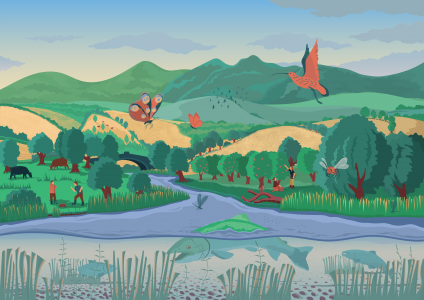
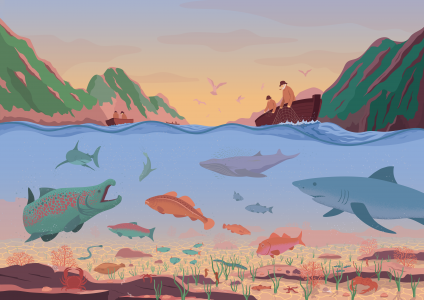
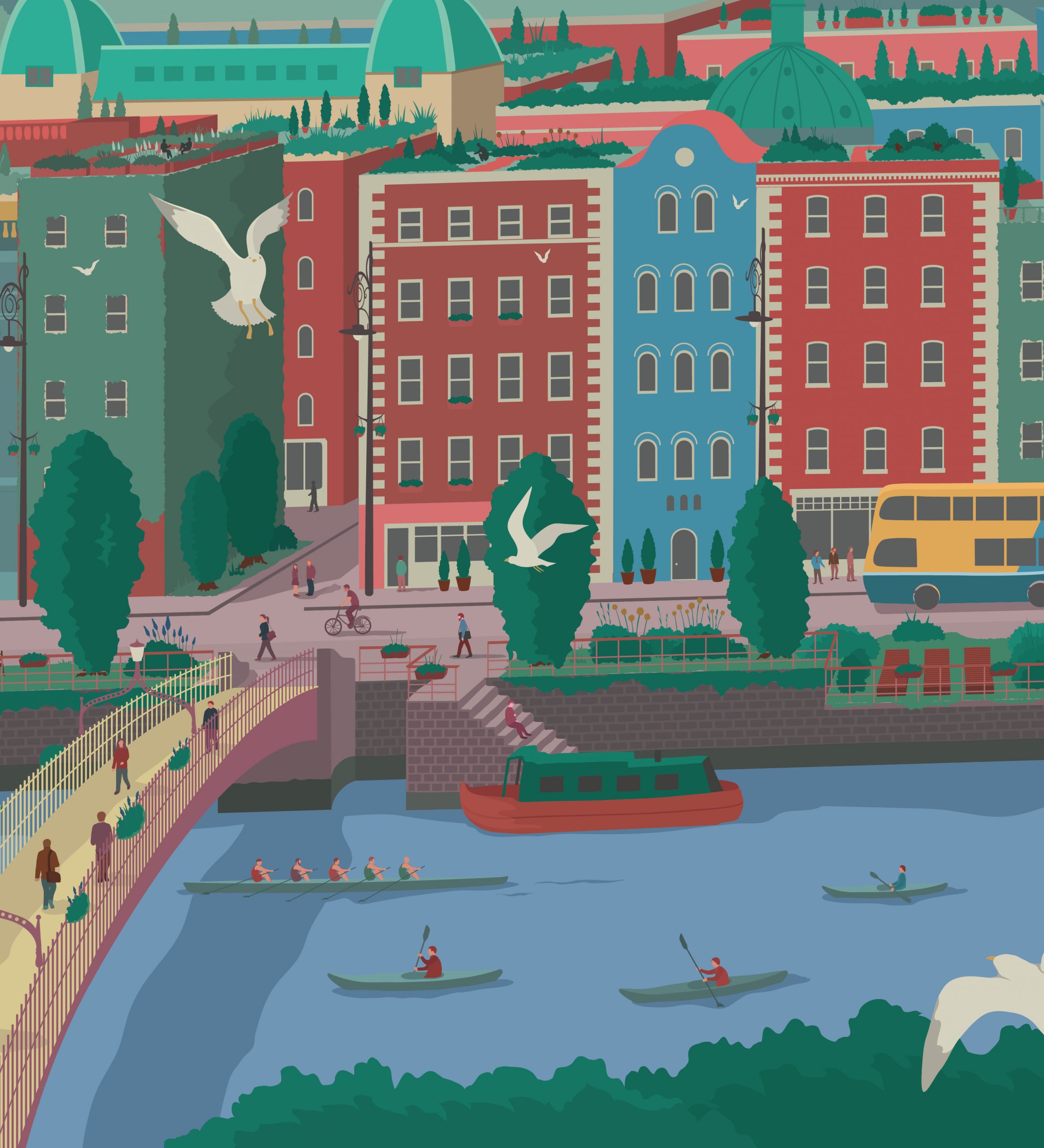
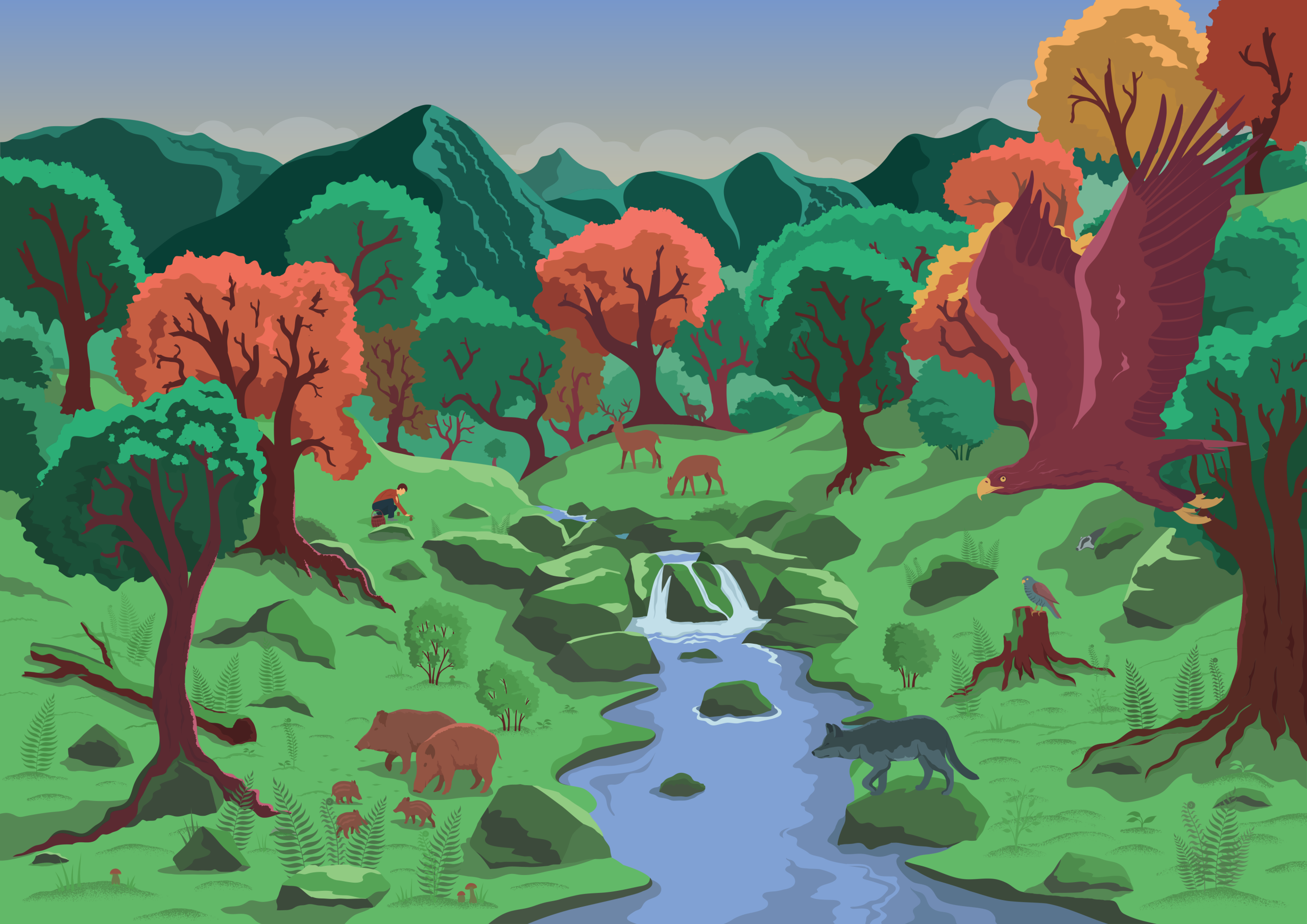
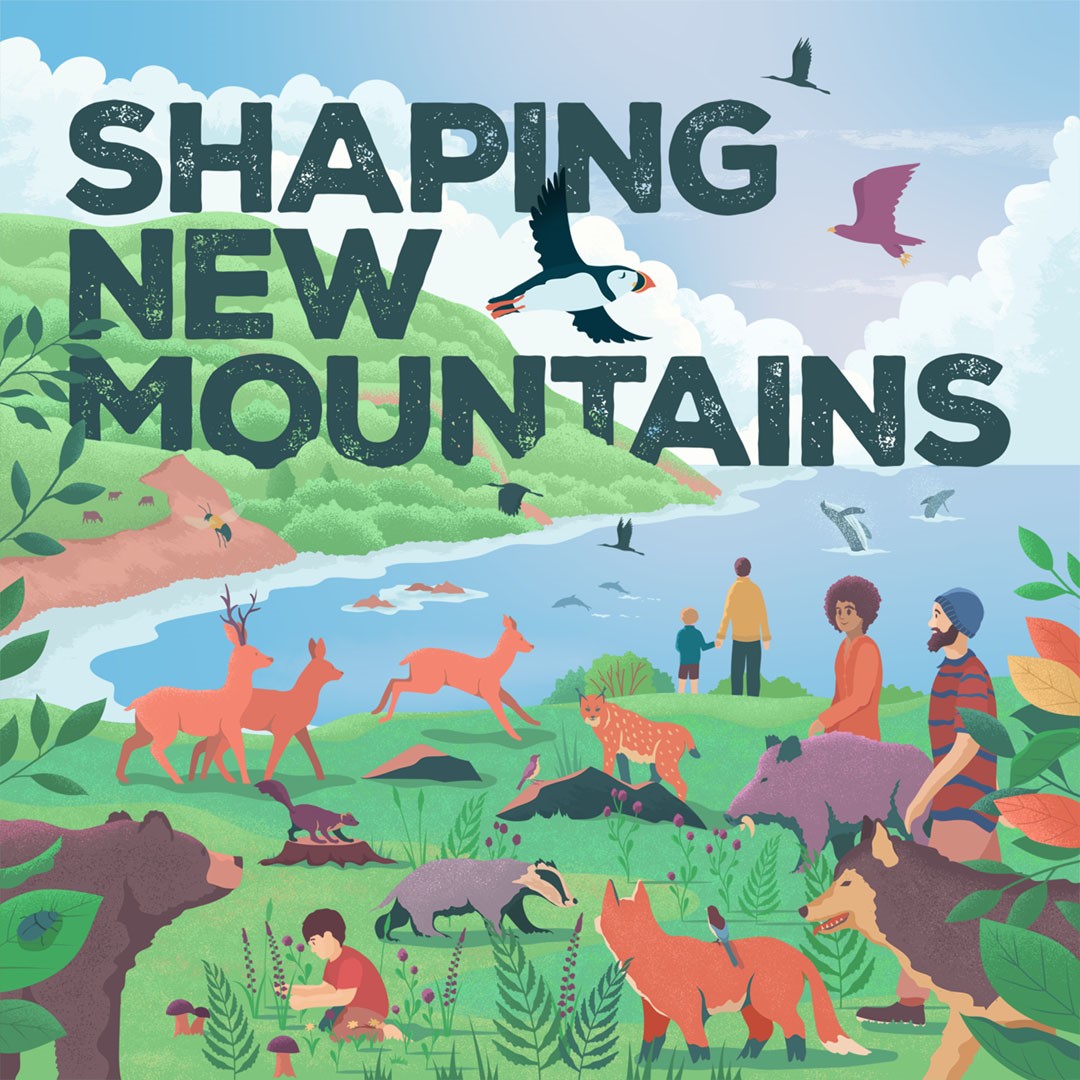
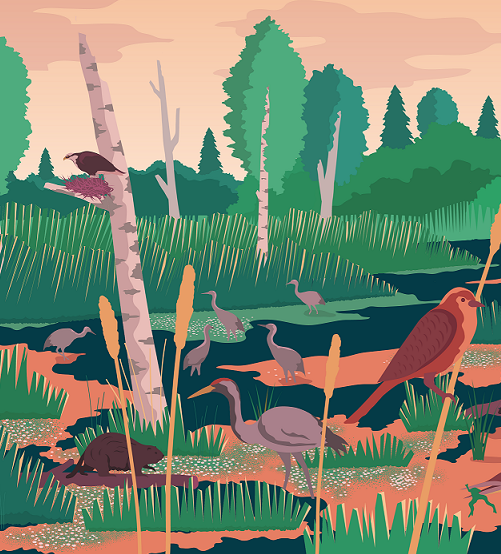
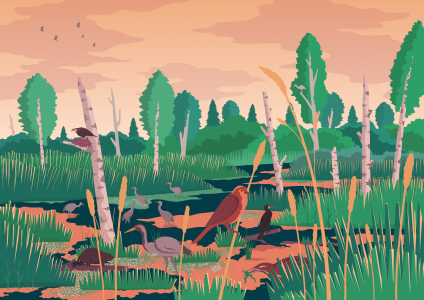
    Artwork by: Naomi McBride

    In the ancient legend of the Children of Lir, the eponymous siblings – Fionnuala, Aodh and the twins Conn and Fiachra, are transformed by Lir’s jealous second wife into swans.

    In this form they would stay for nearly a thousand years “sick with human longings, starved of human ties, with their hearts all human cramped to a bird’s stature. And the human weeping in the bird’s soft eyes” in the words of poet Katharine Tynan.

    Legend has it that the spell would be broken after 900 years but, as Tynan’s closing stanza puts it:

    “Housed warm are all things as the night grows colder,

    Water-fowl and sky-fowl dreamless in the nest;

    But the swans go drifting, drooping wing and shoulder

    Cleaving the still water where the fishes rest”[i]


    The swans, thankfully, are still with us.

    When I was a child I learned that Ireland had three species of swan: the Mute Swan, the Bewick’s Swan and the Whooper Swan. But these days we really only have two.

    The Mute Swan is probably the most familiar of the three, resident year-round, staying by their mate for life and, unless hissing at a passing dog, mute.

    The Bewick’s Swan, meanwhile, is a winter visitor. Or, at least, it was; the numbers in Ireland have dropped like a stone in the last 30 years and are now only turning up at 1% of their numbers compared to the 1970s.

    This is thought to be due to climate change, with the swans ‘short-stopping’ in other countries between Ireland and their Arctic breeding grounds, but their overall population is also in decline.

    The Whooper Swan, finally, is another winter visitor and in appearance very similar to the Bewick’s Swan. In contrast to their cousin, however, there has been a 40% increase in the number of Whooper Swans wintering in Ireland since the mid-1990s.

    They gather in flocks on lakes, river floodplains and sheltered coastal waters pretty much all over Ireland. They’re a joy to watch… and to hear! On a still winter’s day along the slowly drifting Shannon River somewhere in the midlands, their communal honking rings out across the farmland. From a distance they could even be squabbling siblings.

    For many, swans are the epitome of grace and elegance, but on this January day in 2020 I am looking on a small flock of Whooper Swans which are anything but.

    On water they glide effortlessly, in the air their long, slow wing beats are assured, but on dry land they have all the poise of a fully-suited scuba diver in a conference centre. They honk as they waddle, lifting their broad, webbed feet clear of the grass before pushing on awkwardly in their small delegation.

    They feed on the pasture during the day but in the evening they take flight, returning to a nearby lake or expanse of open water where they can rest, free from the threat of land-based predators. In this corner of County Longford, that normally means Lough Ree along the River Shannon, or perhaps, if conditions allow, flooded winter fields.
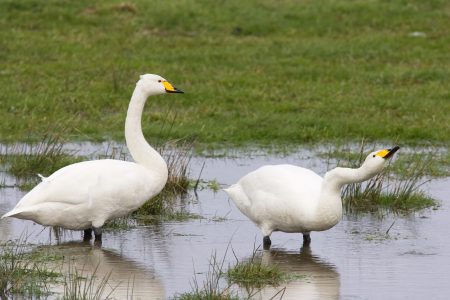
    Whooper Swans. Image source: Mike Brown

    Back in the day, the vast raised bogs that clung to the banks of the Shannon were good enough for the swans but the bogs are now largely gone. They were replaced with machinery, railway lines and workers.

    The smokestacks and barrel-shaped cooling towers at Lanesborough and Shannonbridge rose from the flat plains as monuments to this industry. These peat-fired electricity stations powered the nation in economic hard times and employed thousands of people for decades.

    “Bord na Móna [the state agency established in the 1950s to exploit the bogs] have been a major positive for this area” says Niall Dennigan, a native of Magheraveen, a townland not far from the power station at Lanesborough.

    “My father worked for Bord Na Móna for the best part of 11 years… uncles as well, the company has been the heart and soul of this area. Most people around here are gutted that the power station is closing down”.

    “Bord Na Móna has been the heart and soul of this area”

    In November 2019, the ESB (the principle energy provider in Ireland and operator of the peat-burning power plants) announced that the two facilities at Lanesborough and Shannonbridge (West Offaly) would cease to operate at the end of 2020. With their closure, 80 ESB jobs and over 100 Bord na Móna jobs are to be lost. At their height the two power stations employed over 170 people, while hundreds more have been employed indirectly.

    The imminent death of industrial peat extraction should be a surprise to no one.

    Since the first machines cut into the spongy surface in the 1950s the end has been in sight. Individual bogs first became worked out in the early 1980s, spurring the Royal Dublin Society (RDS) to hold a seminar on the matter, noting then that “the most memorable feature of that first day must be the series of utterly fundamental questions on the regional social and economic implications of the inevitable changes… references were made to “whole villages for sale”. “Devastation” was a term used more than once.[ii]“

    In October 2015 Bord na Móna announced that it would formally cease all industrial peat extraction by 2030. This decision was criticised at the time as being too far out, it was already clear that the company’s intensive use of state subsidies and unsustainable carbon footprint would not allow it limp on for another 15 years.

    At the 1988 seminar a series of men (and they were all men) were invited to the RDS to ponder the future uses of the midlands bogs. Much of the land, it was assumed, would be suitable for plantation forestry. Investigations into converting it into productive grassland – arguably an endeavour which has been under way since the dawn of agriculture in Ireland – were under way but were thus far unpromising.

    The Managing Director of Bord na Móna at the time, Edward O’Connor, was nevertheless upbeat, noting that peat exploitation globally was “nowhere near maturity”. Exciting developments were under way in Russia and Finland, while in the arid province of Almeria in Spain “success is to be anticipated” in growing fruit and vegetables on a peat medium where irrigation was dependent on over-exploited, salty groundwater.

    There would be exciting commercial opportunities in the “cleansing of liquid and gaseous effluents” as well as undefined “medicinal and therapeutic effects”. Ireland’s groundwater pollution problem would be “cured” using peat to filter wastewater from dodgy septic tanks while peat could “scrub noxious odours that emerge from meat rendering plants, fish processing plants and any other organic based noxious gas emitter”.

    Furthermore, there would be a “niche market” for peat (“properly marketed, priced and packaged”) as an absorbent for oil spills and even heavy metals – “the peat can then be incinerated in a controlled way to recover the metal”[iii].

    Mr O’Connor concluded his delivery by saying that “we have to develop a brand of entrepreneur who will not rest until he has set up new businesses and is trail blazing Irish peat at profit across the world stages.”

    Few of these wheezes came to fruition. Peat in septic tanks gained some traction. Commercial forestry, by far the largest of the enterprises in terms of the anticipated land area to be employed, quickly proved to be unviable.

    But Bord na Móna’s determination to blaze the commercial trail did not cease.

    But Bord na Móna’s determination to blaze the commercial trail has not ceased

    By 2015, then-Chief Executive Mike Quinn was announcing the cessation of peat extraction but the company was set to transform itself into an alternative energy company, centred on biomass, wind and solar power. According to the Irish Times, the traditional peat briquette was to be transmogrified into ‘biomass briquettes’ while the semi-state company would be opening a new wind farm every year for the next seven years, many of which would be in conjunction with solar panels. Biomass, he said, was a “huge opportunity”.

    Yet, things didn’t quite work out. The biomass which was burned in the power plants included palm kernels sourced from palm oil plantations (i.e. former rainforest) in Indonesia as well as biodiverse forests in the USA and they were even importing wood product from as far away as Australia. Hardly in keeping with its new ‘naturally driven’ slogan.

    The burning of palm kernels came to a halt in 2017 while plans to invest €60 million in a wood pellet plant in the US state of Georgia were dropped following protests from local environmental groups.

    Grants to encourage farmers in Ireland to grow miscanthus, or elephant grass, were a flop because burning the plant produced chlorine which corroded the boilers. Farmers were subsequently wary of later schemes asking them to grow willow.

    In early 2018 the then-Minister for Climate Action Denis Naughten heralded the announcement to convert peat-burning power plants in the midlands to biomass as “historic”.

    But it was the failure of the company to source biomass that led to the announcement a year and a half later that power plants at Lanesborough and Shannonbridge would be shut down permanently. Since then we hear that Bord na Móna is tapping birch trees for their sap, a popular drink in Finland apparently, and something which we’re told is part of the company’s ‘Brown to Green transformation’.

    Chief Executive Tom Donnellan told the Westmeath Examiner that “where we once milled peat we are now harvesting a pure, new, entirely natural and organic health product. The Birchwater Project is still in its development phase but is progressing well with excellent harvest yields from these peatlands”.

    There’s also talk of fish farming and herb cultivation, something which its website says is “inspired by the unique nature and beauty of our peatlands”. The company has a number of wind farms up and running, but new developments are not appearing at the pace which was anticipated.

    No solar energy farms had been approved at the time of writing while during the summer of 2020 all industrial peat extraction was forced to cease arising from a protracted legal battle with Friends of the Irish Environment due to the lack of environmental impact assessment for any of Bord naMóna’s operations.


    Bord na Móna was established as a semi-state company and it is in their DNA to ‘blaze a trail’ for profitable exploitation for the bogs. In a way their relentless pursuit of a commercial ‘use’ for the bogs is a broader reflection of the Irish psyche which expects land to be under active cultivation.

    For centuries the bogs were seen as wasteland, a quagmire, an impediment to our progress as a nation and then, when the means became available, a resource to be exploited. I don’t blame Bord na Móna for their heroic struggle for commercial innovation. I’m certainly not against renewable energy developments, particularly wind and solar, which are essential for decarbonising the economy.

    I just wish the company could be put out of its misery so that we can talk about where the real potential for the bogs lies: nature restoration.

    Can we talk about where the real potential for the bogs lies: nature restoration?

    Back in Magheraveen Niall Dennigan is getting his coat. It’s a glorious winter day and he’s keen to show me around. This is where he grew up. Although he worked for a bit as an electrician in Dublin he felt the pull of home and moved back to Longford with his wife to rear their three children. They built their own home which is near their parents’.

    Niall’s story shows that the common line about rural Ireland ‘dying on its knees’ is more complicated than it seems. People like him want to live in these areas but they are not getting jobs with the traditional employers – which, in this part of Longford, has been Bord na Móna for the past 70 years.

    “There’s no employment here at the minute” Niall tells me, “I can live here because I can work from home, but for that I need a good broadband connection. Lots of people around here still don’t have that”.
    Five years ago, the low hill to the west became the site of a wind farm, a project run by the state forest agency, Coillte. Niall insists that he is not against wind farms but believes that the project did not take local concerns into account.

    “It was a one-way street with them. There was no meaningful consultation with people, the community was just presented with the plans”, he says. It soured local opinion. “For years people had put their faith in Bord na Móna, they told the community that they would keep people working. But there are very few jobs in wind farms.”

    Despite knowing for decades that turf-cutting would end, at the time we spoke no plan had been put in place for workers who were then facing redundancy. Mention of a ‘just transition’, Niall says, is greeted with scepticism. “We had been promised that the bogs between here and Lough Ree would form part of the Shannon Wilderness Park, and we were very excited about that.

    Bord na Móna promised that once they were finished removing peat from the bogs that it would be handed back to the community. We were excited about the tourism and amenity potential for the project”. So, when Bord na Móna applied for planning permission in early 2019 for a 24-turbine wind farm on lands at Derryadd near his home, the very lands that were promised for the Shannon Wilderness Park, Niall led local opposition.


    The idea that the worked-out bogs could be given back to nature is not new. Back in 1988 at the RDS, then minister for Energy and Communications Ray Burke told the seminar that “where cutaway [bog] is low-lying and has been exploited through the use of pumps, it will generally flood once these pumps are turned off. Even if left alone, such sites quickly form scenic areas, as reeds and birch trees naturally colonise the surrounding residual peat and wildlife re-establishes itself.”

    Burke, who spent four and half months in prison in 2005 after pleading guilty to making false tax returns, was suggesting the idea – something which would today be quickly recognised as ‘rewilding’ – as the last resort, after forestry, conversion to agricultural land or any other commercial use had been ruled out. Later, the idea took root in some local communities.

    This prompted John Feehan, a figure well-known to many in the midlands and beyond for his prolific writings on the ecology, heritage and history of the region, to write a prospectus in 2004: ‘A Long-lived Wilderness: The Future of the North Midlands Peatland Network’ which set out the opportunity in developing a Wetlands Wilderness Park centred on the Bord na Móna lands in the north midlands. It would be vast, hugging the northern shores of Lough Ree and encompassing a cluster of industrial bogs referred to as the Mount Dillon group. In it he wrote:

    “Once harvesting activity comes to an end – indeed, before in many cases – natural processes of recolonisation take over on the cutaway, and in time the bare surface is replaced by a mosaic of evolving ecosystems of great ecological interest that develop on the residual peat. There will be woodland and scrub, dominated by pine, birch and willow. There will be oases and fringes of natural acid grassland, fen, marsh and small areas of bog, with considerable areas of shallow open water and the marginal habitats associated with it. These spontaneously established ecosystems are in equilibrium with the changed conditions which human exploitation of the original bog has brought about.”
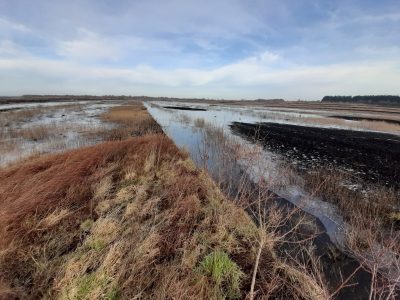
    Nature just needs time and space

    In short, very little needs to be done. “A modest amount of intervention” is sometimes needed to retain water in shallow lakes – the plan states – “but this should never be on a scale, or use materials, which are out of character with the developing wilderness. Wilderness requires that we keep our hands off and let an ecological equilibrium that is in tune with the altered conditions establish itself.”

    Feehan envisaged the return of lost species such as the marsh harrier and the booming of the bittern, a bird which disappeared from Ireland in the 1840s.

    In 2011 the Golden Eagle Trust (GET) invited a pair of Swedish ecologists to visit the bogs in the Mount Dillon Group to assess them for their suitability for reintroducing cranes, another long-lost bird. Lorcan O’Toole, from the GET showed them around and they concluded that there are “oodles of suitable crane habitat” available.

    there are “oodles of suitable crane habitat” available

    It is still an ambition of the organisation to bring cranes back to Ireland but when I spoke to Lorcan for this research he told me that “the Golden Eagle Trust wouldn’t have anything to do with a crane reintroduction project that was anywhere near a wind farm”.

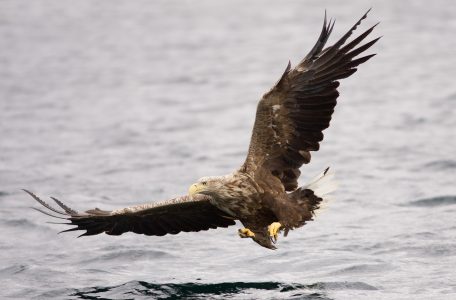
    Meanwhile, local ornithologists eye the skies for wandering white-tailed eagles in the hope that this top predator might establish a territory on the shores of Lough Ree.

    In 2013, Longford County Council published their plan to realise the Mid-Shannon Wilderness Park as an amenity destination of “international value”. There’s no doubt that a vast wilderness area with a rich patchwork of native woodlands, lakes and wetlands, with great flocks of birds including bitterns, cranes and white-tailed eagles, would be attractive to tourists from home and abroad.

    It would avail of existing walkways along the Royal and Grand Canals, boating and kayaking along the River Shannon through Lough Ree and heritage sites such as the Corlea Trackway, a 2,000-year-old wooden boardwalk designed to cross or, perhaps, access the centre of the bog for ritualistic purposes.

    The Longford County Council document is mostly about amenity and realising the potential tourism value of the project. It also stresses that the project would be perfectly compatible with renewable energy projects. It doesn’t dwell on the word ‘wilderness’ too much, perhaps relying on its self-evident evocations.
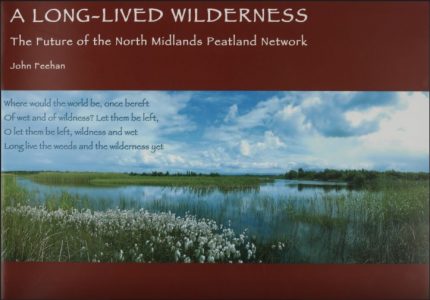
    It’s been on the shelf for too long

    It was probably wise that they didn’t try to define what a wilderness is, but if anything, ‘wilderness’ is equivalent to ‘nature first’. Are commercially intrusive projects like wind turbines and solar parks compatible with wilderness?

    Would people travel from abroad to visit a ‘wilderness’ that wasn’t really true to its name? Certainly, any proposal to reintroduce cranes to a landscape with wind turbines 185m in height (one and a half times the height of the spire in Dublin’s O’Connell St) would be off the table.

    Although wind turbines are not the bird-killing machines portrayed by some, there are particular birds which are susceptible to fatal strikes – including large or soaring birds such as cranes, white-tailed eagles and whooper swans.

    These were the arguments presented to a special hearing on Bord na Móna’s wind farm proposal, to be located bang in the centre of the proposed Shannon Wilderness Park, held in Longford in July 2019. I was there on behalf of the Irish Wildlife Trust to put forward our objection to the scheme. Niall Dennegan, and his ‘No to Derryadd’ community group presented a robust critique of the planning documents, including the likely effect the turbines would have on the local whooper swan population.

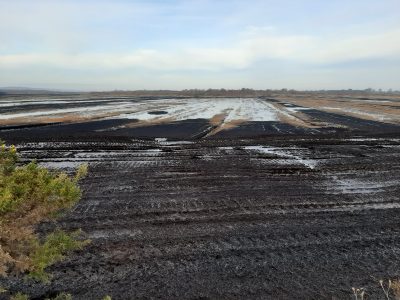
    When I visit him in January 2020, a final decision had yet to be made. Niall drives me up a local road to a nearby bog where peat extraction stopped some years ago. On either side of the road a brown expanse of bare peat stretches out to the horizon. This is also the site for one of the proposed turbines.

    The weather has been wet and on the north side of the road, off in the distance, large pools of water have formed. Through the binoculars, we can just about see three white shapes gliding across its surface. It is a small group of whooper swans, bowing their heads and honking to each other, deep in conversation. Around the edges we can also see the establishment of mosses, rushes and the first saplings of birch and willow recolonising the peat.

    Although this process would continue even in the presence of a wind turbine, Niall tells me that Bord na Móna would be required to maintain the pumps to keep the area dry while the rotating blades would present a demonstrable hazard to the swans. “They simply won’t hang around if the wind farm is allowed to go ahead” he says.

    We finish our day with a walk across Niall’s father’s farm, which borders another edge of the bog. It’s a silent landscape with no birds or even leaves to catch the whisper of the wind. But Niall tells me that last summer the silence was broken by a sound not heard in many decades – the cry of the curlew.

    In the summer of 2019, it was believed that a pair of curlew, one of Ireland’s rarest and most threatened birds, had nested on a rushy corner of the cutaway bog. The sound is unmistakable. “We’ve had silence here for many years,” says Niall, “but now the sounds are coming back. If we stay true to the Wilderness Park idea we have such a positive alternative to reimagine the midlands.”

    Later in 2020 it was announced by the new government that 33,000 hectares of mined out midlands bogs, less than half Bord naMóna’s landholding, would indeed be rewilded and rewetted. According to Green Party lead Eamon Ryan, the move will prevent the release of 3.2 million tonnes of carbon dioxide by 2050. The plan would keep Bord naMóna workers in a job after the power plants closed and there’s no doubt that this is the most significant step we’ve seen towards healing this damaged landscape. Also, that year the company received planning permission for their proposed wind farm at Derryadd, although this decision was subsequently sent for a judicial review, and as of March 2021 a final ruling had not been made.
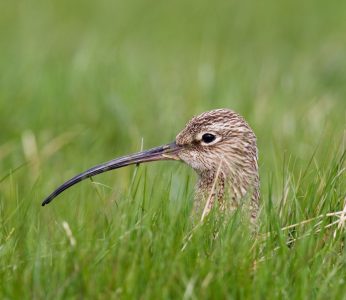
    Image source: Curlew by Mike Brown

    Peatlands can be described as a kind of ‘super-habitat’. Across the globe, they store about a quarter of the world’s soil carbon even though they only cover 3% of the land area. What really makes them special though is their phenomenal ability to remove carbon from the air and lock it away more or less permanently (other types of soil also build up over time but much more slowly).

    As well as their climate benefits, they act as giant sponges, regulating the flow of water off land and thereby moderating the peaks of flooding and the troughs of drought in river catchments.

    And they clean water too. United Utilities, a water company in the north-west of England, has invested £22 million restoring uplands bogs since 2005 because these natural systems are cheaper and more effective in removing pollutants and in particular the tiny particles that can make water coming down from the hills turbid.

    Bogs are particularly unique places, adapted to extremes of climate and especially areas of high rainfall, and so are home to unique wildlife. However, these amazing feats go into reverse when peatlands are damaged.
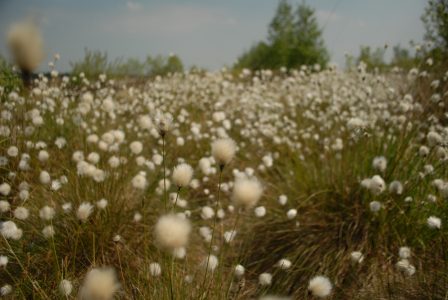
    Small but mighty

    Degraded peatlands emit billions of tonnes of greenhouse gases, estimated to be 5% of total global emissions. In Ireland the emissions from the great expanses of bare, afforested, burnt or over-grazed peatlands are not fully accounted for in our annual reporting to the United Nations Framework Convention on Climate Change.

    However, that will change in 2026 when a more rigorous reporting regime is to be introduced. Some calculations which have been done to-date are finding that this could mean a possible ten-fold increase in our reported emissions under this category[iv]. Early in 2021 it was announced the Ireland would begin voluntarily reporting emissions from ‘managed’ peatlands and wetlands. This will include farmland on peat soil as well as mined out industrial sites but excludes uplands peats or certain areas where there is turf-cutting for domestic fuel.

    The good news is that peatlands can be restored. Removing pressures and blocking drains that were installed to dry them out is laborious, but it works. Research from Scotland, where large-scale peat restoration began in the 1990s in the Flow County to the far north, showed that after 16 years the bogs switched from emitting carbon to removing it from the atmosphere.

    The good news is that peatlands can be restored

    Initiatives which sound like they are good for the climate – such as wind turbines or forestry – may be doing more harm than good when they are on peatlands. These days, it is widely acknowledged that rewetting peatlands is the most impactful action we can take to stop the haemorrhaging of greenhouse gases into the atmosphere from these landscapes. It is a view reflected by every peatland scientist that I spoke to for this project.

    One of those, Dr Catherine Farrell, used to work for Bord na Móna but is now a researcher at Trinity College Dublin. She completed her PhD on peatland restoration in the early 2000s and is a self-described ‘bog woman’.

    Her work was based in the far north-west of Co. Mayo, at Bellacorick, a vast expanse of Atlantic blanket bog and one of the few of this type which was subject to the industrial extraction techniques more familiar to the midlands.

    “At the time we were trying to bring life back to an industrial landscape” she tells me. “We were blocking drains and reshaping berms to stop water running off the land and carrying peat and underlying glacial sand with it. The Owenmore River is important for salmon so by rewetting the bog we were also protecting the river habitat – it’s all connected.”

    Catherine was captivated by the landscape in this relatively little-known part of Ireland. “It felt exotic, it definitely has a wilderness feel to it. I spent a lot of time on my own, surrounded by this vast expanse of bog… and I loved it.”

    Her work allowed her to see, and document, how nature could recover all by itself once the conditions were right. “Bogs are designed to hold on to water so our work was based on the basic principles of bog systems” she says. “We wanted the water to stay on the land and where we managed to do this – not too much, not too little – we could soon see the sphagnum establishing itself.”

    Sphagnum is a collective term for a family of mosses which are sometimes known as the ‘bog-builders’. As they recolonise the drains and bog pools, they establish a healing layer of vegetation across the scarred land, slowly allowing other bog species to take a hold. “Our first trial plots were in 1997. By 1999 we could see visible results. But you have to work with the system, this is not gardening,” Catherine tells me. “It’s incredible. Moss can grow an entire landscape. But you need to give it time and you have to leave room for the unpredictable.”

    Sphagnum moss can build whole landscapes

    At the time, Catherine says, few people saw the potential of entire landscape restoration. When she went on to work for Bord na Móna she brought this vision to the industrial bog sites in the midlands but admits it was sometimes a battle to change people’s minds. “Some in the company really wanted to see restoration work being done, others were fearful. But sometimes you have to dig your heels in”.

    Catherine built up a team of ecologists which set about mapping the sites and developing the works that needed to be done to restore wet conditions. Machine-workers, who had been employed on taking the peat out of the bog, were perfectly skilled in the delicate work required to block the drains and reprofile the land.

    By 2018, Catherine and her team had 15,000 hectares of bog either restored or under ‘rehabilitation measures’ but impressive as this is, it represents just 18% of the 80,000 hectares owned by Bord na Móna, which itself is just about one third of the total area of bog in the midlands. I ask her how far she thought we should be going with this idea: “There are no significant challenges to rewetting and/or rehabilitating all of the midland’s bogs. The main issue will be dealing with adjoining landowners given that most lands beside the Bord na Móna bogs were drained when the initial bog drains went in. So, we have to work beyond the boundary where we can and within our confines where we must, as it were. But even within these constraints, we have an unprecedented opportunity before us to deliver for nature, water, flood mitigation… all of the web of life can return and people are very much a part of that.”


    As a climate solution it’s important in the first instance to keep the carbon where it is. That means stabilising the peat by rewetting it. When it comes to actually removing carbon from the air, however, it’s complicated. It’s not always clear that the conditions for actually growing peat will prevail.

    There is virtually no chance that the raised bogs will re-form where extensive mining of the peat has occurred, instead, on these ‘cutaways’ we will get something different – fens, embryonic bog-forming communities of plants, wetlands, open water, wet grasslands and wet woodlands.

    Carbon can be released even from healthy bogs if there are prolonged droughts in summer. Methane, a greenhouse gas which has 25 times more heating potential than carbon dioxide, can be released from decaying vegetation in ponds and lakes. However, despite the complexities, re-wetting and having a skin of vegetation on dryer areas is the best way to manage the land for climate and other benefits.

    Essentially, we need to let nature do the heavy lifting. “We shouldn’t impose our will on nature – it won’t work”, Catherine says. “There will always be parts of the bog which can’t be rewetted because they’re on higher ground. But here you’ll always see moss coming in, then rushes, and that forms a nursery for tree seedlings so you’ll see willow and birch come in in a process of natural regeneration on these drier areas. Natural regeneration is best – peatland plants grow into the place and transform it as they grow; the system evolves. We definitely don’t need to be planting trees! In my experience of working on bogs across Ireland, working with nature is best. Give it the starting point and support its needs – stop the causes of degradation and replace that with wise use and management where required. Or leave it to its own devices. Every site is different. Nature takes time, but nature works!”

    “We shouldn’t impose our will on nature – it won’t work”

    Are we ready to let go of the bogs? For many in rural Ireland burning turf is a cultural signature, an intimate part of their identity which is revived by its distinctive smell wafting on a still winter evening.

    It’s the rough feel of the sods in the hand as they’re tossed in the hearth and perhaps the memory of elders who spent long summer days on the bogs ‘saving the turf’. Yet the dark side to burning turf is not only the damage inflicted to climate and biodiversity.

    According the Environmental Protection Agency (EPA) 1,180 people die prematurely due to air pollution in Ireland every year. The main culprits are exhaust fumes from motor vehicles and burning solid fuels like coal and turf.

    The latter is not just confined to outdoor areas on smoggy November nights but soot from open fires is also contaminating lungs inside homes. The EPA found that homes which burned peat had indoor carcinogenic pollution levels in excess of World Health Organisation limits. In some towns and cities smoky coal is banned but turf gets a free pass due to its cultural connections (and, no doubt, strong lobbying from turf-cutting contractors inside the Dáil, at least one of whom is also a sitting TD).

    In 2019 the Irish Times highlighted an EPA study which found that cancer-causing particulate pollution was twice as high in Longford (which burns peat and doesn’t have a ban on smoky coal) than in Bray in Co. Wicklow (which doesn’t burn peat and does have a ban on smoky coal).

    Such disparities also reflect households’ access to fuels such as natural gas, which is less polluting but which tends to be only available to those in urban areas. It also reflects historic proximity to traditional turf-cutting plots – 38% of households in Offaly heat their homes with peat compared with only 1% in Dublin.

    An Irish Times article in 2019 quoted Paul Kenny from the Tipperary Energy Agency as believing that people who live in rural areas close to bogs view turf as a cheap fuel, yet they could spend up to €3,000 a year on their combined energy from turf, coal, sticks, fire lighters and electricity. “We did deep retrofits on three ex-local authority homes in Thurles [Co. Tipperary] whose fuel bills were €2,400 each. Following the work, these houses were heated for under €1,000,” he told the newspaper.

    According to another Irish Times article, an estimated 400,000 households in Ireland suffer from fuel poverty, defined as spending at least 10% of your income on keeping your home warm and comfortable. In 2017 then-Minister for Communications, Climate Action and the Environment Denis Naughten[v] told a conference on Fuel Poverty and Climate Action that “energy poverty is an environmental issue. It is an economic issue that blights lives, and energy efficiency is the most important means of tackling energy poverty”.

    Nevertheless, the Irish government’s record on retrofitting homes has thus far been poor. A European Court of Auditor’s study published in 2020 found that funding provided by the EU was used to replace, rather than supplement, Ireland’s home energy-efficiency scheme. The report also found that the scheme, as it was then designed, did not improve the energy rating of most of the homes that were worked on[vi].

    Asking people to stop burning turf may at first seem like the opening salvo in a culture war. A massive programme of retro-fitting draughty homes which reduces heating bills, saves lives and creates local employment, on the other hand, may meet with significantly less resistance.
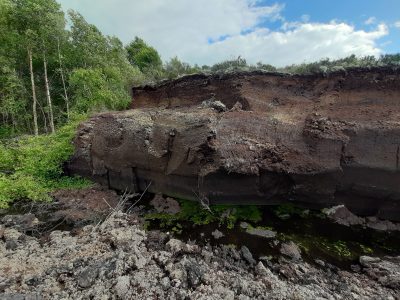
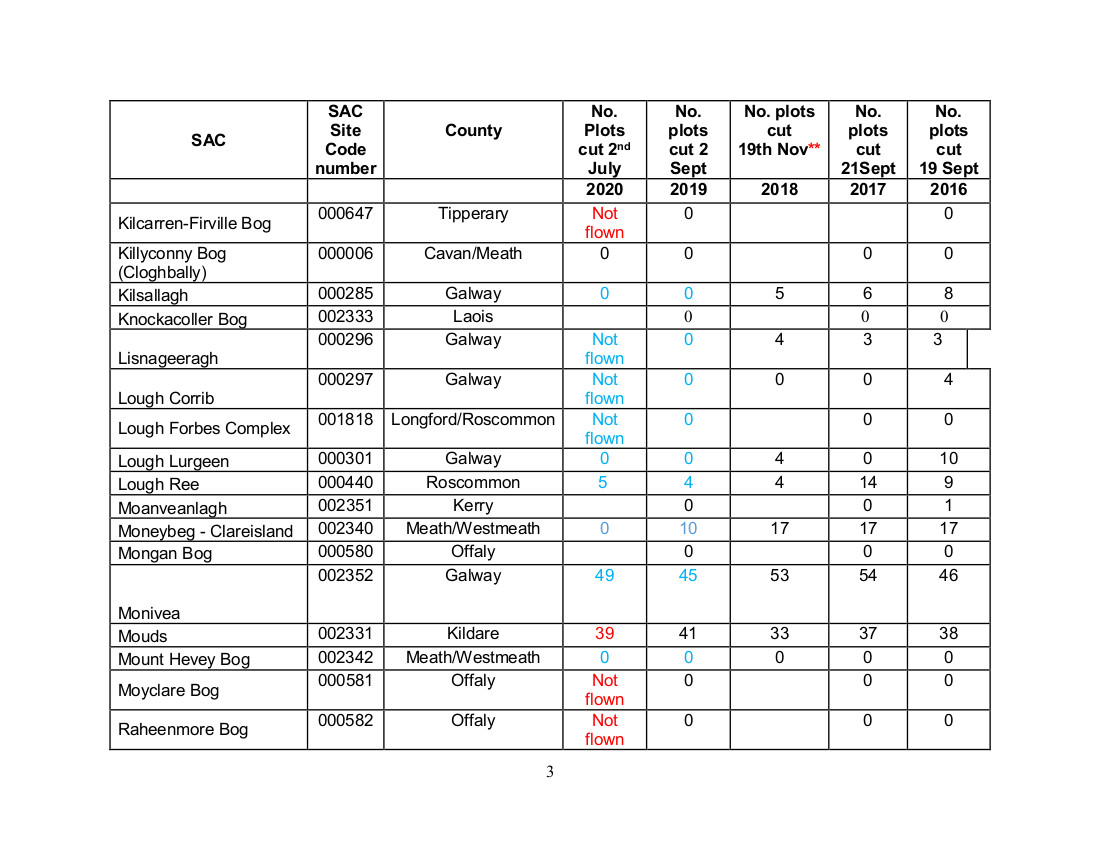
    Mouds Bog SAC in Kildare – cutting turf for fuel goes on

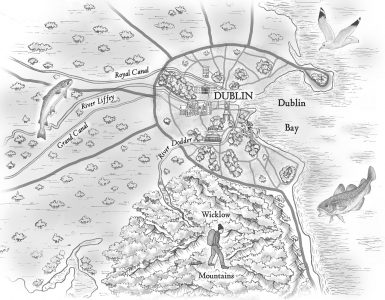
    Were this cultural shift to come to pass, the scale of opportunity is truly immense. When you look at a map of the boglands you’ll see they do not form one continuous band. Rather, they are peppered in smaller bog fragments forming an arc from east Galway and Roscommon, down the banks of the River Shannon to Tipperary and east to the Bog of Allen in Kildare.

    the scale of opportunity is truly immense

    With a little imagination it is not hard to visualise corridors of woodlands, lakes, marshes, reedbeds and riverbanks knitting them all together into one coherent expanse.

    The Shannon Wilderness Park, as it is currently proposed, could be just the kernel of the greatest natural landscape restoration project ever seen in Western Europe. There are those who will despair at this idea – imagining that a land not actively worked by the hand of man will mean a land without people.

    This notion must be consigned to the last century where it belongs. Restoring the bogs will require active management, with a need for local ecologists and rangers. Not only that, but the very skills needed for blocking drains and reprofiling land to hold water are those of the machine workers who are now fearful for their futures.

    Small-scale, nature-friendly farming should be encouraged to revitalise agricultural lands between the bogs. Tourism opportunities will doubtless arise if what is on offer is truly a wilderness experience.

    But more than that, the unlimited access to nature that will be afforded to local people will itself be an attraction to companies to invest and to families looking for a high quality of life.

    Many towns like Tullamore and Roscommon already have reasonable property prices and less of the urban stresses like traffic and congestion. What if they also had limitless access to safe walking and cycling paths in a rich and varied landscape?

    Local communities have much to gain; how can they be convinced? Decision-making in Ireland tends to be centralised, but we have no shortage of active, engaged community groups which are fountain-heads of innovation. Is there a way to harness these forces to forge a new relationship with nature?


    Namibia is not a country you might think of as a source of inspiration for Irish bog conservation. Hugging the Atlantic coast of southern Africa it is mostly known to outsiders for its vast desert regions. In fact, it is the driest country in sub-Saharan Africa.

    Yet it is from this unexpected location that Chris Uys arrived to Ireland in the late 1990s. Settling with his Irish wife in the midlands town of Abbeyleix (Co. Laois) he tells me that adjusting to rural Irish life brought some challenges: “this was the 1990s” he says. “There weren’t many foreigners in Ireland. I had to register every year at the Garda station as an ‘alien’ under the Aliens Act from 1935!”

    Chris – who has lost none of his distinctive Southern African accent in the intervening decades – describes how he set about integrating with the local community on arrival to the small rural town. He joined a local photography club. He applied to do a course as a tourist guide (Abbeyleix at that time was one of a number of designated Bord Fáilte ‘heritage towns’) and this gave him an insight to Irish history and culture. He got a job within nine months of his arrival.

    He recalls at the time that the town had a heritage centre but it was not financially viable; tourist buses on their way to Kerry didn’t stop in the town but money was available for amenity projects such as walking trails and there was an energy to the town. It was at this time, he tells me over coffee in the Abbeyleix Manor Hotel, that the “the bog situation blew up”.

    The Abbeyleix Bog can be found to the south of the town, right beside the hotel in fact, and up to the 1970s it had been an area where locals and employees of the nearby De Vesci estate cut turf by hand for burning in their homes. In the mid-1980s Bord na Móna bought the bog from the estate and set about clearing vegetation and digging drains in preparation for industrial peat mining.

    However, mining works didn’t go ahead at that time. In early 2000 however it appeared that Bord na Móna were to set to move in again. “We heard that drains were to be dug across the bog”, Chris recalls, “but there was no planning application sign and an ad in the local newspaper didn’t mention Abbeyleix, the community had been left totally in the dark. We went to the EPA [Environmental Protection Agency] to check their file but there had been no communication with them from Bord na Móna. Then in June 2000 we got a tip-off that machinery was about to move in – so we blockaded the entrance with an old crane”.
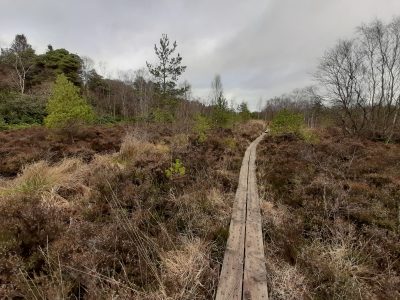
    Abbeyleix Bog – the community built this

    The ‘we’ Chris refers to was a strong contingent of local people – up to 100 by one account – who were not happy that industrial peat extraction was about to commence on what they saw as an area of high heritage and amenity value to the town.

    While Bord na Móna had been popular in the area, particularly as a long-standing source of local employment, at that stage “the writing was on the wall” says Chris. Local values were shifting, with other sources of employment and greater levels of ecological awareness and in particular the great value of bogs. And so, over the space of a single weekend, the community came together in support of protecting the bog.

    But the battle was just beginning, and it would be 2008 before Bord na Móna finally agreed to abandon their plans completely. By that stage the community of Abbeyleix had not only organised themselves but had assembled an impressive team of ecologists, photographers and environmental scientists as well as forming collaborations with national wildlife organisations and state-bodies like the EPA.

    Today, Abbeyleix Bog is not only a much-loved local amenity, with its boardwalks and information signs, but has seen significant restoration works including drain-blocking and volunteer-led workdays to remove alien invasive species. A survey by peatland scientists in 2020 found that since works commenced, the area of active bog (i.e. where the peat layer was growing) had grown from 1% of the area to 13% – a phenomenal achievement.

    Thanks to people like Chris and others in the town, Abbeyleix Bog is a shining example – perhaps the best we have in Ireland – of community-driven conservation. Yet their work is not done; the bog still has no formal protection in law. “We’re still waiting on a signature,” Chris says in referring to their effort to have the bog designated as a Natural Heritage Area, something that would give the bog a legal status and which is awaiting ministerial approval.

    Chris went on to join the Community Wetlands Forum, which had been established in 2013 to facilitate locally-led conservation projects and promote collaboration not only with each other but with universities and state agencies. “We need community engagement,” Chris asserts but he feels there is still too much resistance among state-players. “We need enabling laws to allow communities access to decision-making. Communities need to have the power to decide their own destinies.”

    He thinks a lot more needs to be done to join the dots with wider issues. “We can’t look at things in isolation. We have the Sustainable Development Goals from the UN [which identify the need to tackle seemingly disparate issues, like equality and climate change, in parallel] but they’re not being talked about. They don’t get a mention in any of the political party’s manifestos!” (at the time we spoke in January 2020 Ireland was gearing up for a general election).

    Chris gets to talking about his home country and how we can learn from how issues surrounding nature conservation have been addressed there.

    Namibia, he tells me, came out of a dark period after winning its independence from South Africa in 1990. The previous century had seen a brutal period of German colonialism, followed by apartheid and a civil war which had been on-going since the 1960s.

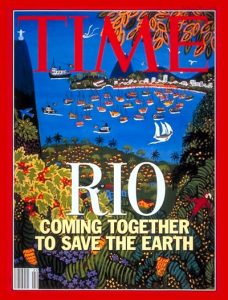
    While the Earth Summit was going in in Rio de Janeiro in Brazil in 1992 the Namibian political establishment was putting their country together. The parties worked hard to build a consensus for a new constitution across diverse ethnic and political lines.

    It was based upon human rights and democracy but it was progressive in other ways. Article 95 of the constitution declares that: “The State shall actively promote and maintain the welfare of the people by adopting [among other things, the] maintenance of ecosystems, essential ecological processes and biological diversity of Namibia and utilization of living natural resources on a sustainable basis for the benefit of all Namibians, both present and future…”

    Imagine that: a constitutional document that directly links the welfare of its people to that of its nature and biodiversity, and which protects this relationship for the generations which are yet to come! The Irish Constitution, in contrast, has no mention of nature, biodiversity, ecosystems or future generations.

    The Namibian Constitution has proven to be more than just fine words. In 1996 the government established a law to allow communities establish their own wildlife conservancies.

    This allows for the management of communal land as well as collaboration with private companies in tourism initiatives. It is entirely voluntary; communities must submit a map of the area they want to manage along with a list of community members and the objectives they hope to achieve. The establishment of the conservancies is sanctioned by the Department of Environment in the capital, Windhoek, but any revenue earned stays within the community.

    The result has been an astounding success. After decades of over-exploitation of big game, wildlife populations are rebounding, including elephants, black rhinos, lions and leopards. Namibia has the largest population of cheetahs in the world as well as growing numbers of other endangered species.

    Poaching has dramatically declined as good wildlife management is seen as integral to livelihoods. Conflict with big predators is managed through the conservancies, which can pay out compensation, replace livestock or implement innovations which deter predator attacks (check out the inspiring TED talk featuring a young Kenyan who invented a simple configuration of flashing LED lights which successfully deter lions from attacking cattle in their pens).

    Today, Namibia is a shining light of conservation hope – fully 42% of their land is protected along with 12,000km2 of marine conservation area.

    Protected areas are divided between national parks under state administration (18%) with a near-equal area (17%) with community conservancies and includes the protection of the entire coastline.

    According to the Nature Needs Half project established by conservationist Edward O. Wilson “by connecting its people to their environment through conservancies, community forests, and community management, Namibia is becoming a country of environmental stewards”.

    It is an example to us here in Ireland, and perhaps especially to the communities across the Shannon region, of how new ways of seeing can bring new life and a new future to the people who live there.
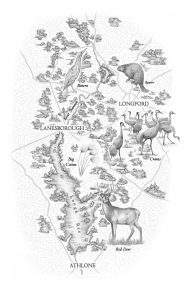
    Artwork by: Jacek Matsiak


    [i] The Children of Lir by Katharine Tynan. From Woven Shades of Green’ Edited by Tim Wenzell. 2019. Bucknell University Press.

    [ii] ‘The Utilisation of Irish Midland Peatlands’. 1989. Proceedings of a Workshop held in the Royal Dublin Society from September 21-24 1988. Edited by C. Mollan. Royal Dublin Society.

    [iii] Ibid.

    [iv] Wilson et al. 2015. Derivation of greenhouse gas emission factors for peatlands managed for extraction in the Republic of Ireland and the United Kingdom.

    [v] Denis Naughten held this post in cabinet from 2016 until 2018, when he resigned after being found to have had a number of private dinners with the leading bidder for a lucrative national tender for the rollout of broadband services.

    [vi] ‘No energy rating rise for half of homes given grants’ by Daniel Murray. Sunday Business Post. May 3rd 2020.
  • Press Release: Irish Wildlife Trust finds that no permits for ‘controlled burning’ were issued in the North, East or South of Ireland in 2020, and only two in the West

    Press Release: Irish Wildlife Trust finds that no permits for ‘controlled burning’ were issued in the North, East or South of Ireland in 2020, and only two in the West

    Press Release

    15th March 2021

    Irish Wildlife Trust finds that no permits for ‘controlled burning’ were issued in the North, East or South of Ireland in 2020, and only two in the West

    The Irish Wildlife Trust (IWT) has received information from the Department of Housing, Local Government and Heritage from Freedom of Information that throughout 2020 only two permits were issued by the National Parks and Wildlife Service for so-called ‘prescribed’ or ‘controlled’ burning in Ireland.

    Both of these consents were in the Western Division with no permits issued in the Eastern, Southern or Northern divisions. Permits from the NPWS are required where burning is planned within one of Ireland’s 400+ Natura 2000 sites which cover approximately 13% of the country including large uplands areas.

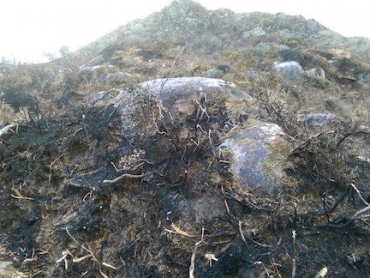
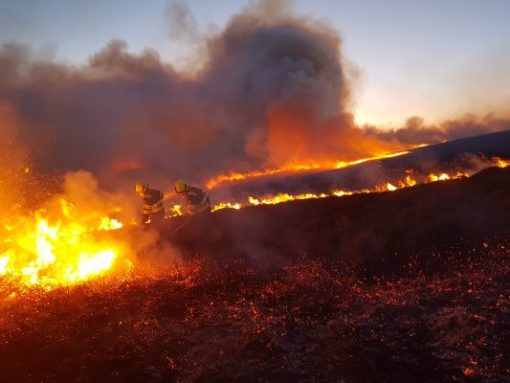
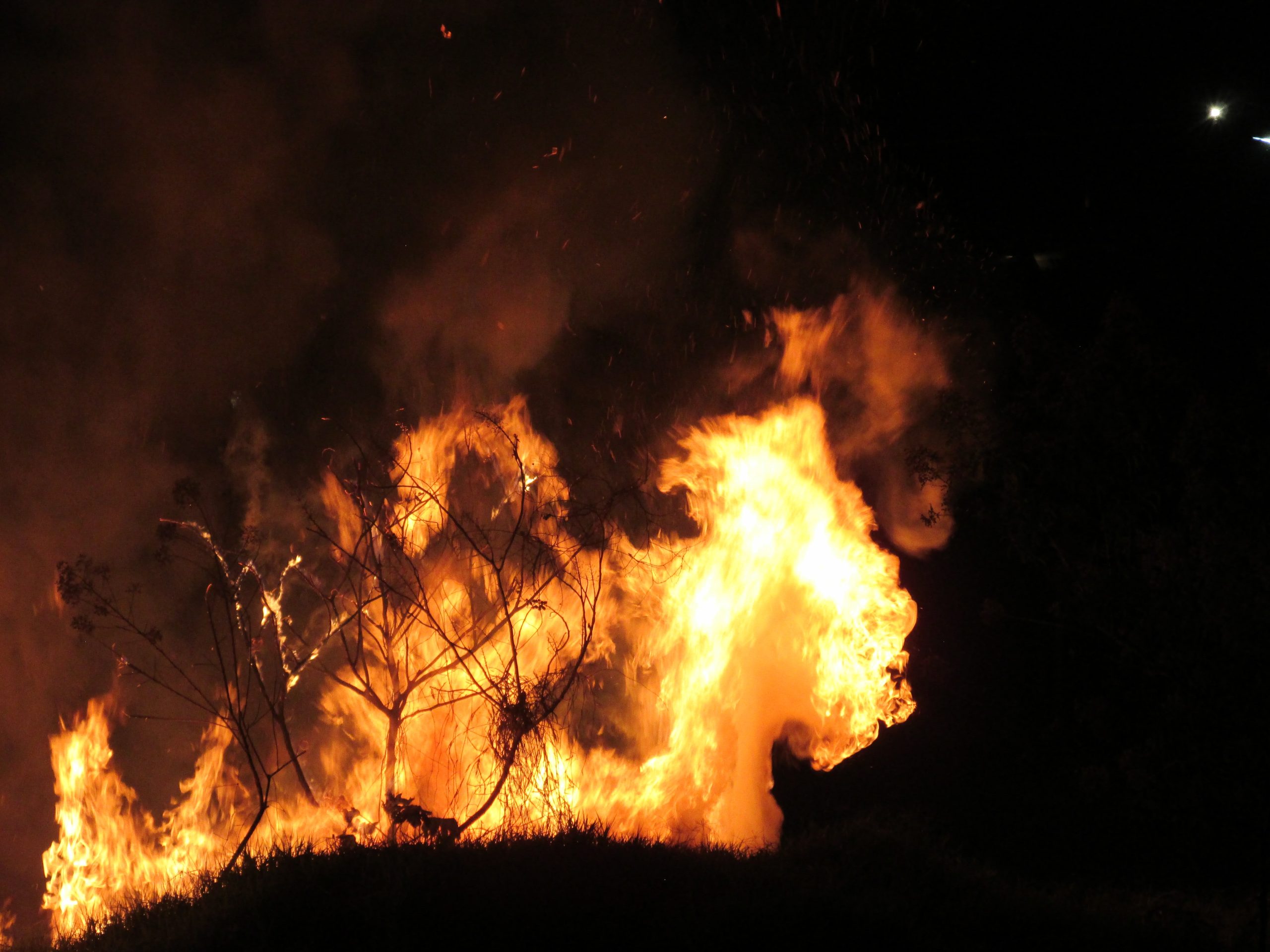
    While not all burning takes place in Natura 2000 sites, we know that in 2020 there were dozens out-of-control fires in protected areas across the country, including Wicklow, Carlow and Kerry. While all burning is prohibited during the nesting season (March to August) under the Wildlife Act, we also had out-of-control fires in January and February of this year, however our data shows that there is unlikely to be any controlled burning taking place in Ireland at any time of the year.

    IWT Campaign Officer, Pádraic Fogarty says “There seems to be an assumption that setting fires to the hills in January or February is ok, but what we’re seeing is illegal and out-of-control fires even at these times of year. The truth is that there is likely to be near zero controlled burning anywhere”.

    Controlled burning of vegetation on the hills is an enormously polluting and harmful activity and is not a practical land management option in Ireland. Restoring native woodlands and wetlands, which naturally store water and so are wetter, gives us the best hope to minimise fire risks while also avoiding the pollution and habitat destruction that occurs from burning of any kind. Land use policies, particularly forestry and farming, should promote rewilding and ecosystem restoration rather than penalising farming for having natural vegetation on their land.

    ENDS

    CONTACT: Padraic Fogarty IWT Campaigns Officer irishwildlife@iwt.ie
  • The senseless logic of burning land

    The senseless logic of burning land

    The senseless logic of burning land

    Pádraic Fogarty March 13th 2021

    Let’s say for a moment that I’m a farmer in the uplands and I want to clear land for my grazing animals. I’ve been told by all the farmer organisations that fire is a perfectly acceptable tool for the task and I may even have heard that it’s beneficial for wildlife and vegetation, but I’m also aware that burning between March and August is illegal under the Wildlife Act. So I want to do this by the book. Where to start?  I go to the Department of Agriculture’s website and I put ‘burning’ into their search engine. This brings up three results: two warnings not to burn during the nesting season (one from 2019 and one from 2021) and a link to a consultation on draft guidelines for burning of vegetation in March, something that closed in January 2019. Ok, so nothing there, but I have lead. So, I Google ‘guidelines for burning of vegetation in March’. This reveals some links to the consultation, which were held after the Heritage Bill debacle, but nothing to indicate that these guidelines were actually finalised so I remain none the wiser.

    Next, I try Teagasc, the farm advisory body. Better luck this time, I find a document called ‘Prescribed Burning – Code of Practice’. It’s 42 pages long. Alright, not too long I think, so I make myself a cup of tea and sit down to read them. I’m told early on that “with the right application fire can enable rapid and cost effective treatment of unwanted vegetation” but also that “poorly planned or executed burning will cause long-term damage to soil and upland hydrology or hasten unwanted vegetation change that will in turn reduce productivity in livestock or wildlife habitats” as well as placing human life and property at risk. The guidelines stress the burning should only be carried out by skilled and experienced personnel but these people are thin on the ground as this type of prescribed burning has no tradition or history in Ireland.

    It also asks me if burning is really necessary, highlighting that grazing regimes and mechanical means of vegetation clearance can be alternatives, but my flock of sheep are already on the hill and I’m not familiar with the kind of machinery being referred to, in any case the Irish Natura and Hill Farmers Association have said that burning is an “essential part of upland management”.

    I press on. Section 1.3: Be aware of the law. “Several legal constraints apply to controlled burning and individuals planning to burn must be aware of these to avoid the risk of prosecution and/or penalties under the Department’s Support Payments for Farmers (e.g. Single Payment, Disadvantaged Areas)”. The last bit is in bold and underlined, and I’m keen to be law abiding, so I’m really paying attention for this bit.

    “Specific legal measures that affect the use of fire for land management are contained within the following relevant legislation:

    Wildlife Act, 1976

    Wildlife (Amendment) Act, 2000

    Birds and Habitats Directive

    Air Pollution Act, 1987

    The Safety, Health and Welfare at Work Act, 2005 and Safety, Health and Welfare at Work (General Application) Regulations, 2007

    Forestry Act, 1946

    Waste Management Act, 1996

    Waste Management Act, 2008

    SI No. 286 of 2009 – Waste Management Regulations

    Fire Services Act, 1981

    Fire Services Act, 2003

    Criminal Damages Act, 1991

    In addition to penalties arising from breaches of the above legislation, Local Authorities may impose a charge on the owners of property, or the beneficial occupiers of the property, in relation to fire service costs, where Fire and Rescue Services have to be called to deal with a fire.”

    Burning is a failure of land management

    I’m also warned that any breach of the above regulations would constitute illegal burning which will threaten my single farm payment. I am an average sheep farmer and my income is only €14,780 a year while my payment from the taxpayer is substantially more than what I’m actually earning [i] so were I to lose this, I’d lose more than my entire income. I’m starting to have doubts.

    I also read that I should have a written burning plan as well as extensive consultation with neighbours and other ‘stakeholders’. I’m told that if I live within one mile of a forest that I do not own I must notify the Garda station giving seven days’ notice and if I’m in a Special Area of Conservation or Special Protection Area I must contact the National Parks and Wildlife Service (NPWS) and obtain a ‘notifiable action authorisation’. I have no idea what the weather is going to be like in seven days or if it will be dry enough, or calm enough, for burning. I’m starting to think I need something stronger than tea, and I’m only on page 9.

    This hypothetical scenario may go some way to explaining why ‘controlled burning’ or ‘prescribed burning’ really doesn’t happen in Ireland. The IWT did a Freedom of Information (FoI) request last month to ask how many ‘notifiable action authorisations’ were issued by the NPWS in 2020. It turns out there were zero in the Eastern, Southern and Northern divisions. There were two in the Western division, one of which was on coastal grassland’ (we haven’t got our hands on the other one due to Covid restrictions).
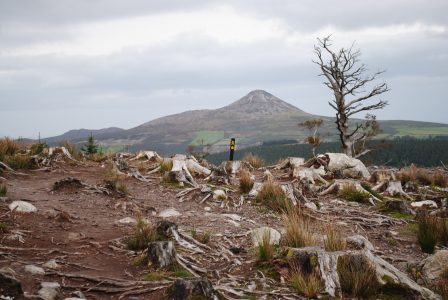
    Following a spate of out-of-control fires in Kerry and Wicklow in February last, Wicklow TD Jennifer Whitmore asked the Minister for Agriculture, Charlie McConalogue, if “farmers who have burned land during January and February 2021 without the necessary controls and permissions in place will have their single farm payment reduced”. The answer: “My Department investigates incidents of illegal burning using the most up to date technology and satellite imagery.  Where such investigations identify land that has been illegally burned, such land is deemed to be ineligible for payment under the BPS [Basic Payment Scheme]”. This reads to me like they don’t know whether out-of-control = illegal. We’ve put in another FOI in an effort to get clarity.

    Where groups have tried to burn within the rules and within the permitted season they have found that the weather and the availability of trained personnel has limited their plans.*

    All of this shows how there is virtually no such thing as ‘controlled’ or ‘prescribed’ burning in Ireland. Leaving aside the disastrous environmental impacts of fires on peatlands, it is no longer tenable for farming groups to claim that fire is ‘essential’, desirable or even feasible.

    Burning of land, whether it’s controlled or otherwise, is a failure of land management and is largely a product of putting sheep at the centre of upland farming models. If we remove the sheep from the equation we can see a whole new spectrum of possibilities opening up, from rewilding of upland woodlands and bogs, to nature-friendly grazing with small cattle on drier areas for those who want to continue farming. But there is no policy to support this.

    With increasing focus on the potential of peatlands for storing carbon, as well as new polices on farming and forestry on the near horizon, this policy black hole is crying out to be filled.


    *This article has been updated because the original said that no planned burning had been carried out by the SUAS farming group in Co. Wicklow and that was incorrect, sorry.

    [i] Teagasc National Farm Survey 2019 Results

  • Chapter 7: Pearl Valleys Farmland

    Chapter 7: Pearl Valleys Farmland

    Chapter 7: Pearl Valleys Farmland

    And precious their tears as that rain from the sky

    Which turns into pearls as it falls in the sea

    Thomas Moore (Irish poet 1779-1852)


    by Naomi McBride

    The water was slightly murky but as the swirling vortex slowed I could see the outlines emerge from the bottom of the tank. Even then it took a few moments for my eyes to adjust; the colour and shape of the creatures perfectly blending with the dark rocks which had been placed around them for support.

    I had been expecting more for some reason, but there were only a handful, ten maybe, in the tank. A far cry from the thousands, perhaps even millions, which once formed their company. They seemed lonely to me and their fate desperately precarious as I stared at them, leaning over the side of the plastic tank that was their temporary home.

    “You should have been here yesterday,” Paul says. “The water was crystal clear. But it rained a lot overnight and that washes sediment into the water so unfortunately the view is not so good today”.

    I stare at them a bit longer and Paul points out the small trout. I would have missed them as they too are perfectly camouflaged – dark backs against the black stones. I was expecting the fish to be bigger but Paul explains that they have to be young fish if the project stands any chance of success. Then he turns the pump back on and the water starts to swirl again. It’s important that the water keeps moving to provide oxygen and a constant supply of tiny food particles. “It’s terribly sad to see them going extinct, but we’re going to do what we can,” he says.

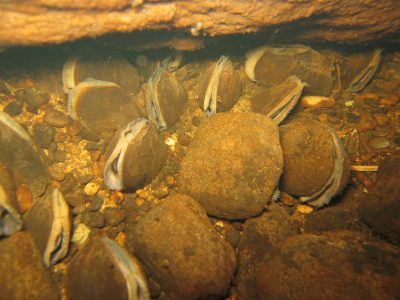
    Freshwater pearl mussels. Image source: Eugene Ross

    The freshwater pearl mussel is a bivalve, belonging to the family of invertebrates which have two shells joined by a hinge, like the common blue mussels which are enjoyed with chips or the cockles and clams which are similarly prized by gourmands.

    As an icon of conservation, alas, it fails on many fronts. It is fairly plain to look at, practically no one has heard of it or could identify it among a bivalve line-up, and it’s the opposite of ‘charismatic megafauna’ – with no eyes or fur and no behaviour to endear it to an internet audience.

    Yet there is much more to this mollusc than meets the eye. Beneath its bland and sedentary exterior there sometimes dwells within a pearl as alluring and lustrous as any from its marine bivalve cousins and for over a thousand years these have been greatly sought after in Ireland.

    The Tuatha Dé Danann, a mythical race of deities, knew that swallowing a pearl would endow them with the gift of eternal youth. There are suggestions that the Phoenicians traded with Irish pearl collectors in ancient times while their association with high status and royalty can be seen on the façade of Dublin’s Custom House, where Edward Smyth’s representation of the River Bann is crowned with strings of pearls[i].

    But the folklore pales in significance when compared to the story of freshwater pearl mussels themselves. In Irish waters they are known to live to well over 100 years old, while in more northerly regions they may reach twice that and so are among the longest-lived animals in the world.

    Adult mussels spend most of their lives rooted in one spot, usually in rivers though they are historically also known from a number of lakes. Males release their sperm into the water which the nearby females then inhale.

    The fertilised eggs are nursed within the mother’s bosom until conditions are right, when, following cues which may be linked to temperature or movements of the moon and stars (no one knows!), they spawn in unison, sending billions of fertilised eggs in a cloud of pearl mussel plankton to be carried by currents downstream.

    The tiny larvae are on a mission. To survive, they need to be inhaled by a salmon or trout and as they pass through the fish they will clasp themselves to the gills where they can develop in safety for about a year.

    When they are ready, the young freshwater pearl mussels – known as glochidia – will release their grip on the gills and sink to the bottom of the river. A tiny foot then gropes in the gravel for just the right spot and then, when satisfied, it will orient itself, supported by the surrounding stones, for its filter-feeding future of a century or more.

    At somewhere between seven and 15 years of age it will be sexually mature and will remain fertile, producing billions of young, right until its death.

    Commercial exploitation of mussels typically involved extracting the animals from their riverbed home and opening the shells to see if there was a pearl inside. This invariably resulted in the death of the mussel and since only about 1 in 1,000 actually had a pearl the process was massively destructive and wasteful.

    Overfishing of whole catchments is known to have occurred so that by the early 1900s the commercial exploitation of pearls had more or less ‘died out’[ii].

    Nevertheless, the mussels’ prodigious ability to reproduce along with intact river systems and the great numbers of salmon and trout surging through them, meant that populations remained widespread, if much reduced in absolute numbers.

    But in recent decades the mussels have stopped reproducing. Land use change not seen since the felling of the ancient forests has transformed the landscape. A combination of malfunctioning private septic tanks, crumbling urban wastewater treatment systems, industrial forestry and farming activities, obstructions along rivers such as hydroelectric dams as well as landscape-scale drainage of land has led to a collapse of our natural river systems.

    The mussels, adapted to clean water, have not coped with this transition and are disappearing. Since the introduction of the European Union’s Habitats Directive in the early 1990s the freshwater pearl mussel has been a protected species and back then we committed to restoring populations.

    But this has not been effective. According to the latest assessment (2019) from the National Parks and Wildlife Service (NPWS) many populations have decl ined within the last decade to the point of near extinction stating that:

    “the observed acceleration of population decline and further decreases in recruitment rates are alarming and raise questions as to the restorability not only of the small populations on the verge of extinction, but also of some priority populations with hundreds of thousands or millions of mussels. […] Riverbeds have become so clogged with silt, algae and rooted plants that young mussels can no longer survive. In many rivers, adult mussels have become stressed and are prematurely dying owing to habitat deterioration”[iii].


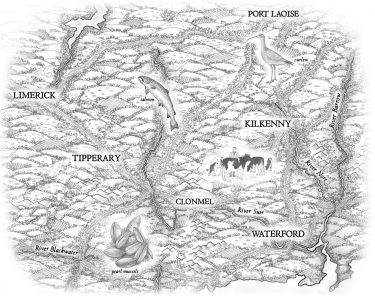
    Paul Carroll works for Waterford County Council at the water treatment plant in Kilmeadan, just west of Waterford Town. Here, water extracted from points within the catchment of the River Suir is treated to a drinkable standard in a series of tanks before making its way to homes and businesses in the Waterford area.

    Two years previously Paul joined with local groups to improve the lot of the freshwater pearl mussels which live along the Clodiagh River, a tributary of the Suir.

    With assistance from Irish Water, the body that runs the treatment plant, Inland Fisheries Ireland, the NPWS and Dr Evelyn Moorkens, the foremost authority in Ireland on freshwater pearl mussels, he has set up two tanks where he hopes the mussels can be captive bred.

    “We originally thought there were over a thousand mussels left in the Clodiagh River” he tells me, “but our most recent surveys tell us there’s now maybe less than 100. We’re failing to protect them… you’d need to be super optimistic to think we’re going to meet the targets”.

    “you’d need to be super optimistic to think we’re going to meet the targets”

    The targets he refers to is the Special Area of Conservation along the Clodiagh River which was designated specifically to restore ‘favourable status’ to the mussel population. In particular a target of restoring the population to 10,000 mussels was identified in a 2017 NPWS report.

    Paul winces when I ask him how he thinks this population is going to be restored. “The youngest mussel we have is 40 years old. There are no young mussels surviving to adulthood, with the very low numbers now in the river they may be gone completely in 10 years or so. The clock is ticking.”

    Paul brings me round the back of the main building to show me the captive breeding tanks which he has set up. He explains how the glochidia need to attach themselves to the gills of a salmon or trout but as the fish grow they develop an immunity which prevents the glochidia from attaching. Hence the need to use young fish in the tank.

    He tells me that while the adult mussels are surviving and spawning and the glochidia are finding their host fish, when it comes time for the larvae to drop off the fish the river bed is too clogged with silt and sediment, and the water quality too poor, for them to develop into adults. An ancient cycle that has been turning since the end of the Ice Age has creaked to a halt.

    “We’re taking a twin-track approach,” Paul explains. “We are trying to artificially create conditions to rear the mussels up to about five years of age, then we can put them back in the river when they can survive on the own. But we also need to work at the catchment level to stop the pollution entering the river in the first place. And that’s a massive challenge”.

    Paul is working as part of the Local Authorities Water Programme, something which is bringing together communities to highlight the value of clean water as well as to promote solutions to issues faced by the river.

    This was established as part of Ireland’s implementation of the EU’s Water Framework Directive, something which stipulated that all our waters were to have achieved ‘good status’ by 2015 except where there were exceptional circumstances. As well as greater cooperation and communication, a team of ‘community water officers’ has been hired.

    They are surveying entire river catchments to identify pollution sources and putting a human face on government initiatives. When it comes to conversations with farmers and landowners Paul concedes “it’s a delicate discussion”.

    They have no extra money to offer farmers for changing practices. The solutions which are commonly promoted such as leaving buffers along streams and ditches, digging sediment traps and fencing rivers to keep out livestock are important but small steps (as I write some funding is being sought to implement some of these solutions).

    What’s really needed is a transformation of agricultural policy, that’s the Common Agricultural Policy which is decided among the 27 nations of the EU and, with the departure of the UK, is likely to see a cut in its budget.

    “What’s really needed is a transformation of agricultural policy, that’s the Common Agricultural Policy”

    But Paul and the Local Authorities Water Programme (LawPro for short) have allies.

    The Portlaw Heritage Group, based at the bottom of the River Clodiagh catchment, have understood the importance of the freshwater pearl mussels in their local river and have taken the conservation project under their wing.

    With their help, LawPro are setting up a “Friends of the River Clodiagh” group to include the villages of Rathgormack and Clonea along the entire river catchment.

    Paul drives me about 20 minutes outside of Kilmeadan to the magnificent Curramore House estate, home to the ninth Marquis of Waterford and a Victorian mansion which surrounds a castle dating to the 12th century.

    It was built by the de la Poer family which came to Ireland from Normandy at the time and sits within 2,500 acres of land including woodland and grazing pastures along the banks of the Clodiagh River.

    The current manager of the estate, Alan Walsh, is a keen supporter of the freshwater pearl mussel project and is not only helping to improve the water quality running off his land, but has offered the use of the Curramore Stream, a rivulet that flows into the Clodiagh, as a donor site for Paul’s captive-reared mussels. The surrounds are idyllic, with dense woodland and formal gardens which draw the eye to the impressive old house.

    Paul and I stand on a bridge looking down on the clear waters below. The early winter air is cold but fresh and the colours of the fading leaves are exquisite.

    “It’ll be an ideal site” he says, “not only as a refuge for the mussels but as a place where walkers can see these most threatened species in their native habitat. We hope we can install an information panel that will help to tell the mussels’ story to the passers-by.”

    Because the Curramore Stream is small, and originates on the land within the estate, the water quality can effectively be controlled. But once the mussels enter the main channel of the Clodiagh River they’re subject to all the pressures from throughout the catchment – from the degraded uplands to the intensively farmed fields in the lowlands.

    When I visit Paul in November 2019 he tells me that he is awaiting a visit from Dr Moorkens who will examine the small trout for signs that the tiny glochidia have attached themselves to the gills. Then it will be a question of waiting for the glochidia to fall off and nursing them to the point where they can survive by themselves.

    When I look at the fairly low-tech plastic tanks and pumps used to keep this project going, and when I see Paul prepared to devote years of his own time in providing the slimmest lifeline to a vanishing species I can’t help but feel conflicted. Full of admiration for what he is doing and a surge of hope in the face of our extinction crisis yes – but also a feeling of despair that the response is not greater.

    If the freshwater pearl mussel is to survive, we’re going to need a lot more tanks and a lot more people like Paul.

    “we’re going to need a lot more tanks and a lot more people like Paul”

    Three weeks later he sends me an email: “Just to let you know that Evelyn [Moorkens] was down today to check the gills and there was good glochidial encystment! [the larvae attached to the fish] Plenty more work to do but it’s great to get a positive result for now.”

    For the moment, hope has the edge in the fight to save the mussels.

    —

    Over-grazing, burning and erosion of peat in the uplands along with clear-felling of conifer plantations leaving swathes of bare soil are all sources of sediment washing down from the hills.

    But when rivers reach the lowlands they enter the large agricultural areas. Here, modern farming promotes land drainage which changes the pattern of water flow – faster in flood and drying out quickly in drought – and which can carry large quantities of sediment off the land.

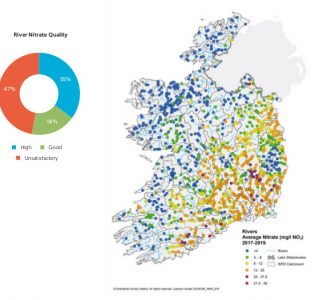
    Pollution of rivers from nitrates is concentrated in the south-east of Ireland (Image source: EPA).

    Ploughing fields exposes soil to the elements while leaving fields bare after harvesting crops (typically during the wet winter season) is another source. But even so-called ‘permanent pasture’ where cows are grazed outdoors for most of the year is now a problem. Pollution comes from nutrients in manure and artificial fertilisers, land drainage and disturbance of soil from the trampling of hooves.

    According to the Environmental Protection Agency farming in Ireland is the greatest source of water pollution, not only sediment but run-off from manure and chemical additives such as artificial fertilisers and chemical sprays. In 2019 their report on the status of our waters shows a near disappearance of ‘high status’ water bodies and a reversal of previous trends which had begun to show an overall improvement. It is not a coincidence that the decline of the pearl mussel has matched that of our water quality.

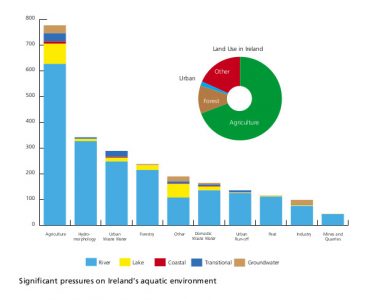
    Agriculture is the dominant pressure on water quality in Ireland (Image source: EPA).

    In 2011 the government prepared a strategy for the conservation of the freshwater pearl mussel in Ireland. It highlighted how we have 46% of the entire EU population, emphasising not only how the mussels have declined throughout their range but also the vital role we must play if they are not to go extinct entirely.

    Under the Habitats Directive Ireland designated 19 Special Areas of Conservation holding 27 populations of mussels. The plan stated at the time that out of 96 populations only one was assessed as ‘favourable’.

    In assessing mussels’ prospects it differentiated between those areas where there are still relatively high numbers in a small river catchment and where conservation measures were likely to produce results, and those where mussel numbers were low, in very large river catchments and where it was felt that the measures required would not be successful – at least in the short-term.

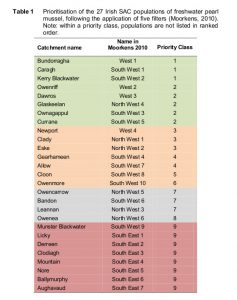
    It concluded that eight populations, all of which are in the north and west of the country, should be given top priority and since the plan’s publication we have seen the roll out of special programmes to address pollution in these areas.

    However, as we move down the list it becomes clear that the scale of the task to save the mussels becomes overwhelming. Eight of the catchments, all of which are in the highly productive farming areas of the south-east and south-west, have a mere 0.35% of the national population with what the plan describes as “a large number of significant point sources and highly intensive agricultural land use over large areas of the catchment.”

    It went on say that “it is unlikely that any of the six south-east populations… can be restored” and recommend that the efforts to protect these mussels should be wound down, even going so far as to suggest that the protections be removed from some areas altogether, such as the Rivers Suir, Slaney, Nore and Barrow. Such a strategy would mean the swift extinction of freshwater pearl mussels from the entire south-east. It’s also a strategy which appears to be working.

    As part of the research for this project I tried to get to the bottom of why it has been decided that freshwater pearl mussels are to go extinct from rivers where it has thrived for thousands of years.

    why has it been decided that freshwater pearl mussels are to go extinct from rivers where it has thrived for thousands of years?

    Is it because it is too expensive? The NPWS report states that “it is very unlikely that [conservation] measures, if applied and irrespective of cost, would be effective”.

    Or is it just that it’s too difficult? We have laws in place, many of which were passed years ago, to clean up our waterways and ensure that endangered species like the pearl mussel are restored to health. Yet these have not been effective because they have not been implemented with any degree of enthusiasm.

    It’s all about priorities (source: NPWS)

    Apart from the moral conundrum, is it even legal to decide that the freshwater pearl mussel can be jettisoned because the challenge of saving it is too great? The answer, thankfully, is no.

    While in 2018 then-Minister for Culture, Heritage and the Gaeltacht, Josepha Madigan, removed the freshwater pearl mussel from a list of conservation objectives for the River Blackwater in County Cork, the High Court found in favour of a legal challenge to this decision – so the protection remains.


    When you appreciate just how clean the water needs to be to allow the juvenile mussels to proliferate, they can seem unreasonably exacting in their demands. Certainly, they seem far fussier than any other animal that we know of – more so even than fish like the Atlantic salmon which is also suffering from the effects of water pollution.

    But then this shows just how much we have affected our river systems – the mussels, after all, were prolific in their reproduction for thousands of years.

    It’s only since the 1950s that things started going seriously downhill for them. So what would it take to restore our rivers in the south-east? Investing in wastewater treatment plants for towns and cities is a financial decision and so should be straight forward.

    Giving local authorities and the Environmental Protection Agency the resources to enforce provisions for private septic tanks, quarries and sand pits is similarly a financial decision. Which leaves us with the elephant in the room – farming.

    Changing how we farm is not merely a decision on how we spend public money, though it is that. It is also a cultural and social domain. The food industry is deeply embedded within the export-driven, growth-fixated psyche which lives like a parasite in the brains of economists, politicians and civil servants. Fixing the issues in agriculture means evicting the invader. And if we’re to measure success in this endeavour we need look no further than an inconspicuous, dark-shelled mollusc which, very occasionally holds within it a pearl of the most exquisite beauty.

    —

    The valley of the River Suir, along with its sister rivers throughout the south-east of Ireland – the Blackwater, the Nore, the Barrow and the Slaney are the main (read profitable) agricultural-producing areas in Ireland. These are the areas renowned for centuries for their fertility and are the centres of Ireland’s more recent boom in dairy farming.

    The removal of dairy quotas in 2015 has seen a rise in income for farmers in this sector, the only sector of food production in Ireland which is profitable (although still heavily dependent upon subsidies).

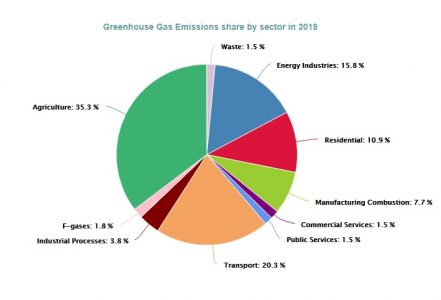
    As well as the issue of water pollution, agriculture in Ireland is the largest contributor to Ireland’s greenhouse gas emissions and the greatest driver of species extinction and so is operating way beyond the limits of nature.

    While exports of food and dairy products like powdered milk are booming, prices for farmers’ produce, particularly beef but also sheep, vegetables and grains, is static or falling.

    In 2019, the head of the farm advisory body Teagasc, revealed that farm incomes had dropped by 20% on the previous year to €23,482 and warned that 30,000 farmers face poverty. That year saw a splintering of farm representative bodies and blockades of meat plants by angry beef farmers because of low prices.

    The popular RTÉ programme Ear To the Ground claimed in December 2019 that the number of vegetable growers in Ireland had halved in the last 20 years with a mere 160 growers left in the country. Even in the much touted dairy sector, the number of dairy farmers has fallen from 80,000 in the 1980s to only 18,000 today. In what has been referred to as the ‘dairy paradox’, industry expansion actually means fewer people working the land.

    Farmers blame supermarkets for the squeeze but they are also feeling the pressure to improve their environmental performance alongside a growing cultural shift towards veganism and vegetarianism. There are some who suggest that farming itself is coming to an end as food technology will advance to the point that all essential nutrients can be artificially manufactured from widely available resources – effectively creating food out of thin air.

    Farming as it was known for thousands of years went through a transformation in the post-war years. Whatever happens now, it’s about to go through another one. Can this be done in a way the saves farmers and beleaguered species like the freshwater pearl mussel?

    —

    There are farmers who are finding a way.

    It’s Halloween when I roll up the driveway to the home of James Foley. James is a dairy farmer in the townland of Cooleydoody in County Waterford. He comes from a farming family and his father is still farming in Dungarvan, not too far to the south-east of here.

    His wife, Clodagh, also has farming in her blood and together they are raising their young twins in this bucolic corner of Ireland. James and Clodagh’s farm lies on the brow of a hill overlooking the surrounding green fields and hedgerows.

    Not far to the north flows the River Blackwater, a renowned salmon river and one which was once home to healthy populations of freshwater pearl mussel. Today, the water quality is decent enough and the salmon fishery is among the few in Ireland which is open to catch and release angling, but the pearl mussels are not doing so well.

    One of the tributaries, the Lickey, saw its population plummet by over half between 2005 and 2009. But despite government efforts to remove protection for the species in the river, there are still many thousands of mussels and it is one of the few rivers where juveniles have been recorded. There must surely be hope yet for recovery.


    James has been trying something new on his farm and soon after a dinner of homecooked ham and cabbage he enthusiastically grabs his shovel, beckoning me to follow him through the yard and onto his experimental field. His field looks different for a start – although it’s nearly November the plants are still waist-height.

    “I get farmers looking over the hedge at it, they think the field is rough looking, they think it’s full of thistles” James says.

    It is rough looking, not like the carpets of shiny green fields that we’re used to looking at. For many decades, farmers have been encouraged to seed their fields with a single species of grass – perennial rye mostly – a grass that has been referred to as the ‘Ferrari’ of Irish dairying.

    This monoculture has been largely responsible for the loss of wildlife from the centre of fields but it also means a monoculture in the bits we can’t see: the soil.

    Replacing natural diversity with homogeneity affects the structure of the soil, reducing the level of biological activity and leading to poor health of the soil overall.

    “Most soil in Ireland is practically inert” James asserts. “We’re told to reseed with just one grass species and then douse it with artificial fertiliser to grow as much grass as possible. But this is terrible for the soil – most of the nitrogen ends up going into the air or washing off the land”.

    “Most soil in Ireland is practically inert”

    James is right; although soil is an enormous store of locked-up carbon, in Ireland monoculture fields are greenhouse gas emitters, due to the methane from the animals themselves but also due to the nitrous oxide which comes off the fertiliser.

    Artificial nitrogen has also been referred to as the ‘crack cocaine’ for perennial rye, a dependence that costs farmers thousands of euro every year to maintain the high. In 2018, at the height of a drought which stretched through the Irish summer, James reseeded one of his fields. But this time, instead of just one species, he sowed a mixture.

    Among the plants were chicory, which has pale blue flowers that are popular with bees, ribwort plantain, an inconspicuous plant with roots up to a metre in depth, and bird’s-foot trefoil, a native species also popular with bees and which, being a legume, can fix its own nitrogen from the atmosphere.

    Bird’s-foot trefoil is also a food plant for at least five of our butterfly species. James hopes that other native plants will colonise the field over time. “The hedgerows about the farm are full of native wildflowers and are a bank of biodiversity” he says, “hopefully some of them will make their way into the pasture. We’ve known for a long time that hedgerows are great for wildlife, but we want to get nature back into the centre of the field – that’s where most of the land is!”

    Bird’s-foot trefoil: good for butterflies, good for soil fertility

    Despite the drought, the plants flourished. “You should have seen the amount of butterflies in this field over the summer, and there were none in the one beside us. You could even see there were more swallows over this field because there were more insects generally.”

    James clearly gets great pleasure from seeing wildlife return to his farm, but this is not the main reason why he wants a diversity of plants growing in his field. “I have a family, I have to make my farm profitable. I think that learning from nature can improve the health of my animals and reduce my costs – I’m not putting any artificial fertiliser or pesticide sprays on this field” he says.

    James is part of a group of farmers in this part of Ireland who are promoting ‘regenerative farming’. It has been described by the scientists behind the Drawdown Project as farming which includes “no tillage, diverse cover crops, on-farm fertility (no external nutrient sources required), no or minimal pesticides or synthetic fertilisers, and multiple crop rotations, all of which can be augmented by managed grazing”.

    The Project ranked regenerative agriculture at 11th in terms of its potential climate benefit, calculating that it has the potential to reduce carbon dioxide emissions by 23.15 gigatonnes and savings of US$1.93 trillion by 2050[iv] (former US vice-president Al Gore is a fan). It has elements of the more familiar organic farming but chiefly the difference is the focus on the soil. The report produced by the Regenerative Farming Ireland group states: “Regenerative agriculture is about working with nature’s many natural cycles to provide nutritious food with a minimum environmental footprint. It is also about the regeneration of the families that are at the heart of so many food systems. It is about their economic viability and their rewards being derived from the consumer, not the taxpayer.”

    James and his colleagues are joining the dots between the multiple pressures facing farmers and have found that the answer to many of their problems has been largely under their feet all along. To demonstrate what we’re talking about, James seizes his shovel and drives it into the ground. He does this repeatedly, at right angles, lifting a cube of earth and laying it to one side.

    There are farmers who are joining the dots

    We crouch down and peer into this small pit. “The chicory has a deep tap root,” he explains, “and this breaks up and aerates the soil much deeper than the perennial rye grass. This means rainwater can percolate deep into the soil, something that can’t happen where the soil has been compacted”.

    The earth in his hands is quite dry and crumbly and it’s full of worms – this is a good sign. Earthworms are vital for soil health but a study from England showed that worms were rare or absent from 40% of fields[v] (we have no information from Ireland about the worms or the biological health of the soil more generally).

    Deep roots and earthworms greatly improve drainage and this works to the farmers’ favour during times of drought (as the plants can avail of water stored deeper in the soil) and at times of flood (absorbing water that would otherwise sit on top of the field). James repeats the test in his neighbouring field, where there is only one type of grass plus some clover. Here the soil is noticeably different, much more gluey and dense, and not so many worms. His cattle enjoy grazing the variety in their new field and, so far, he has noticed no difference in his productivity.

    But the advantages of this approach don’t stop there. Green plants actively photosynthesise light and transfer liquid carbon through their roots into the soil. Taller plants, with more leaves and more varieties of them, do this with much greater efficiency than a thin layer of one type of grass. James is availing of an abundant and free source of carbon and nitrogen which are contained in the air at all times and using them to build resilience and fertility in his land.

    Grazing cattle leave their dung on the ground to be colonised by dung beetles. The beetles, of which a number of species have been identified in Irish fields, actively carry the dung back into the soil where the nutrients are recycled. There is even evidence that dung beetle activity can reduce the amount of methane from the cowpat by burrowing into and aerating it, thereby reducing overall greenhouse gas emissions[vi].

    The widespread use of ivermectin to combat parasites in cattle, and which is toxic to dung beetles, has led to the decline of these important insects on Irish farms.

    Dung beetle

    Meanwhile, the structure of the vegetation, both above and below ground, holds the soil together, meaning erosion is virtually nil and, because fertility comes from nature and not a bag, the pollution from artificial nitrogen use is avoided.

    Regenerative techniques, if used alongside much greater tree planting on farms, active hedgerow management and the protection of river corridors through the creation of broad buffer zones where farm animals are excluded, hold the key to eliminating water pollution from agriculture and reducing the greenhouse gas emissions from Irish farms.

    James’ field is small but he hopes to expand his multi-species meadows to the rest of his land in the coming years. He’s one of thousands of farmers in the Blackwater valley where, if regenerative farming became the norm, the effects would literally trickle down to the river where we could see the freshwater pearl mussels rebound.

    —

    Environmentalists are frequently heard calling for Irish farmers to diversify away from a reliance on beef and dairy. It’s one of the central themes of the Regenerative Farming Ireland manifesto.

    Beef and dairy in particular are under fire for the large environmental impacts associated with the way they are produced in Ireland. Many consumers have responded by turning to vegetarian or vegan diets while farming groups have reacted angrily, pointing to the large environmental impacts of some plant foodstuffs such as imported avocados or almonds. Yet the science is clear.

    In 2019 the Intergovernmental Panel on Climate Change (IPCC) published their special report on land, stating that:

    “balanced diets, featuring plant-based foods, such as those based on coarse grains, legumes, fruits and vegetables, nuts and seeds, and animal-sourced food produced in resilient, sustainable and low-GHG [greenhouse gas] emission systems, present major opportunities for adaptation and mitigation while generating significant co-benefits in terms of human health”.

    So major dietary shifts are needed. But it’s not as simple as reducing the argument to meat/dairy versus vegan. As farmers like James are fond of saying: ‘it’s not the cow, it’s the how’.

    “So major dietary shifts are needed”

    But in Ireland, only a tiny fraction of the meat and dairy products we produce, not only from cattle but also sheep, pigs and poultry, can be considered to be from ‘low-emission systems’. The IPCC also highlighted the need to reduce food waste, currently between 25 and 30% of all food produced is thrown out, something which is responsible for up to 10% of all greenhouse gas emissions. Moving away from animal agriculture altogether is not required but bringing it back within the limits of nature is necessary and will require major changes. Are these necessarily going to be painful for farmers?

    Farmers involved in tillage (cereal grains such as barley and oats) and horticulture (the growing of fruit and vegetables) have been under similar strains to other sectors. Yet these plant-based systems are not free from environmental impacts. Cereals are typically grown to feed animals rather than people and so are an inefficient use of land. Fields in tillage, where soil is ploughed or left bare over the winter months, are sources of carbon dioxide and sediment run-off while degrading the biology of the soil. The sector is heavily dependent on the use of chemical sprays such as the herbicide glyphosate, without which tillage farmers say they cannot operate.

    The IPCC recommends the use of no-till systems (i.e. using alternatives to ploughing when sowing crops) and planting cover crops (plants which can be sown straight after harvesting the main crop, thereby covering any bare soil, reducing erosion and adding carbon back to the soil through photosynthesis). There are a number of farmers in Ireland already following this advice (see www.baseireland.com).

    Fruit and vegetables grown in Ireland should have a bright future. When I visit Con Traas at his orchard in Cahir, County Tipperary I find him surprisingly upbeat considering the generally gloomy pall which has descended on the farming community.

    “Horticulture in Ireland is nearly as valuable as the sheep and tillage sectors put together,” he tells me (and later sends me the figures to prove it). “But it should be a lot bigger. We currently import 95% of our apples but we could be growing half of them here. Also, Ireland is ideal for crops like celery, onions and potatoes but we nevertheless import a lot of these crops”.

    Con helped to set up the Horticulture Industry Forum in 2014 to represent the sector’s interests. He tells me that the big supermarket chains control 90% of the retail market and use this bargaining power to squeeze margins to the bone. This means cheaper food for consumers but much of this is being sold below the cost of production, a tactic used by the supermarkets to lure shoppers through the doors.

    “This totally undermines the value of the food we’re producing, discourages investment or new entrants and ultimately is a threat to our food security” Con says.

    The low profit margins made by fruit and veg growers have left them vulnerable to weather extremes and Con worries about the impacts climate disruption will have on his orchard. In 2018 he lost 20% of his crop after a particularly fierce storm hit right at harvest time. In 2015 the Horticulture Industry Forum highlighted that unless the issue of below-cost selling was addressed, Ireland’s capacity to sell fruit and veg will be “seriously diminished”. The forum called on the government to implement a ‘National Food Policy’ noting that much of our food is imported, sometimes from considerable distances and which leaves us vulnerable to food shortages.

    When defending Ireland’s export-driven and environmentally ruinous food production model, the government and the large farmer representative bodies frequently cite its contribution to global food security. They are often heard quoting United Nations projections on population increase – currently 7.8 billion – but expected to rise to 9.8 billion by 2050.

    There’s no doubt that feeding the world while maintaining a habitable planet is the greatest challenge faced by humanity. Yet the global food system is riven with inequality. According to an editorial published in The Journal of Sustainable Agriculture in 2012 we were at that time producing enough food for 10 billion people yet the UN’s Food and Agriculture Organisation (FAO) says that the number of undernourished people has been rising since 2014.

    The FAO said that, in 2017, 821 million people did not have enough to eat. The authors of the editorial were emphatic that “hunger is caused by poverty and inequality, not scarcity… In reality, the bulk of industrially produced grain crops […] goes to biofuels and confined animal feedlots rather than food for the one billion hungry. The call to double food production by 2050 only applies if we continue to prioritize the growing population of livestock and automobiles over hungry people.”[vii]

    They argued that agro-ecological methods, such as organic and/or regenerative production models, hold the key to feeding the world. The Irish industry/government drive is doing nothing for global food security and is, in fact, undermining our own food security by creating a production model that is increasingly reliant on imports and one which is vulnerable to disruptions in fragile distribution systems. For example, in 2008, 42 countries banned food exports in order to secure their own supplies – something that is likely to become more common as the effects of global heating intensify.

    A 2019 article in the influential journal Foreign Policy declared that climate collapse “will rip the heart out of [Asia’s] food system, leaving 800 million people in crisis. And that’s just Asia. In Iraq, Syria, and much of the rest of the Middle East, droughts and desertification will render whole regions inhospitable to agriculture. Southern Europe will wither into an extension of the Sahara… intensive droughts could turn the American plains and the Southwest into a giant dust-bowl”.

    The other main defence of the status quo in Ireland is that we are very efficient producers of beef and dairy and, as demand is rising for these commodities, it is better to produce them here than elsewhere. It is true that demand is growing in places like East Asia even if meat consumption has flattened off in the West. However, our relative efficiency is completely irrelevant when faced with the absolute limits of greenhouse gas concentrations, water pollution and mass extinction.

    Indeed our use of the land, in prioritising livestock over other forms of food, or land solely for biodiversity, is notably inefficient. The current system does not even have the benefit of claiming that it is delivering for farmers, many of whom are increasingly disillusioned and/or broke.

    Globally, livestock provide just 18% of calories but take up 83% of farmland

    “in prioritising livestock over other forms of food, or land solely for biodiversity, is notably inefficient”

    Con does not fall into this category. His orchard near the River Suir has been growing apples, pears, plums, sweet cherries, strawberries and raspberries since 1968 when his parents moved to Ireland from Holland.

    Since the early 1970s they’ve had a shop on the farm, selling their produce directly to customers, including an apple cider which – I can confirm – is delicious (see www.theapplefarm.com). As well as the shop they run a campsite during the summer months and Con is happy with prices he gets from his larger customers, including the Dunnes Stores chain, which he says is willing to pay a premium for Irish-grown apples.

    Over a slice of apple tart, Con and I talk about how a carbon tax on food might make locally grown fruit and vegetables more competitive while Con suggests that a nitrogen tax might encourage better soil management and reduce pollution. Although the below-cost selling of food has been repeatedly highlighted as an issue for Irish growers, this has so far not gained any traction with governments.

    In 2017 Ireland imported 72,000 tonnes of potatoes, 47,000 tonnes of onions, 29,000 tonnes of tomatoes, 23,000 tonnes of cabbage and 15,000 tonnes of lettuce valued at €175 million. If we are to shift to more plant-based diets surely the decline of the horticulture sector at once is problematic but also presents an opportunity for Irish farmers?

    —

    Eating is a political act, and politics does much to shape our food system. If we want changes to the way in which we farm, it will have to come from politicians. So no analysis of Irish farming can be complete without talking to one.

    “Eating is a political act”

    In fact, I get to speak to two – Pippa Hackett is a Green Party senator from County Offaly while her husband Mark is a councillor on Offaly County Council. They are also organic farmers and have big ideas for what needs to happen to change farming in Ireland.

    “Consumers don’t know where their food comes from. Many farmers don’t know where their food comes from… very few farmers today even eat their own food” Pippa laments.

    Pippa and Mark rear cattle and sheep on their land. They went organic as it was in keeping with their environmental ethos while a government scheme also means an extra €10,000 a year.

    In 2015 Ireland had the third lowest level of farmland in organic production in the European Union. At around 2% of land area, it was nearly 10 times less than Austria (at 19%) and well below the EU average of 6.2%.

    Pippa, who was appointed as a ‘super junior’ minister for Land Use and Biodiversity in 2020, told me that Ireland should be aiming to have 20% of our land in organic production by 2030.

    “We are only putting about €10 million per year into organics at the moment” she told the Irish Independent newspaper early in 2020, “it’s pathetic”. “The bottom line on the Green Party’s vision for agriculture is that we have to embrace nature in everything that we do” she added, noting that the agricultural strategies of recent governments have been ‘disastrous’.

    A common mantra is that ‘farmers can’t be green if they’re in the red’ and I ask Pippa and Mark if it is possible for farmers to make a decent living while farming in an environmentally-friendly way.

    “Absolutely,” they chime. “Since going organic we have seen our veterinary costs decline because we have healthier animals, we spend nothing on artificial fertilisers or chemical sprays and we get a premium price for the beef and lamb we’re selling. There’s no doubt farming can be economically viable while protecting nature”.

    The Green Party want farming to diversify, with an emphasis on growing more fruit, vegetables, grains and nuts here in Ireland as well as ensuring livestock are fully pasture fed. Currently in Ireland we do not grow enough grass to feed all our farm animals, meaning supplementary feed has to be imported. A 2018 report by international NGOs highlighted how soy imported chiefly from South America to the European Union as feed for chicken, pigs and cattle is driving deforestation, wild fires and human rights abuses.

    We also have a growing number of feedlots here, where cattle are housed indoors permanently, including systems where animals are fed on grass which has been freshly mowed – technically still being ‘grass fed’ but never actually entering a field. Pippa feels we need greater connection to our food.

    “Every town should have a market to allow farmers to sell locally produced food straight to customers. We could make it tax free for people to rent land for horticulture or provide tax relief to those who are eating food they have grown or reared themselves”.

    Pippa and Mark’s farm is not only producing beef and lamb. They rear foals, have a pen with free range chickens (all the eggs are sold locally) while also growing pear trees and raspberries. Pippa’s excellent pear chutney (which she gifted me after my visit) lasted all of three days in my house.

    But ultimately this is a political battle. “The less is more argument is a hard sell,” she concedes. At a meeting organised by the Irish Farmers’ Association, where she was one of the only women speaking, she was booed by sections of the crowd after announcing she was from the Green Party. But she adds, people approached her afterwards to distance themselves from the booers.

    “The less is more argument is a hard sell”

    “I also get lots of people calling with ideas… there are a lot of farmers out there who know the system isn’t working”.

    When I visited Pippa and Mark’s farm in January 2020 they were gearing up for a general election in which Pippa was hoping for a Dáil seat. She has already done a lot in changing perceptions of the Green Party as being one that is solely focused on urban issues – some farmers were even saying they’ll vote for them, something unthinkable until recently.

    Pippa ultimately didn’t win enough votes for a seat but polled strongly in an election which saw the Green Party surge to its strongest performance ever (with 12 seats). She remains a senator and was appointed as Minister for Land Use and Biodiversity in the Department of Agriculture in the new administration. Her message can only become more relevant with time.

    If we are to do anything to save dying species like the freshwater pearl mussel, it quickly becomes apparent that we need to change everything. The mussels, with their complicated life cycle and demand for ridiculously high standards of water quality, are not making it easy for themselves. Yet they are also pointing to how far we have drifted from a natural system that allowed them to flourish for millennia.


    Many farmers are seeing that major changes are on the way and are correct to be pointing at the low cost of food as being directly linked to their wages and the costs associated with meeting tighter environmental regulations.

    A study in the journal Nature at the end of 2020 found that were the costs of greenhouse gas emissions paid for on the supermarket shelf then the price of meat would double and that dairy products would be 75% more expensive.

    Agriculture is the biggest source of greenhouse gas emission in Ireland (Image source: EPA).

    A kilo of Irish mince in the supermarket that today costs just over €7 would be more than €14 while a litre of milk would rise from €1.24c to €2.36. In this study, the benefits of organic meat production did not come out significantly better than conventional forms of farming. Although organic systems are clearly better for nature as they cut out the use of chemicals, they can do little to reduce the emissions of methane from animals, and that is still the biggest source of greenhouse gases from Irish agriculture (65% of the total). This highlights the inescapable link between cattle numbers in Ireland – over 7.2 million in June of 2020 – and emissions, which need to reduce by 55% by the end of this decade.

    Meanwhile, Netflix films like ‘Kiss the Ground’ have brought much needed attention to the health of our soil and the capacity of farming landscapes to remove carbon from the air. But measuring this is complicated and gains are easily lost if somehow land management reverts to industrial techniques. Are customers prepared to pay double the price for animal-based food?

    What effect will droughts and extreme weather have on our ability to produce food in Ireland?

    It’s not the cow, it’s the how… but it’s also the how many


    In a report released by the Drawdown Project at the end of 2020 on the topic of farming and climate change, the authors highlight that there is “no silver bullet”[viii]. They concluded that:

    It’s not the cow, it’s the how… but it’s also the how many

    “We strongly endorse approaches that focus both on immediate emissions reductions from the Farming and Land Use sector and long-term investments in regenerative agriculture that can advance farming practices, significantly improve local environmental conditions and soil resilience, and create substantial carbon sinks that can also help address climate change.”


    In my research for this episode I came to the conclusion that yes, we can save the save the freshwater pearl mussels, and we can do it without going hungry or putting farmers out of business. We can imagine millions of mussels once again carpeting the riverbeds of the Suir, the Blackwater and the Barrow, in a landscape with beef and dairy cows, barley and oats, apples and carrots, hedgerows and native forests.

    But to do it, we need a revolution in how we farm. This will include putting farmers and people back at the centre of our food policies. And we don’t have very long to do this. The mussels live for a very long time, but they don’t live forever.

    Artwork by: Jacek Matsiak


    [i] Lucey J. 2005. The Irish Pearl. Wordwell Ltd.

    [ii] Ibid.

    [iii] NPWS. 2019. The Status of EU Protected Habitats and Species in Ireland. Volume 3: Species Assessments. Unpublished NPWS report. Edited by: Deirdre Lynn and Fionnuala O’Neill

    [iv] Hawken P. (editor). 2018. Drawdown: the most comprehensive plan ever proposed to reverse global warming. Penguin Books.

    [v] Stroud J.L. 2019. Soil health pilot study in England: Outcomes from an on-farm earthworm survey. PLoS ONE 14(2): e0203909. https://doi.org/10.1371/journal.pone.0203909

    [vi] Slade E.M, Riutta T., Roslin T. & Tuomisto H.L. 2016. The role of dung beetles in reducing greenhouse gas emissions from cattle farming. Sci Rep 6, 18140 (2016). https://doi.org/10.1038/srep18140

    [vii] Holt-Giménez E, Shattuck A., Altieri M, Herren H. & Gliessman S. 2012. We Already Grow Enough Food for 10 Billion People … and Still Can’t End Hunger. Journal of Sustainable Agriculture, 36:6, 595-598

    [viii] Farming our way out of the Climate Crisis. December 2020.

  • Chapter 6: the Ulster Shark Coast

    Chapter 6: the Ulster Shark Coast

    Chapter 6: The Ulster Shark Coast

    Once upon a time there was a little boy who lived with his granny at Easkey. He always went down to feed the fish at the pier. He stole bread from his old grandmother for which she used to beat him, but still he did steal the bread and feed the fish.

    One day in feeding the fish the sea was very rough and he fell into it and all the people on the pier could do nothing to save him. Then to their great horror they saw a large shark appearing which seemed to swallow the little boy. But it was not so; he did not swallow the little boy.

    But to the great relief of all the people present the big shark swam to the pier and landed the little boy safely on the step unhurt.

    Then the little boy ran home rejoicing and all that was looking on went home very thankful for the boy’s deliverance. They also learned a lesson that the great Maneater of the Ocean can return thanks for the deeds of kindness.

    told by Annie Morrison, Co. Sligo, from the National Folklore Collection (1930s)[i]


    Artwork by: Naomi McBride

    “If we do not make a place where the fish can grow and live, we will not see fish here. There will be a time when there are no more fish to catch. Our future generations will only see drawings of fish in a book”.

    “First it was the salmon. Now we have lost the right to fish any type of fish. To get bait for our crab pots, we’re now forced to buy frozen fish caught by foreign trawlers. Like a baker who bakes no bread, we’re now islanders who fish no fish.”

    These two quotes are both from island fishermen.

    They tell a remarkably similar story of our rapidly changing seas – a story that has gone from plenty to scarcity, of ancient traditions disappearing, of a foreboding transformation in the vast oceans – at once lapping at our shores close to home, at once absent from our minds, our newspapers and our daily conversations.

    Were they to meet, our two fishermen would, no doubt, have many stories to share. But they are worlds apart.

    The first, Calixto Sinda from Amlan on the island of Negros in the Philippines; the second, a lament from John O’Brien from the island of Inis Bó Finne, off the coast of Donegal. Both men come from traditions where the sea runs like salt through their blood. They have seen their way of life vanish before them, the power they once had to make a living taken away from them – transferred to fewer, bigger boats by lobbyists and politicians who see little value in preserving places like Inis Bó Finne.

    The endings to these stories have not yet been written, but on Negros in the Philippines the fishing communities are now authors of their own destiny.

    In 2010 the community of Amlan and the marine ecosystem upon which it depends was “on the brink of collapse”. Commercial fishing, including the use of poison to catch fish and even dynamite blasting, was damaging the coral reefs despite falling within the Tandayag Marine Sanctuary. The sanctuary is small, only 0.06km2 and was designated in 1996. But drawing lines on maps without community support does not protect wildlife – something we know from painful experience here in Ireland.

    But in 2010 an international environmental non-governmental organisation (an eNGO), RARE, moved in – not to boss the locals around and tell them what they had been doing wrong, but to work with local activists to facilitate better management of the reserve.

    Local people were employed and government agencies were supportive, but crucially the local fishers saw they had a problem and could see the benefits of doing things differently. The community helped to design a reserve area where no fishing would take place. This allows space for fish to grow and spawn. The extra fish fry increase populations of fish which spill over into areas where fishing is permitted and so catches increase.

    In 2018, working with scientists who identified their waters as critical recruitment zones for fish, the community themselves decided to more than triple the size of the reserve from nine hectares to 30 hectares.

    According to one local official, “the community is vital to the success of the Marine Protected Area (MPA) because they are the ones who are there, so they are the managers… without the community it would not be successful”.

    Image source: WWF

    In 2019 RARE backed ‘Fish Forever’ projects in ten countries, mostly in the tropics, supporting one million fishers. Since the MPA at Amlan was managed, the amount of sealife has ballooned from a low of 13 metric tonnes in 2013 to nearly ten times that, 123 metric tonnes in 2016, only three years later!

    The community no longer feels that this is a government programme or an eNGO initiative, but something that is theirs. Vice-president of the project, Steve Box, summed it up by saying “it’s not really about the fish. It’s about people, coastal communities, and fishing as a livelihood, a job, and a way of life”.

    It’s a sentiment that John O’Brien and fishermen on islands around the coast of Donegal might agree with.


    Ireland has a twin problem when it comes to sea. Firstly, the ecosystem has collapsed to such a degree that it only supports a tiny fraction of the marine life it once did.

    Secondly, what remains is divided very unequally. Within the European Union’s Common Fisheries Policy Ireland gets a very small share of the catch and that catch is distributed (by the state) to a very small number of players. Following the Brexit trade deal between the EU and the UK, agreed on Christmas Eve 2020, Irish fishermen took another hit as the amount of fish they will be permitted to catch in UK waters will fall by up to 40%.

    “the ecosystem has collapsed to such a degree that it only supports a tiny fraction of the marine life it once did… what remains is divided very unequally”

    Meanwhile, MPAs cover a tiny extent of our seas, 2.3% at most, and none of these areas is subject to management measures. Ireland had already agreed to a target of 10% by 2020 while many scientists agree that this figure must be much bigger, more like 30% if we are to restore healthy seas. But why do we have to stop at 30%? Can’t we protect all of our seas?

    Is it possible to catch marine creatures, support fishing communities and protect the seas at the same time? The answer should be: yes. But it will mean managing all types of fishing activity that goes on, something that simply doesn’t occur in Irish waters.

    It will mean recognising that some types of fishing, like using ‘supertrawlers’ with nets the size of football stadia, dragging weighted nets across the sea floor or setting nets for a long time in areas known to be important for endangered species, are simply too damaging and need to end. It will mean setting limits for everything, not only the bigger boats but the smaller boats too and even low impact activities like sea angling and gathering seaweed.

    Bottom trawling in the seas around Ireland is extensive and highly damaging. Image source: Marine Institute Ireland.

    In 2020, new regulations were brought into force by then-agriculture minister Michael Creed which prohibited all trawling by boats over 18m in length within six nautical miles of the coast. It was to have ended the practice of ‘pair trawling’ for sprat by 2022. Sprat are a small fish that can shoal in big numbers and are the food source for everything from whales to seabirds to bigger fish. Pair-trawling involves two vessels dragging a fine-mesh net between them and, with no limit to how much can be caught, in the space of a few days the waters can be sieved clean, particularly in sheltered estuaries where the fish are gathering to spawn. It’s something that has been going on for years even in our MPAs such as Kenmare Bay, Donegal Bay and the Shannon Estuary.

    That much of this fish was being churned up to make fishmeal, and so not even earning much for the boat owners, underlined the insanity of this type of fishing. When the consultation on the trawling ban was opened to the public, the Department of Agriculture, Food and the Marine received over 900 submissions. This was more than any response to a consultation from this department in relation to marine matters ever and small-boat fishers, anglers, environmental groups and ordinary citizens were united in supporting the ban.

    The big fishing industry bodies – the producer organisations – were united in opposition, and later took legal action against the move. In October 2020 the High Court upheld their complaint, the pair trawlers were back in cleaning out the estuaries only days later, and the government later took the decision to appeal.

    The new measures were important, maybe the most important we’ve seen so far, so it’s disappointing that they could not be supported by all fishermen. But even so, they don’t go far enough if proper management of our coastal waters is not put in place.

    How can we go about reorganising our view of the sea? Can we empower local fishing collectives to manage their own areas, guided by scientists providing an evidence base with rules which are supported and enforced by state agencies?

    “Can we empower local fishing collectives to manage their own areas?”


    The seas across the north coast of Ireland are cold and rich.

    The basalt towers of the Giant’s Causeway are said to be the remains of a path built into the sea between Ireland and Scotland by the giant Fionn MacCumhaill. Fionn built the path to fight a giant from Scotland, Benandonner, but, according to the legend, Benandonner took flight and destroyed the causeway behind him.

    Even today, giants can be found in these waters but these days they are less likely to be warring with one another. I once saw one while taking a boat to the Blasket Islands in County Kerry on a warm May day some years ago. We hadn’t gone to look for Basking Sharks but by chance someone spotted the triangular fin slicing through the water and the boat’s engine was cut.

    As the shark approached, we could see its outline in the clear waters below, its cavernous mouth sieving the water for tiny food particles. They’re totally harmless of course, but you could see how earlier generations might have feared them, knowing little of their habits.

    That we know anything about basking shark biology today is in large thanks to volunteer scientists in the Irish Basking Shark Study Group (IBSSG) who have been tracking and tagging the beasts since 2009.

    Image source: Basking shark by Mike Brown

    Emmett Johnston founded the organisation with Simon Berrow, better known for his work with the Irish Whale and Dolphin Group, after holding a seminar on the shark in Greencastle, Co. Donegal. Emmett went on to complete a PhD with Queens University Belfast looking at the shark’s movements, behaviour and connectivity in the North East Atlantic. Self-funded, or applying for grants here and there, the Irish Basking Shark Study Group now counts 15 scientists from home and abroad.

    “We estimate that up to a quarter of the world’s basking sharks are moving through the waters off the north Ulster coast” Emmett tells me. “That’s a lot of sharks. And it’s not only basking sharks that use this productive sea area – it’s porbeagles, blue sharks, tope, minke whales, skates, maybe even angel sharks”. The latter is a critically endangered bottom-feeder with an Irish population now likely to be in the teens or low twenties. “It’s here that the colder, nutrient-rich waters flowing up the Irish Sea meet with the warm Atlantic swells. That triggers the seasonal phytoplankton blooms and creates a flow of energy right through the marine ecosystem, from small fish to sharks and whales and even humans”.

    In 2015 the IBSSG invited Peter Klimley, also known as Dr Hammerhead and a world-renowned shark biologist, to visit Ireland. In 1999 Klimley wrote an article for Scientific American entitled ‘Sharks Beware’ in which he raised the alarm about declining shark populations across the world’s oceans. Comparing the vilification directed towards sharks following the massive success of Peter Benchley’s 1974 novel Jaws, and subsequent film of the same name directed by Steven Spielberg, to the reality of human rapaciousness, he presented a chronicle of decline of a number of species in the North-East Atlantic under the heading ‘Who’s Eating Whom’[ii].

    He detailed the collapse of shark fisheries, something in which Irish and European boats participated in Irish waters, including porbeagle sharks (decline of 97% between 1964 and 1967) and basking sharks (decline of 93% from the 1950s to the late 1960s). Klimley spoke to a packed house in Dublin’s RDS and later visited Malin Head in Donegal.

    “In global terms Ireland is not so famous for its terrestrial wildlife,” Emmett told me, “but Peter Klimley brought home to us what we are known for – being an island in the North Atlantic!” It sounds pretty obvious when it’s put like that, but the reality is Irish people are not all that engaged with the ocean that’s all around us. “Irish coastal waters stretch right out into the open ocean off the continental shelf and are some of the best shark habitats in the world!” he added.

    “…Peter Klimley brought home to us what we are known for – being an island in the North Atlantic!”

    If Irish people know little about the sea around us, even fewer of us are likely to be aware of its importance for sharks. Yet a remarkable 71 species of sharks and rays have been described from our waters.

    In 2018 researchers from the Marine Institute, based in Oranmore outside Galway and using roving cameras at depths of 750 metres below the ocean surface, discovered a ‘shark nursery’ – a vast accumulation of shark egg cases. This was something never before seen in Irish waters and the researchers speculated that the female blackmouth catsharks gathered in this spot because it was a healthy coral reef, so providing protection for the young sharks upon hatching out of their leathery egg cases.

    That’s right – a ‘healthy coral reef’ 750 metres under the sea off the coast of Ireland. The oceans are slow to give up their secrets but when they do, they are mind blowing. The video footage is remarkable.

    A 2016 report from the National Parks and Wildlife Service highlighted how “Irish waters are of key importance to many of these species, hosting critical spawning and/or nursery aggregations”.

    The nursery discovered by the Marine Institute scientists falls within a Marine Protected Area and so any remaining healthy coral reef is now safe from the bottom trawlers. The government report added that “moreover, these waters are the focus of some of the most intense fishing effort in Europe.”

    As if to underline this point, and also in 2018, the Naval Service detained a Spanish-registered fishing boat off the south-west coast with a tonne of shark fins on board. It is estimated that this haul came from 5,000 individual sharks (possibly blue sharks but it’s hard to tell when the bodies are not attached to the fins) despite the fact that removing the fins of sharks at sea has been illegal in the EU since 2013. The fins were likely destined for Asia where shark fin soup is still considered a delicacy. In May 2019 the skipper of the Virxen da Blanca pleaded guilty in Cork Circuit Court and was fined €2,500 along with the forfeiture of catch and gear worth €165,000. That’s a fine of 50 cent per shark.

    If sharks are remarkable for their beauty and their ancient evolutionary history, they are also remarkable for the degree to which they are threatened with extinction. Although in Ireland on average a third of all species are classified as ‘threatened’ or ‘near threatened’, when it comes to our sharks and rays it is double that. In Irish waters, it is exceptional for a shark or ray species today not to be on the way out.

    “sharks are remarkable for their beauty and their ancient evolutionary history, they are also remarkable for the degree to which they are threatened with extinction”

    When Peter Klimley came to Ireland, he suggested to Emmet that a ‘Shark Park’ would be a neat idea for drawing attention to Ireland’s unique marine heritage while creating a protected area for endangered species.

    To Emmet, the idea resonated: “we have National Parks on land to protect unique landscapes – why do we have none at sea covering our greatest natural habitats?” he wondered out loud. For such an idea to succeed, he added, would require “really good buy-in from local communities”.

    Emmet and his colleagues set about drawing up a proposal for a ‘Malin Head Ocean Centre, National Marine Park & Biosphere Area’. It had two main components: a visitor centre at Malin Head, along the Wild Atlantic Way, to showcase Ireland’s exceptional marine biodiversity and an ‘integrated marine zone’ which would be Ireland’s first National Marine Park encompassing offshore islands and existing protected areas along with surrounding areas of ocean.

    The plan they produced is remarkably detailed and thought-through. It was costed (€1.3 million for the interpretive centre, cost neutral for the marine protected zone as the state already owns the islands and seas) and set out a timeframe for delivery (2014–2020).

    It highlighted how tourists tend to spend only half an hour at Malin Head, Ireland’s most northerly point, with the main attraction being a derelict signal tower. It described the unemployment and brain drain and how “there is no plan for job creation north of the Derry/Letterkenny road” but the tone was upbeat:

    “Achievement of this proposal will transform Malin Head, one of Ireland’s remotest socially deprived areas with traditionally low levels of employment and education into a viable community with a sustainable future operating in relative harmony with their surrounding natural environment”. There would be direct employment in running the centre as well as research and management posts for the marine protected area as well as secondary jobs in low-impact ocean-based tourism – kayaking, deep sea diving and the like.

    waiting to be implemented

    The report also acknowledged that the traditional fishing industry is on its knees. It’s a legacy that’s not so easy to shake off.

    “People here see themselves as from fishing communities even though many of them don’t actually fish. In reality, the coastal communities have been devastated, the vast majority of fishing in local waters here is potting for crabs and lobsters – and they’re not even fish” Emmett said.

    The idea for the Marine Park was not only centred on the fact that the waters off Malin Head are among the best in the world for viewing basking sharks but would require engagement and buy-in from the local fishing community.

    This would depend “entirely on community desire, engagement and agreement”. As such the project envisaged a ‘voluntary conservation area’. Emmet related a story about how in the early 2000s the local fishermen at Greencastle had initiated one of Ireland’s first ‘no take zones’ for juvenile cod, which was being overfished at the time. In theory this would have allowed both the local and regional cod population to recover, but the locals and even the Irish state found it difficult to stop boats from outside the area coming in and taking what they wanted.

    When Emmett approached the locals with his Marine Park idea, he said they were understandably cautious but open to it. He told me that it would be possible to have a managed area that would allow the establishment of a more locally focused sustainable fishery, while protecting the sharks and other marine life.

    According to Emmett “Many of the larger shark species are seasonal visitors and when here, they aggregate close to the shore at rocky outcrops or wrecks located in strong tidal streams. These places are already difficult for the larger trawlers to deploy their fishing gear in, so it may not be such a big loss of fishing area to set these aside for conservation. Also our research is starting to provide valuable information on shark behaviour, for instance basking sharks mainly feed at the surface only during the day, at night they swim at greater depths – so a simple method to avoid sharks getting entangled as bycatch could be to fish surface waters at night. Also, the basking sharks are particularly susceptible to collisions with boats, so we could use boat speed limits and broadcast radio warnings to skippers at certain times of the year when the sharks are more likely to be on the surface. If anglers want to target blue sharks or other species then there’d need to be protocols on catch and release and proper training provided on shark handling. These are fairly sensible approaches that would allow people to continue to make a living or enjoy their pastimes while being genuinely conservation-centred”.

    As the sharks move across the north Irish coast, and on into Scottish waters, Emmett envisaged a much larger transnational Shark Sanctuary stretching across this corner of the North Atlantic. But the national support is missing. “Developing countries have been much better at implementing coastal zone management. Here – it’s either no government support at all or a top-down heavy hand approach is taken, either way – we have made little progress with regard to practical shark conservation or for that matter, the conservation of Ireland’s wider marine-based biodiversity” Emmett concludes.


    In August 2014 researchers tagged a female basking shark off the coast of Malin Head with a radio transmitter. However, after a few months, the transmitter malfunctioned and stopped sending signals. These gadgets are expensive and so few of them are deployed. Sometimes they malfunction and that’s the end of the story.

    But this time, three years after the tag was first attached, the shark was photographed by a diver… 4,600km from Malin Head, off the coast of Massachusetts in the USA. Thanks to social media, the photo did the rounds and the tag was identified by scientists from Queen’s University in Belfast.

    It was only the second time ever that a basking shark was tracked across the Atlantic Ocean and the discovery “completely changed the way we think” said one of the researchers. There’s still a lot that is not known about these mysterious behemoths.

    They appear in the waters off Ireland and Scotland in spring with the appearance of blooms of phytoplankton, clouds of tiny plants which colour the waters green. The sharks sieve tiny plants and animals from the water through their enormous mouths. But no one knows where they go or what they feed on in winter, then the phytoplankton dies back, in just the same way that the leaves of plants on land fall to the ground in autumn.

    Some think their giant livers, which are full of oil and so are stores of energy, get them through the lean months, but no one knows. That they are ocean wanderers had been suspected and the sharks off the coast of Ulster have long been considered as part of the same population as those off the west coast of Scotland, which should hardly be surprising given that it’s the same body of water that just happens to be fringed by countries in different national jurisdictions.

    In July of 2019 the Scottish Wildlife Trust the and UK’s Marine Conservation Society launched a campaign to designate a massive area of ocean around the Hebridean Islands as a Marine Protected Area, with the designation principally aimed at protecting the globally important numbers of basking shark and minke whales which appear there over the summer months.

    However, while the proposal sounds positive, it was criticised at the time for failing to explain how the MPA designation would actually help to restore the basking shark population, which is now endangered with extinction throughout its global range (and decreasing).

    It was not the first attempt to protect sea life in this part of Scotland and the seas are already a layer cake of legal protections with bureaucratic titles including Special Area of Conservation, Sites of Special Scientific Interest, Local Scenic Areas and Special Protection Areas. One of these Special Areas of Conservation (SAC) – the Sound of Barra – straddles the waters between the island of Barra, 175km north of Malin Head, and its larger neighbour to the north, South Uist, along with the smaller Isle of Eriskay.

    The SAC was first proposed for designation in 2000 under the strict rules set by the European Union’s Habitats Directive and it immediately faced fierce opposition. Someone who was on Barra as this drama unfolded was Dr Ruth Brennan, now a senior research fellow at the Trinity Centre for Environmental Humanities in Trinity College Dublin.

    Ruth told me that “Under the rules of the Habitats Directive, only scientific criteria could be considered when proposing the SAC’s boundaries, which led to the situation that when representatives from government agencies visited the islands to consult with local people about the proposed designation, they could only ‘take note’ of the social and economic concerns. The Scottish government could not take them into account when making the decision to designate – something which infuriated many of the locals. The Habitats Directive became a major hindrance to the implementation of conservation measures as it created this artificial separation between people and nature”.

    “The Habitats Directive became a major hindrance to the implementation of conservation measures”

    There was good reason for this in fairness. It was felt at the time that were social and economic considerations allowed, then these would have been used to dilute protections. But it also has to be acknowledged that the system of nature protection designed by the Habitats Directive, despite its strong points, has been an abject failure in Ireland.

    When the outline of a management plan for the SAC was brought by Marine Scotland (the state agency leading the process) to the Barra islanders for discussion the message was simple – we’re prepared to engage if we can lead the process, not if we only have a seat at a pre-determined table led by government agencies.

    Marine Scotland returned with a blank sheet of paper, laying the foundation for a community-led, co-management process in which the various parties could participate. Nevertheless, despite all the wrangling, a management plan has yet to be agreed, 20 years after the lines of the SAC were first drawn and seven years after it was legally designated.

    Ruth brings an alternative perspective and one which is undervalued in the world of nature conservation. She describes herself as a marine social scientist, but as we walk across the cobble covered expanse of Trinity’s 16th-century Parliament Square late on a November afternoon, I learn that she is much more than that.

    She studied law, also in Trinity, and was a solicitor of the Supreme Court of England and Wales before heading to Central America to be a dive master. In 2007 she completed a Masters Degree in Coastal and Ocean policy in Plymouth University in England before heading to the Scottish Association for Marine Science and University of the Highlands and Islands to work as a researcher and do a part-time PhD entitled “What lies beneath: probing the cultural depths of a nature conservation conflict in the Outer Hebrides, Scotland”.

    In 2016 she even found time to devise a marine litter strategy in Jisr-al-Zarqa, an Arab-Israeli coastal village. Ruth describes her work to me as “making values, norms, worldviews and power relations visible. People tend to imagine traditional views of our relationship with nature as linear, for example, that people impact nature, or people receive benefits from nature. But it’s not linear, we interact with the natural world in a complex way that is much more interdependent”.

    While on the island of Barra, a five-and-a-half-hour ferry journey from the Scottish mainland, she witnessed first-hand the tensions between many of the islanders and their traditional relationship with the sea, and government-led initiatives to promote nature conservation.

    Scottish Natural Heritage, the agency in Scotland equivalent to Ireland’s National Parks and Wildlife Service and known by its acronym SNH, was mockingly referred to by some as ‘See No Humans’.

    Meanwhile the people of Barra were portrayed in certain media articles as being ‘anti-nature’ in their opposition to the proposed SAC. “My research explored how the highly-charged word ‘conservation’ has different meanings depending upon who you’re speaking to,” says Ruth. “Many of the islanders I spoke to perceived the government’s understanding of conservation as ‘hands off’… ‘draw a line around’… ‘keep out!’, while to many of the islanders conservation meant ‘hands on’… ‘live with’… ‘use wisely’”.

    The islanders have a very long and intimate knowledge of the sea and when SNH drew the lines around the Sound of Barra SAC it appeared arbitrary to many islanders and without recognition of the culture of the area, where people and nature had been intertwined for generations.

    “The policy approach to conservation dictated by the Habitats Directive, which SNH and the Scottish government were obliged to implement, didn’t reflect the lived experience of many local people”.


    One of the projects Ruth worked on, together with visual artist and film-maker Stephen Hurrel and members of the Barra community, was an art-science-community collaboration called Sea Stories. An online, interactive cultural map of the sea around Barra, Sea Stories gathered and recorded some of the names, stories and cultural knowledge of the sea around Barra’s shores, which are rich in meaning and intangible heritage. The map explores the intimate relationship between people and place, making visible the rich cultural knowledge that exists in the sea around Barra. You can see it on mappingthesea.net/barra/ .

    This intimate knowledge of places is something which has been lost to a great degree in Ireland. An RTÉ documentary in 2018 explored the words for place and nature in the Irish language including the lexicon surrounding seaweed with the abundance of traditional names which, it turns out, are matched closely to the more modern application of scientific taxonomy.

    Fishermen had names for points in the ocean such as Fochais na nDeargán – the submerged rock of the sea bream – or Lag na mBodagh – the hollow of the codling – which are now all but lost as we’ve distanced ourselves from the elements and the creatures which inhabit them.

    Seán Mac an tSíthigh, who featured in the programme, spoke of how “extreme attention was paid to the subtleties of the landscape… we only have the surface of the tradition remaining today and especially with the transition that’s happened in terms of fishing and farming you don’t have people as active on the land or at sea as they would have been. Nowadays the lobster fishermen, who are doing it commercially, they’re using radar to find the fishing grounds. They’re not using the old indicators of the place names or even the weather signs, they’re using modern technology. And because of that they don’t have the intimacy with every crack and every rock as the lads in the naomhóg [the traditional open row boats] would have had 50 to 60 years ago.”

    Ruth tells me how the connections between science, art and cultural heritage are essential to articulating the complexities of the human-nature relationship. It’s a long way from how we currently manage human activities in the sea.

    “the connections between science, art and cultural heritage are essential to articulating the complexities of the human-nature relationship”

    “The ‘Our Ocean Wealth’ plan [produced by the government in 2012, and with its pictures of dolphins and coastal scenery] was largely focussed on the economic benefits, goods and services provided by the marine environment to the exclusion of other ways of understanding the sea and human-nature relationships. We have to widen the lens. There is also an issue of social justice. When one way of framing an issue dominates over others – we need to ask, who is being marginalised by this framing and why? Who is influencing and making the decisions and who do these decisions serve?”

    Ruth’s current project is helping to design new ways to manage small-scale fisheries on the Irish islands in a way that highlights and promotes marine stewardship. To this end, she is working closely with the Irish Islands Marine Resources Organisation, which counts among their members fishing men and women from islands of Cork, Galway, Mayo and Donegal.

    Ruth says “Islanders are trying to challenge the current set up. They may be few in number but fishing is central to their identity”. I ask her if she thinks islanders are willing to engage with the process to create Marine Protected Areas – “oh yes” she replies “but they probably won’t do it as an Irish Wildlife Trust project [referring to the organisation I work for], they’ve been working on their own MPA project for several years. So it’s far more likely that they would do it as an islands project. They’ll do it if they can own it”.

    Talk of ‘no-take-zones’, where all extractive activity is prohibited, would probably be a no-no for them. “Coastal communities need to be in the driving seat” she says.


    I agree with Ruth that the islanders must feel a sense ownership over the MPA process if it is to work, but I also feel we need to have no take zones, if only so we can see what the sea would look like were all commercial activity to cease. There is also good evidence to show that no take zones can benefit fishing communities, as fish and crustaceans multiply and spill over into areas where fishing is allowed.


    The fishing industry is currently a mess. Despite promises of reform, overfishing remains a prevalent feature of commercial exploitation of many fish species. While the awful impacts of plastic in the oceans have exploded in the public consciousness, the fishing industry remains by far the greatest impact on marine ecosystems. Even where plastic is concerned, a study by environmental campaigners Greenpeace found that the fishing industry is responsible for most plastic litter at sea with 640,000 tonnes of nets, pots, traps and ropes dumped every year[iii].

    Most marine litter is from fishing

    Because this stuff is designed to catch and kill marine life, referred to as ‘ghost gear’ when it has been discarded, its effects are far more deadly than straws and the lids of disposable coffee cups, which rarely make it to the sea in any case.

    Although the European Union will say that it has a strict system of regulation when it comes to commercial fishing, with its quotas and ‘total allowable catches’, in fact there is virtually no supervision of this system.

    In Ireland, state agencies have a target of monitoring a mere 1% of all fishing trips – that is, having independent observers on board to document things like the unwanted ‘bycatch’ of protected species – but this is based on the voluntary acquiescence of boat owners and, not surprisingly, few are willing to be supervised. We therefore don’t even meet this meagre 1% target.

    In 2018 a report by the European Commission auditing Ireland’s control and monitoring of fishing activity found “severe and significant weaknesses” with a lack of “effective” enforcement and penalties.

    It highlighted in particular how inspections at Killybegs, Ireland’s largest fishing port, checking the size of fish-holding tanks and cross-checks with reported landings were done on pieces of paper rather than electronically, and so preventing any coherent monitoring at a national level.

    It highlighted how “the enforcement and sanctioning system in Ireland is inadequate, with the apparent lack of follow up of suspected infringements by the [Sea Fisheries Protection Authority] and a lack of effective, dissuasive and proportionate sanctions applied” and that there were doubts regarding the official landings of key fish species such as mackerel due to the “manipulation of weighing equipment”.

    Back in 2013, following a massive public campaign led by celebrity chef Hugh Fearnley-Whittingstall, the EU was set to ban the practice of dumping dead or unwanted marine life overboard – an appallingly wasteful practice. But a ‘compromise’ was agreed that this would only apply to commercially valuable species, leaving everyone to figure out how those species would be separated from the mass of biology scraped off the seafloor and dumped on a ship’s deck. As a result, the practice continues unabated.

    And then there’s the issue of human rights abuses and allegations of slavery and human trafficking that have dogged the Irish fishing industry for some years now. One media report suggested that 25% of people trafficked into Ireland were destined for fishing boats and despite there being 64 confirmed cases of human trafficking in 2018 there have been no prosecutions.

    Kevin Hyland, who was the UK’s anti-slavery commissioner and who received an OBE for his work, said: “I’ve met some of these fishermen and it’s terrible, their treatment is shocking. And again, there’s never been a prosecution [in Ireland], there’s never been any action.”[iv]

    A 2017 report from the Department of Justice and Equality highlighted how in November of that year 12 Indonesians were found working “in very poor conditions” on a Spanish-registered fishing vessel docked in Castletownbere in Cork while it also stated that “concerns persist in relation to the exploitation of non-EEA [European Economic Area] workers in the Irish fleet.”[v]

    Meanwhile the US State Department has downgraded Ireland to ‘tier 2’ in its efforts (or lack of them) to combat human trafficking noting that “the government did not convict any traffickers under the anti-trafficking act; there were no convictions under this law since it was amended in 2013”.

    Ireland standing out. Image source: US State Dept.

    All the while the ocean ecosystem comes under increasing strain. Not only is it being overfished and polluted with the detritus of humankind, it is also acidifying from the absorption of elevated carbon dioxide concentrations in the atmosphere (which dissolves in water to form carbonic acid) and it is running out of oxygen.

    In 2019 the International Union for the Conservation of Nature warned that “Ocean regions with low oxygen concentrations are expanding, with around 700 sites worldwide now affected by low oxygen conditions – up from only 45 in the 1960s. In the same period, the volume of anoxic waters – areas completely depleted of oxygen – in the global ocean has quadrupled”.

    Warming of the oceans is contributing to the depletion of oxygen while the rising sees are set to indiscriminately engulf coastal towns and cities, from Waterford to Shanghai by the end of the century.

    Ruth Brennan is working with the small-scale island fishermen for their right to fish for a fair share of the catch in their waters. They are largely locked out of the quota system of the Common Fisheries Policy (CFP) meaning they are predominantly left with ‘non-quota’ species.

    No long permitted to catch salmon, this means crabs and lobsters, hence the fishermen no longer catch fish. The system as it stands is unfair and Ruth points out how the most valuable species end up in the hands of very few. For instance, it has been alleged that 91% of the Atlantic herring quota has been allocated to 23 large boats, owned by a mere 18 individuals.

    Under the CFP, island fishermen fought for, and won, special recognition. One clause specifically allows national governments to provide incentives to these fishing communities to reduce their environmental impacts, whether through reducing energy use or alleviating damage to habitats. In 2014, the Irish government was advised to examine the feasibility of issuing ‘heritage licences’ to small-scale, low-impact fishers.

    On foot of this, the Island Fisheries (Heritage Licence) Bill was brought before the Dáil in 2017 seeking a pretty modest 1% of annual fishing quota for species such as mackerel, which was worth over €200 million to Irish supertrawlers in 2019.

    Among the communities that would benefit are the fishermen of Arranmore, off the coast of Donegal.

    The islands have always been romanticised as repositories of the Irish language and culture, even as we’ve watched them decline, but it’s nevertheless hard to resist their charm. With mass migration to the towns and cities it’s a wonder we have anyone left on the islands at all and you’d think we’d be throwing the kitchen sink at maintaining their unique identity.

    That means not only tourism, which is obvious enough, but other forms of employment, and above all – fishing.

    I have visited many of the Irish islands over the years but until I stepped off the ferry from Burtonport in late July of 2019, I had never been to Arranmore. The day before I had addressed the MacGill Summer School in Glenties, a festival of mostly political thought which has been running since the early 1980s, and I had spoken to the audience about our extinction crisis.

    It seemed like an apt location to be driving the message home. The emptying of the oceans and the inequality driven by global commodity markets have been most apparent in coastal communities like those on Arranmore. In 1898 it had 60 boats fishing for herring from its harbour, while harvesting kelp was a significant occupation. There were no fewer than four herring curing stations on the island at that time as well as the lucrative salmon fishing. Today there are 15 small boats, mostly potting for crustaceans[vi].

    I get a coffee in the café in Burtonport while I wait for the ferry. The building is new but there are sepia photos on the walls showing women sorting through great heaps of herring, a scene of bygone days.

    The days of plenty

    It’s a short crossing to the island. The ferry has colourful paintings of sealife on the walls of the small waiting room, but it’s too nice a day to be inside. From the deck, a seal eyeballs me as we leave the harbour and a little further out a dolphin briefly breaks the surface, slowly arching its back before disappearing under the swell.

    Seamus Bonner meets me off the ferry with a smile and a handshake and brings me to the island’s newly opened innovation centre a stone’s throw from the harbour. Telecoms company 3 have recently installed superfast broadband as well as enhanced 4G wireless internet. The company is promoting new technologies which includes not only fast internet for all the islanders, but the ‘internet of things’: sensors on buoys so fishermen can more easily locate their pots at sea as well as monitoring water quality in holding tanks for crabs to ensure they are maintained in optimal condition before sale.

    It’s a forward-looking project for an island which has suffered from emigration and decline for many decades. Nevertheless, I find an island that is full of young people staying for a few weeks to improve their Irish (Arranmore is a Gaeltacht destination) as well as a group of radio enthusiasts gathered at the far end of the island around a cluster of antennae leaning into the Atlantic Ocean.

    Arranmore is twinned with Beaver Island in the USA and at its north-western end there’s a roadside statue of the Blessed Virgin Mary overlooking a pond with a stone circle flanked by an otter and a beaver. A sign pointing west indicates 2,750 miles to the Great Lakes.

    Seamus is bringing me on a drive around the island and explains that many of those who emigrated from Arranmore found themselves on Beaver Island, which sits at the northern end of Lake Michigan, near the US/Canadian border (Beaver island’s main thoroughfare is called Donegal Bay Road in recognition of the historical connections).

    Nearby, choughs (a type of coastal crow with jet black plumage and a scarlet, scimitar-shaped bill) alight on the short turf. The cliffs here form a protected area for them along with other seabirds. We see a raven ride an updraft, hovering motionless as it stares down at the choppy waves. The vastness of the ocean lies at our feet. I joke with Seamus that he could push me off and no one would know to look for me here.

    Chough. Image source: Mike Brown

    Seamus is the secretary of Arranmore Island Community Council but fishing is in his blood. “My family has been living on the island since at least the 1800s. We were involved with mixed farming but mostly fishing. It was seasonal, there’d be herring in October, followed by crabs over the winter, then mackerel, as well as salmon.

    Growing up, everybody was involved, but industrial fishing has changed everything. It’s been a slow decline, but the loss of the salmon in the late 2000s was an especially hard blow” he says.

    “there’d be herring in October, followed by crabs over the winter, then mackerel, as well as salmon… but industrial fishing has changed everything”

    He has been lobbying national politicians to promote the Island Fisheries Bill, which he says would allow access to fishing quotas to be divided amongst the islands every year, enabling seasonal fisheries around the islands.

    He tells me that “small boats in Ireland of less than 12m in length make up 86% of the fleet yet we only get 0.85% of the quota, how is that fair?”

    But they met with opposition from the government at the time, which used a spurious ‘money message’ to prevent the bill progressing[vii]. Seamus is scathing of the inertia in the civil service and the lengths the state will go to in preventing equitable access to fishing quotas.

    He points to the hundreds of tonnes of fish which are caught in supertrawlers in a single pass. Sometimes these fish are not even caught for human consumption but are ground down into fishmeal or go for pet food.

    He also notes that EU rules allow for special support to be given to island and rural communities but the Irish government hasn’t followed through. But while Seamus is wistful he is also imagining how things can be different.

    “These days it’s very hard to eat locally caught fish” he says, “we want to develop a system that puts the fishermen more in control of their earnings, by catching fish on demand for sale directly to local restaurants where we can capture a premium price. And we’re working on developing technologies, such as phone-based apps that link the fish all the way through to the customer – people will see where their money is going”.

    Seamus and some of the island fishermen made a trip to Galicia in north-western Spain to see how managed areas for fishing work in practice. It involves scientists and government agencies supporting fishermen in setting limits to how much fish is caught.

    It’s a system that benefits the environment as well as providing better, more stable incomes for the fishermen. “We saw there that it’s not all confrontation, but enforcement is key” he says.

    “We saw there that it’s not all confrontation, but enforcement is key”

    It sounds a lot like a Marine Protected Area and I ask Seamus does he see a role for fishermen in protecting marine life here in Donegal. “There is nervousness here about MPAs” he replies, “no-take zones would wipe out the fishing communities – we feel we have to be part of the management.” I ask him about seals as calls for a cull are an on-going feature in the fishing press. He smiles back at me. “Seals are small-scale fishers – just like us. We’re happy to share the sea with them, there should be plenty to go around”.

    I’ve brought my bike, and after leaving Seamus I cycle around the island. I underestimate how steep the climb is to the northern side, pumping sweat in the lowest gear as I again pass the lake with the stone beaver and otter, before hurtling down the unswerving, potholed road that leads to the lighthouse.

    On the return leg, I’m halfway back to the harbour, enjoying the breeze and the views to the Donegal mainland as I roll down the hill, when I realise I’ve lost my car keys so I have to stop and labour up the hill again, now in a nervous sweat that I won’t find the keys and I’ll be goosed.

    Thankfully I find them in a spot near the road where I had earlier tumbled off the bike on the slippery grass, evidently the keys had fallen out of a side pocket. Now I’m looking at the time and realising I have to hurry back to catch the ferry. I’m a perspiring mess as I wheel back to the south side of the island, and before leaving, gasping, I call into the local shop for a cooling Iceberger.

    The teenagers are eyeing me, wondering if they need to be concerned. I regain my composure, and while I’m there I pick up a bag of locally harvested dulse, a seaweed. It’s been harvested on Arranmore and coastal areas like it for centuries, probably millennia. It’s a little salty as a snack but I later discover it’s phenomenal when steeped in steaming vegetable stock and poured over ramen noodles. If nothing else, a visit to the islands is always an adventure.


    What does the future hold for island and coastal communities like Arranmore? Are they destined to decline remorselessly, to be abandoned like so many islands before them?

    What does the future hold for island and coastal communities like Arranmore?

    Will a combination of fiercer winter storms and dwindling sealife leave summer tourism as the only source of economic life? We have to hope not. We have to hope that nature still has the potential to heal itself if and when we decide it is worth restoring.

    We have to also hope that a fairer system can be devised for sharing what we take from the sea so that ancient connections can be maintained. If we can make these connections, the Ulster Shark Coast can benefit some of the largest and most charismatic creatures in the sea, as well as the people who depend on it for their identity.

    Artwork by:  Jacek Matsiak


    [i] www.duchas.ie

    [ii] Klimley P. American Scientist. Nov-Dec 1999. Vol. 87. No. 6. Pp 488-491.

    [iii] Ghost Gear: The Abandoned Fishing Nets Haunting Our Oceans. Greenpeace Germany. November 2019.

    [iv] Over 60 confirmed cases of human slavery in Ireland in 2018 – but no criminal convictions. By Lix Farsaci. Irish Mirror. November 23rd 2019.

    [v] Trafficking in Human Beings in Ireland. Annual Report 2017. 2017. Department of Justice and Equality.

    [vi] Ferriter D. 2018. On the Edge. Ireland’s Off-shore Islands: a Modern History. Profile Books.

    [vii] A ‘money message’ is an obscure procedure that allows the government to block legislation if it feels it requires tax and spending measures. The minority Fine Gael government was criticised for over-use of this mechanism to block the progress of legislation it didn’t like. At the end of 2019 Opposition parties were accusing the government of stalling over 50 bills in this way from the legalisation on the use of medicinal cannabis to climate emergency measures.

  • Our tortured relationship with trees

    Our tortured relationship with trees

    Our tortured relationship with trees

    If there’s one thing that unites nearly everyone in Ireland it’s that we’re all in agreement that the current attitude to trees is pitiful. Whether you’re an urbanite watching your street trees being torn down or a worker in a sawmill watching your supplies of timber dry up there is broad consensus that things have gone terribly wrong for a country that has such a rich history and folklore surrounding trees and woodlands.

    Hedgerows are ruthlessly hacked to bits, the Office of Public Works is busy tearing trees and other ‘nuisance’ vegetation from river banks, rural communities watch in horror as ancient fields are ploughed and planted with lines of pines and the forestry industry is in a state of collapse as legal compliance finally starts to catch up with the licencing system.

    These acute pressures are overshadowed by a climate and biodiversity crisis which demands that we both restore a semblance of our natural ecosystems while also increasing the use of timber products in construction.

    A typical conifer plantation

    Since Ireland’s meagre efforts to restore our native woodland have produced scant results it is the forestry industry that has come to dominate how the planting of trees has been perceived. And that industry is now in a tailspin. Under Andrew Doyle, who was minister in charge of forestry under the last Fine Gael government, a single ecologist worked in the Forestry Service, despite rules on the implementation of the EU’s Habitats Directive coming into use for forestry licencing in 2012.

    Under his watch, the lack of proper implementation of EU law allowed a debilitating pileup in applications for felling, new planting, thinning and infrastructure. In 2019 Doyle commissioned Scottish planner James Mackinnon to carry out a review of the system and his report was published towards the end of that year. It made a number of worthwhile recommendations to get the industry back up and running although its recommendation to introduce fees to the appeals process was contentious (and opposed by the IWT).

    Doyle left the most almighty mess for his successor, the Green Party’s Pippa Hackett, who is now minister of State for Land Use and Biodiversity with responsibility for forestry. She has overseen a recruitment process to beef up capacity in the licencing division as well setting up a Forestry Policy Group (FPG, which is attended by the IWT as well as a number of other eNGOs) and appointing Jo O’Hara, former Chief Executive of Scottish Forestry, to produce an implementation plan for the MacKinnon report.

    Hackett also rushed through changes to the Forestry Act last autumn which has imposed fees on objectors. A subsequent exposé by Niall Sargent at Noteworthy showed that most of the appeals were being upheld, underlining the fundamental lack of compliance in the forestry industry.

    This week Jo O’Hara published her report. In her presentation to the FPG she was clear that there is an urgent need to act swiftly and has recommended that a project management approach be taken. She noted that the increase in staffing and resourcing are bearing fruit but “have not been sufficient to address the underlying problems of uncertainty, timescales and lack of trust and confidence”.

    The importance of legal compliance does not seem to have sunk in with the industry which this week issued a press statement with the Irish Farmers’ Association calling for the removal of certain activities from the licencing system altogether while noting that “the cost of planting or managing forests at farm scale is no longer viable”. The statement called for more grants of public money to help meet these costs but that is surely not an option for Minister Hackett. O’Hara noted in her report that “at the most fundamental level… is the need for a societal ‘licence to operate’ for forestry” and that “this societal licence demands that the public benefits are clearly accepted as exceeding the public costs and risks associated with forestry operations”. This social licence is fast eroding for an industry that relies so heavily on public funding (c.€100 million per annum).

    Meeting minimum legal requirements for forestry operations is surely the floor of what the public should expect. The risk is that compliance issues are so acute that we forget to lift our eyes to the horizon to see what is possible, and what is needed, in the face of the ecological crisis. Writing in the Irish Independent, Pippa Hackett this week wrote that “without question, the issue of the backlog is pressing. But we must go beyond it to address questions like what this country – and its people – wants from its trees. We simply must establish an agreed vision of the role of trees, woods and forests in Ireland’s future.”

    The forestry industry is rapidly losing its social licence.

    O’Hara’s report alludes to this also, noting that public statements from government about ambitious planting targets “have failed to galvanise the requisite public support”. While the forestry industry flounders, where is the plan to restore our native woodlands? This plan needs to be rooted in identifying and addressing conservation issues in existing native woodlands before expanding them and joining them up so that they have the scale required to be ultimately self-sustaining.

    Where is the plan to address the legacy of failed plantations in places which all acknowledge should never have been planted? What happened Coillte Nature’s announcement in July last for a ‘Wild Western Peatlands’ project? While even this – at 2,100 hectares – is small compared to the vast areas of legacy plantations across the uplands and west of Ireland. We need a programme for Coillte like we have seen for Bord naMona that will address this issue of landscape rehabilitation in a coherent manner.

    Can a commercial timber industry rise from the ashes that is close to nature, moving away from monocultures and clear-felling to continuous-cover and natural regeneration? O’Hara notes that “over-reliance on a single species is unnecessary and short-sighted when one considers the threat of further environmental changes due to climate change or new pests and diseases”.

    Meanwhile we need to stop destroying the trees that we have. The OPW and the decrepit Arterial Drainage Act need reform while tree strategies for towns and cities need to be properly funded so that trees are seen as the essential infrastructure that they are.

    And what of the role of communities? The Mackinnon report didn’t mention them. It was therefore outside the remit of the O’Hara report to make recommendations in this regard but she nevertheless noted that “additional work to improve local and regional community engagement with their local forests would help to mitigate the risk [of losing societal licence]”.

    There are lots of reasons to be bitter at past (and current) failures. But we have a moment now that could be transformative in healing our tortured relationship with trees. In 1971 Dr Eileen McCracken at Queen’s University in Belfast wrote in her book* on the history of Irish woodlands that “it is true to say that the future landscape of Ireland lies in the hands of the forest planners. Have they a plan or is land being acquired and planted piecemeal, regardless of its site?” Jo O’Hara has identified the creation of a new forest strategy as a high priority. We need to get on with it.


    *’The Irish Woods Since Tudor Times: The Distribution and Exploitation’ by Eileen McCracken. 1971. The Institute of Irish Studies, Queen’s University Belfast.

    For more on the restoration of the Wild Atlantic Rainforest or the role of trees and urban forests in our towns and cities, check out my Shaping New Mountains project on the IWT website.

  • Chapter 5: Natural Capital

    Chapter 5: Natural Capital

    1. Natural Capital

    … as he waded slowly up its course, he wondered at the endless drift of seaweed. Emerald and black and russet and olive, it moved beneath the current, swaying and turning. The water of the rivulet was dark with endless drift and mirrored the high-drifting clouds. The clouds were drifting above him silently and silently the seatangle was drifting below him and the grey warm air was still and a new wild life was singing in his veins

    James Joyce, A Portrait of an Artist as a Young Man


    Surely, it’s not fair. There’s something unjust about the idea of creating large, wild areas in rural locations far from the main towns and cities. Why should these lucky few people get to enjoy such wonderful treats while the majority of the population stares at concrete and whose idea of rewilding is cutting the grass once a month instead of once a fortnight?

    Why should rural communities get all the attention when the majority of the population (63% of Ireland’s population lives in towns or cities) live nature-depleted lives, commuting long distances in smoggy, congested streets, never hoping for a chance encounter with anything wilder than a blue tit?

    So much water… so much space… so much potential for nature. Artwork by: Naomi McBride


    I live on the edge of Dublin City. I’ve always felt Dublin wasn’t bad in terms of access to green spaces. The Phoenix Park was a childhood playground and I remember spending summer days catching eels in its streams or exploring the wilder parts of the Furry Glen where I could catch a glimpse of jays.

    More often I’d hear their expletives, a cry that lends the jay its name in Irish: an scréachóg choille or the ‘woodland screecher’. Many Dubliners live close to one of the canals, one for each side of the city, and each are ribbons of greenery pouring nature into the heart of the city. Yes, there are the swans and ducks, but there are also otters and kingfishers while it’s possible to fish for roach and even pike in their (relatively) clean waters.

    Dublin is one of the few capital cities with a UNESCO Biosphere Reserve on its doorstep – Dublin Bay – including the unique Bull Island Nature Reserve with its throngs of wetland birds, seals and unique plant life.

    There are the rocky outcrops on Howth Head and Killiney Hill, with fragments of oak forest and holdouts for red squirrels. And Dublin is a maritime city. A short boat trip from the harbour town of Howth will bring you to Ireland’s Eye with its puffins, peregrine falcons and swirling colony of gannets.

    Even on O’Connell Bridge, in the heart of the city, people can enjoy feeding the herring gulls and black-backed gulls. Yes, gulls are popular with headline writers who like to portray them as marauding adolescents but for many city-dwellers they are the only contact with nature they have – and many love their company. Although not tame, in the city you can get close enough to them to appreciate their impressive size and their handsome plumage.

    Further out on the bay, near the iconic Poolbeg chimneys, BirdWatch Ireland and Dublin Port have set up nesting pontoons for Arctic terns, an elegant seabird which undergoes epic migrations from the Arctic in the north all the way to the Antarctic in the south. They’re easy to spot from the ferry on the way to Holyhead or from the walkway out to the Poolbeg lighthouse.

    Bull Island has every legal protection for nature on the books.

    Whole books have been written about the wildlife of Dublin and material is not hard to find. But here is a question – does nature survive in Dublin despite our best efforts or because of them?

    “does nature survive in Dublin despite our best efforts or because of them?”

    Do we welcome wildlife to our uniquely human environment or are we merely grudgingly impressed that some species have managed to survive – even thrive – in a world we have created exclusively for our own needs.

    Bull Island, after all, didn’t exist until the construction of the Bull Wall in the 1820s and was the entirely unintended consequence of shifting tidal currents and patterns of sediment deposition. Today the island enjoys nearly every legal protection we have on the books and yet those who know it best bemoan the unbridled amenity uses which include golfing on the sand dunes, kayaking and paddle-boarding among roosting seabirds, quad bikes on the salt marshes and free-running dogs (despite bye-laws stipulating that dogs should be on a leash). Three species have gone extinct in recent years: the hare and nesting little tern and ringed plover[i]. A new visitor centre is planned which is designed to bring more people to the already heavily-used island. During the Coronavirus lockdown in early 2020, the ringed plover was reported to have returned to its historic nesting sites, but without greater control of disturbance, this effect is not likely to be repeated in 2021.

    The coastal promontories at Howth and Bray, despite being ‘protected areas’, are nearly annually burnt to the soil as a result of carelessness or downright vandalism. Dublin Bay, once home to oyster reefs and vibrant marine life, is now virtually devoid of fish while the under-treated effluent of two million people discharges to a chronically polluted estuary. Over-flows and ‘accidental releases’ of raw sewage can make the Bay’s beaches unswimmable.

    Dublin sits at the foot of the largest expanse of uplands in Ireland, stretching from Tallaght and Sandyford in the southern suburbs all the way to Carlow and Wexford and yet the vast bulk of this is made up of nature-free conifer plantations or sheep ranches. Even the Phoenix Park is dominated by non-native trees and vast expanses of species-poor grasslands.

    Dubliners are rightly proud of the Park and are quick to tell visitors that it’s the largest enclosed urban park in Europe. At a shade over 7km2 it’s certainly big – five times that of London’s Hyde Park and twice that of New York’s Central Park. I can also attest that despite the crowds at the zoo, the throngs which descend for music concerts or the annual ‘Bloom in the Park’ trade fair, it is easy to find a quiet spot to lie in the grass on a summer’s day. The eels are gone but it’s still possible to hear the jay screeching in stands of old oaks.

    No, we don’t really make an effort to make our city wildlife friendly. There’s a considerable body of evidence about how green spaces are good for our mental health, how they’re great at cleaning city air, cooling buildings in summer and sheltering them from cold winds in winter. Yet we don’t really see the potential and we have yet to see these green spaces as essential infrastructure, just as important as the sewers, the electricity ducts or the roads.

    —

    Seventeen times bigger than the Phoenix Park is Rio de Janeiro’s Pedra Branca State Park which harbours a chunk of Atlantic Rainforest, a biodiversity ‘hotspot’ with 338 species of bird and 51 species of mammal. According to Wikipedia it has 40 park rangers and Brazil’s first environmental police unit.

    Twelve and a half times bigger than the Phoenix Park is Sanjay Gandhi National Park in Mumbai, India. The park is home to a small population of leopards which are known to make forays outside the confines of the park into the city streets themselves. Scary? A 2018 study found that the leopards were helping to control the city’s population of rabid wild dogs, saving the local authority money and possibly saving up to 90 lives a year[ii].

    “Gandhi National Park in Mumbai, India… is home to a small population of leopards”

    Even in Europe, the expansive Bymarka, on the edge of Trondheim in Norway extends over 80km2 (eleven and a half times the size of the Phoenix Park). It is a swathe of pine and fir forest with lakes, bogs and swamps as well as good numbers of moose, beaver, roe deer and even what is believed to be Norway’s oldest wolverine (at 18 years old). Bymarka is a place I know well as it’s the home of my in-laws and a place I have being visiting for over 20 years.

    In winter the people of Trondheim ski along its snowy tracks, some of which are even gently lit at night. In summer there’s swimming in the lakes while autumn is a time for picking mushrooms and blueberries. Good public transport and a network of hiking trails make the forest accessible to all. So accessible in fact, that many ‘forest kindergardens’ operate in it. Children here spend nearly all of their day in the forest.

    There is no commercial extraction of timber and so the place feels wild and natural, even if its bears and wolves are still missing. The ‘town’s forest’ (as Bymarka translates from Norwegian) is less than half the size of the Wicklow Mountains National Park. Yet, unlike the Wicklow Mountains, it is full of nature.

    What if we stopped looking at Dublin as a place exclusively for people, letting some nature creep in under the door; but instead flung the gates open wide to bring wild nature right into our streets and parks?

    “What if we stopped looking at Dublin as a place exclusively for people… but instead flung the gates open wide to bring wild nature right into our streets and parks?”

    —

    The mountains south of Dublin currently don’t have much nature in them. Rewilding could change that.

    There’s a point along the path leading through Ticknock Forest Park, just five minutes from Dublin’s perpetually congested M50 motorway, that commands a sweeping view of the capital. Late on a summer’s evening in July 2019 the air is damp from a recent downpour but the light is soft on the buildings in the city centre, casting a glancing glow on the silvery bay and the hill of Howth far to the north.

    It is my first time to visit Ticknock, one of a series of commercial forestry plantations strung along the low hills south of the city, but I am here on this evening to meet with Ciaran Fallon, who is the director of Coillte Nature, the state forestry company and the country’s largest landowner. Ciaran was a Green Party councillor from 2004 to 2008 but later moved to Coillte as Director of Stewardship in 2012.

    He is in affable humour when we meet and why wouldn’t he be? His employer has recently announced the creation of a new unit within the company to be known as Coillte Nature. It may end up like a bad bank for commercial forestry, a NAMA for trees if you will, where poorly performing plantations can find a home without bringing down the books. It makes perfect sense, about one third of Coillte’s plantations have little or no commercial value, with many of these in areas with high scenic, amenity and wildlife potential.

    In 2017 Ticknock, along with a number of other plantations in the Dublin foothills which are profitable from a timber perspective, were due to be clear-felled. But opposition from the Green Party and amenity interest groups managed to halt the plans. Coillte Nature has now developed a vision to convert all of these areas into native woodlands.

    “It’s incredibly exciting” Ciaran enthuses, “we’ve only ever thought of these places as commercial entities, the only value we’ve put on them is in the timber when it is all clear-felled away. But over 200,000 people come to this place every year to enjoy the outdoors, the value of that never appeared on our books”.

    The opposition to clear-felling back in 2017 forced a rethink. “Now we can imagine transforming all of these plantations into permanent broadleaved woodlands, it’s going to be a stunning amenity for Dubliners in the decades ahead”.

    Indeed, the popularity of the area is testament to people’s pent-up longing for contact with nature. The 200,000 people who visit Ticknock do not get to see much nature – nearly all of the trees are homogenous blocks of dark conifers – but for now this will just have to do. It is a plywood imitation replica of nature but one which nevertheless provides relief from the angular tedium of the suburbs. But now we have a new vision – one which finally recognises that an immense native woodland on the doorstep of over 1 million people will be of considerably more value than clear-felled pulp.

    We look down over the city – the expanse of the Phoenix Park can be seen to west, the Liffey behind its quay walls winding its way to the Bay and the North Bull island spreading north of its mother wall.

    “The landscapes are always changing, everything we’re looking at is in a state of flux. In 50 years’ time we could come back and who knows what it will be like? If we don’t tackle climate change then much of the coast may even be surrendered to the sea. Coillte were the first to bring trees to the Dublin Mountains back in the 1950s – before that, it had been centuries, maybe millennia before there were forests here. Now we’re looking to a new future for these areas. Who knows what they’ll look like? Maybe the changes won’t be readily perceived as positive as one way or another we’re going to be removing a lot of the trees that are here today. Should we take them all down in one go and let nature take over? Or should we do it slowly and gradually and try to control the process? There’s no doubt that this is a learning curve and public acceptance and participation will be key to its success” says Ciaran.

    I share Ciaran’s enthusiasm for his sense of possibility. I’m especially keen as it’s near enough to where I live. The thought of setting off on a day’s hike from Ticknock, heading west to Tibradden and then the Featherbeds (recently incorporated with the Wicklow Mountains National Park) enveloped in the ethereal world of a shady woodland is heady.


    But why stop there? Coillte Nature is just getting going. So far, it has a budget of €5 million and has identified nine of their properties in the Dublin Mountains for conversion. This is impressive but it is only a small part of the upland expanse which stretches all the way to Mount Leinster in the south. We should really be imagining a vast wild wood encompassing all of this land. In this context it’s just a first baby step. And what about facing the other direction? We know the forest can extend to the south, but can it also creep to the north, into the city itself?


    Cities are frequently seen as the opposite of nature. Many people would take the view that nature’s place is in the countryside, where there’s space, while the city is for buildings and infrastructure. While we have lists of high value habitats which are not only located in, but are dependent upon, farming, there are no such views of urban areas as being worthy of such protections. Natural ecological processes are not seen to apply to towns and cities – it is simply the not the place for them.

    But is this view correct? Can we imagine the metropolis providing essential ecological benefits, such as purifying water, storing carbon, producing food or recycling nutrients? We have become so used to the idea of cities as polluting and hostile to wildlife that we forget there is no particular reason as to why this should be.

    Many of the Asian mega-cities are dangerously vulnerable to ecological breakdown; large parts of Indonesia’s capital Jakarta, for instance, is sinking by an astonishing 25cm per year (that adds up to a five metre slump in only 20 years at a time when sea levels are expected to rise by 16cm over the same period). Building on wetlands as well as excessive and unregulated extraction of ground water, itself a result of inadequate infrastructure to meet the needs of a burgeoning population, are combining with climate change to threaten this city of 10 million people.

    Manila and Shanghai face similar issues. The response in Jakarta has been grandiose and expensive mega-projects based on heavy engineering. Following a devastating flood in 2013, the Indonesian government earmarked a whopping US$40 billion to build a 25km sea wall and a string of 17 artificial islands to seal off Jakarta Bay. But these hard solutions come at great ecological cost, frequently destroying coastal habitats or creating new problems elsewhere, e.g. where floodwaters are only diverted to other vulnerable locations.

    Singapore, a wealthy city-state, has taken a different tack. Surrounded by the rising sea, it is also facing increasingly ferocious storms. In 2006 the city authorities, in contrast to their Indonesian neighbours, looked to nature for help.

    Between 2010 and 2018 they completed 75 projects creating wetlands and opening up canals to provide natural storage areas for flood waters. They have been reforesting the city through their ‘Garden City’ initiative launched shortly after independence by their founding father, Lee Kwan Yew, who said “I have always believed that a blighted urban jungle of concrete destroys the human spirit. We need the greenery of nature to lift up our spirits.”

    “a blighted urban jungle of concrete destroys the human spirit. We need the greenery of nature to lift up our spirits”

    Singapore has a vision

    Today nearly 10% of Singapore is protected for nature conservation, these reserves are linked up through a network of 180kms of ‘Nature Ways’ and 200 hectares of green space on the roofs of skyscrapers and other buildings. The city’s ecological approach to planning has saved it money, provides more reliable water for its citizens, has helped to attract jobs and investment, has created a pleasant place to live for families and is now a model for other cities across Asia which are facing similar issues.


    Closer to home, London officially became the first National Park City in 2019 claiming to “want more bird song, ultimate frisbee, hill-rolling, tree climbing, cycling, hedgehogs, volunteering, sharing, outdoor play, kayaking, clean air, otters, greener streets, outdoor learning, ball games, outdoor art and hilltop dancing in the city”.

    This was the brainchild of National Geographic Explorer Daniel Raven-Ellison, who told that magazine in August 2019 that “one in seven children has not visited a green space in the past year… I am talking about a cultural shift and challenging people’s notions of what their relationship with nature should be like.”

    I found it hard to decipher what exactly is behind the designation, the website produced for the project does not cite a budget or whether the city authorities are to undertake any actual projects. There is advice for how local communities can get involved and there’s also a National Park City Foundation which will coordinate activities.

    Too often (and we’ve seen it in Dublin) announcements which are high on branding but low on specific objectives amount to little more than greenwashing. It’s crucial to involve local communities but this must be met with top down support for initiatives including funding, expertise and – if required – enforcement of rules. There’s no doubt that it’s a bold vision, one which can transform how we see nature in urban spaces, but time will tell whether it produces measurable results.

    I discuss this with Neasa Hourigan, then a Green Party councillor for the Cabra/Glasnevin Local Electoral Area in north Dublin (subsequently elected as a TD). At the time we spoke, she had been recently elected as part of the ‘green wave’ during local and European elections in 2019 which saw her party win two seats in the European Parliament (and nearly a third) as well as quadrupling their number of council seats.

    The Phoenix Park: the city’s green lung, but it could be a lot better.

    We meet in the Phoenix Park on a sunny August evening. Behind us, the ‘40 acres’, a vast open space usually inhabited by herds of fallow deer but occasionally taken up by papal audiences, such as the one that saw one million people throng to hear Pope John Paul II in 1979. In front of us lies a steep valley which descends into the Furry Glen, a quiet pond with water birds and fringed with mature trees. It’s a place I visited many times as a child when a small nature centre on the other side of the valley distributed maps for a wildlife ‘treasure hunt’ and which had a display of deer antlers and other artefacts from the woodland. It was a place for rubbing leaves with crayons and learning the tell-tale signs of squirrel gnawings on pine cones. The building is still there but hasn’t been used for this purpose for many years.

    Shortly after Neasa’s election, the Office of Public Works (the authority responsible for managing the Park) issued a public consultation on what they referred to as a ‘Visitor Experience Strategic Review’ for Dublin’s biggest open amenity space. She was quick to notice that the plans for the Park amounted to little more than commercialisation of public space – with designs for expanded car parks and converting the charming gate lodges into accommodation for Airbnb.

    Neasa galvanised public opinion in expressing their concerns for the plan, which can be seen as part of a wider trend which views parks and nature reserves as little more than assets for leveraging greater tourist numbers and economic growth.

    In her submission to the consultation she called for more rewilding of the Park and I wanted to know more about what she had in mind. “There are too many wide open, manicured green spaces” she told me, “we could be looking at a lot more native woodland to bring a sense of wildness to these areas”.

    Right enough, a lot of the trees are not native and while they might look great, they have fewer relationships with invertebrates, fungi or smaller plants than indigenous species. This all means that the biodiversity of the Park is a lot poorer that it might otherwise be.

    “we need to be clawing back every green space”

    Neasa is adamant that we have to be looking everywhere for nature wins – “we need to be clawing back every green space,” she says emphatically. “Green space is mostly seen as recreational but it’s much more than that. Every single tree in the city is working flat out – we need to see them much more as essential infrastructure than we do right now”.

    Indeed, the Dublin City Tree Strategy, published by the council, lists all the things that city trees do, including landscape screening to enhance aesthetics, storing carbon, saving energy by regulating temperatures around buildings, improving air quality, cleaning rainwater run-off and slowing its flow off hard surfaces, improving social cohesion, reducing recovery time from illness and injury and even bringing down crime rates.

    The benefits of trees from the Dublin City Tree Strategy

    The strategy acknowledges that, unlike most human-built infrastructure, the value of trees increases with time. It points out that there are an estimated 60,000 street trees and an additional 40,000 trees in parks across Dublin while overall it is estimated that tree canopy covers 10% of Dublin City.

    This, says Neasa, is “average at best”. Right enough it is half as much as Cork, while in Stockholm it’s nearly 60%!

    The other noticeable thing about trees in Dublin is what Neasa calls “a green apartheid”. This is the almost linear correlation between wealth and tree cover. Take a visit to Wellington Road in Ballsbridge, Dublin 4, one of Dublin’s wealthiest neighbourhoods and you’ll notice that it’s practically forested. The red-bricked mansions are barely visible in summer behind the leafy curtains of foliage.

    This not only creates a pleasant vista but endows the street with a tranquility which muffles the traffic and calms the nerves.

    Green apartheid?

    Drive around less well-off districts and it’s a totally different story: bare concrete and wide, open plains of tightly mown grass that are instinctively repellent and alienating as well as providing nothing for wildlife. Unlike Dublin 4, these places subconsciously quicken the step, deter lingering and are boring just to look at.

    Neasa contends that many of her constituents are more concerned about being evicted than about the quality or quantity of green space in their area. In this regard, meaningful green space can be seen as a luxury. But it isn’t. People in Cabra have an equal right to the benefits of a clean and vibrant environment to those on Wellington Road.

    I bring up the issue of vandalism, particularly where new trees are broken or damaged quickly after being planted but Neasa wastes no time in dismissing this as an issue. “Place something new in an environment and it will become the target of vandalism – we won’t change that. We can break through that barrier so that trees are not seen as anything extraordinary, then vandalism won’t be an issue.”

    She highlights how the City Council will provide trees to community groups but that those groups then need to maintain them. There’s also a need to train local people to become guardians of their green space, but the funding for this kind of outreach is not there. A new Tidy Towns group in her neighbourhood is bringing local volunteers together and there is hope that this will lead to greater pride of place as well as visible improvements. Neasa is adamant that the local authorities are not properly equipped to deal with the climate/biodiversity emergency and that reform will be needed.

    She says there are too many councillors (63 on Dublin City Council alone while the actual urban area has four separate local authorities). Property taxes could be used for improving public spaces but councillors generally vote for keeping these low – and so money for enhancing the public realm isn’t there.


    What could local authorities be doing? Maryann Harris is the Senior Executive Parks Superintendent and Manager of Biodiversity for Dublin City Council. Born and raised in the New York City area, she studied Landscape Architecture in Cornell University, New York before moving to Ireland.

    When we met she was knee-deep in her PhD, which was looking at the management of UNESCO biosphere reserves in European cities. Dublin is lucky to have one of these extending across Dublin Bay. Much of the bay is also within the EU’s ‘Natura 2000’ network of protected biodiversity sites.

    Bays and headlands at Baldoyle, Malahide, Howth and Bray enjoy similar protections. The city also has a small number of sites which were identified for protection in the 1970s – like the valleys of the Liffey and the Dodder Rivers – but the actual legal statutes were never forthcoming. The lines on the maps remain and if nothing else this highlights their presence to other would-be land users.

    Unlike other countries, such as the UK, local authorities have no ability to create their own nature reserves or protected areas. So, the lack of even lines on maps can be disastrous.

    In September 2019 a small wetland in Tallaght, within the South Dublin County Council area, was buried underneath nearly two metres of dumped spoil, something which was undertaken by the County Council itself.

    Earlier in the year the wetland had been surveyed by the Herpetological Society of Ireland and its science officer, Collie Ennis, described the place as a ‘gem’ with abundant frogs, newts, invertebrates and bats. The council had been supportive of its protection but, it seems, nobody told the drainage department before they went out with their diggers. Lines on maps – so far the apex of conservation achievement in Ireland – do provide some protection. But we have to start realising the far greater value from these places through actual management and wardening.

    Maryann goes further – she thinks these places also need buffer zones, as exist for the Dublin Bay Biosphere Reserve, and we need to be measuring the effectiveness of protected areas. “Are they doing what they are supposed to be doing? We don’t know! The protected areas are isolated and they should be joined up to local areas if we want to get the most from them”.

    She’s excoriating of past failures, including how the city lost its red squirrel population “by choices which disregard urban biodiversity in national policy” but ultimately protecting nature will require land acquisitions – something that is expensive and contentious. “We can’t buy new green space,” she says, but she points to a trend in the United States that is seeing what she refers to as ‘unbuilding’, chiefly the demolition and return to green space of retail centres which have closed due to online competition.

    Red squirrels were common in Dublin up to the 1980s. Image source: Mike Brown

    The idea of tearing up concrete to create more green space is not as crazy as it might sound. In fact, it’s already being done in cities like Paris where three new parks were created in 2019 in some of the most densely populated parts of the city and with a collective area the size of the Parc de Princes sport stadium.

    These are integrating play spaces for children along with native trees and even wetlands. Parisian city authorities are also investing €5 million in a new linear forest which is envisaged will hug the busy Périphérique motorway.

    These initiatives are multifunctional, reducing noise pollution, adapting to climate change and expanding opportunities for contact with nature in disadvantaged neighbourhoods.

    Anne Hidalgo is major of Paris and chair of the ‘C40’ coalition of cities – an organisation dedicated to leading the fight for climate action in the face of state recalcitrance. She told TIME magazine in September 2019 that “wherever possible, we are removing asphalt to give space back to nature. Soon, the Eiffel Tower will sit in the middle of a large park. With tree planting programmes, real urban forests will act as lungs for neighbourhoods across the city.”[iii]

    The New York Times declared that “she has positioned herself prominently among the mayors of the world’s premier capitals as an advocate for what she bills as a new, and necessary, kind of urban landscape”.

    Measures have included closing off the right bank of the River Seine to traffic, transforming a highway in the heart of the city into a pedestrian and cyclist thoroughfare with cafés and greenery, as well as 8,000 other projects which will see nearly 1,000km of dedicated cycle lanes in a city notorious for its traffic jams and poor air quality.

    Her approach has not been universally popular, provoking the ire of motorists in particular. There has been disruption and the opposition has been fierce at times, something Mme Hidalgo attributes in part to sexism. “Part of it has to do with being a woman. And being a woman that wants to reduce the number of cars meant that I was going to upset lots of men. Two-thirds of public transport users are women,” she told The New York Times.

    But the results have been impressive: car ownership has nearly halved since 2001 while its ranking as a bike-friendly city has risen to eighth place in 2019 from 17th in only 2015. In June 2020 Hidaldo was re-elected mayor while TIME magazine declared her among the 100 most influential people of that year.

    Trees and other natural vegetation just need some soil to flourish.

    Demand for space in cities is intense. But only our perspective needs to change to see where the opportunities lie. Seen from above, cities like Dublin can seem like expanses of grey, empty space. Roofs have been viewed as of little value except for air conditioning vents and plant rooms. But this is changing as people see the opportunities of converting acres of impermeable roofs to green spaces and even farms.

    A ‘green roof’ can serve many purposes – from replicating the amenity value of a park or garden in the sky, to cleaning and slowing the flow of rainwater run-off. The plants chosen can be pollinator-friendly and can even attract ground-nesting birds (threatened species of seagull such as the herring gull and black-backed gull are already nesting in numbers on Dublin roof tops).

    ‘Blue roofs’ can be designed with constructed wetlands to store rainwater which can then be used for flushing toilets – cutting down on water demand and reducing pressure on municipal drainage pipes (overflows during storms are a frequent cause of pollution in Dublin Bay).

    The world’s largest roof-top farm opened in Paris in 2020 with 14,000m2 of fruit and vegetable plots which are expected to produce 900kg of produce every day during high season.

    When we think about how car-sharing and self-driving cars are expected to drastically reduce the numbers of private vehicles on our roads in the coming decades, we can quickly see how the space for safe walking, cycling and greenery becomes available in abundance.

    Between road space and surface car parking it is estimated that some cities in the United States devote 50–60% of their downtown areas to cars. Even if this figure is likely to be much smaller for a city like Dublin it clearly demonstrates the phenomenal cost to communities from private car usage. Deaths from traffic accidents and air pollution, noise, congestion and chronic respiratory conditions would be eliminated. The opportunity cost from not having safe, clean, shared spaces for lingering and moving around is staggering. So staggering, that in the future we will surely look back in horror and wonder how we tolerated such unhealthy urban environments.

    “we will surely look back in horror and wonder how we tolerated such unhealthy urban environments”

    Maryann also highlights the need for cities to look beyond their boundaries. “In terms of flooding and water quality government bodies should be trying to control land use at the headwaters of rivers flowing into the city so they can be best managed for water quality and flood prevention. We are spending enormous money at the bottom of the catchment building walls that are detrimental to biodiversity but very little in comparison to softer measures upstream. It should be done on a regional basis but our government structures are very weak at that level, due to the political constructs we reinforce through local parish pump politics. It’s all very small, parochial and short-term when what we want are sustainable, communal and long-term decisions for biodiversity and climate change.”

    This point was brought into sharp relief in early November 2019 when 600,000 Dubliners were placed on a boil water notice. Water from the treatment plant at Leixlip, to the west of the city, was contaminated with the harmful microbes cryptosporidium and giardia and according to the media reports at the time, the water was undrinkable due to the lack of certain filters and disinfecting UV lights at the plant.

    Dubliners get their water from the Wicklow Mountains but the landscape is badly degraded.

    There was no commentary that I was aware of which asked why water in the River Liffey, upstream of the city, was contaminated with organisms which are products of human and animal waste. Anyone following the course of the Liffey into its headwaters would trace it through a landscape of farms and one-off houses associated with animal run-off and malfunctioning septic tanks, before reaching the Wicklow Mountains, themselves dreadfully degraded from peatland erosion, plantation forestry, sheep grazing and fires. Restoring these landscapes would serve to protect the drinking water supply for the city if only we could see the connections.

    Maryann’s office, and others like it in the greater Dublin area are doing what they can on the meagre resources they’re given. She tells me how they are mapping and restoring urban wetlands, surveying remnant populations of frogs, working with local schools to foster connections with nature and creating urban woodlands. But getting decision-makers to see nature as anything more than a second or third tier issue is a struggle.

    The Climate Change Action Plan for Dublin which was published in 2019 recognises that nature-based solutions are “critical in climate change adaptation”. The city faces some significant climate challenges, including predicted sea level rise of at least a metre by the end of the century, increased storm surges, greater wave height, flooding and other weather-related pressures.

    Sea level rise is set to transform Dublin. c. Dublin City Council Climate Change Action Plan.

    Indeed, some of the maps in the plan are frightening – showing much of the central and eastern portions of the city at risk of inundation. Flood alleviation schemes are likely to swallow much the budget for climate adaptation programmes. Actions under the plan which fall under nature-based solutions, and which are budgeted, are entirely based on holding workshops and developing strategies. Actual work on the ground, including pilot projects to install green roofs on civic buildings and demonstration sites to showcase nature-based solutions in action are highlighted as ‘awaiting budget’.

    One positive project that is under way and which is proving the value of nature is along the River Tolka, a shortish river which runs for most of its course through urban parts of north Dublin. It has long been among the most polluted rivers in Ireland, chiefly through a combination of road run-off and what are known as ‘misconnections’. Misconnections are where drainage sewers from industrial and housing developments were plugged into the pipe leading to the local river rather than the one going to the treatment plant at Ringsend.

    It has meant that industrial discharges, raw sewage, waste from washing machines, dishwashers and showers flows unimpeded into the River Tolka. Near where I live, the river flows through a densely wooded valley before opening onto a floodplain that is a haven for wildlife. I have seen kingfishers and otters while the lack of general access or management lends the area a wild lushness that belies its proximity to the M50 motorway and sprawling Blanchardstown Shopping Centre.

    But the water is foul. It tends to stink like the basin of dirty dishes you didn’t get around to before going on two weeks’ holiday. It is grey and murky. When it washes over the floodplain it deposits a wave of fertiliser loved by nettles, some of which are nearly two metres tall in late summer.

    Urban rewilding: full of wildlife and protecting downstream areas from flooding.

    In 1999, in response to a particularly foul misconnection near Glasnevin, the city council installed a specially designed wetland. The idea was to harness the natural ability of microbes to break down the pollutants found in domestic wastewater. Using a variety of native plants including yellow flag iris, willows and bulrushes, the wetland serves to slow the flow of run-off for long enough to allow the bugs to do their work – turning nitrogen and phosphorous into nutrients which can be taken up by the plants and neutralising harmful bacteria. With no working parts, the wetland requires virtually no maintenance. Instead of roaring pumps and belching emissions, the wetland rings with birdsong and the hum of dragonflies.

    Work is now under way to address misconnections further upstream and the Tolka is among 190 ‘priority’ water bodies across Ireland. This aims to achieve ‘good status’ by 2021, something which was supposed to have happened by 2015.

    The Dublin Climate Action Plan identifies how repeated flooding events along the Tolka have swamped homes and business in recent years, including November 2000 when nearly a metre of rain fell on the city in one downpour, affecting 250 properties. The Tolka River Valley Greenway is in part a response to this – demonstrating the multi-functionality of green spaces for people and wildlife. Although the river is still terribly polluted, in 2011 Atlantic salmon were spotted in its lower reaches for the first time in over 100 years. Nature, it seems, is ready to forgive our worst transgressions.


    Reimagining the city should not stop with our rivers, parks and mountains. Dublin has always been a coastal and maritime city and until relatively recently fishing boats plied the bay, selling the fruits of the sea at Irishtown and Dun Laoghaire. Oyster reefs spread out from Ringsend and Clontarf but have been totally extirpated. Could they come back? Oyster restoration projects are under way in the UK and USA and, tentatively, even in Ireland. Nearly everywhere it is tried it has been successful. In protecting the seas – with its beds of sea grass, forests of kelp and natural reefs – we are also taking climate action as these habitats are proven to store carbon and reduce the intensity of storm surges. Marine Protected Areas work – in fact conservation, in general, works.

    This holds just as true in the city as it does in the countryside.

    Dublin could be heaven. c. Jacek Matsiak.

    [i] Cooney T. 2018. North Bull Island Bird Report 2017 (www.bullislandbirds.com).

    [ii] Braczkowski et al. 2018. Leopards provide public health benefits in Mumbai, India. Frontiers in Ecology and the Environment. Vol16 Issue3 pg176-182

    [iii] ‘Our cities cannot become climate sanctuaries for the rich’ by Anne Hidalgo. TIME. September 23rd 2019.

  • Chapter 4: The Wild Atlantic Rainforest

    Chapter 4: The Wild Atlantic Rainforest

    Chapter 4. The Wild Atlantic Rainforest


    Glen of the scarlet-berried rowan

    Fruit praised by every flock of birds,

    For the badgers a sleepy seclusion

    Quiet in their burrows with their young

    14th Century Irish poem


    c. Naomi McBride

    It is no more than a twig the size of a chopstick standing upright in the ground. Only its single, serrated green leaf gives it away, not only as being alive, but as to its identity. It is a rowan tree.

    Little about its frail finger of a ‘trunk’ gives any hint that this plant could, one day, become a tree worthy of the name. Nothing epic, mind you: the rowan does not grow to be ancient or mighty like the oak or the beech, but it can stretch to 15m in height – decent enough.

    In early summer it bears great plumes of creamy flowers, its faint haze drawing flies and bees to slake their thirst for nectar. In autumn these turn lipstick scarlet, weighing down the slender pedicles and providing a great feast for blackbirds and thrushes.

    At the same time, its leaves put on a show of colour not out of place in a Gustav Klimt painting. Even in winter its taught bark is colonised with mosses and lichens that lend light and texture even on the darkest days.

    These are known as ‘epiphytes’ – plants which grow on other plants, and indeed the rowan is known to be an epiphyte itself – doing just fine on the crest of an upturned mass of tree roots or finding a nook in a sheltered cranny of a small cliff or ancient oak.

    The rowan is not especially flashy like the cherry, and never defines a place like the oak or willows do (you’ll never visit a ‘rowan forest’). It does seem to fit in though, nestling perfectly in its chosen spot, accommodating itself nicely to the earth and vegetation around it. Who knows why it was revered as fid na ndruad, ‘the druid’s tree’, in ancient times.

    Nor why it seems to have attracted a disproportionate volume of folklore, such as how it could stop the dead from rising (easily proven you might imagine), or that eating a rowan berry from the tree planted by the fairies on the slopes of Ben Bulben in Sligo would guarantee you’d live to at least 100.

    The unassuming rowan tree has made itself at home in the human imagination just as it does in our damp, crumbly earth. The rowan that I’m looking at, sadly, is unlikely to have such an illustrious future.

    Nothing too flashy, but the Rowan tree is a hugely important tree for wildlife.

    It’s April and I’m in Uragh Wood, a brushstroke of ancient oak woodland along a hillside on the Beara Peninsula in County Cork. It is a fragment of the rain-drenched Atlantic Rainforest which once clothed the western half of Ireland and it’s hard not to be impressed by the size of the trees and the lush vegetation which hangs from their branches – epiphytes, as we now know to call them, great wads of flappy green lichens called ‘lungwort’ (for the pattern on its upper surface) and ferns, including the cellophane-like filmy ferns, tiny in comparison with some of their cousins, and right at home in these rain-drenched valleys.

    At least, so long as you keep your eyes pointing upwards, the forest might look something like it did two millennia ago, when the great woodland still stretched out along the fingers of west Cork and south Kerry.

    But the forest floor is something altogether different: it’s completely bare. Apart from a mat of last year’s dead leaves and the moss-covered rocks, there are no plants. Perhaps this is something only noticeable to the trained eye, but this forest is entirely missing its ground flora and not only that, there are no young trees.

    “…this forest is entirely missing its ground flora and not only that, there are no young trees”

    Apart from my valiant rowan pushing its head up through the leaf litter, this forest has had most of the life sucked out of it. In fact, it’s all being eaten by a three-pronged herbivorous army of non-native Sika deer, goats and sheep. I  admire the little rowan, how it must make do with its circumstances, so full of potential, so eager to be part of the forest community – if only it were given a chance it would have so much to give.

    Severe overgrazing in Killarney National Park – notice the lack of shrubs

    Were it not for the army of hungry munchers it would help rejuvenate the forest. And I don’t mean just Uragh Wood – that’s tiny – I mean the forest: the Wild Atlantic Rainforest, which could – if we wanted it to – stretch from the outskirts of Macroom, right out into the Atlantic Ocean via the fan of peninsulas from Dingle in the north to Mizen Head in the south.

    How easy – or difficult – would it be to realise this vision? Clearly, ancient forests don’t just spring up in 10 or 20 years but it’s surprising how trees, just like our doughty rowan, are already waiting in the wings for their chance to reach to the skies.

    Many of these trees, like the rowan, birch, willow and hazel can literally spring out of the ground in an incredibly short space of time. Allowing the trees to return would transform the landscape, from one which is largely open and barren today, to one which is lush and teeming with life.

    “Allowing the trees to return would transform the landscape, from one which is largely open and barren today, to one which is lush and teeming with life”

    An enormous oceanic rainforest, which joins up existing fragments of native woodland like the one in Uragh with others in Killarney National Park and elsewhere would be a wondrous place. It would help restore threatened habitats, like the few bits of old oak woodland which remain, and species, such as the freshwater pearl mussel (because native forests are so good at cleaning water).

    It would suck up an enormous amount of carbon and I have no doubt would be a hit with locals and visitors alike as an amenity resource. I have always dreamed of a place in Ireland where you could sling on your backpack in the morning and walk for the whole day in one direction under a canopy of leaves, something I have so far only been able to do in other countries.

    The Conor Pass, Co. Kerry. Many consider our bare and barren hills to be scenic and ‘unspoilt’.


    The Wild Atlantic Rainforest would not function over the long term unless there was a large predator to control the numbers of deer. I have no illusions that this would be met with outright hostility in certain quarters. People will have an instinctive reaction to wolves, but what about the much shyer lynx?

    “People will have an instinctive reaction to wolves, but what about the much shyer lynx?”

    Or what about bringing back wild boar – another essential component of our woodlands but a big animal which would make its presence felt?

    There are those who find the prospect of reintroducing long-lost large animals thrilling (and – for the record – I’m one of them!). But then I don’t live in the south-west and I don’t depend on the land for my livelihood. I have no doubt that a discussion about even having more trees in the landscape will rouse deep emotions, but my gut feeling is that most people really have never thought about it at all.

    The hillscape of the west of Ireland has been like a wallpaper to people’s lives and has left an impression of how the countryside should look. It can be seen in paintings hanging in the National Gallery of Ireland in Dublin as well as postcards all along the ‘Wild Atlantic Way’.

    Yet these impressions are flawed in one respect – simply because so many changes have already occurred to this landscape. Look at the proliferation of plantation forestry which has marred the landscape but which has been widely tolerated because of the impression that it brought jobs and economic activity to areas with few job opportunities.

    On this basis, would the return of large, forested areas be similarly accepted? They would bring economic opportunity but, I would argue, one that is much more widely spread than single-focus land uses like monoculture plantations. Could people overcome their initial apprehensiveness, particularly about large animals roaming the hills, if they could see the direct benefit in terms of people staying in rural areas and strengthening communities?


    I am aware that I am walking on culturally ‘thin ice’. There is a long history of people, typically middle-aged, men from urban backgrounds (i.e. just like me) imposing their vision on a landscape where the local people do not feel like they are involved.

    This has traditionally been more about power– who gets to wield it and why – and resource grabbing, particularly when the resources are public monies in the form of subsidies. The current rash of planting taxpayer-fuelled conifer plantations in places like County Leitrim is a demonstration of this.

    I can’t help my gender, my age or my background. Perhaps to some, these are grounds enough to discount my views. What I can do is try to bring in the voices of people who may be able to shine a light on my blind spots. My wish is not for people to disappear off the land to be replaced by wolves and bears – rather, my wish is for people to regain control over their land, something which has been robbed from them by a rain of subsidies, bureaucracy and lobbyists who claim to have their best interests at heart. My hope is that were people to be handed this power, they would choose to live in a landscape that is rich in thriving nature.

    Could people come to accept large animals living in the woods? Image source: Christels via Pixabay.

    My point of entry to the Wild Atlantic Rainforest starts with Eoghan Daltun, a man who has taken what many urbanites would consider to be a dream escape from Dublin’s hard edges and smoggy air to the bracing winds and soft contours of west Cork.

    When I visit him in his home outside the village of Eyeries, near the western end of the Beara Peninsula, it is ten years since he left the city to start a new life as a west of Ireland hill farmer. Only his accent now betrays his Inchicore roots:

    “I’ll always be a blow-in” he says resignedly but without a hint of regret. Eoghan bought a farm that came with a share in a commonage – a swathe of land on the hill above his house and where a blue stain distinguishes his sheep from those of the co-owners. His home commands enviable views over the ocean and even, on a good day, the Skellig Islands off Kerry’s Iveragh peninsula.

    But Eoghan didn’t come to this place for the view, at least not in the literal sense. He had a view all right, but only in his mind’s eye, and it is one that must have been hard to visualise when he first arrived. “When I got here the land was in poor shape. Yes, there were trees but there were sheep …and goats, they had eaten pretty much everything… no plants on the ground while many of the trees had been killed because the bark had been stripped from them”.

    Eoghan feels there should be a tenth circle of hell just for goats. “Goats eat everything, I mean anything, they even climb trees!” Feral goats are descended from animals brought to Ireland three to four thousand years ago from the Middle East where they evolved to climb mountains and eke out an existence in arid conditions. They’re the only animals I have seen in Ireland which can munch their way through gorse, a plant so spiny it would, to us, be like getting your lips around a porcupine.

    Eoghan applied for a government grant under the Native Woodland Scheme which provided funding to erect a deer-proof fence around his farm. He then arranged to have the goats and sheep escorted off the property.

    He also spent a lot of time removing the invasive rhododendron not only from his own property, but from surrounding areas where new seeds might find their way onto his land. Normally under these schemes the next step is to start planting trees.

    A forester would come in and choose species considered suitable and they would be placed in the ground at appropriate spacings, perhaps within plastic tubes to stop hares eating the saplings. People love planting trees almost as much as they love tearing them down. It is seen as a panacea to all environmental ills. It gives people something to do and no doubt lends an air of satisfaction to the planter.

    “Thorny trees and bushes are dismissed as useless ‘scrub’ in the planter’s impatience to see an ancient oak forest unfold in 10 to 15 years”

    When the saplings die, as they frequently do when plonked in ground for which they were unprepared, people are quick to conclude that ‘trees won’t grow’ in that spot. Thorny trees and bushes are dismissed as useless ‘scrub’ in the planter’s impatience to see an ancient oak forest unfold in 10 to 15 years.

    Where pockets survive, the Atlantic rain forest bursts with life

    The eagerness of the planter overlooks the fact that trees have been planting themselves quite successfully for millions of years. In fact it was Oliver Rackham, an authority on trees and woodland if ever there was one, who quipped: “Tree planting is not synonymous with conservation; it is an admission that conservation has failed”.

    Eoghan has read Oliver Rackham’s books, and a lot more besides judging from the expanse of bookshelves in his living room – something akin to a small library that is rare to see in homes today.

    So after the fence went up and the farm animals were gone he did something that is anathema to many environmentalists: he waited.

    It would not be fair to say that he did nothing, because close observation is not passive. So he observed – patiently, intensely and his waiting and observing were surprisingly quick to pay off.

    What had been a smooth lawn of unidentifiable shoots soon became a lush carpet of wood anemones, bluebells, wood sorrel, ferns and bramble. Greenery closed in on the little stream running through the land, the water now sparkling in its translucence.

    The holly, which had much of its bark stripped by the goats, was springing forth new shoots. When I visit in early 2019 it is hard to make out the pattern of the farm that was there before it; in only 10 years the transformation has been dramatic. As we make our way through the undergrowth Eoghan points out details for my attention – “that birch just appeared in the last three years, look at it now!” The tall oak and ash which had been growing before he arrived were mother trees, now casting their offspring on ground where they at least have a chance of survival.

    This is not gardening – it’s the opposite. It’s relinquishing control over the surroundings – something humans find challenging to say the least.

    “This is not gardening – it’s the opposite. It’s relinquishing control over the surroundings – something humans find challenging to say the least”

    Eoghan is keen to show that the land is pregnant with life, if only we had the courage to allow it flourish. He is conscious of local sensitivities (his neighbours no doubt think it eccentric to own land but not farm it) but he also brings school tours to see what a real Irish forest looks like.

    The children collect bugs and creepy-crawlies, try to identify them and then release them back to the forest.

    “People gain a different appreciation of the landscape and the value of the woodland,” he tells me.

    Across the road there is a small field which is outside the deer fence and still gets some grazing by sheep for a few weeks of the year. But this is not enough to overwhelm the vegetation and already there are signs of the forest re-emerging – a flush of bluebells has appeared where they had not been seen before.

    Bluebells are synonymous with our native woodlands and have relatively heavy seeds which do not disperse easily. For these reasons they are considered an indicator of old or even ancient woods, and where they emerge in the absence of surrounding trees it is likely to be a sign that here once stood a forest.

    The haze of indigo is like the first dip of a painter’s brush in water – it hints at possibility; the masterpiece that awaits. And already the other brushstrokes are apparent: the anemones, the pignut, the hawthorn and the rowan trees.

    Later in the day we walk to the higher ground, the patch of commonage which Eoghan shares with a small number of other farmers. It looks out over a narrow inlet and the great expanse of Atlantic Ocean beyond.

    On dry land though, the great expanse is of brown grass and bare hillsides. Eoghan explains to me how all of these hills could be lush with Atlantic rainforest just like his small corner. Farming sheep here is not profitable and only continues because of the subsidies provided by the government.

    Most sheep farmers do not rely on this for their income, instead having jobs elsewhere, but keeping sheep for other reasons – the few extra quid or perhaps keeping up a tradition in the family.

    What if the subsidies were to change? What if there was a financial incentive for commonage owners to farm less?

    For Eoghan there is little doubt that if the price was right, the sheep could be removed from the hills. This is sometimes seen as land abandonment but in fact there would still be a need for people.

    The invasive rhododendron lurks in these peatlands and payments could be linked to keeping the land rhododendron-free. Sika deer, another invasive species, is also found on the Beara Peninsula and, for the foreseeable future, their numbers need to be controlled by people. There is employment in path maintenance for walkers or guides for visitors. So abandonment is not the desired outcome. In fact, it is likely that more, and more diverse, employment opportunity linked to the land would arise.

    Rhododendron (seen here in the foreground) is an invasive species which will strangle the Atlantic rain forest if not controlled.

    The next day Eoghan and I meet with Clare Heardman, the local ranger for the National Parks and Wildlife Service and is it Clare who introduces me to Uragh Wood Nature Reserve.

    It’s a cold day for April and a charcoal sky threatens rain. We stand on a hillock overlooking Gleninchaquin Lake and the ancient forest beyond.

    Clare points out a relatively new area of woodland next to the Uragh Reserve which was established by a local farmer under the Native Woodland Scheme and although it lacks the very old oak canopy it is impressive how well the birch, willow and rowan have made themselves at home. There’s another patch of land previously planted with conifers by state-forestry company Coillte, which was clear-felled (i.e. all the trees were taken down in one go) and then native trees were allowed to colonise all by themselves.

    In fact, I’m taken aback at how many trees are already growing in this landscape. Compared to some parts of the country, such as Connemara, it is positively lush. We spot a family of goats wandering through the valley floor while higher up the hilltops are as bare as anywhere else.

    The Uragh Wood Nature Reserve itself had a deer fence but a part of it fell down and was not repaired – the lack of funding for simple measures like fence repair has set conservation of the reserve back a decade – but still, Clare believes the fence is due to be fixed and once the grazing animals are out the regeneration will be quick to get going again.

    Clare later brings me on a drive across the mountain pass which leads from Kenmare Bay on the northern shore of the Beara Peninsula, towards Bantry Bay on its southern shore. The weather now is closing in but despite the rain the changes to the landscape are apparent.

    We first past through a band of small farms along narrow roads with boundaries so leafy the trees almost meet in the middle. On open ground the signs of woodland emergence are everywhere – it is astonishing to see just how extensive the growth of scrub has been.

    This really is land abandonment, because outward migration and low economic viability have led people to turn their backs on the land. The new native trees are a sign of healing but were rhododendron to take hold it would strangle any ecological recovery.

    “The new native trees are a sign of healing but were rhododendron to take hold it would strangle any ecological recovery”

    As we descend on the southern slopes, we stop to look at a new project funded by the Native Woodland Scheme near an important roost for the rare lesser horseshoe bat. The foresters here have opted not to erect an expensive and maintenance-intensive deer-proof fence, but rather there is an array of hundreds of plastic tubes, each one containing a native tree sapling.

    Each tube is secured by a plastic cable-tie to a wooden stake. The tubes protect the saplings from being eaten by deer, hare or rabbits. But at the same time the tubes are not ideal.

    The saplings frequently die inside them, sometimes baked by the microclimate when the sun shines (something akin to a greenhouse). This can be an ideal environment for pests or disease. Their stems do not respond to the natural climate and so can be weak when the tubes are eventually removed, leaving them more prone to blowing over.

    All that plastic and plantation grown timber is resource-intensive which requires someone to return to the site many years later to retrieve thousands of items of unrecyclable materials. On the other hand, if the grazing on the land was controlled – e.g. by removing domestic animals or managing deer numbers, the land would quickly cover itself in thorny brambles or gorse.

    These are natural herbivore excluders and protected nursery zones for sapling trees which eventually overshadow the brambles to move on to the next stage of woodland creation.


    As the wind blows the rain sideways our final stop is the main road which overlooks the Glengarriff Nature reserve. This patch of forest is a rival to Killarney for its ancient oaks and rushing waters lined with stooped boughs of oak and alder. Clare tells me how plans to buy land adjacent to the reserve, and so create a much larger Glengarriff National Park, were stymied by the economic recession over a decade ago.

    Some of the surrounding land is already owned by state companies, such as Coillte, and in the last decade or so clear-felled conifers have been replaced with locally-sourced oak saplings. Buying land, particularly commonage land, by the state to expand nature reserves and national parks is another option for restoring the Wild Atlantic Rainforest and one which should be complementary to subsidy schemes for private landowners.

    The lack of resourcing for the National Parks and Wildlife Service however has been so debilitating that even when they have been given land, there is no money for management plans, public engagement or actually implementing any conservation measures.

    When the state bought nearly 2,000 hectares of land to expand the Wicklow Mountains National Park at the end of 2016, the announcement was accompanied by assurances to local sheep farmers that their grazing regimes could continue. In other words, the expansion of the national park would in no way affect how the land was going to be managed.

    The wind and rain blast in our ears as we look down on the small cushion of treetops in the Glengarriff Reserve and we exchange forlorn glances at the opportunities missed which would have seen expansion of the forest well under way by now. From this point, with the right vision in place, it’s not hard to see the treetops spreading out from here to Uragh Wood and even reaching Eoghan’s rainforest on the edge of the peninsula much further west from here.

    White-tailed eagles are now breeding in Ireland. Image source: Mike Brown

    Retreating from the squalls, Clare and I talk about these issues over warm soup and toasted sandwiches. As we come to, we discuss local attitudes and whether the community is ready for a great expanse of forest or the reintroduction of large animals.

    White-tailed eagles were released in Killarney National Park over 10 years ago, between 2007 and 2011 as part of a joint project between the National Parks and Wildlife Service and the Golden Eagle Trust.

    Clare recounts how there was initially loud opposition from some quarters and a fair dollop of fear mongering. The eagles are far bigger than any other bird in this part of the world (although similar to the golden eagles released in Donegal a few years earlier) and are top predators.

    Prior to the reintroduction of the two eagle species Ireland had been without a top predator (other than humans) since the early 1900s. Clare has been working to help build support among the local community and allay the fears held by some.

    “I saw the attitudes change. As local people started to see eagles around Beara they were excited by the presence of these magnificent animals. Any fears quickly turned to understanding and respect once landowners saw for themselves that the eagles didn’t pose any threat to their livestock”.

    “I saw the attitudes change. As local people started to see eagles around Beara they were excited by the presence of these magnificent animals”

    Clare’s role in the introduction was vital as the birds soon spread out from Killarney and started nesting in the surrounding valleys and coastal areas where she works. One pair established a nest on an island in Glengarriff Harbour and is frequently seen by day trippers visiting nearby Garinish Island.

    Another pair nested on private land and Clare made contact with the farmer to let him know.

    Wild boar. It’s not only trees that are needed to make a forest – the animals are essential. Image source: Mikewildadventure via Pixabay.

    “I gave him an old telescope and he set it up in his front room where he could keep an eye on the nest. He was originally hesitant as people had been saying that the eagles would prey on the farmers’ lambs. But after a while he was among the eagles’ biggest fans – he was so proud that they had chosen to nest in his valley!”

    Clare’s knowledge and personal contact with the local farmers were key elements in local acceptance of the eagles. The farmer in question went on to boast about ‘his’ eagles to his neighbours and it is these conversations that changed perceptions. The return of the eagles brought no direct benefit to anyone in terms of farm payments or subsidy schemes.

    Nobody benefits financially, and the farmer to whom Clare lent her telescope didn’t get a cent for watching over the nest, keeping Clare informed of the development of the chicks or spreading the word among his neighbours that he was the proud custodian of such impressive birds. He did it simply for the love of it and, presumably, the joy he got from his connection with wild nature on his doorstep.


    The next morning I take a walk to ‘Lady Bantry’s Lookout’ in the Glengarriff Nature Reserve. It had rained non-stop since the previous afternoon and the river through the forest was swollen and turbid.

    Unlike Uragh Wood, or the Killarney National Park not far from here, there are no sheep to be seen and deer have not eaten the forest floor to the soil. So here not only can you see the lofty branches and crenulated forks of ancient trees, but the air is alive with birdsong and the ground is awash with primroses, brambles, anemones and wild garlic.

    The short trail is named after the wife of the Earl of Bantry and who, confined to a wheelchair, was lifted to the top of the hill for picnics in the 1800s. The view from the summit – if you put your back to the conifer plantation – is a rare one in Ireland.

    Glengarriff Wood Nature Reserve, Co. Cork

    Before you lies an expanse of treetop, curving with the rolling hills and seemingly stretching to the horizon. I imagine for a moment sitting here on a summer’s evening and the cloak of green fanning out in every direction – reaching the tip of the Beara peninsula, connecting with the Killarney National Park to the north and extending inland to the low hills of the Lee valley.

    —

    It’s May and I’m heading back to the south-west to visit a new project which is hoping to improve conditions for hill farmers and the environment.

    I arrive in Killarney in time to take an evening wander out to Ross Island within the Killarney National Park. The evenings are stretching out now, and I arrive at Ross Castle to a near empty car park and the sense that I’m going to have the woods all to myself.

    I’m not far wrong and I delve under the canopy just as the setting sun washes its waning light through the trunks of oaks and beeches. I have a quiet moment as I disturb a group of red deer hinds, but I don’t disturb them enough for them to bolt. They eye me carefully before relaxing and lowering their heads.

    The forest here is not only unusual but unique. There are yew trees, familiar to most as graveyard trees, but in their natural setting their branches extend like fingers bristled with their evergreen needles.

    They grow here in shady settings, their burgundy wood is known for its incredible durability while the trees can be as ancient as the forest itself. While many have been planted in churchyards, the association is likely much older than that as it is believed that in some cases the trees pre-date the churches.

    In the Ogham alphabet the letter I is referred to as sinem fedo (oldest tree) and caínem sen (fairest of the ancients)[i]. Here also is the mystic strawberry tree, confined to a handful of locations around Ireland, absent altogether from Britain, and a tree believed by botanist David Webb to be practically immortal due to its ability to regenerate itself from a fire-proof, underground ‘lignotuber’[ii].

    He believed the strawberry trees in Killarney sprang from seeds over a thousand years ago. Walking along the path to the tip of the peninsula it is possible not only to imagine but to see what the Wild Atlantic Rainforest looks like and smells like and feels like.

    “He believed the strawberry trees in Killarney sprang from seeds over a thousand years ago”

    With a little imagination it is possible to believe that wild creatures still roam its shadowy places and that a day’s hike would only bring you deeper into its heart. But this is not why I came to Killarney.

    One of the more positive developments in addressing farming and the environment in recent years has been the appearance of European Innovation Partnerships (EIPs).

    The idea is taken from the successful model of farming with nature pioneered in the Burren, County Clare at the turn of the century and is based on farmers using their knowledge of the land with scientists and government agencies to produce well-defined results. One of these is based in the MacGillycuddy Reeks along the Iveragh Peninsula, that’s the peninsula just to the north of Beara, and is best known for the Ring of Kerry and Ireland’s tallest peak – Carrauntoohill.

    It’s relatively easy for me to find people who think restoring the rainforest is a good idea and I think that ideas for actually achieving this are pretty well-established. However, I am keen to speak to people with a background in farming in the area.

    The timing of my visit is ominous, even if I didn’t plan it that way. The week before, the United Nations Intergovernmental Science-Policy Platform on Biodiversity and Ecosystem Services (IPBES – a scientific forum assessing biodiversity along the lines of the Intergovernmental Panel on Climate Change) released a devastating report on the state of the planet’s ecosystems.

    It warned that humanity’s very survival is being threatened by the unsustainable exploitation of forests, wetlands, oceans and freshwater bodies. Up to a million species are at risk of extinction by 2050 unless urgent action is taken. As if to underline that these global reports are hitting home at the local level, days later an Irish species took one more stride towards extinction in Ireland.

    The ring ouzel looks very like a common garden blackbird except for its distinctive white bib. Once common across upland and hilly areas of the country it had been reduced to two populations – one in Donegal and the other in the Macgillycuddy Reeks of Kerry. Dr Alan Mee of the Golden Eagle Trust tweeted “On the same day as IPBES report hit the headlines, [I] covered most of [the] main ring ouzel sites in Reeks Kerry with… no birds located. Sad but likely witnessing local extinction of the species, once found in 28 Irish counties”.


    Against this backdrop I head to Beaufort and the office of the Macgillycuddy Reeks EIP and on a gloriously sunny spring morning I sit in the garden with the project manager Trish Deane and project ecologist Mary Toumey.

    We’re literally sitting at the foot of the mountains which look stunning with crowns of little fluffy white clouds. Mary is from Dublin and was once a biodiversity officer for a Dublin local authority while Trish is from a farming family on Slieve Mish on the Dingle Peninsula.

    She’s a proud Kerrywoman and has a no-nonsense air about her. Mary and Trish’s job for the next three years aims to “improve the sustainability and economic viability of farming the Macgillycuddy Reeks” while at the same time enhancing the biodiversity of the mountains.


    The entire area falls within a Special Area of Conservation (SAC), identified as among our most important conservation sites since the late 1990s and the release of EU funds aims to develop farming which is compatible with the aims of the SAC.

    I ask Trish about her upbringing and the changes that have occurred in recent decades. “When we grew up we had a few cattle on the hills and some sheep on lower ground but the cattle disappeared and only the sheep stayed on. But farming is dying out, there are very few new farmers in this area, most are in their 50s and 60s and don’t have family members to take over.”

    She is frustrated at the policies which have allowed this dramatic cultural shift to happen. She talks about a few landowners who ‘farm the subsidies’ on offer despite not living in the area or even farming the land.

    She has worked in the field of rural development for some years and has helped put a human face on government programmes. She tells me how she helped one elderly farmer apply for a state medical card – “he had no idea how much money was going out and was shocked when I told him that it was more than what he was getting in”.

    “he had no idea how much money was going out and was shocked when I told him that it was more than what he was getting in”

    Like nearly all farming in Ireland, sheep rearing is entirely dependent upon state subsidies. I ask Trish and Mary about the condition of the land and they would agree that in most cases the vegetation is over-grazed.

    The rules under which farmers are eligible for the basic subsidy payment are contingent upon the land being in ‘grazable condition’. This has led to burning of land, razing of scrub and destruction of important habitat for which the SAC is designated.

    Although the project had only been under way since the second half of 2018, Trish and Mary have already walked the land and have met with every farmer. One of the main outcomes of the project is what Trish succinctly refers to as “the learnings”.

    She tells me how when she asked the farmers why their land was in an SAC – i.e. what were the habitats or species which made it special – only one knew. “Nobody ever told them,” she explains.

    The farmers (somewhat belatedly) are now gaining from Trish and Mary’s ecological expertise, while at the same time, imparting their own intimate knowledge of the mountains to each other and the administrators.

    I’m slightly taken aback at just how underdeveloped and neglected communication has been even at this basic level. It goes a long way in explaining why both upland farmers and the ring ouzel are facing a similar fate.


    The Macgillycuddy Reeks are among the most popular walking areas in Ireland and the increasing numbers of visitors have had little benefit for local landowners. Private walking tours are not obliged to contribute financially and the farmers see the use of their land as a “free-for-all”.

    A part of the project will involve the farmers being paid for path maintenance, for keeping walkers on the main tracks and for reducing the impacts of trampling and erosion.

    They will also be paid for tackling rhododendron clearance on the hills and payments are strictly linked to actually doing the work. “There are no handouts, if you don’t to the work you don’t get the payments,” Trish is keen to emphasise.

    These are clearly good things to be doing while a large part of the project will be training for all of the landowners on habitats and species. There will also be results-based habitats payments which deal directly with animal grazing.

    This is crucial, as there are still too many sheep resulting in over-grazing the vegetation – something that is directly linked to the disappearance of the ring ouzel and the decline of other important habitats.

    I specifically ask Trish and Mary about this; can we ease up on the animals, could we see a move away from sheep and back towards traditional cattle breeds (which are gentler on the vegetation while allowing trees and shrubs to develop naturally on steeper slopes), and what is the place for trees on the mountains?

    “Yes, bringing cattle back to the hills is being trialled as part of the project” they tell me. In fairness three years is not a long time (and a budget of less than €1 million) for a project like this to produce results.

    “The land will always need to be managed,” Trish asserts. “The question is how do we work the land”.

    She talks about how cattle could be brought onto certain areas with electric fences to stop them wandering off, but this is the beginning of a process that has to involve the farmers every step of the way.

    Given that there are only about 26 landowners across the whole mountain range and given the enormous problems of income inequality and an aging farmer profile, the questions she poses are indeed urgent if farming is to continue as a way of life on the hills.

    “I’m going to be an optimist to the end… the most important thing to come from this project is the learnings, to get farmers sharing their knowledge again and being actively involved in shaping their future”. She recounts how she visited one farmer on his deathbed and how, just before he passed away, he took her hand and asked “will you take care of the mountain for me?”


    Trish and Mary are doing what should have been done 20 years ago when the signs of rural and ecological decline first became apparent. I am impressed with their energy and commitment, and hope that their project can be successful. I am trying not to dwell on the opportunities which have been lost over the last two decades and which now leave a mountain to climb if we are to save critically endangered species like the ring ouzel.

    We have little time to experiment and must move quickly not only to restore landscapes but to ensure that communities, not least the farmers, see the benefits of restoration so that they are at the forefront of these efforts.

    We have to hope that in 2022, when the project comes to an end, that it doesn’t meet its end from budget cuts or myopic government bean counters. There will no doubt be lessons to be learned but it is already clear that bringing nature back without abandoning the land will involve local decision-making.


    Where does that leave the Wild Atlantic Rainforest?

    I don’t see how the creation of an enormous woodland is incompatible with the continuation of small family farms or even farming on hills.

    Artwork credit: Jacek Matsiak

    If we can have fewer animals, and a move away from sheep towards cattle, woodland will naturally regenerate on large areas which are not suitable for grazing.

    We can do this in tandem with buying public land to expand national parks and nature reserves and switching from payments on sheep commonages to native woodland expansion. The rainforest doesn’t have to uniformly blanket the land – it can sit like a lattice on the countryside, interweaving through small farms and patchy open areas of hillside. The pieces are all in place. The saplings of the rowan trees are standing by.


    In the next episode of Shaping New Mountains I look at my home city – Dublin, and wonder – can it be the Natural Capital? I hope you can tune in.

    [i] Nelson E. C. & Walsh W. F. 1993. Trees of Ireland. The Lilliput Press.

    [ii] Webb D.A. Some Observations on the Arbutus in Ireland.. The Irish Naturalists’ Journal, Vol. 9, No. 8 (Oct., 1948), pp. 198-203

  • Press Release: Irish Wildlife Trust welcomes Oireachtas report on pre-Legislative Scrutiny of General Scheme of the Marine Planning and Development Management (MPDM) Bill

    Press Release: Irish Wildlife Trust welcomes Oireachtas report on pre-Legislative Scrutiny of General Scheme of the Marine Planning and Development Management (MPDM) Bill

    Press Release

    18th February 2021

    Irish Wildlife Trust welcomes Oireachtas report on pre-Legislative Scrutiny of General Scheme of the Marine Planning and Development Management (MPDM) Bill

    Photo Credit: Kieran Boyce

    The Irish Wildlife Trust (IWT) welcomes the report on the pre-legislative scrutiny of the MPDM Bill which will provide for development projects in the marine environment, particularly off-shore renewable energy.

    The IWT wishes to thank Steven Matthews TD (chair of the committee) for his work, as well as the other members of the committee who engaged with this work.

    The IWT particularly welcomes the recommendation that the designation of Marine Protected Areas (MPAs) be provided for in the Bill. Currently Ireland is not in compliance with a variety of commitments to designate and manage MPAs and so issuing consents for development is not only premature, but runs directly contrary to these commitments.

    Under the Maritime Spatial Planning Directive, Ireland is expected to submit its framework for sustainable development in the marine environment to the European Commission by the end of March. However, in the absence of MPA designation this framework will not be compliant.

    The IWT therefore welcomes the recommendation of the Oireachtas committee that the MPDM be “proofed to ensure full compliance and compatibility” with all relevant national and EU legislation and directives.

    IWT campaign officer Pádraic Fogarty says “The original draft of this bill was seriously flawed in our view as it totally ignored the need to designate MPAs in Irish waters. This pre-legislative scrutiny report goes a long way in addressing that, but we need a firm commitment from the government that MPAs will not be left behind in the rush to develop off-shore renewable energy”.

    The IWT was among the witnesses to the Oireachtas committee in December 2020.
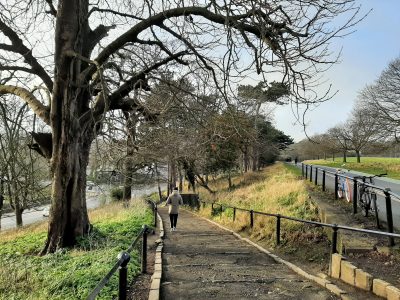
    Ireland has committed to designating 30% of our oceans as MPA by 2030 however currently just over 2% is designated and even these areas provide only paper protection due to lack of management measures.
    ENDS
    CONTACT: Padraic Fogarty IWT Campaigns Officer irishwildlife@iwt.ie
  • Press Release: Irish Wildlife Trust welcomes independent review of the National Biodiversity Action Plan

    Press Release: Irish Wildlife Trust welcomes independent review of the National Biodiversity Action Plan

    Press Release

    16th February

    Irish Wildlife Trust welcomes independent review of the National Biodiversity Action Plan

    The Irish Wildlife Trust today (16/2/21) welcomes the report of the National Biodiversity Forum which highlights serious weaknesses in the state’s approach to biodiversity protection.

    The IWT particularly welcomes the recommendation that the next National Biodiversity Action Plan be placed on a legal footing to ensure accountability for its delivery – in a similar manner to the Climate Action Bill.

    The independent expert report highlights the shocking failure of the state in abandoning its responsibilities to conserve nature and in particular it emphasises the need for government policy to be aligned to the goals of the National Biodiversity Plan. Currently, policies to expand economic output from the sea or agricultural land are directly at odds with biodiversity targets.

    The report highlights that existing protected areas on land and sea are merely ‘paper parks’ which offer no real protection while endorsing a new approach to reaching national and EU targets of protecting 30% of land and sea by 2030. The report says this should be done with public land while also incentivising local communities and private landowners to create nature reserves.

    IWT campaign officer, Pádraic Fogarty (who represented the Environmental Pillar on the National Biodiversity Forum) says “we can’t just go on producing colourful reports. The state must acknowledge its central role in delivering on commitments made in previous plans. Complying with environmental legislation is the bare minimum that we should be striving for – we need to be a whole lot more ambitious in restoring nature to our island.”

    The government will shortly be preparing Ireland’s fourth National Biodiversity Action Plan. The IWT urges Minister Malcolm Noonan (the minister responsible for developing the plan) to endorse the report of the National Biodiversity Forum and to act swiftly on its recommendations.

    ENDS
    CONTACT: Padraic Fogarty IWT Campaigns Officer irishwildlife@iwt.ie
  • What Value Nature?

    What Value Nature?

    What value Nature?

    It has long been argued that one of the reasons for our biodiversity crisis is the failure of economics to account for environmental harm. The effects of habitat destruction or pollution from industrial effluent has been dismissed as an ‘externality’ as though the air we breath and the water we drink is somehow not necessary for a functioning economy.

    This gaping hole in the study of economics has been acknowledged for many years and, in an effort to plug the gap, a number of ecological economists have promoted the idea of ‘natural capital’.

    All of the stuff that is produced by the economy, from roads to laptop computers is the ‘produced capital’ while the labour and ingenuity of people is the ‘human capital’; both have long been integrated into economic models. ‘Natural capital’ on the other hand, remains ‘external’.

    The idea of ‘natural capital’ makes many nature-lovers queasy.

    This has partly come from the impression that it is attempting to put a price on nature and certainly the language that is used (forests and wetlands are ‘stocks’, birds and fish are ‘assets’ etc.) seems to confirm this. The Irish Forum for Natural Capital defines the term as “an economic metaphor for nature; a concept that frames the world’s resources like plants, animals, water, and minerals as assets or stocks that yield a flow of benefits to people.”

    From the Economics of Biodiversity: the Dasgupta Review

    It has always seemed to me like a clumsy way to make the natural world fit into to our financially-driven mindset, when we should really be striving for the reverse. Enthusiasts say that if nature doesn’t appear on balance sheets and cost-benefit analyses then it will be ignored. But the underlying assumption here is that those making decisions are rational bean-counters and that bankers and ministers for finance will stop destroying nature when presented with the numbers.


    The Office for National Statistics in the UK, which has been drawing up natural capital accounts for a number of years, has stated that the “partial asset value of UK natural capital” in 2016 was close to one trillion pounds. This has not stopped the destruction of ancient woodlands to make way for the HS2 highspeed railway line which will link London to the North of England.

    Nevertheless, economics is important. It would be crazy for even the most ardent proponents of nature’s intrinsic value to suggest it does not have a role to play in solving to the ecological crisis.

    Earlier this month, at the request of the UK government, the Indian-British economist Partha Dasgupta published ‘The Economics of Biodiversity’ or, as it has been more commonly referred to: The Dasgupta Review. The main report is over 600 pages long so my blog readers will forgive me if I confined my reading to the 100-page ‘abridged version’ (a 10-page ‘headline messages’ is also available).

    Unlike the Stern Review, which was published in 2005 and was a landmark report on the economics of climate change, the Dasgupta Review does not attempt to put a cost to the economy on the loss of biodiversity. Nor does it attempt to put a price on nature. What it does do is identify some of the market failures which have led to humanity teetering on the brink of a global ecosystem collapse.

    Some of the ideas will already be familiar. The use of Gross Domestic Product (GDP) as the single measure of how we’re doing as a nation is “based on a faulty application of economics”. A nation can record ‘healthy’ growth in GDP while destroying nature (“eroding natural assets” is the term used) and that is exactly what has been happening as we celebrate the notional idea of ‘economic growth’, particularly since the 1950s.

    The Review states that “the macroeconomic theories of growth and development that have shaped our beliefs about economic possibilities and the progress and regress of nations do not recognise humanity’s dependence on Nature” – something that is hardly a controversial idea, but one which is nevertheless entirely absent from mainstream economic thinking.

    It logically follows that since we only have one Earth, the degree to which humanity can appropriate nature’s bounty is “bounded”. This idea was forcefully advanced way back in 1972 with the seminal publication by the Club of Rome entitled (not obscurely) The Limits to Growth.

    The Limits to Growth was laughed at at the time and even today many people blithely assume that human ingenuity (i.e. technology) will ride to the rescue. But Dasgupta confirms the Club of Rome’s conclusions through calculations taking into consideration a growing world population and the stated aim of meeting the UN’s Sustainable Development Goals (SDGs; ending poverty, inequality, providing education, clean drinking water etc.) by 2030.

    Increases in “efficiency alone are highly unlikely to be able to close the gap” and “no matter how ingenious we can be, global output must also be bounded”. There is no substitute for setting hard limits to our actions such as greenhouse gas emissions or protecting areas from exploitation.

    The financial argument kicks in when highlighting the colossal subsides doled out by governments and which are harmful to biodiversity, somewhere between 4-6 trillion dollars when environmental damage is taken into account and a figure which dwarfs the sums spent on nature conservation. (A report this week showed how subsidies to the fossil fuel industry in Ireland increased in 2018 to €2.4 billion).

    Despite the jarring language around ‘natural capital’ many of the solutions are widely supported, particularly ‘payments for ecosystem services’ and which are already deployed throughout the world, including here in Ireland.

    Consumer products are “under-priced” providing “people with an incentive to consume not only too much, but also consume the ecologically wrong sorts of goods”. Irish farming groups are increasingly highlighting how food is too cheap while so much of our food (up to a third) is wasted. However, with nearly 70% of all agricultural land given over to animal-based food production, the ecological cost of lamb, beef and dairy means this sector must be drastically scaled down.

    Perhaps the most interesting thing about the Dasgupta Review is that he does not believe that fixing what he describes as the “institutional failure” of states and markets will, on its own, solve the problem.

    Yes, we need new metrics for measuring well-being; not just wealth but “inclusive wealth”. He also notes that the current mindset has been allowed to develop due to an increasing detachment between ordinary citizens and the natural world. “Such detachment is in part a symptom of societal change, including growing urbanisation, the profusion of technology, and reduced access to green spaces. Detachment from Nature has meant a loss in our physical and emotional state.”

    The remedy to this is education, and lots of it. “Establishing the natural world within educational policy would contribute to countering the shifting baseline, whereby we progressively redefine ourselves as inhabitants of an emptying world and believe that what we see is how it is and how it will continue to be. This shifting baseline has been termed the ‘extinction of experience’”.

    There is also room for “an awareness of the sacred to encompass a sense of awe and wonder, of a way to become aware of the transcendent. […] Biodiversity does not only have instrumental value, it also has intrinsic worth – perhaps even moral worth. Each of these senses is enriched when we recognise that we are embedded in Nature. To detach Nature from economic reasoning is to imply that we consider ourselves to be external to Nature. The fault is not in economics; it lies in the way we have chosen to practise it.”

    Irish media normally devotes plenty of space and airtime to the views of our economists – I wonder how many of them will read the Dasgupta Review.


    In the latest episode of Shaping New Mountains I looked at how a shift in our values is what’s really needed to break the logjam in the ecological crisis.

    Check out

  • Chapter 3: Restoring Connections

    Chapter 3: Restoring Connections


    Shaping New Mountains

    Chapter 3: Restoring Connections


    I am the wind which breathes upon the sea,

    I am the wave of the ocean,

    I am the murmur of the billows,

    I am the ox of the seven combats,

    I am the vulture upon the rocks,

    I am the beam of the sun,

    I am the fairest of plants,

    I am the wild boar in valour,

    I am the salmon in the water,

    I am a lake in the plain,

    I am a word of science,

    I am the point of the lance of battle,

    I am the God who created in the head the fire.

    Who is it who throws light into the meeting on the mountain?

    Who announces the ages of the moon?

    Who teaches the place where couches the sun?

    (If not I) 

    ‘The Mystery’ by the Pre-Christian druid Amergin. Translated from the 11th Century An Leabhar Gabhala (Book of Invasions) by Douglas Hyde, Ireland’s first president.


    If everything needs to change then where can we begin? How far back do we need to go to get at the root of our troubled relationship with the planet? “Very far back” says Sister Colette Kane of An Tairseach Ecology Centre in Wicklow Town.

    It’s a bright January morning in 2019 when I meet Sr Colette in the Ecology Centre and organic farm high above the tangle of narrow streets below. Situated within an enormous red-brick Dominican Convent and school which was established in the 1870s the building, at least, seems to typify the Catholic Church in Ireland at that time – looking down on the community, imposing and overbearing.

    Not at all like the softly-spoken, kind-eyed Sr Colette who started work at the centre in the early 1990s. She leads me to the centre’s cosmic garden for a tour of the story of the universe. Yes – these nuns have a cosmic garden!

    The garden, converted from a tennis court only a decade earlier, is now enveloped with vegetation and at its centre lies a stone spiral; beginning at the Big Bang the visitor is invited to contemplate the deep history of time, following the path in a gently arcing clockwise direction, stopping at intervals to admire the hand-painted stones that punctuate the journey. There’s one which marks the creation of the Earth, another (much later) to indicate the earliest known life form, and on to multi-cellular life, the emergence of life on land, the extinction of the dinosaurs and – all bunched up at the end – the evolution of humans and their headlong rush to industrialisation, symbolised by a row of smoke stacks spewing out the by-products of our civilisation.

    It’s not how Creation is understood in the Bible. “Misinterpretation of some passages in the Bible has a lot to answer for,” asserts Sr. Colette, who grew up in Belfast during the Troubles. She saw how gangs of youths pulled trees out of the ground to create barricades – wilfully destroying their own environment.

    “I couldn’t understand why they would do such a thing” she laments. She believes our Christian heritage, with its origin story rooted in the Book of Genesis, continues, to this day, to be misrepresented.

    “Misinterpretation of some passages in the Bible has a lot to answer for”

    For some the concept of ‘dominion’ gives us licence to destroy nature. It is the line:

    Be fruitful, and multiply, and replenish the earth, and subdue it: and have dominion over the fish of the sea, and over the fowl of the air, and over every living thing that moveth upon the earth.

    (Genesis 1-28, King James Bible)

    in particular which allows us to treat the non-human world like a larder from which we can take what we will, without feeling we should give anything back.

    To those who feel this is far-fetched, I refer you US President Donald Trump’s first head of that country’s Environmental Protection Agency, Scott Pruitt who, before he resigned in scandal, told the Christian Broadcasting Network that “the biblical world view with respect to these issues is that we have a responsibility to manage and cultivate, harvest the natural resources that we’ve been blessed with to truly bless our fellow mankind.”

    According to this philosophy, ignoring climate change and even opening national parks to fossil fuel exploitation is not only right, it is a duty among elements within the Christian Right.

    Since at least 1492, when Christopher Columbus set foot on the American continent, God and Jesus have been used to create the morally righteous space in which people and nature have been remorselessly exploited for profit.

    Sr. Colette points me to ‘the Great Chain of Being’, a visual representation of the universal order believed, in medieval Europe, to have been decreed by God. It places God above all else, followed by the angels and other angelic beings. Beneath this lies humanity, itself differentiated between kings above the peasants and men above women. Animals were subdivided between (superior) wild and (inferior) domestic varieties, with hierarchies within these groups to prioritise the useful and beautiful over the useless or ugly. Then came the plants, beneath all these were the serpents, especially condemned for tempting Eve into bringing evil to the world, and then the minerals.

    The Great Chain of Being: an idea that entrenched human dominance of nature


    The ‘Great Chain of Being’ entrenched a Western, white, male-dominated, exploitative world view which has spawned atrocities since the 1500s – from slavery to logging ancient forests – and which continues to convulse the world to this day.


    By the 17th Century science was beginning to erode the dominance of the Church. The birth of rationalism and the Enlightenment brought answers to questions not found in the Bible. Yet this did not include what we would today consider to be a more enlightened attitude to nature.

    The influential French philosopher René Descartes proclaimed that the creatures of the Earth were no more than machines, incapable of feelings or reason, and so inferior to humans. The natural world, it was fashionable to believe at the time, was like a clock – composed of moving parts all running like a toy, wound by the hand of an almighty creator.

    René Decartes, for whom plants and animals were no more than machines


    This coincided with the idea of progress, the view that wild nature was degenerate and could only be improved by an axe, a plough or domesticated animals. It seeped into our art, the notion of ‘picturesque’ reflected in landscape paintings that portrayed ordered, domesticated and subdued countryside as ‘beautiful’ and worthy of depiction. This infuses our mindset to this day – just look at the popularity of the ecologically-moribund ‘Wild Atlantic Way’.

    The corollary of all this is that nature – not tamed by the hand of man is useless, or even worse: threatening. It explains why top predators are dismissed as ‘vermin’, unwanted plants as ‘weeds’, why we find it so easy to launch culling or eradication programmes for species we find inconvenient or even why we can bulldoze an ancient forest or drain a bog for the sake of jobs or ‘economic development’.

    “nature – not tamed by the hand of man is useless, or even worse: threatening”

    In the early 1800s the Prussian adventurer Alexander von Humboldt, after blagging a visa from the King of Spain to enter the Spanish colonies of South America (then off-limits to nearly all non-Spaniards), found himself heading up the Orinoco River (in today’s Venezuela) in a canoe with his botanist companion Aimé Bonpland.

    Alexander von Humboldt, who saw everything as interconnected and part of a unified whole


    Searching for a connection between the Orinoco and the Amazon the two explorers collected samples and made maps of heretofore uncharted terrain. But it was von Humboldt who would excel himself in his insatiable appetite for knowledge and understanding. There was no field of endeavour which escaped his analysis. From the movements of the heavens to the appalling treatment of slaves on the colonists’ plantations he began to see the world, not as the rationalists would have it – as cogs in a machine – but as an infinitely complex web of connections. He decried how the imperialist Spaniards treated the indigenous peoples but at the same time noted how their subjugation of wild nature, and in particular the clearing of the rain forest and the draining of lakes, led to flooding, drought and even changes in the climate.

    He sketched zones along the slopes of Andean peaks, remarking how changes in vegetation could be correlated with temperature, and even noted how wind carried pollen particles, insect eggs and seeds to colonise distant places. After descending Ecuador’s highest volcano, Chimborazo, he drew out what he called his Naturgemälde, an untranslatable German term meaning ‘painting of nature’ but which implies a sense of wholeness or unity[i].

    It is why he has been called the ‘Inventor of Nature’. According to his biographer Andrea Wulf: “Humboldt was not so much interested in finding new isolated facts but in connecting them. Individual phenomena were only important ‘in their relation to the whole’”. His ideas were revolutionary and he was to become Europe’s, if not the world’s, most famous and celebrated scientist.

    He decried the mechanistic view of nature and the belief that the classification of life forms into compartments (which had been underway in earnest since the Swede Carl Linnaeus proposed his universal system of naming life in the mid-1700s) was the pinnacle of natural science. Instead, he argued for the centrality of wonder, poetry, song and imagination in the sciences in his book Views of Nature.

    The English poets William Wordsworth and Samuel Taylor Coleridge were fans, the latter declaring that they lived in a ‘epoch of division and separation’, blaming philosophers such as René Descartes and scientists such as Carl Linnaeus for their ‘philosophy of mechanism’ which ‘strikes Death’. Wordsworth sneered at the naturalist with his urge to classify as a “fingering slave, one that would peep and botanise upon his mother’s grave”[ii].

    According to Wulf, Coleridge and Wordsworth were ‘turning against the idea of extorting knowledge from nature with ‘screws or levers’ […] and against the Newtonian universe made up of inert atoms that followed natural laws like automata. Instead, they saw nature as Humboldt did – dynamic, organic and thumping with life.


    In 1869, one hundred years after his birth, Alexander von Humboldt’s centenary was marked by parades and celebrations across the world. From Melbourne to Moscow, San Francisco to Cape Town there were speeches and parties to honour the contribution he had made to science. A crowd of 25,000 thronged Central Park in New York to witness the unveiling of a bronze bust, while then-US President Ulysses Grant joined 10,000 devotees in Pittsburgh, Pennsylvania to celebrate the great man. To this day his name is sprinkled across the maps of North and South America, giving his name to rivers, towns, ocean currents and even a species of penguin.

    His work directly inspired Charles Darwin who carried his books on board The Beagle and echoes of his thinking are found right up to James Lovelocks’ Gaia hypothesis, which proposed that the Earth was a single living system. He practically founded the science of ecology and, in his rejection of slavery and promotion of human rights, as well as his view that art was an essential medium for the understanding of scientific concepts, his views retain their relevance to this day.

    In Wulf’s view, the advent of war in 1914 radically shifted public attitudes to Germany and Germans, instilling prejudice and negativity that would not begin to dissipate for another 50 years. By this time von Humboldt had been largely forgotten in the English-speaking world and his mantle as ‘the Inventor of Nature’ passed to an Englishman, Charles Darwin.

    In the decades that have passed since, science has become ever more specialised and fragmented and scientists themselves continually decry the entrenchment of ‘silo thinking’ whereby people rarely discuss matters beyond their own tiny niche of investigation. Media reports can segue from a story on climate change to cheery projections of economic growth in the airline business without a hint of irony. Irish discussions of agriculture can talk about greenhouse gases without connecting production intensification with the extinction of species, water pollution or income inequality among farmers. Tourists can gush about the natural beauty of the landscape unconcerned that they’re looking out on a collapsed ecosystem. We have lost the ability to join the dots.

    “science has become ever more specialised and fragmented… we have lost the ability to join the dots”

    Sr Colette leads me through the main hall of An Tairseach’s (meaning ‘threshold’ in Irish) ecology centre – in an alcove there’s a beautifully sculpted Celtic cross, hewn from wood, with roots extending from the base of the cross to symbolise the life-giving connection between spirituality and nature. The centre was established in the 1990s by the Dominican sisters.

    They had 70 acres of farmland but could see the damage that modern farming techniques were doing to the land, so they set about reclaiming it and converting it to organic production. Today there is a small herd of cattle, a few pigs and about five acres of organic vegetables apart from what is grown in six large tunnels. The farm provides vegetables and meat for the Ecology Centre as well as for sale in the Farm Shop and at a number of markets around Dublin.

    While on my tour we bump into Sr Julie Newman and Sr Marian O’Sullivan, two of the founders, who happily recall the journey they have been on. They tell me how during the Celtic Tiger years local politicians tried very hard to get them to sell the land for housing. The community resisted all inducements because they had made a decision to preserve the land for the conservation of wildlife as well as for organic food production.

    The local community were delighted that the land was being preserved and helped in many ways including with the planting of trees. “Nature has a right to exist” the sisters told me and, raising an index finger towards the heavens – “it has rights!”

    “Nature has a right to exist… it has rights!”

    Values are at the heart of their ethos: ‘truth and fairness in relationships’, ‘respect for the whole community of life’, ‘graciousness to all who come’ and ‘beauty in all its dimensions’. And so their project goes much further than organic farming. They were a pioneer user of solar panels to generate electricity and have set aside land that is only for nature.

    Sr Colette insists that education is the key to reversing the mentality that has allowed centuries of over-exploitation. Since their establishment they have been running courses in ecology and what might be called ‘ecological spirituality’ including retreats for those who wish to immerse themselves in the reflective space provided by the centre.

    They have been running a specially designed programme called ‘Knowing Our Place: from stardust to sand’ for teachers and Sr Colette has noticed an uptick in interest in recent years. Yet she laments the slow pace of change. Even the ‘Green Schools’ programme, which has been running for years, while it is “a positive attempt at raising awareness of sustainable living is not nearly ambitious enough for something as important as our relationship with nature”.


    I have to admit that I was unfamiliar with the work of An Tairseach until I started researching this project and it came as somewhat of a surprise to me that there were religious institutions in Ireland thinking in this way.

    Like many of my generation, I had decided some time ago that the Church in Ireland had little to offer and, in my own bubble of interacting with ecologists and NGOs, I had assumed that if there were movements out there fighting for greater environmental protection then I’d surely know about them. I was wrong.

    I returned to the centre later in the year to hear from Fr Sean McDonagh, a Columban priest and eco-theologian. He worked in the Philippines and spoke about how deforestation there has been combining with stronger storms caused by climate change leading to mudslides, flooding and the destruction of farmland in communities already wracked by poverty. Yet people didn’t seem to see the connections.

    Fr Sean has been writing about the ecological crisis since the 1980s yet he is clearly not impressed with the tardiness of the Church in joining the dots been human welfare and environmental degradation. During his seminar he name-checks various Popes and their pronouncements which failed to recognise the severity of the issue.

    Deforestation is not only habitat loss, it leads to soil erosion, water pollution and can change local climates

    He references a publication from the World Council of Churches back in 1994 entitled ‘Signs of Peril – Test of Faith’ and which began to develop what he described as a ‘theological and ethical framework to help them understand the implications of climate change for their faith’[iii]. Yet the Vatican maintained, in his words, a “general reticence”.

    That same year, for instance, the Catholic Catechism stated that “God willed creation as a gift addressed to man… Animals, like plants and inanimate beings, are by nature destined for the common good of past, present and future humanity”[iv].

    Fr Sean knows his stuff, and he’s been talking and writing about it for a long time. He tells our small seminar that “we’re destroying the beauty and wonder of our planet”. He says that while we can see the damage we’ve done to our land, it’s unfortunately invisible in the oceans but, he adds “World War II ended in 1945 on land, but it has continued at sea”.

    He clearly carries the weight that many ecologists feel in that the warning signs, which are so plain and obvious to us all, continue to be ignored. “There’s a great need for education aimed at all sectors of society… including ‘ecological theology’ in Catholic schools, seminaries and theological institutions”.

    “There’s a great need for education aimed at all sectors of society…”

    In 2015, Pope Francis published his encyclical Laudato Si: On Care for our Common Home. Although (to my regret) I paid it little heed at the time, when I did get around to reading it I found it to be the most powerful piece of ecological writing I had read in years.

    Both Sr Colette and Fr Sean agree that it is a quantum leap in Church thinking, and because the Pope addresses the encyclical to “every person living on this planet”, you don’t have to be a Catholic to be inspired by it.

    In it the Pope is blunt about the current state of affairs:

    ..our common home is like a sister with whom we share our life and a beautiful mother who opens her arms to embrace us… [but] this sister now cries out to us because of the harm we have inflicted on her by our irresponsible use and abuse of the goods with which God has endowed her. We have come to see ourselves as her lords and masters, entitled to plunder her at will. The violence present in our hearts… is also reflected in the symptoms of sickness evident in the soil, in the water, in the air and in all forms of life.


    Finally, we’re beginning to join the dots again. Not since Alexander von Humboldt have the connections between science, art and ethics been so skilfully woven:

    “If we approach nature and the environment without this openness to awe and wonder, if we no longer speak the language of fraternity and beauty in our relationship with the world, our attitude will be that of masters, consumers, ruthless exploiters, unable to set limits on their immediate needs.


    It is this sea change in our values which is surely at the heart of our current predicament. The Pope fudges the whole Genesis ‘dominion’ thing and although it has taken over 2,000 years for this to be corrected the Pope makes up for it in his force and clarity.

    “It is not enough to think of different species merely as potential ‘resources’ to be exploited, while overlooking the fact that they have value in themselves. Each year sees the disappearance of thousands of plant and animal species which we will never know, which our children will never see, because they have been lost for ever. The great majority become extinct for reasons related to human activity. Because of us, thousands of species will no longer give glory to God by their very existence, nor convey their message to us. We have no such right.”

    “It is this sea change in our values which is surely at the heart of our current predicament”

    To me, it is this talk of ‘values’ and ‘rights’ that holds the key to the transformation that is needed.

    The Pope writes that he is convinced that “change is impossible without motivation and a process of education”.

    Writing in the ‘Irish Response’ to Laudato Si, Fr Sean McDonagh asks himself: “will this transformative education happen? Will humans turn from being ‘masters, consumers and ruthless exploiters’ to feeling ‘intimately united to all that exists?… I am convinced that without serious reflection and education at an individual and community level Laudato Si will be ineffective, because what is called for here will involve massive changes.”

    He later remarked to our seminar how he had attended a national conference on biodiversity earlier in the year but was astounded that amid all the sessions on conservation science and economics, there wasn’t a single mention of ethics. “How can we change things without challenging our ethics?” he pondered, rhetorically.


    Faced with the remorseless advance of the global economic juggernaut, making these massive changes can seem daunting. However, they’re not beyond reach. All human cultures possess value systems which provide the ground rules for cooperation. In the absence of laws and law enforcers, values have provided human societies with a means for maintaining cohesion and resolving conflicts.

    Today we broadly accept that historic buildings should not be demolished even if the land is valuable from a development perspective, or that mining for minerals in scenic areas is a bad idea (even if occasionally such projects are proposed). We mostly agree that robbing and stealing are bad, not only because they are themselves morally wrong, but because we all benefit when such norms are widely accepted and enforced.

    And values are not immutable – once a central part of many companies’ business models, today human slavery is outlawed everywhere (although practised furtively). Polite conversation no longer permits talk about black people or women in the way white males felt at liberty to do until quite recently (even if they still hold the thoughts in their head while social media seems to be no holds barred).

    In Ireland, in only the last five years, public attitudes to gay marriage and women’s reproductive rights flipped in a dramatically short space of time. Nobody talked about economics during these debates. It is why I find that trying to shoehorn nature into the world of economics via terms such as ‘ecosystem services’ and ideas of ‘natural capital’ are all wrong.

    Economics needs to find its place in the biosphere – not the other way around.

    Human rights, including the rights of gay people to marry, or for women to make their own decisions concerning their bodies, are now enshrined in law.

    Laws tend to follow our values (although not always) as, particularly in modern societies, they are necessary in upholding people’s rights in the face of opposition. However, the reverse is not the case – values do not follow laws.

    This is where we have been going wrong since the 1970s – despite the raft of environmental legislation (see episode 2), nobody feels particularly compelled to see these enforced, and so nature continues to vanish.


    It’s over 70 years since Aldo Leopold wrote about what our environmental values should look like. Born in the US state of Iowa in 1887, he was forever what Americans refer to as an outdoorsman – hunting, fishing, camping and perpetually observing nature.

    He studied forestry and was instrumental in establishing the United States’ first wilderness area (a term which has legal standing in that country) in New Mexico in 1924. He was assigned to shooting large predators such as mountain lion, bears and wolves which were considered no more than vermin to ranchers who had recently moved into the area.

    But he developed a respect for these top predators, something which progressed to seeing them not only as having a right to exist, but as essential for the health of the ecosystem as a whole. He saw nature as something that was not just there to provide humans with benefits but as something that had intrinsic values.

    He was a founder of the Wilderness Society in 1935 but it was his writings that gave his work a legacy which lasts to this day.

    In A Sand County Almanac he writes about a plot of land in Wisconsin he had purchased. The landscape had been badly degraded from ploughing the prairies, felling the forests, degrading the soil, wild fires and overgrazing the pastures with herds of domestic cattle. The big predators had been exterminated.

    In the book, published in 1949 just after his death, he elaborates on what he refers to as ‘the land ethic’. It is a manifesto for a relationship with land that goes beyond limitless exploitation. The ethic, which now extends across the human family, must now, he opined, encompass the land under our feet, what he referred to as ‘a process in ecological evolution’.

    “An ethic, ecologically, is a limitation on freedom of action in the struggle for existence. An ethic, philosophically, is a differentiation of social from anti-social conduct.”[v]

    It is this idea of limits which is so anathema to mainstream economic and political thinking. It also explains why creating another nature reserve or extolling the virtues of recycling will not, on their own, result in the changes we need to see.

    Leopold’s A Sand County Almanac sold over 2 million copies and remains the most influential text when it comes to environmental ethics. Yet it had no impact on what has come to be known as ‘the Great Acceleration’ – the exponential increase in extraction and resource use which has broken through so many of our planetary boundaries.


    1992 was a landmark year for Planet Earth with the holding of the Rio Earth Conference in June of that year. “Coming Together to Save the Earth” proclaimed the cover of Time magazine: “tens of thousands of diplomats, scientists, ecologists, theorists, feminists, journalists, tourists and assorted hangers-on… If size and ambition were the measures of success, the United Nations Conference on Environment and Development in Rio de Janeiro would take all the prizes. The so-called Earth Summit, more than two years in the making, will be the largest and most complex conference ever held — bigger than the momentous meetings at Versailles, Yalta and Potsdam.”[vi]

    The Earth Summit, where great promises were made

    Our own President Michael D. Higgins was present at that gathering, and he spoke of his reflections of the event at a conference in Dublin early in 2019:

    “1992 represented such a hopeful juncture when it seemed that the world was finally coming together to address the existential challenges of our age… and while there have been some notable advances to this end, I think it is fair to say that the agenda of work recognised then is far from complete.”

    He recalled the Business Council for Sustainable Development (BCSD), which was established at Rio and included at that time 48 CEOs and how they were the ‘most sophisticated people’ he interviewed for a documentary he was making at the time. Delegates leaving the summit were left asking, he said “[if this meant] that the BCSD were going to initiate a whole new wave of changes in relation to the impact of irresponsible corporations on the environment and vulnerable parts of our planet”.

    This gave him hope but he recalled how others travelling with him could see how the business leaders recognised that the word ‘sustainable’ would now be unavoidable and were set to “colonise the new language”.

    He went on lambaste these businesses as the “same corporations that said to peasants in Ecuador whose water was poisoned: we will fight you until hell freezes over, and then we’ll fight you on the ice, with armies of lawyers, ranged against peasants who were representing their village and the children who would be born in it for generations to come.”

    I was there to watch the President deliver these words and it electrified the crowd. The previous day, the Minister with responsibility for nature conservation, Fine Gael’s Josepha Madigan, told RTÉ news that people could put up bird boxes to tackle the extinction crisis.

    The President’s uncompromising call for entire system change, acknowledging that “if we were miners, we’d be up to our knees in dead canaries” brought cheers and a standing ovation – if only because he could recognise the scale of the problem and its insidious roots.

    President Higgins – he gets it

    “if we were miners, we’d be up to our knees in dead canaries”

    Our world is essentially a white, male, Western one. To most of us it is synonymous with wealth creation, technological innovation, cultural riches and progress. Since the conquest of the Americas in the 1500s it is a model that has been exported, by force, to every corner of the world. To the colonised and displaced peoples (with whom Irish people share a legacy) this world is synonymous with an altogether different set of values. It is hard for those of us who live in this bubble to break through the barriers to hear their voices, because in many cases they’ve been dispossessed of them.

    Take the song, ‘This Land is Your Land’ by Woodie Guthrie. It was written in 1940 in response to the gaping inequalities created during the Great Depression of the 1930s and includes the lines:


    This land is your land, this land is my land
    From California to the New York Island
    From the Redwood Forest to the Gulf Stream waters
    This land was made for you and me


    It was meant as a riposte to ‘God Bless America’ and has become an anthem for Americans with liberal politics, including environmentalists. The song is one of the most popular in American folklore for its political message of solidarity with the oppressed and downtrodden.

    But not everyone sees it that way.

    In 2017, during a climate march for Earth Day in Washington DC, black climate activist Mary Annaïse Heglar found herself in the centre of a predominantly white throng when the crowd erupted in song.

    She describes herself as a ‘black woman in a green space’, from Birmingham, Alabama and instinctively reluctant to join large, white crowds. In hearing the opening line of ‘This land is your land’, she says she felt her stomach ache.

    The song evokes the landscapes of America but for Heglar, “there is not a single verse that I, as a Black woman, can relate to, not one that speaks to my experience nor my complicated relationship to the land on which I stand”.

    For the founding fathers of America, who subjugated minorities while at the same time creating national parks and wilderness areas, “it was less about protecting nature than it was about laying claim to it—for people who looked like them.”

    “In today’s environmental movement” she wrote for Dame Magazine “it’s not so much outright hostility toward people of color. It’s more that people of color represent a blind spot for the environmental movement.”

    She later took to Twitter, on Earth Day in 2019, to explain why she got involved in the environmental movement:

    “Ever since I got involved in this space… it became real clear real fast why the movement was so anaemic. Simply put, the movement was telling itself an incomplete story that rendered people – [especially] people of color – to the margins.

    People of color are largely invisible in this color-blind movement. And I don’t know how I’m supposed to feel about that. But I do know how I feel: dismissed, silenced, erased. But also motherfucking determined to make you see me.”


    I think that the blind spot Heglar refers to is relevant to us here in Ireland because it prevents us from looking over the brow of the hill, to see that alternatives are possible and that other voices are worth listening to. It is a challenge to a monoculture of thinking.


    It’s not only essential that we give voice, and listen to, those of indigenous and non-white heritage, but also the half of the world which has been ignored for most of human history – women.

    I meet with Sinead Mercier who is founder of the Dublin EcoFeminists, a growing movement of (mostly women) who recognise the interconnectedness between the exploitation and degradation of the natural world and the subordination and oppression of women.

    Sinead explains to me that eco-feminism “is not really about women but about who’s being exploited. The ecofems were set up to campaign on Repeal the 8th and also to address the constant, quite sexist and racist, argument brought up in a lot of environmental circles that overpopulation is the source of climate change, and which inevitably results in blaming and controlling women’s bodies (particularly the bodies of women in the global south.)

    “eco-feminism is not really about women but about who’s being exploited”

    This colonial belief in an inherent right to rule over and exploit women, or colonised peoples, is allowed because these sections of society are “othered” from the powerful and then are equated to something we have been trained to denigrate and exploit without respect – nature”.

    Our conversation is peppered with recurring themes: work that is not acknowledged, marginalised voices, power imbalances and the mechanisms which have led to the subordination of both women and nature.

    There is more than an echo here of the #metoo movement, debates around consent and ‘toxic masculinity’.

    Speaking to The Irish Times in 2018, French presidential candidate Ségolène Royal, a woman who went on to serve as environment minister in the cabinet of her former partner François Hollande, was clear in her belief in the connection between misogyny and environmental degradation. “The vocabulary is the same,” she told the newspaper, “Women and nature are damaged, aggressed, sullied, raped, victims of predators, exploitation and abuse”.

    It’s a theme that has been picked up here in Ireland by our former President Mary Robinson and comedienne Maeve Higgins in the podcast series ‘Mothers of Invention’ which declares: “Climate change is a man-made problem — with a feminist solution!”

    Climate breakdown: A man-made problem… with a feminist solution


    Sinead believes that the traditional, male-dominated, approach has led to perspectives of nature as mechanical and this has led us inexorably to today’s separation between people and the land:

    “We’re not separate: we’re a part of nature,” she says.

    “It’s this false separation which has led us to think we can just take as much as we want. For example, colonialism sought to denigrate and lower other races by connecting them to “wild” or a “passive and exploitable” nature – nature is without a subject and so are women and other colonised peoples. They have to be ruled over and decisions made for them because they cannot rule themselves as they are the mercy of natural passions. How this affects the environmental movement is when we blame poor people for environmental damage as they struggle to survive in the nature that remains after exploitation. The people that ‘save nature’ are white, well-to-do Northern Europeans, not African peoples, indigenous peoples, travellers or small farmers who connect nature to their livelihoods”.

    Sinead illustrates the real impacts this has with the example of when, at the World Economic Forum meeting in 2020 in Davos, Switzerland, Ugandan climate activist Vanessa Nakate was edited out of an Associated Press photo with Greta Thunberg and other white student activists. “Media are more comfortable with Jane Goodall’s and white activists than with people from the Global South” she concludes.

    “And the reason for this is pretty dark,” she adds. “The belief that overpopulation is the cause of climate change is still so strong and the blame is almost squarely lain at the door of developing countries. Having African climate activists speak out – with their own voice, power and subjectivity – rather than be presented as charitable cases or dangerous wombs – is not something Western media (or to be honest many Western environmental NGOs) are comfortable with.”

    Despite our history of colonisation, our attitude to the land and the sea retains much of the extraction-based, exploitative mindset of the white, male settler. We can learn from indigenous peoples even if they don’t look like us or don’t share our history.

    Take the Mapuche Nation of southern Chile. They maintained their autonomy right up until the 1880s when their lands were taken by the new Chilean Republic and today they number over one million people.

    Their landscape is one of profound beauty, with forests, mountains and great rivers. Their worldview holds that there’s an earthly river – which connects individual tribes and families across valleys, and a spiritual river in the sky (the constellation that Western scientists call the Milky Way) which is a ‘galactic river’ and home to all of their ancestors which have departed the Earth.

    The earthly rivers are sacred places, home to plants and animals but also spirits, and anyone wishing to take something from these wetlands and marshes must first ask permission. To pollute a river or damage its fragile habitats is an act of desecration, causing the spirits to flee – something which can only result in sickness and ill health falling on the people.

    For the Mapuche, the Río Biobío was their great river which ran through the lives of the wildlife, the people, their dead ancestors and the spirit world. That was until it was dammed in the 1990s with a series of three giant hydroelectric barriers, displacing communities and flooding thousands of hectares of land. This has led to an outbreak of depression, substance abuse and social issues among the Mapuche people.

    Their campaign has had more success in recent years and in 2019 Alberto Curamil, of the Mapuche community, won the prestigious Goldman environmental prize for his work in preventing new dams on the Cautín River. At the time I was researching this story, he was detained by Chilean authorities on robbery charges, something his supporters maintain was politically motivated.

    As he was unable to accept the prize in person, his daughter, Belén, accepted on his behalf in San Francisco saying: “The Mapuche struggle is an ecological struggle, it is a struggle for life and its continuity… We are people of the Earth, whose main mandate is to protect everything that makes existence possible, based on a spirituality connected with the natural elements.”

    “The traditional Western view of rivers — and of nature generally — has failed us”

    “The traditional Western view of rivers — and of nature generally — has failed us. Western legal systems and governments traditionally viewed water and water rights as property, leading to overuse and contamination. One criticism levied by environmental groups is that in countries like Chile and the United States, corporations are granted the same rights as people while the living ecosystems upon which we depend for survival are not”.

    So wrote Jens Benöhr, a Chilean anthropologist, and Patrick J. Lynch, an American attorney in an article for the Yale School for Forestry and Environmental Studies. This last point is critical, and it is leading to new movements for the granting of legal rights to ecological features, and rivers in particular.

    The article cites developments in New Zealand and India while in 2019 Lake Eyrie in the USA citizens can now sue corporations for pollution as if the lake were a person. But to me, the most eye-catching so far is the case of the Río Atrato in Colombia, whose Constitutional Court granted legal personhood to that river in 2017.

    It flows through the Chocó region, a biodiversity hotspot and home to 91 indigenous communities. The ruling gives rights to the river for its protection and, where necessary, its restoration. It obliges the Colombian government to establish the Atrato Guardian Commission which will consist of 14 legal guardians from communities affected by mining and pollution. It is early days, and the people are battling powerful gold mining interests, but they now have an important legal mechanism which enshrines their ethics and values before a court.

    Could we see this in Ireland?

    Were the River Shannon to have legal rights, citizens could sue the state so that the dam at Ardnacrusha is removed – something which has led to the near disappearance of the river’s fish life. Or a board of guardians could ensure that the peatlands along its banks, which have been stripped away in the last 70 years, are restored and rewilded.

    Are rights for nature the missing piece in our legal framework?

    Will our values evolve so that such a constitutional amendment would be approved by the Irish people by a similar margin to that for marriage equality in 2015 or abortion in 2018? In fact much work has already been done in this regard.

    Are rights for nature the missing piece in our legal framework?

    In the wake of the financial crash of 2009, the government established a Constitutional Convention made up of politicians and ordinary members of the public. It invited the assembly to consider changes under some pre-defined headings but also invited members of the public to submit their ideas, including through a series of public meetings.

    I remember attending one of these in Dublin and speaking up for the idea of a right to a healthy environment in the constitution. In the end, this idea won the most support among ordinary members of the public who had made submissions.

    Yet the idea was dropped in the final report.

    In 2017, the Environmental Pillar (an amalgam of environmental non-governmental organisations in Ireland) called on the Citizens Assembly to include a constitutional amendment among its recommendations.

    It had been tasked to develop a plan to ‘make Ireland a leader in tackling climate change’. Although making 13 excellent suggestions in reaching this goal, the Assembly did not view climate change in the wider context of ecological breakdown, and the recommendation was not included.

    Donna Mullen, spokesperson for the Environmental Pillar, said at the time “This constitutional approach will yield benefits to our economy, society, and most importantly, health. Already 1,200 people are dying prematurely from air pollution in Ireland each year, with over 150,000 deaths across the globe already attributed to climate change every year”.

    I spoke to Donna in 2019 and asked her why she thought the idea had been dropped back in 2009. “It seemed to me that there was political interference. Although the members [of the Assembly] seemed to want it, and certainly the general public wanted it, when you watched the videos of the convention, the public seemed slightly in awe of the politicians, who were adept in public speaking. However, we had great support from some politicians. I noticed that in the next citizens assembly, politicians were excluded.”

    I ask Donna why a change to the Constitution would make any difference given that we already have such an elaborate body of environmental law:

    “Constitutional protection gives the environment the status it deserves. It would be then on a par with property rights and protections. All new legislation would have to consider the environment and any poor environmental laws or policies could be challenged.

    I’ve been to visit a few countries and looked at it in action. One interesting thing is that everyone tells you about the constitutional environmental protection – from taxi drivers in South Africa to tour guides in Namibia – the people feel they have ownership of their environment.”

    “Constitutional protection gives the environment the status it deserves. It would be then on a par with property rights and protections”

    Already in Ecuador and Bolivia the rights of ‘Mother Earth’ (Pachamama – the Andean goddess of the Earth) are enshrined in the constitution. In Columbia, the ‘collective right’ of the environment has been in force since the early 1990s but as part of this it is recognised that care for nature must be a part of the daily culture of everyday citizens and state institutions – something that has been lost here in Ireland.

    These approaches have had mixed success.

    In March 2019 I went along to a meeting of the Latin American Solidarity Centre in Dublin where I heard Aldo Orellana López and Gabriela Burnett, both from Bolivia, speak about their home country.

    The talk was billed as “Environmental Issues in Bolivia: what do the rights of nature really mean in Latin America’s most indigenous country?”

    I trotted along, full of hope that I’d hear about a country from the global south which had turned the tide on Western, corporatist, extractivist economic models of development. Bolivia had been led by its leftist leader Evo Morales from 2006 to his overthrow in 2019 and was the country’s first indigenous president. The Pachamama clause entered their constitution in 2009.

    However, as it turned out, this did not draw a line in the sand to protect Mother Earth.

    Orellana López and Burnett told us how today 80% of the Bolivian economy is based on extraction, the rate of deforestation increased post-1990 and megadams are planned to quintuple in output.

    “Bolivia has the best laws for the protection of the environment and human rights on paper,” they told us. In reality, the government has stuffed the courts with their cronies, and judicial challenges using the Mother Earth law have so far failed. “In Columbia there is a high rate of murder, but you can trust its legal system,” Orellana Lopéz told me flatly when we chatted after his talk.


    On an international front, there is a growing movement to include Ecocide as a crime equivalent to genocide or crimes against humanity. ‘Ecocide is defined as serious loss, damage or destruction of ecosystems, and includes climate or cultural damage as well as direct ecological damage.’ It was championed by British lawyer Polly Higgins until her untimely death in 2019 and who was campaigning to include Ecocide in the Rome Statute, so that it would be a prosecutable crime in the International Criminal Court at The Hague.

    She described herself as a “lawyer for the Earth”. She wanted to criminalise “mass damage and destruction” which is “of such significance to humanity as a whole that it should stand as an international crime”. It is, she asserted, the ‘missing law’.

    There is no doubt in my mind that had such a law existed in the aftermath of World War 2, state-companies like Bord na Móna, the Office of Public Works and Coillte would have been found guilty of ecocide – not to mention the private interests which industrialised the seas or the politicians who allowed the conversion of natural riches into short-term profits.

    I am not suggesting that these people and entities be sued in retrospect (if that were even possible). I am suggesting that these bodies now have a duty of reparation and restoration for the damage they have caused.


    What I am calling for is a fundamental reappraisal of our relationship with nature. I am drawing on international initiatives such as the UN’s Decade of Ecosystem Restoration which will last for the 2020s, along with the ever more urgent need to de-carbonise our economy and to draw down carbon from the atmosphere.

    To some people this may sound threatening, and I am talking about changing every aspect of how we do business and live our lives. But I also want to assuage fears that this will be a zero-sum game, i.e. that allowing nature to grow necessarily means a retreat of humanity and commerce. People may see calls for rewilding as equivalent to depopulation and abandonment, the loss of their culture and communities. I strongly feel that this is not the case. What I am looking for can be summarised in the following points:

    1. The rights of people to a healthy environment including, but not limited to, access to clean air, water, wild nature, and productive soil.

    2. The rights of nature enshrined in our constitution, including the right to exist and to perpetuate, in accordance with the laws of natural selection, for native biodiversity.

    3. A right of return for species of plants and animals that have been driven to extinction by human activities.

    4. Full and enthusiastic implementation of the UN’s Sustainable Development Goals.

    5. An obligation by the state and other education providers to include the protection of natural systems in their programmes – regardless of, but appropriate to, the topic.

    6. The establishment of an independent nature conservation agency, with powers of prosecution, to oversee the implementation of relevant legislation and programmes. This includes a massive increase in funding for this agency and other biodiversity-related programmes.

    But more than these administrative measures, we need to be able to reimagine our country. We need big ideas that can show people that dealing with the ecological emergency need not mean sacrificing our way of life. In fact, we can deal with these issues and make life fairer and better while we’re at it.

    “more than these administrative measures, we need to be able to reimagine our country”

    I hope I’m not asking too much. To live in an ecologically stable, more equal, healthier world that does not imperil the future of our children will discommode some I have no doubt. But I hope that most people will see it for what it is.

    To help in this I want to promote six big ideas (not all of which are mine I should point out) for specific places in Ireland. I have tried to meet the people already working on them and to visit the places where I imagine they will unfold, and to figure out how to overcome the barriers to implementing them.

    These ideas are fully in line with the advice by scientists for staying within planetary boundaries. Specifically they are fully compatible with our existing environmental legislation and the Paris Climate Agreement to keep the Earth’s temperature within 1.5°C above pre-industrial levels.

    Studies have shown that restoring soil on farmland, bringing back large, native forests, protecting the oceans and rewetting peatlands can bring us nearly one third of the way to meeting this target. The biologist Edward O. Wilson has proposed setting aside half of the Earth for nature. This is possible within a stabilised human population, something which is now expected to happen by the end of this century (see www.half-earthproject.org). Wilson is thinking more about protecting the great diversity of life on Earth as well as the ecological processes which are essential for human welfare and the avoidance of mass extinction. But the science which brings these two goals together is rapidly advancing.

    A paper published in 2019 added its voice to the call for a Global Deal for Nature, a companion agreement to sit alongside the Paris Climate deal.

    The researchers are calling for 30% of the Earth to be formally protected by 2030 and for this to increase, through what they term ‘climate stabilisation areas’, to 50% by 2050. The risk here is that Ireland will turn up to this meeting (originally due to take place in Kunming, China at the end of 2020 but postponed to May 2021 due to the Coronavirus), say all the right things, sign up to whatever’s going, and then come home pretending nothing of interest happened.

    I say this not because I’m particularly cynical but because this has been the Irish government’s strategy in previous such meetings. They may well feel it has served them well up to now. But I feel that already they’ve run out of road.

    The ‘half Earth’ researchers say “this approach not only safeguards biodiversity but also is the cheapest and fastest alternative for addressing climate change”[vii]. They also caution that while headline goals are simple and easy to communicate, they can be fudged by authorities who find ways to protect areas with little added value, or just because the risk of conflict is low.

    The scientists promote a ‘bottom up’ approach at the local level for deciding how much and where should be protected. Plus, it is not necessary to equate giving land to nature with ‘human-free’. Some human uses are compatible with preserving naturally functioning ecosystems. In Ireland, at least, restoration will need hands-on management for the foreseeable future (e.g. to eradicate invasive species or to control herbivores) so that nature conservation in itself could become a significant employer of local people.

    We also need solutions for other areas so that farms and cities can be more nature-friendly. In reality what I am proposing is a menu of options that will lead people away from the most damaging practices and towards those alternatives with the greatest potential for meeting climate and nature goals.

    The solutions I have in mind could be applied in many areas of our island but I thought it would be easier to imagine a future Wild Atlantic Rainforest, a Pearl Valley Farmland or a Shark Coast if I restricted it to particular areas.

    The danger with all big ideas is that they may be seen as being imposed upon people particularly when they come from people (like me) who don’t live or work in these areas. Even in the area I do live in (Dublin) I still have to convince 1.5 million people that more nature in the city is a good idea.

    Unlike in Britain, where there are relatively few landowners and people with deep pockets willing to advance ideas for ‘rewilding’, in Ireland we have many family-run farms and commonages with only poor environmental groups and no big donors. All we have is the power of our ideas and our willingness to win hearts and minds. So I am emphasising that these are ideas that could become reality. By default I think that these are good ideas and I would love to see them realised, but ultimately if this is to happen it must be for local people to decide.


    In the next episode I will look at the Wild Atlantic Rainforest – could we really create a large expanse of oak forest across the west of Cork and Kerry? Imagine throwing on your backpack and walking all day in one direction under an unending canopy of leaves and branches. I hope you can tune in.


    [i] The Invention of Nature: The Adventures of Alexander von Humboldt. Wulf, A. 2015. John Murray.

    [ii] Ibid.

    [iii] On Care for our Common Home, Laudato Si: The Encyclical of Pope Francis on the Environment with Commentary. 2013

    [iv] Laudato Si: An Irish Response. Edited by Sean McDonagh. Veritas.

    [v] Leopold A. 1949. A Sand County Almanac. Oxford University Press.

    [vi] ‘Summit to Save the Earth by Philip Elmer-DeWitt. TIME. June 1st 1992.

    [vii] Dinerstein et al. 2019. A Global Deal for Nature: Guiding principles, milestones, and targets. Science Advances.

  • Chapter 2: The Heart of the Matter

    Chapter 2: The Heart of the Matter

    Shaping New Mountains: Chapter 2

    The Heart of the Matter


    “What is your trouble?” the gentle queen asked.

    “During a year”, Conn replied, “there has been neither corn nor milk in Ireland. The land is parched, the trees are withered, the birds do not sing in Ireland, and the bees do not make honey.”

    “You are certainly in trouble”, the queen assented.

    From the tale of Becuma of the White Skin


    How did we get to this point? How is that we have seen the destruction of nature as not only an unfortunate side effect of development but even a necessary prerequisite for maintain our economy? How can it be that we are seemingly oblivious to the fact that we are surrounded by collapsed ecosystems?

    Trying to answer this question is a bit like trying to unravel yesterday’s cold spaghetti; lines of enquiry break off in your hands, while tracing the roots of diverse disciplines leads to a congealed mass of indistinguishable stodge.

    Ultimately, it’s impossible to separate out any one thread from the now solidified mass. This is a problem.

    I trained as a scientist – studying biology, chemistry, physics and maths in broad strokes. I later trained in geography and environmental science, later still in ecology. This didn’t prepare me for tackling politicians for not taking action to protect the environment, and I still think that political leadership is the most important factor in making the changes we need.

    But politicians I speak to will say that the environment is rarely, if ever, an issue that comes up on doorsteps. One Green Party councillor told me that in his time in office in a rural Irish county, never once did he receive a phone call or an email of concern about climate change or pollution, never mind vanishing birdlife. There is no reward for politicians who stick their neck out for an issue that clearly their constituents don’t care about.

    But surveys have shown that people do care, so presumably they are just not aware that nature is in such trouble or cannot see how this affects their daily lives. But how would they know nature is in trouble when newspapers, TV and radio are filled with headlines about politics, hospital waiting lists, Brexit or the Coronavirus, while, at best, nature is relegated to the ‘soft’ spot on the evening news to lift the mood after all the serious stuff has been dealt with? The slow unravelling of the natural world rarely provides the punchy headlines to feed our short attention spans. Journalists will say that science reporting requires time and effort, and people are no longer willing to pay for good journalism.


    Yes, we all live within the natural world but we also live in an economy and a community. The messages coming from environmentalists are often at odds with the values we hold in these other areas. So, for instance, we’re all in favour of a healthier environment but not if it means harming valued economic sectors – particularly when our neighbours or family members work in those industries.

    Our lack of knowledge about nature – few now know the names of everyday plants or animals – leaves us uncertain as to how to think about ecological issues. How then can we express nagging concerns when the language is not available to us?

    We have lost our personal connections with nature but how did this come about, and what can be done to restore these connections? These are not easy questions to answer, and certainly not by just one person. Luckily there are lots of people in Ireland thinking about these issues so, in a collective way, we can draw on shared knowledge and experience. In Shaping New Mountains we will meet some of these people.

    But first things first – it’s time to bust some myths about protecting nature.


    1.    Rich countries (like Ireland) have a more advanced attitude to environmental protection than poor ones.

    The late 1960s and into the 1970s are considered to be the dawn of a modern eco-awakening which spawned the birth of the environmental movement. This period saw the rise of organisations like Greenpeace and the World Wildlife Fund (as well as smaller groups in Ireland such as the Irish Wildlife Trust). It also saw the enacting of a whole body of environmental law such as the Endangered Species Act in the USA or the Birds Directive in the European Union. Irelands’ Wildlife Act dates from 1976.

    Yet this was all a very Western phenomenon. This has led to a generally held view that rich countries, including our own, are more ‘advanced’ and that environmental protection is part of this supposed enlightenment. Poor countries have bigger priorities, like poverty, but as they get richer they’ll catch up.

    This is patently nonsense. In fact, throughout the world it is European colonialism that is responsible for a wave of extinction and habitat destruction from the 16th century onwards. It was not indigenous peoples who butchered the last of the Steller’s sea cows or the Dodos.

    Even today some of the worst environmental destruction is happening in rich countries. As recently as 2018 Australia was not only accused of being one of the worst places on Earth for deforestation but also for allowing the death of the Great Barrier Reef due to a combination of agricultural run-off and political-level climate denial.

    Canada continues to log old-growth forests in British Columbia – utterly irreplaceable habitats, the loss of which impacts upon local salmon populations and the native Nuu-chah-nulth tribal community which holds great spiritual value in the ancient trees. That’s on top of the great swathes of boreal pine forest that have been cleared to mine tar sands in Alberta, surely one of the filthiest forms of energy production known.

    Even in Germany, frequently seen as being genuinely an advanced nation in its environmental approach, a 12,000-year-old forest in the region of Hambach is being cleared for an open-pit lignite mine which is already 85km2 in extent, considered to be one of the largest manmade holes on Earth.

    Norway, one of the richest countries in the world, cannot bring itself to sharing its enormous tracts of mountain forest with wolves despite the great progress being made in places like (much poorer) Romania, where traditional farmers have learned to coexist with large predators. A mere 94 wolves are permitted to live along the Norwegian borderlands with Sweden while in 2019 Norwegian authorities shot 55 lynx out of an estimated population of only 340.

    “Norway, one of the richest countries in the world, cannot bring itself to sharing its enormous tracts of mountain forest with wolves”

    Contrast that with India, population 1.3 billion and a lowly 130th on the United Nations’ Human Development Index. This is a county where 42% of children are malnourished according to UNICEF and yet it managed to increase the population of wild tigers by 30% between 2010 and 2014. That there are tigers in the wild at all today is in large thanks to the efforts of India and its people, who evidently hold its wildlife in great esteem, while also benefiting from nature tourism.

    In Ireland there’s consternation when pine martens attack chickens or pheasants which have been reared to be shot by gun clubs, yet we expect people in poverty-stricken countries to live alongside large, dangerous animals like lions and hippos.

    In Sri Lanka, a country of similar size to Ireland but with four times our population and a quarter of our wealth, there is an impressive network of national parks with wild elephants, bears, leopards and crocodiles.

    In Rwanda, with one of the highest population densities of any country, its government is working with conservation organisations to increase wildlife populations and re-introduce animals that had disappeared from some areas, including rhinos. In 2017 alone, there were projects to reintroduce cheetahs to Malawi and, after Herculean efforts to eliminate poaching from Chad, a record 81 elephant calves were counted, increasing the wild elephant population for the first time in more than a decade.

    It is countries like these that make conservation look easy, but it isn’t. According to Global Witness, an organisation dedicated to protecting human rights and the environment, a record 212 environmental activists were murdered in 2019, with Columbia and the Philippines among the most dangerous places for those defending nature. From the perspective of these poor, so-called underdeveloped countries it is the rich that have destroyed their own environment and, in a 21st century twist on the continuing colonial drama, are now happy to export ecological ruin to the four corners of the globe to feed their insatiable appetite for consumer goods.

    Sri Lanka is poorer and more populated than Ireland but has large animals like elephants, leopards and bears.

    Whatever it is about our domineering Western culture, we are the ones who are far behind the other peoples of the world. We are already heavily indebted to them for holding on to the great riches of biodiversity that still remain. So, for starters, we need a dollop of humility to realise the we need to start learning from those countries which are doing it right against the odds.

    “we are the ones who are far behind the other peoples of the world”

    Perhaps we could invite African ecological missionaries to come to Ireland to spread their gospel? I can envisage schoolchildren in Nairobi or Manaus in the Brazilian Amazon being sent home with money boxes adorned with pictures of our impoverished landscapes.


    2.   Conservation is expensive, so we can’t afford it.

    Why on earth would we prioritise spending money on saving a snail or a bird of prey over much-needed funds for hospitals or schools? Yes, saving the environment is important, but first things first.

    There’s no doubt about it – conservation costs money. Sometimes this means buying land or paying for compensation schemes, e.g. to turf-cutters for staying away from sensitive bog habitats. Much of conservation is boots on the ground involved in education and enforcing wildlife law, and that requires investment.

    According to the Annual Report of the Department of Culture, Heritage and the Gaeltacht taxpayers gave €17,104,00 for running the National Parks and Wildlife Service (NPWS) in 2017 while a report commissioned by the aforementioned department and University College Dublin highlighted that between 2010 and 2015 a decent €250 million was spent on biodiversity annually, across all aspects of the economy (chiefly agricultural and fisheries subsidies).

    So where is the problem? Why do we have no management plans for any of our National Parks? Why does the National Biodiversity Data Centre have to stagger from one year to the next with no guarantee that funding will be available to keep their work going?


    €250 million is indeed a lot of money and were it to be spent wisely it would go a long way in implementing much-needed conservation programmes and initiatives. There are two issues with this.

    Firstly, the NPWS is grossly underfunded for what is expected of it. While the NPWS’s allocation of €17 million sounds like a lot, in fact it is pretty much the same as what we gave to Bord na gCon, the Greyhound Racing Board in that year. This is an institute which spent €47,000 of public money on public relations advice in 2017 despite having accumulated €20 million in debt.

    In fact, even this lavish expenditure on dog racing is dwarfed by the €64 million we gave to Horse Racing Ireland or even the €41 million we gave to An Bord Bia, for marketing Irish food as ‘green’ and ‘sustainable’.

    The NPWS is currently understaffed without even rangers on the ground in some areas and has no money to advance management plans for protected areas or education programmes. Their workload is strictly confined to meeting minimum legal requirements to keep Ireland out of the dock of the European Court of Justice – something they’re not particularly successful at –  and anything beyond that is ignored due to ‘lack of resources’. In 2019 then-Minister for Culture, Heritage and the Gaeltacht, Josepha Madigan, welcomed funding of €5 million for upgrading infrastructure at our National Parks and Nature Reserves, which she described as “part of the economic engine that drives local economies”.

    The lack of understanding of what’s happening in nature is palpable. In 2020, following the election of the Green Party to government, the NPWS got a much needed increase in its funding but, greyhound racing also got an increase, so we still spend less on our nature reserves than we do on the dogs.

    A meagre 1.3% of total spending is on biodiversity in the sea. Meanwhile the great bulk of the €250 million (80% of it according to the NPWS/UCD report) went on subsidies to farmers. And there is no audit body or requirement to analyse what benefits accrue from these agricultural subsidies.

    We do know that over 14,000 farmers are in receipt of subsidies for putting a heap of sand in their yard, ostensibly to create new habitat for bees even though there is no scientific basis for thinking that heaps of sand can save our bees from extinction. Farmers are given money to put up bat boxes (even though our most highly protected bat species – the lesser horseshoe bat – doesn’t use bat boxes) and bird boxes (even though out of 37 species of our most threatened birds in Ireland, perhaps one – the barn owl – will use an artificial nestbox). At the end of the day very little of this money is used for meaningful conservation and the public gets terrible value for money.

    As well as the millions spent (ineffectively) on biodiversity, there’s also the public money spent on actively destroying the environment. This would include the approximately €100 million per year towards subsidising plantations of non-native conifers, or the €100 million we have until recently been giving to Bord na Mona every year to keep burning peat, an even dirtier fuel than coal.

    “As well as the millions spent (ineffectively) on biodiversity, there’s also the public money spent on actively destroying the environment”

    Writing in The Irish Times in 2018, John Fitzgerald, then-chair of Ireland’s Climate Change Advisory Council noted that “if the peat-fired power stations were closed tomorrow, and the workers involved continued to be employed on their current wages, subsidising these jobs would only cost €50 million, not €100 million. Electricity consumers would pay less to subsidise these jobs, and Ireland’s greenhouse gas emissions would fall substantially as a result of discontinuing this polluting fuel use.” He charitably referred to it as a ‘misguided policy’, emphasising that when it came to the economy, the direct emissions of greenhouse gases and the forgone benefits of restored boglands this was a “lose-lose-lose” situation. Even Coillte, the state-forestry company and the largest land-owner in Ireland, is estimated to be losing money on one third of its estate, largely on high scenic and biodiversity-potential land in the west of Ireland which was inappropriately planted with conifers in the 1950s and 60s. Remember, this is public land we’re talking about.


    So all in all there’s lots of money sloshing around that could be helping to reverse extinction, restore habitats and improve water quality. Is it enough? That question has never been asked. Certainly, looking at conservation as only a cost is not appropriate. There are enormous benefits to restoring nature that dwarf the economic layouts. As the sixth wealthiest country on Earth in 2020 we really have no excuses.


    3. Environmentalists want to turn rural Ireland into Jurassic Park.

    This is an accusation that was levelled at me by a West Cork TD at the end of 2017 when I appeared before a parliamentary committee examining changes to the Wildlife Act. It’s an old chestnut really, and one which is up there with ‘environmentalists care more about birds than people’; (an accusation also levelled at me when I tried to defend our rivers from dredging schemes in the wake of flooding earlier that year).

    At the root of this criticism is the widely held belief that farmers and environmentalists are at cross-purposes. It is also founded in genuine concerns about rural depopulation and the perception that environmental designations are overly restrictive. We reinforce this view when we talk about ‘compensating’ farmers for having nature on their land. More recent talk of ‘rewilding’ and bringing large carnivores like wolves back to Ireland – something I am very much in favour of – has led people to believe that environmental groups are happy to see depopulation and the disappearance of farming from the landscape in particular.

    Welcome to rural Ireland?

    This argument has suited certain groups, particularly the big farming organisations, who are content to see environmentalists painted as ‘radical’ or ‘extreme’. Their default response to measures such as new regulations on water quality or land designations has been to call for ‘balance’ – which in reality means derogations from legislation, special pleading to politicians or watering down of the aforementioned schemes to the point where they don’t do what they were intended to do.

    Up to now this has worked wonderfully and goes a long way in explaining why we spend so much money on biodiversity but get so little in return. In reality, however, this has only bought time.

    Farming now is composed of splintered factions – not because of environmental concerns but because the big farm lobby groups have failed to deliver stable and decent incomes for their members. Many of these ordinary farmers are beginning to see the mirage that industrial farming really is: more inputs, more mechanisation, more debt, more stress and at the end of the month not much to show for it all.

    And so many farmers are looking again at environmental arguments and seeing that maybe there is something in it for them after all.

    Fed-up with rising inequality and a wave of intense scrutiny from climate campaigners to vegans on one side, and the threat of tighter financial margins on the other, not to mention how the young are simply not entering the profession anymore, farmers are looking at their options.

    As Saoirse McHugh, a former-Green Party election candidate from Achill Island in Co. Mayo, and someone whose impressive electoral results showed that there is a growing appetite in rural areas for green issues,  put it: “the big farm lobby needs desperately to keep small farmers onside as it is their image that is sold worldwide. It is a picture of a farmer and his dog on a windswept hill with 40 sheep, a farmer walking through a lush meadow with a few browsing cows, or a farmer leaning on an old Massy 135 that we see on adverts for Irish food, on milk cartons, and on government documents… The small farmers should reclaim their image, the image that is used to win big trade deals, to ensure enormous profits for the few, and to thwart any conversation around environmental impacts of farming in Ireland”.

    As for environmentalists being ‘anti-farming’, in my time working for an environmental organisation I’ve always been astounded at how ecologists bend over backwards to emphasise their farmer-friendly credentials – almost to the point where it is an article of faith that must be recited before having an opinion on what’s happening to the natural world.

    But environmentalists are not off the hook either. We have been slow to realise that the ecosystems we have learned about from university textbooks don’t actually exist in Ireland. Instead of a food chain with apex predators lording it over herbivores and plant life, in this country at least, we have a dominant primate with all other life under its yoke. People, therefore, need to be central to any debate about ecology. One of our failings has been to overlook this. So while no ecologist I know has ever promoted clearing land of its human inhabitants, I can see why it might look like we have.

    Environmentalists “have been slow to realise that the ecosystems we have learned about from university textbooks don’t actually exist in Ireland”

    The changing debate on environmental impacts hopefully allows an opportunity for us all to reassess these roles.

    4. People just don’t care.

    This may be the most frequent complaint I hear from nature-lovers in explaining why so little action is taken to protect the planet. Sometimes I wonder, could it be true? Could it really be that people are not bothered that the creatures with which we share our countryside are being exterminated? I can’t believe this. After all, polling of public opinion has consistently shown that very high numbers of respondents say that nature is important and that we have a duty to protect it.

    For 10 years I was an adjudicator in the national ‘Tidy Towns’ contest and, in that time, I had the pleasure of visiting hundreds of towns and villages across Ireland. The Tidy Towns contest started life as a beauty contest and in the over 50 years of its existence in many ways it has been burdened by its name. Originally focused on litter and flower displays, in recent decades it has developed into a model of community engagement with environmental issues.

    Yes, there’s still plenty of hanging baskets but communities are digging deep into wider issues such as sustainable transport, waste and energy use. Many are enthusiastic participants in the all-Ireland Pollinator Plan designed to halt the slide to extinction of our bees and other pollinators. Groups are putting up nest boxes for swifts and bats or working with their local schools on progressing the ‘Green Flag’ initiative whereby participants address their environmental impacts.

    What’s remarkable about the contest is that it is entirely voluntary, and hundreds of communities take part every year. It has been going on in Ireland for so long that in some ways it is taken for granted – but explaining its working to a French guest recently I was greeted with astonishment that such a phenomenal amount of work could be done on a voluntary basis. I have yet to encounter anything like it in any other country. We can’t look at these people and tell them they don’t care about their environment.

    If I look back over the past 10 or so years of environmental activism I might instinctively look at my own work for the Irish Wildlife Trust, or the work of our sister organisations across the spectrum of non-governmental organisations (NGOs).

    But that would be a mistake. Some of the really big wins have come about not because of NGOs but because of the energy and passion of local people who love the nature around them. In 2017 Ireland banned the practice of ‘fracking’, a technique of extracting gas from rock formations that is associated with contaminating water supplies. In 2015 a mega-salmon farm planned for Galway Bay, and aggressively pushed by state agencies, was ditched due to concerns for wild salmon. At the end of 2018 Minister for Agriculture Michael Creed announced that trawling by large boats within six nautical miles of the coast would be banned from 2022 – this followed lobbying from small-boat fishermen who rely on the waters close to shore for their livelihoods (a decision which was sadly overturned in the High Court in 2020). These campaigns were backed by NGOs but what really got them over the line was active, vocal and organised local people who care about their environment.

    Maybe the question needs to be re-phrased: in the face of impending ecological meltdown from climate change, species extinction and pollution, do people care enough?

    The answer is not yet, but this is changing as the scientific evidence becomes more alarming and this, in turn, is better communicated through the media. At the end of 2018 I took part in a rally in Dublin City centre by an impromptu band under the banner ‘Extinction Rebellion’. Despite the short notice, several hundred people turned up and for the first time we heard speakers talk about climate breakdown, extinction, human rights and equality all on the same stage.

    “do people care enough? The answer is not yet”

    By early 2019 school strikes, inspired by the Swedish teenager Greta Thunberg, were being held across the world, including here in Ireland. In March 2019 tens of thousands of school students took to the streets in countries around the world in what The Guardian referred to as “a global movement challenging politicians to act”.

    “I think enough people have realised just how absurd the situation is. We are in the middle of the biggest crisis in human history and basically nothing is being done to prevent it. I think what we are seeing is the beginning of great changes and that is very hopeful” Thunberg told the newspaper.

    There are signs that, even through the ravages of the Coronavirus pandemic, with its roots in habitat destruction and trafficking of wild animals, there is a realisation that we must act urgently to reverse the damage being done to the natural world.

    For 30 years we’ve been told that small, individual choices would make the big difference. People dutifully separated their rubbish, changed their light bulbs and turned off the tap when brushing their teeth. But now we know that those small actions are not going to be enough.

    We need transformative changes and if there is individual action that matters, it is when we use our voices – and votes – to demand those changes. The best thing we can do as individuals is to stop thinking like individuals.

    The media have been painfully slow in communicating the realities of the ecological crises but as that slowly changes we see ordinary people standing up to demand a lot more of our politicians. This brings hope, because people do care – they care deeply.


    5. The science is uncertain, we need more data!

    In 2000 the Marine Institute, the state body which produces scientific data on our marine environment, published its annual Stock Book outlining the state of commercially important fish populations.

    One of their headings concerned the crawfish, a large crustacean resembling a lobster but without the large pincer claws. Crawfish were, and are, highly prized among fine diners and back in the 1990s they fetched prices up to £30 a kilo (over €50 in today’s money). As fishermen sought to maximise their profits they switched from trapping the crawfish in pots to a much more efficient mode of capture known as tangle nets.

    The tangle nets were so successful that the population of crawfish soon took a nosedive, such that the Marine Institute highlighted how catches fell by over 70% over the 10-year period and the scientists were clearly not impressed:

    “The cause of this decline is widely regarded as the use of ‘cray nets’ – tangle netting which causes considerable destruction to crustacean and fish stocks.” They added: “many, possibly the vast majority, of fishermen would like to see its use prohibited but it is still legal”.

    And as of 2021, over twenty years later, that had not changed. The use of tangle nets is controversial not only because of its impact to crawfish (now recognised as an endangered species), but also due to the many other creatures that meet their end suffocating in the nets or falling easy prey to hungry seals.

    The angel shark (now critically endangered) was particularly vulnerable. In 2006 the government passed a regulation prohibiting the use of nets for the capture of crawfish but this has had no effect because nets continue to be used for other species.

    The critically endangered Angel Shark c.Alamy Stock photo


    In 2018 the Marine Institute, using funds from the European Union, initiated a tagging programme for endangered rays and the angel shark in the Tralee Bay area of County Kerry, the last holdout for many of these species. The purpose of the survey was to gather more information on the status of the remaining animals and, happily, they found that the angel shark is not extinct, but the population may consist of fewer than 10 animals. This is great news (of a sort) but we’re still waiting on actual protection measures so that the sharks and rays can recover in population without falling victim to tangle nets.

    The solution to this issue has been obvious to everyone for decades: come to an arrangement with the local fishermen to help them transition to lower impact fishing gear and establish Tralee Bay as a Marine Protected Area. Yet we are still waiting for this to happen. Knowledge does not translate into action.


    This has come as a surprise and source of despair to many scientists. Marine biologists in particular see their data routinely ignored by their political masters who persist in believing that that data needs to compromise with lobbying pressure they’re feeling from industry interests.

    “Marine biologists in particular see their data routinely ignored by their political masters who persist in believing that that data needs to compromise with lobbying pressure they’re feeling from industry interests”

    In 2007 the National Biodiversity Data Centre was established in Ireland, bringing together monitoring and recording schemes into one database where its director, Dr Liam Lysaght, hoped it would make biodiversity ‘visible’ to policy makers. Heretofore the information was scattered and hard to access – now there would be no excuses. Trends and projections could be accessed at a click of a mouse. The hard scientific facts of mass extinction would be ‘mainstreamed’ into public policy, ministers could wield the sword of reason in their duels with the lobbyists. Yet this has not happened. “I thought it very important to establish the National Biodiversity Data Centre in order to collect evidence on how wildlife was faring in Ireland, so that decision-makers would respond to what the evidence was showing” Dr Lysaght told me dolefully. “As it turned out, I now appreciate that evidence alone is inadequate for the formulation of public policy; decisions seem to be taken primarily on lobbying by vested interests.”


    Asking for more data, when the facts are already blindingly obvious, is the same as asking for more time to consider your options as flames consume your home. Had there been leadership in the 1990s not only would it be unlikely that the angel shark would today be critically endangered, but the fishermen might still be earning an income for their crawfish.


    6. We need to get this stuff into schools!

    We have lost our connections with nature. Despite our love for it, most people don’t really know what it looks like, feels like or smells like. Glued to the glorious footage of David Attenborough documentaries we think nature is far away and has somehow joined the mythology of our ancestors. Like unicorns, Barney the Dinosaur and the Salmon of Knowledge we somehow know that the people-less vistas of virgin nature don’t really exist and, somehow perversely, feel that the nature we see around us every day is somehow not real, not authentic.

    For older generations nature was a barrier to progress and modernity – see the pride in reclaiming land or finding a use for the bogs. For my generation (I am now 47) the alarm-bells were ringing when we were in primary school. We could see the clearing of the rain forest and the destruction of the bogs on TV along with a rising chorus of scientists and activists demanding the end to whale hunting and unfettered pollution.

    I remember my teachers in the early 1980s (when I was around 10 years old) telling us that we would be the generation to protect the Earth. And yet my generation has proven to be the greatest threat to life on this planet since the asteroid that wiped out the dinosaurs.

    In 2018, most of the leaders of the government, including the Taoiseach Leo Varadkar, were younger than me. I have met with some of these politicians and have found myself trying to explain some of the most basic concepts of ecology such why monocultures don’t have wildlife in them, why pollution in our rivers is bad or how state-sponsored overfishing has plundered our seas for over a century.

    These are educated and clever people but what does it say about the education system they have been through? How far does this permeate? The popular farming TV programme, Ear To the Ground is known for its progressive views on the environment and in December 2018 featured an interview with journalist Ella McSweeney and a group of young farmers. She was greeted with blank faces when she asked about their level of concern for climate change and biodiversity loss. “It’s all about production” replied one.


    I have two children, one in the early years of secondary school and one in college. They tell me that nature studies (or even science more broadly) is not a regular theme of discussion. The schools themselves have little by way of green space due to poor planning for expansion when they were built originally.

    Teachers and students have virtually no ability to name even the common birds or trees that do appear. The science behind climate change is not understood and perhaps only confined to those who end up doing one of the science subjects for the Leaving Cert. So it is quite possible for a student to enter the world as young adult, after 14 years of state education with no level of ecological or scientific literacy whatever.

    “Teachers and students have virtually no ability to name even the common birds or trees”

    Yet some young people are taking notice. Around the world increasingly they are taking to the streets. The penny is beginning to drop that my generation are hanging them out to dry and that our political servants cater only to the here and the now and the few. Time is not on our side. I still hear from adults that we need to get these issues into schools – and they’re right. But I worry this is also used as a cop-out on their behalf. Maybe we need to get the grown-ups back into school as well?


    Dara McAnulty is a teenaged Fermanagh native who has drawn wide attention for his passion and unabashed love of nature. Like many of his generation he is finding his political voice and venting his frustrations. In 2018 he told Belfast Live that “people aren’t taught about nature. In primary school we had work sheets that we were doing and my teacher crossed out the nature bit and said ‘you don’t need to know about that’…I’ve spoken at events with thousands of people – my MP, leaders, politicians, teachers, students – the lot. It hasn’t made an ounce of difference”.


    Jenny Quinn is an educator and researcher who has contributed for many years to Irish Wildlife magazine (the publication of the Irish Wildlife Trust of which I have been editor on and off for over 10 years).

    She has written about nature and education and how one is vital to the other but is concerned that not enough is being done to join the dots. Now working in Bristol in the UK she says that “sustainability ideas are fragmented and programmes aimed at promoting positive environmental behaviours (such as Green-Schools) are promoted as extra-curricular, as opposed to being embedded in curricula. This can lead to students feeling detached from sustainability issues. Much of this stems from insufficient knowledge about environmental sustainability amongst teachers. To be effective, education for sustainable development should be embedded across the curricula and involve experiential place-based learning. Students can then truly appreciate the importance of place and in turn the value of sustaining healthy ecological, social and economic interconnections. In other words, students should be experiencing issues relating to sustainability instead of just learning about them.”

    In reality, we have an enormous job of education ahead of, across all ages, professions and sectors of society. In third level colleges, some level of ecological training is essential; whether you’re studying to be a chef, and engineer or an accountant.

    The Coronavirus pandemic gives us an idea of the kind of public awareness that is needed in an emergency while the current government has committed to holding a citizens’ assembly on biodiversity loss in 2021. I have high hopes that that can help to engage and empower people for the task ahead.


    “The Coronavirus pandemic gives us an idea of the kind of public awareness that is needed in an emergency”


    7. We need better laws.

    Although it’s not really a widespread belief that our laws are not up to scratch I think few people fully realise just how much environmental legislation has stacked up in the last four decades, and that much of this is actually quite powerful. Here is a non-exhaustive list of nature protection laws which have been enacted or ratified in Ireland to date including national, EU and international treaties:

    • The Ramsar Convention 1971 (named after a city in Iran, it’s an international treaty for the protection of wetlands, there are 45 Ramsar sites in Ireland).
    • The Wildlife Act (1976, amended in 2000). The Wildlife Act protects individual species as well as providing for the designation of protected areas for wildlife such as Nature Reserves or Natural Heritage Areas.
    • The EU Birds Directive 1979 (safeguarding bird populations including designating areas for their protection).
    • The Bern Convention 1979 (to conserve the wild flora and fauna of Europe, its preamble declares that “wild flora and fauna constitute a natural heritage of aesthetic, scientific, cultural, recreational, economic and intrinsic value that needs to be preserved and handed on to future generations”.
    • The Convention on the Conservation of Migratory Species of Wild Animals (also known as the Bonn Convention) 1979. This is a global treaty which was established in recognition that many animal species wander across national political boundaries.
    • The Habitats Directive 1992. Nations of the European Union agreed to protect wildlife ‘in the wider countryside’ as well as protecting specific species and habitats and getting them to ‘favourable status’.
    • The OSPAR Convention 1992. For the protection of the marine environment in the North-East Atlantic with restrictions on pollution as well as the protection of ecosystems and biodiversity in the maritime area.
    • The Convention on Biological Diversity (CBD) 1992. Agreed at the Rio Earth Summit along with the International Framework Convention on Climate Change (IFCCC), recognising that climate change is a problem of global significance, requiring coordinated global action. The CBD recognised for the first time in international law that the conservation of biodiversity is “a common concern of humankind”. They have meetings referred to as a Conference of Parties (COP) while governments committed to developing ‘strategic plans’ for biodiversity.


    Ireland produced its first plan in 2002. That year, 190 signatories (all bar the USA) to the convention (including Ireland) committed to a ‘significant reduction’ in the rate of loss of biodiversity by 2010. In 2006 the European Union committed to halting biodiversity loss by 2010. By 2010 it was clear that this had not happened. In an article entitled ‘Biodiversity: It’s Now or Never’ the International Union for the Conservation of Nature (IUCN) implored governments to do more in the face of mass extinction and habitat loss. “If a third of your family were threatened with extinction, or if only one third of your business was productive, or if you were losing trillions of dollars a year, would you be worried? Would you do something about it?”.

    “there are now calls for yet another global treaty to be agreed in China in 2021. This time they really mean it… apparently”

    In 2011, in Aichi, Japan, signatories reaffirmed their commitment by agreeing to end biodiversity loss by 2020. In 2011 Ireland published its second Biodiversity Action Plan and its third plan in 2017. Biodiversity loss has accelerated in this time, and in 2020 we learned that not a single one of the Aichi targets had been completely met. With this mind there are now calls for yet another global treaty to be agreed in China in 2021. This time they really mean it… apparently.
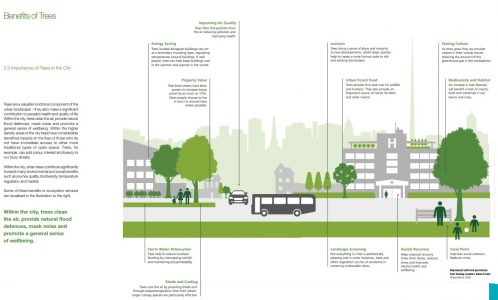
     

    • The Kyoto Protocol 1997. For the first time, industrialised countries (including Ireland) had legally binding targets for the emissions of greenhouse gases. The USA did not ratify the agreement despite being signed by President Bill Clinton.
    • The EU Water Framework Directive 2000. Binds member states to achieving ‘good ecological status’ of all rivers, lakes, estuaries and coastal zones by 2015 or, with some exceptions, by 2027 at the latest.
    • The EU Marine Strategy Framework Directive. Members states were to achieve ‘good environmental status’ of marine waters, including the creation of a network of strictly enforced Marine Protected Areas by 2020.
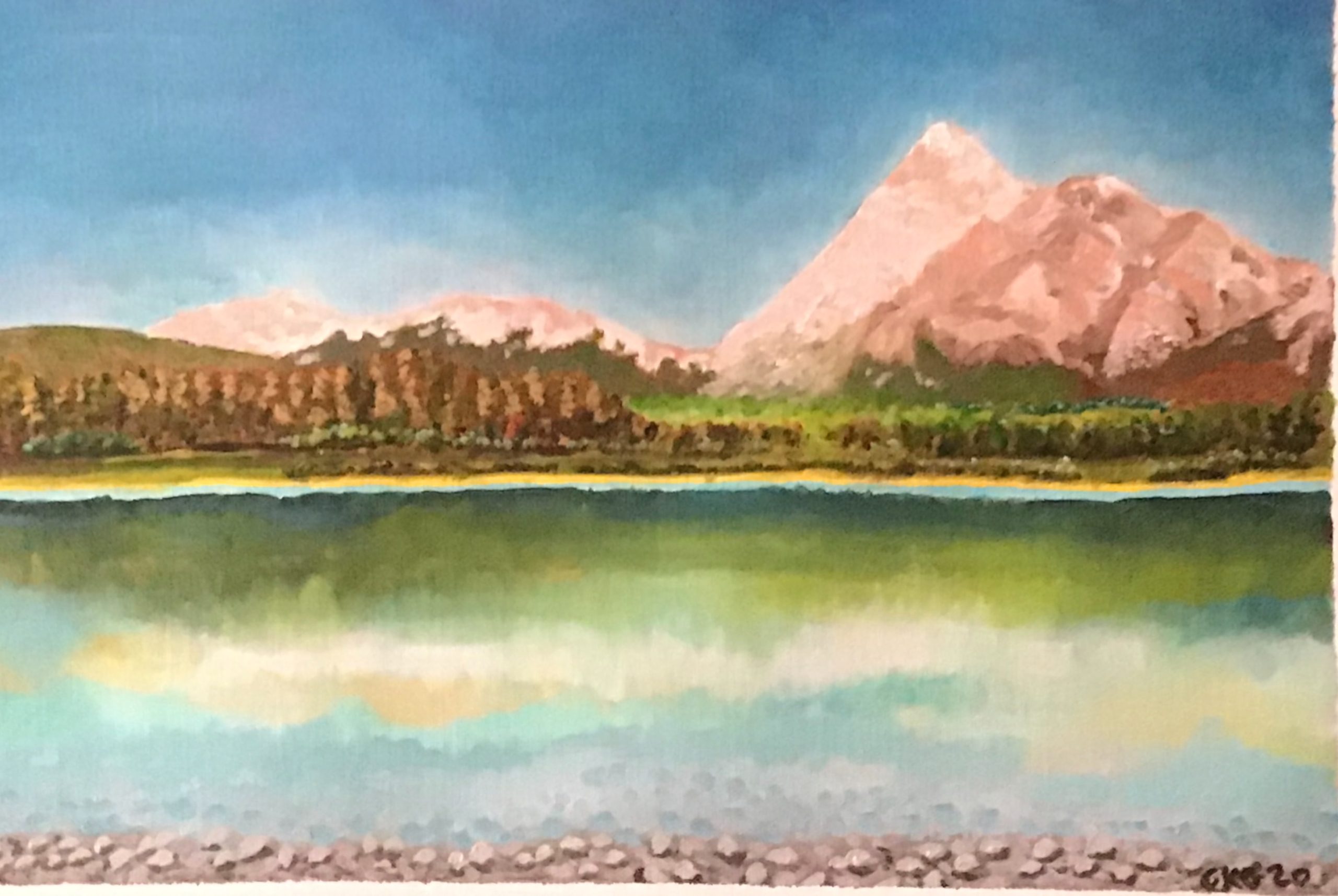
    • The Common Fisheries Policy in 2013 set a legal deadline for ending overfishing and restoring fish populations by 2020 at the latest.
    • The Paris Climate Agreement 2015. Signatories to the accord agreed to keep global temperatures to within 1.5 degrees of pre-industrial levels (we have already experienced approximately 1 degree of warming). Our Taoiseach at the time, Enda Kenny, told the assembled delegates that “Ireland is determined to play its part”, while at the same time telling the assembled Irish press outside the conference hall that climate targets were ‘unrealistic’.


    You would be forgiven, after reading this list, for thinking that by now we should have a clean, healthy environment where nature is flourishing within networks of protected areas and carefully managed human activities steered by the principles of wise use.

    Yet we all know this is not the case. International treaties are criticised for ‘lacking teeth’ yet European laws are backed by the European Court of Justice while our own laws are enforced within our national judicial system and these haven’t achieved much either.

    In the four decades during which this hefty body of ecological legislation has unfolded we have had governments of all political stripes and colour (including Green) so there’s no point in blaming ideologies of left and right. The next time you hear a politician crowing about the salience of rule of law bear this in mind.

    At the end of 2017 the High Court in Dublin ruled that “a right to an environment that is consistent with the human dignity and wellbeing of citizens at large is an essential condition for the fulfilment of all human rights”. Although this was not upheld, such a ruling would be a game-changer and may force the state, through the courts, to properly enforce the laws and treaties it has put its name to.

    Elsewhere, the law has been used to great effect by environmental groups over the years most notably in highlighting that whole industries like forestry and peat extraction have not been compliant with the law. In 2020, a landmark case led by Friends of the Irish Environment was successful in the High Court in demonstrating that the government’s plans to meet legally-binding greenhouse gas reduction targets were inadequate. Yet, these campaigns take many years to reach fruition while state agencies have shown themselves to be remarkably creative in their quest to avoid meeting legal environmental obligations.

    Ireland has yet to implement a law to allow for Marine Protected Areas (c. M Brown)

    I would not go so far as to say that the existing body of legislation is sufficient: we still need instruments for the designation of Marine Protected Areas and to legally protect marine species, such as sharks. Our vitally important hedgerow network enjoys very little legal status. But these will not be enough.

    I struggle to explain to my children how it is that governments can bring in laws only to invest great energy is trying to wriggle free of them. In January 2021 a senior judge, Anthony Collins, told the Irish Independent newspaper, that the state displayed an “astonishing reluctance” to comply with EU environmental law including on septic tanks, habitats, nitrates and phosphate pollution, urban wastewater treatment and environmental impact assessments. “The state willingly went along with all of them and yet when it came to implementing them and applying them, dragged its heels” he told the paper.

    “I struggle to explain to my children how it is that governments can bring in laws only to invest great energy is trying to wriggle free of them”

    Why is it left to small and poorly-funded environmental groups, frequently with lawyers working pro-bono, to drag the government kicking and screaming into court? What is missing? Paradoxically, the answer might be another law – but I’ll come to that in the next episode.


    8. Technology will come to the rescue.

    The Dark Mountain Project was established following the publication of a manifesto by two English writers in 2009, proclaiming:

    “We intend to challenge the stories which underpin our civilisation: the myth of progress, the myth of human centrality, and the myth of our separation from ‘nature’”.

    It dwells on our over-confidence in the civilisations in which we live, quoting Bertrand Russell on the work of novelist Joseph Conrad, suggesting he ‘thought of civilised and morally tolerable human life as a dangerous walk on a thin crust of barely cooled lava which at any moment might break and let the unwary sink into fiery depths’, and declaring that “human civilisation is an intensely fragile construction […] built on little more than belief: belief in the rightness of its values; belief in the strength of its system of law and order; belief in its currency; above all, perhaps, belief in its future.”

    The hard copy of the manifesto, slim, brooding and potent, bound in blood-red and titled Uncivilisation – The Dark Mountain Manifesto, reminds me of the vial of liquid labelled ‘drink me’ in Lewis Carroll’s Alice in Wonderland. It is a dark vision (the title of the project suggests they’re not pretending otherwise) but one which sits too easily within dark corners of my own thoughts. Drink it in and prepare to descend to the abyss.

    Yet anyone who has spent any length of time reading history or learning the fundamental laws of science knows that civilisations end and continual growth of anything, let alone an economy, is a physical impossibility. We know that what we see as immutable foundations of societies, such as national borders, government institutions, currencies and laws, are merely figments of our collective imagination and could all evaporate like ether.

    “continual growth of anything, let alone an economy, is a physical impossibility”

    In recent times, technology has come to represent one of these foundations. Unlike bank notes or laws signed by politicians, which are just pieces of paper after all, technology is real and tangible. It has transformed our lives, particularly since the 1950s, so that I can spend a Monday morning typing thoughts onto a screen instead of hand-washing bedsheets or toiling in a field. Technology has progressed so rapidly in this time that there are now well-founded concerns that the balance of power between people and machines is being inverted.

    Our blind-spot is our doe-eyed infatuation with these shiny, beautifully designed gizmos which risks sucking us into a trance-like torpor and which is already undermining our democracies and sense of individuality.


    Paul Kingsnorth, one of the authors of the Dark Mountain Manifesto, wrote an article for Orion magazine in 2012 about the seductive nature of technology and specifically how it relates to the classes he gives on how to use a scythe: What he describes as “an ancient piece of technology; tried and tested, improved and honed, literally and metaphorically, over centuries”:


    Using a scythe properly is a meditation: your body in tune with the tool, your tool in tune with the land. You concentrate without thinking, you follow the lay of the ground with the face of your blade, you are aware of the keenness of its edge, you can hear the birds, see things moving through the grass ahead of you. Everything is connected to everything else, and if it isn’t, it doesn’t work.


    But the scythe has been cast aside in favour of lawnmowers and brush-cutters which “roar like a motorbike”, belch out toxic fumes, guzzle fossil fuels, and require the user to ‘dress up like Darth Vader’. “No”, Kingsnorth says in anticipation of the thought running through your head right now, the brush-cutter is not more efficient than a scythe. So why do we never see anyone using a scythe? Why are these tools which were used for so many centuries now relegated to museums and heritage parks? The answer, says Kingsnorth, is our ‘religion of complexity’ bound up in the ‘myth of progress’:


    Plastic is better than wood. Moving parts are better than fixed parts. Noisy things are better than quiet things. Complicated things are better than simple things. New things are better than old things.


    It reminds me of the apocryphal story about how NASA spent millions on developing a pen which could work in space, while the Russians simply brought pencils. Google Maps has done away with paper maps, on occasion leading people to their death. Able-bodied people stand waiting for a lift to shunt them up a single floor. We upgrade our phones even though the one we had worked perfectly well. We’re carried along in the cyclone of what we have assumed to be ‘progress’ but in reality we have no idea where it’s headed. And there’s no end to it. Sensible voices from policy and scientific communities have articulated what needs to be done to address the ecological crises: move away from fossil fuels; rein in unfettered capitalism so that it works for people and planet; reduce consumption levels among the wealthy within a waste-free economy; people and corporations should pay their fair share of tax; oceans, forests and wetlands should be protected.

    Yet these proposals are met with howls of indignation as if it were simply not possible to live full and happy lives within these parameters. And within this is the continual allure that new technologies will be found which will allow us to carry on as we are. In March 2019 the Economist reported on the UN Environment Assembly which was meeting in Nairobi, Kenya (and which opened with a warning that humanity was in ‘dire straits’ due to eco-degradation).

    The Swiss delegation tabled a motion calling for an expert review of ‘the science of geoengineering, including studies on the suite of available technologies, how each might be deployed and how well they would or would not work, as well as any possible negative consequences’. The Economist suggested that:


    Among the most controversial but also effective and affordable geoengineering options are planetary sunshades. By using high-flying aircraft, for instance, to spray a fine mist of mineral or man-made particles into the upper stratosphere, a portion of the sun’s incoming energy could be bounced back out into space before it gets a chance to warm the planet.


    Even in the unlikely eventuality that proposals such as these work without disastrous unforeseen consequences, they would do nothing to halt the sixth mass extinction, reverse ocean acidification, feed the hungry or clean up dirty waterways. Yet, for some, the thought of living on a dead and divided planet is easier to assimilate than changing our behaviour or curtailing our lust for unfettered wealth.

    In 1972 a group of scientists created a computer model to predict how long it would take for our civilisation to collapse. The book, The Limits to Growth, asserted that exponential growth of the economy, population and pollution would inevitably lead to collapse. The book was widely ridiculed, not least by those who saw technology as keeping pace with these demands, an argument which initially seemed rational – for instance in the face of developments in agricultural production or artificial birth control.

    The ‘Limits to Growth’ was published in 1972 and it’s warning on exponential growth are coming to pass

    However, nearly 50 years on, the predictions are bearing out. They wrote at the time that “the hopes of the technological optimists centre on the ability of technology to remove or extend the limits to growth of population and capital”. Among the models run by the computer, and described in the book, are those where technology advances exponentially alongside resource consumption, pollution and population – and under every scenario a collapse of population by the year 2100 is forecast.

    It pointed out that although technology has kept pace with population and pollution there had been no exponential increase in social change (political, ethical or cultural) and that is as true today as it was in 1972. “Faith in technology as the ultimate solution to all problems can thus divert our attention from the most fundamental problem – the problem of growth in a finite system – and prevent us from taking effective action to solve it” they concluded[i].


    9. Humans are separate from the rest of nature

    What is the connection between the extinction of the curlew and epidemics in mental health issues or obesity?

    What does drinking water quality in Co. Roscommon have to do with the incomes of beef or sheep farmers across the west of Ireland?

    How are melting Antarctic glaciers, Middle Eastern conflicts and depopulation in parts of rural Ireland interconnected?

    What has the illegal trade in endangered pangolins have to do with the Coronavirus pandemic?

    For many, these issues are discrete topics that occupy different parts of our brain, different pages of the newspaper and to varying degrees, require different levels of urgency and attention. Yet they are all fundamentally linked in ways that should be obvious to us but are not.

    “we have learned from nature that everything is connected but, in another way, we feel that this only applies to nature”

    In ways, we have learned from nature that everything is connected but, in another way, we feel that this only applies to nature, and since we humans have divorced ourselves from nature, the maxim no longer applies to us.

    But it does. Everything around us, from the components of your smart phone, the water from your tap to the asphalt on the road under your feet has come from nature. And it is a zero sum game – if it has appeared here, then it is no longer over there. In fact, since we all share the one planet – there isn’t really any ‘over there’.

    This can seem daunting at first, paralysing even, especially if you are one of those people (like me and my family) who try to make small changes in our consumption patterns.

    Those haddock fillets which I bought for dinner, are they somehow connected to human trafficking and allegations of slavery on poorly-regulated fishing trawlers?

    Are the carbon emissions from my trip to see pristine nature contributing to the collapse of that very ecosystem?

    Am I happy to vote for political parties who defend Ireland’s corporate tax regime so that we can attract foreign investment? Am I, at the same time, eager for Ireland to meet international commitments on overseas aid? Perhaps I would not have been aware that Christian Aid, a charity, has calculated that Zambia, one of Ireland’s chief recipients of overseas aid, has lost tax revenues equivalent to 40% of the aid we gave them thanks to the tax treaty between our two nations until 2015.

    Or that Ireland has consistently opposed a financial transaction tax or EU moves to harmonise tax laws and improve tax transparency, something which directly affects the budgets available for social programmes, public infrastructure and environmental protection.

    Ireland scores well on some Sustainable Development Goals but falls far short on environmental targets

    According to the Coalition 2030 group of Irish civil society organisations, Ireland’s “facilitation of abusive international tax planning results in billions of dollars, which might otherwise be used to fund sustainable development, being funnelled away from state Treasuries in those countries”[ii].

    Perhaps you are among the 22.5% of people in Ireland on a low wage (the second highest rate in the OECD group of countries) and have no choice but to buy low-cost clothing for your children, which in turn may come from sweatshops in east Asia using child labour and discharging toxic effluent into local water courses.

    Unravelling these issues is an impossible task for most of us. But the flipside of this approach is considerably more cheery. What if we could tackle all of these overlapping issues at once? What if, by adopting more thoughtful policies, we could address climate breakdown, mass extinction, poverty and inequality all at the same time? After all, what’s the point of clean air and healthy cities if the people in them don’t have decent housing or if rising sea levels will inundate them? Why would we fight to reduce ever-rising global temperatures if ecosystems are collapsing to the point where we don’t have a secure supply of food and clean water?


    The idea of bringing the seemingly disparate challenges together is encapsulated in the UN’s Sustainable Development Goals. There are 17 in all, ranging from achieving gender equality, ending hunger and ensuring quality education to protecting life on land and in the oceans, taking action on climate change and providing clean water and sanitation. The beauty of the approach is in their interconnectedness. Governments cannot pick and choose which areas they’d like to target but must develop strategies to tackle them all together.

    Ireland already scores well in some areas, such as education and health, but with significant challenges in meeting environmental targets, reducing poverty (especially among children) and creating a fairer tax system.


    Seen in this way, the bewildering parade of challenges can be tackled as a once-in-an-epoch opportunity.

    Thriving nature, peaceful and healthy communities, a fair economy that is the servant of society. To get there, we need to change everything. It is why one of the chants from the school climate strikers is: ‘system change – not climate change!’.

    It is these ideas which are at the heart of Kate Raworth’s Doughnut Economics, a book whose central idea is that we must find a way of living within the limits imposed by nature (the planetary boundaries and the outer ring of the doughnut) while meeting human needs (the inner ring of the doughnut).

    The debate required to achieve this is far more than the socialist versus capitalist slugfest which has re-emerged as a theme of social media tropes. There is no -ism which we can take down off a shelf like a recipe to address our current predicament. Market capitalism has been wonderful for providing us with consumer goods but is making our planet unliveable and is leaving millions in a cloud of dirt as the few speed off with fantastical wealth and technology.

    For Raworth, “for those who are willing to rebel, look sideways, to question and think again, these are exciting times”. It’s time to ditch our standard measure of economic success, Gross Domestic Product (GDP), as the ‘cuckoo in the nest’ – an idea which has outgrown its purpose and which threatens to exhaust those trying to feed it. It’s time to bring in new metaphors, new pictures and to give our economies new purpose. It’s time to get inside the doughnut.


    So, if we have the wealth and the ideas, if people really care and are motivated, if we have all the science and data we need to make good decisions, all (or at least most) of the laws required, if we can start to see the interconnectedness of everything, what is it going to take break the logjam. How exactly are we going to save nature and, by extension, ourselves?


    [i] Meadows D.H., Meadows D.L., Randers J. & Behrens W.W. 1972. New American Library.

    [ii] Coalition 2030 report. July 2018.

  • Press Release: Irish Wildlife Trust welcomes commencement of National Parks and Wildlife Service Review

    Press Release: Irish Wildlife Trust welcomes commencement of National Parks and Wildlife Service Review

    Press Release

    03rd February 2021

    Press Release: Irish Wildlife Trust welcomes commencement of National Parks and Wildlife Service Review


    The Irish Wildlife Trust (IWT) welcomes the announcement by Minister of State at the Department of Housing, Local Government and Heritage, Malcolm Noonan, that the review of the National Parks and Wildlife Service (NPWS) has been launched [i].

    This was key ask of the IWT in the run-up to last year’s election and the Programme for Government included a commitment to “review the remit, status and funding of the NPWS, to ensure that it is playing an effective role in delivering its overall mandate and enforcement role in the protection of wildlife”.

    IWT campaign officer Pádraic Fogarty says: “The development of a strong and independent nature conservation agency is the single most important element in addressing the biodiversity emergency. The NPWS has been defunded under previous governments and cannot meet even minimum legal requirements. This review is a fantastic opportunity to reimagine the state’s role in restoring nature, not just complying with the law, but bringing nature back to our lives and our landscapes on a much wider scale”.

    The IWT looks forward to the stakeholder engagement element of the review and hopes that this will be open to the public to also express their views. Any new agency should have a central role in education and engagement with local communities, promoting local as well as national biodiversity targets and providing scientific advice to all government departments in delivering their responsibilities in this area.

    ENDS
    CONTACT: Padraic Fogarty IWT Campaigns Officer irishwildlife@iwt.ie
  • The War on Rivers

    The War on Rivers

    The War on Rivers

    “In recent years land drainage policy has received attention on two counts: the adequacy of the financial returns to investment of public funds in drainage has been questioned, and it has been alleged that adverse impacts on the environment also result therefrom”.

    It might have been written yesterday but these lines are the opener to a review of land drainage policy written by Richard Bruton (now a Fine Gael TD but then a research officer with the Economic and Social Research Institute – ESRI) and Frank Convery in 1982 – nearly 40 years ago.

    In fact, land drainage works had been going on since Famine times, when the starving poor were forced to work for relief and bureaucrats dreamt up infrastructure projects in the hope of boosting the economy. This was all achieved with manual labour and subsequent decades of depopulation resulted in ‘neglect’ of the rivers which simply went back about their business.

    By the 1930s a new impetus emerged with the availability of heavy machinery while the war years saw famine and food shortages throughout Europe, in turn increasing demand on productive farmland.

    The problem, the ESRI noted, was not an excess of rainfall but the saucer shape of Ireland: “as a result, the rivers flow slowly through poor channels. Much of the land suffers from periodic or prolonged flood damage. Even at low-flow, the rivers provide poor outfalls that prevent adjoining lands being properly drained”.

    The result was the Arterial Drainage Act, signed into office by the nation’s first president Douglas Hyde on the 1st of March 1945, since when it has remained unchanged.

    Ireland’s 1st president, Douglas Hyde, signed the Arterial Drainage Act into law

    The ‘drainage problem’ was two-fold. Field drainage was a job for individual landowners while arterial drainage was the widening, deepening and straightening of the main river channels. One was necessary for the success of the other.

    The River Brosna, a tributary of the Shannon, was the first to get a going over in the late 1940s with many more to follow in subsequent decades right up to the early 2000s, among them the Corrib, Boyne, Inny and Blackwater in Co. Monaghan. There were many more minor schemes as well as embankments of tidal rivers such as those at the mouth of the Rivers Shannon and Fergus in Co. Clare.

    Environmental concerns were raised almost immediately although the Commissioners of Public Works, later the Office of Public Works (OPW), were exempt from the Fisheries Acts at the time and for many years, when the bulk of the works were undertaken, were exempt from any form of environmental impact assessment (EIA). The late-ecologist Oscar Merne, warned that drainage of turloughs was threatening the last holdouts of black-necked grebes – a bird that was last confirmed nesting in Ireland in 2011.

    The OPW ‘maintain’ 11,500km of rivers (the blue lines)

    A report of the Inland Fisheries Commission in 1975 noted complaints from anglers that:

    “Drainage operations eliminated desirable natural meanders in rivers, removed holding pools, destroyed spawning beds, and produced canal-type water courses characterised by long stretches of steep banks piled high with rubble and spoil.”

    It bemoaned the lack of research being carried out on the impact of these works, to salmon and trout in particular, although what work had been done suggested that long term damage to salmon numbers was limited. What I have never seen is a study which has assessed the impact of drainage on the ecology of an entire river system. Even today, when some form of EIA is produced, the baseline is the already-drained channel.

    The Commission report noted the obligation under the Arterial Drainage Act to undertake continual maintenance of drainage river channels. It noted that “the impact on fisheries of recurring drainage maintenance work gives cause for anxiety”.

    These days the OPW notes that Under Section 37 of the Arterial Drainage Act 1945, it is “statutorily obliged to maintain all rivers, embankments and urban flood defences on which it has executed works since the 1945 Act in “proper repair and effective condition”.”

    And so, entirely at the public expense, the OPW must, by law, periodically go back to the 11,500km of rivers to keep them “in a condition that ensures they are freeflowing, thus reducing flood risk and providing adequate outfall for land drainage”.

    This means that, for no other reason than statutory obligation, the OPW sends in the heavy machinery, tearing out bankside trees and vegetation, destroying fish spawning beds and generally keeping rivers in a canal-like state.

    The OPW is not above the law, but in practice you wouldn’t believe this.

    It schedules and designs its own works, writes its own impact assessment reports, gives itself permission to fire on and, when things go wrong, reviews themselves and implements their own corrective actions.

    To get access to reports, such ‘appropriate assessment’ decisions and supporting reports, we need to go via Freedom of Information. In 2018, we found that the OPW destroyed a kilometre of the Newport River, in Co. Tipperary, a part of the Lower River Shannon Special Area of Conservation, and faced no sanction whatever.

    In 2018 the OPW destroyed 1km of Special Area of Conservation and faced no sanction

    The result is a state agency fixated on heavy engineering, operating outside the law with no oversight and working to legislation that was enacted at the same time Russian troops were marching on Berlin.

    Today our rivers are in a sorry state. Over half are polluted while large dams and other obstructions means migratory fish like eels, salmon and sea lamprey face extinction. But the arterial drainage programme has torn the heart out of rivers by undermining their basic ecological function.

    Rivers are meant to meander and flood, it is how nature has adapted to variations in climate and topography. The dynamic essence of a natural river system creates a vast array of habitats not only for fish but birds, trees and other plants, mammals and invertebrates.

    Humans are not outside this system – most of our big towns and cities rely on our rivers for drinking water. After spending millions of euro on destroying the river ecosystem we then have to invest more millions in removing silt and harmful bacteria to make the water drinkable.

    The IWT has started a petition to urge Patrick O’Donovan, the minister in charge of the OPW, to reform the Arterial Drainage Act. We want a new piece of legislation that works for people and nature, one that is fit for the biodiversity and climate emergency.

    Flooding remains a severe, and growing, threat due to climate breakdown but we must focus our efforts on protecting homes and businesses, not farmland.

    Indeed, the herculean effort that is made to keep water off farmland means it is adding to flooding risk in towns and cities downstream.

    The OPW should be obliged to implement nature-based solutions and should be strictly restricting heaving engineering works where no other options are available. We can pay farmers for storing the water, preferably through restoring and rewilding of river flood plains.

    The OPW must be more transparent in their approach and it should go without saying that they need to comply with the law. The National Parks and Wildlife Service or the Environmental Protection Agency should be given the power of authority to licence works carried out by the OPW and given power of investigation and sanction when standards are not met.

    If you agree, please sign the petition: Reform the Arterial Drainage Act | Uplift

  • Chapter 1: The End

    Chapter 1: The End

    Part 1

    Episode 1: In the End


    The beauty of the world hath made me sad,

    This beauty that will pass;

    ‘The Wayfarer’ by Padraic Pearse

    Imagine if all the birds vanished from Ireland. Picture for a moment your daily routine, except with no bird song, no seagulls rummaging around the bins, no rooks descending on freshly tilled fields, no clouds of gannets and fulmars trailing after fishing trawlers.

    Imagine they had all simply disappeared.

    Many years later, people would reminisce about the size of the seagulls or how the robin would literally stand on the spade handle, watching expectedly for worms while you dug the garden. “Isn’t is an awful shame we don’t have these things anymore” people would say.

    And time would pass.

    Our lives would likely go on as normal. Birds in Ireland don’t pollinate crops and so their passing would not affect food supplies.

    They don’t play any particular role in modern beef or dairy production and are not needed for rearing lamb on hillsides or pigs in factory sheds. In some places there would be more pests but this could be countered by greater application of trapping or chemical repellents. For many, removing a nuisance abundance of crows, pigeons and seagulls would be a great plus.

    A burgeoning industry for garden bird food would collapse and summer trips to seabird colonies would dwindle but, by-and-large, this would not precipitate a great employment crisis.

    The Wild Atlantic Way would still draw many thousands of visitors to peer at its guano-stained, but now lifeless, cliffs and rocky outcrops. In time, the names of most of the birds that once called Ireland home would be forgotten and only a few would live on in art, poetry or song – like the tiny wren remembered on St. Stephen’s Day in Lá an Dreoilín, where straw-clad marchers traditionally called door to door for offerings.

    If noticed at all today, the clicking wren harmlessly flits through briars, but our ancestors didn’t have much time for them.

    An old tale tells how:


    The wren is mortally hated by the Irish; for on one occasion, when the Irish troops were approaching to attack a portion of Cromwell’s army, the wrens came and perched on the Irish drums, and by their tapping and noise aroused the English soldiers, who fell on the Irish troops and killed them all. So ever since the Irish hunt the wren on St. Stephen’s Day, and teach their children to run it through with thorns and kill it whenever it can be caught. A dead wren was also tied to a pole and carried from house to house by boys, who demanded money; if nothing was given the wren was buried on the doorstep, which was considered a great insult to the family and a degradation.[i]

    Although this tradition lives on, the practice of catching and pinning a (sometimes live) wren to the end of a pitch-fork (thankfully) does not survive.

    So the parades go on without the need for any actual wrens. We wouldn’t really miss the little birds.

    And in our imagined future, like today, few people would recall the cry of the redshank, the sight of a golden eagle darkening the sky or the heart-stopping fright as a red grouse explodes out of the heather at close range.


    In fact, we already know what this future looks like.

    14 species of bird have gone extinct from Ireland (if you only include those which have not been reintroduced – like the eagles and the red kite – or found their own way back – like the great-spotted woodpecker).

    Many of these, like the crane and the bittern, have been gone so long that no living person remembers a time when they were part of our natural fabric.

    The corn bunting disappeared in my lifetime (some time in the 1990s) but, being rather inconspicuous, this was scarcely noticed. A further 37 species are on BirdWatch Ireland’s ‘red list’, meaning their populations have ‘declined severely’ since 1800 or where their breeding range has declined by 70% or more over 25 years. At a human level, this means that most of these birds are culturally extinct – in other words, most people are unlikely to ever encounter them over their lifetimes.


    And so there is already practically no personal experience surviving of breeding curlews, redshanks or corncrakes, hunting barn owls or soaring golden eagles. Virtually no one has heard a yellowhammer calling from a hedge, with its unmistakable ‘little-bit-of-bread-no-cheese’ song. And as these phenomena pass from human experience, so they pass from our art and heritage.

    But there is something clearly at odds with the passing of beauty and song and the story we are told by ecologists that our very existence depends on nature.

    Few people doubt this to be true, but how can we then explain why – in Ireland at least – our material lives have never been better while all around us the natural world fades into oblivion?

    Were all the birds really to vanish tomorrow, why would it not affect our lives more directly? Yes, we would feel it in our hearts, but if nature is as vital as people say, why would we not then feel it in our stomachs and our pockets as well?

    Were all the birds really to vanish tomorrow, why would it not affect our lives more directly?

    Ecological collapse is normally the stuff of science fiction movies like Blade Runner or dystopian novels like The Road by Cormac McCarthy. The archetypical theme will be familiar to anyone who’s ever seen a zombie movie – a relatable ‘everyman’ character is plunged into a world transformed, where the familiar and comfortable are suddenly the alien and dangerous. In these worlds, from Pixar’s Wall-e to Margaret Atwood’s The Handmaid’s Tale, the natural world as we know it is gone, dead even.

    The opener to Blade Runner 2049, staring Ryan Gosling and Harrison Ford, bases the film’s premise on the “the collapse of ecosystems in the mid-2020s” which gave great power to a single industrialist whose “mastery of synthetic farming averted famine”. Beleaguered citizens scratch out an existence in soulless cities, or, in the case of Wall-e, are morbidly obese imbeciles in flying saucers. Ecological collapse in these worlds is the total annihilation of biological life – with the exception of human beings, of course. And to read the press these days, it’s a world which is coming to place near you, very, very soon.


    In 2017 a headline in London’s Independent newspaper screamed: Scientists warn of ‘ecological Armageddon’ after study shows flying insect numbers plummeting 75% and went on to quote the researchers saying “we appear to be making vast tracts of land inhospitable to most forms of life, and are currently on course for ecological Armageddon. If we lose the insects then everything is going to collapse”.

    That same year a headline in The Irish Times decried how Intensive farming could cause ‘ecological Armageddon’ if insects are destroyed over an article on continued agricultural intensification and the use of the herbicide Glyphosate.

    Meanwhile British naturalist Chris Packham warned in June 2018 that the “UK [was] facing ‘ecological apocalypse’” while in March of that year The Guardian cautioned that “Europe faces ‘biodiversity oblivion’ after collapse in French birds”. This article went on to say that the “authors of [the] report on bird declines say intensive farming and pesticides could turn Europe’s farmland into a desert that ultimately imperils all humans”.

    But in many ways this view of ecological collapse is off the mark. Firstly we might imagine that the result of ‘ecological Armageddon’ would be dead landscapes, and yet anyone who routinely has to escort spiders from their bathroom will tell you that life is still very much all around us.

    Secondly though, and arguably more worryingly, it is presupposed that the collapse of the living world is still some point away in the future. It isn’t. It may come as a surprise that the world we inhabit – here in Ireland at least – has already experienced a total collapse of ecological systems.

    And although this may be hard to fully grasp, it does go a long way in explaining why the vanishing of what’s left of our bird populations would not hurt us in our stomachs or our pockets. To explain why this is so we need first to understand what an ecosystem is and what it means when it collapses.

    Photo: Dikaseva on Unsplash. The science fiction version of ecological collapse.


    In ancient times plants and animals were considered to be the unique products of a divine creator, each moulded and shaped independently. Right up to the 18th Century, the populations of plants and animals were thought to be regulated by God himself, with just enough hawks to ensure the smaller birds would not be diminished, just enough little fish to keep the big fish sated.

    In Western science it would be Alexander von Humboldt, a Prussian adventurer and explorer who, in the early 1800s, was the first to see how everything in nature was intimately connected with everything else.

    The study of these infinite connections ultimately became the study of ecology. It would illuminate an understanding of the world as the web of life – with each species only a gossamer thread from every other. And so the concept of the natural world as a system emerged: the ‘eco-system’.

    As every living thing is utterly dependent upon its surroundings, not only the living parts of it but also the non-living air, water, soil and climate, the ecosystem is defined in space. This means that when we talk about an ecosystem we really must set out where its boundaries lie.

    It could be the vast oceans – effectively a single ecosystem broken up by smaller patches of land – or the enormous rain forest of the Amazon in South America. Or it could be the ecosystem inside our gut; inhabited by thousands of species of bacteria which are essential for our health and well-being.

    A typical back garden or a farm is an ecosystem and each of these examples shares the common features that they are physically contained and consist of a variety of living organisms interacting with each other and the non-living elements around them. In the same way it can be argued that there are infinite ecosystems, there are also ecosystems within ecosystems, or just one giant global ecosystem which connects all living things, including every person and the junk which has piled up around us.


    The way in which ecosystems work is far from clearly understood; even in the smallest of ecosystems – a corner of your garden for instance – there are uncountable organisms, from protozoans, bacteria, fungi and larger invertebrates like worms, beetles and springtails. And that’s before we even look at what’s happening above ground!

    A good analogy for explaining this, and one which extends to how it affects us as humans, is that of the car.

    Imagine for a moment that you are the proud owner of a brand spanking new Tesla Model S. It’s a beautiful piece of engineering which combines cutting-edge technology with lusty design and a price tag to match.

    The concept of a car as a mode of transportation doesn’t do the Model S justice. Among its many features are ‘adaptive lighting’ which lean into your bend – perfect for night-time driving on a windy road.

    The Model S also comes with something called ‘bio-weapon defence mode’ which, according to the website “removes at least 99.97% of particulate exhaust pollution and effectively all allergens, bacteria and other contaminants from cabin air. The bioweapon defence mode creates positive pressure inside the cabin to protect occupants.”

    I could list the full inventory of special features from safety, entertainment, navigation and comfort that no doubt make the vehicle a pleasure to drive. Lest we overlook it, the Tesla Model S is a status symbol, letting everyone know what you think of yourself and where you see your standing in the world.

    The most pristine ecosystems, such as a perfectly intact forest, work in much the same way. Their beauty is instantly apparent, but it has taken an awful lot of time in development to get it that way.

    All of the various components of the car are equivalent to the species in an ecosystem. Our eyes are only capable of seeing the large, obvious, flashy bits on the outside (mostly the trees in this case) but thousands of tiny working parts, the great majority of the total, are largely hidden from view. We have no idea how these work or how they’re assembled but when they all come together the system hums along.

    A pristine ecosystem is remarkably stable; many of the tropical rain forests have stood for millions of years without changing their basic form. Like the Model S, our pristine ecosystem includes a lot of features. From a human perspective, some of these are essential, like food, shelter and clean water. But to stop there would be to see the Tesla as merely a mode of transportation.

    The pristine forest also provides fuel, medicine, pets and beasts of labour, a great variety of materials (for clothing, cooking, building and creating), amenity, spiritual sustenance, art (both as inspiration and the means to create it), recreational drugs (including alcohol and hallucinogens) and great variety in diet, something which results in culinary culture and so is much more than just nutritional sustenance).

    At a larger scale, the forest helps to regulate the global climate system as well as hydrological and nutrient cycles all of which make Earth habitable for us in the first place. The Amazon rainforest, for instance, is so big that it underpins the water supply to virtually the whole of South America and plays a significant role in global climate patterns due to the amount of carbon it stores.

    Imagine – the loss of this single forest expanse that underpins human welfare would have global, and frightening, ramifications. The great stability of the pristine ecosystem meant that people living in it were protected from one year to the next from extremes of drought or flood. Indeed for the great majority of human existence (i.e. the pre-agricultural bit) humans lived within these ecosystems and all of their needs were provided for (including status symbols like the feathers of flamboyant birds for head-dresses or the shells of sea creatures).

    The collapse of the Amazon ecosystem is a very real possibility


    This is not to argue that early humans didn’t impact negatively on their environment as it is pretty certain that people were responsible for the mass extinctions of large mammals in the Americas and Australia. Nor does it mean that ecosystems never changed – they did, and sometimes quite abruptly – but the likelihood of these changes being catastrophic are much lessened when all the species are intact (and as I’ve already mentioned, many of the great rainforests have survived, largely unaltered, for many millions of years).

    For most of us the Tesla Model S will be above our price range, so let’s say we opt for a Nissan Leaf instead. It also acts as a mode of transportation, with many of the features of the more luxurious Tesla so that it too will hum along nicely even without the adaptive lighting or bio-weapon defences.

    In our analogy this would be an ecosystem that doesn’t have all the great features of the ancient, pristine forest, perhaps a dryland or a mountainous area which has a lower abundance of food or harsher living conditions. Not all ecosystems are going to provide the same range of services that us humans find valuable.

    Nevertheless, they retain their essential function and stability.

    There are no ecosystems in Ireland which fall into either of the above categories and it is a long time since we had anything approaching a pristine or totally natural ecosystem on our island.


    Now imagine you’re a first-time car buyer and all you can afford is the clapped-out banger a friend of a friend will give you for €300, no questions asked. You soon discover the radio is bust, the heating doesn’t work and the last time the de-mister on the back window actually cleared the fog Bertie Ahern was in power.

    You don’t get too upset about these things because you’re proud of your new purchase and it gets you from A to B, and after all that’s all you really care about. This is what happens when we start taking species out of an ecosystem. It may look the same on the outside, but it stops doing a lot of what it may have done before. Maybe the seas are not so rich in fish or the big trees are gone so that a valuable building material is no longer available.

    Although the loss of species may be imperceptible to us, and the disappearance of many species goes largely unnoticed by the great majority of us, the system it leaves behind is irreparably weaker and more vulnerable to further changes.


    When people in Ireland started to clear the forest to create farmland it resulted in a dramatic transformation from ancient woodland to open grassland. There were species which couldn’t cope with this change and went extinct (for instance the wood lark, the lynx and species of beetle which depend upon large quantities of dead and rotting wood); there were species which managed to adapt to the new landscape and even thrive (such as badgers, blackbirds and many wildflowers and their pollinators which were drawn to the light-filled spaces and pastures grazed by farm animals); and there were some which had never survived in a woodland but which found that agricultural systems provided the open grassland they preferred (such as skylarks, barn owls and corncrakes).

    The pre-industrial farmland continued to provide food (albeit significantly lower in variety), clean water, jobs and cultural sustenance.

    A system emerged which today would be referred to as ‘agro-forestry’ or ‘sylvopasture’ where the planting of trees helped to protect soil, define field boundaries, keep herds apart and improve animal health by providing shelter from cold winds or strong sun. These hedgerows needed to be maintained and cut back periodically, thereby providing a source of forage for the animals, fuel and timber for a variety of needs, as well as apples, hazelnuts, berries from rosehips, sloes and hawthorns.

    Skins and wool from animals provided clothing. Farming dramatically changed the social structure of communities and is widely believed to have greatly accelerated the rise of powerful elites and economic inequality (something which plagues farming to this day). In short, the new agricultural ecosystem continued to provide a lot of what the forest had done but it fell short in some important areas.


    Now imagine you’ve arrived from outer space and you’ve never seen a car before. I show you an engine and ask you to explain what it is for. You turn it over and you can see it has pistons, spark plugs, crank shafts and connecting rods and you may hazard a guess that it was used to power a great machine. But you’d be hard pressed to imagine that it took a family of four great distances in style and comfort.

    This is the dilemma that many ecologists face in Ireland today when standing in a field or on a hill or gazing through murky water on a deep-sea dive. We see species – evidently these landscapes are not dead.

    We see green fields, brown hills and the grey surface of the sea but we have no idea how these spaces once teemed with life in all its wondrous diversity

    But so many of the species are missing, there are alien species which were never there before people introduced them, and so many of our plants and animals only exist in much smaller (or sometimes bigger) populations then they once did. Standing gazing at a spark plug, it is impossible to conceive of a Tesla Model S or even a Nissan Leaf. We see green fields, brown hills and the grey surface of the sea but we have no idea how these spaces once teemed with life in all its wondrous diversity.

    The ecosystems which once existed have all collapsed.

    It was once a BMW

    Comparing nature to a car is useful, but as a metaphor it falls short. Machines built by humans can be taken apart and put back together again. Although they are complicated, all machines are understood by people because they were created by them.

    Nature, on the other hand, is beyond our comprehension.

    Science only gives us a glimpse of how its component parts interact with one another.

    Ecosystems, once damaged beyond a certain point, cannot be put back together again. Cars, even the Tesla, inevitably deteriorate and break down. Nature, however, perpetuates and renews itself through eons of time with each component dependent upon the system, and the system depending upon its components – the species. As Jeremy Lent says in his fantastic book, The Patterning Instinct: complex systems, such as a living being, a brain or an ecosystem “arises from a large number of nonlinear relationships between its components with feedback loops that can never be precisely described”[ii].


    The International Union for the Conservation of Nature (IUCN) has stated that ecosystem collapse “involves a transformation of identity, loss of defining features, and/or replacement by a novel ecosystem. It occurs when all ecosystem occurrences (i.e. patches) lose defining biotic or abiotic [that is, living or non-living] features and characteristic native biota [species] are no longer sustained.”

    This definition can apply to all areas of Ireland.

    Our seas have been overfished and trawled to oblivion, the land has been so deforested that only about 1% of the surface consists of native woodland while of the midlands’ ‘raised bogs’ at most only 0.6% remains intact.

    In upland and mountain regions only 28% of the peatland and heath habitats are ‘worthy of conservation’ and even these have been routinely burned, overgrazed and drained, leaving nearly all of their characteristic bird species threated with extinction.

    Our rivers meanwhile are mostly polluted, dams block the migration paths of fish and 11,500km are subjected to routine arterial drainage schemes which have drastically altered the natural flow patterns of the water.

    Even the farmland, which was until relatively recently a benign landscape for nature, has been transformed through the use of industrial chemicals and fertilisers and neglect of the ancient hedgerow network.

    All of the natural systems we see around us have suffered a ‘transformation of identity’ and a ‘loss of defining features’.

    All of the natural systems we see around us have suffered a ‘transformation of identity’ and a ‘loss of defining features’

    Collapse has been devastating for many of the wild plants and animals which live in Ireland. At least 120 have gone extinct (although a handful of these have returned) and up to a third of those remaining are threatened with extinction or are what the IUCN refers to as ‘near threatened’.

    The family of fish comprising sharks and rays has fared worst, with over two thirds of all species in Irish waters falling into these categories. The latest assessment of mammals shows only one species threatened with extinction (the black rat, which was never native anyway) but this rosy view masks the fact that seven species (nearly a quarter of the current total) are already extinct: the right whale, grey whale, brown bear, lynx, wild cat, wild boar and the wolf. But what has collapse meant for people?


    Today in Ireland we can no longer rely upon nature for clean water and we depend entirely on machines and chemical processes so that the water from our taps is drinkable.

    During the Covid-19 crisis we have been forced to stay within 5km of our homes and many have found that the nature we need for our physical and metal heath just isn’t there – or we don’t have access to it.

    Modern Irish farmland continues to produce food, particularly beef, lamb and dairy products, but much of the food we produce is also used solely to feed these animals and very little is made up of vegetables or grains destined for human consumption. A report from the United Nation’s Food and Agriculture Agency showed that since 2000 Ireland has been a net importer of food energy, as is the European Union as a whole.

    Agriculture is the biggest source of water pollution and greenhouse gas emissions and, according to the National Parks and Wildlife Service, is the greatest driver of extinction in Ireland. So the long list of benefits which were once provided by the pre-industrial farming ecosystem has dwindled drastically.

    As well as directly effecting the environment, this transformation has seriously impacted on farmers themselves. Although the Irish Food and Drinks industry returns enormous profits, and according to the state marketing agency, An Bord Bia, has recorded export growth of a massive 60% between 2010 and 2017, this has not benefited most farmers. Indeed the number of people working in agriculture has fallen by about 20% since the late 1990s while all farmers depend heavily on state subsidies to make a living.

    In 2019, nearly half of farmers earned less than €10,000 – far below the minimum wage.

    And it’s not only farmers.

    The coastal fishing fleet has suffered dramatic declines in catches with the great majority of small boats relying heavily on crabs and lobsters which are destined for diners in fine restaurants.

    And so the marine ecosystem barely provides employment in these areas, scarcely produces nutrition (in terms of the quantity of calories in the catch) and has left sea life in such a poor state that even many anglers and scuba divers are losing interest in practicing their pastime.

    And with the tangible benefits go all of the intangible aspects which we once derived from nature – the culture, the language, amenity, art and spiritual connections which is what has made Ireland unique.


    Ecological collapse has directly affected many Irish communities and yet it may feel to many people that this has not affected our way of life. Indeed, Irish people today enjoy a high standard of living in comparison to practically everywhere else – how can this be when the biodiversity we’re told is vital to our survival has been left in ruin?

    The answer lies in our consumption patterns. Everything we eat, from a bar of chocolate to a take-away curry contains ingredients from the four corners of the Earth. Even products we could safely assume are Irish are nothing of the sort. Irish beef relies heavily on imported cattle feed including soy beans from deforested land in Brazil and palm oil-derived milk replacers which are fed to calves after they’ve been separated from their mothers.

    Everything we eat, from a bar of chocolate to a take-away curry contains ingredients from the four corners of the Earth

    So-called ‘organic’ Irish salmon are fed fish meal which is the ground-up marine life from who-knows-where. The non-edible consumer goods which clog our homes may have been sourced from mines in dozens of countries while our entire economy is predominantly fuelled from imported fossil fuels.

    This includes 90% of our coal, which originates in Colombia, two thirds of which is linked to the Cerrejón open cast mine. In 2018, this mine was subject to a complaint from four development agencies, including Trócaire and Friends of the Earth, to the Irish government calling on it to cut ties with the mine due to allegations of human rights abuses, displacement of indigenous peoples and environmental destruction.

    In late 2019 the UN Committee on the Elimination of Racial Discrimination added their voice to stop buying this coal, citing a “serious abuse of human rights particularly affecting people of African descent and indigenous peoples”.

    At the height of the economic boom in the mid-2000s, Ireland was 10th in the world for the size of our ecological footprint. This fell back following the subsequent crash, but since then we’ve had another boom and another, pandemic induced bust, but our footprint continues to be way above the majority of countries.

    The latest data shows that our ‘overshoot day’ – that is the day of the year when we have used up resources at a rate that can replenished by the planet – is April 27th – meaning that after that date we are using resources which are not being replenished. This represents 35th place in the countries examined. And so Ireland races ahead on the motorway of human development which is wreaking ecological havoc the world over.

    Since our own ecosystems have collapsed, our consumption patterns can only be sustained by exporting collapse to other countries. And by the rationale which we have followed so far, if the global ecosystem collapses then we really do put our supplies of food, clean water and the myriad other benefits healthy ecosystems bring to humanity in dire peril.

    So, contrary to the dystopian views of science fiction, this world is not dead – it is merely transformed into one which is unrecognisable from what existed only a few centuries ago. This will indeed be apocalyptic for many of Earth’s inhabitants and in this sense there have been some illuminating studies as to just where the boundaries of this doomsday scenario lie.

    The Stockholm Resilience Institute has identified nine planetary boundaries: stratospheric ozone depletion; loss of biosphere integrity (i.e. biodiversity loss and extinction), chemical pollution, climate change, ocean acidification, freshwater consumption, land system change, nitrogen and phosphorous flows to the biosphere and oceans, and atmospheric aerosol loading.

    The researchers highlighted three of these: climate change, biodiversity loss and nutrient cycles where the outer limits have already been exceeded. At the university of Leeds in the UK, researchers there have attempted to adapt these indicators to the level of individual countries, measuring and ranking nations against their CO2 emissions, phosphorous, nitrogen, blue water, ecological footprint, material footprint and land use change.

    Ireland’s report card shows that we are exceeding six out of the seven boundaries, with only ‘blue water’ within our allocated limit.

    Ireland report card: could try harder

    The global situation currently looks bleak. The Stockholm Resilience Centre published further research in 2018 which analysed the current trajectory of these life-supporting Earth systems and found that “social and technological trends and decisions occurring over the next decade or two could significantly influence the trajectory of the Earth System for tens to hundreds of thousands of years and potentially lead to conditions that resemble planetary states that were last seen several millions of years ago”.

    They called this the Hothouse Earth – a new state that would be irreversible and would clearly have catastrophic effects for humanity and all other life on Earth.

    the Hothouse Earth – a new state that would be irreversible and would clearly have catastrophic effects for humanity and all other life on Earth

    It’s terrifying, but to be gripped with fear would be the wrong response. The authors point out that we still have an opportunity to act through “collective human action”. “Such action entails stewardship of the entire Earth System – biosphere, carbon sinks, behavioural changes, technological innovations, new governance arrangements, and transformed social values”. Meaning – we need to change everything.


    So Ireland is knee-deep in the climate and extinction crises and there is ample evidence that for all the wonderful benefits of modern consumer culture we are, in fact, up to our neck in ecological debt.

    Ireland, of course, is not alone in this mess. The University of Leeds team found only 16 countries which were operating fully within their bio-physical boundaries (among them, Sri Lanka, Guatemala and Nepal). This means we can learn from others who are already living within their ecological boundaries.


    It also means we have time (albeit not much) to harness our own unique creativity and resolve to create a better world – better cities, more secure communities, resilient farmers and fishers, inspiring landscapes. We’re going to need it all – not just science, money and policy, but art, folklore, faith (if you have one), spirituality, music and song and a restoration of a sense of wonder, joy and connectedness in nature.

    In 2017 my book Whittled Away charted just how much of our nature has vanished. In Shaping New Mountains, I want to imagine what a nature-filled Ireland would look like, and how we might get there.

    In Whittled Away I mentioned many of the solutions which have been tried and tested both in Ireland and elsewhere and pleaded for greater political prioritisation for nature conservation. I still firmly believe that bringing nature back would be of huge benefit to people, particularly local people, whether your locality is a city, the countryside or by the sea.

    But I’d be lying if I said I was optimistic. So far there is little indication that the biggest political parties understand the extinction crisis or feel compelled to act.

    Although 2019, when I started working on this project, was remarkable for the level of media and public attention given to climate change and plastic waste, there are still depressingly few who see the bigger picture or are willing to talk about habitat loss, pollution and overhunting – still the main pressures on nature in Ireland. And as I learn more about climate change and how it’s rearranging the furniture of our surroundings before our eyes, I feel less confident that some of the solutions I proposed in Whittled Away, such as marine protected areas or rewilding, can actually be successful in the way I first thought.

    But don’t confuse my lack of optimism with fatalism. I am still convinced that, no matter how small the window of opportunity shrinks, no matter how heavily the odds seem to be stacked against the likelihood that we’ll see radical change, the battle will still be worth it. I’m up for the fight – and I hope you will be too.


    In Episode 2 of Shaping New Mountains I try to get to the heart of the matter and in doing so try to explode a few myths – are rich countries like Ireland really more advanced than poor ones in their protection of the environment?

    Is nature conservation too expensive?

    Do environmentalists in Ireland want to turn the countryside into a theme park resembling Jurassic Park?

    Can we rely on technology to figure things out?


    That’s in the next chapter of Shaping New Mountains.


    [i] Lady Wilde. 1899. Ancient Legends of Ireland. Chatto & Windus, London.

    [ii] Lent J. 2017. The Patterning Instinct. Prometheus Books.

  • Press Release: Irish Wildlife Trust welcomes publication of report on Marine Protected Areas (MPAs) but process must be accelerated

    Press Release: Irish Wildlife Trust welcomes publication of report on Marine Protected Areas (MPAs) but process must be accelerated

    PRESS RELEASE

    26 January 2021

    Irish Wildlife Trust welcomes publication of report on Marine Protected Areas (MPAs) but process must be accelerated

    The report published today by the Department of Housing, Planning and Local Government will advise the government on how to expand Ireland’s network of MPAs. This report is a crucial step towards safeguarding more of Ireland’s diminishing marine life. The Irish Wildlife Trust welcomes the publication of the report and now urges the government to act swiftly on its main findings.

    It is of major concern that it has taken over three months for this report to be published while Minister Darragh O’Brien is now proposing a five month public consultation period. Ireland first committed to designating 10% of our seas as Marine Protected Areas in 2010 and yet today Ireland’s coverage – at 2.4% – is among the lowest in the world. The Programme for Government commits to protecting 30% of the sea by 2030 but, nearly two years since the Dáil declared a climate and biodiversity emergency, there is no sense of urgency from the Minister.

    Ireland’s marine biodiversity, especially inside bays and estuaries, is impacted heavily by fisheries and aquaculture activities as well as from pollution and climate change. The existing network of MPAs covers a mere 2.4% of Ireland’s marine region and so is entirely inadequate.

    “Our current MPAs are supposed to safeguard the most precious habitats and species from human pressures, but lack of management means even here biodiversity continues to be lost” says Regina Classen, IWT project officer. “We cannot delay further. The government must move from talking about protection to meaningful action on the ground”.

    Ireland must develop a coherent approach to human activities in the marine environment. Currently, legislation before the Dáil (the Marine Planning and Development Management Bill) will provide for installations of offshore renewable energy while Ireland must present its Marine Spatial Plan to the European Commission in March. The latter plan requires that Ireland take a proactive approach to conservation and restoration of the marine environment but without even the mechanisms for creating MPAs, and with such an appalling track record in this field, this approach is fundamentally flawed. The IWT is fully supportive of expansion in renewable energy generation however this must be done in a way that also addresses the biodiversity emergency.

    ENDS

    Contact: Regina Classen IWT Project Officer marine@iwt.ie


    The Irish Wildlife Trust is a member organisation of Seas At Risk (SAR), a European NGO based in Brussels. IWT, SAR and partner NGOs from France and Portugal are working on a collaborative campaign to make MPAs work in Europe. The Irish Wildlife Trust gratefully acknowledges Oceans5 funding support.

  • Shaping New Mountains

    Shaping New Mountains

    Shaping New Mountains

    In 2017 I wrote a book called Whittled Away: Ireland’s Vanishing Nature. One of the reasons I wrote the book was because I didn’t feel that people realised the true extent of the damage that has been inflicted, and continues to be inflicted, to nature in our country.

    It painted a fairly grim picture but I also felt that it was important not to shy away from this – after all, we can’t really address a problem if we can’t be honest about it, even though this can be uncomfortable. Although Whittled Away did talk about some of the solutions to our ecological problems I felt there was an opportunity to elaborate on these more. Working in nature conservation can be hard going, but there is also lots happening… and lots of people who are working on making things better, so I wanted to do a project that highlighted some of this work.

    I also felt that Whittled Away never got to the heart of WHY we have found ourselves in the situation we do – and that is pretty important. It may explain why we find it so difficult to act and to make the changes that are needed. When I tried to do this I quickly found that I wasn’t talking about nature any more… but people. Inequality, consumption and trade, our values and economics… these issues kept popping up. So, I wanted this project to really make the human connection – we are, at the end of the day, central to this story.

    Part 1 of this project tries to get to the root of our climate and biodiversity emergency. I look at some of the myths that have emerged around environmental protection and I examine how our values have been shaped so that destroying nature has been seen as a necessary part of development as a nation. If we are to find a way out of the crisis that we find ourselves in, we have to see the connections between multiple issues, and – perhaps above all – we have to feel that we are a part of the natural world.

    I’ve called it SHAPING NEW MOUNTAINS – it’s a line from a poem by Mary O’Malley called ‘The Storm’, in which she says:

    The wind rises. Locked in woodlands

    I hear it turning ash and oak

    As I am hauled to where the sea

    Is shaping new mountains. At midnight

    Mad airs howl like wolves

    And all the trees are bending

    I feels to me like we are in a storm right now – but the idea of ‘shaping new mountains’ is ambiguous: it could be disastrous, or it could be transformative in a positive way. In 30 or 40 years time, Ireland will likely look very different from what we see today, we have a chance now to shape that change for the better.

    In the second part of Shaping New Mountains I will explore ‘Six Big Ideas’ for bringing nature back to our lives and our landscapes. Many of the ideas – I should be quick to point out – are not mine, but have been around for a while. So during 2019 and 2020 I travelled the length and breadth of Ireland to visit the people who are already helping to make some of these ideas a reality.

    Like the ‘Wild Atlantic Rainforest’ in the south-west of Cork and Kerry. I visit a landowner who has made a start, a wildlife ranger who is working on the ground and a team of people working with local farmers to address the social as well as the environmental issues facing the landscape in this part of Ireland.

    What about transforming Dublin into a ‘Natural Capital’, where trees are seen as essential infrastructure, where waterways run clean and where the mountains south of the city are allowed to develop into a wildwood with wolves and wild boar. I talk to the state forestry company which is converting industrial plantations into native forests, a politician about ‘nature apartheid’ and a city official about how we can unleash nature’s potential.

    The freshwater pearl mussel is among our most critically endangered species. It can only survive in the cleanest water. Can we save the pearl mussels while providing a livelihood for farmers producing healthy food? In Farming the Pearl Valleys I talk to three farmers who are doing it.

    The ‘Ulster Shark Coast’ imagines a vast marine protected area across the north of Ireland exploding with sea life. I talk to the wildlife ranger who first developed the idea, a social scientist on the human aspects of island life and I visit Arranmore Island in Donegal to find out how this can be done while encouraging traditional fishing.

    The idea of a ‘Shannon Wilderness Park’ has been around for some time and imagines the restoration of peatlands and wetlands from the industrial cut-away bogs in the Midlands. I interview locals and peatland scientists on how communities can become guardians of nature.

    Finally, I look at ‘Bear Country’ in west Galway and Mayo where rewilding could happen on an immense scale. Can we restore long-lost species like wolves, bears and lynx is a way that is welcomed by local people? I talk to a sheep farmer, a specialist in reintroductions and an artist from Mayo on the complexities of wilderness in a lived-in landscape.

    In the two years it took me to undertake this project the world has been convulsed. Extremism is on the rise, trust and respect for others is fraying, inequality is worsening and, early in 2020, the Covid-19 virus triggered a pandemic that has so far claimed a staggering 2 million lives and which has drastically curtailed our personal freedoms. All the while climate change and ecological breakdown tighten their grip.

    Extreme weather including droughts and floods as well as wildfires and water shortages have been global issues – but have also affected us here in Ireland. In the past two years, Greta Thunberg has become a global voice of climate protest, we’ve had school strikes and civil disobedience from Extinction Rebellion. It’s hard to escape the feeling that we are living through a time of great change. Will this be the dawn of a new relationship both among the peoples of the earth and between people and nature? Or have we already lived through ‘peak human’, destined to descend into a death spiral of internecine conflict and collapsed ecosystems? I want to answer these questions, not by starting at the beginning… but at the end.

    In Episode 1 I look at the idea of ecological collapse: what it means; why does it matters and why it’s staring us in the face.

    Shaping New Mountains will serialised over the next 10 weeks in podcast format as well as on the IWT website – iwt.ie – where you can find links and other reference material, including the wonderful artwork created for this series by Jacek Matysiak and Naomi McBride

    Make sure to subscribe to the IWT podcast feed on Spotify, Apple Podcasts, Soundcloud, or wherever you get your podcasts – or follow IWT on Facebook, Twitter and Instagram for all the latest updates. To become a member of the IWT and to support our work in addressing Ireland’s biodiversity crisis, visit Become a Member – Irish Wildlife Trust (iwt.ie) – thank you for your support

  • 30×30: the new colonialism? Or the only way to save life on Earth?

    30×30: the new colonialism? Or the only way to save life on Earth?

    30×30: the new colonialism?

    Or the only way to save life on Earth?

    In 2016 the eminent, Harvard-based biologist Edward O. Wilson, made a radical proposal for the protection of the Earth’s biodiversity. Known as ‘Half Earth’, it is “a call to protect half the land and sea in order to manage sufficient habitat to reverse the species extinction crisis and ensure the long-term health of our planet” and was published as a book of the same name.

    It has since generated significant discussion within the conservation world as to whether such an approach would be achievable, desirable or even effective. As blunt targets go, it certainly captures the imagination; according to www.protectedplanet.net at present less than 10% of the Earth currently falls within a protected area with just over 16% of land and 7.7% of the marine. In Ireland the figures are c.13% and 2.5% respectively. So, increasing these figures to 50% is nothing if not ambitious.


    Protected areas currently cover less than 10% of the Earth

    But simplistic headline targets mask the complexities of the human/non-human relationship and can too-easily become mere hostages to fortune.

    One early reaction to the idea was that it could harm biodiversity and people, particularly poor people, as it “ignores the powerful engines of resource extraction and consumption that are the main drivers of biodiversity loss globally”.

    Another study concluded that protecting the Earth is theoretically possible, but that this would likely be targeted at politically ‘easy’ places (remote, barren and with little likely conflict with human uses), concluding that “achieving conservation goals by creating more protected areas in current wilderness might locally be helpful, but it is not sufficient to protect biodiversity at large”. The point being, where is protected, and how, is just as important as how much.

    In 2019, an influential paper in Science Advances suggested that protecting all “native ecosystems” along with transitioning to clean energy is required to maintain the global temperature increase to within 1.5 degrees Celsius, in line with the Paris Climate Agreement. The authors proposed a Global Deal for Nature which would target protecting 30% of the Earth’s surface by 2030 in addition to a further 20% ‘designated as climate stabilization areas’ “thereby reducing extinction threats and carbon emissions from natural reservoirs”. This analysis had the advantage of joining the dots between climate and biodiversity and the 30% protection target by 2030 (30 x 30) has entered mainstream policy circles.

    It is included in the EU’s Biodiversity Strategy, published last May and which includes for 10% of land and sea as ‘strictly protected’. The idea is that the Global Deal for Nature will be agreed in Kunming, China in May of this year as part of ‘COP 15’ – a meeting of the signatories to the Convention on Biological Diversity. It has been heralded as a companion agreement to the Paris Climate Accord.

    Earlier this week, French President, Emmanuel Macron, convened a ‘One Planet Summit’ in an effort to build momentum towards the Kunming meeting. Along with the President of Costa Rica, he has mustered a ‘High Ambition Coalition’ of nations committed to 30×30. Ireland, represented at the meeting (virtually) by ministers Pippa Hackett and Malcolm Noonan, announced that Ireland would be signing up to the coalition. What does all of this mean?

    13% of land and 2.5% of seas in Ireland are nominally protected

    Clearly, we have an ecological emergency which must be dealt with urgently. But how this is done will determine whether we tackle this successfully while making people feel included and addressing inequality, or simply creating more ‘paper parks’ while further alienating people and widening the gap between the haves and the have-nots.

    In advance of the One Planet Summit, a group of scientists published an open letter warning that a policy paper to advance 30 x 30 “reads to us like a proposal for a new model of colonialism”, critising the way it is being promoted for an over-emphasis on replacing traditional uses of nature with tourism, the lack of diversity among the authors, and for failing to address “important drivers for the loss of biodiversity that have been identified by numerous studies, including high levels of consumption, especially by wealthy countries”.

    How does this apply to us here in Ireland? While government commitment to the target is welcome it has not been articulated how the targets are to be met. We still have no legislation for creating Marine Protected Areas while we have no official analysis as to why our existing network of protected areas is abjectly failing to achieve targets that have been around since the 1990s.

    With only a few exceptions, land designations in Ireland have been accompanied with a dreadful lack of communication or dialogue with the landowners (typically farmers) and a complete absence of management measures (something for which the European Commission is taking Ireland to court).

    Farming organisations have reacted angrily at the idea of more designations, claiming to have been reassured by the previous government that there would be none. They have a track record of opposing any moves towards greater environmental protection and, in my experience, have refused to engage constructively in addressing concerns or promoting the solutions. But ultimately I agree with their general view that designations have been bad. They have failed people and nature, so why would we believe that more of them will achieve anything?

    In my view there can be no progress until we hear an admission from the State that it has failed in its duty to protect our natural heritage and, by extension our common right to a healthy environment, and that their policies have left us with collapsed ecosystems and an outsized responsibility for reducing greenhouse gas emissions. This must include abandoning the continued pretence that Irish farming and fishing are somehow ‘sustainable’ and shutting down greenwashing initiatives, especially Origin Green.

    The State must then lead in delivering on promises already made and, when it comes to expanding protected areas, it must lead here too by restoring nature on degraded public land especially national parks and nature reserves but also areas owned or managed by local authorities and semi-states like Coillte and Bord naMóna. Recent initiatives like Coillte Nature and the announcement that Bord naMóna will ‘rehabilitate’ 33,000 hectares of land are positive but they’re not enough.

    The State needs to make it easy and attractive for private landowners or local communities to create and manage their own nature reserves – so that people feel a sense of ownership, belonging and connection to nature in their areas.

    The current government has made some big strides in the right direction but we are still not seeing the level of urgent action that is required if we are to meet ambitious goals like 30 x 30. There is no getting away from the central role that they must play in the coming year to make the transformative changes that we know are needed. If we see this leadership then ‘half-Ireland’ will not only be achievable but will be a national project we can all take pride in.

  • Press Release: Irish Wildlife Trust welcomes Government commitment to ‘High Ambition Coalition for Nature and People’ at today’s One Planet Summit

    Press Release: Irish Wildlife Trust welcomes Government commitment to ‘High Ambition Coalition for Nature and People’ at today’s One Planet Summit

    PRESS RELEASE

    11 January 2021

    Irish Wildlife Trust welcomes Government commitment to ‘High Ambition Coalition for Nature and People’ at today’s One Planet Summit

    The One Planet Summit, which takes place today at the initiative of French president Emmanuel Macron and which will be attended (virtually) by Malcolm Noonan, Minister of State for Heritage and Electoral Reform, will draw attention to the biodiversity crisis and will pave the way for a mooted ‘Global Deal for Nature’, due to be held in China later this year (COP15 of the Convention on Biological Diversity).

    The IWT welcomes Minister Noonan’s confirmation that Ireland will be among the group of countries which have formed a ‘High Ambition Coalition for Nature and People’. This coalition is committed to the protection of 30% of land and sea by 2030 (in Ireland ‘protected’ areas currently cover 13% of land and 2.5% of sea), as well as the promotion of Nature-based Solutions to address the climate crisis.

    Minister Noonan’s commitment, on behalf of the government, is welcome but must be backed by urgent action to end overfishing, create Marine Protected Areas, restore bogs, rivers and forests, reduce pollution and create a nature-friendly farming system.

    IWT campaigns officer, Pádraic Fogarty, says “We’ve had 40 decades of talking so we really need to start acting in a way that reflects the state of emergency declared by the Dáil nearly two years ago. We’re still waiting on delivery of commitments made in the 1990s and 2000’s which were to have seen extinction and pollution as a thing of the past. Yet our extinction crisis is only deepening”.

    The IWT is calling on minister Noonan to outline how he intends for Ireland to reach the ambitious new goal of protecting 30% of land and sea by 2030 in a way that will foster local and community stewardship of the natural environment. We also call on him to urgently deliver on commitments made in the Programme for Government including commencing the review of the National Parks and Wildlife Service and publishing the expert report on Marine Protected Areas which has been on his desk since last October.

    ENDS
    CONTACT: Padraic Fogarty IWT Campaigns Officer irishwildlife@iwt.ie
  • What to expect for 2021

    What to expect for 2021

    What to expect for 2021

    2020 had been billed as a ‘super year’ for climate and biodiversity issues and, in a way, it was, but not like anyone could have imagined.

    Major conferences on climate, oceans and a ‘new deal for nature’ were all postponed due to Covid-19. A major, but under-reported, report from July just gone, by the Intergovernmental Panel on Biodiversity and Ecosystem Services (IPBES – the UN science panel which warned in 2019 that 1 million species are at risk of extinction) emphasised the crucial link between the Coronavirus and, what UN secretary general António Guterres described as, humanity’s ‘war on nature’.

    “There is no great mystery about the cause of the COVID-19 pandemic – or of any modern pandemic”, said Dr Peter Daszak, President of EcoHealth Alliance and Chair of the IPBES workshop on biodiversity and pandemics. “The same human activities that drive climate change and biodiversity loss also drive pandemic risk through their impacts on our environment. Changes in the way we use land; the expansion and intensification of agriculture; and unsustainable trade, production and consumption disrupt nature and increase contact between wildlife, livestock, pathogens and people. This is the path to pandemics.”

    It has been widely reported that lockdown has brought people closer to nature, maybe because the shops have been shut, because people have had more time on their hands or because we have spent more time than we ever could have imagined exploring the 5km radius from our homes.

    So 2020 was, as it turns out, a super year for nature and there’s every chance that 2021 will be just as super, but will it be super-good or super-horrifying?

    For a start, all the summits are back on, including the ‘COP 15’ meeting of the Convention on Biological Diversity, now expected to take place in Kunming, China in May. This will be an opportunity for world governments to develop a companion agreement to the Paris climate accord but this time for nature.

    The headline target is for what is being termed ’30 by 30’, that is, the protection of 30% of land and sea by 2030. The EU has already included this in their biodiversity strategy which was published last year, and endorsed by our Taoiseach Micheál Martin at a virtual leaders summit in September. Goals like these are fraught; will they result in any meaningful action?  As a New York Times op-ed in December pointed out “many difficult questions must now be answered: Which places should we conserve? What do we count as “conserved?” How do we conserve it? And who decides?”

    c. European Commission

    Here in Ireland, we certainly can’t just double our protected area network without addressing the reasons why our current system is failing so badly. Will Ireland even be represented in China by a government minister?

    At home, all eyes will be on the Climate Bill, which will come before the Dáil early in the year. The Oireachtas committee completed its pre-legislative scrutiny before Christmas and produced a strong report. Their recommendations include bolstering the language throughout the bill as well as introducing an obligation to address biodiversity and nature-based solutions in meeting climate goals. We’ll be watching closely to see if the Dáil will take these recommendations on board.

    Elsewhere, the Green Party will keen to be seen to be making progress on its wins in the Programme for Government. Of particular interest will be the proposed reform of the National Parks and Wildlife Service, something Minister Malcolm Noonan has been very tight-lipped on but who revealed through a parliamentary question that he hoped it would be completed by June.

    Minister Noonan, and his Fianna Fáil colleague, Darragh O’Brien, received a report in October from an expert group on the expansion of Ireland’s woefully inadequate Marine Protected Area (MPA) network. Over two months on, this report is still under wraps. Why this should be is a mystery. The publication of the report will be accompanied by a public consultation – a vital step but one that will take time. The clock is ticking so can the ministers please just get on with it.

    Directly related to the MPAs is the issue of industrial fishing. The usual meeting that decides the fishing quotas ended without deciding much last December, as Brexit negotiations were still underway. What was apparent was a change in tone from the European Commission in its dealings with ministers and an increasing sense of frustration that national governments don’t share their ambition in ending overfishing (or indeed meeting other environmental targets). Expect more of this friction in 2021.

    Fishing was a major sticking point of the Brexit trade deal and the industry here has seen its access to commercially important fish populations cut by up to 40%. The final agreement commits both sides to “promote sustainable fisheries and good fisheries management”. In both the UK and Ireland governments have committed to significant bail outs for those impacted, including money to tie up boats permanently. Will this be used to help restructure fishing and help to phase out harmful bottom trawling?

    Small boat fishers will be watching closely for the government’s appeal of the decision to overturn the ban on trawling by larger boats within six nautical miles of the coast – something they said was more important to them than Brexit.

    Also EU related is the continuing drama over the Common Agriculture Policy (CAP). Just before Christmas, the Commission released its recommendations for Ireland’s CAP Strategic Plan, that is – how Ireland plans to distribute the money under the next round of CAP. The report was pretty clear that Ireland is failing to deliver on environmental, social and certain animal welfare grounds. This is another field of battle between Ursula von der Leyen’s ‘Green New Deal’ and the business-as-usual mindset of many politicians in national capitals.

    Last December, the Department of Agriculture here released its ‘Ag Climatise’ plan which it claimed was a roadmap to climate neutrality in the agriculture sector. It was derided by climate activist-journalist John Gibbons as “dead on arrival” while Green ministers – including Pippa Hackett and party leader Eamon Ryan have distanced themselves from it, including saying it was merely a “first step”. Battles involving farming and the environment are likely to intensify in the coming year, how many will be within the government itself?

    On the forestry front we see that the industry here too is in meltdown, with investigations by Niall Sargent of Noteworthy showing that even since October, over half of all appeals to the Forestry Appeals Committee have been upheld due to inadequate environmental assessments, including by state-forester Coillte. Will the additional cost of compliance with environmental law – something that will reduce profitability in an industry already heavily dependent upon state subsidies – be the final nail in the coffin of our current commercial forestry model?

    Pippa Hackett’s cross-sectoral forestry forum (which is attended by a number of NGOs including the IWT) has met twice already. 2021 will see the development of a new forestry programme which will need to be radical if it is to address our multitudinous predicaments.

    This year will see the rehabilitation of peatlands step up a gear with the recent announcement that 80,000 acres of worked out bogs are to be rewetted. This is major but questions remain as to what work will be done and where – we hope that Bord naMóna can communicate its works openly and transparently, not least with local communities. Their project to put wind turbines on the bogs at Derryadd (which was supposed to be the site of the ‘Shannon Wilderness Park’) will be subjected to judicial review. We hope that will quash the decision and that we will move away from putting wind turbines on peatlands.

    Peat extraction on non-state land will continue to be contentious (another industry in meltdown due to non-compliance with environmental law) while a pre-holiday proposal to ban all burning of solid fuels is likely to cause ructions in some rural areas despite the clear environmental and health benefits.

    The last 12 months have been a roller coaster. Covid has poured expansion foam into the cracks of our unequal and ecologically destructive economic system. But it has also shown that we can deal with severe crises in a broadly humane fashion without inflicting austerity. The next 12 months will reveal much about our ability to apply these lessons to the climate and biodiversity emergency – buckle up!

  • The Case for Beavers in Ireland

    The Case for Beavers in Ireland

    The Case for Beavers in Ireland

    Published on: 18 December 2020

    By Padraig Fogarty

    The opinions expressed in this blog are those of the author and do not necessarily represent those of the Irish Wildlife Trust.


    I have been agog these last few years watching in envy as beavers have popped up across Britain. Having gone extinct in the 1600’s these famously industrious rodents are now back to work at Knapdale Forest in Scotland as well as ten sites in England in which they are either established or imminently about to be reintroduced. A project in Wales is looking close while beavers now enjoy protected species status in Scotland. Twitter accounts[i] give regular updates on their progress (which has not been all plain sailing) sometimes with engrossing video footage of the animals going about their business. I could watch them all day hauling pieces of wood from A to B, shoring up the dams and lodges or munching on vegetation while leaning back on their paddle-like tails. Engrossing.

    Beavers are not just adorable and fascinating animals. They are what a recent article in British Wildlife described as “agents of change”[ii]. After their release in 2009 in Knapdale Forest in the west of Scotland they immediately set about changing the entire landscape. They felled mature trees and created dams, thereby raising the water levels to flood large areas, creating ponds and wetlands. This is a very creative form of destruction as our broadleaved trees are actually adapted to being felled (think hedge-laying or coppicing to promote vigorous new growth which mimics this natural process).

    Where there are beavers there is a flourishing of life. Studies in Sweden found that plant diversity was up to a third higher in beaver ponds compared with beaver-less areas. In creating these open wetlands, the beavers are promoting the habitat which favours the aquatic plants they prefer to eat – pretty cleaver eh? A bit like farming. The shallow, unshaded wetlands are quickly colonised by all manner of invertebrates as well as amphibians, birds and mammals. Everything from teal and green sandpiper to bats were found to thrive at beaver ponds in Finland. Initial worries about beaver dams creating obstacles for migratory fish like salmon and trout are likely unfounded: a study in Norway found that these fish are able to make their way through them. In shaping their landscape the beavers create the messiness which, in nature, provides opportunity for a vast range of other plants and animals.

    But their benefits don’t stop there. In reshaping rivers and wetlands their dams have been shown to improve downstream water quality and ‘slowing the flow’ to reduce peaks of flooding and drought. Of course, more studies are needed but the wide-ranging benefits of beavers are likely to become more apparent as this research emerges.

    So can we have them in Ireland? There’s no question in my view that they would be of benefit, helping to restore naturalness to our collapsed river systems while – at very low cost – helping to alleviate the affects of water pollution. On the novel landscapes of the soon-to-be-rehabilitated midlands bogs, they would accelerate the rewetting of peatland and so would be climate action heroes.

    But there’s a snag – there is no evidence that beavers were ever present in Ireland and so, unlike Britain, this would be an introduction rather than a reintroduction. That is likely to set many ecologists into a spin from the get-go. Accepted guidance from the International Union for the Conservation of Nature is clear that restoring plants and animals to their original range is a good idea – the corollary being that it’s not a good idea if the said plant or animal was never there in the first place. This is for good reason, not least that introducing species has gone disastrously wrong in the past: just look at the rhododendron-filled valleys of Waterford or Kerry.

    On the other hand, beavers are highly unlikely to be invasive in Ireland because they are adapted and have evolved in Western Europe (unlike rhododendron which originates in the far Caucuses region).

    In any case, the issue with ‘invasive species’ in Ireland throws up uncomfortable questions – such as why native wild boar has been listed in legislation as ‘alien invasive’ or why invasive (but commercially profitable) Pacific oyster and Cherry laurel are not. Domesticated sheep – with origins in the Middle East – are free to roam the hillsides of Ireland, wreaking ecological havoc. An unknown, but likely high, number of non-native pheasants are released into the Irish countryside annually with unknown impacts on our native wildlife but this seems to arouse little concern.

    So, if we’re comfortable with pheasants and sheep and Pacific oysters – why do we need to be a stickler for the rules around beavers? I can image another criticism will be that it creates an arbitrary bar to what we should be introducing/reintroducing, that humans are just playing around with the ecosystem. Where would it all end?

    This is entirely valid – like beavers, there is no evidence that wild cattle or horses were ever in Ireland since the end of the last Ice Age. This doesn’t mean they weren’t here (evidence in this field is scanty) and frankly it’s hard to explain why we didn’t have beavers given that our sodden island would have been perfect for them and it was only a flap of a flattened tail between the north coast of Antrim and Scotland. But we’ve no issue with cattle or horses here either.

    It’s also too late to be warning about the risks of playing god – humans have been playing god since their arrival, more like the Hindu deity Vishnu – destroyer of worlds – type of god. What we do, or don’t do at this point in time will mark the destiny of the natural world for good or for ill. Not playing god is not an option.

    Lastly, were beavers to somehow run amok to create some imagined economic disaster, being slow and relatively large, it would be an easy task to gather them up and re-locate them. So what are the arguments against introducing beavers? I can’t think of any, so I’m going to put my cards of the table: yes we should be bringing beavers into Ireland on account of the clear advantages they can bring to restoring our shattered ecology. Let them be our allies in the fight to clean our waterways, reduce flooding and locking up greenhouse gases. And maybe some day I’ll sit in a hide with a flask of tea and I really will get the chance to watch them all day.


    [i] See @HelenMcCallin @gow_derek or @Cornwallbeaver

    [ii] ‘Beavers: the original engineers of Britain’s fresh waters’ by Wilson et al. British Wildlife August 2020.
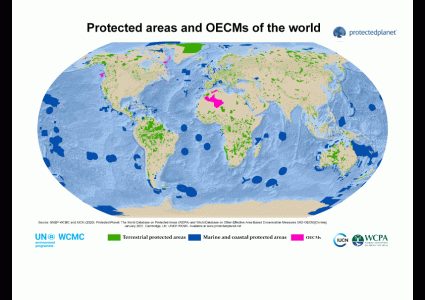
  • What’s the point of industrial fishing?

    What’s the point of industrial fishing?

    What’s the point of industrial fishing?

    The prominence of Brexit in the media was eclipsed this year by the Covid-19 health emergency but it has re-emerged in recent weeks due to the failure of the EU and UK to negotiate a future trading agreement. One of the sticking points has been fishing, an area that carries a sort of totemic importance despite its relative economic insignificance (the entire fishing and seafood sector is less than half of one percent of Ireland’s economy).

    The tiny economic contribution is inversely proportional to the ecological damage that is wrought on the marine environment by fishing. Perhaps because this has been going on for a long time we have become inured to the ecological collapse of our oceans. Fishing however is not a monolithic business; there are the big boats and then there are the small boats. The big boats take the lion’s share of the catch, are concentrated in a small number of ports, and have the ear of government ministers and their officials (they literally sit outside the door of the negotiating room in Brussels every December when the quotas are carved up). The small boats are the bulk of our fishing fleet (c.80% of boats are less than 12 metres long), they are reliant on non-quota species (i.e. what’s left after the big boats have filled their bellies) and are not represented in Brussels at crucial meetings. While the big boat guys have said that a no-deal Brexit will be ‘game over’ for them, the small boats have said that the recent overturning of a ban on large boats fishing within six nautical miles of the coast is a far greater threat to their viability.

    Big boats are concentrated in a few places, small boats are widely spread out around our coast

    The collapse of the marine ecosystem, combined with the enormous dangers posed by climate breakdown, rising sea levels and extreme weather events is more important than the survival of the fishing industry. Many of us would like to see the promotion of the small boats, which, if properly managed, could be very low impact on the marine environment and form the kernel of distinctive local economies. Although these days I avoid fish, I do hope for a day when I can visit a coastal town like Baltimore in Cork, and order freshly caught turbot or pollack from the sea nearby, which I know is well managed for all its diversity. But we’re a long way from that.

    Meanwhile, the industrial side of the house is facing a squeeze from the overdue implementation of the Common Fisheries Policy, which, way back in 2013, promised that all overfishing and dumping of unwanted catches would end by 2020. The politicians have failed to deliver on this and the government is being taken to the High Court by the Friends of the Irish Environment (and best of luck to them!). Instead of delivering a gradual implementation and putting in place the means to transition to less harmful forms of fishing, the Irish government and its EU partners have ignored their obligation, so that there is now a real possibility of a disorderly and abrupt shutdown of whole sections of the fishing industry, most notably bottom trawling but also much of the herring fishery.
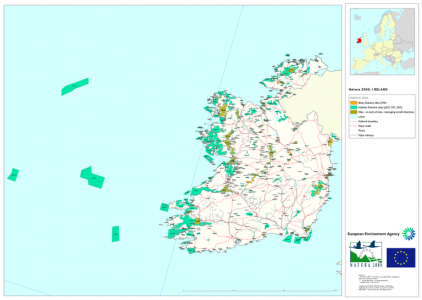
    Data from the Marine Institute shows that overfishing is getting worse, not better

    When you take all of this in its entirety, we need to ask the question – what’s the point of industrial fishing? Apart from destroying the environment and driving more numerous and more diverse fishing activities out of business, it does nothing for food security. In the Western world eating fish is something mostly reserved for eating out. The bulk of the bottom trawling catch is for Nephrops (Dublin Bay prawns), most definitely not a crustacean that is sustaining the needy. So, can we do without industrial fishing completely – rewilding large parts of the ocean to retore biodiversity and deal with the climate crisis – and focus our efforts on management of the small boats and aquaculture which actually deliver for small communities?

    The debate over supertrawlers may help us resolve the issue. Supertrawlers are universally loathed but I have seen no one stick their neck to out tell us exactly what one is. Sinn Féin’s Pádraig MacLochlainn recently called for supertrawlers in Irish waters to be banned, saying it was a “scandal” that two Dutch boats, each over 100 metres in length, were “allowed to hoover up the fish” off Donegal and that the Irish government should “put a stop” it. The Dutch boats were among 21 vessels registered in the EU over 100 metres in length, truly massive boats. There are no Irish registered vessels of this size although the Annelies Ilena, which now flies a Polish flag, was originally the Atlantic Dawn, built for Irish-man Kevin McHugh. It has been described as “the greatest fish killing machine the world has ever seen” but also by our then-Marine Minister Frank Fahey as “one of the proudest moments for the Irish fishing industry”. Anyway, the point is that Ireland has skin in the supertrawer game. Ireland has 17 vessels over 50 metres in length, still very big boats. I have a feeling that Pádraig MacLochlainn does not have these boats in mind in his call to have supertrawlers banned.

    Helpfully, the International Union for the Conservation of Nature (IUCN) has defined industrial fishing as boats  over 12 metres long “with a capacity of >50 kg catch/voyage, requiring substantial sums for their construction, maintenance, and operation and mostly sold commercially, and that all fishing using trawling gears that are dragged or towed across the seafloor or through the water column, and fishing using purse seines and large longlines”. The IUCN says that industrial fishing should be excluded from Marine Protected Areas. This definition largely coincides with what I have differentiated here as the ‘big boats’ and the ‘small boats’ in the Irish fishing fleet.

    Another important issue is the ownership of the fish. The marine is a public good, technically nobody owns the fish and other sealife. But yet the fishing industry pays nothing for it – basically we, as in Irish society, allow the boats access to the fish for free. Attempts have been made in the past to find out who exactly is benefiting from all this free fish, i.e. how is the quota of our fish is divided among individual boats. However, the Department of Agriculture, Food and the Marine have withheld this information. We do know that in the UK, over 50% of their quota has been sold off to non-UK boats, including supertrawers like the 119 metre, Dutch-owned Frank Bonefaas.

    So we see that a public good has been privatised for the benefit of a tiny number of people at great public expense. The continuation of industrial fishing is an enormous social issue as well as an environmental one. We could do without it.

  • Reform of the NPWS is urgent

    Reform of the NPWS is urgent

    Reform of the NPWS is urgent

    “We desperately need new thinking, new concepts, new contexts, new teaching methods, new curricula, better communication between all the participants in nature conservation. If we had a new and vitalised education programme, half the battle would already be won.” David Cabot, then a scientist for An Foras Forbhatha (and among Ireland’s foremost ecologists of the past half-century) was addressing a conference on Nature Conservation in Ireland in 1983. Nearly 40 years ago. He warned that “we are living at time of rapid economic, social and environmental change” and that “government has an obligation to respond constructively to these challenges”… “Most serious of all is the apparent lack of political commitment to nature conservation.”*

    Needless to say, the political will never materialised. Nature in Ireland can no longer be described as being in freefall, but has already hit the ground. Only its faintest gasps can still be heard.

    It would take over three and half decades from Cabot’s plea for the term ‘climate and biodiversity emergency’ to enter everyday use. An Foras Forbhatha would eventually morph into the National Parks and Wildlife Service (NPWS) which we know today as the chief guardian of state programmes to safeguard biodiversity. Its primary responsibility is to enforce the Wildlife Act, manage the protected areas network (~12% of land and 2.5% of seas), run our six national parks, oversee the implementation of the National Biodiversity Action Plan, advise other public bodies on land use decisions including planning applications, and educate the masses all on the wonders of nature and why it’s worth restoring.

    It is hard to know how to refer to the NPWS as it is not an agency or even a single body – lately, it sits within the heritage division of the Department of Housing, Local Government and Heritage,  alongside the National Monuments Service and Built Heritage, Architectural Policy and Strategic Infrastructure. There is no head of the NPWS as such; responsibility ultimately lies with the minister of the day. After effectively being defunded under Fine Gael (which saw a 70% cut in its non-staff budget) its allocation was recently doubled. This is welcome for sure. I was hoping we could at least be able to say that the NPWS was in receipt of more public funds than greyhound racing, but in the end the greyhounds also got more money so we’re not there yet.

    Healthy Serpula reef from Co. Galway (c. Seasearch)

    The NPWS has many fine people working for it but any observer in recent years can only conclude that it is a deeply dysfunctional organisation. When was the last time you heard an NPWS spokesperson on the radio talking about our biodiversity crisis? Their social media presence is woefully inadequate for the times we live in (no presence at all on Facebook or Instagram). I was told some years back that press releases were only permitted so long as they made the minister look good.

    That we are abjectly failing to even stem the march of destruction of nature should be obvious by now but can be underlined in two recent studies by the Irish Wildlife Trust. One found that habitats in marine Special Areas of Conservation (SAC) have drastically deteriorated in recent years. In one instance, a beautiful and complex reef structure in Co. Mayo, made of Serpula vermicularis – a type of worm – and a feature for which the SAC is designated, was obliterated by a scallop trawler. The NPWS were not able to tell us whether scallop trawling had ceased since the event in question, whether the perpetrator faced any sanction or whether there were now any restoration measures in place.

    Destroyed Serpula reef in Blacksod Bay SAC (c. NPWS)

    Separately, the IWT revealed earlier this month that despite being outlawed since 2011 turf-cutting continues on half of the SACs in Ireland which are designated for the vanishing raised bog habitat. In 2020 turf-cutting was carefully monitored at 16 raised bog SACs and the IWT has received confirmation that just one permit for turf-cutting in these areas was issued by the Department since 2014. Yet, no intervention is made to halt this illegal activity.

    We should not be too quick to blame the NPWS for these clear and egregious failures. The NPWS lacks resources (a mere three people work in their marine division), it lacks leadership, it lacks a voice and it lacks independence. These have all been decisions made by previous politicians who have seen nature conservation as a threat to growth and development or, perhaps more acutely, a threat to votes in their own areas (Fine Geal TD Jimmy Deenihan probably lost his seat in part because he was charged with bringing an end to turf-cutting on SACs, including in his Kerry constituency).

    Politically speaking, and a bit like nature itself, the NPWS have been banished to the basement in the hope that it can be forgotten. Legal constraints prevented it being killed off altogether. The last government tried – largely successfully – to ignore its muffled cries. The new government has taken some pity, but even a doubling of its previously miserable funding will not be nearly enough.

    Mouds Bog SAC in Kildare – where illegal turf-cutting continues

    We cannot address the biodiversity and climate crisis without a fully functioning nature conservation agency. This may be boring but it is fundamental. The programme for government helpfully includes a commitment to ‘review the remit, status and funding of the NPWS’ and the IWT has used every opportunity to highlight the need to get on with this task.

    Nearly six months in, we have heard little from the government on this issue despite writing to Minister Malcolm Noonan on a number of occasions. Thanks to Cian O’Callaghan of the Social Democrats, who recently submitted a parliamentary question to Minister Noonan, we have some insight. The minister replied that he has “decided that the review should be headed by an independent chairperson overseeing a triptych review process [presumably referring to the remit, status & funding] with a target completion date of Summer 2021”.

    This process is urgent and we must start with a blank slate. Ultimately, the funding required will be substantial (a figure of €100 million per annum has been floating around but an analysis of needs has not been carried out). Just as importantly will be to restore a sense of purpose and independence to any new agency. It should be a body that is visible (with branding and uniforms for field staff), it should be empowered to speak out for nature not only on our airwaves but in holding other branches of government to account. This last part is diplomatically difficult but we see in the Environmental Protection Agency how the right leadership makes all the difference. Nature Ireland (for want of a title!) should be the pride of the nation – pointing the way to a nature-filled future that benefits everyone. It could happen – but I can’t stress enough the urgency of this task. To get there we will need a strong dose of political will.


    *From Nature Conservation in Ireland. Progress and Problems. 1983. D.W. Jerry (editor)

  • Press Release: New information shows that unlawful turf-cutting remains widespread on Special Areas of Conservation

    Press Release: New information shows that unlawful turf-cutting remains widespread on Special Areas of Conservation

    Press Release

    12th November 2020

    New information shows that unlawful turf-cutting remains widespread on Special Areas of Conservation

    Mouds Bog SAC in Kildare

    Data from the Department of Culture, Heritage and the Gaeltacht (DCHG), and acquired by the Irish Wildlife Trust under Access to Information on the Environment rules, shows that mechanical turf-cutting continues to be a widespread issue on Special Areas of Conservation (SACs) in Ireland despite the practice being unlawful since 2011.

    Under the EU’s Habitats Directive, 57 sites have been designated as SACs specifically for their raised bog habitat. This is one of the rarest habitats in the world; in Ireland the extent of ‘active’ raised bog (i.e. where wet peat was still growing) was mostly recently calculated at 0.6% of its original extent. However, this figure is now likely to be significantly smaller. The details sent to the IWT (and reproduced below) show that of the 57 SACs, turf-cutting was monitored by the National Parks and Wildlife Service (NPWS) at half of the sites (28 SACs) since 2016.


    In a statement sent to the IWT by DCHG, “in accordance with the Wildlife (Amendment) Act 2000 and the European Communities (Birds and Natural Habitats) Regulations 2011, turf cutting may not take place on raised bog SACs or NHAs [Natural Heritage Areas] unless with the prior consent of the Minister of Culture, Heritage and the Gaeltacht or of another public authority, if applicable”. It seems that this regulation is widely ignored.

    Turf-cutting took place at 16 SACs in 2020. Mouds Bog SAC in Co. Kildare as well as 13 others (including Barroughter Bog SAC in Galway, Callow Bog SAC in Roscommon and Coolrain Bog SAC in Laois) have been cut every year since 2016 (as far back as the requested figures went).
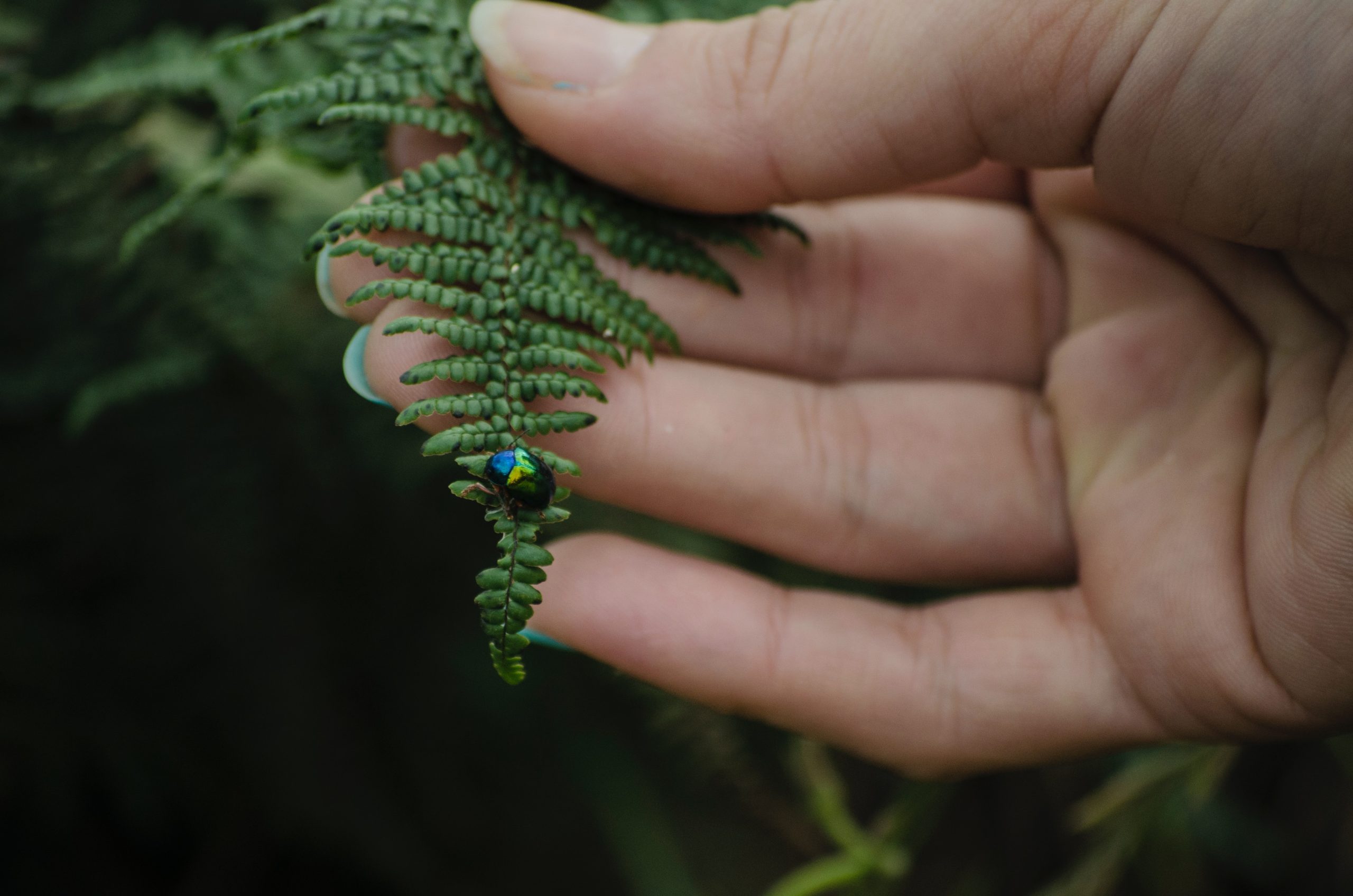
    Peatlands in Ireland are not only unique habitats for rare species but play an important role in storing carbon and in regulating flood water run-off. They are a significant part of our heritage and are frequently important amenity sites. However, when peatlands are damaged through drainage, turf-cutting, animal grazing or forestry, these processes go into reverse. It is particularly distressing therefore so see that even in the small number of ‘protected areas’ peatlands continue to be lost under the noses of the authorities.

    IWT campaigns officer Pádraic Fogarty says “The battle to save the bogs has been traumatic for many involved but we at least thought that issues had been resolved with the prohibition on turf-cutting in raised bog SACs and the publication of the National Peatlands Strategy. Now we learn that these have been meaningless exercises and that we’re continuing to lose even these tiny fragments.

    It’s bizarre that at a time when EU funding is going to actively block drains on 12 raised bog SACs (see www.raisedbog.ie), and that government spending is being directed toward rewetting worked-out bogs, that elsewhere authorities are turning a blind eye to the use of heavy machinery cutting the bogs away. So far, we’ve been doing a spectacular job of monitoring the disappearance of nature in Ireland.”

    The IWT has sent our findings to Ministers Darragh O’Brien and Malcolm Noonan (in whose department the NPWS now lies) as well as the European Commission. In July, the EC referred Ireland to the European Court of Justice for failing to protect SACS and for failing to implement management measures at any of the 423 SACs in the state.

    Contact: Padraic Fogarty IWT Campaigns Officer irishwildlife@iwt.ie
  • Rewilding the Park

    Rewilding the Park

    Rewilding the Park

    There’s a corner of the Phoenix Park, Dublin’s largest open space, that hints at wildness. It’s different from the rest of the Park in that it’s less manicured, messy looking, with unmown meadows and patches of scrubby thorn bushes. Most people walk right past it but within its tangled undergrowth there are fallen giants: great ash trees that have been toppled, perhaps many years ago. The crown of the trees have created a cage of branches, making access difficult for deer, and so patches of brambles have grown up. Brambles are among our most important plants for wildlife and provide the dense cover needed for our smaller songbirds to nest in.

    A burrow under a heavy trunk looks a little small to be a fox den, maybe it’s a rabbit’s or a stoat’s. Fungi are sprouting from the rotting dead wood and gently lifting an old layer of bark reveals colonies of woodlice, centipedes and spiders. Intricate patterns on sapwood tell us that grubs of beetles and weevils make a living in the wood itself – if there were woodpeckers in the Park they’d be hammering away trying to get at them. When big trees fall over they create a cavity in the ground where the roots were and this typically fills with water, creating a mini wetland for frogs and aquatic bugs. Over a century or more the breaking down of dead wood recycles nutrients back into the soil, but for many trees falling over does not mean death. They simply send new shoots skyward and carry on as before. This has happened to one of the fallen trees in this area.

    Revealingly, a rough path has been trampled to one enormous trunk where a ‘saddle’ has been worn smooth and shiny from children eager to climb on it.

    Fallen trees frequently are not dead but send out new shoots

    Despite the immense value of fallen trees and dead wood, our obsession with tidiness means that this entire phase of a tree’s life is normally sawn up and carted away. This is a feature all over Ireland and what is unusual about the corner of the Phoenix Park that I have just described is that it exists at all. Virtually every other corner of the Park is meticulously manicured to such a degree that it actively prevents even common wildlife from gaining a foothold.

    Life thrives on dead and fallen trees

    Last week it was brought home to me just how fastidious the authorities in the Park have become. Strong winds had toppled a large beech tree, probably on the Friday night. I cycled past it on the Saturday and on the Sunday I paid another visit. The trunk had snapped off completely, revealing a hollow interior that had been colonised by some kind of fungus. It fell on the high side of the hill, away from the nearby path and on a sloped area which has rough grass. I emailed the Park authorities on my return suggesting that it was not a hazard to anyone and asking that it be left where it lay. On Monday I got a reply thanking me for the email and promising to look into my request. By Thursday the tree was gone. Apart from the jagged stump, the whole thing had been tidied away – it looked to me that even the leaves had been swept up. Why is this habitat destruction still going on?

    It took a mere 5 days to tidy away all trace of this tree

    Don’t get me wrong, I love the Park. I love the size of it – I still find that I’m discovering new nooks and hidden corners. It has amazing trees, particularly oaks but also beeches, chestnuts and pines. It also has wildlife in it: foxes, grey squirrels and, of course, the deer. A biodiversity survey by Trinity College on the grounds of Áras an Uachtaráin, initiated by the president himself, found a rare specimen of a cave spider as well as a family of badgers. I love to see (and hear) the jays, because they don’t normally hang around the kind of housing estate that I live in. In summer there are nesting skylarks near the 40 acres and it’s wonderful that we still have their uplifting song in the heart of the city. But by and large the Park fails to live up to its potential.

    The red squirrels and corncrakes went extinct from it in the 1980s. I don’t remember there ever being hares or barn owls although it seems perfect for them. During the summer just gone I spent a few moments on a warm day sitting in one of the vast expanses of grassland and saw not a single butterfly or flying insect. The birdlife is mostly magpies, rooks, pigeons and jackdaws, with a few mallard and heron on the ponds. There’s more of course but the gardening mindset of the OPW, which manages the Park, is holding it back. It could be so much better.

    Vast grasslands with few wild flowers or flying insects

    Imagine for a moment that they let the trees just lie on the ground. Immediately you introduce a layer of complexity that simply isn’t there right now. Imagine the existing wooded areas were fenced off from the deer, new scrub and young trees would emerge – introducing another layer of complexity. When the OPW plant new trees, incredibly they’re still planting non-native species, including holm oak, a Mediterranean tree that is useless for wildlife in Ireland.

    We can keep the historic character of the Park and I’m not suggesting that it be rewilded in its entirety. We don’t have to convert any of the open grasslands to new woodlands – just manage what’s there differently. The grasslands are dreadfully species-poor, but the OPW seem very resistant to adding diversity for pollinators and other insects, in the belief that the deer will only eat the flowers. This doesn’t make sense. Their outdated conservation plan says that a ‘strategic objective’ is to “conserve the Phoenix Park’s natural plant and animal species along with their habitats while improving biodiversity”. But they don’t seem to be doing anything to improve biodiversity – quite the opposite. It is in their plan to create new native woodland, to allow dead and fallen trees to stay and to fence off areas from deer – but I don’t see any evidence of this on the ground.

    The amazing difference a fence makes – but this fence has a gap in it so is no longer effective

    What about bringing lost species back? The pine marten is making its way up the Liffey valley but will need to cross one of the busy roads to get to the Park. Shouldn’t we be building a wildlife bridge to make it easy for them? If they make it, and presuming they start to control the grey squirrel population, can we bring back red squirrels? Could we reintroduce goshawks (a large bird of prey), corncrakes or one of the many species of deadwood-dependent beetles which have gone extinct from Ireland?

    The importance of rewilding in addressing the climate and biodiversity emergency is now a mainstream idea. One of the reasons I love it is that it’s for everyone, whether you live in the city or the countryside. The Park is great but it’s not unique, there are acres and acres of near-sterile green spaces in Dublin and, no doubt, other towns and cities in Ireland. Can we rewild them all? There’s nothing stopping us trying if we can only let go of our urge to tidy everything up all the time.

    We could create wildlife bridges and corridors to allow animals move around the city
  • Corrosive power relations, not farmers, are killing the planet

    Corrosive power relations, not farmers, are killing the planet

    Corrosive power relations, not farmers, are killing the planet

    Feeding the world while bringing food systems back within nature’s limits is the challenge of the century. But farmers are mostly low wage workers and worry that greater environmental expectations will mean a further squeeze on their income.  Is it possible for them to be green while staying out of the red? Last month, the Irish Wildlife Trust held a webinar with Sinead Moran, a dairy farmer in Co. Mayo and Clive Bright, a beef farmer in Co. Sligo, who are both producing food following organic and regenerative principles (you can watch the event here). They both sell directly to their customers which help them control the price of their produce.

    It is clear from their experience that it’s indeed possible for farmers to be profitable while at the same time enhancing the soil, avoiding pollution and maintaining habitats for nature. Clive has been planting trees and has added a pond, though he admitted this is likely to result in a reduction in the subsidy payments he receives. Both Clive and Sinead prosper despite decades of government and EU policy which values land only in terms of kilos of beef or litres of milk produced. Listening to them, the notion that farmers and environmentalists are instinctively in conflict with one another quickly evaporates. There is, nevertheless, a conflict. But the battle lines are not, as some would have you believe, between farmers and environmentalists, or urban versus rural, but instead are between the small number who gain most from the system and those who do not.

    Addressing the climate and biodiversity emergency was always going to be a power struggle. This was brought into sharp relief this week in Brussels with the negotiation of the EU’s Common Agricultural Policy (CAP). The CAP has become notorious for the size of its budget – the EU’s third biggest spend and worth nearly €59 billion in 2018, most of which is spent on direct income subsidies to farmers. Despite being stated aims of the CAP to protect nature and to ensure that farmers earn a ‘reasonable living’, it has markedly failed on both fronts.

    It doesn’t do what it says on the tin

    A New York Times investigation last year exposed how the CAP drives environmental destruction, is milked by oligarchs and the well-connected, and how many of the politicians in the EU institutions are themselves beneficiaries of what was termed the “enormous E.U. subsidy program [..] built to keep the money moving”. In Ireland the top recipients of CAP money include state agencies like Teagasc and Bord Bia, beef-baron Larry Goodman (€400,000 in 2019) and an equine company founded by Sheikh Mohammed bin Rashid Al Maktoum, Vice President and Prime Minister of the United Arab Emirates and Ruler of Dubai who received a quarter of a million euro in 2019 (wasn’t the CAP sold to citizens as producing affordable and safe food rather than thoroughbred horses?).

    The CAP works on a seven-year cycle and the next round is currently under negotiation. Previous rounds have failed dramatically to reduce greenhouse gases or reverse biodiversity loss across the EU and only last week, a report from the European Environment Agency highlighted how intensive agriculture is among the top threats to nature. The reform of the CAP has therefore been a critical element of the EU Commission’s Green New Deal, backed by the Farm-to-Fork and Biodiversity Strategies and published earlier this year. But the Commission’s noble plans have run into the quicksand of industry lobbyists and the national politicians who are keen to keep them on side.

    In advance of a meeting of the EU Council of Ministers this week, Harriet Bradley of BirdLife (a Brussels-based NGO) remarked how national agricultural ministers “start every session with a private session with the big ag lobby” adding that “this is why agricultural policy looks like it does”. Harriet played a blinder on Twitter this week (@HarrietBirdlife) shining a light on the murky dealings which go unnoticed in national media. It turned out that a key vote in the European Parliament was brought forward by a day, at very short notice, leaving documents untranslated and MEPs unprepared. The vote, when it happened, was a victory for the status quo.

    Oliver Moore, who writes for www.arc2020.eu noted that the ‘compromises’ and subtle changes of language were exactly the same as when the last CAP was negotiated in 2014, noting “The same process is occurring – Some ambition from the Commission, Lots of earnest words everywhere. Then it’s watered down by Council (national ag ministers). Then by the Parliament (MEPs). Every time.”

    Alan Matthews, professor emeritus at Trinity College Dublin, and well known for his moderate and clinical analysis of the CAP, noted that the vote was a “two fingered” salute to the EU’s Green Deal. And it wasn’t only the parliament, national agriculture ministers clearly aren’t keen on it either, watering down commitments to increase the extent of organic farming and fiddling the wording so that nothing concrete will be expected of farmers in delivering on biodiversity or climate aims.

    That this outcome was a triumph for business as usual was reflected in the anodyne responses from the Irish Farmers Association and our own Minister for Agriculture, Food and the Marine, Charlie McConalogue. The IFA was quoted in the Irish Times as saying “We need to strike the right balance to ensure economic as well as environmental sustainability” while in a press statement, Minister McConalogue welcomed the deal saying “I am satisfied that Ireland’s interests have been protected”. This language is bitterly familiar; the line has been held, the right balance has been struck, ‘Ireland’s interests’ have been protected. Meanwhile, the rest of us are expected to shoulder the increasing tide of pollution, extinction and inequality to keep the big-ag machine well-greased.

    The CAP incentivises the destruction of habitats

    In fact, when the public was asked for its say, back in 2017, the response was overwhelming. 322,000 EU citizens took part and 85% of respondents wanted more ambition to protect the environment while a similar figure (88%) wanted fairer incomes for farmers. But one wonders what the point of this consultation was. When it came down to it, we only got more of the same. This power relationship between the agri-chemical giants, the meat industry, the farming associations that claim to represent the best interests of farmers, and our national politicians is now corrosive to the point of ruination. It has threatened the credibility of the Commission and of the EU as whole as it goes into global negotiations on climate and biodiversity in 2021. At least now it should be as clear as day where the real conflict lies.

  • Press Release: Budget marks a significant change in direction in the state’s approach to nature protection

    Press Release: Budget marks a significant change in direction in the state’s approach to nature protection

    Press Release

    15th October 

    Budget marks a significant change in direction in the state’s approach to nature protection

    Curlew by Mike Brown

    The Irish Wildlife Trust has welcomed this week’s announcements in the budget which will start to address our biodiversity crisis. New funding announcements have been made across a range of sectors which will address historic shortfalls, most significantly a more-than-doubling in allocation to the National Parks and Wildlife Service (from €13m to €29m). Additional initiatives in agriculture (organic farming, results-based projects, soil studies), close-to-nature forestry, peatland restoration and investment in Irish Water will all contribute to healthier water and landscapes for people and nature.


    Under the previous government, the NPWS was defunded and neglected, we hope that the rebuilding of this key function of the state can now begin. It is vital that this extra money is spent on actual conservation measures and not diverted to tourism infrastructure in national parks and nature reserves (which we have seen before).


    While the additional funding is not likely to be sufficient in the longer term, we look forward to the root and branch review of the NPWS which was committed to in the Programme for Government, and which will address structural and resource deficits. An Ireland filled with nature again will require ambition but presents enormous opportunities.


    IWT Campaign Officer, Pádraic Fogarty says: “We saw a focus on biodiversity in this year’s budget which we have never seen before. This can only help in bringing an end to the relentless downwards trajectory which we have witnessed in biodiversity in Ireland. We expect this will be the start of a longer term recovery that includes the vital review of the NPWS, a new forestry programme, the ending of overfishing and the creation of marine protected areas as well as an agri-food strategy that is fit to deal with the climate and biodiversity crises. All of these have been promised by the new government and are all essential in delivering the system-wide changes needed.”


    ENDS

    CONTACT: Padraic Fogarty IWT Campaigns Officer irishwildlife@iwt.ie
  • Nature-based solutions

    Nature-based solutions

    Nature-based solutions

    This week saw a significant milestone in Ireland’s tortuous journey from climate laggard to climate leader with the publication of the Climate Action and Low Carbon Development (Amendment) Bill. It is a significant achievement for the Green Party in particular, which delivered on its promise to deliver the bill within the first 100 days of government. Non-governmental group Stop Climate Chaos was measured in its response, noting that it was a “substantial improvement” on the 2015 law but with “significant weaknesses” remaining. Especially worrying is the commitment in the bill merely to ‘pursue’ carbon neutrality by 2050, rather than actually ‘achieve’ this goal. It is much the same as the way I get out of bed in the morning aiming to pursue a healthy a virtuous life knowing that, when this doesn’t happen, I don’t need to beat myself up. It’s not really a commitment at all in fact. Let’s hope this can be fixed as it makes its way through the chambers of the Oireachtas.

    c. www.naturebasedsolutions.org

    If it does, ‘carbon neutrality’ within the next 30 years is an ambitious goal that is set to transform our lives and our country. The phrase is sometimes used alongside ‘net zero’ emissions which means that we may still be burning fossil fuels in 2050 but that these emissions will be offset, or even negated, by removing greenhouse gases from the atmosphere. Business-as-usual advocates cross their fingers that some technological breakthrough that can capture carbon and store it away permanently will allow pollution and habitat destruction to continue unabated; there is no evidence that such a technological breakthrough is on the horizon.


    Undisturbed native woodland can be best for storing carbon

    On the other hand, a means for carbon capture and storage does exist. Indeed, it has been in research and development for over 3.5 billion years: nature. Chlorophyll in plants has been using solar energy to take carbon dioxide from the air and using it to grow leaves, roots, branches and trunks for eons. Some of this carbon is exhaled by the plants when the sun goes down, but much of it goes into growing the plant itself. A living tree locks this carbon into its ever-growing trunk – the humble birch will do this for decades, an oak will do it for hundreds of years, a yew tree may well keep doing it for over a millennia.

    Carbon is also passed into the soil, where it enters a symbiotic relationship with fungal mycelium threads, adding to, and building up, soil more or less forever. When plants die, rotting can release carbon back to the atmosphere. However, the big, slow-growing trees do this incredibly slowly. In certain conditions, e.g. where low humidity prevails, the pace of rotting is so slow its negligible. Very large and slow growing trees such as yew or the giant cedars of the Far East, may not rot at all – effectively locking in carbon permanently. In healthy peatlands, vegetation can be prevented from rotting due to the acidity of the peat, locking in even more carbon – again, more or less permanently.

    In the ocean, water naturally dissolves around 30% of the carbon from the air, which is balanced by the growth of marine organisms, from tiny plankton to shell-bearing molluscs and crustaceans, coral reefs and great whales. This absorption has increased with greater concentrations of CO2 from fossil fuel burning and it is estimated that 1,300 gigatonnes of extra CO2 has been removed over the last 200 years, or 38% of human-driven emissions in that time. The ocean has also absorbed about 90% of the trapped heat, meaning that without the cushioning effect of the seas – our goose would already be cooked by now. This cushioning cannot last as the seas warm and acidify, disrupting its carbon cycle and reducing its ability to absorb even its ‘normal’ amount. Healthy coastal habitats can also store carbon, e.g. from sea grass meadows to kelp forests – habitats which are also rich in biodiversity.

    Pressure from bottom-trawling (c. Marine Institute)


    But these days nature in Ireland is not absorbing carbon. Our forests are effectively non-existent and commercial plantations are no substitute, likely releasing more carbon then they absorb. Our bogs are significant greenhouse gas sources as they are drained and stripped of their vegetation from fires, grazing animals or turf-extraction. Our agricultural land is also a source of climate-altering gases, not only from the application of artificial nitrogen and methane from cattle and sheep, but also erosion and depletion of soil biodiversity (and so soil carbon). At sea, the removal of  marine life, from overfishing to historic reductions in populations of the great whales, has diminished its carbon storage capacity. Bottom-trawling, which relentlessly agitates sediments which had been building up on the sea bed, is also releasing greenhouse gases, and nearly everywhere around our coast is subjected to this most damaging form of fishing.

    The good news is that our new Climate Bill explicitly contains a clause to allow for climate action funding to be granted for projects that “support projects that seek to increase the removal of greenhouse gas, particularly nature-based solutions that enhance biodiversity”. This is a great win for Jennifer Whitmore, the Social Democrats TD for Wicklow, who fought to have this clause inserted. A SocDem press statement to commemorate World Environment Day earlier this year stated that this means “using nature itself to solve our environmental problems in a sustainable and cost-effective way… When it comes to carbon capture, we are all aware of the benefits of planting trees. But, there’s many other nature-based actions we could take that would help also. For example, rewetting our bogs or building up our ‘blue carbon’ by protecting and restoring our marine environments such as seagrass beds. These solutions all need to play a large part in our climate adaptation and mitigation strategies.”

    Indeed, some estimates reckon that using nature-based solutions can help to achieve as much a third of our climate goal under the Paris Agreement. Restoring our forests and peatlands, promoting regenerative forms of agriculture and protecting the seas are key actions in rebuilding ecosystems. We now know that everything from saving the curlew to rebuilding commercially valuable fish populations are also forms of climate action. It’s very exciting to see this recognised in the Climate Bill.

  • PRESS RELEASE: Irish Wildlife Trust calls for moratorium on all trawling within six nautical miles of the coast following High Court ruling

    PRESS RELEASE: Irish Wildlife Trust calls for moratorium on all trawling within six nautical miles of the coast following High Court ruling

    PRESS RELEASE

    09th October 2020

    Irish Wildlife Trust calls for moratorium on all trawling within six nautical miles of the coast following High Court ruling

    Following the High Court ruling [i] that has overturned a decision to prohibit trawling by larger boats within 6 nautical miles of the coast, the IWT has written to Minister for Agriculture, Food and the Marine Charlie McConalogue and Minister for Land Use and Biodiversity, Pippa Hackett, calling for a halt to all trawling in this zone until a new arrangement can be put in place. The original decision to ban trawling by boats over 18m in length came after a public consultation in 2018 which was roundly supported by low-impact fishers in smaller boats, anglers, environmental groups and members of the public. It was heralded at the time as the single most important move to protect fisheries and marine biodiversity that we have seen. There is consequently widespread anger and dismay that this has now been undone.


    IWT Campaign Officer Pádraic Fogarty says “we’re urging ministers Hackett and McConalogue to act swiftly on this High Court decision and to tell us how the trawling ban can be reinstated on a permanent basis. Until then we need to see all inshore trawling shut down so that any recovery in marine life which may have been underway is not completely undone.”


    Trawling for small fish such as sprat removes the principle food source for sea life, whether its whales, dolphins or larger fish. Bottom trawling, which scrapes a net across the sea floor, obliterates important habitats for fish spawning and should be phased out across our seas.


    ENDS

    CONTACT: Padraic Fogarty IWT Campaigns Officer irishwildlife@iwt.ie